Teaser Tuesdays: The Dorothy Parker Audio Collection

Teaser Tuesdays is a weekly bookish meme, hosted by MizB of Should Be Reading. Anyone can play along! Just open your current read to a random page and share a few sentences. Be careful not to include spoilers!

I am listening to the most delightful collection of Dorothy Parker’s short stories and reviews and the like. Her style of humor is wry and cynical but right up my alley. Here’s your teaser, from the story Dusk Before Fireworks:

“Please don’t call me ‘women,'” she said.

“I’m sorry, darling,” he said. “I didn’t mean to use bad words.” He smiled at her. She felt her heart go liquid, but she did her best to be harder won.

Parker is frequently hard on her female characters.


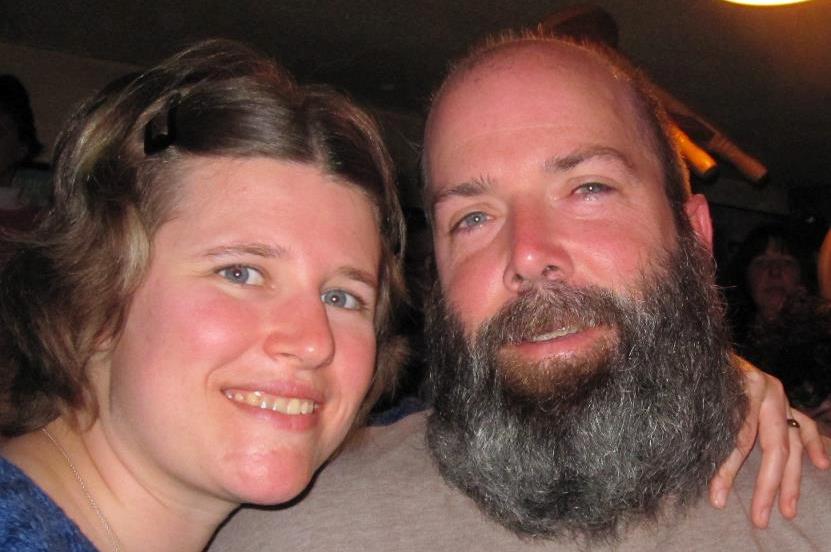
And, bonus: Happy Birthday today to my beloved Bearded Husband!!

“A Christmas Memory” by Truman Capote

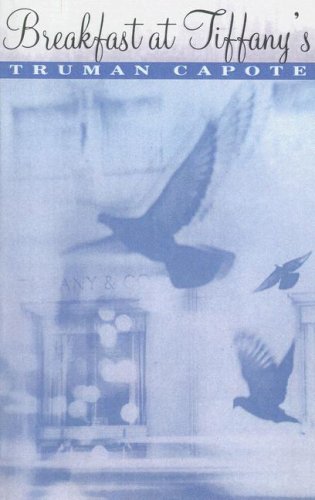
This short story comes from my paperback copy of Breakfast at Tiffany’s and Three Stories. (Yes, I promise the cover image at right is of a book that includes stories, too.) It was just too easy to read this short, sweet, sad tale before bed one night, just before leaving on our trip.

Our first-person narrator is a child of seven, and this is the story of his relationship with his best friend, an unnamed distant cousin, aged sixty-something. She calls him Buddy, after an earlier best friend who died when they were children. Buddy and his friend live together, along with other family members who do not view them as favorably as they do one another. Along with the little dog, Queenie, Buddy and friend are one another’s world. They make fruitcakes together every fall for friends far and wide. There is an inevitable sad ending to this story which you can read into the disparate ages of these two friends if you so choose.

It’s brief and simple in terms of plot, but that is so often true of some of the best pieces of writing. And this piece is lovely. I only knew Capote through In Cold Blood, prior to this; and while that is very different kind of work, I get the same simple evocation of place, of sights and smells and feelings. I think I can best share the beauty of this story by giving you a few short passages.

Meet the friend:

A woman with shorn white hair is standing at the kitchen window. She is wearing tennis shoes and a shapeless gray sweater over a summery calico dress. She is small and sprightly, like a bantam hen; but, due to a long youthful illness, her shoulders are pitifully hunched. Her face is remarkable – not unlike Lincoln’s, craggy like that, and tinted by sun and wind; but it is delicate too, finely boned, and her eyes are sherry-colored and timid.

After saving up to buy ingredients to make their fruitcakes:

Silently, wallowing in the pleasures of conspiracy, we take the bead purse from its secret place and spill its contents on the scrap quilt. Dollar bills, tightly rolled and green as May buds. Somber fifty-cent pieces, heavy enough to weight a dead man’s eyes. Lovely dimes, the liveliest coin, the one that really jingles. Nickels and quarters, worn smooth as creek pebbles. But mostly a hateful heap of bitter-odored pennies.

On declining an offer to sell the Christmas tree they have just harvested:

“Goodness, woman, you can get another one.” In answer, my friend gently reflects: “I doubt it. There’s never two of anything.”

And the sad ending comes too soon.

I hope these passages shared with you better than I feel able to do, the quiet, loving, reflective mood. It is somber from the beginning, but also loving and solemnly celebratory of the beloved friend. Does that make sense? This story is a masterpiece in understated, simple evocation of emotion and mood.


Rating: 6 coins.

The House on Mango Street by Sandra Cisneros

Another gift from my buddy Fil, and another hit! Fil says he hasn’t read this one yet, himself, and I say to him and to all of you: hurry up and read this slim but powerful book! My 25th anniversary edition includes an introduction entitled “A House of My Own” by Cisneros, which was gold; do find an edition with this intro, because it’s wonderful. I would say it was my favorite part of the book but I can’t relegate any other part to less-than-favorite.

So first, the introduction. (A bell rang for me as I opened this book, as I was reading A Room of One’s Own simultaneously.) Cisneros describes a former self, the woman pictured on the opening page, a young woman living in her own apartment in Chicago, after graduate school, working to become a writer. It’s a really lovely essay all on its own, describing some of the challenges that faced a young Latina writer and looking at that former self through her older, wiser eyes. It was beautiful. I cried a little, not because anything was too terribly sad (okay, there was that one bit), but because it was so well-done. And it served as a beautiful introduction, as it introduces the young woman who composed the short stories, the episodes, the anecdotes that make up The House on Mango Street, not yet knowing that they would become a book. Rather, she was working on her MFA thesis in poetry, so those fiction fragments (or “little-little stories”) were extracurricular, failed to fit into a known body of work. But oh, the book that they became…

The House on Mango Street is a collection of short stories, and I mean short – the longest run to 3-4 pages, most 1-2, some just a paragraph long. As a whole, they follow Esperanza (the narrator) through the first year of life at the first home her parents own, on Mango Street. It is not the home they aspired to and Esperanza doesn’t like it very much. She has a lot in common with Cisneros – the city, the time, and the ethnic background; but I know from “A House of My Own” that Esperanza is really a combination of Cisneros’s students, people she’s known and people she’s made up, and herself. There is a coming-of-age element, as well as a theme of home – what makes a home, what a person need from her home.

The stories are entrancing. The style is great, is dynamic; it’s both poetic and conversational. It’s not formal; sometimes a sentence runs on until it loses track of itself, but I’ve come away with the strong impression that every word was carefully chosen and exactly in its place. The economy of language reminded me of Hemingway, although I don’t suppose Cisneros gets compared to him very often, and I don’t mean to say that they’re very similar. Rather, they both seem to have very carefully created what looks like simple language but turns out to be poetry. (There is of course always the danger that I see Hemingway everywhere because I’m crazy about his work.)

The subject matter is mostly mundane and ordinary (a young girl’s life and disillusions, her disappointment that she has to wear old shoes with a new dress to a party) but also serious, weighty, and sad (because such things happen to a young girl, too). I only knew Sandra Cisernos by reputation before I picked up this book; that will have to change, because she’s amazing. It’s only about 100 pages long (including the introduction), a super-easy read, and so powerful. No excuse! Go get yourself a copy.

Teaser Tuesdays: The House on Mango Street by Sandra Cisneros

Teaser Tuesdays is a weekly bookish meme, hosted by MizB of Should Be Reading. Anyone can play along! Just open your current read to a random page and share a few sentences. Be careful not to include spoilers!


I had a difficult time choosing a teaser from this amazing book for you. My review is yet to come, but in a nutshell – read it.

From “Minerva Writes Poems,” here’s your teaser:

Minerva cries because her luck is unlucky. Every night and every day. And prays. But when the kids are asleep after she’s fed them their pancake dinner, she writes poems on little pieces of paper that she folds over and over and holds in her hands a long time, little pieces of paper that smell like a dime.

Speaking of poems… prose poetry, no?

Black Mask (audio)

Classic hard-boiled crime stories from the historic and genre-defining pulp magazine Black Mask, in a beautifully performed audio collection.


Black Mask magazine (1920-1951) was a defining force in the pulp-magazine genre of hard-boiled detective stories, and this collection offers five representative pieces for the first time in the audio format. The excellent spoken performances are a rare treat, especially when finding stories of this vintage is in itself a challenge. The masters of the genre are represented in this collection, including Dashiell Hammett, under a pseudonym. Don’t skip the introduction, either: it’s a worthwhile and informative history of pulp magazines, the detective/crime genre, a number of classic authors, and Black Mask in particular. Each story has its own short introduction as well, adding to the value of the collection.

“The Phantom Crook” takes on organized crime in order to free a damsel in distress from blackmail. A case of arson and apparent murder is not what it appears. Another blackmail case threatens to take advantage of a well-meaning but bad-tempered newspaper photographer. A drunken reporter tails a detective into a warehouse district in pursuit of a crook. And in the final tale, a Florida private investigator named Sail, working off his boat, investigates a case of sunken treasure while the bodies stack up. In each story, the gritty, taut suspense is reinforced by an appropriately gruff audio performance.

Black Mask has released a total of three collections of short stories. The following two promise more of the same: dark, suspenseful, character-rich crime drama. Readers of the modern hard-boiled detective/P.I. genre owe it to themselves to check out their roots in these fine examples of detective-noir classics.


I wrote this review for Shelf Awareness for Readers. To subscribe, click here, and you’ll receive two issues per week of book reviews and other bookish fun!

Stationary Bike by Stephen King (audio)

I’m going to call this one a short story, at only an hour and a half, unabridged. It made for a nice short entertaining story during our drive up for a bike race a few weeks ago.

Richard Siftkitz is a freelance commercial artist, making his living by drawing and painting commissioned works for advertisements, pamphlets, movies posters, record covers, and the like. He’s 38 years old when the story opens, and his doctor is concerned about his cholesterol level (Richard likes to eat a lot of fast food). The doctor explains the issue with a metaphor: he tells Richard that there is a little team of workmen, of the hardhat-and-work-boots variety, living inside his body, working hard to keep his arteries clear of the junk Richard is putting into them. If they are made to work too hard for too many years, they’ll get tired, start doing sloppy work, and eventually quit or be overcome.

Richard takes this concern to heart, and goes out and buys… that’s right, a stationary bike. He sets it up in the basement of his apartment building and paints a mural on the wall, of a road through a forest. This road represents both the road he pretends he’s riding down, and one of the roads that his little tiny interior metaphorical workmen are keeping cleared for him. He pins up maps on the wall and considers himself to be riding down real roads in upstate New York, eventually achieving the Canadian border and riding onward deep into the Canadian forests. Richard’s very active imagination simultaneously creates full lives for the team of four men he envisions working inside his body. He gives them names and backgrounds and families.

Without ruining too much for you, I will say that Richard’s imagined workmen take on lives of their own, and his imaginary ride through the Canadian woods takes on proportions larger than he meant for it to have. He finds himself in danger.

I found this short audiobook entertaining and spooky. The tension built nicely. There were little clips of music that played in between chapters; it started off sort of Musak-ish, but as the story got creepier, the music got creepier, growing with the mood. It was well done. Luckily (since I’m not real good with horror!) it wasn’t unbearably scary but it did give us some creeps. I liked it.

Winesburg, Ohio by Sherwood Anderson

Winesburg, Ohio is a collection of short stories that is more than the sum of its parts; the short stories are connected, all being set in the fictional town of Winesburg and concerning overlapping characters. We are most interested in George Willard, a town native who we most often see as a young man working as a reporter at the town paper (or, “the” reporter). Several of the stories give us Willard’s experiences (always in third person), but a number of them concern other inhabitants of the town. These men and women usually have some small personal tragedy that has thrown off the rhythm or intentions of their lives.

The work as a whole has a very quiet, contemplative tone and mood. Very little of great import goes on; but simple, sad lives are carried out, and hearts are broken quietly. It is moving. Anderson excels at bringing a character to life for a brief moment; and then he moves on.

I came to this book through Hemingway’s recommendation (and was finally motivated to get it off the bookshelf for the Where Are You Reading? Challenge‘s Ohio requirement). It has been a little while since I’ve read a biography of Hemingway so I’m a little rusty on the details, but I recall that Anderson played a role in his early writing career – encouraged him to write, gave him tips, maybe recommended him for publication. I think he pushed Hem to move to Paris as a youngster, which he did with his first wife Hadley, with results that I think we can safely say influenced his career as a writer. Anderson definitely influenced his style; I got this out of Malcolm Cowley’s excellent introduction, but it’s readily evident even without that clue. The same short, simple sentences that say so much with so few words are recognizable in Anderson’s stories; see my book beginnings post, or:

The Presbyterian Church held itself somewhat aloof from the other churches of Winesburg. It was larger and more imposing and its minister was better paid. He even had a carriage of his own and on summer evenings sometimes drove about town with his wife. Through Main Street and up and down Buckeye Street he went, bowing gravely to the people, while his wife, afire with secret pride, looked at him out of the corners of her eyes and worried lest the horse become frightened and run away.

This quotation comes from “The Strength of God,” one of my favorite stories.

As character sketches, these short stories are outstanding. As a whole, though, this book failed to grasp me the way I’d hoped – certainly it failed to grasp me the way Hemingway does. While I saw Papa on these pages, unmistakably, I was also constantly reminded of Sinclair Lewis’s Main Street, another quiet, subdued story about everyday, small-town life and its quiet tragedies. Perhaps it is the repetition of that phrase, “Main Street,” that got me, but I kept seeing Lewis’s work in this one, and frankly Main Street is a more memorable book. Like happens to me sometime when I fail to deeply appreciate one of the “classics” (ahem The Picture of Dorian Gray), I worry that it’s me, not the book, that I’ve missed something beautiful that would be obvious to someone with just a little higher IQ. I have to shrug this off, though. This collection does have value; I don’t want to give an impression otherwise, it just might not be *my* ideal cup. Almost every story builds a character who is real and often sympathetic. The tone is unique and if nothing else, the view into small-town life of a certain era is fairly unique. We can’t all love the same books, and life is more colorful for it.

The Red Badge of Courage by Stephen Crane

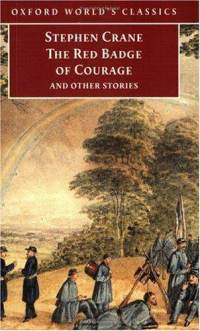
I came into this book with a vague notion that it is a classic that was taught in schools more commonly before my day, and that it was popular with boy-children, also mostly before my time. It is a Civil War story. “The youth,” as we mostly know him, Henry Fleming, signs up against his mother’s wishes to go fight for the Union, and the book follows his war experience.

The bulk of this story is taken up not with events but with the turmoil inside Henry’s head. He is fascinated by war and wants to participate; it takes a certain amount of internal argument before he signs up, and then he thinks he’ll make his mother proud. Then after much waiting in camp, when it appears that he might actually see battle, he becomes petrified with the fear that he’ll run. He meets battle, stands and fights at first, wondering at his nonchalant courage; and then turns and runs. While a fugitive deserter in the woods on his own, he convinces himself that running was in fact the wise and respectable decision; then upon encountering the army again he comes filled with self-loathing. He watches a friend die. He rejoins his regiment with an excuse for his absence and becomes confident again. And on and on – you get the idea. It’s the story of a young boy’s difficulty with the concept of fighting and, most centrally (as in the title), the concept of courage. I’m not sure we ever learn the age of “the youth,” which I regret; I kept wondering how old he was, but maybe the point was that we’re unclear on that question. There is more fighting; our youth stays and fights; there is a victory. (Perhaps it is The Victory; I’m not sure.) At the end of the story, Henry has found a peace and a confidence in himself; the war seems to have helped him grow up.

I kept track, off and on, of the uses of the color red in this book. Aside from the obvious red of blood, war is repeatedly characterized as a red animal, and the flag is a red and white woman who demands and inspires Henry’s courage. And red is not the only color to receive repetitive attention. Yellow is cowardice and men’s pale, sickly, frightened or wounded faces. (Henry’s mother threw a yellow light on the color of Henry’s ambition, by opposing his wish to join the army.) Purple is twilight; blue is the Union uniform as well as the sky, and rage is variously red, black, and purple.

I like this passage; note all the colors used:

He was being looked at by a dead man who was seated with his back against a columnlike tree. The corpse was dressed in a uniform that had once been blue, but was now faded to a melancholy shade of green. The eyes, staring at the youth, had changed to the dull hue to be seen on the side of a dead fish. The mouth was open. Its red had changed to an appalling yellow. Over the gray skin of the face ran little ants. One was trundling some sort of bundle along the upper lip.

Honestly, though, I was not particularly taken with The Red Badge of Courage. It had its moments of colorful imagery that I found charming; and at times Henry’s turmoil felt very human and sympathetic. But for the most part I was a little bit bored. Relatively little action takes place; mostly we hear about Henry’s anguish. I hate to be callous about his struggles – this is war, he is but a “youth,” war is terrible – but it felt to me like rather much circling around the same emotions. It wasn’t as evocative, at least for me, as it could have been. Books about the war experience should twist the knife deeper than this one did.

I also found a few aspects of Crane’s treatment of war a little surprising. For one thing, we almost never heard about the enemy; aside from being dressed in gray and being the antagonist of the battle scenes, the Confederates aren’t developed at all. Many war stories, and especially Civil War stories, paint the opposing army as tragically familiar, thus illustrating the futility and ultimate tragedy of war. This book seemed to take a pass on any such message, which left me feeling a little hollow.

As I sum up my experience reading this book, I have to say I didn’t find it very moving. I would love to hear from someone else who did, though. Any fans of The Red Badge of Courage out there?

book beginnings on Friday: Winesburg, Ohio by Sherwood Anderson

Thanks to Katy at A Few More Pages for hosting this meme. To participate, share the first line or two of the book you are currently reading and, if you feel so moved, let us know what your first impressions were based on that first line.


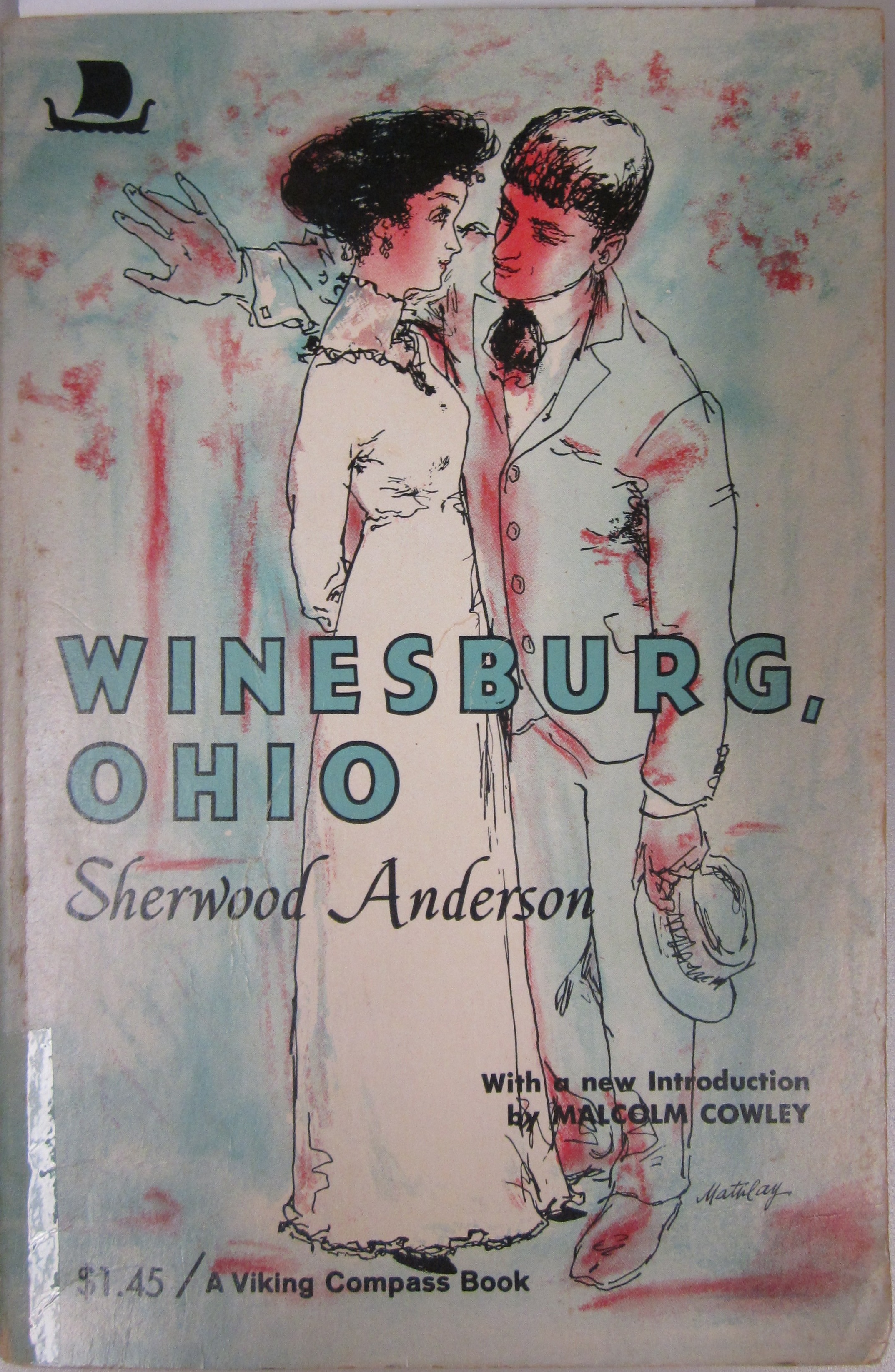
I have Winesburg, Ohio on my shelf because Hemingway recommended it. It turned out to be one of the easier ones from his list of recommended reading for me to get: my mother read the list when I originally posted it, and passed on Winesburg along with another I can’t put my finger on at the moment… this paperback copy, “a Viking Compass book,” was the first reset and redesigned edition since the original typesetting of 1919. It was published in 1960 and has my father’s name in the front cover. I wonder when and how it came to him; he would have been young for it in 1960. I wonder if it was for school? Pops, can you help?

This is a collection of short stories, and the first, entitled The Book of the Grotesque (Anderson’s original title for the collection, in fact) begins…

The writer, an old man with a white mustache, had some difficulty in getting into bed. The windows of the house in which he lived were high and he wanted to look at the trees when he awoke in the morning. A carpenter came to fix the bed so that it would be on a level with the window.

I look forward to my first reading of Sherwood Anderson’s work. His name is less known than many of the writers he influenced, even helped shape, or helped establish their careers – Hemingway being one, along with Faulkner and Henry Miller. Have you read any Sherwood Anderson?

book beginnings on Friday: Black Mask Stories edited by Otto Penzler

Thanks to Katy at A Few More Pages for hosting this meme. To participate, share the first line or two of the book you are currently reading and, if you feel so moved, let us know what your first impressions were based on that first line.


Classic pulp fiction from one of the original pulp mags! On audio! Well performed! Great fun. I give you the beginning of the first book on this compilation: “Come and Get It” by Erle Stanley Gardner, read by Oliver Wyman.

Ed Jenkins was warned by a crook he had once befriended to be on his guard against a girl with a mole, that she would lead him into deadly peril. This crook was shot the instant he left Ed’s apartment, seemingly by accident.

I love the gritty tone of these stories – especially as performed here. It’s great stuff. Also, Husband really enjoyed this story in particular, because our name is Jenkins too. 🙂