



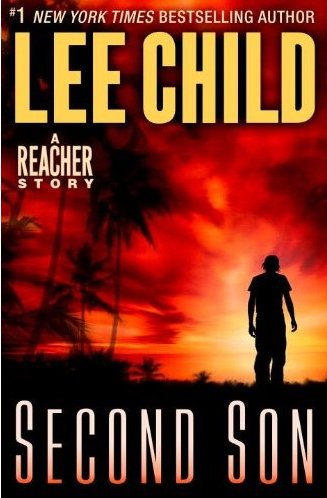
The Second Son by Lee Child

A slight diversion from the norm here, for Mr. Child as well as for me: he has written a Jack Reacher short story (as opposed to his usual novel), set in Reacher’s childhood (as opposed to adulthood), and here’s the big one – gasp – available only as an e-book, and not in “real” print. I was excited about the first two and not about the third. I have been a late adopter of many forms of technology, and the e-book, while a great thing for a lot of people (even some friends and family, people I KNOW), still scares me and strikes me as a little bit blasphemous. Give me ten years to get used to the idea and maybe I’ll get one someday. But for now, I said, how will I read this Reacher story? My mother bought it for me (thank you Mom) and I went over there on a Saturday afternoon with a brown bag lunch and sat down and read it. So this was an experiment with the e-format, as well as a Reacher story.

So. First, the story. We know Reacher (in the series of novels about him, of which I’ve read 10-and-change of 16) as an adult; I believe he was 36 when we met him in Killing Floor. In The Second Son, he’s 13. As his fans already know, his father is in the military, his mother is French, he has a brother two years older (Joe), and they move constantly – like every few months. The family of four has just arrived in Okinawa, and as usual, the local military kids (who have been there just perhaps a little longer than the Reachers) want to fight Reacher and Joe. (Yes, he went by Reacher even as a kid.) Joe is accused of one crime, and their father of another. Their maternal grandfather is dying, back in France. And Reacher saves the day. I don’t think that’s too spoilery, since he always does.

This was an enjoyable little story. If you normally like Reacher, you’ll like this; it has all the right ingredients. Reacher is a badass; he meets a cute girl and impresses her; he saves the day. If anything, the requisite suspension of disbelief is slightly greater than in the novels, because he’s just a kid here, so his badassery is that much more amazing. There’s one line I found especially funny where …some sort of military authority can’t believe he’s about to ask this 13-yr-old kid for help in his investigation. But really, if you’ve bought into Reacher, you’re comfortable with the suspension of disbelief, so you should be fine. It made me sigh with satisfaction. It’s like a Reacher novel in miniature.

And the format? Well, I don’t have any strong or specific complaint. It worked fine, although I had to tilt it just right to avoid glare at one point. The pages turned. I played with changing up the font size. I’m not against it. The strongest argument I know in favor, is for travel: not having to lug a largish number of books around, but having them all in that slim little package. My mother has some 40? books open on her machine right now, just because they’re there, but I don’t see this as a selling point; I’ve been known to read 2, 3, even 4 books at once, but more than that is just silly. I see that as actually detracting from the reading experience, because I’d be so confused, so start-and-stop. I’d rather be immersed in a book. I know the point is not to have 40 books going at once, of course, and if I were traveling it would be nice to carry less. But so far in my life this is not a great need for me.

I’m not angry at the e-book. But I’m not enamored; I love real books (battered old paperbacks, preferably) too much, and don’t feel a need for what I see as the greatest reason for e-books, that carrying of less. But it was an interesting experience to get to try one out with a quick read like this. Thanks Mom. If you read The Second Son, please do share your thoughts.

And the rest of you (Mom included) – would you care to share your e-reader-vs-print thoughts?

The Ransom of Red Chief by O. Henry

The Story of the Week this week is The Ransom of Red Chief, by O. Henry, and I strongly encourage you to go spend 10 minutes on it if you have never read it. I had never read any O. Henry, and I was very pleased. He’s a funny man! Go read this quickie about “two desperate men” and their scheme to make a few bucks.

The Eyes of the Panther by Ambrose Bierce

This week’s Story of the Week is The Eyes of the Panther by Ambrose Bierce. I read it in just a few minutes, and after adjusting to the somewhat clunky transition (is it just me? I had to go back and reread) on the second page, I really enjoyed it. It’s spooky; it reminded me of Poe, actually. I was not familiar with Bierce but did enjoy the introduction to him – particularly the mention of his relationship with Hearst, who figured in the book I just finished, Newspaper Titan. Small world. I love it when my reading overlaps itself like that.

At any rate – this is a short story about a woman’s explanation of her own insanity, and I don’t want to tell you more than that. It is quietly disturbing, in an enjoyably, cozily spooky way, and not in an unable-to-sleep-after-reading-it way (for me at least). Go check it out.

vocabulary lessons: South Texas Tales

I thought I’d share a few more words I was inspired to look up by my recent read: a Mexican-American collection of short stories.

Cuatro Milpas is both the name of a cantina (bar) and the bartender/owner’s favorite song. Apparently a milpa is “a small field in Mexico or Central America that is cleared from the forest, cropped for a few seasons, and abandoned for a fresh clearing.”

anaphora: “a rhetorical term for the repetition of a word or phrase at the beginning of successive clauses.” From the story Dona Porfiria Comes Calling, “Their father was a prolific reader and whenever he spoke to them using anaphora, they knew from past experience that they were doomed.”

Shibboleth: “any distinguishing practice that is indicative of one’s social or regional origin.” In its usage in the story by the same name, the Shibboleth (capitalized in the story, but this does not appear to always be the case) is basically a secret handshake.

menso: “someone who is stupid and/or annoying.” Used in dialog: “Hey! Jou’re not so ‘Mr. high and mighty’ now, eh rich boy? Jou’re daddy’s not aroun’ here, menso!” I like this phonetic expression of accents, a la Twain in Huck Finn and so many more (although I believe Twain was the first).

dècimas: defined in the story itself. Let me just share with you a short passage:

Sebastian remembered the dècimas and their complicated forty lines. A man would challenge another to a verbal duel by nailing a quatrain to the front door or a fence post. The challenged had to answer within a week by producing a complicated forty line poem with four ten line stanzas. Not only that, but the poem had to have a strict octosyllabic beat with an ‘abbaaccdde’ rhyme scheme. Many a man had tried and failed to meet the verbal challenge, but the CÌsneros men were fine ‘dècimeros’ and always relished the competition.

Isn’t that an awfully cool tradition? And so literary! I would be very impressed to observe one of these challenges being met.

merienda: context clues tell me that this is something like a late-afternoon meal of dessert. In my interwebs-searching for a definition, I found a source of information that I especially appreciated. (You may observe that I vary my sources: Wikipedia, About.com, online dictionaries including the urbandictionary.com, or whatever seems most appropriate to my need.) I found a blog that nailed this one, in a surprisingly close-to-home post about eating in the Med Center, where I work. Dr. Ricky defines the term for me:

Although loosely translated to mean snack, merienda cuisine is markedly different from what Americans consider snacks (which appear to me as extended desserts). They aren’t simply sweet items meant to provide a quick spike of blood sugar – merienda foods are proper filling small versions of regular meals, more often savory than sweet.

…and so on, discussing the food he (I think it’s a he? I could be wrong) is accustomed to seeing at meriendas in different countries.

These little cultural learning moments were great fun for me. Have you learned any new words lately?

South Texas Tales by Patricia Cisneros Young

South Texas Tales: Stories My Father Told Me by Patricia Cisneros Young is a slim volume of short stories, taken in part from the stories the author grew up with. It’s a quick and easy read, and an enjoyable one.

These simple and simply told stories read almost like fables; they reminded me of the Coyote Native American stories I read as a child. These stories aren’t just for children, though. The writing style is sparse and straightforward, but these vignettes evoke a time and a place.

Issues addressed include race and racism, marriage and spousal abuse, religion and faith, and even suicide; many stories are about family, love, or the value of hard work. But all of these themes are understated. The stories are quietly powerful but always unpretentious. I enjoyed the minimalist, unfussy style very much; it’s rather palate-cleansing. There’s nothing fancy here, but the stories have value despite being… spare.

Just to give you a quick sampling:

Shibboleth is a story about the Masons acting ruthlessly for their own benefit, and feeling the wrath of the community in turn. The characters are drawn quickly and in broad strokes but it’s enough to feel the pride of the Hinojosas, and to respect Don Manuel’s speaking out, even if it’s too late.

Blood Moon Lullaby is heartbreaking but, I fear, all too true and common a tale.

The Courtship of Red Collins is a bit clumsy but also an awfully realistic-feeling portrayal of small town society and racism, with a surprising turn at the end. Unrealistic? Perhaps. But in that these tales read like fables, I can appreciate the moral.

A Good Day for Dying is a wise choice to finish the collection, because I found it to be the most powerful story of them all. I appreciated Don Sebastian and would like to sit under the mesquite tree with him, myself. It begins:

The old man was tired. Life had given him his fair share of trials and woes and now Sebastian, after surveying his vast estate, decided that the time had come for him to die. The bed that he crept out of had been imported from Paris and brought out to his ranch by mule train. It had been a surprise gift for Sara, the woman who had shared it with him for forty-eight years. He missed her warmth.

These unadorned, down-to-earth stories were remarkably powerful, and I think them a fine accomplishment for such a modest little book. I’m glad I stumbled across them.

Teaser Tuesdays: South Texas Tales by Patricia Cisneros Young


Teaser Tuesdays is a weekly bookish meme, hosted by MizB of Should Be Reading. Anyone can play along! Just do the following:

* Grab your current read
* Open to a random page
* Share two (2) “teaser” sentences from somewhere on that page
* BE CAREFUL NOT TO INCLUDE SPOILERS! (make sure that what you share doesn’t give too much away! You don’t want to ruin the book for others!)
* Share the title & author, too, so that other TT participants can add the book to their TBR Lists if they like your teasers!

I first learned about South Texas Tales: Stories My Father Told Me when I got a request for it here in the library. I’d not heard of it, but it sounded very interesting, and I was pleased to pick it up when we got it in (not least, because of that beautiful cover! Look at that!).

Your teaser today comes from page 65:

Jagou had not counted on the popular support of the communities, both in Brownsville and in Matamoros, rallying around the grief-stricken Hinojosa family. He watched nervously as regular customers became scarce and his daily sales margins dwindled to a trickle.

I am not sure that Jagou has done a good thing… or are the customers being unreasonable?

I look forward to reading these stories of a unique area right in my backyard.