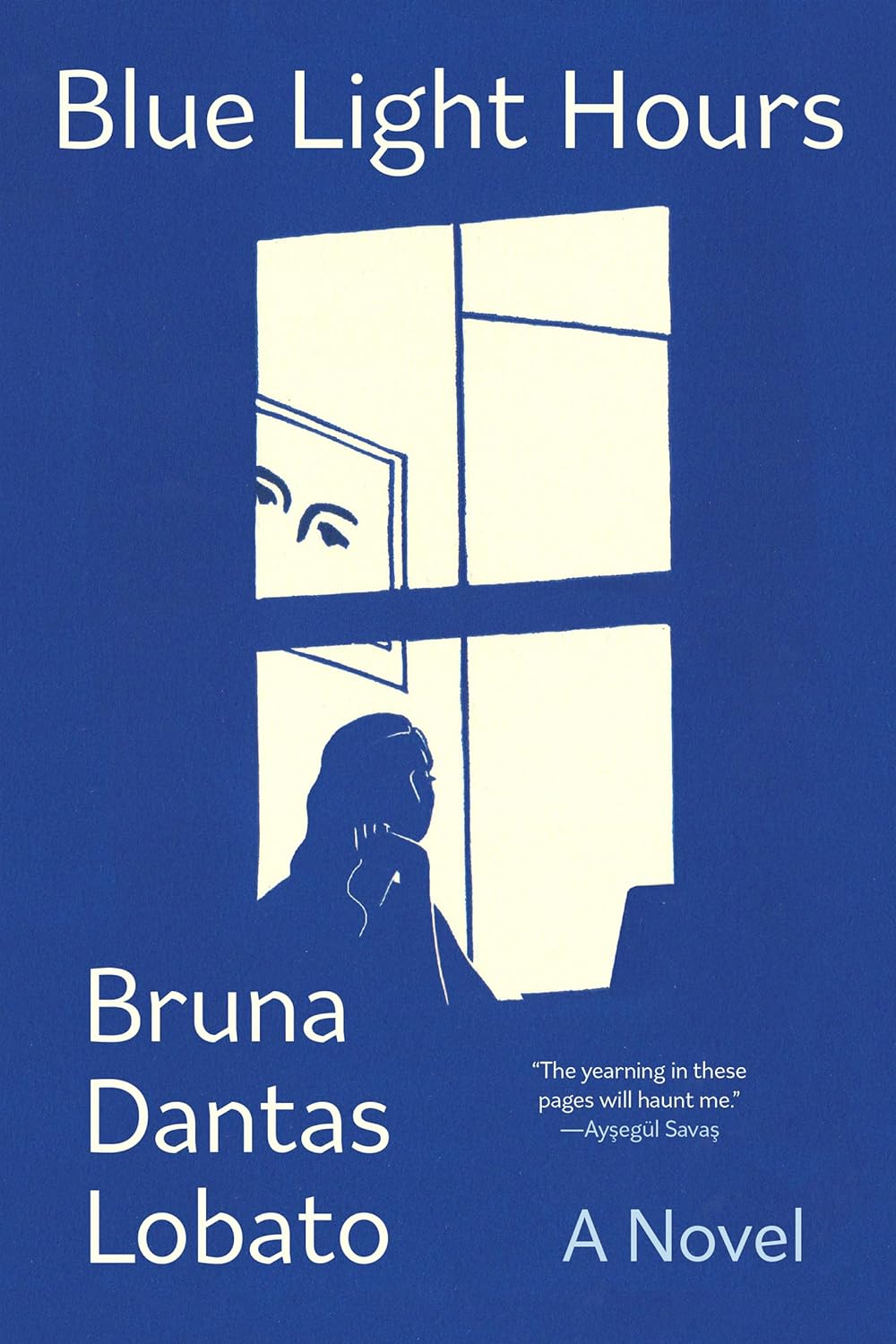
Blue Light Hours by Bruna Dantas Lobato

A mother and daughter separated by continents navigate distance and intimacy through the “miraculous blue light” of video calls in this haunting debut.

National Book Award-winning translator Bruna Dantas Lobato makes her authorial debut with Blue Light Hours, a subtle, contemplative story of a mother and daughter divided by 4,000 miles, who come together via screentime and memory. With love, care, quiet humor, and pervasive yearning, this thoughtful story explores the dilemmas of coming of age and leaving home, the tension between separation and connection.

On a full scholarship, the daughter departs her home in Natal, Brazil, “prepared to brave the world, even if it hurt me,” for a liberal arts college in a remote part of Vermont, leaving behind a mother who suffers from insomnia, migraines, and depression. The daughter navigates unfamiliar culture, food, and language, while the mother observes her first Christmas alone. The daughter feels guilt, torn between two very different lives. “I stared into my green tea, wishing someone… had warned me about how hard it would be to leave, how hard to stay.” Both women rely on their Skype calls: “On the shiny blue screen, there was my mother, my friend, the only person who always knew me.”

This story is told in three sections, “Daughter,” “Mother,” and “Reunion,” but “Daughter” occupies the bulk of the book, so that readers see her loneliness and her striving to make a new life work, even as she worries about what she’s left behind. “Daughter” is also the only section told in first-person perspective, while “Mother” identifies that character only as “the mother,” although both protagonists remain nameless. In “Reunion,” the mother travels to New York City and they make Grandma’s chicken soup together, “dipping pieces of bread into their old lives.” A moving passage details the items in the daughter’s bathroom, all the gadgets and conveniences that are unfamiliar to the mother, and the mother’s brief wish for the simpler bathroom of home. “But when she turned the crystal knob on the bathroom door and saw her daughter at the end of the hallway, sifting powdered sugar on French toast with a wand, she couldn’t help but take the wish back. She couldn’t resist thinking that things were perfect just as they were, golden faucets and all, without any gleaming glass between them.”

Blue Light Hours documents with wisdom and tenderness what is gained and lost when one leaves a home to build another, and the less universal experience of putting a 27-hour flight between mother and child. It tells painful, beautiful truths: with independence comes loneliness as well as freedom, and raising a daughter also involves losing her. Dantas Lobato’s careful, lovely prose will linger long after these pages end.


This review originally ran in the August 15, 2024 issue of Shelf Awareness for the Book Trade. To subscribe, click here.


Rating: 7 electric toothbrushes.

Season of the Swamp by Yuri Herrera, trans. by Lisa Dillman

Yuri Herrera applies his exceptional gift for succinct, imaginative storytelling to a fictionalized history of Benito Juárez in exile in New Orleans.

By 1853, Benito Juárez had served as judge, deputy, and governor of the state of Oaxaca, but he would not become Mexico’s first indigenous president until after a period of exile. Among other locations, he spent 18 months in exile in New Orleans, a time about which relatively little is known. With Season of the Swamp, Yuri Herrera (Signs Preceding the End of the World; Kingdom Cons; A Silent Fury; Ten Planets) sheds speculative light on this brief chapter in Juárez’s life. Herrera’s regular English translator, Lisa Dillman, again brings a precise ear for Herrera’s linguistic play to this spellbinding fictionalized history.

Besides Herrera’s contextualizing prologue, the name Benito Juárez almost never appears. Instead, readers accompany an unnamed protagonist, in close third-person perspective, from his arrival in this remarkable “city that served up accidents on a platter” through his departure, by which time “if one day he was dropped there without anyone telling him where he was, he’d know it was New Orleans even with his eyes closed.” Juárez marvels at the heat, the Yellow Jack epidemic, the local culture soaked in music and dance, and the stray dogs. He has seen other cities–“Seville, Gibraltar, New York–all of them rich, but none like this, where you could so clearly see the blood on the gold.” He is dismayed at the enslaved people, referred to as “the captured,” sold in open markets and subjugated, as in the novella’s memorable opening scene. He meets with fellow exiles and political minds, makes new friends, settles in. New Orleans is beautiful and horrifying, and Herrera portrays both aspects simultaneously, with humor and lyricism: “A moment later, the austere innkeeper began mopping up the sanguineous intimacies smeared all over the floor.”

Wordplay and a special attention to language form a persistent feature in Herrera’s work. A fellow expat claims Méjico, but Juárez recognizes it’s been pronounced “not with a Mexican ex but a Spaniard’s jay…. ‘This is the vegetable market,’ Cabañas veed iberically.” Juárez is attuned to new languages, including music and body language, and thinks of language learning as related to his time spent teaching high school physics: “his students began to glimpse a new world in those equations, the same way you see animals in the clouds, except these animals actually existed.” A sense of wonder and play, linguistic curiosity, and a knack for being both morbid and funny, contribute to an absorbingly pleasurable read, even amid the death and tragedy. Herrera offers another brilliant novella steeped in political and historical time and place.


This review originally ran in the August 1, 2024 issue of Shelf Awareness for the Book Trade. To subscribe, click here.


Rating: 8 high-flown zees.

The Drowned by John Banville

A recluse discovers an abandoned car and winds up involved in a missing-person case with Strafford and Quirke, who are back at work in this novel of secrets and quiet desperation.

John Banville’s The Drowned transports readers to a dour small town on the 1950s Irish coast, where one tragedy after another makes a small cast of characters reconsider what they know and value in the world they inhabit. In his established style, Banville (The Singularities; Snow; Ancient Light; Holy Orders writing as Benjamin Black) offers a stark series of events in understated tones and with a handful of voices. These include Dublin Detective Inspector Strafford and the brilliant pathologist Quirke.

“He had lived alone for so long, so far away from the world and its endless swarms of people, that when he saw the strange thing standing at a slight list in the middle of the field below the house, for a second he didn’t know what it was.” It turns out to be a luxury motorcar, abandoned, engine still running. The loner who discovers it actively avoids human contact: “Yes, life, so-called, was a birthday party gone wild, with shouting and squabbling, and games he didn’t know the rules of, and one lot ganging up on the other, and knocking each other down and dancing in a ring like savages, the whole mad rampage going on in a haze of dust and noise and horrible, hot stinks.” He approaches, against his better judgment, and winds up involved in a missing-person case, which will draw Strafford to town, even as the detective wrestles with his own relationships: an estranged wife, a much younger girlfriend, and ever-complicating ties to Dr. Quirke. “We have one thing in common, at least,” Quirke quips to Strafford. “Death.” Death is an obvious theme, not only in the two characters’ professional lives but throughout Banville’s troubled setting.

Enriched by Banford’s attention to detail, the narrative grows more compelling in its telling by these and other characters, each suffering more or less alone even when they are married, partnered, or set next to immediate family. “The least of remembered things are the most affecting. That walk, the birdlike turn of her head, those trim ankles.” The Drowned is slow building, sedately paced, and grim, but wickedly absorbing. By the mystery’s denouement, some readers will have guessed the perpetrator’s identity, but it is less that identity and more the psychology of it that is Banville’s final blow. Through these intricacies and its murky sense of foreboding, this inexorable novel will continue to advance Banville’s considerable reputation.


This review originally ran in the July 29, 2024 issue of Shelf Awareness for the Book Trade. To subscribe, click here.


Rating: 7 barstools.

The Crescent Moon Tearoom by Stacy Sivinski

This entrancing debut stars triplet witches who can see the future, but must work together and individually to grasp their own.

Stacy Sivinski’s first novel, The Crescent Moon Tearoom, is a sweet, wise balm of a story about family, change, and coming into oneself.

The Quigley triplets, Anne, Violet, and Beatrix, have always been close. Their beloved mother was a powerful Diviner, able to read the future in various signs. Her daughters put the same skill to use in the Crescent Moon Tearoom, where the three young witches sell magical teas and delectable baked goods and tell fortunes to hordes of Chicago’s women and witches. The tearoom (run out of the family home, itself an endearing character with a will and magic of its own) does a booming business, but all is not well with the Quigley sisters. A challenge comes from the Council of Witches: the younger three must help three older witches discover their Tasks, which is a witch’s very reason for existence and is imperative to complete before a witch passes, or she’s “doomed to linger as a spirit for all eternity.” If they fail, the Council will close their shop. The events entwine with a potential curse on the sisters, threatening to undo everything the sisters love.

Although nearly identical in appearance, the Quigleys are quite different individuals. Their mother used to say, “Violet has her head in the clouds, and Beatrix’s nose is in a book. But [Anne’s] feet are always planted firmly on the ground.” While Violet (the family baker) is volatile and in constant, foot-tapping motion, Beatrix is shy and dreamy. Anne is the caretaker, the brewer of teas, and has secretly been holding back her own magical powers so as not to surpass her sisters. They “had been locked in their web of affection and dependence for so long now. Their bonds had taken shape during childhood and seemed to be coated in bronze.” As they struggle with the ominous Council’s extraordinary demands, their differences are highlighted, even as each sister finds opportunities for new growth.

Sivinski’s droll telling details the lovable Quigleys with all their quirk and charm, each with their own moving emotional arc. Chapters are headed with signs and symbols, as one might find in tea leaves at the bottom of a cup, with brief descriptions of their meaning: a fan suggests flirting with temptation; a bat foreshadows a fruitless endeavor. Each line captivates: “As seers, the Quigleys had long ago accepted that questioning what they saw in the remnants of their customers’ tea was about as useful as trying to wash cherry jelly out of a silk blouse.” With its sweetness, realistic challenges, and satisfying resolution, The Crescent Moon Tearoom is a rare pleasure. Readers will miss the Quigley sisters at this novel’s end.


This review originally ran in the July 26, 2024 issue of Shelf Awareness for the Book Trade. To subscribe, click here.


Rating: 8 petals.

Maximum Shelf author interview: Michael Idov

Following Monday’s review of The Collaborators, here’s Michael Idov: The Moment When Things Open Up.


Michael Idov is a novelist, director, and screenwriter. A Latvian-born American raised in Riga under Soviet occupation, he moved to New York after graduating from the University of Michigan. Idov has written for New York magazine and has been the editor-in-chief of GQ Russia. He is the author of Ground Up and Dressed Up for a Riot and has worked on film and TV projects including Londongrad, Deutschland 83, Leto, and The Humorist. He and his wife and screenwriting partner, Lily, divide their time between Los Angeles, Berlin, and Portugal. The Collaborators, coming from Scribner on November 19, 2024, is a lightning-paced espionage thriller.

Does this novel fit the spy thriller genre?

Michael Idov
(photo: Ilya Popenko)

I don’t think the spy thriller is a genre. I think it’s an umbrella milieu, like horror in film. There’s something about the clandestine world that works as a device for boiling down the issues that could be tackled in any genre. From le Carré’s best novels, basically great literature of British manners, to Mick Herron’s social satire, to outright farce and parody, or a post-modernist puzzle box like Ian McEwan’s Sweet Tooth, my favorite novel of his–the spy thriller novel has room for all of that. My goal was never to transcend or put a gloss or a spin on the thing. I love the thing itself and I wanted to do it justice. Any deviations from the formula are just things that naturally come through, dragged in by my own biography and personality, consciously and unconsciously.

Every genre offers both the writer and the reader enough elasticity that at some point the term becomes meaningless, unless it’s a very pure and formulaic example. Which sometimes, when executed well, can also be great. Readers are very savvy. They know the structure. They almost hum along with the melody, even if they’re hearing it for the first time. There is a certain pleasure in seeing every beat hit at the right moment in the right manner.

How much research did you do?

I gave myself two rules. Not being a spy, putting as much of myself into it as I could was the best hope for authenticity and verisimilitude for this book. So the rules were: at no point will any scene take place anywhere I haven’t lived myself. I wouldn’t be describing abstract cities, but specific intersections, streets, cafes. And, at no point will a character speak a language that I don’t speak. If I speak it badly, so will they. That’s why Maya’s French is so shitty, because mine is. There’s a sprinkling of Latvian and German, precisely because that’s the most I could do for the characters. But when it comes to actual research into the intelligence community–I’m lucky to have a few people in the OSINT world (open source intelligence), and this comes through in the character Alan Keegan. I am fascinated by that world, even more so than the “classic” intelligence agencies. I feel like OSINT is a force for good in the world more often than classic intelligence work.

Some things that may feel like genre inventions are taken directly out of reality. My favorite two examples: the opening is very explicitly based on the Ryanair Incident of 2021, when they called in a fake bomb threat to land a plane over Belarus, in Minsk, and yanked an opposition reporter off the plane and let everyone else go. Which led to Belarus becoming even more of a pariah state, and no international airlines fly over it since then. And the other thing that seems like a complete action-movie moment that’s entirely real is, in the fall of 2022 somebody hacked the Russian Uber equivalent, Yandex, and did send like 300 taxis to the same address, creating a traffic snarl that brought the city to a standstill. The moment I read about it, I knew I would use that real event as the climax of a car chase. There’s a huge paper trail around that incident, and people are arguing still whether this was the Ukrainians or some sort of harmless prank.

This goes to my general impetus behind the novel itself. Spy novels tend to come in two flavors: realistic and fantastic. I’m very fond of the term spy-fi that people use to describe things like the Mission Impossible movies. There is room for something that is very realistic and researched and true to the underlying geopolitical situation, but at the same time still finds room for a couple of car chases and a shootout. Because these things do happen! To prove that point, I’ve used the ones that actually have happened.

How do you stay organized for such a complex novel?

Everything has to be plotted out, structurally–as screenwriters rather unpleasantly put it, “beat out” in order to function. I have a 40-page document that’s just the chronology, down to the hour of what happens when, and how long it takes every character to move from point A to point B, and what time it is in every time zone. You have to make sure that there are no whoppers, like oh, it’s the middle of the night in New York, so you can’t describe people going to work. It is a giant Lego set.

That said, I did try to leave room to surprise myself. Oftentimes this happens when you imagine a space in minute detail, and then let your characters go in that space and surprise yourself with what your characters can do there. You build a room and then you make up what happens based on what props you’ve given the characters. Maybe this is where my movie brain took over. Okay, I have a clear view of this, wouldn’t it be cool if X did Y in these rooms.

This novel is expertly paced. What’s the secret?

Just being a fan of the genre. Imagining myself as a reader and not wanting to bore myself. When you really feel for these characters, at some point you develop a feel for when things start to drag: I’ve got maybe two more pages here before something needs to happen–as Raymond Chandler said, when you don’t know what to do, have two people burst in with guns.


This interview originally ran on July 17, 2024 as a Shelf Awareness special issue. To subscribe, click here, and you’ll receive two issues per week of book reviews and other bookish fun.

Maximum Shelf: The Collaborators by Michael Idov

Maximum Shelf is the weekly Shelf Awareness feature focusing on an upcoming title we love and believe will be a great handselling opportunity for booksellers everywhere. The features are written by our editors and reviewers and the publisher has helped support the issue.

This review was published by Shelf Awareness on July 17, 2024.


“When the MiG-29 swung into view, barely 50 yards portside, passenger Anton Basmanny in seat 12A didn’t feel all that surprised. In fact, he even knew the reason it was there. He was the reason…. When you were the Kremlin’s least favorite blogger, a lot could happen.” Thus opens The Collaborators, a ripping gem of a novel by Michael Idov (Ground Up; Dressed Up for a Riot) that transports readers around the world–Minsk, Moscow, London, Berlin, Los Angeles, Portugal, Morocco, and more–and through a range of geopolitical and interpersonal intrigues. Propulsively paced, and containing as much humor, romance, philosophy, and whimsy as classic spy-thriller action, this brilliant novel will charm readers and linger long after its final pages.

After beginning with the plight of the Kremlin’s least favorite blogger on board a troubled flight to Riga, Idov’s narrative jumps to an American spy at work in that capital city. “At Yale, from where the CIA recruited him, Ari Falk had been an Army ROTC scholarship student… and a Slavic literature major: half meathead, half egghead. Add a Jewish name, desperate poverty, and tense foster-kid demeanor, and the result was so difficult to parse that most peers gave up without trying.” Falk likes Riga, but his job concerns him: he may be a bit too ethical, or even sentimental, for CIA work. “Falk felt like the farmer who adopted a new shelter cat each time a coyote ate the previous one. Once you subtracted the issue of intent, he ran a coyote-feeding program.” Falk is looking for Anton Basmanny, who has not arrived as expected.

Pages later, Idov introduces Maya Chou Obrandt, an aspiring actor, daughter to a Taiwanese-American mother and a Russian-American, self-made-billionaire financier father whose death by apparent suicide has just been announced on the news–but with no body, his fate remains unknown. Idle, frustrated, she sets off to search for her missing father. “As long as she was Maya Chou Obrandt, Girl Detective, she wasn’t Maya Chou Obrandt the twice-relapsed twenty-three-year-old addict, or Maya Chou Obrandt the corpse.” On their separate but intersecting missions, Maya and Falk meet by accident at a marina in Tangier, and team up as an unlikely duo: the disaffected CIA agent and the wayward heiress, who uncover decades-old plots beyond either’s imagining.

The Collaborators features short, punchy chunks of narrative switching close-third-person perspectives between a number of characters. Anton, Falk, and Maya are joined by a Russian bagman, a British open-source intelligence innovator with no poker face, and players from various espionage agencies, all lively with idiosyncrasies and multilingual dialog. But all are not what they seem, as identities shift and allegiances come into question: a teenaged Jewish boy at a refugee camp near Rome in the 1980s exhibits commercial acumen that attracts the attention of an American spy; a striking older couple fly business class but are untraceable; Russian agents across history and an aging CIA man intersect in unexpected ways. Not all the characters whom readers will meet, and even like, survive until the novel’s end, but Idov makes every loss and gut-punch count. The action opens in 2021, but events appearing as flashbacks from the Cold War through the 1980s and ’90s strongly influence that present. Idov spins a complex plot, spanning decades and much of the globe, but it proceeds at a lively pace: beware the late-night binge read.

Idov’s many strengths include line-by-line clever riposte (“stop looking at me like I’m a talking dog,” Maya tells Falk when the latter is indeed impressed by her reasoning) and the details that make his characters individual and often lovable (a band t-shirt, a love for bad tea). Readers with an interest in the geopolitical intrigue will certainly be drawn in by modern-day plots involving telecommunications, commerce, and machinations of power, but it is equally rewarding to sink into the dramas of love affairs cut short by espionage (one character’s sacrifice is labeled Faustian by another who may face a similar choice).

Although it does excel at certain features of the espionage thriller–car chases, shootouts, and double- and triple-crosses–The Collaborators is by no means a book for genre readers alone, or even primarily. There is much to love for anyone who appreciates an engaging story, and despite its plot-related strengths–compelling pacing, adrenaline-charged action sequences–the story at heart is character-driven. Characters espouse thought-provoking philosophies and go to great lengths to navigate romances challenged by international intrigue. Despite the body count, the novel often harbors a lovely, even feel-good tone.

Idov’s intelligent, emotive spy novel is funny and sweet, as well as blood-soaked; clever and riveting in its plot twists; and focused on idiosyncratic characters first and foremost. No special expertise in Russian intrigue is required, nor even a special interest in the espionage genre. Brilliant, entertaining, rocketing, and unforgettable, The Collaborators is not to be overlooked.


Rating: 8 glasses of tea.

Come back Friday for my interview with Idov.

Something in the Woods Loves You by Jarod K. Anderson

A profoundly depressed poet takes to the woods and delivers a lovely, moving memoir of nature writing and mental illness.

In his 40s, poet Jarod K. Anderson (Field Guide to the Haunted Forest; Love Notes from the Hollow Tree) left his job in academia to try to survive the debilitating depression he’d mostly hidden for decades. Early on in his memoir, he describes taking a walk in the woods, quietly observing nature as he had not in some time. He communes with a great blue heron and finds that there may be solace in a place where he’d forgotten to look.

Something in the Woods Loves You describes the slow and difficult process of seeking help and getting better, in increments, and with relapses. Anderson’s journey to wellness is not and perhaps never will be complete, but he does progress, and with a poet’s sensibility and attention to language and detail, this memoir relates not only his story but also philosophies and outlooks that will be helpful to many readers. While its subject matter is undeniably heavy, Something in the Woods Loves You is frequently light and positive.

There are notes of advice, but they’re always couched within Anderson’s personal experience, which he acknowledges will not be universal. The result is a memoir of the slow passage toward improved mental health, a deeply beautiful work of nature writing, and a treatise on the underestimated connections between the human and “natural” worlds. The setting is solidly grounded in Anderson’s home landscapes in Ohio (and, briefly, Tacoma, Wash.).

Organized in a seasonal cycle, Something in the Woods Loves You opens in winter: “A white page. An elm scribbled on a snow hill. Empty space making each syllable of life more vital…. Winter is the deep breath before a song.” In that stark season, not without effort, Anderson decides to seek help. In spring (“a gentle calamity of warmth and color”), he obtains access to antidepressant medication and, after a false start, finds a good fit in a counselor trained in cognitive behavioral therapy. In summer, the depression begins to lift. Fall brings a relapse, and the lesson that life will involve ups and downs.

Something in the Woods Loves You is also structured around 20 species, which include sugar maple, morel, eastern bluebird, lightning bug, raccoon, and human. “Fieldmouse” considers toxic masculinity in Western culture, including the unwillingness to ask for help. “Crow” contemplates a balance between science and magic. These are joined by many shining, glinting details, rendered in a poet’s prose under a careful eye: great blue herons “are a mix of shaggy and angular, a blade of yellow stone dressed in flowing robes stitched from overcast skies.” With these and other scintillating observations, Something in the Woods Loves You is revelatory.


This review originally ran in the July 16, 2024 issue of Shelf Awareness for the Book Trade. To subscribe, click here.


Rating: 8 seeds.

Entitlement by Rumaan Alam

With an atmosphere that is sexy, enchanting, and unsettling, Rumaan Alam’s expert fourth novel probes concepts of privilege, wealth, value, and morality.

Rumaan Alam (That Kind of Mother; Leave the World Behind) offers a slow-burning, insidiously creepy study of money and culture in his quietly distressing novel, Entitlement.

Native Manhattanite Brooke, at 33, feels hopeful about her new job at a charitable foundation, following nine unhappy years spent teaching at a charter school. “People heard the Bronx and thought lead paint, asthma, trucks, and whores at Hunts Point,” but it wasn’t funding that was the issue, exactly. She’s not professionally ambitious so much as she yearns for a little more than she has. The new job is initially just that–until she forms a special bond with the octogenarian billionaire, the famously self-made Asher Jaffee, whose money she disburses. Brooke embraces his advice to “Demand something from the world. Demand the best. Demand it.” As she sinks into the sumptuous life Asher invites her into, Brooke becomes increasingly confident in the demands she makes of the world, sure that she is doing good and doing well. With Alam’s signature tone of building foreboding, however, the reader becomes less and less sure.

Money is at the heart of Entitlement: what money can and cannot buy; how to give away Asher’s; where Brooke can find more for herself. Her financial status is, if not perfectly secure, not uncomfortable (even if nothing like her dear friend Kim, whose trust fund runs to the unspecified millions). Meanwhile, race is a more understated part of her story. Brooke, a Black woman with a white mother and a white brother (she’s adopted), “spent most of her time with white people, who never discussed the allegiance of race, because they did not need to.” Moreover, “Brooke didn’t care to defend the fact that she felt more loyalty to an old white man than a Black woman her age.”

Her difficulties with priorities and identity are most apparent in conversations with a robust cast of family and friends, and with the woman whose humble but humming community dance school Brooke would like to fund: the older Black woman is self-assured, yet resists Brooke’s help in a way she doesn’t comprehend. “Brooke didn’t know how to phrase it. Would the money not make them happier? Wasn’t that how money worked?”

Entitlement explores the difference between “wants” and “needs” through Brooke’s contrast to the dance school proprietor, who insists she does not need Asher Jaffee’s money. Alam is ever adept and incisive with the subtle examination of interpersonal as well as systemic issues: race, class, ambition, avarice. Entitlement provides a deceptively silky backdrop for the kinds of thrillingly uncomfortable questions at which Alam excels.


This review originally ran in the July 11, 2024 issue of Shelf Awareness for the Book Trade. To subscribe, click here.


Rating: 8 heels.

The Axeman’s Carnival by Catherine Chidgey

Told in the voice of a magpie, with humor and wisdom, this unflinching portrait of nature picks at the thin veil between the elemental violence and drama of both human and animal worlds.

Catherine Chidgey (Pet; Remote Sympathy) offers a singular combination of compassion, desperation, dark humor, and slow-building terror with The Axeman’s Carnival, set in rural high-country New Zealand. The story is told through the unusual perspective of a magpie fallen from the nest and rescued by a woman named Marnie, who lives on Wilderness Road with her husband, Rob, a sheep farmer and competitive axeman. They’re “under a lot of pressure,” a refrain that contributes to a general sense of foreboding: a drought threatens their livelihood; Marnie mourns a lost pregnancy; she is isolated from the world beyond their farm. An ominous thread runs through their lives in ways that readers gradually become aware of.

The narrator shares memories of being in the eggshell, occupying the nest with his sister and brothers. “She lifted me into her pillowed palm” and a relationship begins. Marnie releases the magpie to his flock, but he chooses to return to the woman he adores; she names him Tama, and posts his pictures to the Internet, which gains Tama a following. The sheep station suffers setbacks, and Rob’s temper and drinking become increasingly menacing, even as he trains for the annual competition where he hopes to win his 10th golden axe, which will offer both the affirmation he craves and a badly needed monetary prize. Tama’s Internet fame presents a financial opportunity for the family, but also puts them in the public eye, with new risks. Tama’s view of events is curious, in both senses of the word; “that was how houses worked,” he repeatedly notes, with each strange or sinister observation.

Magpies are very smart birds. Tama relates the story with humor and wisdom. He mimics human speech and understands it well enough to communicate, and the reader benefits from his viewpoint as he describes events, with grim foreshadowing. “When I think about what happened later, I remember that day,” he says, of various small violences. “Rob honed an axe with his honing stone…. He ran the blade through the hair on his forearm to test the sharpness, and we watched his crime show about shapely murdered women with torn-off clothes who’d let their attackers in their front doors.” Rob’s temper, his taste for crime shows and murdered women, his axes and admirable strength, his jealousy and Marnie’s fear, all contribute to the reader’s trepidation of what is to come. But The Axeman’s Carnival has tricks up its sleeve, and Tama himself should not be underestimated.


This review originally ran in the June 18, 2024 issue of Shelf Awareness for the Book Trade. To subscribe, click here.


Rating: 8 cashews.

The Queen City Detective Agency by Snowden Wright

A disgruntled PI and a plot as wildly complicated as the history of the American South itself combine in this spectacular, darkly funny mystery.

Snowden Wright (American Pop; Play Pretty Blues) immerses his readers in a gritty, troubled small-town Mississippi with The Queen City Detective Agency, and introduces an indomitable protagonist.

It’s the 1980s and the country is about to reinaugurate Ronald Reagan when a small-time felon called Turnip does “a Greg Louganis off the roof” of the county courthouse in Meridian, Miss. Turnip was implicated in the murder, allegedly by hire, of a successful local real estate developer, and rumored to be involved with a mythical criminal syndicate called the Dixie Mafia that may or may not actually exist. Turnip’s suspicious death (by rooftop dive, or was it by poison?) and the murder he may or may not have helped arrange wind up entangled with cockfighting rings, domestic violence, child brides, centuries-old institutional racism and class discrimination, and much more.

Enter Clementine Baldwin (that’s Clem or Ms. Baldwin to you) of Queen City Detective Agency in Meridian, a decaying railroad town that was once the second-largest in the state. “Clem loathed this place and its vitiated nostalgia, redolent of an era when that idiot Atticus Finch thought he could win a rigged game, when you needed a tool to open a can of beer…. At least the beer cans had gotten better.” A disillusioned former cop, Clem is also a Black woman in a city, state, and nation that respects neither. She’d rather just be called a private investigator than a lady PI. For her second-in-command, she went looking for a prop: “completely useless in most circumstances, but, in hers, as handy as locking hubs on a muddy day. In other words, the prop had to be a white man. The guy needed to have hominy for gray matter….” But instead she found Dixon Hicks, “whose name said it all,” a prop who turned out to be a good partner and even a good friend.

Clem is a quintessential hard-boiled detective with entirely legitimate beefs with the world around her. She drinks too much, but who wouldn’t? Partnered with the genuinely, surprisingly good Dixon, she is a smart, courageous, flawed heroine, with plenty of dark humor and a storied past. Wright’s prose is clever and delightfully funny even while handling serious social ills. The Queen City Detective Agency is a remarkable work of Southern noir, featuring crackpot characters both silly and sinister, a longstanding history of greed and white privilege, and an unforgettable private investigator. Readers will be anxious for more featuring Ms. Baldwin.


This review originally ran in the June 14, 2024 issue of Shelf Awareness for the Book Trade. To subscribe, click here.


Rating: 8 rocks.