Dream Team: How Magic, Michael, Larry, Charles and the Greatest Team of All Time Conquered the World and Changed the Sport of Basketball Forever by Jack McCallum

A funny, respectful, expert, complete–and literary–examination of 1992’s Olympic Dream Team and its permanent effects on basketball.


The U.S. Olympic basketball team of 1992 was known as the Dream Team because it included the game’s biggest stars, including Magic Johnson, Larry Bird, Charles Barkley and Michael Jordan.

Sports Illustrated‘s Jack McCallum (Seven Seconds or Less, Unfinished Business) brings these colorful personalities to life as he recounts the creation of the Dream Team and its path to Olympic gold. When a meat inspector from Belgrade came up with the idea of rescinding the amateurs-only clause of Olympics competition, it made it possible for the U.S. men’s basketball team, traditionally made up of college players, to become a squad of NBA All-Stars, characterized by outrageous and iconic players and an unusual vision of the game. As McCallum tells it, this team took its ambassadorial role seriously, as the superstars relinquished their playing minutes to the greater goals of victory, teamwork and honor in a manner arguably absent from today’s game.

Dream Team‘s tone is occasionally reverent, but just as McCallum begins to speak in mythic terms, he reminds us that these men were only human, tapping into their personal lives and private sides (when his shared history with them allows). McCallum is nothing if not opinionated, but always fair in his analyses, and the quotations and one-liners that pepper his text are pure gold in terms of entertainment as well as illumination of the fine sport of basketball.


This review originally ran as a *starred review* in the July 17, 2012 issue of Shelf Awareness for Readers. To subscribe, click here, and you’ll receive two issues per week of book reviews and other bookish fun!


Rating: 7 points.

City of Ravens: London, the Tower and Its Famous Birds by Boria Sax

A bird’s-eye view of the Tower of London’s famous raven residents and their role in history and myth.


The Tower of London combines commercial tourism, history and myth in a single site, and its iconic ravens are a part of all three functions. Legend has it that when the ravens leave the Tower, Britain will fall. Boria Sax’s City of Ravens blends a highly readable narrative style with academic research into Britain’s history, the study of birds and Sax’s own interest in animal-human relationships. Sax examines the ravens’ changing significance in London’s imagination, from being harbingers of death and doom as they fed off the bodies of those executed at the Tower to being heralded as guardians of Britain’s Empire–likely due to their role, during the Blitz, of warning of incoming bombs.

Sax’s research largely dispels the popular belief that ravens had been pets at the Tower since medieval times, and he is ambivalent about the accuracy of the historical raven record. After highlighting a few individual ravens’ personal histories, he finishes by considering the ecological questions raised by the captive birds whose wild counterparts have begun to repopulate London, weighing the options for protecting both the ravens and their mythical standing.

These musings, admittedly conjectural at times, draw on diverse resources including newspaper archives, popular literature, early tourist guides to the Tower and other historical sources–as well as fictional accounts. Part history, part deconstruction of myth, part bird study, always lovingly respectful of the birds themselves, City of Ravens is a whimsical, entertaining and informative journey into London legend.


This review originally ran in the July 13, 2012 issue of Shelf Awareness for Readers. To subscribe, click here, and you’ll receive two issues per week of book reviews and other bookish fun!


Rating: 5 wings.

Racing Through the Dark by David Millar

The unexpectedly inspirational story of a pro cyclist’s “clean” return to the sport after doping.


David Millar was an avid bicycle road racer in his teens, and after he turned pro at age 22, he raced in all the big European events, including the Tour de France, where he wore the yellow leader’s jersey. He resisted doping for years, but not forever; he was eventually busted for the illegal use of performance-enhancing drugs. His story was, perhaps, not highly remarkable in a sport already ridden with doping scandals, but it became noteworthy when he spoke out about his experiences, took a strong anti-doping stand and returned to the sport as a high-profile–and still highly accomplished–“clean” racer. Racing Through the Dark is his story.

Millar’s memoir begins in childhood and follows through rocky years on the pro circuit, the painful decision to dope after abstaining for years, the details of his bust and the raging alcoholic haze of his ban before returning to the sport. It includes anecdotes featuring many of pro cycling’s biggest names, including Mark Cavendish, Stuart O’Grady and Lance Armstrong. Millar’s voice is appealingly open and artless. He takes full responsibility for his poor decisions even as he criticizes pro cycling’s traditional code of silence that overlooks or condones widespread use of illegal drugs. While Millar excoriates the culture of doping, he doesn’t use it as an excuse. He comes across in the end as a surprisingly honorable figure, whose continuing professional career offers a final theme of redemption.


This review originally ran in the July 3, 2012 issue of Shelf Awareness for Readers. To subscribe, click here, and you’ll receive two issues per week of book reviews and other bookish fun!


Rating: 5 skinny tires.

The Boy Kings of Texas by Domingo Martinez

A starkly honest memoir of growing up on the Texas-Mexican border in the 1970s and ’80s, with a wry twist.


Domingo Martinez was born in the early 1970s in Brownsville, Texas, on the Mexican border. His youth was marked by violence and family drama; he grew up wanting only to escape, but unsure how to do so. The Boy Kings of Texas introduces readers to Martinez’s embarrassing, philandering father; his terrifying, work-obsessed grandmother; his older sisters (two of whom successfully pose for a short time as rich white girls); his generally forgotten mother; and centrally, his older brother, Dan. (There’s also the passed-down story of his grandfather, who died young–a Mexican criminal celebrity recalled as the Brer Rabbit, the Billy the Kid, the Rhett Butler of his day.) Martinez describes in glaring, painful detail his drug-dealing friends and family–one time, he bought pot from two local thugs who turned out to be his uncles but who didn’t recognize him through their drug-induced haze–and his gradual, excruciating withdrawal from Texas and the life he’d always known.

The Boy Kings of Texas eventually follows Martinez to Seattle and his agonizing attempts at starting fresh there, handicapped by a misguided childhood whose dominant lesson was machismo at the expense of all else. While a final, happier ending is hinted at (“but that is another book”), this memoir is concerned with the deep distress of a bordertown kid unclear on his place in the world. Martinez’s story is heartrending and uncomfortable, but he maintains a surprising sense of humor that keeps his reader cringing and rooting for him.


This review originally ran as a *starred review* in the July 3, 2012 issue of Shelf Awareness for Readers. To subscribe, click here, and you’ll receive two issues per week of book reviews and other bookish fun!


Rating: 5 tortillas.

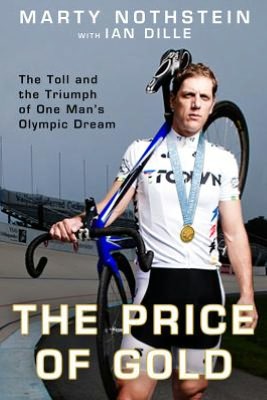
The Price of Gold by Marty Nothstein and Ian Dille

A story of competition and commitment that will raise readers’ heart rates as it brings the antagonistic world of velodrome racing to life.

Marty Nothstein’s athletic accomplishments include dozens of national championships and several world championships. His event is the relatively obscure match sprint in track cycling, and he is the most accomplished American sprinter of the modern era. The Price of Gold details his journey from childhood to Olympic gold and silver, with serious injuries, deep disappointments and unimaginable intense training along the way.

The story begins with Nothstein’s silver medal at the 1996 Atlanta Olympics, then backtracks to a sleepy Pennsylvania town where a bored teenager seeks an outlet for his aggression. Nothstein’s natural talent, powerful physique and hostile, hyper-competitive spirit perfectly suit him for track sprinting. This sport combines cunning tactics with raw power, and Nothstein would become an exemplar of its reputation for ruthlessness. Relationships are built and sometimes broken, but the intense drama is blunted by a surprisingly sweet note, as Nothstein’s wife, Christi (herself an elite junior racer), provides constant and complete support.

Cycling fans familiar with Nothstein’s reputation for belligerence may be surprised at the thoughtful tale he has to tell here and will be tickled to recognize many cycling greats threading through his story. The Price of Gold focuses on hard work, competition and achievement, pulling no punches in conveying the rough edges, but also communicating great emotion.


This review originally ran in the June 12, 2012 issue of Shelf Awareness for Readers. To subscribe, click here, and you’ll receive two issues per week of book reviews and other bookish fun!


Rating: 7 laps.

Dead Scared by S.J. Bolton

A disturbing high-speed thriller involving a rash of university student suicides and a mysterious someone with the power to give bad dreams.

Detective Constable Lacey Flint thinks she is going undercover as an attractive but neurotic student at Cambridge University in the hopes of exposing whoever might be driving students to commit suicide at an alarming rate and by violent means. The longer she spends living on campus and undergoing hazing and humiliation, however, and the more she learns about those earlier suicide cases, the less clear her role becomes. The university counselor who is her only contact is clearly living in fear, as are many of the women around her, and Lacey begins to undergo the same out-of-body experiences and gruesome nightmares described by the girls who’ve killed themselves. Is Lacey herself at risk?

The enigmatic DC Flint, introduced in 2011’s Now You See Me, has a storied past that Bolton leaves largely unrevealed–a trait shared by many other characters. Alternating with Lacey’s first-person perspective, the novel regularly checks back with her superior officer, Detective Inspector Mark Joesbury, who struggles with the truth of what he’s sent Lacey into. They share a shadowy past and some chemistry, but this is one of several aspects left shrouded in mystery, adding to the compelling, suspenseful mood established by thematic elements like evil clowns, sexual abuse, gory scenes of suicide and a panoply of psychiatric issues. Fast-paced, spooky and uncomfortable, Dead Scared keeps its reader on edge until the final paragraph.


This review originally ran in the June 8, 2012 issue of Shelf Awareness for Readers. To subscribe, click here, and you’ll receive two issues per week of book reviews and other bookish fun!


Rating: 6 whispers on the back of your neck.

La Roja: How Soccer Conquered Spain and How Spanish Soccer Conquered the World by Jimmy Burns

An examination of Spanish history through the filter of a beautiful game.

Jimmy Burns has an emotional relationship to the soccer teams and the legacy of his native Spain. He’s written several books on the sport, culminating in La Roja, which sets out to tell the story of Spanish soccer, from the moment when the British introduced the nation to the sport in the 1880s to the present day, when the sport has become ubiquitous. Soccer acted as a major propaganda tool in the Spanish Civil War; Franco used it to maintain control of local populations, installing loyal political figures as club presidents and managers. During his rule, Spanish club teams fought fiercely amongst themselves, with regional politics playing a heavy role; in international play, Franco’s politics were at the forefront of every interaction. These were underachieving, frustrating years for Spanish soccer. Only in the late 20th century did Spain begin to come into its own, winning Olympic gold in 1992 and, finally, the pinnacle of a World Cup championship in 2010.

Burns relates nearly 150 years of Spanish soccer history, capturing its roots, the regionalism, the racism, the politics, the bullfighting connections and even a cultural reminiscence of Don Quixote. He portrays personalities, rivalries, strong emotions–including his own–and moments of shining success for a much-beset nation. Often heavier on history than on sport, La Roja is a window into Spain and its component cultures, regions and histories as well as a celebration of soccer and its most recent champions.


This review originally ran in the June 1, 2012 issue of Shelf Awareness for Readers. To subscribe, click here, and you’ll receive two issues per week of book reviews and other bookish fun!


Rating: 5 soccer balls.

To the Last Breath by Francis Slakey

What begins as a self-satisfied adventure story becomes an account of personal transformation.

Francis Slakey was a physics professor at Georgetown University who paid more attention to his blackboard than he did to his students. He described himself as withdrawn and considered it a good thing. Then, as he tells it in his memoir, To the Last Breath, a chip on his shoulder sends him hunting a world record. His goal–to climb the highest peak on every continent and surf every ocean–was intended to be a physical test, a self-absorbed, even narcissistic pursuit of excellence in sport.

Along the way, though, Slakey experiences many cultures, flirts with spiritual enlightenment and comes to suspect that seeming coincidences along the way mean something. The physical challenge turns out to be the least significant aspect of his journey, as the threat of guerrilla warfare becomes as real as the fear of falling off a cliff. Slakey ends up changing his ideas about what matters most in life; his experiences with the power of nature and the power of human contact turn his world upside down–for the better.

Slakey brings a scientist’s matter-of-fact treatment to a tale of international travel and cultural interaction. He transports his reader to Yosemite, Kilimanjaro and Everest (as well as Antarctica), encounters violence in Indonesia and terrifying driving habits in Morocco and returns home more intact than he began. A love story, an athletic journey, an introspective process of discovery, To the Last Breath is Slakey’s evolution.


This review originally ran as a *starred review* in the May 22, 2012 issue of Shelf Awareness for Readers. To subscribe, click here, and you’ll receive two issues per week of book reviews and other bookish fun!


Rating: 5 mountains scaled.

A Queer and Pleasant Danger: The True Story of a Nice Jewish Boy who Joins the Church of Scientology and Leaves Twelve Years Later to Become the Lovely Lady She is Today by Kate Bornstein

A radical gender theorist and performance artist’s memoir makes its eye-catching subtitle look staid.


Kate Bornstein started life as Albert, a Jewish kid on the Jersey shore who knew when he was four and a half years old that he wasn’t a boy. Bornstein’s path was predictably complicated from there, but the lengthy list of problems she lists in her prologue astounds: she suffers from leukemia as well as anorexia, borderline personality disorder, post-traumatic stress syndrome and a history of cutting; she’s a sadomasochist, a transsexual and a former member of the Church of Scientology. Furthermore, A Queer and Pleasant Danger states from the outset its purpose of hopefully someday introducing Kate to her daughter and grandchildren, currently estranged.

If this list of disorders and minority statuses sounds alarming, never fear. Bornstein is funny, flippant, irreverent and witty. We follow Albert as a child in Jersey, a student at Brown, post-graduate studies in theater at Brandeis and the search for meaning that brought him to Scientology; then on his journey to become Kate, through a new life in San Francisco, Seattle and finally New York, with a series of relationships of every arrangement imaginable (and unimaginable). She generally has a good time, especially after becoming Kate, and her story ends on a positive note. Her tone is most serious in discussing the world of Scientology, which she presents as decidedly distressing and wacky, but her voice overall is impertinent and great fun. A Queer and Pleasant Danger is not for the faint-hearted, for reasons that become fairly evident (see: sadomasochism), but is ultimately uplifting, hopeful, even joyous–and always droll.


This review originally ran in the May 11, 2012 issue of Shelf Awareness for Readers. To subscribe, click here, and you’ll receive two issues per week of book reviews and other bookish fun!


Rating: 6 upheavals.

A Difficult Woman: The Challenging Life and Times of Lillian Hellman by Alice Kessler-Harris

Lillian Hellman’s paradoxical, powerful personality set against the backdrop of a turbulent century.

Lillian Hellman (1905-1984) was many things: a successful playwright, screenwriter and memoirist; a suspected Communist (maligned as an unrepentant Stalinist) who stood up against political intimidation in the 1950s; a labor organizer and civil rights activist; partner to Dashiell Hammett for more than 30 years; a woman criticized for being manlike and grasping, but simultaneously overly feminine and stylish; a New Orleans-born resident of New York, Hollywood and Martha’s Vineyard who persisted in calling herself a Southerner. She was respected for her literary contributions, hailed as a hero by a feminist movement that she largely rejected, praised and excoriated for her politics and, ultimately, vilified for what came to be seen as the outrageous mendacity of her memoirs. It would be difficult to locate a biographical subject more contradictory or complex. In A Difficult Woman, Alice Kessler-Harris makes an excellent case that Hellman represents the complexities and changing mores of the 20th century.

The contradictions in her personality and politics are brought into relief by her written work–including plays still popular in repertory theater today–which always included strong moral statements. The concepts of truth and deception, or betrayal and loyalty, play large roles in her work and this insightful biography, rich with context, shows how they were also themes that defined her life. Not an apologia, but an exploration of nuances, A Difficult Woman gives us an infinitely more complex Hellman than the popular image that has survived her.


This review originally ran in the May 1, 2012 issue of Shelf Awareness for Readers. To subscribe, click here, and you’ll receive two issues per week of book reviews and other bookish fun!


Rating: 9 ambiguities.