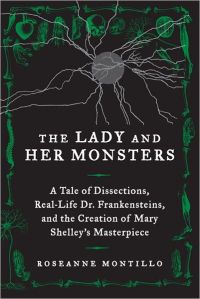
The Lady and Her Monsters by Roseanne Montillo

A spirited investigation of the bizarre times that inspired Mary Shelley’s Frankenstein.
monsters

On its surface, Roseanne Montillo’s The Lady and Her Monsters is an exploration of the genesis of Mary Shelley’s Frankenstein. But Montillo clearly rejoices in meandering through the volatile times that gave life to Shelley’s gothic classic, and her multifaceted literary study expands to include discussions of anatomy and alchemy, suicides, ghoulish dissections of men not quite dead and the dramatic death of Percy Shelley at sea.

In the early 19th century, Europe grew increasingly fascinated with life, death and man’s ability to control nature. Grave robbers known as “resurrectionists” provided subjects for human dissections that were conducted both in medical schools and for the general public’s entertainment. Scientists and imposters experimented with the capacity of electricity to restore life. Into this environment, Mary Shelley was born to Mary Wollstonecraft (A Vindication of the Rights of Woman) and William Godwin, a famous reformer of the day. Percy Bysshe Shelley was her lover and eventual husband; her sister was lover to Lord Byron. The foursome were traveling in Italy, telling the ghost stories with which Percy Shelley was obsessed, when–as Mary Shelley and legend have it–a human monster appeared to Mary in a waking dream. It was also in Italy that she may have first heard the surname Frankenstein, tied to the inspiration for Bram Stoker’s Dracula, as well as to Sir George (he who killed the dragon). In Montillo’s enthusiastic prose, such diverse and macabre subjects make for a lively survey, not only of Shelley’s masterpiece, but of an odd and colorful time in European history.


This review originally ran as a *starred review* in the February 8, 2013 issue of Shelf Awareness for Readers. To subscribe, click here, and you’ll receive two issues per week of book reviews and other bookish fun!


Rating: 5 volts.

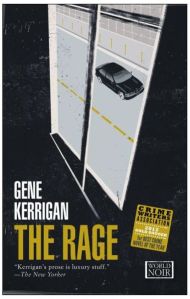
The Rage by Gene Kerrigan

A noir crime novel featuring the collision of a motley group of characters in modern Ireland.

rage

The Rage by Gene Kerrigan (The Midnight Choir) is a multifaceted, character-driven story of crime and remorse. Vincent Naylor, freshly out of prison, is back to planning a robbery with his old accomplices, most notably his beloved big brother, Noel. Bob Tidey is an experienced and jaded police detective, still devoted to doing good but with the growing feeling that his employers limit his best efforts. Maura Coady is a retired nun living with her guilt and regrets. When Maura witnesses something out the front window of her apartment that doesn’t look quite right, she calls Tidey to report it, setting in motion a string of events that run counter to the Naylor brothers’ movements toward the next big score. The reader watches each player’s trajectory on this collision course, but still won’t guess the big finish until it crashes into place.

The Rage will please readers of crime thrillers and literary fiction alike. The atmosphere effectively evokes contemporary Ireland, with all its discontent and economic frustration, and in this way brings to mind Tana French’s lyrical Dublin Murder Squad mystery series. Bob Tidey’s cynicism and gruff efforts at romance recall Michael Connelly’s hero Detective Harry Bosch. The intersecting story lines and crescendo of action create a cinematic effect. Kerrigan’s compelling characters carry this thriller breathlessly through to its climax, but it is the engaging dialogue, thoughtful and absorbing prose and social conscience that make The Rage memorable.


This review originally ran in the February 8, 2013 issue of Shelf Awareness for Readers. To subscribe, click here, and you’ll receive two issues per week of book reviews and other bookish fun!


Rating: 6 regrets.

The Honored Society by Petra Reski

An intriguing and sensational, but not sensationalist, study of the Italian Mafia through character sketches.

Petra Reski had covered the Mafia as an investigative journalist in Germany for years, to the minimal interest of her editors and readers, who considered it an Italian problem. Then, in 2007, six Calabrians were executed in the town of Duisburg, and suddenly the German public was interested in the Mafia.

In The Honored Society, Reski composes character studies of various players both within the Mafia and fighting against it, based on her reminiscences of meetings and interviews. In addition to mafiosi and police investigators, her subjects include public prosecutors, defense lawyers, priests, fellow journalists and Mafia wives and daughters. Accompanied by her cabbie, Salvo, and her photographer, Shobha (as well as Shobha’s mother, a famous anti-Mafia photographer in her own right), Reski travels the streets of Italy and recalls the personalities she’s known. Her sketches of these “bad guys” and their adversaries are intimate and contemplative, rooted in years of experience. Even while excoriating the actions and influence of the Mafia, she seems to feel respect, even affection, toward certain individuals, revealing a conflicted relationship much like the one she describes between the Italian public and its famous criminal organization.

Generally, Shaun Whiteside’s translation of Reski’s work (from the German original of 2008) reads as straightforward, simple prose; but a quiet poetry lurks in certain turns of phrase and carefully crafted images. The Honored Society is an unusually structured view into the strange and powerful world of the Italian Mafia.


This review originally ran in the January 15, 2013 issue of Shelf Awareness for Readers. To subscribe, click here, and you’ll receive two issues per week of book reviews and other bookish fun!


Rating: 6 expensive handbags.

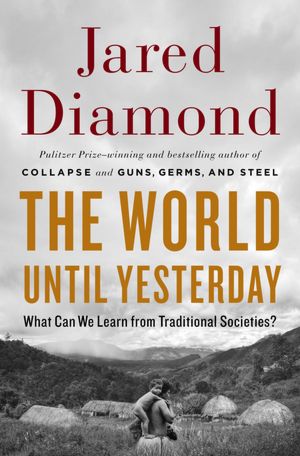
The World Until Yesterday by Jared Diamond

An ambitious but effective–and charming–exploration of the salutary lessons offered by traditional societies.

For many decades, Pulitzer Prize-winner Jared Diamond (Collapse; Guns, Germs and Steel) has split his time between his native United States and the traditional societies of New Guinea. In The World Until Yesterday, he compares traditional ways of life with “WEIRD” (“Western, educated, industrialized, rich, democratic”) methods of problem-solving. Recognizing the daunting breadth of such a subject, he selects a few areas for examination, including dispute resolution, child-rearing, elder care, religion and the connection between lifestyle and non-communicable diseases like Type II diabetes. In each area, he compares traditional practices with modern ones, considering the evidence from angles both strictly scientific and personal.

Diamond supplements his extensive fieldwork with substantial research to draw credible conclusions and posit plausible theories. But he writes conversationally, using the first person liberally as he meanders across disciplines such as anthropology, sociology, geography, statistics and evolutionary biology. This disarmingly personal tone is one of the greatest strengths of the book. Diamond also discusses preconceived notions that he and the reader may have, then moves on to new theoretical ground. While acknowledging aspects of traditional societies to which we do not wish to return–cyclical violence, infanticide, frequent starvation–he identifies certain strengths as well, like negligible rates of heart disease and restorative justice systems. “What can we learn from traditional societies?” Diamond asks in his subtitle; his plan to discover the wisdom and experimentation of more than 10,000 years of human society is well-executed.


This review originally ran as a *starred review* in the January 4, 2013 issue of Shelf Awareness for Readers. To subscribe, click here, and you’ll receive two issues per week of book reviews and other bookish fun!


Rating: 8 yams.

Life Below Stairs: True Lives of Edwardian Servants by Alison Maloney

A simple but thorough glimpse into the lives of British house servants in the early 1900s.

In the wake of Downton Abbey‘s wild success, Alison Maloney’s Life Below Stairs offers an in-depth look at the lives of the serving class in the era of King Edward VII (1901-1910) and the Great War. She examines all aspects of servants’ place in society and relationships to their masters and one another, including social backgrounds, the responsibilities of each servant in households large and small–from the lowly house or hall boy and the maid-of-all-work to the butler and housekeeper–and their working conditions. She also provides details on fine dining, complete with table service instructions and menus that boggle the mind. Finally, she describes servants’ opportunities for retirement or marriage out of service, giving the modern reader an idea of exactly how limited their lives could be. Many poor children and teens would feel lucky to get a position in a “good house,” and not feel dishonored by such a post–in contrast, a contemporary source relates, “service [was] considered rather degrading in America.”

Although comprehensive in its survey of staff’s lives, options, and conditions, Life Below Stairs is a surprisingly easy read. Short chapters and accompanying tables, contemporary newspaper clippings and illustrations make this an accessible and charming way to study the lives of Edwardian servants. As a companion to Downton Abbey or simply a dip into another time, Maloney’s study satisfies.


This review originally ran in the January 4, 2013 issue of Shelf Awareness for Readers. To subscribe, click here, and you’ll receive two issues per week of book reviews and other bookish fun!


Rating: 6 eyes lowered.

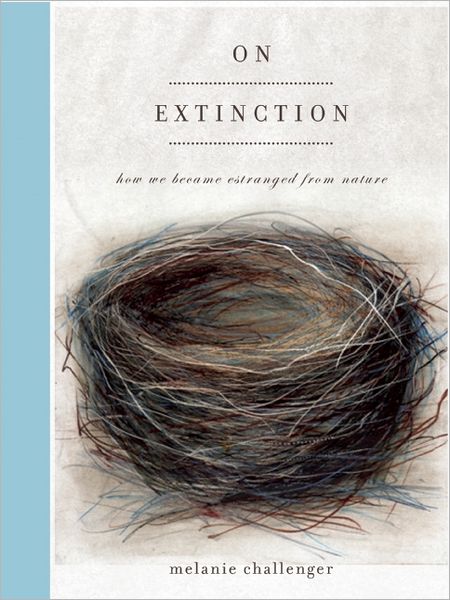
On Extinction by Melanie Challenger

A lyrical contemplation of biological and cultural extinctions and their significance in our human future.

Poet Melanie Challenger (Galatea) was alarmed to note that while she knew both her grandmother’s and her mother’s favorite wildflower, she did not have a favorite because she didn’t know enough wildflowers from which to choose. In On Extinction, she travels to places that embody the history of human connections to nature and muses on our growing estrangement from our environment.

The title suggests Challenger’s initial focus on extinctions: not only of plants and animals, but of cultures, languages and industries. She quickly discovers a growing secondary interest in nostalgia, like our attraction to extinctions, which makes the dodo bird the subject of so much curiosity. In her travels through the Arctic and the Antarctic, England, South America and Canada, she attempts to reunite with nature and find her own favorite wildflower. She also asks: Can humans live productively in this world without destroying it? She is made hopeful by our reverence for the past and for natural beauty.

Challenger brings a loving sense of wonder to the natural world, realizing how little she knows and relishing the process of learning. She looks backwards with the intent of remaking our future relationship with the planet. She does, as one might expect, discuss Muir and Thoreau, but she also turns to Locke, J.S. Mill, Rousseau and especially Darwin, seeking a philosophy of the natural world and our place in it. Highly literate with a lovely, almost reverent tone, On Extinction notes human threats to our environment but ultimately remains hopeful that we can reestablish a healthy relationship with the Earth.


This review originally ran in the December 21, 2012 issue of Shelf Awareness for Readers. To subscribe, click here, and you’ll receive two issues per week of book reviews and other bookish fun!


Rating: 6 falling leaves.

The Black Box by Michael Connelly

Harry Bosch’s investigation into a 20-year-old murder linked to the Rodney King riots and the first Gulf War is set to a moody jazz soundtrack.

The Black Box, Michael Connelly’s 25th novel, comes 20 years after his first, The Black Echo, which introduced readers to Los Angeles detective Hieronymus (Harry) Bosch. These days, Bosch is working with the LAPD’s Open/Unsolved Unit, and he decides to pursue a 20-year-old case that was originally his: the murder of Danish photojournalist Anneke Jespersen during the 1992 riots. Bosch never got a chance to investigate thoroughly–but, as regular readers know, Bosch never gives up. As he pursues the reason Jespersen came to Los Angeles in the first place, he finds himself investigating war crimes dating back to Desert Storm. Searching for the “black box” that will reveal the recorded secrets of Jespersen’s murder, Bosch also lands (not unusually) on the wrong side of the police department’s leadership.

All the strengths that Connelly’s readers have come to expect are on display. He employs an expert sense of place in evoking a gritty, stark Los Angeles, and the mood of the novel is dark and brooding. The pacing is taut, the characters well developed. Bosch’s side interests in jazz artists like Art Pepper and baseball greats like Casey Stengel provide depth and layers to his personality. Series readers will enjoy the updates on ongoing story lines, as Bosch’s daughter, Madeline, continues to mature and his relationship with girlfriend Hannah struggles along. But like all Connelly’s atmospheric, fully realized novels, The Black Box can also be read as an entirely satisfying stand-alone mystery.


This review originally ran in the December 14, 2012 issue of Shelf Awareness for Readers. To subscribe, click here, and you’ll receive two issues per week of book reviews and other bookish fun!


Rating: 6 furrowed brows.

Encounters from a Kayak: Native People, Sacred Places, and Hungry Polar Bears by Nigel Foster

One man’s reminiscences of flora, fauna and miscellanea encountered while paddling the globe.

For decades, Nigel Foster has been kayaking the world’s oceans, lakes and canals–as well as teaching the skill, designing the equipment and writing about his experiences. Encounters from a Kayak collects more than three dozen of his articles in a single volume, many of them never previously published. Each examines a moment in time in which Foster–sometimes alone, sometimes with fellow enthusiasts–interacts with the natural world and its inhabitants from his small craft. It is one of the strengths of the collection that not even the oldest pieces (extending as far back as the early 1980s) feel dated.

The stories are organized thematically around creatures, people, places, and flotsam and jetsam; the diversity and scope of Foster’s contacts in all these categories are impressive. In his encounters with historic artifacts in Scotland, local police in Shanghai and monkeys in the Florida Keys, Foster brings a sense of humble wonder to his environment. Naturally, he considers issues of ecology and conservation in his travels, but he never lectures. Rather, in unadorned prose, he delivers the experiences themselves: the glow of bioluminescence, the ordeal of a Dutchman’s flight from Nazi occupation by kayak, the history of a sleepy Minnesota town and the real-life Scylla and Charybdis of Scarba and Corryvreckan, just off the Scottish coast. Foster’s unassuming consideration of his surroundings is charming, simple and occasionally poetic. Natural history, human history, birds, jellyfish, thunderstorms and more come together to entertain and educate in Encounters from a Kayak.


This review originally ran as a *starred review* in the December 14, 2012 issue of Shelf Awareness for Readers. To subscribe, click here, and you’ll receive two issues per week of book reviews and other bookish fun!


Rating: 5 campfires.

Real Man Adventures by T Cooper

A dryly witty journey from female to male, with musings on what it means to be a man.

T Cooper, the author of several successful novels (including The Beaufort Diaries and Lipshitz 6), is fascinated by masculinity, perhaps in part because he’s had to work a little harder than the average man to get there: he was born female. Yet even as he explores the essence of masculinity and his own experiences with gender in Real Man Adventures, he expresses some reluctance to delve into the personal.

There is definitely some autobiographical content, but Cooper takes his own privacy seriously, as well as that of his wife and daughters, and is less interested in hashing out the details of his own life than he is in exploring the meaning and role of masculinity in society and the difficulties facing transgender men and women. Real Man Adventures sidesteps the concept of a straightforward memoir, instead compiling a whimsical collection of miscellanea: letters, interviews, lists and original art all help Cooper and his readers explore together what makes a man. This structure works perfectly, and feels like a conversation with Cooper himself.

Deeply honest, even while guarding a few precious items of privacy, Real Man Adventures is a brave book. Cooper does a great service not only to transgender people whose paths might be made a little clearer, but also to their loved ones, neighbors and acquaintances, who should find it a little easier to navigate relationships and communications thanks to this frank discussion. And the irreverent, wry humor throughout keeps Cooper’s brash personality at center stage, where it belongs.


This review originally ran as a *starred review* in the Nov. 27, 2012 issue of Shelf Awareness for Readers. To subscribe, click here, and you’ll receive two issues per week of book reviews and other bookish fun!


Rating: 8 pronouns.

On Arctic Ground: Tracking Time Through Alaska’s National Petroleum Reserve by Debbie S. Miller

A call for the preservation of Alaska’s natural heritage, with exquisite photos.

At 23 million acres, Alaska’s National Petroleum Reserve is the largest single unit of public lands in the United States, none of it permanently protected. Rich in oil, gas and coal, it is also home to an astounding diversity of plants and animals, many endangered and threatened; the migratory birds of six continents begin their lives in the Reserve. Debbie S. Miller’s On Arctic Ground is a striking plea for the conservation of this irreplaceable natural space.

Although it can be read cover to cover, the best way to enjoy this book is to take its short chapters one by one. Each provides mind-boggling details–like the bar-tailed godwit’s nonstop, 7,000-mile migration from western Alaska to New Zealand–and makes the starkly moving point that this incomparable area is highly vulnerable. Breathtaking full-page pictures throughout offer stunning portrayals of the Reserve’s strange and spectacular life forms.


This review originally ran in the Nov. 23, 2012 issue of Shelf Awareness for Readers. To subscribe, click here, and you’ll receive two issues per week of book reviews and other bookish fun!


Rating: 8 caribou.