The Women Who Changed Photography: And How To Master Their Techniques by Gemma Padley

Gemma Padley’s The Women Who Changed Photography: And How to Master Their Techniques delivers brief, punchy profiles and incisive assessments of what is revolutionary about these underappreciated photographers. In short chapters, Padley presents 50 women–some well-known, some all but unknown–from all over the world, born from 1799 through 1992. Profiles and portraits are followed by photographs, with Padley’s instruction on how to mimic what is special about the work. This includes technical advice (how to combine and blend portraits; hand-tint a photo; play with angles, color, and flash) and the conceptual (how to use photo stories to raise awareness on an issue). Photographers include Anna Atkins, who “privately published the first book to be illustrated using photography,” and Anne Wardrope, the “first woman in America to photograph her own nude body.” They work in documentary, portraiture, art, photojournalism, and cover war, fashion, conservation, and more. Wide ranging and diverse, with fascinating storytelling, these contents are visually stunning and technically detailed, and will please readers with a variety of interests.


This review originally ran in the November 5, 2024 gift issue of Shelf Awareness for Readers. To subscribe, click here, and you’ll receive two issues per week of book reviews and other bookish fun.


Rating: 7 apertures.

Mask of the Deer Woman by Laurie L. Dove

A disgraced police detective takes a job as tribal marshal to pursue the mystery of a series of missing women, but has trouble seeing beyond her own lost daughter.

Laurie L. Dove’s atmospheric, frequently grim, and emotionally charged debut, Mask of the Deer Woman, features a former police detective trying to outrun her old life by taking a job as tribal marshal on an Oklahoma reservation. Carrie Starr is half Indigenous, but out of touch with that part of her personal history. Tasked with solving the cold cases of a growing number of missing Indigenous women and girls, she is inclined to focus instead on her own lost daughter.

Marshal Starr is the novel’s protagonist, but Mask of the Deer Woman‘s chapters shift among various characters, beginning with Chenoa Cloud, a college student from the rez who is determined to prove the presence of an endangered beetle on her tribal grounds. Documenting an endangered species promises to earn her funding and a job–a way off the rez for good, and not like the others “who left and never came back, or who couldn’t come back.” Chenoa’s disappearance into the Saliquaw Nation’s backcountry sets the stage for Starr’s arrival. The Bureau of Indian Affairs job is a last resort for Starr, and not one she relishes, but her daughter’s murder and the man she subsequently gunned down ended her career as detective. Trading on her late father’s Saliquaw identity earns her a poorly appointed cinder-block office, a BIA-issued, broken-down Ford Bronco, and the locals’ distrust. She carries a bottle of Jameson in her backpack and under the Bronco’s front seat, and a joint in her shirt pocket. Each missing young woman blurs into her daughter, and she flinches away from “the terrain she’d have to cover in the process. The dark space of whatever was out there. Caves. Old mines. Her own mind.”

Beyond the intoxicants she takes to escape her pain, Starr is knocked off-balance by tales of the Deer Woman. Part monster, part avenging angel, part capricious force of nature, this legend seems to follow the disoriented marshal, although the boundaries between magic, hallucination, and self-medicated grief are unclear. To boot, the rez is at odds with the nearest town, and the tribal council must field a controversial proposal to frack for oil, with associated infrastructure. Political and commercial machinations accompany the missing women and the struggling tribal marshal in a novel of grief, violence, community, empowerment, and pain.

This dark mystery will thrill readers and immerse them in a powerfully portrayed world of great losses and high stakes.


This review originally ran in the October 25, 2024 issue of Shelf Awareness for the Book Trade. To subscribe, click here.


Rating: 6 blue jay feathers.

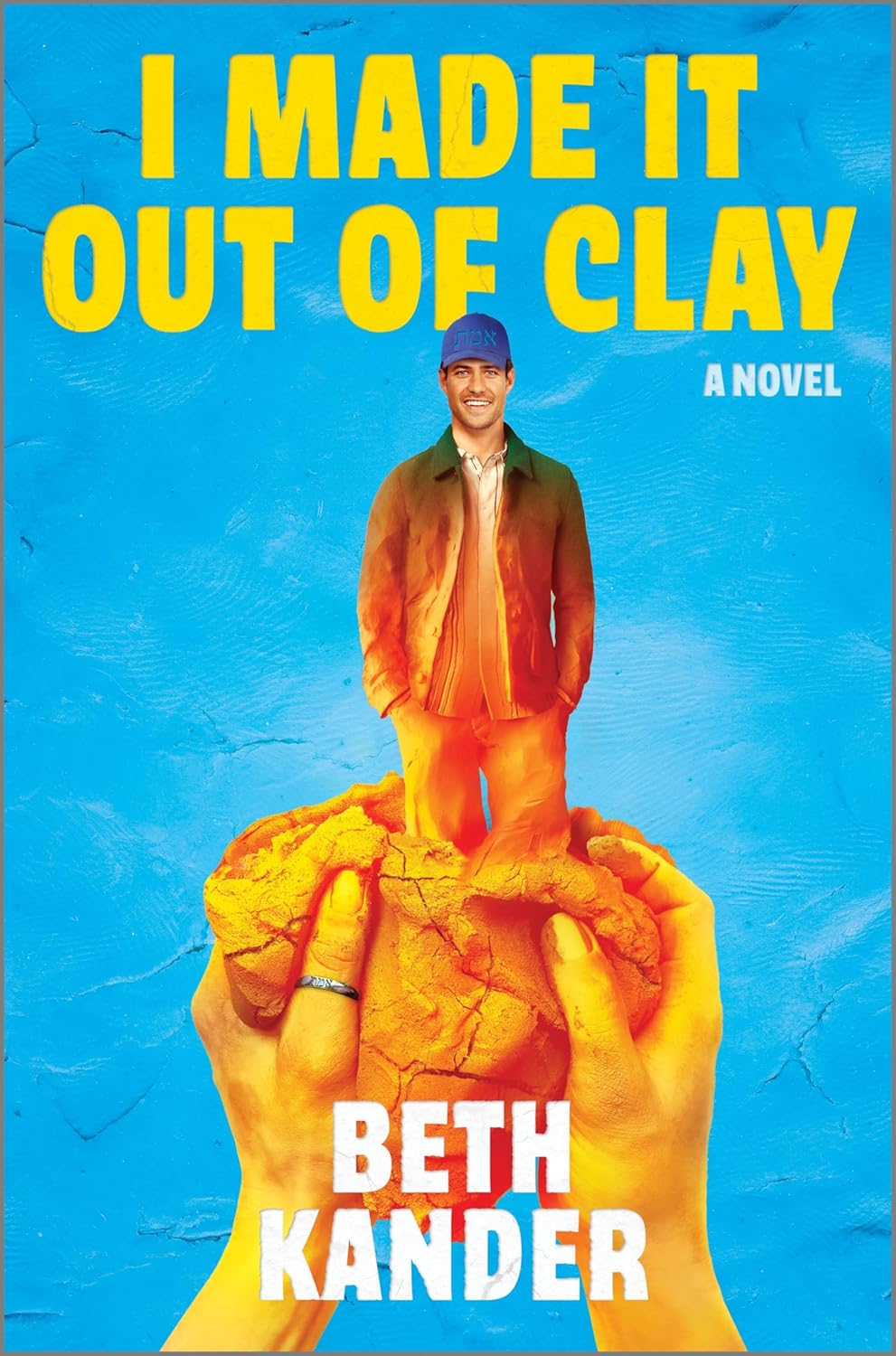
I Made It Out of Clay by Beth Kander

As Eve’s life devolves into crisis, she creates a golem to solve it all, in this lovely, absorbing novel of grief, dark humor, and love and friendship, with a dash of magic.

Beth Kander’s I Made It Out of Clay is a lovely, absorbing novel of grief, dark humor, and love and friendship, with a dash of magic.

In contemporary urban Chicago, as the holiday season approaches, Eve is struggling: she’s about to turn 40 years old, and she’s nowhere near done grieving her beloved father, who died just over a year ago. Eve and her father always loved Christmas–a guilty pleasure in their Jewish family not shared by the surviving members. Layoffs are threatened at work, her best friend has been distant, she’s had some disturbing encounters on the train recently, and she’s begun hallucinating her dearly departed grandmother, a Holocaust survivor who seems to be trying to warn Eve of something. Eve is not close to her mother (overbearing) or her younger sister Rosie (overly perfect), who’s scheduled her wedding for Eve’s 40th birthday weekend. Eve has (foolishly) promised to bring a plus one to Rosie’s wedding, but she’s so far failed to find a date. Unfortunately, her neighbor crush doesn’t seem to get her jokes or her cringeworthy attempts at flirtation.

In desperation, late at night and rather drunk, Eve recalls a story told by her grandmother, ventures into the dank corners of her apartment’s basement, and builds herself a golem out of foundation clay. A golem serves as protector and companion in Jewish tradition, and she feels in dire need of both. The next morning, a hungover Eve wakes up to find a handsome (and very naked) man in her apartment. She is horrified, in disbelief, attracted to him, and a little disgusted with herself. Is Eve’s golem a figment of her imagination? A monstrosity? Or the answer to her fondest wishes? Heading into Rosie’s wedding, all of Eve’s crises–work, friendships, the absence of romance, family strife, civil unrest in the wider world–crash and crescendo together. A golem is either the best or worst idea she’s ever had.

I Made It Out of Clay is a charming rework of a traditional tale. Frequently grim, it explores some of the darker elements of modern life: depression, loneliness, grief, bigotry. But it’s also sweet and very funny, especially in the moments when Eve lets her friends and, eventually, family into her life, and finds that they may have some of their own struggles. Kander gifts her readers with a novel that is often serious and sad, but ultimately uplifting, as Eve learns, “This isn’t the end of anything. It’s just one more beginning, like every damn day can be if we just let it.”


This review originally ran in the October 4, 2024 issue of Shelf Awareness for the Book Trade. To subscribe, click here.


Rating: 7 bagels.

The Greatest Lie of All by Jillian Cantor

A young actress takes on the role of a glamorous romance author and gets more mystery–and romance–than she’d reckoned for.


The Greatest Lie of All by Jillian Cantor (Half Life; The Hours Count; Margot; The Lost Letter) is a propulsively paced story of intrigue, romance, and suspense starring two women a generation apart navigating family, love, secrets, and art. In one of their several parallels, each uses a professional pseudonym, so that four names delineate these two character arcs.

Readers meet the young, up-and-coming actress Amelia Grant just after the death of her beloved mother, and in the moment when she discovers her actor boyfriend in bed with his costar. At this low, Amelia is primed to accept her biggest role yet: to play the fabulously successful romance author Gloria Diamond in a biopic. Gloria had been Amelia’s mother’s favorite; it feels like a sign and a way to be close to the mother she’s lost, the only person who had called her by her birth name, Annie.

Heartbroken but determined, Amelia travels from Los Angeles to Gloria’s remote Seattle-area home to get to know her subject before filming begins. But “the Gloria Diamond” is distinctly unfriendly, cold, and dismissive. Even as Amelia finds a tentative friendship with Gloria’s son, Will (“cute, in an academic kind of way”), she despairs at ever understanding what makes the older woman tick. Gloria’s career was built on her famous, brief romance with her late husband, Will’s father. But the more Amelia learns, the less convincing that story is. She embarks on an informal investigation fueled by shadowy motives: her desire to play a “true” Gloria Diamond; her curiosity about the nature of love, especially as her mother so appreciated it in Diamond’s fiction; and Will’s reluctant desire to understand his mother. As she pursues the history of the author once known as Mary Forrester–Mare to her friends–Amelia begins to wonder about her own role in the drama unfolding before her.

In chapters that shift between Amelia’s perspective and that of the young Mare, The Greatest Lie of All shines in its plot twists and surprises, and, most of all, its pacing, which accelerates from a slow burn to a heart-thumping momentum. The tension increases, stakes rising as Gloria/Mare and Amelia/Annie must reckon with their pasts to chart their shared present. Danger accompanies every possibility of romance, and family history matters more than it originally appears. Cantor’s experienced hand shows in this classically crafted thriller, which will keep its readers tautly engaged to the final scene.


This review originally ran in the September 24, 2024 issue of Shelf Awareness for the Book Trade. To subscribe, click here.


Rating: 6 glasses of wine.

author interview: Oliver Radclyffe

Following my review of Frighten the Horses, here’s Oliver Radclyffe: Barely a Category.


Oliver Radclyffe‘s work has appeared in the New York Times and Electric Literature. He is the author of Adult Human Male and his memoir, Frighten the Horses, was just published by Roxane Gay Books/Grove Atlantic Press. Radclyffe lives on the Connecticut coast with his four children.

What was different about your two books?

Oliver Radclyffe
(photo: Lev Rose)

Writing this book took me 10 years. I wrote a manuscript in five years about coming out as a lesbian in mid-life. But by the time it was finished, I was already midway through my transition. When I started sending it out to agents, I pitched it as the first of a two-book series; I would write the transition second. The agents said, that’s not going to work.

So I started again from scratch, focusing on my gender and the denial that I had been experiencing. I wrote that book over a three-year period. Got an agent; she started submitting it. We got feedback from editors that they weren’t clear who the book was for. I hadn’t thought about my audience; I needed to distance myself from that to write what I was writing.

While that book was out on first submission, Roxane Gay announced she was opening her imprint. I had this thunderbolt moment: What if I rewrote this for Roxane Gay? I’d done her master class on writing through trauma, I’d seen her interview trans people, I knew who she was publicly, I knew the way she thought and what her values were. I thought, I can tell this story to this woman. I wasn’t thinking Roxane Gay might buy the book, it was just an exercise in how to fine-tune it. I spent another nine months rewriting.

During resubmissions, I had an essay published in Electric Lit which Patrick Davis from Unbound Edition Press read, and he called me up and said, I want to commission you to write a book of essays. At that point I wasn’t sure the memoir was going to be published. So I said okay. We signed the contract, and then Roxane got back to us. There was a minor panic about the timing of publications. Grove said, we can do this, but we need a year’s grace between the two books. That meant I had to write the book in three months. So the difference between the two books? One took me 10 years and one took me three months. It was actually really fun to write to a really tight deadline.

Why tell your story?

For the first draft, the starting point was in 2011, when I needed to read books about people who were discovering their queer identities in midlife. They really didn’t exist, particularly in my situation: married, masquerading as heterosexual, with kids. I was about to blow up my own life, and I desperately wanted to find somebody who’d been through this before. I’m Gen X; I wasn’t going to start going onto Reddit forums. I started looking for books, and they didn’t exist. I’d always wanted to write. That old cliché: write the book you want to read.

When I wrote the second draft, about transitioning, the focus shifted from writing for a queer audience to trying to be a bridge. There were so many books at that point written for trans people, I didn’t feel the need to add to that canon. I was in a unique position to write to cis people because I had been in essentially a cisgendered heterosexual life for so long. When I first started transitioning, I said to all my friends, please don’t hold back on the questions. Anything you want to know, even if you think it might be rude or weird or uncomfortable, ask. That’s what I set out to do, but not in a didactic way.

Legitimately, I am less vulnerable than a lot of trans writers. I’m trans masculine, I’m white, I’m comfortably off, I live in this lovely house in the Connecticut suburbs with my children. I am not in a position of extreme danger and vulnerability. When I made the choice to write about some of the more intimate details, I thought, I’m going to do this because I can. I wanted people to understand that transness is not ideological. It’s incredibly physical. The only way to show this is by going into those details about my body. It’s not something you can think your way out of, or intellectualize your way out of–it’s your body that is leading this journey. I leaned into that. I hope that other trans people do not feel that I have opened a door to invite cis people to ask those questions unsolicited! Because obviously it is curated and controlled by me, the writer. But I did feel it was important to go there.

The timeline in your writing jumps around.

Those jumps weren’t there originally. In the early drafts I didn’t have any backstory, but the real-time narrative really doesn’t make sense without it. An early reader said, you have to take all references to your privilege out of this book. Nobody is going to want to read about the poor little rich girl. I said yeah… I really can’t do that. Because, firstly, none of this story makes sense without referring to my privilege. And secondly, I’ve spent my life pretending to be something that I’m not so that people will like me, and I am not going to do that anymore. I recognize that my privilege is going to put some people off, and that’s okay. The story doesn’t make sense without explaining what I came from and the processes I had to go through to figure out how to live my life as the person I am now, given what I came from.

I love the humor in a story that is often fraught.

That’s the English; we tend to use humor to disguise discomfort and pain. I think it’s in my DNA. It’s a coping mechanism. I remember there were times I used to laugh till I was crying, my stomach was hurting, over things that were so absurd and ridiculous. It’s a much more enjoyable way of releasing emotion than getting angry and throwing plates at the wall. Also, this journey was tricky and difficult, but compared to what some trans people have to go through, it wasn’t devastating or catastrophic. I wasn’t in any danger, crucially, which is unusual. So I felt like this was a book that could be written with a light touch without disrespecting what had actually happened.

I’m so happy at the moment about the quantity of books by trans people that are being published. We are in this amazing period where trans writers, trans artists, trans filmmakers, trans musicians–they’re everywhere. I just went to see the Whitney Biennial and it’s just full of trans artists. It’s incredibly exciting: every one is different, every one is amazing and bringing something different and new to this canon. And that’s important, because this isn’t one experience. Nobody can be a spokesperson for the trans experience because we’re all so different. The more we put out there, the more people can understand the diversity within this category. It’s barely a category, really.


This interview originally ran in the September 20, 2024 issue of Shelf Awareness for Readers. To subscribe, click here, and you’ll receive two issues per week of book reviews and other bookish news.

Frighten the Horses by Oliver Radclyffe

Oliver Radclyffe’s memoir, Frighten the Horses, is an arrestingly forthright and open account of self-realization, a portrait of a transgender experience that is beautiful, honest, and raw.

After an absorbing, funny opening scene, Radclyffe rewinds to a less happy time. Readers accompany him on a difficult path as he spent the first four decades of his life trying to live up to expectations. His British upper-class childhood was privileged but disjointed. On brief occasions in boarding school, art school, and while riding motorcycles, he felt like one of the boys, but never felt he truly fit in. He became a housewife of status, then immigrated to the Connecticut suburbs and soon found himself raising four children and a golden retriever puppy. But something had always been off, and the memoir moves back and forth in time to portray Radclyffe’s anxiety and soul-searching. He eventually comes out as lesbian, divorces, and comes out as a transgender man.

These events and discoveries are presented in scenes with color, detail, and dialogue, and Radclyffe’s writing style is smooth, relatable, and effortless to read. With humor and compassion for himself and others, Radclyffe describes his own resistance to and acceptance of his gender and sexuality as he wrestles with the complexities of gender identity, sexual orientation, feminism, class, and family dynamics. This disarming, gorgeously written, and generously vulnerable memoir uses imagery to great effect. In sharing this individual narrative, Radclyffe expands and advances the way trans experiences are represented in literature. Smart and incisive, Frighten the Horses is unforgettable.


This review originally ran in the September 20, 2024 issue of Shelf Awareness for Readers. To subscribe, click here, and you’ll receive two issues per week of book reviews and other bookish news.


Rating: 9 steps.

Come back Friday for my interview with Oliver Radclyffe! I’m really excited about this one.

The Bishop’s Villa by Sacha Naspini, trans. by Clarissa Botsford

In this transporting novel based on real events, a shy cobbler in an Italian village during World War II is gradually drawn into quiet acts in the Resistance.

Sacha Naspini (Nives) brings close and poignant attention to true events with his historical novel The Bishop’s Villa, translated from the Italian by Clarissa Botsford.

In the fall of 1943, in the sleepy village of Le Case in Tuscany’s Maremma region, a cobbler goes about his daily business. Solitary and quiet by nature, René makes do with just two fingers on his right hand following a childhood accident with a lathe; his nickname in town is Settebello, after the “lucky seven” card in scopa. When the local bishop rents out the seminary and surrounding villa to be used as a prison camp for the region’s Jewish population, Le Case mostly plods on as before. Some local residents speak cruelly of the prisoners; many simply ignore their presence. René mends the shoes brought to him for repair by prison guards. For most townspeople, the war is poverty, deprivation, and the passage of time.

But René’s neighbor Anna, a lifelong friend, has just lost her son, who fought for the Resistance until he was captured and executed by the Wehrmacht. Anna is galvanized; René wants her to stand down. And then Anna vanishes, leaving behind a note for René. She has gone to join the partisans, to “fight for Edoardo and for Italy.” When René learns that Anna might have become imprisoned in the bishop’s villa, he finds that he can no longer fail to act. His subtle sabotage begins with boots. “He chose rusty nails, some so brittle that they crumbled at the first blow. He hammered them in a little crooked, curved inwards as if he were aiming for the heel… the hole in the sole would get wider, like a small surface wound.”

In short chapters, Naspini draws readers into René’s world: first the tightly confined life of the village cobbler, traveling back and forth between home, workshop, and Anna’s apartment, and then to the tighter confines of a cell in the bishop’s villa. Botsford’s translation is terse and atmospheric, punctuated by lyrical or romantic phrasings: wonder is “like a child unable to describe a treasure they’d chanced upon under a stone.” With torture, “you can chew [a man’s] bones clean, but you can’t touch his soul, which means you will never win.”

The Bishop’s Villa is absorbing, transporting, beautiful, and grim. Naspini’s Author’s Note makes clear his drive to lay bare a shameful chapter of history; but with this novel he has also written a love story, for without Anna, “René would never have used the tools of his trade to fight his war.” The result is moving and layered.


This review originally ran in the September 12, 2024 issue of Shelf Awareness for the Book Trade. To subscribe, click here.


Rating: 7 soles.

Life After Dead Pool: Lake Powell’s Last Days and the Rebirth of the Colorado River by Zak Podmore


With Life After Dead Pool: Lake Powell’s Last Days and the Rebirth of the Colorado River, investigative journalist Zak Podmore tackles a massive, complicated set of questions about western water management and the Glen Canyon Dam, the construction of which created a reservoir called Lake Powell. Arguably the most politically fraught and symbolic dam in the southwestern United States, Glen Canyon has long had its fans and detractors. The Millennium Drought, “an indefinite change in precipitation patterns” in the region, has “done three-quarters of the work toward draining Lake Powell already,” but this leaves numerous challenges: Indigenous people’s water rights, engineering and hydrology puzzles, the ecological implications for long-flooded lands freshly exposed to open air or buried under millions of acre-feet of sedimentation, and more.

Podmore acknowledges his own biases about the dam, which was in place before he was born. But he proceeds with copious and in-depth research into the many and complex issues it poses, considers what he learns with an open mind, and integrates hard science, cultural awareness, and competing viewpoints into an admirably accessible work of creative nonfiction. Podmore avoids binary options and magical thinking, and his study is richer for it. Included are surprisingly hopeful notes, such as the rapid recovery of native plants and ecosystems in newly exposed side canyons: “A canyon one hundred miles away, drowned for half a century, had restored itself in fewer than twenty years.” With narrative style and colorful characters, Podmore (Confluence) has composed a compelling, readable, and entertaining as well as educational text. Life After Dead Pool is superlative: important, insightful, and a pleasure to read.


This review originally ran in the August 30, 2024 issue of Shelf Awareness for Readers. To subscribe, click here, and you’ll receive two issues per week of book reviews and other bookish news.


Rating: 8 cans of beans.

Maximum Shelf author interview: Lisa Genova

Following Friday’s review of More or Less Maddy, here’s Lisa Genova: On Empathy.


Lisa Genova–who’s been hailed as the Oliver Sacks of fiction and the Michael Crichton of brain science–is the author of Still Alice (adapted into an Oscar-winning film starring Julianne Moore), Left Neglected, and Remember: The Science of Memory and the Art of Forgetting, among others. Genova holds a degree in biopsychology from Bates College and a Ph.D. in neuroscience from Harvard University. Her sixth novel, More or Less Maddy (Gallery/Scout Press, January 14, 2025), features a young woman coming to terms with bipolar disorder.

Why bipolar?

Lisa Genova
(photo: Greg Mentzer)

I’m excited to talk about the distinction between a mental illness and a neurological condition. There’s a stigma attached to the idea of mental illness. I can’t trust you, you’re crazy, you’re dangerous–all of that gets piled on immediately. We would never refer to ALS, autism, or Alzheimer’s as a mental illness. And yet depression, schizophrenia, bipolar–those are also neurological conditions. To distinguish them as mental illness seems to add an unnecessary burden on these folks that this is somehow their fault.

My neuroscience background is my unique lens on fiction and it’s why I write, because these topics are so daunting and overwhelming, and fiction is such a lovely place to help people empathize. I picked bipolar disorder because I had a sense it was everywhere.

Every time I said my next novel was going to be about bipolar disorder, it got the same reaction: a mix of gasps, whispers, and applause. That’s never happened with any other topic I’ve announced. People started DM-ing me on social media: I have a mother, I have a brother, I have a dad. Not necessarily offering to talk to me, although a lot of people did, but others were just thanking me already for this book I hadn’t written yet. I felt an enormous sense of responsibility and opportunity to contribute something meaningful.

Your website identifies you as an “empathy warrior.” Is that what drove you to fiction?

My grandmother had Alzheimer’s. I was 28 when she got the diagnosis. I had a Ph.D. in neuroscience. Alzheimer’s was not my area of expertise, but I had the vocabulary. I dove into the research, I read on how the disease was managed from a clinical perspective, but what was missing was, what does it feel like to have this? And how to feel comfortable with her Alzheimer’s. I had a tremendous amount of sympathy for her, and for us, but I did not know how to be with her. If she started talking to plastic baby dolls, I left the room. I let my aunts take over. I felt heartbroken, frustrated, scared, and embarrassed. I felt sympathy, but sympathy actually drives disconnection. Keeps us emotionally separate. I didn’t know how to get to empathy. I didn’t have the understanding or the maturity to just be with her and imagine what it’s like to be her in a room, not recognizing it as her home. Everything I’d been reading about Alzheimer’s was from the outside looking in. The scientists, caregivers, and social workers have valuable points of view, but none of them were the perspective of the person who’s living it. Fiction is where you get a chance to walk in someone else’s shoes, find that human connection, that shared emotional experience. That was the beginning. When Still Alice worked, and I got feedback about how much it helped, there was so much appreciation–I just knew. I love doing this, and now I feel the value in it. I’m going to keep going.

How did you create Maddy?

I begin all my stories by reading as much as I can. I read lots of memoirs and textbooks, and then I go out and talk to people. For this book I sought out the authors of some of those textbooks. I talked to the guy who runs the bipolar treatment center at Mass General. I found a psychiatrist at McLean Hospital. I spoke with psychiatrists from all over. If you have diabetes, there’s a single protocol, no matter where you live in the world. With bipolar that is not the case. You go to 10 doctors, you’re going to get 10 different prescriptions. I’m always trying to tell the truth under imagined circumstances, but one thing I’m very cognizant of is my books are known for being informed. They’re researched, and they’re going to be used as a blueprint. They’re used in medical schools, in OT, PT, speech pathology. I wanted to get the best practices right. My experts are always the people who live with it and their families. I spent a lot of time talking with lots of people. It’s an ongoing conversation, it’s in-depth and really intimate, and I’m grateful that people trust me with their stories.

Bipolar begins young. I wanted Maddy to be a woman. I wanted to consider the expectations of her to live a normal life as a woman, and the limitations that imposes. If this starts just as you’re launching a life, how disrupting and confusing would that be? I wanted her to be a college student, with all those expectations and pressures. In making her a comedian, I wanted her to choose something that was outside the stability of the expected life. Comedy I liked because it’s very public; she’d be in front of people. Comedians sort of live the bipolar experience. If you’re killing it, that’s the highest high. You’re connecting, everybody gets you, there’s a human bond. If you’re bombing, it’s the lowest of lows. It’s a death. Weirdly, that swing is a nice metaphor for what it could feel like to be bipolar. I’m a big comedy fan, so this gave me a lovely excuse. Comedians who are great at what they do, it’s because they’re speaking truth. They’re tapping into a vulnerability in the human condition. If I could write my character’s comedy and that progression toward having something meaningful to say about accepting herself with bipolar, that would be really cool. It was terrifying, too, because I’d never written comedy. I did take a standup comedy writing class and I did a five-minute set.

Did you discover a new calling?

Oh no. Ohhhh, no. Not going to quit my day job.

Do you consider yourself an activist author?

That’s what the “empathy warrior” is about. It’s about humanizing, destigmatizing. These books are an opportunity. If I see someone with dementia, or who might be manic, my reflexive response isn’t, I need to get away from that. My response becomes more, I’m not afraid of you. How can I help?

I advocate for resources for care and for research. In the author’s note of this book I send people to the International Bipolar Foundation for more education, and to donate money if they’d like. I’ve raised millions of dollars for Alzheimer’s care and research. And we’re 15 years out from Still Alice, so I stay as an activist, advocate, empathy warrior. I want my books to be a reason for people to learn more, to contribute, to offer help.


This interview originally ran on August 27, 2024 as a Shelf Awareness special issue. To subscribe, click here, and you’ll receive two issues per week of book reviews and other bookish fun.

Maximum Shelf: More or Less Maddy by Lisa Genova

Maximum Shelf is the weekly Shelf Awareness feature focusing on an upcoming title we love and believe will be a great handselling opportunity for booksellers everywhere. The features are written by our editors and reviewers and the publisher has helped support the issue.

This review was published by Shelf Awareness on August 27, 2024.


Harvard-trained neuroscientist Lisa Genova debuted as a novelist with Still Alice (2007), about a woman who is diagnosed with early-onset Alzheimer’s disease. Genova’s later novels Left Neglected, Love Anthony, Inside the O’Briens, and Every Note Played feature characters with hemi-spatial neglect, autism, Huntington’s disease, and ALS, respectively. Her sixth novel, More or Less Maddy, follows a young woman with bipolar disorder. As ever, Genova brings both an expert understanding of the neuroscience and a masterful eye for compelling characters in an emotionally textured narrative. Maddy’s story is completely absorbing; it may keep readers up all night.

Maddy Banks has had a privileged upbringing in suburban Connecticut. There were some tough times in her early childhood, and her father is a shadowy figure. But since her mother, Amy, remarried, it’s been easy: dinners at the country club, a popular boyfriend, a highly successful older sister, and an easygoing jock of an older brother. In high school, “each day was laid out for her like a matching outfit on a bed, when both her inner and outer worlds felt organized, predictable, happy, and light. Life was handed to her like a potted succulent, small and tidy and requiring little effort to maintain.” But the transition to college has not been smooth: “She remembers herself then… and it’s as if she was a different girl in another lifetime. She can’t pinpoint exactly how, but she doesn’t feel like she used to feel.”

Her first year at NYU is a shock: “The impossible-to-keep-up-with workload, living with a roommate who drove her crazy, having no clue what to major in, still not finding her passion or her tribe, losing [her boyfriend] Adam. Twice.” In her sophomore year, Maddy’s diagnosed at the student health center with depression. The antidepressants she’s prescribed help to set off her first manic episode, a big splashy event that results in her first stay in a mental hospital. Maddy and her family–who are loving, if not always graceful with the challenges they face–are in for a roller coaster.

In her more stable moments, and especially during the hypomania that often precedes full mania, Maddy develops an interest in stand-up comedy. Along with her love for Taylor Swift–and delusions about their friendship, with a budding business and creative relationship–Maddy’s passion for comedy becomes a trigger for her mother: getting excited about comedy, Amy Banks believes, means a manic episode is imminent. But while Maddy does not in fact have a personal relationship with Taylor Swift, she does have a gift and a passion for comedy. In Amy’s country-club world, this is not a reasonable life path. But Maddy wants it to be. It is one of the tricks of bipolar disorder that “real” excitements can be mistaken for illness, making it difficult for Maddy to pursue her legitimate dreams.

Maddy, her family, and readers learn about bipolar disorder together, with accompanying denial, anger, grief, the ups and downs of sorting out medications and side effects, and relapses. It is heartrending to see Maddy’s anguished efforts to come to terms with her disorder and to dissect what is real and healthy from what is delusion. Readers are privy to her self-talk: “It’s okay to feel disappointed and sad.”; “It’s okay to be happy.”; “It’s okay to be giddy.” It is one of the greatest gifts of fiction to allow readers into experiences that are not their own, to find empathy. Genova’s descriptions of Maddy’s episodes are evocative, clear, and relatable: “Before her hypomania ripened to rotten, there was a delicious sweetness to her thoughts and life. She had a massive amount of unearned confidence in her ability to do anything that struck her fancy. She made big dick energy look flaccid by comparison.”

Secondary characters are equally convincing and essential. Amy is capable of actions that frustrate Maddy (and readers), but she also genuinely wants the best for her child. Maddy’s sister, Emily, is almost too perfect–life comes easily for her, and it’s the life of their mother–but she is goodhearted, and that seems to be the life she truly wants. Maddy’s high school boyfriend, Adam, is one example of the gradual realization that things are not always as they appear. He had the right markers–basketball star, handsome, popular–but readers, and Emily, see some red flags in his treatment of Maddy, who goes on to make other exemplary friends and meet other objectionable characters along her rocky path.

It is an important element of Maddy’s development that she chooses to embrace her own unique self–her sense of humor, her interests, her differences–rather than follow the cookie-cutter plan laid out by her upbringing. “When Maddy was growing up, being normal was always the unquestioned goal…. Normal was her default, unexamined way of life. It meant fitting in, blending with the colors, sounds, and shapes around her.” All young people are out to find themselves; Maddy must live her own version of that. She is not defined by her disease, but is rather a complex young woman navigating the expected tumult of coming-of-age with added complications. Her story is affecting, harrowing, beautiful, and enlightening, as well as a great pleasure to read.


Rating: 8 notebooks.

Come back Monday for my interview with Genova.