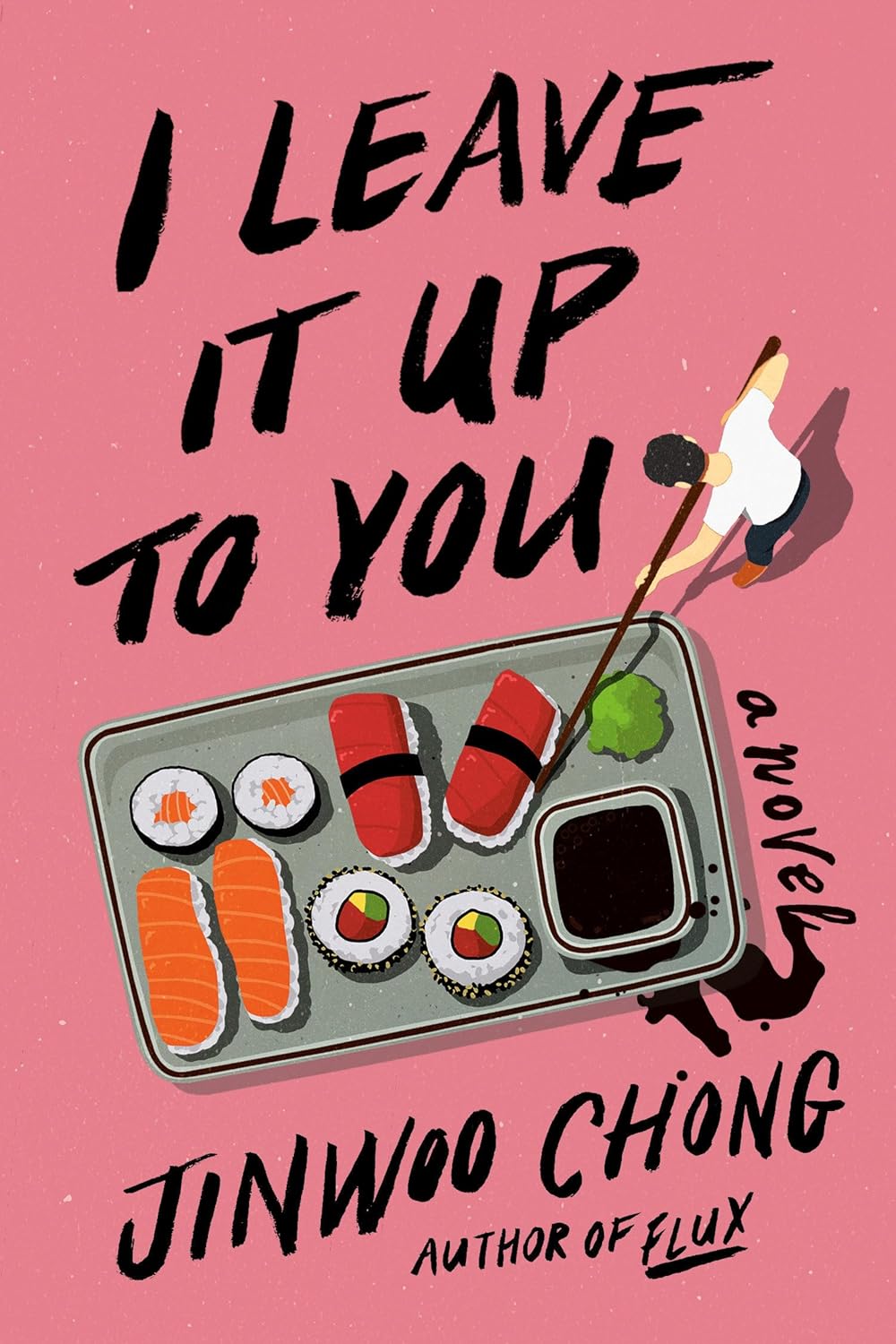
I Leave It Up to You by Jinwoo Chong

A young man wakes up from a coma and returns to the family, and the family sushi restaurant, that he’d left behind, with comical, heart-wrenching, hopeful results.

I Leave It Up to You by Jinwoo Chong (Flux) is a funny, bittersweet, heartwarming story about family, love, and making every minute count.

Readers first meet Jack Jr. in what he is slow to realize is a hospital room. He wakes up intubated and gagging. He’s confused about his whereabouts and circumstances, and he asks for his husband. His nurse is thrown into a full panic: Jack Jr. has been in a coma for 23 months and was not expected to regain consciousness.

No one will answer when he asks for his husband. Jack Jr. has missed his 30th birthday and the first 18 months or so of the Covid-19 pandemic. A few weeks into this remarkable recovery, he returns home, not to his Manhattan apartment, but to his father’s home in New Jersey. He goes back to the family business, a struggling Korean-Japanese sushi restaurant, which was once meant to be his life’s work and which he has not seen in 12 years. Jack Jr. has lost everything, and he finds himself in an unfamiliar, masked world. For much of the narrative, the old wounds he was avoiding–that he will now have to face–remain shrouded from the reader.

Jack Jr.’s kind and loving Appa (father) is a passionate sushi chef and workaholic; his Umma (mother) is private, reserved, and fiercely loyal; his especially estranged brother, James, is a recovering alcoholic with a dear wife and a new baby to join the teenaged nephew that Jack Jr. barely knows. Wise, gawky, 16-year-old Juno is perhaps the member of his family that Jack Jr. best connects with. And then there is Emil, formerly Jack Jr.’s nurse, and now potentially poised to become something more. Through these endearing characters, Jack Jr. considers that perhaps “there was more to loving something than smiling at it.”

In Jack Jr.’s first-person voice, these mysterious, painful new challenges are wrenching, but his love for his wacky family, and theirs for him, are unmistakable throughout. Alongside the flavors of carefully prepared nigiri, dak juk, soy, ponzu, and plenty of pork belly, humor and off-kilter love shine brightly in this tale of realizing what’s really important and making the most of one’s own time. The title of I Leave It Up to You refers to a translation of omakase, the Japanese dining tradition of asking for the chef’s choice, and also nods to the novel’s sweet attention to the care of self and others. While recovering from his physical injuries, Jack Jr. must also navigate old fractures with a family he hasn’t seen in years, let go of a relationship with no closure, and remain open to a surprisingly promising future. The story winds up delightfully warm and soothing, for all the bumps along the way.


This review originally ran in the January 31, 2025 issue of Shelf Awareness for the Book Trade. To subscribe, click here.


Rating: 8 bowls of juk.

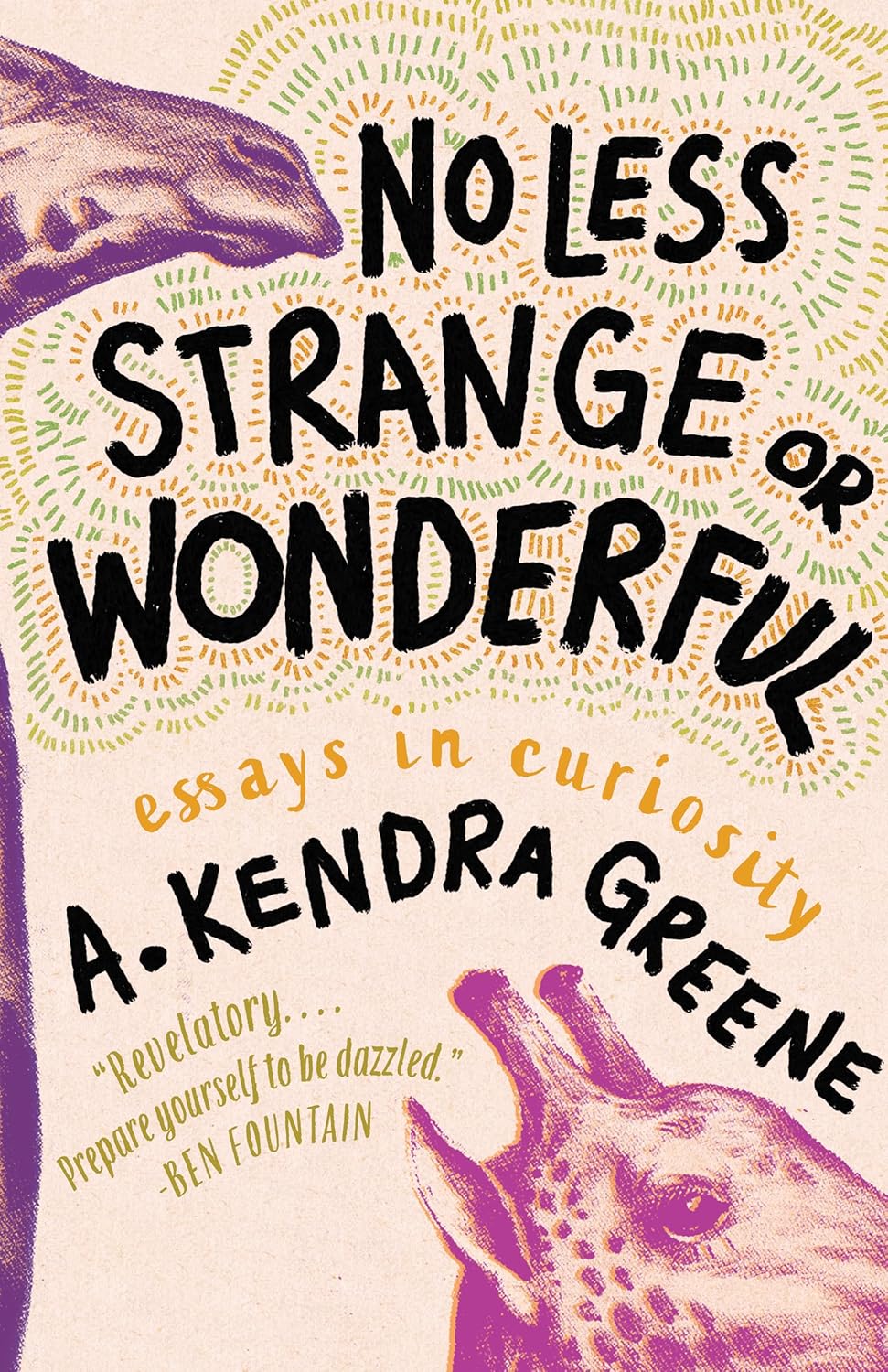
No Less Strange or Wonderful: Essays in Curiosity by A. Kendra Greene

Astonishingly imaginative, wise, and weird, the essays in this illustrated collection–featuring natural phenomena, children, death, and costuming–have the power to reshape the way one sees the world.


A. Kendra Greene (The Museum of Whales You Will Never See) offers a magical, mind-expanding selection of observations in No Less Strange or Wonderful: Essays in Curiosity. Greene employs a delightful, often childlike wonder in this collection about discovery–where she interacts with others, where humans interact with the rest of the world, and what might be made of all of it. Greene’s perspective is fresh and inventive, open to all possibilities, and the results are surprising and wondrous.

Greene’s essays vary in length and take place around the world. “Wild Chilean Baby Pears” considers a crime: in 1979, a museum visitor stole a specimen of the extinct ivory-billed woodpecker from the University of Iowa Museum of Natural History. Greene, who has been a museum visitor as well as a museum worker and a teacher, explores this act from several angles; unexpectedly, she empathizes deeply with the thief she calls “Visitor X.” “Until It Pops” details a dress made for the author out of balloons, and her experience of traveling to Chicago for Twist and Shout (the annual balloon twisters’ convention).

Brief and spellbinding, “The Two Times You Meet the Devil” describes encounters on a country road in Argentina and in a bookstore of unnamed location, respectively. “The more I think about it, the more I wonder how many times we have met, crossed paths at least, exchanged a look, and the devil has said nothing.” “The Sorcerer Has Gone to Italy” is about death, as well as rocks, valleys, turf houses, forgetting, stick-shift cars, whales, kayaks, summer staff, television, and metaphor. “People Lie to Giraffe” is about real giraffes (one in particular) as well as the likeness of a giraffe suggested by a photo of the author’s long arm and pinched fingers. It explores everything encompassed in a child’s imagination, how to make the world, and what it means to tell the truth or tell a story.

Greene is always present, participating in the action and dialogue, postulating philosophies and understandings. Greene is an artist in several media (book arts, photography, illustration), and a teacher as well as a writer; this collection is illuminated by her own illustrations and images. The scope of her essays (26 in total) is mesmerizing, her language glittering, and her ideas exuberant and profound. She says it best herself: “It is a thing the essay loves: to tend, carefully, painstakingly, to the fact of the world.” As for what we communicate with art: “everything resonant and whole and shining, all at once, perfect, every bell ringing, yes.” Yes.


This review originally ran in the January 27, 2025 issue of Shelf Awareness for the Book Trade. To subscribe, click here.


Rating: 9 sprays of bougainvillea.

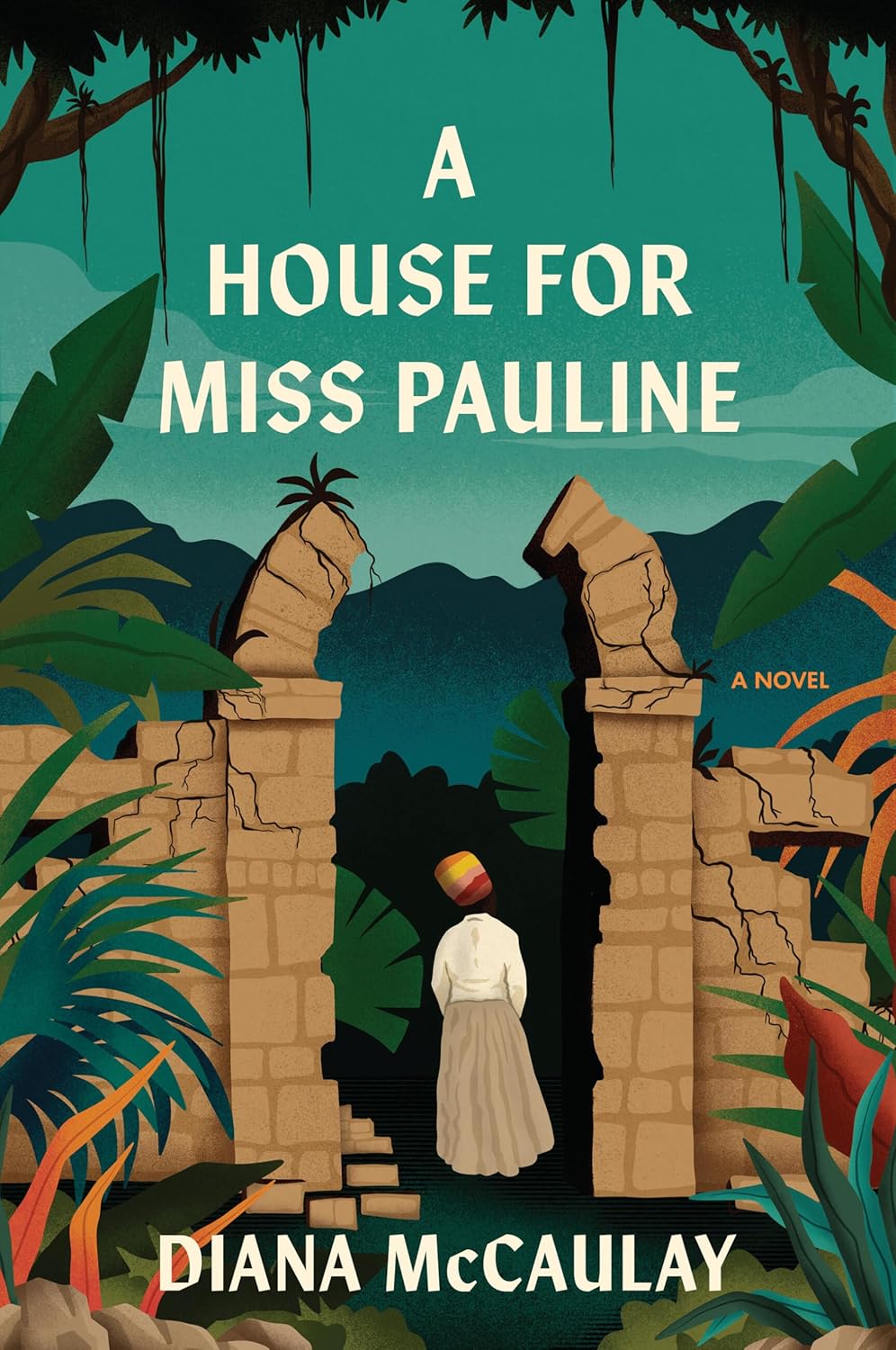
A House for Miss Pauline by Diana McCaulay

Near her 100th birthday, a rural Jamaican woman faces the good works and wrongdoings of her own life and her island’s history in this richly written novel of vivid characters and big themes.

Diana McCaulay’s sixth novel, A House for Miss Pauline, features an indomitable 99-year-old woman in rural Jamaica, trying to reconcile rights and wrongs near the end of a long life. Miss Pauline exhibits a brave honesty that endears her to readers as she wrestles with not only her own actions but centuries of wrongdoings on an island steeped in sugar and slavery. Kingston native McCaulay (Gone to Drift) evokes a rich setting through the food, climate, and other details, such as her characters’ Jamaican patwa, which brings them to vibrant life.

Miss Pauline is less than a month away from her 100th birthday when the stones of her home begin to shiver, shake, whisper, and howl to her. She has lived in the village of Mason Hall in Jamaica’s St. Mary parish all her life, having borne two children with her beloved (long-dead) partner, had many friends and lovers, and been an elder to the town. The village is built largely of stone salvaged from a plantation big house Miss Pauline once discovered and designated for reuse in building her own home and many other structures.

In this literal and symbolic rebuilding, she led her community in reclaiming what had been stolen: land, human lives, freedom. She is certain now that the stones are prompting her to reckon with her own life’s work: community building, but also the unresolved disappearance of a white man who came to Mason Hall decades ago to challenge Miss Pauline for the ownership of her land. A House for Miss Pauline is a deeply captivating story of one complicated, admirable life and the nuanced history of Jamaica. It grapples with how people are connected to place, and how that plays a role in the concept of land ownership and responsibility. “Does the cotton tree judge her for what she did? Surely it has seen worse? How to evaluate crimes, one against the other?”

Miss Pauline turns first to her granddaughter in New York, and then enlists a local teen, Lamont, for help with the mysteries of the Internet and a smartphone. Lamont, who’s alone in life, will play a role beyond research assistant for the near-centenarian, prompting consideration of what constitutes family. In her attempts to establish the future of her home and her land, Miss Pauline will also face surprises about her own history: “Maybe you have to go into the past to make the present right. Maybe the long ago is demanding something of the here and now.” Thoughtful, defiant, and just, the frightened but fierce Miss Pauline is uncowed in the face of youth and change; she’s a hero for readers of all backgrounds.


This review originally ran in the January 17, 2025 issue of Shelf Awareness for the Book Trade. To subscribe, click here.


Rating: 7 panganat.

The Café with No Name by Robert Seethaler, trans. by Katy Derbyshire

A humble café in post-World War II Vienna serves as backdrop for all the large and small dramas of everyday life in this subtly scintillating novel.

The Café with No Name by Austrian writer Robert Seethaler (The Field; The Tobacconist) opens in 1966 Vienna. Robert Simon is 31 years old and about to embark upon the quiet dream of his lifetime. It’s his final day at the market where he’s worked for seven years, as he begins to clean out and shape up a long-empty café across the street. Simon is a solitary, steady, and kind man who was orphaned as a young child during the war and is now a reliable worker who keeps to himself. “For a while he worked as a glass clearer and brush boy in the Prater beer gardens, and perhaps it was there–as he roamed between the tables in search of empty glasses, chicken bones and cigarette stubs in the light of the coloured lanterns–that he first felt a nascent germ of yearning: to do something that would give his life a decisive affirmation. To one day stand behind the bar of his own establishment.” He realizes this modest ambition with the café on the edge of the bustling market, where Simon serves blue-collar workers like himself. He offers beer, wine, coffee, and raspberry soda; bread with drippings and gherkins; and a place of respite. He is soon joined by a single employee, a loner like himself. Mila, too, finds a home in the café with no name.

Seethaler’s tender novel follows Simon and his café for the 10 years that they operate, until a change in the building’s ownership pushes the small business out again. These years see Simon’s Vienna neighborhood rebuild from postwar austerity, its population and workforce swell and change, and cultural patterns begin to shift. The café is a microcosm of these evolutions.

The Café with No Name does not have a plot filled with action, conflict, and resolution; instead, it focuses on mundane details of life. “Simon couldn’t help smiling at the thought of all the lost souls who came together in his café every day.” An aging prizefighter, two older ladies who drink and chat in the afternoons, the cheese shop proprietor and her painter boyfriend, and Simon’s friend the butcher are among the regulars; they and others experience death and dismemberment, quiet violences, loss, and alcoholism, but also uplifting moments of humanity, friendship, and love. There are, remarkably, no villains in this novel, only people struggling against ordinary human challenges. While Seethaler’s characters face significant difficulties, the story never feels grim, but rather steadfast and even hopeful. Katy Derbyshire translates Seethaler’s prose from the German with calm delivery, charming descriptions, and understated humor. This lovely novel sweetly and simply emphasizes built family, resilience, and rebirth.


This review originally ran in the January 14, 2025 issue of Shelf Awareness for the Book Trade. To subscribe, click here.


Rating: 7 paintings.

The Garden by Nick Newman

This eerie, thought-provoking novel combines sisterly love and end-of-the-world horrors in an unforgettable pairing.

Nick Newman’s The Garden is a shape-shifting novel, an enigmatic fable that twists slowly into a more sinister dystopian narrative with a surprising turn at the end. The questions it asks and the hard truths its protagonists turn away from will keep readers intrigued.

Evelyn and her younger sister, Lily, have lived in the garden all their lives, more or less. They remember little from before, although in the early years there were parties, their father holding court, their mother overseeing. Then the people went away, and the gates were locked, as were the doors to the bulk of the sprawling house. The sisters live now out of the kitchen, which “still [feels] too large,” and in the garden, where they keep bees and a few aging chickens and grow vegetables, herbs, and flowers. Their mother’s handwritten almanac directs their daily work, which is getting harder as their bodies grow older, but the garden provides everything they need and nothing is expected to change–until it does.

The sisters haltingly identify the creature that appears in their kitchen, stealing their honey, as a boy. Aside from its sheer novelty, the situation is frightening. The boy is unknown and therefore unsafe, a curiosity and a threat. “You know what boys turn into, don’t you, Sissie?” Lily speculates, “He’s probably poisonous.” But Evelyn considers, “Boys did become men, Lily was right about that, but what her sister actually had in mind, she did not know. A cocoon, perhaps. A chrysalis… Evelyn could not deny a perverse desire to learn firsthand, to feed and water the grub and see what it might grow into.” As they wrestle with this new challenge in their long-immutable garden–perhaps less an Eden than a prison–the sisters find themselves facing new choices and turning against each other in new ways.

Newman’s gifts lie in the quiet accumulation of his novel’s unsettled atmosphere, its changeable nature. The garden provides food, sustenance, and floral beauty; it is also constantly threatened by dust storms capable of burying the known world. Readers know both more and less than Evelyn and Lily do, and knowledge and its absence are increasingly terrifying, especially as the sisters begin to confront long-buried secrets about their own past. The possible and the inexorable collide in this parable of change, which probes the promises and terrors of personal choice and portrays various approaches to possibility. “The vagueness of their mother’s threats had made a blank space… and only now was Evelyn realizing that she and her sister saw that blankness quite differently. It excited Lily. It terrified Evelyn.” The dystopia it represents may be more real than readers originally understand.


This review originally ran in the January 7, 2025 issue of Shelf Awareness for the Book Trade. To subscribe, click here.


Rating: 7 marigolds.

A Perfect Day to Be Alone by Nanae Aoyama, trans. by Jesse Kirkwood

This award-winning novel in its first English translation follows a young woman rooming with a distant septuagenarian relative for a year, and the muted dramas of her coming-of-age.

Nanae Aoyama’s A Perfect Day to Be Alone, winner of Japan’s Akutagawa Prize and translated into English by Jesse Kirkwood, is a slim coming-of-age novel of understated beauty.

A young Japanese woman named Chizu moves to Tokyo when her mother goes to China for work; Chizu is to live with a distant relative she’s never met. “It was raining when I arrived at the house. The walls of my room were lined with cat photos.” Chizu is 20; Ginko is 71. Over the course of a year, they move quietly around each other in a small apartment overlooking a commuter train platform. Chizu is periodically impatient, even cruel, toward the older woman, who placidly knits, embroiders, cooks, and, when solicited, imparts advice. The two women establish a thin bond, and then Chizu moves on. This restrained novel follows the four seasons of their connection.

Chizu is a solitary person, without friendships or much success in relationships, nor is she close to her mother, whose emigration doesn’t affect her much. When she arrives at Ginko’s home, she reflects: “I hadn’t bothered introducing myself properly…. I wasn’t in the habit of going around declaring my name to people like that. Nor was I used to others actually calling me by it.” Her life has been passive: “I’d been told to come, so here I was.” She does not want to go to school and instead takes on a series of part-time jobs. She is curious about falling in love, especially when Ginko’s male companion becomes a regular visitor; she is often invited along on their outings. In this and other ways, Ginko proves the more generous member of their household. Chizu is initially dismissive of Ginko, but notes that she “was turning out to be surprisingly normal,” and that her friendship has something to offer.

These observations are made only very subtly, amid daily run-of-the-mill events, including the tiny dramas of Chizu’s workplaces, her forays into dating, and shared meals at the apartment by the rail line. Kirkwood translates Aoyama’s writing with subdued loveliness: “The train was approaching the bridge over the Yanase River. Its banks were lined with slender cherry trees, their branches still bare…. A watch on my wrist, pumps on my feet, a black handbag at my side. I watched a boy taking a brown dog for a run, the two of them tracing a line across the grey concrete.” A Perfect Day to Be Alone ends with less assured conclusiveness than its title implies, but in the spirit of the whole, it nods quietly toward positive change, or at least forward movement: “The train carried me onwards, to a station where someone was waiting.”


This review originally ran in the December 13, 2024 issue of Shelf Awareness for the Book Trade. To subscribe, click here.


Rating: 6 Jintan mints.

Live Fast by Brigitte Giraud, trans. by Cory Stockwell

Brigitte Giraud’s Prix Goncourt-winning Live Fast is a powerful and concise study of love, loss, and the small decisions and turning points that shape life and death.

Brigitte Giraud, the author of more than a dozen novels, won the 2022 Prix Goncourt for Vivre vite. Published in the U.S. under the title Live Fast, this is Giraud’s first book to be translated from French to English. The highly autobiographical novel examines the 1999 death of the narrator’s 41-year-old husband, Claude, in a motorcycle accident. She writes: “There was only one thing I was truly obsessed with, and I’d kept it secret so as not to frighten those around me… because after two or three years, it would have seemed suspicious if I’d persisted in trying to understand how the accident happened…. My brain had never stopped running wild.”

Brief, taut, and tortured, Live Fast begins as the narrator, Brigitte, sells the house she and Claude had been moving into at the time of his death 20 years earlier. Letting the house go is significant, but she has never let go of her confusion and despair over her loss. “The house is at the heart of what caused the accident,” she insists, then embarks on a list of hypotheticals, such as “If only I hadn’t wanted to sell the apartment,” “if only my mother hadn’t called my brother to tell him we had a garage,” “if only it had rained,” and on and on. These wishes form the novel’s chapter titles, and Brigitte compulsively dissects each point on a diagram about cause and effect that she’s been plotting for years.

In this way, as though she’s conducting an incisive postmortem accounting, Giraud analyzes the events that led up to Claude’s inexplicable death. Their family–Brigitte, Claude, and their eight-year-old son–were moving house. They got the keys early; they had access to a garage; Brigitte’s brother needed to store a motorcycle. Readers are treated to detailed descriptions of the Honda CBR900 Fireblade and Honda’s famed engineer Tadio Baba, as well as what song Claude may have chosen to end his final workday with. Giraud even postulates that had Stephen King died–rather than being seriously injured–when he was struck by a minivan in Maine three days before Claude’s accident, Claude might have been spared.

This is a novel about obsessive, repetitive investigation: “You rewind and then you rewind again. You become a specialist in causal relationships. You hunt down clues…. You want to know all there is to know about human nature, about the individual and collective springs from which events gush forth. You can’t tell if you’re a sociologist, a cop, or a writer. You go mad.” In examining these large and small, exceptional and mundane events, Giraud maps grief and yearning as much as the tragic death of a beloved husband and father. Cory Stockwell’s stark translation blends emotion and analysis in the voice of a woman as bereft as ever. Live Fast is a pained but lucid look at loss in its long term.


This review originally ran in the December 10, 2024 issue of Shelf Awareness for the Book Trade. To subscribe, click here.


Rating: 7 columns.

Maximum Shelf author interview: Aaron John Curtis

Following Friday’s review of Old School Indian, here’s Aaron John Curtis: The Punch Is Real.


Aaron John Curtis is an enrolled member of the Saint Regis Mohawk Tribe, which he’ll tell you is the white name for the American side of Akwesasne. Since 2004, Curtis has been quartermaster at Books & Books, Miami’s largest independent bookstore. His debut novel is Old School Indian, a spirited, funny, and gravely serious story about a man who travels from his longtime home in Miami back to the reservation in New York State where he was raised, to process a serious medical diagnosis. It will be published by Hillman Grad Books/Zando on May 6, 2025.

Abe’s story closely mirrors your own. What are the pros and cons of writing autobiographical fiction?

Aaron John Curtis (photo: Cacá Santoro)

The hard part is trying to disguise people who don’t want to be recognized. [I’ve been told] that if you change someone’s physical description, they never recognize themselves, because no one is aware of their own behavior. So I kept that in mind. But I was lucky in that for all the stories, I got permission. The hard part is some of the stuff goes to some pretty dark places. Hot-topic cold-prose is one thing, but it’s easy to go surface, to just say, this happened. My editor was so good at “drill down here, dig a little deeper,” and you do, and it’s emotional, and you lose that day being sad. That’s hard. At the beginning the hard part was actually doing it. Because I had in my mind if you did autofiction, it didn’t count as a real book, like I wasn’t a real author, it wasn’t legitimate.

Because you didn’t make it up?

Exactly. But this is all true and it’s all made up! It’s this weird mix. My writer’s group was really like, just go for it. Once I had the first draft, I was like, oh, this is how I want to write books from now on.

Why this story now?

I did not realize it at the time, but I had been having symptoms for a few years by the time [my illness] started to present. I was in the mountains of northern California, harvesting pot actually, and I had this mark on my leg. Oh, I’ll get that checked out when I get back to Miami. And because I’d been in the mountains, they thought it was MRSA. They treated it like MRSA, and it started to spread, and it was months of them trying to diagnose it. Dermatologist, rheumatologist, dermatologist, rheumatologist… they lived in the same high-rise… all this is in the book. They would have dinner and call me at like 10 at night, sounding like they were tipsy.

They have that sheet of paperwork where they check off what they’re testing for. That second time they were testing, the doctor checked off the whole sheet. And when we got back the results, they were all negative. They didn’t tell the doctor anything, and she just stared at me and said “you’re fascinating.” And I was like, “yeah, fascinating.”

Just trying to deal with that anxiety–whatever I’d been trying to write before didn’t matter. Just to get through my day to day, work a job, support my wife, and all that stuff–I had to get it out somewhere. And it was going toward the page. At the time I still wasn’t diagnosed; I didn’t know what was going to happen to the protagonist, either. And someone in the writer’s group said, well, what if there was a healer? And I was like, oh my god. A Native healer. Thanks for that trope. In my head, I was like, that’s borderline offensive. But then it was like, oh. Hmm. I know a healer. I’m related to a healer. Okay. Yeah. Imagine what getting him involved would look like.

How did you come up with Dominick as narrator? Seems like he was fun to write.

He’s got a little attitude. In my first draft, the narrator was first person, and was pretty hostile toward the reader. I don’t know if that was anger toward the disease or all these issues that had been on my mind about just being Native in life. I imagined a white reader and I had a lot of anger to take out. [Author] Diana Abu-Jaber kind of runs lead on my writer’s group, and she suggested I do it third person, see what that unlocked. That group is mostly older, middle-aged professionals, and then I had a second writer’s group that was younger and all women of color but for one guy. And they had read the first three chapters in that first person, and then the next were in third person, and they said it lost something. One person said, if I read that first book, I’d be running around telling everyone this is the best book ever. The second book, it was still good, but I wouldn’t have had that same reaction. Oh. Hmm.

But I was really digging what the third person was doing. I don’t know exactly when Dominick started. Maybe it was when I was doing the poetry.

Also, I don’t live on the reservation, I never have, and I wanted someone who’s a little more authentically Mohawk than Abe is. I hoped that would address the fact that I’m not born and raised there.

You operate as both novelist and poet. Which is your home?

The fiction comes a lot more naturally. I noticed, as I was editing the book, I was getting better at doing the poetry. And my original thought was, because Abe is working on it as well, as you read the book, the first set of poems would be kind of bad. And by the end you’d be like “wow, he can really do it now.” By the time we came to the final draft of the book, each poem was as good as I could make it.

Poetry is something I want to do more of, definitely a challenge.

What haven’t I asked?

Did Tóta really do a split when she was 72? Yeah, she did. And [her] punch is real.


This interview originally ran on November 18, 2024 as a Shelf Awareness special issue. To subscribe, click here, and you’ll receive two issues per week of book reviews and other bookish fun.

Maximum Shelf: Old School Indian by Aaron John Curtis

Maximum Shelf is the weekly Shelf Awareness feature focusing on an upcoming title we love and believe will be a great handselling opportunity for booksellers everywhere. The features are written by our editors and reviewers and the publisher has helped support the issue.

This review was published by Shelf Awareness on November 18, 2024.


Old School Indian by Aaron John Curtis is an engrossing trip cross-country and through time with an unusual protagonist-and-narrator duo, who together explore family, culture, history, identity, health and healing, community and connection. With serious situations and heartbreaking turns, this debut novel is both thought-provoking and hilarious.

When readers meet Abraham John Jacobs (Abe), he stands half dressed in his great-uncle’s trailer on the reservation where he was born and raised. He’s 43 years old, ill with a yet-undiagnosed malady, and he’s reluctantly agreed to let Uncle Budge try a healing. “If Rheumatologist Weisberg hadn’t canceled his appointment the day before he was supposed to finally get a diagnosis, Abe would probably still be in Miami, trying to decide which Halloween parties to attend.” Budge is an aging former alcoholic with a Butthole Surfers t-shirt stretched across a big belly; his spiritualist mystique fits in between more pedestrian concerns. “Not everythin’ we’re put here to do feels great,” he points out.

Abe has flown in for this visit, or recuperation, minus his wife, Alex, with whom relations aren’t so strong at the moment. The narrator, Dominick Deer Woods (whose identity won’t be clear for some time, and who is given to direct addresses to the reader), acknowledges that “Abraham Jacobs might not sound like an ‘Indian’ name, but you’ve got the hardcore Catholic first name and the surname of what used to be the biggest landowners on Ahkwesáhsne. So if you’re in the know, then you know the name Abraham Jacobs is rez as hell, cuz.” Feisty, bold, and brimming with voice, Dominick enriches this account at every turn.

This latter-day Abe, in Ahkwesáhsne in 2016 with the yet-to-be-diagnosed autoimmune disorder, anchors the novel’s present timeline, which is interspersed with flashbacks to the story of Abe’s life up to this point. Dominick relates Abe’s childhood and teenaged years in less detail, but focuses in earnest when he leaves the rez to attend Syracuse University, where he immediately meets Alex, a larger-than-life, sparkling, Miami-born, blonde musical theater major with whom he will be permanently infatuated. With Alex, Abe moves from Syracuse to Virginia to Miami, enjoys an expansive and mostly fulfilling sex life with a multiplicity of partners of all genders, performs at open mic nights as a budding poet, and eventually marries. Alex has been a regular on the rez for Thanksgiving holidays (a high point for the Ahkwesáhsne Kanien’kehá:ka, who white folks know as Mohawk Indians, and, yes, Dominick gets the irony) for decades. But he will take his time revealing why she’s not here.

At the rez, Abe gets sicker. The lesions on his lower legs look terrible but feel okay; his joints look fine but cause him excruciating pain. His medical team back in Miami is slow with a diagnosis, but when it comes, it’s grim. His faith in Uncle Budge’s healing increases with his pain, desperation, and reluctant observation of the older man’s wisdom. Lying on the carpet to be massaged is one thing; a much harder part of the process involves Abe examining his relationship with his family and the reservation community. The situation with Alex–still at home in Miami while Abe deteriorates up north–continues to decline. Unexpected help may yet be on the way.

Dominick Deer Woods brings intriguing dimensions to this novel. He is “your proud narrator,” while Abe is “our humble protagonist.” He reviews that Abraham Jacobs is “a Native name but that doesn’t make it an Indian name. Dominick Deer Woods, though? You could light a peace pipe with it.” Dominick in these and other respects exists in contrast to Abe. Where Abe is serious, hesitant, and out of touch with Ahkwesáhsne, Dominick is hard-hitting, informed, playful, angry, and very funny. He offers an interplay, a not-quite-literal dialogue, throwing Abe into relief, helping to illustrate and define him. He also offers poetry, and one of the most electrifying descriptions of writing poetry that readers are likely ever to come across.

Abe’s life and Dominick’s smart observations of it present a nuanced investigation of family (by both blood and marriage) and several layers of identity: what it means to be Ahkwesáhsne Kanien’kehá:ka (or, if you must, Mohawk); to be from the rez, on the rez, off the rez; and to navigate American history and modern cultural tropes. Old School Indian is concerned with gaps and distances: between the reservation and Syracuse, between Syracuse and Miami, between Abe and Alex, between Abe and his family back on the rez, between Abe and Dominick. As middle-aged Abe confronts difficult truths about himself, his body, and his relationships, he will consider how he wants to move through the world in large and small ways: in poetry, in love, in health. Dominick observes about a teenaged band that plays on the reservation, “No gig… will be as well-received as this one, since the reality of them will always be chasing listeners’ memories. But they have tonight, and they play and sing like the world is ending tomorrow.” Abe may yet do the same, and he and readers will be better for it.


Rating: 8 gingham sheets.

Come back Monday for my interview with Curtis.

Blob: A Love Story by Maggie Su

This quirky, funny, pained novel considers the challenge, for any of us, of becoming fully human.

Maggie Su’s Blob: A Love Story is a funny and pathos-ridden tale of social awkwardness and self-realization; a modern, delayed coming-of-age. Su’s narrative voice is perfectly pitched for her inelegant but deeply sympathetic protagonist.

Vi is a 24-year-old townie and college dropout in a midwestern college town. She works a hotel chain’s front desk next to a too-perfect perky blonde named Rachel. Vi is still suffering from a breakup eight months ago, barely slogging through her days. Her Taiwanese father and white mother are well-meaning and supportive, but they have trouble connecting with Vi, who has always been a loner; her older brother can be a pain, but he cares, even when Vi struggles to. Then, on a night she ventures out for the rare social occasion, she stumbles upon something new in the alley behind a bar during a drag show: a shapeless blob with a mouth and two eyes. She carries it home and, under Vi’s yearning influence, it grows.

The evolving blob, which Vi will come to call Bob (it starts as a malapropism), is the only fantastical detail in a story otherwise rooted in a very familiar world, featuring the casual racism of Vi’s hometown and her awkwardness with social situations. Bob takes in lots of television (and Fruity Pebbles), and after examining the pictures Vi shows him of movie stars like young Hugh Grant and Ryan Gosling, fashions himself into a tall, stunningly handsome white man with a six-pack. Vi presents him as a hookup or boyfriend; the world has trouble assimilating their match. The pairing is, in fact, a strain. “For a while, he seemed happy enough to eat and breathe and exist–the perfect companion. I should’ve anticipated that molding him into a man would trigger something deeper, some sort of existential awakening. Now he’s just like everyone else. He has needs and desires beyond me…. He could leave without me ever knowing why.” The fear of being left, of course, is key to Vi’s difficulties in navigating the world.

What makes Blob special is its mix of heartrending conflict and silly, self-aware humor. Truly cringy scenes balance sweet ones. Rachel performs off and on as a friend–but Vi scarcely knows how to care for her own problems, let alone anyone else’s, and her past attempts at friendship have often ended in unintended cruelty. Su excels with characters who can be significantly flawed but stir the reader’s empathy. Even Bob, despite beginning his life as a blob, has a surprising amount of personality. In the end, discomfiting though it may be, Blob makes incisive observations about life for a 20-something trying to make it on her own. Blobs and humans alike may yet find home.


This review originally ran in the November 8, 2024 issue of Shelf Awareness for the Book Trade. To subscribe, click here.


Rating: 7 handfuls of cereal.