Maximum Shelf author interview: Dan Marshall

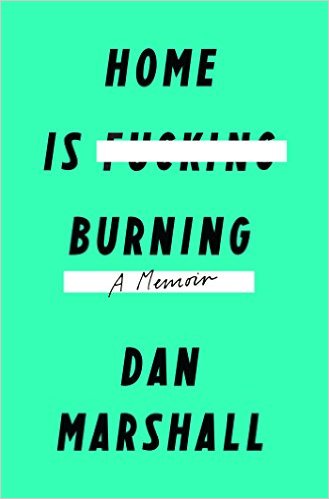
Following yesterday’s review of Home is Burning, here’s Dan Marshall: Self-Deprecation and Happiness.


Dan Marshall grew up in a nice home with nice parents in Salt Lake City, Utah, before attending UC Berkeley. After college, Marshall went to work at a strategic communications public relations firm in Los Angeles. At 25, he left work and returned to Salt Lake City to take care of his sick parents. While caring for them, he started writing detailed accounts about many of their weird, sad, funny adventures. Home is Burning is his first book. He is currently working on adapting it into a screenplay.

Your Facebook notes and blog posts fed into what became the book. What does the writing process look like when you have all that material to start with?

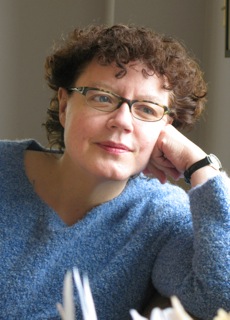
photo: Sharon Suh

photo: Sharon Suh

It was a fairly unique process. The blog was mainly shorter posts: funny conversations, short stories and a lot of lists. When I decided to write the book, I aggregated all the blog posts, and then read through them. The blog was a lot cruder than the book (if you can believe it), and was focused more on trying to make people laugh than on the sentimental moments from the story. So a lot had to change.

The blog also didn’t really have a theme other than, “S**t is bad.” So in reviewing all the material (about 900 pages worth), I had to figure out first what I was trying to say with all this writing–what theme or message I was trying to get across. I started to realize that it’s really a story about a selfish, spoiled kid finally facing something real, and thus being forced to sort of grow up. Once I realized that, it was a little easier to know what should stay from the blog and what should go. So I started trimming it down, cutting parts that didn’t push the story forward or relate to the theme, and adding a few parts that helped to fill in some of the gaps that I didn’t cover in the blog.

Overall, it was a tedious process.

Was writing this book terribly painful, or cathartic?

Certain things–like when my dad announced his desire to die, the Abby break-up, my dad’s eventual death–are always painful to relive and write about. I usually had to take a lot of walks while working on those sections to calm myself down.

Also, the voice I write in is rather dark and sad. So, getting into that morbid headspace is always painful. Whenever I was jumping into a rewrite or going through the book again, I would tell myself, “Okay, you’re going to be sad and feel like shit for a couple of months,” then start writing.

However, writing the book was also really cathartic, especially when I discovered the themes of the book. It was like, “Wow, that was horrible, but I learned a lot.” You learn more from pain than pleasure, so I think writing the book made me wiser. I’m a lot smarter than my friends with living parents.

This is going to sound sappy, but the book was also an opportunity to hang out with my dad again. I could bring him back to life and relive some happy memories. So, that aspect of it brought me a lot of joy. Then, each time I’d finish writing, I’d miss my dad even more. So, I’d fall into a bit of a depression for a few weeks. Nothing that a few burritos can’t cure, though.

Are you this amazingly self-deprecating in real life?

I start everyday by looking in the mirror and booing. Just kidding. I don’t do that.

But I do have a genuine hatred for myself that runs deep. I feel like a little self-hatred is healthy, but I probably overdo it. I’m pretty hard on myself, which is funny on the page, but sort of a drag to live with. I feel really worn down by myself all the time. Sometimes I want to yell, “Leave me alone!” at myself.

I think self-deprecating humor is a defense mechanism because I figure if I think the worst about myself, then I can’t be shocked by anything bad anyone says about me. I do need to work on being nicer to myself. Whenever I’m going on a self-deprecating tangent, my mom always says, “Stop saying so many mean and hurtful things about someone I love.” I should follow her advice.

You share an awful lot of painful personal detail here, both your own and others’. How do you decide where to draw the line? Do you draw a line? Was your family involved in those decisions?

In writing this, I made a commitment to revealing everything and being as open and honest about the experience and my life as possible. I don’t think it’d be that entertaining to read if I were holding back.

Also, I wanted people to know what it was actually like to care for a person with Lou Gehrig’s disease. It’s such a horrible disease, and I think if people were aware of what actually goes into caring for someone with the illness, then more people would donate money toward trying to solve the ALS puzzle. You wouldn’t think it, but like 60% of the care you do for someone who is bedridden is bathroom stuff. So I figured I needed to address all that to give readers the full experience.

When it comes to stuff about me, nothing is off-limits. When it comes to stuff about others, I try to be a little more selective. It’s so hard to have some a**hole write about you, so if someone asks me to take something out of the book, I usually do. But I do try to push it. I often ask, “How much can I reveal about this person and still have them love me?” It varies from person to person. My brother Greg is a writer, so he’s basically okay with anything about him.

My sisters and mom, however, were a little taken aback when they first read the book. My mom’s initial reaction was, “F**k you Danny and f**k your book.” She’s since forgiven me and has been incredibly supportive of the book.

Generally, though, my family has been really good sports about this. They realize that this is a story about our dad more than anything. And they realize that I’m as hard on myself as I am them.

You relate some shocked reactions to your off-color and morbid sense of humor generally. What reactions do you anticipate to the book?

I think the book will get a mixed reaction. Some people will probably really enjoy it. And some people will absolutely hate it. I find that people over 80 tend to not get my sense of humor, so I doubt I’ll be asked to do readings at retirement communities or in Florida.

I’m prepared for all of my Mormon friends to hate me when the book comes out. In fact, I probably won’t be allowed in the state of Utah anymore. I always get a little nervous when a Mormon friend tells me they’ve pre-ordered the book. I try to be especially nice to them so we can hopefully remain friends. I actually really love Mormons now. I didn’t for a long time, but I realized through this that they’re also just trying to get through life.

But I hope people see what I was going for. I know it’s crass, and crude, and contains South Park humor, but I hope they see past all the language and realize that at the core of it, this is a story about a guy learning to love his family and learning how to grow up.

As a screenwriter, can you tell us what rating this book will receive onscreen?

It will receive an R-rating for sure.

What’s next?

I try to keep busy because I’m not good at having hobbies so I get really anxious and bored when I’m not working. I’m working on the Home Is Burning adaptation for New Line Cinema now. Miles Teller is attached to play me and Jonathan Levine is directing.

I have a few other film projects I’m working on. One is a script called F**k Me, I’m Paralyzed (inspired by a true story) about a friend helping his paralyzed friend try to get laid for the first time since his accident. We’re hoping to film in early 2016.

I’m also planning on writing another book that focuses on what life has been like after my dad passed, sort of an exploration about how to deal with moving on from loss and rebuilding yourself–trying to find happiness without the people who made you happy.


This interview originally ran on September 2, 2015 as a Shelf Awareness special issue. To subscribe, click here, and you’ll receive two issues per week of book reviews and other bookish fun!

Maximum Shelf: Home is Burning by Dan Marshall

Maximum Shelf is the weekly Shelf Awareness feature focusing on an upcoming title we love and believe will be a great handselling opportunity for booksellers everywhere. The features are written by our editors and reviewers and the publisher has helped support the issue.

This review was published by Shelf Awareness on September 2, 2015.


home is burningDan Marshall’s life was pretty heavy on privilege. A self-described spoiled white kid with money, he grew up in Salt Lake City and then graduated from UC Berkeley, and was busy enjoying his first real job in Los Angeles and his first real girlfriend, Abby. His family–mom, dad and four siblings–wasn’t perfect, but they were happy, loving and shared a strong if quirky sense of humor, based on fart jokes and four-letter words. His mother had had “terminal” cancer well managed for nearly 15 years. Then came the phone call, while Dan was on vacation with Abby, announcing that his capable, marathon-running father had been diagnosed with something called ALS.

ALS stands for amyotrophic lateral sclerosis, more commonly known as Lou Gehrig’s disease. It’s a terminal neurodegenerative disease that kills off motor neurons, eventually depriving the person affected of the ability to move his own limbs, eat, speak, and breathe. Dan was slow to accept the gravity of the diagnosis, but under pressure from the family, after several months, he takes a leave of absence from his job to move home at age 25 to help out around the house. Home Is Burning is his memoir of caring for two terminally ill parents at once while dealing with a houseful of rowdy siblings with problems of their own. His story is unavoidably terribly sad, but peppered with sex, drugs both prescribed and recreational, copious foul language, lots of alcohol, and deep and abiding love, the Marshall family saga is surprisingly sweet and funny as well.

Although Dan describes them as spoiled and rich, the Marshalls have had their fair share of misfortunes, from mother Debi’s cancer diagnosis and years of chemotherapy treatments to cerebral palsy and Asperger’s syndrome among the children. The eldest sibling, Tiffany, who took over some parenting duties as a teenager when Debi was sick, had become an overachiever apparently teetering at the edge of a nervous breakdown. Greg was a successful college student in Chicago, enjoying his freedom after finally coming out of the closet. Still in high school were Chelsea, a socially awkward ballerina and serious student, and Michelle, a budding alcoholic in a disturbing relationship with her soccer coach. Dan was the second child, and the last to move back to Salt Lake City for their father Bob’s remaining time, which would more likely be measured in months than years.

Dan lingered in the denial stage of the grief process. With the whole family, he’d watched Bob run his last marathon in Boston, in a time nearly twice that which he’d run to qualify. But when Dan moves home, he is dismayed to see how much his father has already deteriorated. With Tiffany living nearby but on her own, “the little girls” still in high school, and Debi inconveniently faced with her toughest round of chemo treatments yet, the bulk of Bob’s caregiving duties falls to Dan and Greg. Together they help him bathe and use the bathroom as he loses the use of his arms. They feed him through his gastrointestinal tube, and take him for walks in a wheelchair as his legs lose their strength. They hook him up periodically to his BiPAP (bilevel positive airway pressure) machine, which helps push air through his lungs. Bob chooses to delay his tracheotomy surgery–which would attach him to a respirator for the rest of his days, and quite possibly end his ability to speak–to attend his own mother’s funeral; but the ill-advised delay ends with a rush to the hospital when his breathing fails, and the procedure takes place under emergency conditions. Happily, Bob retains his speech.

For all Dan and Greg’s love and good intentions, their caregiving is sometimes alarmingly poor: Bob is dropped on the floor, his respirator tubes cracked and broken. He might be considered lucky to survive his family’s care. The household begins to fall apart: Michelle passes out in her own vomit with increasing frequency as the cats pee all over their three-story home, which has been pulled apart by construction to install an elevator and widen doorways. Dan begins drinking more heavily; Abby breaks up with him; Greg takes a full-time job, putting more pressure on Dan; Debi’s behavior grows ever more erratic, with the mental effects of her chemotherapy, her distress at losing her husband, and a new addiction to pain pills. Dan’s outlook and storytelling throughout these mounting stressors is singular. He is remarkably candid about his frustrations and resentments: he loves his father enormously, calling him his buddy, his pal, his road map through life, and describing the effortless quality time shared and advice given–but he is angry to have his own social freedoms curtailed.

The tone of Dan’s writing in this painful period, however, is astonishingly funny, loving, even lighthearted. As he moves back and forth between agony, grief and anger, he displays a fun-loving, off-color, morbid sense of humor and an almost apologetically sweet expression of love for his entire imperfect family and especially their hero, their rock, Bob. Dan interjects his narrative with fantasies in which Debi’s hair grows back, Chelsea doesn’t giggle inappropriately at looming death, Michelle doesn’t marry her soccer coach, Bob stands up and takes himself to the toilet and goes for a good long run in the mountains.

Many stories have been written about terminal illnesses, degrading deaths, and families in grief; but the loving portraits painted here of outrageous and colorful characters joking in the face of ugliness may be unique. As Bob approaches his final chapter, readers will certainly cry, but they will laugh as well. Home Is Burning is a strangely packaged gift: love and pain, death and life, sex jokes, fart jokes and plenty of booze make up an extraordinarily heartwarming love letter from “a sad dude with a big heart who really loves his dad.” In its sad ending there is unlikely joy.


Rating: 9 brimming glasses of wine.

Come back tomorrow for my interview with Marshall.

author interview: Julia Keller

Julia Keller was born and raised in Huntington, W.Va, the daughter of a college mathematics professor and a high school English teacher. As a journalist, she won the Pulitzer Prize in 2005 for a three-part narrative series on a deadly tornado that struck a small town in Illinois; she has also taught writing at several universities. She currently divides her time between Chicago and a small town in Ohio.

Keller’s detective series starring prosecutor Bell Elkins is set in the fictional town of Acker’s Gap, W.Va. The fourth novel in the series, Last Ragged Breath (Minotaur Books, August 25, 2015), refers to a real event, the 1972 Buffalo Creek Flood. Years after this tragedy, a fresh murder challenges Bell to consider the waning coal industry and burgeoning tourism investments. It’s a complex case concerning the nature of memory and revenge.

I reviewed Last Ragged Breath here.

photo: Mike Zajakowski

photo: Mike Zajakowski


You have established a successful series with a well-developed character. Your readers presumably have certain expectations from new installments. Does this make the writing process easier or harder?

Harder–but it ought to be harder, right? I mean, based on the response I get from readers, they know these characters well and they have certain expectations for them, much as our friends have expectations for us and tend to call us out when we veer away from our essential natures. People know Bell Elkins and Nick Fogelsong, and they have an idea about how they’d behave in particular situations. If Bell suddenly became meek and timid, I think I’d hear a lot of outrage from readers because that’s not who she is. Her mistakes are always going to be mistakes of commission, not omission.

Your question reminds me of an aphorism about life choices that I’ve always liked: “Be careful when you choose your rut–because you’re going to be in it for a long time!” It’s the same with creating a series: Be careful when you dream up your characters and their peccadilloes, because you’ll be living with them for a long time–if you are fortunate, that is, and if your series strikes the fancy of enough readers.

In Last Ragged Breath, Acker’s Gap is described as a “beautiful, beleaguered patch of West Virginia.” Could these novels have been set anywhere else?

Absolutely not! I’ve always said that my home state of West Virginia is the most singular state in the country, because it combines stunning natural beauty with so many intractable social problems. Many states are beautiful, and many states have social and economic woes–but only West Virginia combines beauty and sorrow in just this particular and poignant way.

I sometimes gnash my teeth when people mistake West Virginia for “western Virginia” (believe it or not, this is a common error) or lump together all novels set anywhere outside New York or Chicago or Los Angeles. Every place has a specific character and texture–just as every person does. There may be superficial similarities, but the deep essence of a region–its history, the stamp it leaves on those who live there–is unique. One of my favorite lines in Last Ragged Breath comes when Nick Fogelsong contemplates his life in Acker’s Gap: “To walk each day on ground that had given rise to you” is, he decides, pretty darn cool. And so it is.

Did researching the Buffalo Creek Flood take you back to your career in journalism? Was that a comfort or a chore?

You know, journalism used to be the automatic career choice for aspiring writers–everyone from Ernest Hemingway and Katharine Anne Porter to Thornton Wilder and Willa Cather. It enables you to have experiences that you’d otherwise never have. It certainly did for me. I got to go to murder scenes, fly a plane, tour a coal mine–and so much more. That’s not as true today as it used to be–a lot of fledgling novelists end up in creative writing programs in grad schools instead of newsrooms–but for me, journalism was a great education, and I constantly use what I learned there in my fiction.

Many of the cases in the Bell Elkins series have roots in stories I covered. The death of a young boy in A Killing in the Hills is based on a crime story I wrote about. The opening scene in Bitter River–a car being pulled out of a river, with a body inside–is based on a similar moment I had as a reporter at a riverbank. And the retired coal miner in Summer of the Dead whose daughter rigs up a coal mine in the basement so that he’ll feel at home is also based on a real-life situation I came across as a journalist. The coal mine scene in Last Ragged Breath is informed by my own very harrowing journey down into a working coal mine, while researching a story on coal production.

The series for which I won the Pulitzer Prize is set in a small town about the size of Acker’s Gap. Hanging out in that town was a great way to sort of road-test my ideas about small towns in which, as the song says, “everybody knows your name.” That can be wonderful–or it can be stifling.

I like the way you phrased the question–“comfort or chore”–because it’s really a bit of both. I have the comfort of knowing that I’m writing about something I’ve seen and felt, but it’s a chore in the sense that, as a reporter, you are often coming into people’s lives in the wake of tragedy. I grew up hearing stories about the Buffalo Creek tragedy–every West Virginian does–and to return to a time of such heartbreak and loss is difficult, even if necessary.

At the center of the story in Last Ragged Breath is a child survivor of the flood, now a grown man accused of murder. Does Royce Dillard have a historical counterpart, or is he entirely your creation?

Royce Dillard is entirely fictional, but there were certainly flesh-and-blood children who survived the Buffalo Creek flood. Some lost one or both parents. As far as I know, none of these children has ever faced a murder charge as an adult–thank goodness!–but the psychological scars left by the flood are well-documented. Royce’s emotional issues are very loosely based on published accounts of the travails of real-life survivors. So he is fictional, yes–but he represents many people who suffered then, and who suffer still.

You told NPR’s Crime in the City series that you read most literary fiction as crime fiction. You cited Hamlet, To Kill a Mockingbird and the Oedipus stories. Is there a distinction between “genre” crime fiction and these classics? Where do your books fall?

I try to write books that will be accessible and entertaining, yes, but that also give readers something extra–perhaps a way to reflect upon life’s deepest questions, and a way to think about the catastrophes that can befall those who have done nothing to deserve them. To me, any novel–whether it’s categorized as “crime fiction” or “literary fiction” or whatever–is a window into how another human being works out her or his destiny.

I fight against the idea of genre because it’s so limiting. It’s an artificial distinction. It puts novels into boxes and closes the lid–and novels need to breathe! Dorothy Parker once divided her bookcases into two categories: Good and Crap. That’s the only division that really matters.

Will my books turn out to be classics–that is, novels that are read by multiple generations? I’d certainly like to think so.

Last Ragged Breath pulls together strings from past Bell Elkins novels. It appears that the series will continue. What’s next? Do you already have the next book underway?

Oh, yes, indeed. I’m well embarked upon the fifth book in the series. It’s set in an Alzheimer’s care facility near Acker’s Gap. I am intrigued by questions about memory, and by an awareness of how central our memories are to our very essence. When memory begins to fail, what happens to that core self? The basic plot in The Disremembering–that’s the tentative title–is about a series of mysterious deaths at the facility, but the deeper theme is this issue of memory. As more and more people live longer and longer, our culture will be struggling with the problems of Alzheimer’s and its long reach. It is a great springboard for a novel–and a touchstone for contemplation about how the past constantly interacts with the present, in ways both good and bad.


This review originally ran in the September 1, 2015 issue of Shelf Awareness for Readers. To subscribe, click here, and you’ll receive two issues per week of book reviews and other bookish news.

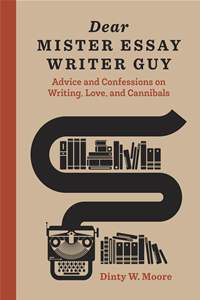
Dear Mister Essay Writer Guy: Advice and Confessions on Writing, Love, and Cannibals by Dinty W. Moore

Finely crafted short essays masquerading as self-effacing jokes about writers and writing, in q&a form.

dear mister essay writer guy

Dinty W. Moore (Between Panic and Desire), the editor of Brevity, solicited respected contemporary essayists for questions regarding the form, so he could answer them in Dear Mister Essay Writer Guy: Advice and Confessions on Writing, Love, and Cannibals. An essay riffing on the question at hand accompanies each q&a. The resulting collection of self-deprecating humor includes bits of writing advice as a bonus.

Cheryl Strayed has concerns about her predilection for the em dash: Moore assures her that “em dashes can replace commas, semicolons, colons, the large intestine, and parentheses.” Brenda Miller worries that Facebook “is like one big communal personal essay”; Moore answers with a selection of his status updates over a period of months, which are as sage and instructive as they are hilarious. Roxane Gay wonders about the value of writers writing about writing. Other seekers of wisdom include Judith Kitchen, Phillip Lopate, Brian Doyle and Lee Gutkind. Moore makes room to share a “found essay” left on his voicemail by Mike the Tree Guy, and to list the side effects of memoir, including “nausea, sleep problems, constipation, gas, and swelling of the navel.”

Moore is rarely serious and keeps his tongue in his cheek throughout, but the result is enlightening as well as entertaining. With fewer than 200 pages, Dear Mister Essay Writer Guy is a quick and enjoyable read, to be taken in pieces as small as the reader prefers. Its witty, modest tone belies the artistry of the essays contained, which are exemplars of the short form.


This review originally ran as a *starred review* in the August 28, 2015 issue of Shelf Awareness for Readers. To subscribe, click here, and you’ll receive two issues per week of book reviews and other bookish fun!


Rating: 7 polar bears, naturally.

The Fish Ladder: A Journey Upstream by Katharine Norbury

A pensive, meandering memoir of searching–for the source of both a river and the author’s life.

fish ladder

In The Fish Ladder: A Journey Upstream, a memoir of two concurrent paths, Katharine Norbury aims to find a river’s source and to discover her own. She is mourning a recent miscarriage and the loss of her father, taking solace with her mother and her daughter, Evie. Norbury was adopted, and all she knows of the woman who abandoned her at a convent is a name. Neil M. Gunn’s novel The Well at the World’s End inspires her to walk a waterway from the sea to the source, as does Gunn’s protagonist. But Norbury’s journey is clearly also metaphorical, a search for herself and her roots.

The route she chooses is not specific: with Evie, she walks parts of several waterways, eventually setting more precise goals along the way, and reaching for Gunn’s work when her plans falter. Her expedition to find her biological family proves to be more challenging, intersecting her pathway upriver, from the location she has discovered is her birthplace.

Norbury’s seeking is set in Britain, and The Fish Ladder doubles as an amateur naturalist study of the country’s flora and fauna. She shares her insecurities and questions alongside Celtic folk tales about salmon traveling upriver to the places of their birth. Her story wanders, but in the end makes emotional and profound ventures into landscape, the importance of place and the very real connections between physical and interior voyages.


This review originally ran in the August 25, 2015 issue of Shelf Awareness for Readers. To subscribe, click here, and you’ll receive two issues per week of book reviews and other bookish fun!


Rating: 5 pieces of chocolate.

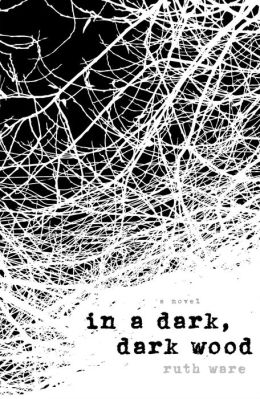
In a Dark, Dark Wood by Ruth Ware

An enchantingly unsettling thriller with mysterious characters and a classically spooky setting.

dark dark wood

Ruth Ware’s chilling, atmospheric thriller In a Dark, Dark Wood is her first novel and the inaugural title published by Simon & Schuster’s new imprint, Scout Press.

Nora is a writer of crime novels, a loner who buys her groceries online and appreciates her solitude. But when she gets an invitation to a hen party being thrown for a woman she hasn’t spoken to in 10 years, her carefully structured life is disrupted. Against her instincts, she agrees to attend, and the party’s setting serves as a disturbing beginning: an isolated castle of steel and glass set deep in the English woods, populated for the weekend by nervous guests, each apparently with secrets to keep.

In the novel’s disjointed timeline, Nora later wakes up in the hospital with fractured memories of being covered in blood, running through dark woods with a sense of urgency; the police are waiting outside her door. What happened to her? Or… what has she done? As the narrative switches between Nora’s confusion in her hospital bed and the events leading up to her hospitalization, she and the reader together begin to wonder: Can she really not remember, or does she not want to? Both timelines accelerate with building suspense toward the big reveal, and eventually Nora will have to go back and recall events from her past that she’d rather leave forgotten.

In a Dark, Dark Wood is peopled by mysterious characters set to a classically spooky backdrop and culminating in blood, broken glass and memory loss. Readers who appreciate being unnerved will be charmed.


This review originally ran in the August 14, 2015 issue of Shelf Awareness for Readers. To subscribe, click here, and you’ll receive two issues per week of book reviews and other bookish fun!
<hr /

Rating: 7 tequila shots.

A Clue to the Exit by Edward St. Aubyn

Edward St. Aubyn’s favorite of his own novels surveys characters from his other work, in a clever, sophisticated consideration of death and consciousness.

clue to the exit

Edward St. Aubyn (Mother’s Milk) calls A Clue to the Exit his favorite of his own novels. Originally published in 2000, it’s now being reissued by Picador.

Charlie is a hack screenwriter who’s just been told he has six months to live. (He takes issue with the idea that his doctor has “given” him six months, as if it were a gift he should be grateful for.) He starts driving more carefully, even as he considers suicide, experimenting with the proper response to this news. He contacts his ex-wife about seeing his daughter; he sells his house and takes half his riches to Monte Carlo to lose it as quickly as possible. And, suddenly inspired, he sets out to write a serious novel–much to his agent’s exasperation.

In Monte Carlo, he meets a beautiful stranger, who he imagines might help him with his burden of mortality. Angelique is a gambling addict, and in her company Charlie feels an equal craving for his own writing. They have a deal: she gambles away his fortune, and he writes in the casino as he watches her. His novel, On the Train, tackles the big question of consciousness, or nothing less than the meaning of life, and Charlie’s autobiographical protagonist is none other than Patrick Melrose, St. Aubyn’s most famous character, who is joined by others that St. Aubyn’s fans will recognize from previous work. The characters of the novel within the novel argue philosophy on a train stuck in Didcot, as Charlie finds himself stuck as well between games of chance and the need to map his own final months.

St. Aubyn’s craft is on full display with this inward-looking work of simultaneous parody and earnestness. Nearly every line is quotable, a small but shining victory of prose. On the Train visits with Proust and Buddha, while “a clue to the exit” references Henry James on “the human maze,” but alongside serious, even wearying considerations, Charlie’s story is often very funny and self-referential. A third-person narrative “is so much more personal than a first-person narrative, which reveals too flagrantly the imposture of the personality it depends on,” writes St. Aubyn in Charlie’s voice: A Clue to the Exit is told in first-person, while On the Train is in the third. This feedback loop is a central device. “Feeling too upset to write, I made the brave decision to write about feeling too upset.” A parade of absurd characters and dinner parties accompanies Charlie’s, and his character Patrick’s, contemplations of death. As Charlie’s six months run out, St. Aubyn continues to surprise his reader in the final pages.

A refined and stylish novel of cynicism and the question of death, A Clue to the Exit is a perfect sample of St. Aubyn’s craft.


This review originally ran in the August 13, 2015 issue of Shelf Awareness for the Book Trade. To subscribe, click here.


Rating: 6 chips.

The Wake by Paul Kingsnorth

This compelling novel of resistance to the Norman Invasion, told in a hybrid of Old English, will satisfy motivated readers of history, ecology and the persistent pull of the old gods.

wake

The Wake is a singular debut novel by Paul Kingsnorth (One No, Many Yeses; Real England), set in England immediately following the Norman invasion of 1066. Its first-person narrator is a landowner named Buccmaster, who has lost everything to the attack: his family, his home, his land and his privilege. He takes to the fens and woods, with revenge in his heart and an intention to drive the French from his land and all of England. There he becomes one of the guerrilla fighters known as green men, whose chapter in history is little known.

What makes this powerful story distinctive is Kingsnorth’s decision to write the story in what he calls a “shadow tongue,” an Old English hybrid of the author’s invention, made slightly more understandable to the modern reader. This choice presents an undeniable challenge to the reader, and requires substantial extra effort to pursue the story. (Hint: try reading aloud, to hear cognates and the rhythm of the speech). But Kingsnorth defends his strategy: it evocatively renders Buccmaster’s voice, and brings to an already gripping saga a layer of new meaning, in that the reader has to participate in creating that meaning through interpreting unfamiliar words. A partial glossary deciphers some words, but many are left for the reader to define via context clues and, yes, guessing. Some readers will be turned away. But those who persist will find the language easier to follow after 20-40 pages, and will be rewarded by Buccmaster’s riveting narrative.

Buccmaster is a follower of the eald (old) gods, as was his grandfather, the gods of wilde places on the earth and its wihts (creatures). His father was not. “I will not spec of my father,” he says, but the story of his father is only one of the details that this unreliable narrator leaves out. As Buccmaster travels overland on foot, gathering companions who also wish to drive out the French, he journeys as well into the myths and traditions of his elders, and envisions a grand role for himself. The fate of his band of green men is as tenuous as that of England, as their leader struggles with reality.

The Wake is an ambitious novel in its themes and scope, in addition to its unusual linguistic decisions. As the English folc in his story become disconnected from their land, they lose their freedom: “if the frenc cums and tacs this land and gifs these treows [trees] sum frenc name they will not be the same treows no mor.” As an impassioned defense of the natural world and people’s responsibilities toward it, the novel acts as a metaphor for modern times. Buccmaster’s personal narrative is a lesson in pride and its dangers, a glimpse of another culture in its own language. Kingsnorth’s captivating first novel is thought provoking, multi-faceted and intriguingly rendered.


This review originally ran in the August 11, 2015 issue of Shelf Awareness for the Book Trade. To subscribe, click here.


Rating: 8 fugols.

Wondering Who You Are by Sonya Lea

A woman’s thoughtful account of life after her husband’s traumatic brain injury.

wondering

When Sonya Lea’s husband, Richard, had surgery to treat his rare appendiceal cancer, they knew there were risks. But they had not considered that Richard would wake up with no memory of his 23 years of marriage and two young adult children, or of his own personality and past. Sonya considers their shared history and difficult recovery in her memoir, Wondering Who You Are.

The details of Richard’s medical story are inarguably painful but often sweet. Sonya’s changed husband is empathetic, guileless and highly motivated to learn. Alternating chapters cover the trauma of his surgery and aftermath, and the story of their teenage romance and decades of marriage, until the timelines merge into one: Sonya’s quest for the husband she lost and her eventual acceptance of the one she’s found. This powerful, gut-wrenching narrative negotiates spirituality, hope and despair, sexual experimentation and a dedicated caregiver’s tireless research and advocacy. Sonya and Richard’s family story wanders geographically as well, from Kentucky to Ontario, Banff, Memphis, Seattle, California, France, India and more. Through assorted, arduous adventures, they learn again to rely on one another, to persist and to accept.

Sonya Lea is a fascinating narrator, by turns vulnerable and fierce, patient and maddened, always devoted. Her writing is contemplative and lovely, and contains just enough scientific detail. The result is a lyrical, intensely candid meditation on memory, identity and the stories we create for ourselves–and a love letter to both the new and old versions of Richard.


This review originally ran in the July 28, 2015 issue of Shelf Awareness for Readers. To subscribe, click here, and you’ll receive two issues per week of book reviews and other bookish fun!


Rating: 9 journal entries.

Coming of Age at the End of Days by Alice LaPlante

In this expert psychological thriller, a disturbed teenaged girl meets a doomsday cult and struggles for survival and identity.

coming of age

The title of Alice LaPlante’s third novel, Coming of Age at the End of Days, succinctly describes its plot. At the beginning, Anna Franklin is 16 and terribly depressed, fixated on death. Therapy and medication do nothing to bring her out of it. Her anti-religious mother begins reading to her from the Bible, just to give them some time together and to introduce Anna to literary references; this does not lighten Anna’s world, but instead gives its darkness meaning, as Revelations resonates with her mood. What finally causes her depression to break is a new family in the neighborhood. Lars and his parents introduce Anna to their church, where it is preached that the Tribulation at the End of Days is coming. There will be blood, violence and suffering. Her heart sings at the news.

Anna begins having a recurrent dream of a central image in her church’s system of beliefs; she has visions and becomes convinced she has an important role to play. Joyfully, she plans for the coming End of Days. Her parents are relieved that she no longer appears suicidal, but disturbed anew at this fresh challenge. Anna and Lars, a compelling, alternately magnetic and frightening young man, are socially isolated and bullied at school. On the other hand, Anna’s parents are loving, wise and committed to her well-being. Additionally, there is Anna’s neighbor Jim–back in his parents’ basement, in his mid-20s, suffering his own breakdown–and a chemistry teacher, the youthful, no-nonsense Ms. Thadeous. When Anna experiences a tragedy that “more than satiate[s] her hunger for death,” these few but remarkable friends represent a chance to reconsider the End she is working toward.

At the center of Anna’s story–and of all these characters’ stories–are obsessions. “Images. Sounds. The Red Heifer. Bosch’s depiction of hell. A rock hitting a tree.” Anna’s mother is a deeply devoted pianist; her father is an earthquake nut, eagerly awaiting The Big One, in a secular obsession otherwise not unlike his daughter’s. LaPlante (Turn of Mind) masterfully weaves a distressing plot in which complex, sympathetic characters, each with a complete and absorbing past, are brought to the brink of destruction and then seemingly asked: What kind of life, and death, will you choose? The reader’s imagination will be won by this brilliant, thought-provoking and memorable novel. Coming of Age at the End of Days perfectly captures the dynamics of family relationships and friendships, loyalties and priorities, and the nuanced workings of an unusual mind.


This review originally ran in the July 23, 2015 issue of Shelf Awareness for the Book Trade. To subscribe, click here.


Rating: 8 times vermillion.