A Sharp Endless Need by Marisa Crane

This poignant coming-of-age novel combines outstanding sports writing and heartfelt expression of the teen experience, set to small-town Pennsylvania basketball.

Marisa (Mac) Crane’s second novel, A Sharp Endless Need, is a propulsive, perfectly crafted coming-of-age story centered on basketball and queer sexuality. With razor-honed prose, Crane (I Keep My Exoskeletons to Myself) offers authentic descriptions of teen angst and young love as well as exemplary sports writing, and a few memorable sex scenes.

Crane’s protagonist, Mack, is a star point guard and the only one at her small-town Pennsylvania high school who is Division-I bound. Between her junior and senior seasons, her beloved but troubled father dies, and on the heels of this trauma, a new girl transfers to the team: Liv is being scouted by the same schools as Mack, and the two are instantly inseparable. Their on-court chemistry is transcendent; off-court, they share good times but are also nearly immobilized by a desire that both are at great pains to conceal. Mack’s senior year is marked by larger-than-average difficulties: grieving her father, struggling with her distant, disengaged mother, playing hard with drugs and alcohol, and grappling with a sexuality that feels firmly forbidden in her community. The basketball scholarship she’s headed for feels imperative. Her mother sees it as a financial necessity; Mack knows it’s bigger than that. “I needed a future that was all basketball all the time because it was the only future I could imagine for myself. Basketball, I knew, was the only thing keeping me alive.”

Mack’s first-person voice is written from a distance of some years, a voice of wisdom looking back on her high school days. This perspective is one of the novel’s strengths. It is the older, wiser Mack who observes that another player “didn’t notice or appreciate the poetry of her pump fakes–she simply used them for their designated purpose. I guess what I mean is there was no romance.”

Anyone who’s ever been a teenager will relate to Mack’s broader struggles with self-destructive behaviors, desires, and pain. Her particular challenges involve a devotion to craft and the one-and-only ticket out that basketball represents. “Everything outside of that stadium, our problems, our anxieties, our fears, could wait; nothing else mattered but this last play.” The best sports writing evokes not only movement, sensory detail, and skill, but passion, and Crane has a firm grasp on these facets. As Mack’s final season nears its close, her relationship with Liv, her college decision, and more hinge upon a handful of choices and impactful moments. A Sharp Endless Need is unforgettable.


This review originally ran in the April 14, 2025 issue of Shelf Awareness for the Book Trade. To subscribe, click here.


Rating: 8 photographs.

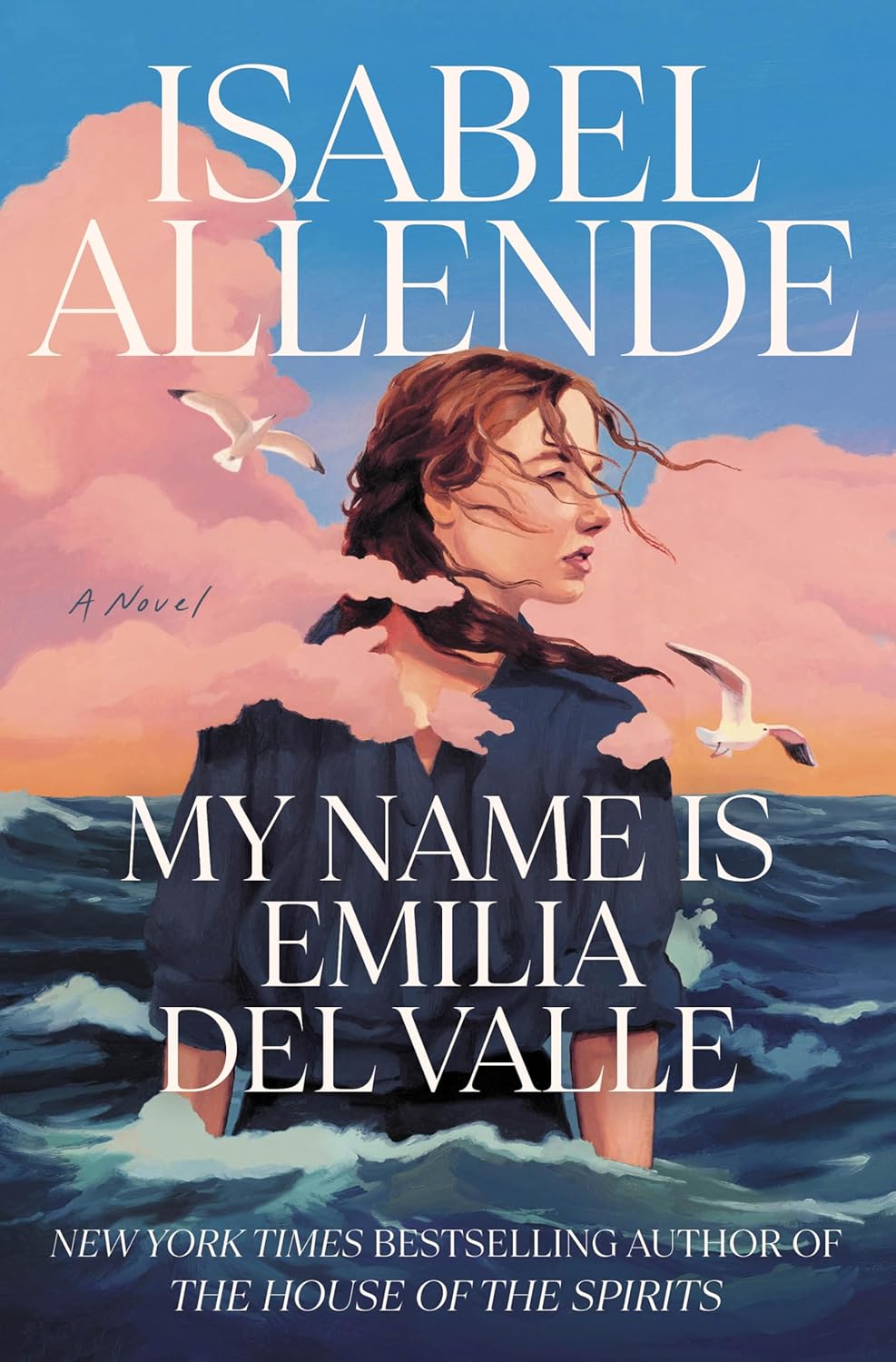
My Name Is Emilia del Valle by Isabel Allende, trans. by Frances Riddle

A daring young woman and groundbreaking reporter journeys from San Francisco to Chile in the 1890s to investigate a civil war and her own roots in this stirring novel by the celebrated Isabel Allende.

Isabel Allende brings the experience of more than 20 books to My Name Is Emilia del Valle, a swashbuckling tale of the life and adventures of a young woman born in San Francisco in the 1860s. Emilia’s story is exciting, empowering, and inherently feminist, as she travels from California to her father’s native Chile during that country’s civil war, bucking social norms and going wherever she’s told she can’t.

A young Irish novice named Molly Walsh is about to take vows as a nun when she is seduced and abandoned, pregnant, by a Chilean aristocrat. Devastated, she accepts a marriage proposal instead from a colleague and friend in San Francisco’s Mission District, who will be the devoted stepfather, “Papo,” to her child. Molly remains bitter toward the absent father, del Valle, but Emilia lacks for nothing in the loving household where her mother and Papo teach the Mission District’s children, provide bread to the poor, and support her unusual goals.

Emilia first makes a living by writing sensational dime novels of “murder, jealousy, cruelty, ambition, hatred… you know, Papo, the same as in the Bible or the opera” (under a pen name, of course). Next she decides to become a journalist, launching a newspaper career, soon traveling to New York (where she takes her first lover and otherwise broadens her worldview) and then abroad: Emilia journeys to Chile to cover the civil war as a reporter for San Francisco’s Daily Examiner. Female reporters are vanishingly rare, but as war correspondents, unprecedented; and Emilia del Valle writes under her own name. She is also motivated to fulfill her mother’s lifelong wish to track down her biological father, del Valle. Emilia finds great danger as well as the opportunity to define her identity for herself. The adventures she encounters along the way fill Allende’s pages with violence, love, high society, and human interest.

As she has in previous acclaimed novels, Allende (The House of the Spirits; Inés of My Soul; Maya’s Notebook; The Japanese Lover) applies riveting storytelling to an exploration of history through the lens of a fictional heroine. Allende’s language, and Frances Riddle’s translation, is evocative in its descriptions of Chile’s lovely landscapes, a young woman’s complicated love for her family, and the horrors of the battlefield, with which Emilia will become painfully familiar. This enthralling novel leaves Emilia, still young, in a position of some uncertainty: readers may hope for more from this plucky protagonist in a possible sequel.


This review originally ran in the April 3, 2025 issue of Shelf Awareness for the Book Trade. To subscribe, click here.


Rating: 7 stitches.

Girls with Long Shadows by Tennessee Hill

Identical triplet girls are linked to tragedies across generations in this evocative first novel set along the swampy Texas Gulf Coast.

Tennessee Hill’s first novel, Girls with Long Shadows, is a dreamy, atmospheric tale of sisterhood and coming-of-age in the fictional town of Longshadow, on the Texas Gulf Coast. Nineteen-year-old triplets Baby A, Baby B, and Baby C were orphaned when their mother died in childbirth; their father’s identity remains a mystery. But they have always known family in the form of their loving but distant Gram (“Manatee” to the townsfolk, for her swimming prowess) and their adopted, nearly deaf younger brother, Gull. The whole town looks askance at the girls, spookily identical and associated with their mother’s early death. The family’s golf course, Bayou Bloom, provides respite, and the bayou itself (where Gram takes a daily swim, joined sometimes by one or more of the girls) offers a connection to nature, its fecundity and floods. Then one fateful summer, an act of violence, combining desire and objectification, ruptures the triplets, the family, and the town.

A tautly plotted Southern gothic, Girls with Long Shadows takes a distinctive perspective in Baby B’s elegiac narration. “That weekend something gurgled beneath, rattled us where we stood.” And: “Even before the worst of what that summer would bring was upon us, I began to mourn the girls we had been.” Baby B speaks as “we” as often as “I.” Only a few people other than themselves can tell the girls apart; even the boys they date may not make the effort. And intermittently the perspective shifts to a “Front Porch Chorus,” in which the town speaks collectively, observing the girls from without: “They’re a blur we never bothered to untangle.” This lack of distinction is both a wound for the triplets and an indelible part of their identity. They feel each other’s sensations and know that this is a boon. Without that link, they would be less themselves. In the eyes of the town, however, they are less human for being undifferentiated, more object or mirror. “All those boys touching all of us at the same time, hands on hands on bodies on hands. It wasn’t even that Pete was the one touching me, it was all of them, their inability to leave us be.”

Encompassing a single summer in the dripping, humid South, Hill’s haunting debut deals in lyricism and tragedy as it considers the harm done to young women by the outside gaze.


This review originally ran in the March 31, 2025 issue of Shelf Awareness for the Book Trade. To subscribe, click here.


Rating: 7 bikini tops.

Maximum Shelf author interview: Eliana Ramage

Following Friday’s review of To the Moon and Back, here’s Eliana Ramage: Personhood Isn’t Static.


Eliana Ramage holds an MFA in fiction from the Iowa Writers’ Workshop. She has received residencies and fellowships from the Kimmel Harding Nelson Center, Lambda Literary, Tin House, and Vermont Studio Center. A citizen of the Cherokee Nation, she lives in Nashville, Tenn., with her family. Her first novel, To the Moon and Back (Avid Reader Press, October 28, 2025), is the spellbinding story of a woman who aims to become the first Cherokee astronaut, with her loved ones and generations of history as backdrop.

Why space? (Which came first: Steph or the astronaut dream?)

Eliana Ramage

(photo: Leah Margulies)

Actually, Della came first! I started writing about Della when I was about 23 years old. I loved her. For me, she’s the easiest to love. I wrote a novel draft from her perspective, astronaut-less, and when I brought in Steph there was still something missing. When Steph turned out to really want something (space travel!), and when she came to live in the same fictional world as Della instead of in a separate project, I got what it meant to need an engine in a novel for the long haul.

As for why space? I love space! I’ve always loved it, since I was a kid watching Star Trek: The Next Generation with my brothers. The show taught me to have optimism when it comes to the far future. It’s easy to feel like there’s no point in our efforts towards good–for other people, for the earth, for both–when you assume we will always do terrible things to each other. Space exploration, an extremely long-term group project, carries a lot of weight for a novel that’s interested in who we are and what kind of world we’ll leave behind. When I say “group” I mean humanity, and I also mean specifically Cherokees. I wanted Cherokee people in the novel to grapple with their identities, as people everywhere have done forever. What does it mean to be Cherokee? When we’re living on Mars–an inclusive and optimistic “we,” because I’d be dead or unwilling–that question will still be there.

Is this a coming-of-age novel?

At first the book was heavily focused on Steph’s early years, because I defined “coming-of-age” more narrowly and as the kind of writer and reader I was. And that’s still true, I’ll read any yearning queer kid with big ambitions!

What changed is that I got older. This book took me up to age 34, with stops like coming out and having a child. The mom-as-side-character turned out to be (of course!) more complicated than I’d thought, and I revisited Steph’s first love with different expectations for what it could hold.

This is still a coming-of-age novel, but now I know personhood isn’t static after a character makes it through their teens. We see how much Steph changes and surprises herself, all the ways her life expands outwards for better or for worse, which is something I didn’t know to expect for myself in my early 20s. Now it’s one of my best hopes for anyone.

You’ve created an interesting blend of points of view and epistolary fragments. How did you choose which voices to highlight?

Kayla, Hannah, and Della are all characters who are or who become hyperaware of how they’re understood by others. For Kayla there’s the pressure to be a certain kind of Native woman on social media; for Della there’s the worry that her story will continue to be told for her after her Native identity was picked apart on a national scale; and for Hannah there’s the tension between what to share with her children and what to keep for herself.

A few years ago, I was messing around with my computer on an airplane and thought it would be a funny exercise to ask how Steph might represent herself on Tinder over about a decade. But 10 years of Tinder profiles is 10 years of choosing how you want to be seen and judged. It went from a joke to something deeper, and I leaned into epistolary forms for other characters. Stepping outside of first-person point-of-view for Kayla, Hannah, and Della meant a more conscious engagement with questions of representation.

Your characters navigate identity, trauma, science, ambition, romantic and familial relationships. How did you handle keeping so many threads balanced in the larger narrative?

I’m so glad I get to talk about school supplies! There were so, so many school supplies. While the novel itself went through a lot of change, I stayed obsessed with trying to organize it. Post-it notes, highlighters, stickers on top of Post-it notes to indicate several things tracked within a single scene… I was inspired by [author] Claire Lombardo, who back in grad school built the most beautiful storyboards and color-coded charts that I’ve ever seen.

Between drafts, I’d make storyboards where different threads were different colors (i.e., “Green is science, according to this green index card this scene is science-y, oh NO wait, why have we not seen a green sticky note for 100+ pages?!”).

By the time I made it to my last three years of edits, I had an evolving system of checklists. As I read each chapter, I’d make myself check off that yes, this chapter had addressed/touched on/hinted at [insert long list of threads I was determined to keep in balance]. Some of the things I’d check for were broad, like the heading “Astro!” to make sure the novel hadn’t strayed from its interest in space. But some were weirdly specific, like (for example) “[Bicycle] Where?” That one meant that for a few objects that really don’t spend much time on the page, I wanted to remember where they’d been stashed and ask myself if they were needed.

To what extent are Steph’s or Della’s remarkable lives based on true stories?

Steph became a character after the first Cherokee Tri-Council meeting, which I attended in 2012 with my family and two Cherokee friends. That first version of Steph wasn’t interested in space, which is wild to me now. Looking back, I think No-Space Steph would react to other people and their actions, but she didn’t have that drive to push forward on her own.

A few years later, long after Steph had become an aspiring astronaut, my brother began a Ph.D. program. He was studying the political and economic history of the Cherokee Nation between 1866 and 1906. Just about everything I was starting to learn from him was surprising to me–regarding both our nation and our own ancestors.

One day, when I was visiting friends in Oklahoma, my brother invited me to join him in the Western History Collections at the University of Oklahoma. That, along with several years of sibling talks that would follow, complicated and deepened my understanding of Cherokee identity and how it was understood in the past and today.

I wanted that for Steph, particularly as she looks to the future, so I decided that up until the year 1860 her ancestors would be my ancestors. Lending Steph a real, research-based history wasn’t the key to many answers for Steph. But it raised questions! And, importantly, it added Steph to a conversation that had begun long before her.


This interview originally ran on March 25, 2025 as a Shelf Awareness special issue. To subscribe, click here, and you’ll receive two issues per week of book reviews and other bookish fun.

Maximum Shelf: To the Moon and Back by Eliana Ramage

Maximum Shelf is the weekly Shelf Awareness feature focusing on an upcoming title we love and believe will be a great handselling opportunity for booksellers everywhere. The features are written by our editors and reviewers and the publisher has helped support the issue.

This review was published by Shelf Awareness on March 25, 2025.


Eliana Ramage’s debut, To the Moon and Back, is a far-reaching, ever-surprising, intricate novel about identity, family, ambitions, career, romance and, yes, astronomy.

When readers meet Steph Harper, she is almost six years old. “I imagine her terrified. Our mother. Two children in the backseat. She drove like a woman followed, even after we left him at the foot of that tall hill. There was blood there, back in Texas, and tiny shards of glass still covered my sister.” Their mother, Hannah, is in flight from a vague threat–abuse, trauma–with her two little girls in tow. Precocious Steph is already developing her obsession with astronomy. Kayla is just a baby, sparkling in broken glass but unscathed by what haunts the others: “Our mother would never have Kayla’s confidence because Kayla had no memory of another self. Of another place. Of what was possible, here on earth. Maybe what was wrong with our mother was also wrong with me.”

From Texas, the fragile family resettles in the Cherokee Nation, in Tahlequah, where Hannah hopes to recover community and reclaim her heritage. Steph and Kayla learn to speak Cherokee. Steph watches the sky and fine-tunes her plans to become an astronaut: when readers meet her for the second time, she is 13 and concerned only with getting into Exeter Academy, which she hopes will put her on course for Harvard and then NASA. She studies the biographies of astronauts and the hard science she will need, with the help of a telescope gifted to her by her mother’s new boyfriend, Brett. “It had been my goal to understand the origins of earth, the universe, and everything in it by my fourteenth birthday. I was behind schedule.” This dream is what gives Steph’s life focus; she needs this to live. “I’d picture an astronaut watching me back. Some astronaut would call his daughter through mission control and she’d say tell me what you see and he’d say oh, the Northern Hemisphere, North America, and that would be true, but also true was Oklahoma, a field, a tree. A girl alone, looking up.” It is also true that the dream, which in some ways saves her, may be what keeps her from finding happiness in relationships on Earth: with her mother, her sister, or the love of her life.

Distracting her along the way are her feelings for girls, which she suspects will not be appreciated in Tahlequah: “If I could figure out the money and the applications and the getting myself to college, I decided I would be gay. Or bi, maybe? At schools like Harvard, they let you figure that out.”

As Steph moves from Tahlequah to Hollis College in rural Connecticut, a parallel character is introduced. She was named Della Owens at birth, when she was adopted by a Mormon couple in Provo, Utah. But as the center of a legal case resting upon the Indian Child Welfare Act, she became known as Baby D. Many Native Americans believe she belongs with her people. Della’s path intersects Steph’s when they find themselves at Hollis together, and they will intertwine from there, coming of age in parallel and navigating romance, Native heritage, and ambition.

For a portion of the book, Della’s first-person voice alternates chapter-by-chapter with Steph’s, which otherwise dominates. Later, these perspectives are joined by various epistolary elements: e-mails, social media posts, text messages. To the Moon and Back excels in surprise; these points of view are only one area in which Ramage takes her reader in unexpected directions, geographically and otherwise. The novel is gloriously expansive, epic, and sweeping. It covers just a couple of decades, from 1995 to 2017, although the history of previous generations certainly comes to bear on the present timeline. But like Steph herself, the story keeps reaching beyond its expected limits. It is not only a coming-of-age story, but also about a variety of Native American experiences, and about queer experiences and those intersections. It’s about lofty goals, astronomy, and yearning. Just when readers grasp the enormity of Steph’s single-minded focus on becoming an astronaut, she reaches further, to becoming a better human being. The events of Steph’s life are often sensational, but always, in Ramage’s expert storytelling, believable.

So many threads would be too much for a less skilled writer to wrangle, but these characters are developed with such steady pacing, depth, and perfect detail that they always feel natural. A plot summary with spoilers would sound, perhaps, absurd. But To the Moon and Back is anything but. It is a complex, absorbing, thought-provoking novel, compulsively readable. Steph is exceptionally eccentric, and her story is also universal, all-encompassing. Her impressive character arc comes, eventually, to wisdom and an unlikely peace: “I want to love the universe, even if I don’t know what it is. I do not have to know what it is.” Readers will be enriched for having shared these pages with her.


Rating: 9 M&Ms.

Come back Monday for my interview with Ramage.

The Lilac People by Milo Todd

A trans man survives with a small chosen family, from Berlin’s lively queer scene in 1932 through the Holocaust and the Allies’ hostility, in this moving historical novel.

With The Lilac People, Milo Todd delves into the nearly lost history of trans people in the Holocaust. Integrating imagined characters with historical research, Todd brings humanity and specificity to atrocities that are still being uncovered. The heartbreaking result honors love and friendship, and ends with hope for one built family of survivors.

The opening pages find Bertie on the outskirts of the German city of Ulm in 1945. He has ridden out the war with his partner, Sofie, “on a little farm that was not theirs,” growing vegetables, raising chickens and one cow. It is an unadorned but not unpleasant life, and they know they are lucky. “The apple blossoms were beginning to show on their three trees at the far edge of their land, pollen spilling out as they blushed.” Then, weeks after the news that the Allies have freed camp prisoners, Bertie finds a body in the garden. Dressed in rags from the camp, the young man is alive, barely. “[The Allies] sent all the pink triangles to jail. And all the black triangles that qualified the same,” he tells Bertie. He wears a black triangle. He is a trans man–like Bertie. This changes everything for Sofie and Bertie, who will be greatly endangered by their choice to hide and protect Karl.

But Bertie finds that he must help, to confront his survivor’s guilt, his failure to protect his own community, and (as a hostile Allied lieutenant accuses) his complicity in Germany’s crimes. Karl’s appearance takes Bertie back to 1932 Berlin, where Bertie assists Dr. Magnus Hirschfeld at the Institute for Sexual Science and is a member of a vibrant queer and trans community, with a tight-knit group of friends that is lost on the Night of the Long Knives. Karl’s existence brings hope, guilt, and memory. To save Karl and themselves, Bertie and Sofie must leave the farm’s relative safety.

The Lilac People is filled with music, with an emphasis on the queer anthem “The Lilac Song.” Sofie is a pianist who gives Karl piano lessons alongside Bertie’s instruction in “how to transvest,” or pass as a cis man. The song is an important piece of history and means of accessing a pride in community that’s been all but destroyed. Notes from the author detail the research required for this writing, what is true history and what is fiction, and just how limited is the historical record on Germany’s queer and trans communities in this era.

The Lilac People is emotionally wrenching, but also lovely in its details, the humanity of its characters, and the resilience and hope at its end, when a fresh start seems possible. Todd has made an enormous contribution to historical fiction with his own research and this beautiful, touching narrative.


This review originally ran in the March 25, 2025 issue of Shelf Awareness for the Book Trade. To subscribe, click here.


Rating: 7 seeds.

Killer Potential by Hannah Deitch

Two young women on the run offer mesmerizing complexity in this smart, propulsively paced, thought-provoking, and electrifying debut novel.

Hannah Deitch’s first novel, Killer Potential, is a bloody, class-conscious, suspenseful thriller starring two young women caught in a spiral of violence, blame, and bonding. This rocket-fueled debut is a deliciously dark, twisting, entertaining read, so beware the urge to stay up all night finishing it.

The novel’s primary narrator is Evie Gordon, who opens by saying, “I was once a famous murderess…. It isn’t true.” Labeled “Talented and Gifted” from the age of eight, Evie thrived on the simple, clearly outlined goals and rewards of formal education. As a graduate, she foundered and eventually landed in Los Angeles as an SAT tutor to the children of the rich and famous. On a Sunday afternoon, she appears at the Victor mansion as usual, only to find Peter and Dinah Victor very freshly and brutally murdered, and an emaciated, traumatized, and nearly mute woman tied up in a closet. In an adrenaline-fueled haze of terror and confusion, they flee the bloody scene together. The bulk of the novel follows Evie and the woman, Jae, as they go on the run, presumed to be the murderers of the Victors, and commit a series of crimes along the way.

Through Evie and Jae’s fragile, yearning, mistrustful bond, Deitch explores privilege and the divide between the haves and have-nots; sex and sexuality; trust and betrayal; what it means to be a “nice” or “good” person; and ambition and aimlessness. The interplay between them offers a taut psychological drama as backbone to a propulsive thriller of gruesome crime, exhilaration, and deception. Killer Potential is disturbing, fun, and unforgettable.


This review originally ran in the March 22, 2025 issue of Shelf Awareness for Readers. To subscribe, click here, and you’ll receive two issues per week of book reviews and other bookish news.


Rating: 7 powdered doughnuts.

rerun: Honeycomb by Joanne M. Harris, illus. by Charles Vess

I’m still thinking about this one with some longing. Maybe it’s time to dip back in. Can I tempt you, or me?

Fairy tales for grown-ups, allegories, visions and horrors: these gorgeously illustrated linked stories are guaranteed to transport.

With Honeycomb, the prolific Joanne M. Harris (Chocolat; Peaches for Father Francis), who has written fantasy, historical fiction, suspense, cookbooks and more, offers an enchanting collection of darkly delightful, imaginative fairy tales and parables of the modern world. (These stories began as a series on Twitter.) Illustrator Charles Vess (Stardust; Sandman) brings to life Harris’s Silken Folk, “weavers of glamours, spinners of tales… whom some call the Faërie, and some the First, and some the Keepers of Stories,” in richly detailed images.

In the world of Honeycomb, the Sightless Folk (regular humans) unwittingly often share space with the numerous and diverse Silken. “There are many doors between the worlds of the Faërie and the Folk. Some look like doors; or windows; or books. Some are in Dream; others, in Death.” These 100 stories form a whole that is magical, fanciful, enchanting and occasionally nightmarish. Some center on single-appearance characters, and some characters are revisited, but all belong to the same universe. “Dream is a river that runs through Nine Worlds, and Death is only one of them.” In special moments, “all Worlds were linked, like the cells of an intricate honeycomb, making a pattern that stretched beyond even Death; even Dream,” and the stories are likewise linked cells.

Some act as allegories, as in “The Wolves and the Dogs,” in which the Sheep elect a Wolf to protect them because at least he is honest. In “The Traveller,” the titular character passes quickly by many delights in pursuit of his destination, which turns out less impressive than he’d hoped. “Clockwork” is a horrifying tale in which a husband rebuilds his wife piece by piece. “The Bookworm Princess,” on the other hand, ends with deep satisfaction. There is the Clockwork Princess and the watchmaker’s boy; a girl who travels with a clockwork tiger; and a mistrustful puppeteer who manifests what he fears. A recurring farmyard is packed with colorful animal characters–a troublesome piglet, a petulant pullet–and allegory, Orwellian and otherwise. The connecting character is the Lacewing King, whom readers meet at his birth in “The Midwife” and follow for hundreds of years, as the fate of Worlds hangs in the balance. “There are many different ways to reach the River Dream. One is Sleep; one is Desire; but the greatest of all is Story….”

Completely engrossing, exquisitely inventive, brilliantly illustrated and thought-provoking, Honeycomb is a world, or Worlds, to get lost in. “Some of these tales have stings attached. But then, of course, that’s bees for you.”


This review originally ran in the May 3, 2021 issue of Shelf Awareness for the Book Trade. To subscribe, click here.


Rating: 9 candied cockroaches.

No Names by Greg Hewett

This dazzling first novel applies poetry to the overawing power of art, friendship, and the ways in which many forms of love blend into one.

Following five books of poetry, Greg Hewett (Blindsight; darkacre) astonishes with a transcendent first novel about friendship, desire, music, loss, and love in its many forms. No Names is rough-edged, glittering, and brilliant as it spans decades and lives, traveling from a fictional American refinery town to Europe’s capitals, from Copenhagen to a place known simply as the Island, and back again.

Solitary teenager Mike’s world expands when he meets easy, outgoing Pete, with whom he shares a love of literature and especially music, and a nearly instant firm bond. Music, for Mike, is all bound up with sex and violence and epiphany: “It’s like I’m busting out of the prison of myself and giving to the world whatever part of me that’s worth anything.” The two guitarists form a punk band in the late 1970s, and with their two bandmates take off on a rocketing tour of the United States and then Europe that ends in enigma and tragedy.

In 1993, another angst-ridden teen from the same gritty, class-divided hometown discovers a dusty record in his mother’s attic and goes looking for a mostly forgotten punk band. Isaac will pursue the mystery of the No Names until he unearths Mike on a remote island in the Faroes, where the haunted older man has been living as a hermit since the band’s 1978 dissolution: “a mythical musician who, for a time, dwelt here and filled the place with songs.” Mike is supported by a Danish classical pianist named Daniel who had briefly been a friend to the band. On the island, Mike describes to Daniel “a state of ecstasy, or ekstasis–that is, becoming entranced, being brought out of oneself” by the aurora borealis, but these lines could as easily describe their relationship with music, or with one another. Mike, Pete, Daniel, and Isaac, among others, form permutations and re-combinations of friendship, affection, artistic inspiration, love, and desire.

Hewett brings a poet’s ear for language to a complexly layered story that treats sex, drugs, and rock & roll as simultaneously hard-grained and gorgeous. His evocations of music and the power of the muse are tantalizing and apt, as are his lines about the strain of finding oneself, of love and lust and pain. By the time No Names flashes forward to 2018, readers will be spellbound, and as much in love with the novel’s protagonists as they are variously entangled with one another. Hewett’s first novel is scintillating and absolutely unforgettable.


This review originally ran in the March 14, 2025 issue of Shelf Awareness for the Book Trade. To subscribe, click here.


Rating: 10 walnuts.

Bad Nature by Ariel Courage

Bleakly funny, gloomy, and magnetic, this novel’s revenge-fueled, terminal road trip will tender surprising truths.

Ariel Courage presents a provocative, hypnotic excursion with her debut novel, Bad Nature, which offers a road trip, a revenge fantasy, and a snarky sendup of American culture.

Courage’s mesmerizingly repellent protagonist, Hester, is a successful lawyer with money to burn–one form of revenge upon her “impracticable, unprofitable” upbringing–and an antiseptic lifestyle kept up by a personal trainer, a dermatologist, a cosmetic dentist, and other professionals. In her nondescript but designer-decorated Manhattan condo, she has regular, emotionless sex with the “objectively repulsive” building super.

Hester relates early in her narrative: “I was always going to kill my father.” This intention shifts from someday to immediate when, just after her 40th birthday, she receives a breast cancer diagnosis. The oncologist tells her that, without treatment, she has six months to live. With characteristic, practiced detachment, Hester quits her job and leaves Manhattan in her Jaguar E-type, aiming for her long-estranged father’s new home in Death Valley. She will kill him and then herself with the gun in her glove box. Simple.

Hester’s cross-country road trip is beset with trouble. She loses the E-type to theft at a Philadelphia rest stop, and with it, her gun and her mother’s ashes. The first lesson that her wealth–an important feature of her constructed armor–will not solve all her problems comes when she must settle for an insultingly affordable rental car. She picks up a hitchhiker: “what my mother had euphemistically called an urban outdoorsman and what in college I would’ve called a crustpunk.” This young man, John, becomes her unlikely companion on a convoluted and indirect route toward the eventual destination. John is a principled traveler: eschewing consumerism, he photographs Superfund sites, documenting destruction. Stops along the way include Hester’s (only) ex-boyfriend from college and a friend (likewise) from high school, with disappointing if predictable results. Hester gets sicker. The outcome of her larger journey is less easy to guess.

Caustic Hester is aware she has “daddy issues” but “I’d rather pluck his eyeballs out with a fork and eat them jellied on toast than endure five minutes of therapy.” Her first-person voice is deeply sarcastic, darkly funny, and almost entirely self-aware. Bad Nature‘s title offers commentary on Hester’s terminal cancer (and her mother’s), on the violent impulses of her hated father (and her own), on the environmental devastation John is called to witness. Even more than wealth, rigorous self-grooming, and personal aloofness, Hester’s carefully cultivated cynicism is her final weapon, and its potential loss might be the most painful and surprising part of this madcap expedition. Courage delights and challenges with this mashup of emotions, until readers may be surprised, in turn, to care about Hester after all.


This review originally ran in the March 6, 2025 issue of Shelf Awareness for the Book Trade. To subscribe, click here.


Rating: 7 dirty fingernails.