author interview: Allison Amend

photo: Stephanie Pommez

photo: Stephanie Pommez


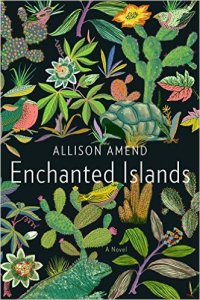
Allison Amend, a graduate of the Iowa Writer’s Workshop, is the author of the novels A Nearly Perfect Copy and Stations West, which was a finalist for the 2011 Sami Rohr Prize for Jewish Literature and the Oklahoma Book Award. She is also the author of the Independent Publisher’s Award-winning story collection Things That Pass for Love. She lives in New York City, where she teaches creative writing. Her latest novel is Enchanted Islands, based on the life of Frances Conway, who lived with her husband, Ainslie, on the Galápagos Islands for several stretches in the 1930s and ’40s. My review is here.

When did you discover Frances Conway, and what about her spoke to you? Did you know you needed to tell this story when you first encountered her?

I discovered Frances through her memoirs. I originally wanted to write about the series of strange disappearances on the Galápagos island of Floreana, but some of the descendants of the people involved are still alive, and Dayna Goldfine and Dan Geller were making a documentary about it, and I felt I wanted more freedom to imagine characters. It was in that period of research, though, that I read Frances’s memoirs and immediately fell in love with her voice. She is funny and witty, self-deprecating and actually a talented writer. This was a voice I wanted to attempt to emulate.

What also struck me about her two books is what they didn’t say. She was 50-year-old woman married to a man more than 10 years her junior, and in her middle age they decided to go to a deserted island? There was some larger story that she wasn’t talking about. It was in the space between the lines that my interest in the story grew.

I had written a full draft of the novel before I went to do research. Frances never mentions in her memoirs that Ainslie has a drinking problem, but I wrote that into the novel. Later, I spoke to the son of someone who knew the couple, who said that the Conways had come to Floreana in part so he could dry out. There are traces of honesty even when we try to hide them.

Have you ever been to the Galápagos?

Yes. My parents took me and my brother when I was just out of high school. It was an amazing trip. During that time I read Floreana, Margret Wittmer’s account of the strange goings-on on the island, and I became fascinated with the human history of the islands.

I returned to do research in February 2015 and found the islands much changed. Land-based tourism is in full effect, and the population of the islands has exploded. I saw many more Ecuadoreans taking advantage of their natural park. It’s wonderful that the islands have become accessible to those who are non-wealthy, but the increased traffic stresses the islands.

Every superlative everyone has uttered about the utter awesomeness of the Galápagos is true. I urge everyone reading this to visit this spot before tourist degradation destroys it.
enchanted islandsWhere is the line between fact and fiction? How firm is it? How important is it to you?

Ehhh, line-schmine. I like to say that fiction dwells in the possible, not the probable. Is it possible that Frances and her husband were spying for the U.S. government? Unlikely. But it does seem clear that Ainslie wrote an anonymous feasibility report for the U.S. Navy, and it is rather strange that a mismatched middle-aged couple would play Swiss Family Robinson on a strategically placed island full of Germans just before World War II, so who knows?

If there had been more historical records about Frances and Ainslie, I might have felt more compunction about inventing their lives, but the dearth of facts seemed to me to be a green light.

How much research did you do, and do you find that part of the process enjoyable?

I love to do research, and all of my books have been research-intense. It is one of the most enjoyable parts of writing for me. This may be because I get to procrastinate and call it writing.

I did try to complete a working draft before I started researching so that I would be sure to focus on creating characters rather than writing a Forrest Gump-like series of important events.

I did a lot of my research on the internet, unsurprisingly. There is a fantastic resource on the human history of the islands compiled by John Woram: www.galapagos.to, which has nearly all the historical documents that exist on the islands. I also did a lot of reading on spying tradecraft in the 1930s, and the role of the Pacific and the Panama Canal in the Second World War. Then there was all that research on Chicago during the turn of the century and San Francisco in the periods between the wars. Oh, and I went to the Roosevelt library and the Allan Hancock collection at the University of Southern California.

I read Frances’s memoirs several times, because I wanted her voice in my head. For a while I considered weaving in parts of her memoir, but I decided that would be more of a gimmick than an asset to the novel, so I tried to put the book out of my head and just write from my memory of her voice.

There comes a time, though, when research starts to inhibit imagination instead of spark it, and then it’s time to put the research away and just write.

Do you have a favorite character or one you feel closest to?

Well, obviously I spent four years or so with Frances, so I feel like I know her (or my fictionalized version of her) very well. But I have sympathy and fondness for all the characters in the novel.

In what ways is this book different from your previous work?

All of my books are different from each other. One of my biggest pleasures in writing is to try something new–it keeps the writing exciting and challenging. After my last historical novel, I swore I would never write another… but the pull of this story was just too great.

Enchanted Islands was a challenge because I was writing in first person for the first time in a novel. And I was writing from a voice that already existed. I didn’t have to match it, but I wanted to be true to its spirit. I was also challenging myself to write a tightly plotted novel, with spies and violence and action. From someone who comes from a literary fiction, character-driven background, highlighting plot is like getting a horse to walk backwards.


This interview originally ran in the June 3, 2016 issue of Shelf Awareness for Readers. To subscribe, click here, and you’ll receive two issues per week of book reviews and other bookish news.

Grief Is the Thing with Feathers by Max Porter

A minimalist meditation on loss takes an unusual slim and poetic form.

grief is the thing

Max Porter’s Grief Is the Thing with Feathers handles bereavement and the novel format in inventive ways. Scraps of poetry, dialogue and ramblings, with lots of white space, fill just over 100 pages, but this sparse little volume takes on no less than love, loss and art.

Three parts, “A Lick of Night,” “Defence of the Nest” and “Permission to Leave,” roundly sum up the grieving process. Brief segments are narrated from three characters’ perspectives: Dad, Boys and Crow. Mom has recently died, and Dad and two young sons struggle to cope until a special Crow comes along to care for them–in a manner of speaking.

The Crow’s voice tends toward the stream-of-consciousness, as a bird’s might, but there’s no questioning its agency and intelligence. Dad is an eccentric Ted Hughes scholar, struggling to write a book on deadline. Under these influences, Grief Is the Thing with Feathers resembles free verse. The Boys generally speak as “we”; despite the occasional singular, the two brothers are interchangeable. In Porter’s poetic bent and unusual usages, “They were in brother with each other.” They are nonetheless realistic and childlike; they wonder, when their mother dies, “Where are the fire engines…? Where are the strangers… screaming, flinging bits of emergency glow-in-the-dark equipment at us to try and settle us and save us?”

This is not a novel for children, with its moments of gore and sex, but it is a whimsical and ultimately pleasing perspective on grief, and utterly original.


This review originally ran in the June 3, 2016 issue of Shelf Awareness for Readers. To subscribe, click here, and you’ll receive two issues per week of book reviews and other bookish news.


Rating: 7 flecks of toothpaste.

Joe Gould’s Teeth by Jill Lepore

This story of a missing manuscript and its darkly unhinged author has momentum and beauty.

joe gould's teeth

Joe Gould is best known through two profile pieces Joseph Mitchell wrote for the New Yorker. In 1942, Mitchell introduced a harmless eccentric engrossed in writing “The Oral History of Our Time”–at some nine million words, supposedly the longest unpublished work in history. In the second piece, in 1964, Gould (then deceased) is a dirty, sinister man, and Mitchell asserts that there had never been any such manuscript. Jill Lepore (a staff writer at the New Yorker and author of numerous works of nonfiction), like so many before her, was intrigued. Was there an oral history, or wasn’t there? Who was Gould, really?

Joe Gould’s Teeth is a biography of Gould, a study of the record he left behind and the story of Lepore’s search. Gould was a graphomaniac; his written legacy includes letters, diaries, essays, ramblings but rather little oral history. Lepore seeks the mythical manuscript, but finds the mystery of a man. She describes herself as stumbling, falling into the “chasm” of Gould, who claimed to be “left-handed in both hands” and whose thinking was “sticky” with details. She follows him through archives and memories, and into his obsession with African-American sculptor Augusta Savage. Savage, as a secondary character, is more sympathetic (and sane), and possibly more enigmatic than Gould.

Lepore’s contribution to this undeniably riveting story lies in her research, but even more in her wise, nuanced telling. Joe Gould was a genius, a madman, destitute, beloved of e.e. cummings and Ezra Pound, by turns likable and malicious. Joe Gould’s Teeth is an astonishing, wide-ranging and thoroughly enthralling work of history.


This review originally ran in the May 31, 2016 issue of Shelf Awareness for Readers. To subscribe, click here, and you’ll receive two issues per week of book reviews and other bookish news.


Rating: 9 notebooks.

The After Party by Anton DiSclafani

The particular culture of 1950s Houston high society is the setting for this disturbing story of friendship and secrets.

after party

Anton DiSclafani’s The After Party opens in the 1950s in Texas in the world of the oil-rich. Narrator Cece has a loving marriage and a baby boy. Her best friend, Joan Fortier, lives the night life, although at 25 she is nearing the end of her prime in this glittering culture of money, power and conformity. In flashbacks, Cece reveals the way the Fortiers took her into their home and–almost–their hearts, and Joan’s mysterious vanishing acts.

Cece has always been deeply committed to serving the needs of Joan. She may rankle at being called a handmaiden, but she can’t help it: Joan has that effect on her. The girls have been best friends since kindergarten, and when Cece is left parentless as a teen, she moves into the Fortier estate, in the closed community of opulent River Oaks, an exclusive neighborhood in Houston.

Cece is obsessively devoted; Joan is carelessly, selfishly wild; and River Oaks is chilling in its regimentation: “We all served the same pimiento sandwiches, from the same recipe, at luncheons.” DiSclafani’s (The Yonahlossee Riding Camp for Girls) depictions are impeccable. Readers familiar with Houston will recognize landmarks like the legendary Shamrock Hotel, and note DiSclafani’s pitch-perfect rendering of River Oaks. The After Party is a puzzle with carefully modulated tension; Joan’s disappearances and carefree disdain for luxury perplex Cece, and the reader, until the final pages. Characterization, strong sense of place and the painful riddle of friendship form a novel that is vibrant, sensitive and suspenseful.


This review originally ran in the May 24, 2016 issue of Shelf Awareness for Readers. To subscribe, click here, and you’ll receive two issues per week of book reviews and other bookish news.


Rating: 7 high dives.

Vinegar Girl by Anne Tyler

Anne Tyler successfully reinterprets The Taming of the Shrew in a modern, pleasingly nuanced novel.

vinegar girl

Vinegar Girl is the third in Hogarth Shakespeare’s line of retold classics by the Bard (The Gap of Time, Shylock Is My Name). Anne Tyler’s delightful, clever novelization sets The Taming of the Shrew in present-day Baltimore, Md., holding faithfully to Shakespeare’s plot and concept but presenting far more complex characters, with absolutely charming results.

Kate is 29 and lives with her absent-minded microbiologist father, Dr. Battista, and her younger sister, pretty and air-headed Bunny. She serves as housekeeper and chaperone, not that they appreciate her efforts. She also works at a preschool, where the kids adore her but the adults have trouble with her sense of humor. Her real passion is gardening. As Vinegar Girl opens, Dr. Battista faces a problem: his gifted foreign assistant, Pyotr Cherbakov, is in the U.S. on an extraordinary-ability visa that’s about to run out. Dr. Battista feels sure he’s on the verge of a breakthrough, but he needs Pyotr to be able to stay a little longer. The reader realizes well ahead of Kate that what her father has in mind is an arranged marriage.

The prickly Kate feels she’s been taken advantage of long enough; she finds Pyotr pushy, and she isn’t looking for a husband, anyway. Kate repeatedly corrects him: she is not a “girl” but a “woman.” As she sees more of him, though, it appears that some of his awkward heavy-handedness may be related to his difficulties with the English language. And her father’s plan to satisfy the immigration authorities doesn’t mean she’d have to be married forever…

Vinegar Girl‘s modern setting and language enliven a classic tale of controversy and gender politics. The novelistic form illuminates the inner workings of Shakespeare’s characters, revealing attractive nuances. Tyler’s Kate is more soft-hearted, and a view of her inner workings exposes her insecurities. This Kate is quite sympathetic in both senses of the word: she empathizes with her eccentric father and the homesick Pyotr, and calls upon the reader’s sympathies. Pyotr is awkward and lonely, but appealingly smitten by Kate’s independent nature. Even Dr. Battista (despite his objectionable motives) and the maddening Bunny are revealed as intricate and ultimately likable characters.

Readers unfamiliar with The Taming of the Shrew will have no problem enjoying this novel, which is funny, fun-loving and uplifting. Those who know the original well will be intrigued by Tyler’s riffs: Is the new Kate less shrewish, or simply better characterized, her motives and anxieties better understood? In either case, the surprising ending, which deviates from Shakespeare’s in important ways, makes for a heartwarming conclusion to a quirky, timeless tale.


This review originally ran in the May 23, 2016 issue of Shelf Awareness for the Book Trade. To subscribe, click here.


Rating: 8 servings of meat mash.

A Robot in the Garden by Deborah Install

This exceptionally charming novel addresses human relationships by way of a one-of-a-kind robot.

robot in the garden

Deborah Install’s first novel, A Robot in the Garden, is a delightful romp and an emotional journey, both hilarious and poignant.

Ben is idle, unemployed, still living in his childhood home in a small town in England, and grieving his parents’ death. He is a constant source of frustration to his wife, Amy. When a robot appears in their back garden, Amy is exasperated, as usual: she tells Ben to get rid of it. Ben is intrigued. The robot, Tang, is decrepit but apparently well-made, and has more personality than the androids the neighbors keep around to do laundry and house chores. Tang is also obstinate, willful and possibly broken beyond repair, but Ben suspects that there is something special about this creature. Together they undertake a riotous expedition, seeking a fix for Tang–and perhaps for Ben as well. On the way, the odd pair encounters bizarre situations, including android sex workers and a radioactive wiener dog, and make new friends. Mulish but endearing, Tang throws tantrums and wins Ben’s heart, and stirs him to reexamine his relationships with the people in his life.

Both Ben and Tang are well-developed, imperfect but lovable characters, and Install has an expert ear for tone and mood. Her dialogue is masterful–Tang’s singular voice develops throughout the novel as he does, and the silliness of this eccentric story provides a refreshing counterpoint to sentimentality. A Robot in the Garden is zany and heartfelt, endlessly funny and often absurd, but speaks directly to the central challenges of the human experience.


This review originally ran as a *starred review* in the May 20, 2016 issue of Shelf Awareness for Readers. To subscribe, click here, and you’ll receive two issues per week of book reviews and other bookish news.


Rating: 8 Premium seats.

The Song Poet: A Memoir of My Father by Kao Kalia Yang

In celebrating a father’s traditional Hmong song poetry, this memoir records the painful history of a loving family and a people.

song poet

In The Latehomecomer: A Hmong Family Memoir, Kao Kalia Yang related her family’s immigrant experience. With The Song Poet: A Memoir of My Father, she focuses on the life and art of Bee Yang: “my father raps, jazzes, and sings the blues when he dwells in the landscape of tradition Hmong song poetry.” The storytelling and emotional communication of that art form was a defining element of Bee’s contribution to his family and his culture, from their home in Laos to a refugee camp in Thailand and, finally, in the United States. When his mother died, Bee stopped singing, and Yang considers the significance of that silence as well.

As its title suggests, The Song Poet is lyrical and beautifully composed, with themes of loss and love, realistic and raw, but enriched by gentle metaphor. It is divided into “Side A” and “Side B,” the first told in Bee’s first-person perspective and the second in Yang’s. These points of view offer immersion in a Hmong culture that values family, and shares a complex system of spiritual celebrations and a way of life centered on the day-to-day necessity of growing and harvesting food. War and violence drive the family to Minnesota, where Bee and his wife do hard, dangerous labor, and are poorly equipped culturally to battle racism and exploitation. But they retain their reverence of family and tradition. The Song Poet is a message of love and thanks to a father who sacrificed for his children’s future, and a memorial to his art.


This review originally ran in the May 17, 2016 issue of Shelf Awareness for Readers. To subscribe, click here, and you’ll receive two issues per week of book reviews and other bookish news.


Rating: 8 flip-flops.

The Hour of Land: A Personal Topography of America’s National Parks by Terry Tempest Williams

In this phenomenal exploration of U.S. National Parks, Terry Tempest Williams turns her smart, poetic eye to place, history, ecology, the future and how we relate to one another.

hour of land

Celebrated conservationist Terry Tempest Williams (Refuge; When Women Were Birds) commemorates the centennial of the U.S. National Park Service with The Hour of Land: A Personal Topography of America’s National Parks. In 12 chapters, she explores 12 parks, their histories and futures. Ecology forms a natural overarching theme, but Williams’s topics are variously personal, global and political. The places she visits range from Alaska to Maine to south Texas, while her subjects span still broader ground: biodiversity and water shortages; suicide and hopelessness; continuing unrest in U.S. relations with Native Americans; climate change; political prisoners from around the globe; and the legacy of the Civil War. Her writing is poetic, passionate and unexpected.

In each chapter, Williams describes a visit to a specific national park, and then investigates the place and her experience there, sometimes directly through narrative storytelling and sometimes metaphorically. She begins with Grand Teton National Park, where her family has often returned over the decades and generations. The history of that park’s founding and the establishment of the Parks system melds with her family story: “Our national parks are memory palaces where our personal histories reside.” With her father, who spent his career laying pipe for industry and development, and a park superintendent, she tours Theodore Roosevelt National Park in North Dakota. Together they birdwatch and debate the balance between fossil fuel extraction and conservation. In Acadia National Park, Williams muses that parks may be “breathing spaces for a society that increasingly holds its breath.” She finds Gettysburg National Battlefield representative of sustained resentments, pain and violence, and at Effigy Mounds National Monument, she encounters cultural heritage and controversy. To escape the pain of Gettysburg and Effigy Mounds, she heads into the desert, to Big Bend National Park.

Gates of the Arctic National Park in Alaska offers escape from a personal tragedy; Gulf Islands National Seashore, in Florida and Mississippi, reveals that the consequences of the Deepwater Horizon oil spill remain, stinking and stinging. Williams visits the exhibit by artist Ai Weiwei on Alcatraz Island in Golden Gate National Recreation Area; the recently established Cesar E. Chavez National Monument; and, of course, her home landscape of Canyonlands National Park in Utah. In Glacier National Park, where the Tempest family tries to celebrate a birthday by retracing old steps, they are instead nearly killed by in a forest fire that sweeps over the chalet where they lodge. In these travels, Williams finds beauty and distress over the future, and opines, “We continue to evolve and transform who we are in relationship to where we are.”

By turns sad, despairing, and hopeful, even thrilled in the presence of natural beauty, The Hour of Land is emotive, intelligent and well traveled. It is only right that Williams should celebrate the Park Service’s centennial with such a remarkable collection of wisdom and scintillating lines.


This review originally ran in the May 13, 2016 issue of Shelf Awareness for the Book Trade. To subscribe, click here.


Rating: 8 long views.

author interview: Fernanda Santos

photo: Nick Oza

photo: Nick Oza

Fernanda Santos covers Arizona and New Mexico as the Phoenix bureau chief for the New York Times. Her experience as a journalist is broad, crossing two continents, several languages and a range of subjects. Her first book, The Fire Line (Flatiron Books), is about the deadly 2013 Yarnell Hill, Ariz., wildfire that killed 19 members of the firefighting team the Granite Mountain Hotshots. My review is here.

How was writing this book different from newspaper work?

I wanted to write a book because I couldn’t answer the questions that I wanted answered in newspaper stories. I knew that somebody would write about this fire, and I would have tortured myself for the rest of my life for not having had the courage to write it. I called a colleague in New York, and he said, look at every chapter as a story. Can you write a 4,000-, 5,000-word story? And I said yes, I can write that. He said they just all have to connect in the end. And it seemed so simple.

On one hand, it was that simple. But on the other hand, it’s very different than writing a newspaper story. I had complete control over it. In newspapers, the editors get hold of your text and shape it, or send it back to you and ask for more of this or that, because they want to drive a specific point. With the book, I kept waiting for the moment when the editors would get my chapters and start telling me where to go and what to do next, and it never came. When I was halfway through, I sent it to Colin Dickerman, my editor at Flatiron. I didn’t even know if I’d written something that resembled a book. And he said, there’s a lot of great material here, great reporting, but it’s a little confusing. Why don’t you do an outline? And I thought, oh! I guess that would help! With the outline, everything was easier. I set deadlines for each chapter. I only had a certain amount of book leave, and I didn’t want to jeopardize the job that I really love. So I assigned myself these stories, like my friend told me, and pursued the deadlines as if an editor was there to enforce them. And all of a sudden it flowed, just naturally evolved from one chapter to the next. A lot of the skills I used were developed over those years writing newspaper stories.

How did you gain access to these men’s families, and their trust?

I approached it very differently than I would if I were to just write a story about the deaths. I was not looking for a quote, or a quick couple of lines to throw in a story to define a character. I really wanted to understand who these men were, and I figured the best way to do that was if I got to meet their families. I had a friend in common with the wife of Andrew Ashcraft. I asked this friend to reach out to her, and we met. Then she referred me to her mother-in-law, who was close to another mother, who was close to another family, and the word started to get around. I guess they liked me. They said I had a lot of patience, and I was very interested in learning their stories.

I wrote letters to other families. I explained what the book was about, why I wanted to talk to them, and I said that although I had their addresses, I had not gone knocking on their doors because I didn’t want to add to their anguish. I wanted to leave them in control. I wanted them to reach out to me, and say if, when and where. And before I realized it, I had met everybody.

I also went to the fire academy in Prescott, where a lot of the Hotshots trained, and some of them taught; one of them, Eric Marsh, helped found the academy. I did the basic training, and then another course, and I’m actually going back to a third. I wanted to understand the world they inhabited, because wildland firefighting is a very small world, very tight. Once I went through the academy I could understand better what former members of the crew and families of the men had told me.

fire lineI love that you explore so many facets of this story: firefighting techniques, the history of fire management in the United States, the science of weather forecasting.

I realized early on I had to explain three things. Readers had to understand what wildland fire is, what it is like to fight a wildfire. They had to understand the very specific conditions of the vegetation in that part of the state, which obviously connects to the bigger issues of the drying of the west, climate change, the warming of the planet. And they needed to understand the characteristics of the storm that hit the fire, that hooked the flames and turned them around on the men. So I spent a lot of time in the National Weather Service office here in Phoenix, and the office in Flagstaff. I hung out with meteorologists, asking questions. They referred me to some texts. And I had two very thick fire policy books that I read, which were very helpful. I met several times with the author of those books, Stephen Pyne. In fact, he read my manuscript to make sure I didn’t embarrass myself.

It was in some ways a relief, when the emotional side of things became hard to deal with–you know, spending six hours with a widow, talking about a husband and a life that in many ways resemble my own. These guys were younger than my husband, but we like to do a lot of the same things these guys liked to do with their wives; we have a child, a lot of them had kids–so you understand the broad outlines of a life at home. Emotionally, that is very hard. There were times that I really looked forward to sitting down with a meteorologist and talking about science. It gave me a break, and recharged me so I could go back and sit down with another family for hours and talk about whatever they wanted to talk about. My husband says that I report with my heart first, which is why sometimes I come home a total wreck. I hope that’s what comes through.

Was it easy to return to your work for the Times?

It was not easy. I went from an environment where I was in complete control, and I took the story as far as I wanted to take it, to an environment where I have limits to the stories I write, the amount of time I can spend, even the way I write them. I remember telling my editor after one frustrating story, how is that I can write a book and I can’t write a story? And he said you can write both, but you can’t write a story as if you are writing a book.

I miss my book. It’s very weird, but I miss the intimate connection that I had with that story.

This was very rewarding, then.

It’s interesting. I’m from Brazil. I came here as an adult, I’d never written a story in English, I went to graduate school, I’ve been at the Times 10 years, and now I’ve written a book about wildfires. A very American story, in some ways. It was such an empowering experience for me, as a person. We know all the conventions, the boxes people try to fit us into. You’re a woman, you’re an immigrant, you’re a Latina; therefore you’re expected to know about immigrants, Latinos, parenting. Not about firefighters, a real man’s world. Because English is not my first language, how dare I write a book? Those were the things in my head. What are you thinking? Why did you get yourself into this? I had all these battles with myself, and I obviously overcame them, because I wrote the book. To me, that was such a priceless experience. My daughter is six, and I’ve been talking to her about what people say you can and can’t do, what girls can’t do. And in Latin culture we’re very respectful to authority. So I’m telling her, sometimes you have to break the rules. Sometimes you have to try something that people think you’re never going to be able to do, so you can prove to them that you can. It really taught me a lot about how far I can go.


This interview originally ran in the May 10, 2016 issue of Shelf Awareness for Readers. To subscribe, click here, and you’ll receive two issues per week of book reviews and other bookish news.

Maximum Shelf author interview: Steven Rowley

Following yesterday’s review of Lily and the Octopus, here’s Steven Rowley: On Obstacles and Octopuses.


Steven Rowley is from Portland, Maine, and is a graduate of Emerson College. He has worked as a freelance writer, newspaper columnist and screenwriter, and lives in Los Angeles with his boyfriend and their dog. He is @mrstevenrowley on Instagram and Twitter. Lily and the Octopus is his first novel.

How autobiographical is this story?

photo: Malina Saval

photo: Malina Saval

There’s no way to deny that it’s partly autobiographical. I did have a dog, named Lily, and when she passed away I went into a funk. The depth of grief I felt took me completely by surprise. After about six months or so feeling completely blocked, not just in writing but in life, I sat down to do what writers often do, which is try to put pen to paper and work their way out of a tough spot. Thematically and emotionally it was autobiographical, but as I kept writing, the character and the plot became more fiction. It got weird, certainly, along the way, but I thought, the story can get as weird as it wants to on the surface as long as I stick to the mission of adhering to absolute emotional honesty.

It sounds like you did the writing as a part of healing.

Oh, it was hugely cathartic. Absolutely. Although it’s largely on the surface about a man and his dog, I see the story more about a character who’s stuck in life. Sometimes our biggest obstacles are those that we make up, that we imagine, or if they’re not entirely imagined, that we exaggerate. So it’s really a story about what it takes to get unblocked and power your way though.

Did you know that that was the story before you were writing it?

It’s interesting. I come from a background in screenwriting, and with screenwriting you have the plot much more laid out in advance. And this was something I was approaching from more of an emotional standpoint, looking to examine themes of grief and depression–I hate to harp on those because the book is, hopefully, not without its humor as well. I was surprised where the story took me because I was so focused on the emotion of it. There’s a big set piece near the end that came completely by surprise.

Why on earth an octopus?

Well, I did have a dog that suffered from something that looked a bit like there was a small octopus on her head. But beyond that, I wanted something as different as possible. What’s most different from a dog that’s covered in fur, that’s basically all spine (since she’s a dachshund) than an invertebrate who’s sort of slimy and hairless and lives in the sea? I liked playing with that dichotomy, that they were as different as different can be. On top of that, I have an enormous respect for octopuses (my editor and I have gone over this time and time, and the plural of octopus is octopuses). They’re so smart, and according to scientists they’re playful, can use simple tools and they learn and adapt as they go. And that’s what I needed, a cunning antagonist. Because the main character learns more about the octopus throughout the story as it unfolds, I needed a villain who would learn and adapt as well, continue to know how to needle our narrator. So, that is an octopus. And I do carry some guilt about villainizing them in any way, because they’re really magnificent creatures. Please everyone, don’t hate the octopus. Just the particular one in this story.


How was writing a novel different from your previous work as a screenwriter?

Screenwriting is a collaborative art. Many people help to bring a screenplay to life as a film, and many times it’s not the writer’s original intent that makes it to the screen. On top of that, when you’re writing a screenplay you’re writing a blueprint, it’s not in and of itself the final product. I had in my mind that I wanted to try a novel someday, so that if nothing else I could point to something bound and finished and say, this is what I do.

A screenwriter’s job is to make the internal external. All emotion and feelings are expressed through action and dialog. In this book, I wanted to luxuriate in themes and feelings. The book is very internal; there’s a very limited number of characters. The narrator has one friend, one sibling, one parent and one therapist, and that’s it. He’s sort of removed from humanity, which is why he has such a powerful relationship with his dog. I really wanted to take the time and explore what was going on inside of his head, and when you’re exploring depression it’s often internal like that. So it just seemed that a novel or prose was the right medium for this story.

Your journey to publication was unusual. Congratulations, by the way.

Thank you! When I finished the manuscript, I was very proud of it as a piece of writing, but I saw it as so deeply personal, and to be perfectly honest I was also worried that it was perhaps a little weird. Self-publishing was also attractive to me because, coming from film, I didn’t want too many other voices trying to tell me it can’t be an octopus, it should be an alligator, or whatnot. My boyfriend recommended I hire an independent freelance editor, so I found a woman named Molly Pisani and she and I worked on the book together. I paid her and I never expected to hear from her again. I went about doing what writers looking to self-publish do. I hired a typesetter, looked at ISBN numbers and how to market the book and sell it, all these things, and out of the blue I got a phone call from Molly about three months later. She said, “I can’t stop thinking about your book. I know a woman who works at Simon & Schuster who I think might respond to it in the same way that I did. Do you mind if I send it?” I said no, I certainly don’t mind, but I was so far down the line toward self-publishing that I really didn’t think anything would come of it. And she did say that it could take her friend a month or two to look at it. That was on a Friday, and on Monday morning I woke up to a call from Simon & Schuster, from the woman who is now my editor, Karyn Marcus. It really happened that quickly.

What’s next?

Everyone is asking, will it be a screenplay or novel? And I have to say that publishing is being incredibly kind to me right now. Working on Lily with my editor, she gave me a note once and said, “…but I defer to your creative vision.” And I almost fell out of my chair! Because in 10 or 12 years really giving it a go as a screenwriter, I had never heard those words from a producer or a studio executive. As a writer, that’s kind of addictive. So for many reasons, my next project, which I’m working on right now, is a follow-up novel. I’ve been really fortunate with this publishing deal, which has allowed me to leave my day job, and I’m focusing on writing full time now. I’m excited.


This interview originally ran on May 9, 2016 as a Shelf Awareness special issue. To subscribe, click here, and you’ll receive two issues per week of book reviews and other bookish fun!