The Art of History: Unlocking the Past in Fiction & Nonfiction by Christopher Bram

A succinct survey of history in both fiction and nonfiction offers advice for writers and readers.

the art of history

Christopher Bram takes on the broad subject of what history has to offer literature–and vice versa–with The Art of History: Unlocking the Past in Fiction & Nonfiction.

Beginning with memories of a high school English teacher, Bram celebrates the interest and value of reading and writing history. His thesis is that history need not be written in dry, textbook form: in both fiction and nonfiction, a talent for storytelling and a keen eye for just the right details, in the right quantity, can render the near and distant past in enthralling fashion. “Details,” he says, “are the raisins in the raisin bread.” He examines works including Gabriel García Márquez’s Love in the Time of Cholera, David McCullough’s The Path Between the Seas and Leo Tolstoy’s War and Peace, and topics ranging through war, slavery in the United States, comedic perspectives and the blending of lines between fiction and nonfiction. An author in both disciplines, Bram does not claim objectivity: he is clear about his love for Toni Morrison’s Beloved and his disregard for Hilary Mantel’s Wolf Hall, among others.

Books in “The Art of” series inspect craft from a perspective seemingly for writers and critics, and Bram offers good advice: “In both fiction and nonfiction, writing well means knowing what to leave out.” But The Art of History works for readers as well, as in an appendix of Bram’s recommended reading. Exploration, appreciation and instruction combine in this slim, accessible study of literary history and historical literature.


This review originally ran in the July 5, 2016 issue of Shelf Awareness for Readers. To subscribe, click here, and you’ll receive two issues per week of book reviews and other bookish news.


Rating: 6 details.

This Is Where You Belong: The Art and Science of Loving the Place You Live by Melody Warnick

A chronic mover seeks to settle down, and offers practical, accessible steps for readers to follow.

this is where you belong

When Melody Warnick, her husband and their two children moved for the sixth time in 13 years, from Austin, Tex. to Blacksburg, Va., she started to wonder if this new town would be a panacea, or if perhaps she was chasing an impossible dream. Had her family’s search for happiness via mobility been a form of magical thinking? So began the work of This Is Where You Belong: The Art and Science of Loving the Place You Live.

Warnick approaches the goal of settling, or of loving where she lives, enthusiastically and broadmindedly. Research is a major component of her work, but it never feels that way. Warnick consults social sciences studies and conducts myriad interviews, and distills what she learns into conversational musings that make the reader feel a part of the process. In the opening chapter, she identifies 10 “place attachment behaviors,” which form the chapters that follow. These include walking more, volunteering, exploring nature and creating something new. For each behavior, she sets a goal and records her progress; each chapter ends with a “love your city checklist” of suggested actions. This Is Where You Belong is a carefully documented experiment, explicitly designed for readers to replicate in their own lives.

By the end, Warnick has established herself as a fallible, likable everywoman, and her struggle to love Blacksburg comes to represent a universal concern. Her journey to feeling attached to where she lives is scientific and packed with research, but also feels like an old friend’s casual banter. This practical exercise in intentional place-based happiness is for the homesick and the optimistic alike.


This review originally ran in the June 24, 2016 issue of Shelf Awareness for Readers. To subscribe, click here, and you’ll receive two issues per week of book reviews and other bookish news.


Rating: 8 ticks on a list.

White Bone by Ridley Pearson

A prolific author of action/suspense novels turns his skills to the distressing problem of elephant poaching in Kenya.

white bone

Ridley Pearson is known for fast-paced, plot-driven series for adults as well as for children. White Bone is the fourth novel in his Risk Agent series (after The Red Room), starring John Knox and Grace Chu, whose relationship undergoes significant change in this installment.

Knox is an importer/exporter of international arts and crafts, a career that provides him good cover for his clandestine work with Rutherford Risk, an international security firm that specializes in hostage extractions. Grace Chu is a forensic accountant and hacker, and a colleague at Rutherford Risk. As White Bone opens, Knox has received a troubling text message from Grace, just before she goes radio silent. Troubled, he follows her into the field.

Grace was sent into Kenya to track a stolen shipment of donated measles vaccines. The case quickly expands to involve the widespread criminal practice of poaching elephants for their tusks and rhinoceroses for their horns, and possibly the funding of terrorism. Corruption is standard operating procedure in Kenya, so Knox must beware of governmental agents and the police as well as the criminals he is tracking. When he arrives in Nairobi, Grace has been missing for days: he fears her cover has been blown.

Pearson’s plot is complex, watertight and humming with tension. The finest details are realistic and disturbing, and often require at least a moderately strong stomach, as when Grace, stranded alone in the bush, suppresses her usual hygiene habits in favor of survival practices gleaned from a Maasai guide. While the bulk of the story follows Knox, Grace appears both directly and in others’ narratives, posing a character development challenge that Pearson handles deftly. A large cast also includes a disillusioned British journalist, a Somali poacher, a Kenyan vigilante/folk hero, a helpful police officer, an activist lawyer and a resourceful Kenyan boy insistent upon becoming Knox’s right-hand man. Knox follows disparate threads and threats; Grace defends herself against jackals, lions and organized criminals; and the novel’s pace races as her situation worsens.

White Bone is richly detailed and filled with intrigue that encompasses terrorism, corruption and lingering colonial strains. Its characters are nothing if not passionate, and these passions include the author’s obvious concern for the central problem of elephant poaching. Pearson’s writing is informative and allows his muscular story to take center stage. Series fans will remain committed, and new readers will be drawn in, with no background knowledge necessary to follow this action-packed novel combining the thriller, adventure and mystery genres.


This review originally ran in the June 24, 2016 issue of Shelf Awareness for the Book Trade. To subscribe, click here.


Rating: 6 interior struggles.

So Much for That Winter by Dorthe Nors, trans. by Misha Hoekstra

Experimental in form, these two novellas explore everyday frustrations in love and art.

so much for that winter

Two novellas by Dorthe Nors (Karate Chop) compose So Much for That Winter, translated by Misha Hoekstra from the Danish. They are as stark and unusual in form as they are bleak in mood. The first is “Minna Needs Rehearsal Space,” which is told entirely in declarative sentences, each on its own line. They range from the mundane to the philosophical: “People love wistful pop”; “Hope is a roe deer on a bluff.” This austere narrative style reveals a more complex story, about a woman who has suffered a breakup and seeks space–literal and figurative–for her work as an avant-garde composer. She hides away in her apartment, daydreams a relationship with Ingmar Bergman, and flees to an island she hopes will mend her.

“Days” follows, formed of numbered lists that make up the days of a woman’s life: a diary of sorts. The unnamed character is a frustrated writer, also with a relationship recently ended. Her days are inordinately filled with walks in cemeteries and lots of ice cream. Again the prosaic details blend with moments of poetry: “2. Sorted laundry, two piles, Tuesday”; “But the one who writes must dare to stand with her fledglings stuck to her fingers and surrender them in showers of spittle and roses.”

The result of these startling, experimental novellas is both somber and playful, the themes of romantic disappointment and creative blocks heightened by the minimalist style. So Much for That Winter is a compelling investigation of form and emotion.


This review originally ran in the June 21, 2016 issue of Shelf Awareness for Readers. To subscribe, click here, and you’ll receive two issues per week of book reviews and other bookish news.


Rating: 7 bike rides.

The Mindful Writer by Dinty W. Moore

This expanded second edition of the popular title about writing from a Buddhist perspective is a small book with big ideas.

mindful writer

Dinty W. Moore (Dear Mister Essay Writer Guy) is often asked to explain how Buddhism influences his writing practice. In struggling to answer this question articulately, he found himself shaping “The Four Noble Truths of the Writing Life.” From these musings was born 2012’s The Mindful Writer, a slim volume of very short, koan-like chapters offering writing advice and formed from quotations by other writers.

In its expanded second edition, The Mindful Writer offers a new introduction and for the first time includes writing prompts that follow the same concepts and quotations as its chapters. Words of wisdom from William Faulkner, Gustave Flaubert, Dorothy Parker, Stephen King and many more pose opportunities to ruminate on how to see and observe, how to work, how to think and live like a writer. Moore examines the sources of creativity as well as the plain hard work of writing, and “the freedom and importance of lousy first drafts.” Refreshingly, he reminds his reader that his advice “should be taken in the spirit of suggestion, not edict… it is not a good idea to cling too fiercely to the advice of others.” Moore is, as usual, funny but also takes his subject seriously. Its short chapters and encouraging prompts make this a guide to keep close at hand, for regular reference.

Its neatly packaged bits of wisdom mean that writers from beginners to experts equally will find inspiration and new perspectives in Moore’s unassuming manual of writerly mindfulness.


This review originally ran in the June 21, 2016 issue of Shelf Awareness for Readers. To subscribe, click here, and you’ll receive two issues per week of book reviews and other bookish news.


Rating: 7 moments.

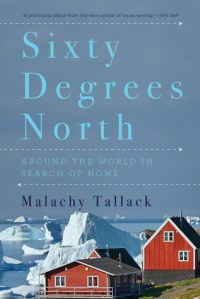
Sixty Degrees North: Around the World in Search of Home by Malachy Tallack

This broadly appealing travelogue combines carefully crafted writing with immersion in Northern lands and contemplation of the idea of home.

Print

Malachy Tallack comes to identify the northern Scottish archipelago of Shetland as home only after a long and troubled journey away and back again. In Sixty Degrees North: Around the World in Search of Home, Tallack grapples with the concept of belonging to a place, while traveling around the world on a single parallel. “For just as we inhabit the landscape, the landscape inhabits us, in thought, in myth and in memory.” He opens with the evocatively titled chapter “Homegoing,” and wraps up, naturally, with “Homecoming.” The chapters in between might be characterized as home-seeking.

These titles serve as shorthand for a considerably more complicated story. Tallack was not born in Shetland, but a loss he suffered in his teens left him there, feeling stranded. Ever since, he has vacillated with the attraction of other places, of movement, and the comforting appeal of an idea of home. Sixty Degrees North describes his travels through Greenland, Canada, Alaska, Russia and Scandinavia, which occupy the space of a year and thus document the North’s extreme seasons. This voyage is literally perambulatory, as Tallack compulsively walks, learning towns and cities by foot. In recalling an earlier time spent in Siberia, he studies his attraction to this place from a greater distance. He pursues home, even as he revolves around it.

While largely concerned with interior musings, Tallack makes a remarkable survey of cultures, climates and histories along the way. Ongoing themes include ties to nature and to community; the tension between isolation and engagement; stasis, movement and exile. His topics range over colonialism and native cultures, and the significance of peat, salmon and reindeer to indigenous peoples. He examines Scandinavia’s social and political systems, particularly in the Åland Islands, which belong officially to Finland but are politically independent and have a majority Swedish population. He touches on the science of climate change, the relative definition of “north” and the question of “denordification… as though by changing, by developing, by warming, the north can actually become less like itself.”

An introverted, quietly likable but troubled narrator, Tallack experiences no momentous events in the course of his travels, and even few conversations. His writing is thoughtfully composed, beautiful and often surprising, such as when he observes, “Loss shapes us like a sculptor, carving out our form, and we feel each nick of its blade.” Sixty Degrees North is not a book of action, but rather an extended meditation, on longing and belonging, on personal ties to place and on the particular nature of a certain band of earth and sea.


This review originally ran in the June 14, 2016 issue of Shelf Awareness for the Book Trade. To subscribe, click here.


Rating: 8 degrees (in two senses).

Magnum Cycling by Guy Andrews

Stunning photographs of bike racing across disciplines and decades, succinctly narrated, provide a compelling historical perspective.

magnum cycling

From Magnum Photos, one of the world’s oldest and most prestigious photo agencies, comes a collection of historic and iconic images of bike racing. Arranged and with accompanying text by Guy Andrews, Magnum Cycling is visually stunning and insightful.

Chapters are organized by themes, times and places, and photographers. The photographs of Robert Capa and Harry Gruyaert each fill a whole chapter, focusing on the 1939 and 1982 Tours de France, respectively. Guy le Querrec’s work covers “winter and spring,” including cyclocross racing in Belgium and France, and the Renault-Elf pro team’s winter training program in 1985. Chapters also address the velodrome, including six-day racing and the Paralympics, and the spectacle of the spectators. Henri Cartier-Bresson and John Vink join an impressive list of featured photographers. Along the way, Andrews explores the history of the Tour de France, national differences in spectator traditions and the legacy of figures like Bernard Hinault, Laurent Fignon and Lance Armstrong. His tone combines awe with humor when he calls cyclocross “simply bonkers… akin, perhaps, to bull-running in Pamplona or cheese-rolling in Gloucestershire.”

The balance of text to photographs is perfect: Andrews’s narrative and captions inform and elucidate, and then get out of the way of the extraordinary images that are the heart of this beautiful book. More than 200 gorgeous, intimate photographs in black-and-white and vibrant color present a view of a sport that is adrenaline-filled, fast-paced and deeply, tenderly human. Magnum Cycling is a superior collection of art, history and emotion.


This review originally ran in the June 1, 2016 issue of Shelf Awareness for Readers. To subscribe, click here, and you’ll receive two issues per week of book reviews and other bookish news.


Rating: 8 moments.

The Whale: A Love Story by Mark Beauregard

Careful research supports this story of a love affair between Hawthorne and Melville that birthed a classic.

the whale

In 1850, Herman Melville was in debt and struggling professionally, particularly with the novel-in-progress he was then calling The Whale. That summer, on a family trip to the Berkshires, he met the older, successful author Nathaniel Hawthorne, and began a relationship that would be passionate and painful, fraught and inspirational. Mark Beauregard explores the intimate friendship between these two literary legends in The Whale: A Love Story.

Based on primary sources including letters and journals, and meticulously researched, this novelization follows the historical record closely, as detailed in an epilogue. Hawthorne’s letters to Melville, lost to history, are re-created here using his other letters and journal entries; Melville’s letters to Hawthorne, however, are reprinted faithfully (with few, documented exceptions). Melville dives deeper into debt to move to the Berkshires and be near Hawthorne. As they discuss cerebral, spiritual and literary matters, grow close and suffer estrangements, Beauregard charts a full-blown love affair. In this telling, Moby-Dick is a labor of love and obsession directed not at a whale but at a man. Melville’s novel (which was dedicated to Hawthorne) continues to compel and confound readers today, and The Whale: A Love Story offers one possible explanation for its tortured mysteries.

In Beauregard’s fittingly emotive account, Melville is preoccupied and fervent, and Hawthorne is changeable, by turns sensitive and cool. Set against a literary community that helped define American letters of the time, this high-spirited story evokes a singular relationship and the complexity of Moby-Dick.


This review originally ran in the June 17, 2016 issue of Shelf Awareness for Readers. To subscribe, click here, and you’ll receive two issues per week of book reviews and other bookish news.


Rating: 7 flashes of lightning.

Everybody Behaves Badly: The True Story Behind Hemingway’s Masterpiece The Sun Also Rises by Lesley M. M. Blume

This study of the creation of The Sun Also Rises illuminates both the compelling story and Hemingway’s complex and not entirely likable personality and behavior.

everybody behaves badly

Many books have been written about Hemingway, but it seems there is still more to be learned. Lesley M.M. Blume’s Everybody Behaves Badly zooms in on the creation of The Sun Also Rises, Hemingway’s first novel and the one that firmly established his reputations, literary and otherwise. As her subtitle promises, Blume seeks the true story: in this case, the real men and women whose lives inspired Hemingway’s fiction, which some claimed was not really fiction at all.

Everybody Behaves Badly is not a biography of Hemingway; it skips his childhood to open with his marriage to Hadley Richardson, and the couple’s move to Paris in pursuit of cheap living and a storied expat community. Blume portrays a devilishly charismatic young writer, ambitious and confident, who easily collected mentors and admirers. She follows that young writer to Pamplona with a group of friends in 1925, and through the weeks after in which he wrote feverishly. Unflatteringly immortalized, one of the people Hemingway transformed into a character spoke of lives divided into B.S. and A.S.: before Sun, and after. Blume’s study concludes as Hemingway’s career expands, his first marriage ends and his second begins.

A biography of a novel, then, Everybody Behaves Badly is itself an engrossing and varied tale: raucous and dissipated, pitiable and serious. Blume’s research offers new detail to a well-studied story, and her narrative style is as entertaining as the original. Obviously required for Hemingway fans, this engaging work of nonfiction will also please a broad audience.


This review originally ran in the June 7, 2016 issue of Shelf Awareness for Readers. To subscribe, click here, and you’ll receive two issues per week of book reviews and other bookish news.


Rating: 8 slight changes.

Coyote America: A Natural and Supernatural History by Dan Flores

This biography of the coyote in biological, political and historical terms illuminates a much-maligned North American original.

coyote america

Dan Flores (The Natural West) examines an iconic North American original in Coyote America: A Natural and Supernatural History. This small, clever, charismatic predator originally roamed the interior West, enjoying a mutual tolerance with the people who lived there. Some Native American tribes built creation myths around the coyote, “America’s universal deity.” After European colonization, coyotes became the enemy of ranchers and herders–undeservedly, as scientists would eventually show, as their prey is more bite-sized. Decades of extermination efforts only encouraged the diminutive canine, however, whose range now extends from Alaska and Canada into Central America, from coast to coast. Coyotes now live in every major city in the United States, which surprises many but, Flores argues, shouldn’t: they were there first.

Styled as a biography, Coyote America follows its protagonist through history, geography, human perceptions and millions of years of American canid evolution, with detailed accounts of governmental policies regarding predators. Flores sees the coyote as an avatar for humankind. Like us, the coyote is highly flexible, can be social or solitary, and adapts well to changing environments. Coyote mythology, well documented in other books, plays a minor role here, although Wile E. makes an appearance.

Flores has a tendency to use nine words where two would do, but his slight long-windedness is well offset by the endless fascinations of his subject. Nature lovers, students of U.S. natural resource policy and those charmed by the native American “song-dog” will be engrossed.


This review originally ran in the June 7, 2016 issue of Shelf Awareness for Readers. To subscribe, click here, and you’ll receive two issues per week of book reviews and other bookish news.


Rating: 7 words.