Stephen King’s The Body: Bookmarked by Aaron Burch

A writer’s examination of the writing that shaped him–even reluctantly–yields layers of self-awareness.

stephen kings the body

Ig Publishing’s Bookmarked series features writers contemplating the literature that has made deep impressions on their lives and work. Aaron Burch’s entry is Stephen King’s The Body, a brief but incisive consideration of King’s novella and Burch’s life in ways that surprise the author and intrigue the reader.

“The Body” is one of four novellas in King’s Different Seasons (which also includes “Rita Hayworth and the Shawshank Redemption”). It is perhaps better known for the film adaptation, 1986’s Stand by Me. Burch’s lifelong fascination began with the movie; he writes here about coming later to King’s written work as he becomes a reader, a writer and a teacher. King’s protagonist, Gordie Lachance, is also a writer and very much resembles King himself. The layers of meta-awareness continue in Stephen King’s The Body: Burch refers to his writing of the book and to its earlier drafts.

“The Body” is a Bildungsroman circling themes of friendship, nostalgia and loss as four childhood friends trek cross-country to view the dead body of a boy their age. Burch explores these themes with tenderness and sentiment, even as he resists the latter. Although “The Body” and Stand by Me provide the framework for Burch’s contemplation, his work is at least as much self-reflective memoir or personal essay as it is literary criticism. As he writes, his marriage looks to be breaking apart–a parallel Burch forces himself to confront. The two processes, writing and considering a marriage, prompt a direct gaze into difficult truths, but as King writes (as Gordie Lachance): “The most important things are the hardest to say.” This is a recurring sentiment in Burch’s slim book, where he earnestly attempts to address those hard things.

Burch exposes himself as a striking character who has a complicated relationship with art–the art he produces (up until now, only fiction) and the art he enjoys. He is an unlikely writer of literary criticism, with his resistance to considering authorial intent, and purposefully avoids behind-the-scenes perspectives on his favorite works. “It can be fun to take apart a magic trick and figure out how it actually works, but it also ruins the magic of the trick.” Having pushed himself, however, Burch is surprised to find his venture into literary criticism extraordinarily enlightening.

Burch elaborates on King’s themes of loss and friendship with those of transitions, of firsts: first date, first kiss, first job, first road trip. As Gordie (or King) writes, “There’s a high ritual to all fundamental events… the rites of passage, the magic corridor where the change happens.” The beauty of Stephen King’s The Body is in Burch entering that magic corridor, and splitting the experience wide open–uncomfortably, even–for the reader to study with him.


This review originally ran in the August 1, 2016 issue of Shelf Awareness for the Book Trade. To subscribe, click here.


Rating: 7 scenes.

Women Lovers, or The Third Woman by Natalie Clifford Barney, ed. and trans. by Chelsea Ray

A sprightly, autobiographical 1926 novel of a Belle Époque lesbian love triangle, written in French by an American and appearing in English for the first time.

woman lovers

The works of Natalie Clifford Barney, an American who lived in Paris and wrote in French, are little known, and her 1926 autobiographical novel Amants féminins was published for the first time only in 2013. Woman Lovers, or The Third Woman is the first English translation.

A scholarly introduction by Melanie C. Hawthorne and a translator’s essay by Chelsea Ray place this work in the context of modernism and evolving gender definitions while detailing Barney’s biography. These introductory materials are revealing and absorbing in their own right, if a little dry in their academic tone. The novel, however, leaps energetically to life.

Barney’s protagonist N., who stands in for the author, believes in love among women as an ideal of pleasure and friendship. “Friendship is simply love without pleasure!” she declares. “Love is heavy for two to carry, and happiness is monotonous.” With a new lover, M., she establishes an “association” by which the two women will comfort those in romantic distress by sharing their affections. When she brings such a woman into her relationship with M., however, N. is unexpectedly left out, jealous and hurt.

Barney is perhaps best known for her aphorisms, and she uses such pithy fragments as well as screenplay-style dialogue, mock journal entries, a combination of first- and third-person perspectives and even drawings to tell her story. Woman Lovers, while brief, is thus a noteworthy and historically significant piece of experimental literature, queer theory and a captivating roman à clef all at once.


This review originally ran in the July 29, 2016 issue of Shelf Awareness for Readers. To subscribe, click here, and you’ll receive two issues per week of book reviews and other bookish news.


Rating: 7 chestnuts.

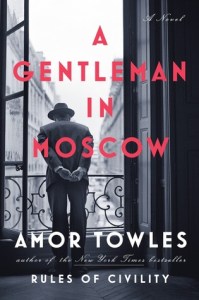
A Gentleman in Moscow by Amor Towles

This grand, sweeping story takes place entirely inside the walls of a luxury hotel in 1920s-1950s Moscow, in lushly evocative writing from the author of Rules of Civility.

gentleman in moscow

Amor Towles’s first novel, Rules of Civility, won readers’ hearts with its strong sense of time and place, fully realized characters and richly evocative voice. A Gentleman in Moscow repeats the feat with those qualities and more.

In 1922, Count Alexander Ilyich Rostov (“recipient of the Order of Saint Andrew, member of the Jockey Club, Master of the Hunt”) appears before a Bolshevik tribunal, accused of “succumbing irrevocably to the corruptions of his class.” He responds with quips, and is sentenced to house arrest in the luxury hotel where he has lived for the last four years. “Make no mistake: should you ever set foot outside of the Metropol again, you will be shot.”

This stylish and cultured protagonist has already lost his family and their estate. Now two armed guards move him from his suite into a monastic room of one hundred square feet. The bulk of his fine furniture, which will not fit in his new lodgings, becomes the property of the People. Remarkably good-natured, Rostov makes the best of his circumstances. He has all he needs in the Metropol: two restaurants, a barber, a seamstress and impeccably mannered staff who know him well. His worst enemy, perhaps, will be boredom–or a waiter who is particularly committed to the revolutionary cause. To brighten Rostov’s days, a fellow resident, “the young girl with the penchant for yellow,” befriends him. And then the hotel opens for him into a world as broad and rewarding as the one he wishes for his new friend–but ultimately as limiting as well.

The charming, complex Rostov is joined by colorful hotel employees (especially a talented chef and maître d’) and visitors, including a lovely actress, a dear friend from his youth and an assortment of Western journalists and businessmen. It is the charm of this expansive, lushly detailed novel that such a rich cast and such diverting and occasionally devastating events can populate the closed space of the Metropol, over a span of 32 years. A Gentleman in Moscow is filled with literary and cultural references–Chekhov, Tolstoy, Tchaikovsky, Humphrey Bogart–and with tastes, smells, humor, love and loyalty. Towles indulges in sentimentality to just the right degree. Readers who enjoy a generous, absorbing story, vibrant characters and immersive time and place will fall in love with this saucy novel. And by the time A Gentleman in Moscow closes in 1954, those readers will be sorry to lose the new friend they’ve found in Rostov.


This review originally ran in the July 29, 2016 issue of Shelf Awareness for the Book Trade. To subscribe, click here.


Rating: 8 jackets hanging in the closet.

author interview: Ridley Pearson

Ridley Pearson is the author of more than two dozen novels, including The Red Room, Choke Point and The Risk Agent, plus the Walt Fleming and Lou Boldt crime series and many books for young readers. He lives with his wife and two daughters in St. Louis, Mo., and Hailey, Idaho. White Bone is the fourth novel in his Risk Agent series.
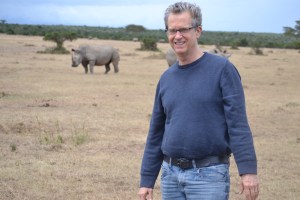
Pearson at Solio wildlife sanctuary: “Time and time again I was a matter of 15 yards from these rhinos.”


White Bone’s plot centers on elephant poaching in Kenya. How did this issue come to your attention?

I heard a statistic about elephants, and it really shocked me. In 2014, the first real decent study documented that 100,000 African elephants had been killed in three years. One of every 12 African elephants had been killed by a poacher in 2011. Three-quarters of local elephant populations are declining. In nine years, there would be no more wild elephants in Africa.

Then I met Mikey and Tanya Carr-Hartley, who run a four-generation-old guiding service in Kenya. Eventually I went, under their care, to Kenya to do interviews and see the country and dig into the poaching, and my hair was blown back.

I interviewed 24 people over the course of three and a half weeks, and 23 of them in some way lied to me. These were very trustworthy sources, including our own (U.S.) State Department. Finally, my last interview was an activist lawyer, and we went through my interviews and she told me point by point who had fabricated what. My jaw dropped. There I’d been digging into this to help everyone, and in some way or another everyone had manipulated the truth.
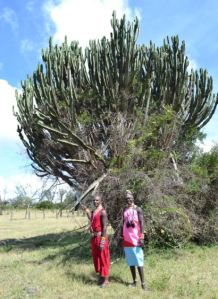
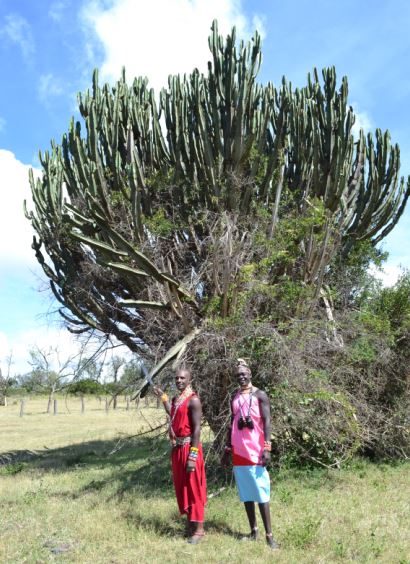
“My guides Ole and Charcoal.”


It was eye-opening, and dangerous. I was in Nairobi when there was a terrorist blast that killed 18 people. I was at a lodge when poachers killed a rhino 300 yards away from me while I slept. There’s a scene in the book where Grace runs into these herdsman, and they try to rape her. Those were two guys I ran into when one of my guides had to go get a vehicle and I was left–by my own choice–and within 10 minutes I ran into these guys, and they did not like me. It was 20 or 30 minutes of, oh boy, all he has to do is lift that spear and I’m going down.

Is there a point at which research makes it harder to write fiction?

My approach is “faction.” My charge is to suspend your disbelief, and I think it works best if I put more fact in than fiction. I do a lot of research. I learned about a guy who was investigating poaching and was a pilot over Mt. Kenya, and his plane happened to go down. A lot of people think that plane was sabotaged; it’s never been proven. I told that story, where a guy was killed in the bush who had been investigating. I just made it a little more palpable and believable for the reader.

Were you searching for John Knox and Grace Chu’s next case, or was this something you needed to write about first, and they were the best fit?

The latter. I just wondered if I could put Knox and Chu into Africa, and what that would look like.

“Ole showed me every plant that could kill you, every root that could heal you: it was unbelievable. I based all that information with Grace off my days with Ole.”


I’ve written 51 books. And I haven’t done this for probably 20 years, but I actually wrote the entire book and put it aside and started over. I just wasn’t buying my own story. It wasn’t lighting me up. And it wasn’t the story my editor (Christine Pepe at Putnam, who’s just one of the greatest editors who’s ever lived) wanted. So I stepped back and thought: What am I doing wrong here? I’ve always wanted to do a book about a person out in the wild with nothing. I’m an Eagle Scout, so I’ve gone through some of this in my own teens. When Ole, my guide, told me that a white person wouldn’t last 24 hours in the bush, I said, well, how could I last 24 hours in the bush? He showed me every plant that could kill you, every root that could heal you. It was unbelievable. I based all that information with Grace off my days with Ole.

How did you handle characterization?

I felt a great depth of participation with Grace because of her circumstances. I think this is the book where readers of the series will go, “Oh, that’s the Grace I’ve been waiting for.” I learned a lot about her. She has a lot of stick-to-it-iveness that I really wasn’t sure about. She’s an accountant by trade, but she went through the Chinese army training, and had some short-lived intelligence experience. So I always sensed that she had this potential. This book was her chance to be out on her own, investigating something that’s a little more money-oriented than pure fieldwork, and then it ends up Fieldwork with a capital F. In previous books you never really got in with Grace and felt her, and were afraid or proud or achieving with her.

The challenge is not to put everything in. In my fieldwork, there were some amazing moments. I had an encounter with one of the people who had lied to me. On the very last night I was there, he came up to me at a party and said, “Hey, listen. I’m terribly sorry about how I played that when we were at Solio.” And I said “Yeah, so am I!” But at least he was man enough at the end to come up and say, “Sorry I just lied to your face.” That was a very emotional moment for me. And you can’t get them all in.

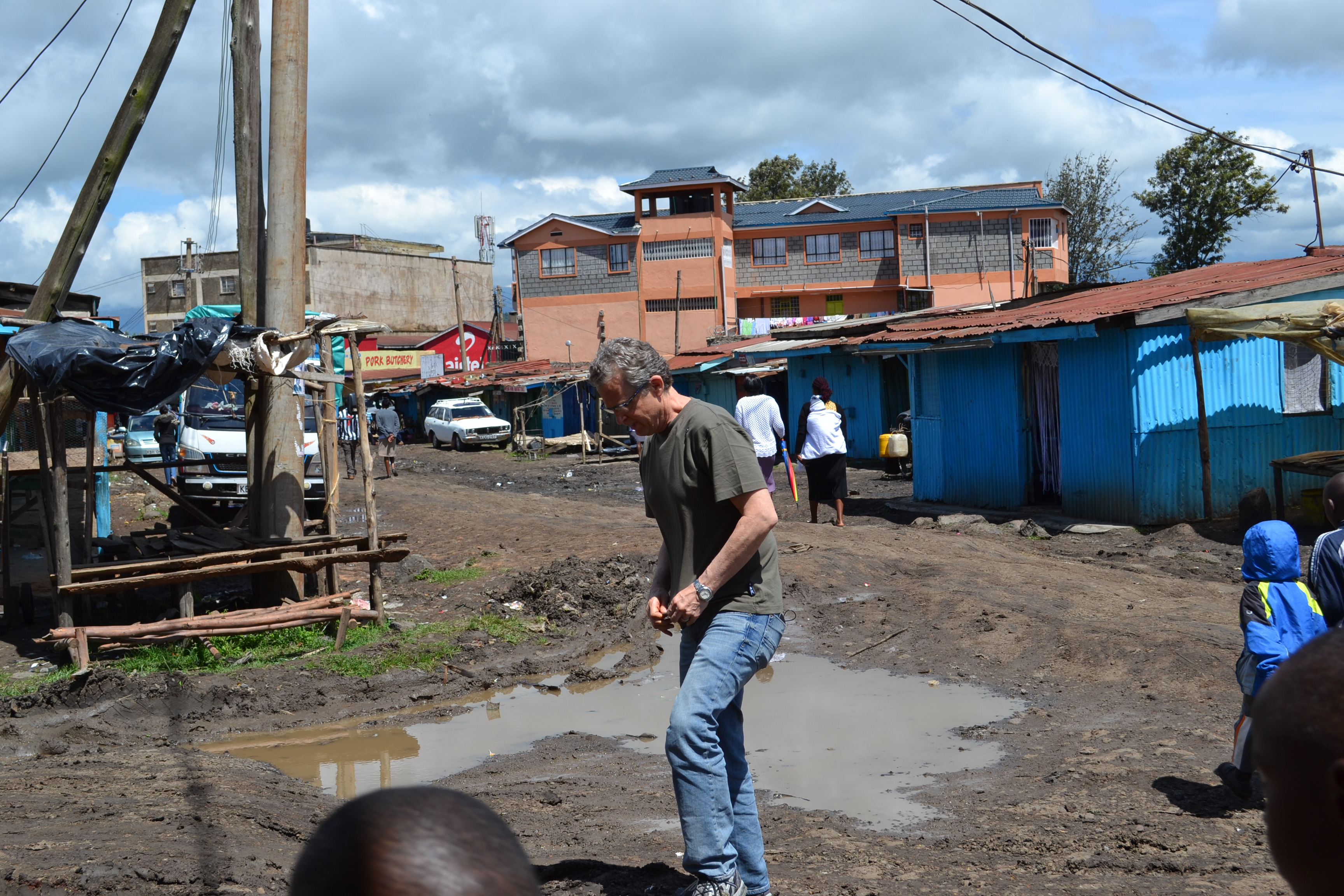
“This is me in what they call a ‘nice’ town near Solio Lodge.”


You regularly write realistically about violence, depravity and corruption. Is this emotionally difficult?

I think you pay for it.

Every day for two years as I wrote this book, these images hung in my head. These stupid idiots come in with automatic weapons on ATVs, they massacre the elephants, they chainsaw their faces off for the tusks, and they’re gone in 15 minutes. For all the dark that Grace and Knox went through, those are the images that haunted me. When you’re there and you see these animals, just how majestic they are–it’s absolutely despicable.

I want to route some of the money from the book there, and get some people at the end of the book to say, “I’ll send $10 to them”–it doesn’t have to be $100,000. It’s just bizarre to me that this is going on, and none of our grandkids will see elephants except in a reserve or in a zoo. An elephant is being killed every 15 minutes, and has been since I started this and long before I started this.

That was the darkness I lived with. Everything else was manufactured. I’ve done a lot of research over 30 years. I’ve been inside the mind of a lot of devious criminals. I’ve spent time in prisons for the criminally insane. I’ve interviewed forensic psychiatrists who have themselves interviewed 140 mass murderers. I’ll say, this is what my guy did, who is he? And we’ll be eating dinner, and the stuff they describe stops me from eating. So there is darkness. And I pay for it.


This interview originally ran in the July 29, 2016 issue of Shelf Awareness for Readers. To subscribe, click here, and you’ll receive two issues per week of book reviews and other bookish news.

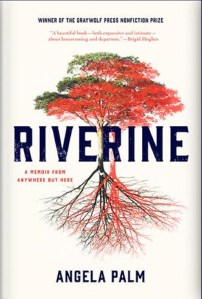
Riverine: A Memoir from Anywhere but Here by Angela Palm

This memoir of a difficult upbringing in the heartland deals also with broader questions of place and free will.

riverine

Vermont editor Angela Palm grew up in a struggling rural Indiana community on the banks of the Kankakee. The river had been straightened to yield farmland, but it frequently flooded back to its original shape, turning each house into an island. Palm’s greatest happiness lay in her love for the boy next door; she fell asleep each night watching him through their bedroom windows. She dreamt of escaping her troubled home life, even without a clear idea of what escape might mean. And then the boy next door was sentenced to life in prison for a horrible crime.

Riverine: A Memoir from Anywhere but Here is Palm’s exploration of her roots and her journey away from them. By a complicated and sometimes messy route, she escaped rural Indiana, but the separation remains incomplete. Even with a family and creative life of her own, far from her hometown, she is pulled back, perhaps most of all by that boy next door, Corey.

Three parts form Riverine: Water, Fields and Mountains. In a blend of storytelling chapters and braided essays, Palm takes the reader chronologically through those environments of her life. Without clear plans, she nevertheless strives for a future free of obligation to her past, while also looking back, trying to understand its causes and effects. As a criminal justice student, for example, she contemplates theories for explaining criminal actions: behavioral, psychological, economic and policing theories, the broken windows theory and the biological theory of deviance. These she experimentally applies to Corey’s crime. Along the way, she repeatedly asks herself “how I loved a person who could do this and why I didn’t see it coming… why I still feel the loss of you in my life.”

Palm’s memoir is not only the story of her life and the divergent parallel life Corey has led, but also an examination of how place forms a person. “The need to look at other landscapes for clues about what already lies within us is real.” Much of her figurative journey away from the gritty setting of her youth has taken place through literal travel and relocation. Tellingly, Riverine begins with a child studying a map. Palm recognizes in herself “a fascination with selvage, run-down places and meaningful interactions with strangers… scarred lands and depressed buildings.” She seeks out abandoned spaces, looking for insight in damage.

Her writing is easy to read, compelling and draws the reader in with its momentum. Riverine is about self-determination, the origin of deviance, and places, particularly the liminal ones. “Fringe investigation was the science of my neighborhood and of my art.” Palm’s story is yet unfinished, but her memoir has an admirable structure and art of its own.


This review originally ran in the July 21, 2016 issue of Shelf Awareness for the Book Trade. To subscribe, click here.


Rating: 8 broken windows.

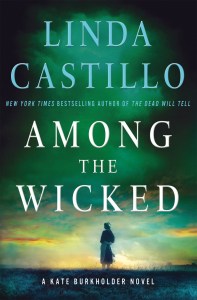
Among the Wicked by Linda Castillo

A gutsy police chief goes undercover in Amish country, reentering a life she thought she’d left behind.

among the wicked

Linda Castillo’s Among the Wicked continues the serial adventures of a likable detective with an unusual background. Kate Burkholder is chief of police in Painters Mill, Ohio, a community more than half Amish. Her relationship with that faith, which she left as a teen, both pervades and complicates her work. She speaks Pennsylvania Dutch and understands the culture, but many resent her desertion. When a young girl dies under suspicious circumstances in the particularly insular Amish community of Roaring Springs, N.Y., Kate is the obvious choice to go in undercover. Her boyfriend, also a cop, has misgivings, but as her fans know, Kate won’t step down from a challenge–or a chance to help.

To enter this secretive society, which is led by a powerful, charismatic and possibly dangerous man, Kate must assume an identity that closely resembles one she might have lived. She poses as a widow, making new friends as well as new enemies. As she nears the frightening truth of Roaring Springs, Kate’s experience among the Amish drives her to reconsider her decisions regarding the faith.

Romantic developments in Kate’s personal life sweetly offset the disturbing events in this engrossing novel. Castillo’s skills are broad. Despite its deceptively quiet setting in Amish country, Among the Wicked is a high-speed, adrenaline-filled case of terror and intrigue: fast-paced and plot-driven, but with nuanced characters and an eye for detail where many thrillers slack off. This gritty mystery will equally satisfy fans of the Kate Burkholder series and first-time readers.


This review originally ran in the July 19, 2016 issue of Shelf Awareness for Readers. To subscribe, click here, and you’ll receive two issues per week of book reviews and other bookish news.


Rating: 8 stitches.

The Jolly Roger Social Club: A True Story of a Killer in Paradise by Nick Foster

A chilling tale about an expat American in Panama whose murderous crimes went undetected for years.

jolly roger

Journalist Nick Foster explores a backwater archipelago of Panama in The Jolly Roger Social Club: A True Story of a Killer in Paradise, a work of true crime and national history. As he investigates the serial killer known locally as Wild Bill Cortez, Foster asks: What is it about this expat society, or this place, that allowed these events to unfold?

William Dathan Holbert was originally from western North Carolina, where he showed an early disrespect for the law and his friends. Foster’s investigative work follows a young man who defrauded his mentor and experimented with white supremacy before running for the border with his girlfriend, Laura Michelle Reese. But it was in the small village of Bocas del Toro in Panama that he came into his own, eventually killing a number of fellow American expatriates for their cash and real estate. On the property of an early victim, he opened a bar called the Jolly Roger Social Club (“over 90 percent of our members survive”), where he groomed future victims. Holbert and Reese still await trial in Panama.

The Jolly Roger Social Club intersperses Holbert’s crimes with Panamanian history, from the building of the Canal to Manuel Noriega’s dictatorship and its ties to United States politics and economics. With this broader perspective and interviews with expats in Bocas del Toro who knew “Wild Bill,” Foster explores the factors that provided Holbert with the setting where his crimes went undetected for years: a remote corner of the Caribbean where people sometimes simply… disappear.


This review originally ran in the July 15, 2016 issue of Shelf Awareness for Readers. To subscribe, click here, and you’ll receive two issues per week of book reviews and other bookish news.


Rating: 7 signatures.

Playing Dead: A Journey Through the World of Death Fraud by Elizabeth Greenwood

This engrossing inquiry into faked deaths introduces curious characters and a litany of questions about life.

playing dead

Elizabeth Greenwood had recently quit teaching public school in New York City to return to school herself, and her student loan debt had hit six figures. She was feeling desperate, trapped and bored with her day-to-day existence. When a friend made a joke about faking her death to get away from it all, she was intrigued.

The idea became the research project that consumed her time and imagination for years, and resulted in Playing Dead: A Journey Through the World of Death Fraud. Greenwood explores the world of pseudocide from several angles. She speaks with several subjects of infamous botched cases, but fails to identify any successful fraudsters (by definition, they are hard to find). She visits with the investigators who pursue these attempted frauds on behalf of the insurance companies frequently scammed (“His workplace, in a way, is the DMV of death”), as well as with professionals in the field of helping people disappear. She also cozies up to a passionate “Believer” in Michael Jackson’s epic prank: that the singer is not dead at all, but in hiding, sending coded messages to his fans. When Greenwood sits down with family members who have been left behind, she finds the most damage inflicted. Finally, in the Philippines, she sets out to purchase her own death certificate.

Initially Playing Dead asks: Is this deception possible in a modern era of closed-circuit cameras, digital signatures and the inerasable Internet? Is it better to fake death, or simply to disappear? Are those who get caught really “morons and idiots,” as one specialist asserts? By the end of her journey, though, Greenwood asks different questions. Why are pseudocides overwhelmingly male? Is this an act of sacrifice or ego? “Is transformation without annihilation possible?” By the epilogue, she has reconsidered, for herself at least, which is preferable: a difficult life or a false death.

Along the way, she acquires a few tips: keep your first name when you take on a new identity. Stay in disguise. Don’t bother with a surrogate body. Quit driving altogether. Disappear on a hike, not into the ocean. And whatever you do, don’t assume you can return home to family and friends after just a few years dead. The exercise of seeking pseudocide for Greenwood, “acts as a gentle reminder that our realities are far from fixed.”

This energetic exploration of a world many readers may not have ever considered is perhaps slightly macabre, but ultimately very human; it is a questioning of how we seek satisfaction in life, and when we cut and run. Greenwood’s narrative voice is humble and approachable, but as an investigator she is tenacious, going the distance–to death and back–to bring this oddly fascinating story to her readers. Playing Dead will please those attracted to the eccentric, as well as anyone who has ever fantasized about leaving it all behind.


This review originally ran in the July 12, 2016 issue of Shelf Awareness for the Book Trade. To subscribe, click here.


Rating: 7 cars.

Ithaca: A Novel of Homer’s Odyssey by Patrick Dillon

This retelling of the Odyssey gives Telemachus more voice than ever before.

ithaca

Homer’s Odyssey recounts Odysseus’s 10-year journey home from the Trojan War, to where his wife and son await him. His adventures along the way take center stage. Ithaca, Patrick Dillon’s retelling, resets that center to the son. With substantially more insight into Telemachus than readers have had before, this version also offers a more fallible Odysseus, with all the drama and yearning of the original.

Dillon remains true to Homer’s setting, but the novel is told in Telemachus’s voice, and the weighty absence of a father he never met defines his existence. At 16, he worries over his role and responsibilities, and his inability to protect his mother: he has no one to teach him how to fight. These interior workings bring Odysseus’s iconic son to light as a nuanced and fully formed character. When the wise warrior Nestor assigns his daughter to be Telemachus’s traveling companion, the story gets an appealing twist: Polycaste is headstrong and capable, and her friendship has much to offer Telemachus. The gods are less present this time around; Telemachus is openly dubious. Veterans of the Trojan War roam Greece as bandits and vagabonds.

Though only slight details are changed, Ithaca is a vibrant and fresh revival; Telemachus’s struggles are illuminated through the use of his own voice. The well-loved classic is present: Penelope is beautiful, determined, fading; the suitors are shocking; Menelaus and Helen fight bitterly; the aging Nestor tries to guide Telemachus true. Dillon’s achievement is in characterization while retaining the heart and passion of Homer.


This review originally ran in the July 8, 2016 issue of Shelf Awareness for Readers. To subscribe, click here, and you’ll receive two issues per week of book reviews and other bookish news.


Rating: 8 arrows.

Paraíso by Gordon Chaplin

Set in Mexican “Paradise,” this moody novel combines fantasy, noir and the complexities of every form of love.

paraiso

Paraíso is an atmospheric novel both realistic and rooted in fantasy, traveling from New York City to Baja, Mexico, and exploring the nuances of love in all its forms. Gordon Chaplin (Joyride) offers a cast of whimsical, imperfect, loveable characters that readers will not soon forget.

As children, they were almost preternaturally close. Their mother named them Peter and Wendy, perhaps an early sign of something odd in family undercurrents. As teenagers, they stole the family minivan and ran for Mexico, but they never made it, apprehended instead at the very point Huck Finn and Jim aimed for.

These episodes are visited in flashbacks, from a present in which Peter and Wendy have been estranged for a decade, over a mysterious family secret. Wendy has finally made it to the little Mexican town of Paraíso, on the Baja peninsula, where she finds herself at the intersection of love and peril. Peter fled New York City after the towers fell, seeking his lost sister. They circle one another as Paraíso nears its conclusion, joined by charismatic associates, friends and lovers. These include Wendy’s best friend, who has been the siblings’ go-between for years; a sinister half-Mexican auto mechanic; an artista from Mexico City; and a teenage girl Peter mentors at work. The momentum of this expertly paced noir fairy tale increases as it nears its denouement.

Gorgeous, vivid scenery and fascinating people enrich a story that is both eccentric and universal: how to love and how to handle betrayal.


This review originally ran in the July 5, 2016 issue of Shelf Awareness for Readers. To subscribe, click here, and you’ll receive two issues per week of book reviews and other bookish news.


Rating: 7 letters.