Maximum Shelf: Vladímír by Julia May Jonas

Maximum Shelf is the weekly Shelf Awareness feature focusing on an upcoming title we love and believe will be a great handselling opportunity for booksellers everywhere. The features are written by our editors and reviewers and the publisher has helped support the issue.

This review was published by Shelf Awareness on October 18, 2021.


Julia May Jonas’s Vladímír is a compelling debut, discomfiting and riveting, and timely in its themes. With dark humor, pathos and sly references to art and literature, this smart, edgy novel challenges assumptions and forces fresh perspectives.

In small-town upstate New York, an unnamed narrator teaches English at a small college. She lives an easy enough life, reading, writing, teaching, exuding “Big Mom Energy” and enjoying the admiration of her students, whose earnest eagerness for improving the world she appreciates. Then a scandal erupts: her husband, John, chair of the English Department, is revealed to have had sexual relationships with a number of his former students. The narrator herself is quick to point out that these all took place before such relationships were explicitly forbidden. She and John had always had an understanding about their extramarital activities. She is surprised to find that her colleagues and students disapprove not only of John but of the narrator as well, and finds herself increasingly resentful: of John, of the academic machine, of her students and of herself.

Into this upheaval comes Vladimir Vladinski, newly hired junior professor and up-and-coming experimental novelist. Vladimir is 20 years or so the narrator’s junior, sexy, flirtatious and married. The narrator is quickly captivated, then obsessed. A two-time novelist with generally disappointing reviews, she has largely turned to literary criticism and book reviews, but now feels inspired to write fiction again. For the first time she feels the work flowing from her effortlessly, and credits Vladimir as her muse. “There was a burning in my body, an extra level of excitement keeping part of me fed and running that required no sustenance. It was longing for the love of Vladimir.” She writes, masturbates and surreptitiously follows Vladimir one day and her beleaguered husband the next, and then even Vladimir’s wife–beautiful, traumatized, a masterful writer herself. Sexual, romantic, literary and workplace jealousies overlap. Things fall apart: John’s hearing (people keep calling it a trial) at the college looms as their already distant and fractured relationship continues to crumble. Their adult daughter moves back home, in dual personal and professional crises of her own, which throws the narrator into new light as a mother. She neglects her work, becoming increasingly reckless until, consumed by her fantasies, she finally commits a shocking act that precipitates a life-changing event for all involved.

That this narrator is a 58-year-old woman is significant, and provides opportunities to consider issues of gender, age, societal and literary expectations and subversions. Her troubled body image provides an undertone from the very first pages, with near-constant references to weight control and her evening skin care regimen. “I prefer to conceal my neck,” she confides, as she compulsively grooms and criticizes her body before each meeting with Vladimir. “A man could always make me feel worse than anything a woman could ever say to me,” she reflects, as she struggles to align her own sexual revolution with the values of her students. Vladímír questions gender and generational tensions, and the intersection of art and morality within the bubble of academia. In the family, household and larger social realms, it addresses every permutation of human relationship and the relationship between power and desire, while also carrying a strong thread of disturbed body image and issues around aging. In other words, this novel is as varied and harried as life.

As a novel so rooted in English departmental affairs should be, Vladímír is also jam-packed with literary references. Vladimir is compared to Jay Gatsby. “Enraged at my vapidity,” the narrator laments, “I forced myself to sit down and read several articles in the latest issue of the New York Review of Books.” Insisting she’s not jealous or bitter about her own novels’ failure to impress, she notes however that “Margaret Atwood wrote exciting books that practically lived inside of a uterus.” Vladimir’s wife says of her own mental health struggles, that her story is “like Nurse Ratched, like Girl, Interrupted, like The Bell F**king Jar.”

Jonas’s narrator has a strong, assured voice, incisively thinking through her decisions and the surrounding issues while simultaneously–and with self-awareness–mucking up her life. The narrator and the novel take on any number of thorny topics. Were the college students who slept with John seizing agency and free love in an empowered, feminist stance? Or were they taken advantage of by an older man with the power structure on his side? What are the pros and cons of an open marriage? Is our cultural hang-up about intergenerational affairs perhaps a little overblown? Some of these questions and perspectives are decidedly uncomfortable, but Jonas consistently pushes those edges, leaning always away from easy answers and toward nuance. Vladímír‘s central characters are rarely likable but they are always captivating; this story harnesses formidable momentum to pull readers through even its most uncomfortable moments. It is a rare victory in a novel to wrestle with such prickly issues and yet be as entertaining as this. Jonas’s prose is clear, forceful and unflinching, and highly sensual: food, drink and sex are ever-present and frankly, complexly evoked.

The narrator writes of Vladimir’s own debut: “The book was funny, clear, awake, vivid. The prose was spare but the voice was not sacrificed in his exact word choice. It felt both like life and beyond life.” The same comments might be made of Vladímír, a clear-eyed treatment of academia and the human condition.


Rating: 7 caipirinhas.

Come back Friday for my interview with Jonas.

The Everybody Ensemble: Donkeys, Essays, and Other Pandemoniums by Amy Leach

Amy Leach’s signature playful style, joyful humor and wise questioning of the universe delight and fascinate in these 23 essays, her second such collection.

With The Everybody Ensemble: Donkeys, Essays, and Other Pandemoniums, Amy Leach (Things That Are) takes her readers on a playful, rigorous, mind-bending romp through human nature, the natural world, spirituality and more. Her perfectly singular voice sings the most surprising notes in an imaginative blend of silliness and seriousness.

This sophomore collection of 23 essays opens with its title offering, in which the narrator welcomes all 20 quintillion animals to the Everybody Ensemble. How will they be arranged and organized? What songs will they perform? Leach glories in lists of the unlikely, the weird and the underappreciated: “speckled and plain, perfect and imperfect, indigo-feathered, green-skinned, orange-toed, squashed of face, cracked of shell, miniature of heart, young as ducklings, old as hills, everybody raise your sweet and scrapey, bangy, twangy, sundry, snorty voices.” This embrace of enormous, diverse multiplicity serves as appropriate introduction to an ecstatic exploration of “everybodyism.”

Leach employs a huge range of rhetorical devices while retaining a sense of whimsy and plain fun. Her genius perhaps shows best in her selection of the singular, startlingly unexpected detail. Adept as she is at wordplay, Leach’s writing goes much deeper than that, wondering and speculating at larger questions. In “The Wanderer,” she considers how to critique the extravaganza show called Earth, “already in production for five million years now” but unfinished. The artist of this show has strengths (facility and versatility), but “imagination unchecked can result in a mishmash.” If only “we could just establish the genre, whether this is supposed to be comedy or tragedy or romance or what,” we could make sense of the effort. Don’t be misled by her joyful absurdity or wit with words: Leach is deadly serious in her questioning of the cosmos, Earth’s composer and whether “even with all the troubles of our time, maybe it can still be fun to be a frog.”

“O Latitudo” ponders the imagined choice of a supervolcano: to erupt or to self-suppress, “consequently composing a gassy, burpy, muddy Ode to Joy.” “In Lieu of a Walrus” offers a list of writers to whom one might turn when the first-choice interlocuter is unavailable, including Hafiz, Ovid and God. “Green Man” honors the mesquite tree, loved by few, who has been given “the freedom to dig his own disputable way.” “Beasts in the Margins” considers the more incongruous illustrations of 14th-century books of psalms: “Who let the monsters into the psalter?” These and other essays range widely in subject matter but accrue to a meaningful whole. Leach is smart, effervescent, earnest and funny. Her voice is perfectly unmistakable, her themes expansive; her prose glitters. The Everybody Ensemble is a revelation.


This review originally ran in the October 14, 2021 issue of Shelf Awareness for the Book Trade. To subscribe, click here.


Rating: 9 extracommercial tigers.

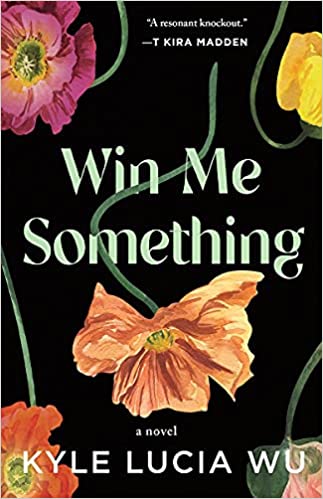
Win Me Something by Kyle Lucia Wu

A young woman must chart her own way, even while quietly craving belonging and home, in this subtle, wise debut.

Kyle Lucia Wu’s first novel, Win Me Something, is a wrenching evocation of yearning in a slim, artful package. The story of Willa Chen, a young woman unmoored in New York City, is defined by liminal spaces and a wish to belong.

In the opening pages, Willa interviews to become a nanny to a wealthy family in Tribeca, even though she can’t quite conceive of what a nanny does. “Maybe I couldn’t imagine these moments because when someone asked about my childhood, my mind clenched and closed like two fists in a pool–fingers squeezing for something to come up with when everything around them was a different kind of matter.”

Willa’s father is a Chinese American immigrant whom she barely knows, her mother a blonde-haired white woman, detached and depressed, who can’t comprehend the microaggressions her daughter faces. Since their divorce when Willa was very young, each has begun a new family, and she feels she belongs to neither. Thus adrift, she enters the Adriens’ household, where she cares for the charming, innocently privileged, nine-year-old Bijou, who studies Mandarin and the violin and cooks coq au vin. Willa feels as unbelonging as ever, but also entranced by the family’s ease, their wealth, their things. “When I looked around their apartment, my veins filled with rushes of want, as if I could see the price tags on everything, as if they would increase my own value.” It’s not that Willa is materialistic, but that she is drawn to the idea of worth suggested by those around her: “I often found myself in friendships with people like this, self-absorbed and sparkling.”

Readers will be engrossed by Willa’s troubled desire to please and her pervasive unease, as she seeks and then deflects the slightest attempt at connection. As she begins to meld into the Adriens’ household, she reconsiders her own childhood and family homes in a series of flashbacks. The subtle racism she encounters is but one thread of Willa’s distress; her estrangement from both of her half-families, and her half-hearted attempts to join the Adriens’, presents a greater challenge on its face, but also stands in for the larger estrangement she feels everywhere she goes, as the in-between spaces of family and race in culture echo each other.

With an eye for just the right detail, Wu offers an understated protagonist, self-defeating but still searching. Win Me Something is a nuanced story of longing, of the paired desires to belong and to strike one’s own path. Willa is a quiet heroine, but unforgettable.


This review originally ran in the September 28, 2021 issue of Shelf Awareness for the Book Trade. To subscribe, click here.


Rating: 7 dresses.

Maximum Shelf author interview: Xochitl Gonzalez

Following Friday’s review of Olga Dies Dreaming, here’s Xochitl Gonzalez: Essential Characteristics.


Xochitl Gonzalez was an entrepreneur and consultant for nearly 15 years before earning her MFA from the University of Iowa Writers’ Workshop, where she was an Iowa Arts Fellow and recipient of the Michener-Copernicus Prize in Fiction. She won the 2019 Disquiet Literary Prize and her work has been published in Ninth Letter, Joyland magazine, Vogue and The Cut. She serves on the board of the Lower East Side Girls Club. A native Brooklynite and proud public school graduate, Gonzalez received her B.A. in Fine Arts from Brown University, and lives in Brooklyn with her dog, Hectah Lavoe.

You beautifully handle an immense amount of content–personal, family/community and geopolitical. How do you keep all those threads straight?

Xochitl Gonzalez (photo: Mayra Castillo)

From a conceptual standpoint, something that really frustrates me about the political situation in our country and in the world is that, for my friends of color, things feel very personal. The personal is political for lots of us. It’s not just a news story. The genesis of this topic is that I had been planning to go with my friends to Puerto Rico for my 40th birthday, and the whole trip got canceled because my birthday fell between Hurricanes Irma and Maria.

In terms of the technical, the answer is that I was a really good wedding planner. You can’t really lose threads–like, wait, I never called the band back! Gut instinct, we should pick this up again, you forgot about this thing.

To be super technical, part of the divinity of this project: I got to Iowa when I was halfway through the first draft, and Sam Chang was doing a novel workshop. She showed us how she’d outlined points of tension in The Brothers Karamazov. (Her new novel, The Family Chao, is somewhat of an interpretation of that book.) I went back and I did that: wrote every point of tension, and I broke down every chapter and if I felt that I’d dropped a thread, or it had gone on too long since you’d heard a note of it, I went back in revision and cleaned that up.

Olga is certainly at the center of this story, but she’s not the only one. Why switch perspectives?

That was really important to me, and I got a lot of pushback originally. If you really want to be nutty about it, Pink-Floyd-listen-to-the-album-backwards type of thing, every character represents a different political point of view. I don’t want to bog us down, because you don’t have to get that to enjoy the novel. I needed to have Prieto’s point of view because I felt it was important to see the different ways that people can experience their Latinidad and their Puerto Ricanness, and relate to a place that they are extended from. Within a family, I’m always so fascinated by the different ways that a trauma can be experienced by someone four years older, or younger. And of course, [since he’s] a queer man, I wanted his perspective voiced. I think it’s an important perspective in our community.

Dick is representative of America’s role in Puerto Rico, which is passive ambivalence. In his mind he’s just kind of doing what he wants. He’s just moving through the world, looking out for his objective, not actively seeking harm but just not considering the byproduct, right? It’s an exploitative relationship that he has with Olga. I thought it was important to voice that.

What makes Olga so magnetic, do you think?

She is so flawed but keeps trying. She fails but keeps trying. And she’s got humor.

I was thinking about all the characters that kept me company when I was young. Esperanza in The House on Mango Street, Franny Nolan in A Tree Grows in Brooklyn, Anne in Anne of Green Gables, all these plucky young women. When I got to be a certain age I had nobody to turn to, and I was like, what happened to Esperanza? I wish I knew. I imagined what qualities that person would have to have. She would have to be ambitious and have a sense of humor to weather the circumstances, the uncharted territory. And strength, because she’s headed places that nobody’s been to and nobody can warn her about, and every step she gets a little further from home, right? That humor, and her resilience–that’s one of the essential characteristics of Puerto Rico. She’s lived so much and just keeps going, with humor. Like a lot of us, a lot of her life, she hasn’t been self-actualized. And this discovery of power is one of the beautiful things about being an American: we actually have some say.

Your various settings share such detail, and such love for these places.

I am a rooted Brooklynite, but I love both places. My Puerto Rico got better on revision. During my winter break my first year of Iowa, I went down and stayed in a one-room Airbnb with a roof deck in San Juan and I wrote out in the sun. I wrote day and night. I walked and I went on trips, and that helped me get it more detailed. I watched a lot of videos of the hurricane and did a lot of visual research.

For Brooklyn, it’s in my soul. I bleed. I had to correct the record. I’ve been reading Brooklyn so much the last couple of decades, and I understood that Brooklyn, because I’ve gentrified myself, right? I know that that exists. But I needed people to see my Brooklyn, the Brooklyn that’s being taken away by gentrification. I wanted to write it tenderly because I feel tender about it. I hadn’t been back home, because of the pandemic, for months, and when I came back I was counting the places that had been torn down. There’s a sense of it fading away, and I felt angry, and I wanted to preserve it with love. I wanted people to see that place that is rooted in working-class families and the rhythms of that kind of life. I wanted to pay homage to that before it changes even more.

Is this a novel with a message to convey, or a novel of individual human stories? Or are those false categories?

I feel polemic writing reverse-engineers a story around a message. It’s the difference between having an agenda versus an organic unfurling of story.

Elizabeth Bowen has an amazing essay on novels, and essentially it says the character is the root. Character makes plot inevitable. I knew who Olga was. I wanted to talk about a Latina woman with some agency and some power but that still is trying to walk in the world with some difficulty, and I knew I wanted to make people give a bit of a sh*t about Puerto Rico. We should care that we have a colony, and because you’re born happenstance one place you have fewer rights than somebody born a three-hour flight away. That should upset us, as people, as Americans. So, character makes plot inevitable. When they hit the circumstance, they can only act in one particular way. This is a book about characters that were specifically chosen to have the background they have because I wanted to discuss what was of interest to me–governance and the experience of Latinx people in the States and in the diaspora. So it’s a bit of both, but it’s designed to be about characters, and they’re engaging around this time, and I picked that point of time to make this all of concern to me. But I didn’t know in the beginning how it would all play out.

I’m so excited about this novel, Xochitl.

It’s very touching that it’s resonated with people who are so different from me and my life experiences, and that’s the beauty of art, right? You take the stuff that happens in life and you turn it into this other stuff that people can appreciate. It’s a powerful thing, really.


This interview originally ran on September 15, 2021 as a Shelf Awareness special issue. To subscribe, click here, and you’ll receive two issues per week of book reviews and other bookish fun.

Maximum Shelf: Olga Dies Dreaming by Xochitl Gonzalez

Maximum Shelf is the weekly Shelf Awareness feature focusing on an upcoming title we love and believe will be a great handselling opportunity for booksellers everywhere. The features are written by our editors and reviewers and the publisher has helped support the issue.

This review was published by Shelf Awareness on September 15, 2021.


Xochitl Gonzalez’s Olga Dies Dreaming is a scintillating, eye-opening story of family, legacies, and political and individual struggles, set in contemporary New York City and Puerto Rico. Readers will be entirely captured by Olga and her family, friends and associates as this spellbinding narrative twists, turns and unfolds over the years and miles. Gonzalez’s stunning first novel feels far more expansive than its not-quite-400 pages.

Olga Isabel Acevedo, Brooklyn-born child of Puerto Rican parents, is an ambitious, status-conscious wedding planner to New York City’s upper echelon. “Using a traditional American metric for measuring success,” she is winning: she left the family home for a fancy New England college, has her own business and enjoys a certain amount of fame via glossy magazine and television appearances. She has a large, close-knit family still based in Brooklyn’s Sunset Park, but with several holes in it: her loving and beloved father, once a proud political activist and member of the Young Lords, now dead from drug addiction and AIDS; her late grandmother who raised her; and most troublingly, Olga’s mother, Blanca, a militant radical who left the family when Olga was not quite 13. “Achieving liberation will require sacrifice,” Blanca wrote to her young daughter. Olga’s involuntary sacrifice in service of Puerto Rican liberation was to give up her mother to the cause.

Crucially, Olga still has her older brother, Prieto, with whom she is very close. If Olga is a star as wedding planner to Manhattan’s upper crust, Prieto is a supernova, the handsome, popular young congressman representing their neighborhood in Washington: “He wasn’t quite code-switching so much as he managed, miraculously, to speak several languages simultaneously, creating a linguistic creole of hip-hop, academia, contemporary slang and high-level policy points that made Olga marvel…. Olga herself had never learned this linguistic mezcla that her brother had perfected; this ability to be all facets of herself at once. She always had to choose which Olga she would be in any given situation, in any given moment.”

However well her career is going, Olga feels a void. Blanca writes to her frequently (via go-betweens, from an undisclosed location) to excoriate Olga for pursuing the meaningless, superficial goals of white society rather than working toward liberation for la raza. Prieto, apparently fighting the good fight (if only, their mother writes to him in turn, from inside a broken system), has his own demons and secrets as well.

The plot of Olga Dies Dreaming sees several delicate balances begin to upset. Olga’s surface-level achievements show cracks as she questions what she’s actually working toward. She meets a man she may truly like, which exposes a weakness: her people skills, so polished at work, don’t hold up to a situation with real stakes. Prieto’s carefully maintained façade falters, one of his secret insecurities threatened. When Puerto Rico is gutted by the one-two punch of Hurricanes Irma and then Maria, Olga takes a few hits herself. Can she navigate a romantic relationship? Will her brother withstand the latest storm in his private life–and is their bond up to the challenge? Perhaps most significantly: what does Olga have to gain–or lose–if her long-absent mother chooses these turbulent times to make a reappearance?

The masterful Olga Dies Dreaming roams far and wide, encompassing the most obnoxiously petty, overindulged weddings of the 1% and the dire straits of rural Puerto Ricans lacking clean drinking water, food or electricity. Such range could get unwieldy in less capable hands, but Gonzalez has a firm grasp of her plot threads. With lively, clever prose and adept political commentary, this novel asks questions about race and assimilation, about government corruption and capitalism, about gentrification and family duty. Olga, Prieto, their aunts and uncles and cousins, Olga’s work associates, casual sexual partners and her new bae: likeable, appalling and everything in between, these characters sparkle with authentic detail. While this is Olga’s story, the point of view does sometimes shift to offer Prieto’s perspective and a few others. Readers (uncomfortably) get inside the head of a deeply unpleasant man of great privilege, for example–aptly named Dick–as well as that of our heroine. Gonzalez is also expert with setting, as her novel travels from the peculiarly organized hoarder apartment of Olga’s love interest to an impressively high-tech rebel compound in the Puerto Rican jungle, an opulent Easthampton beach house and more.

From Blanca’s mysterious and blistering missives come political and ideological rhetoric and intellectual challenges. Olga was named for Olga Garriga, activist for Puerto Rican nationalism, but also hanging over her is the story of Olga from poet Pedro Pietri’s “Puerto Rican Obituary,” who “died waiting dreaming and hating.” These are the extreme options she’s been offered: Blanca’s rigid revolutionary ideal or the unattainable, swank American dream. Instead, in the end, Olga must chart her own path to a third option, one where she might finally find peace.

This novel positively glitters with truth, wit, humor, pathos, trauma, love and pain. Gonzalez’s narrative operates with consummate skill on the level of the individual, the family and the political system. There is much to learn and ponder here about colonialism, corruption and policy. And on a more personal level, Olga casts a spell that will linger with readers long after these pages are closed. Olga Dies Dreaming is simply unforgettable.


Rating: 10 songs.

Come back Monday for my interview with Gonzalez.

I’m Possible: A Story of Survival, a Tuba, and the Small Miracle of a Big Dream by Richard Antoine White

After a childhood of homelessness and few options, the narrator of this rousing memoir becomes a professional orchestra musician and an inspiration.

Richard Antoine White’s memoir I’m Possible: A Story of Survival, a Tuba, and the Small Miracle of a Big Dream begins onstage, with a professional orchestra performance facing “the plumage of red seats,” then flashes back to the narrator’s childhood, homeless on the streets of the Sandtown neighborhood in Baltimore, Md. The tension between these two scenes outlines his story. White is the first African American to earn a doctorate of music in tuba performance; his family and community background has included addiction, violence, poverty, instability and racism. In his prologue, he sets the upbeat tone he’ll hold throughout this memoir. “I want you to read this story and feel like you are a superhero,” he writes. “I am possible. You are possible. Everything is possible.”

White recounts how he survived his mother’s addiction, childhood homelessness, unforgiving Baltimore winters and much more. He was lucky to find family in more senses than the biological, and lucky to find the trumpet (in fourth grade) and, later, the tuba. He journey takes him from Sandtown to the suburbs to the Baltimore School for the Arts, then to the Peabody Institute at Johns Hopkins, graduate school at Indiana University and eventually the New Mexico Symphony Orchestra. He enjoys strong friendships and excellent mentorships, and becomes a hard worker. Music is an escape, “a light going on in the dark. Like seeing a star for the first time.”

White writes passionately about his studies and relationships, his tone disarmingly direct, with flashes of lyric brilliance: “The look on her face was flint and it struck against the steel in me and sparked.” I’m Possible is both a life story and a series of character sketches; White conveys his love for his biological mother and then for the couple who raised him, whom he calls Mom and Dad, and his many friends, mentors and students shine as well. (Look for a cameo by “a skinny upperclassman with a raspy voice named Tupac Shakur, who schooled me.”) White’s message is tirelessly uplifting: he is no genius, he insists, “although I do possess a profound belief in what is possible and a deep gratitude for how I came to be here,” and he reliably credits those who helped him along the way.

This is a story of perseverance, hard work and a little luck; of love of music and the importance of community and both built and biological families. White also comments throughout on the role of racism in his experience and in that of so many in the United States. His casual, earnest storytelling style beautifully suits this moving narrative, and admirably achieves a tone that is stirring but not saccharine. Readers will find his account touching and inspirational.


This review originally ran in the September 7, 2021 issue of Shelf Awareness for the Book Trade. To subscribe, click here.


Rating: 7 Cup Noodles.

When We Cease to Understand the World by Benjamin Labatut, trans. by Adrian Nathan West

Wide-ranging, mystical, crazed and inspired, this singular novel explores theoretical physics through a series of weird, engrossing human stories.

Benjamin Labatut’s When We Cease to Understand the World is an astonishing historical novel of physics, war, human weakness and quantum physics. In a lovely translation from the Spanish by Adrian Nathan West, the fictionalized histories of Albert Einstein, Werner Heisenberg, Erwin Schrödinger and more come alive to disquiet and intrigue readers.

The book opens with Hermann Göring’s addiction to dihydrocodeine and the suicides of many Nazi leaders by cyanide in the final months of World War II. It gets only a little less grim from there. But even with such bleak subject matter, Labatut’s imaginative evocations of disturbed minds from the rarified ranks of mathematics and physics are thoroughly captivating and strangely lovely, joining science with mysticism in surprising ways. “In the deepest substrate of all things, physics had not found the solid, unassailable reality Schrödinger and Einstein had dreamt of, ruled over by a rational God pulling the threads of the world, but a domain of wonders and rarities, borne of the whims of a many-armed goddess toying with chance.”

Labatut’s narrative travels in time and space, covering the development of pesticides, chemical weapons and Prussian blue pigment; painting, literature and opera; the existential angst of particle and quantum physics; eroticism and fever dreams. A young Heisenberg interrupts Schrödinger’s lecture to argue about the nature of subatomic particles. Later the reader sees Heisenberg feverish, ill, madly dreaming of spectral lines and harmonically bound electrons while reading Goethe’s poems inspired by the Persian mystic Hafez. Schrödinger also raves, theorizing and obsessing over the adolescent daughter of his physician. Lesser-known scientific figures include Karl Schwarzschild, the soldier who first exactly solved Einstein’s equation of general relativity and died shortly after; Shinichi Mochizuki, who revolutionized mathematics and then withdrew from the field; Alexander Grothendieck, who fled society to live as a hermit and also gave up mathematics entirely; and the seventh duc de Broglie, a “timid prince” whose Nobel Prize did not help him stomach the infighting among scholars of theoretical physics. These are the figures and the stories that have shaped major advances in science in the modern era; they also verge on insanity.

This astonishing novel blends forms: lyrical, inventive and also rooted in history, concerned with the overlaps of genius and madness, innovation and destruction. “The physicist–like the poet–should not describe the facts of the world, but rather generate metaphors and mental connections…. That aspect of nature required a completely new language,” writes Labatut, and likewise he offers a new way of writing about science and history. The vision of reality painted by When We Cease to Understand the World is terrifying but finely wrought, and will live long in readers’ minds.


This review originally ran in the August 30, 2021 issue of Shelf Awareness for the Book Trade. To subscribe, click here.


Rating: 7 cats.

Maximum Shelf: in the words of Richard Powers

Following Monday’s review of Bewilderment, here’s Richard Powers: ‘Homesick for a Place They Never Knew.’


Richard Powers’s novels include The Echo Maker (winner of the National Book Award for Fiction, 2006) and The Overstory (Pulitzer Prize for Fiction, 2019). His work often explores the connections between human lives, the natural world, science and technology. He has received a MacArthur Fellowship, a Lannan Literary Award and the James Fenimore Cooper Prize for Historical Fiction, among many others, and he has taught at Stanford University and the University of Illinois. Bewilderment (coming from Norton on September 21) is his 13th novel.

Powers wrote a special “Note from the Author” for the advanced reader copies of Bewilderment that explores the meaning of his novel’s title and inspiration, reprinted here.

A Note from the Author

Richard Powers (photo: Dean D. Dixon)

I read the classic “Flowers for Algernon” in sixth grade, when I was eleven years old. Written the year I was born, the story lit up my imagination and settled into that permanent place children reserve for those fables that capture the mystery of life.

In my early sixties, when I came across an account of a remarkable new therapeutic technique called decoded neurofeedback, Daniel Keyes’s story returned to me, every bit as vivid as it had been half a century earlier. “Algernon” told of a cognitively challenged man who is granted intelligence far beyond ordinary human limits. Decoded neurofeedback raised the prospect of a similar fable. Suppose researchers perfected an empathy machine that could greatly magnify emotional intelligence? What might we humans learn to become?

Children possess enormous emotional intelligence, but adult illogic can defeat it. While finishing my previous novel, The Overstory, I kept reading accounts of the toll our growing environmental catastrophe is taking on the young. A new word, solastalgia, seemed to take hold overnight. I began to see how we were raising a generation of troubled kids born homesick for a place they never knew. And we adults were relying more and more on a single response for treating the epidemic ravaging our children’s mental health: medication.

All children are natural scientists. At the same time, they’re also pantheists who know that God is crawling over every inch of the backyard. I had a fierce niece who loved butterflies, and for a long time couldn’t stop drawing them. I had a deeply affectionate nephew who talked to “critters,” but who flew into violent rages at the stupidity of humans. The little girl managed to grow into an accomplished and mostly happy young adult. The little boy did not. Could another kind of emotional therapy have made a difference?

Bewilderment was, in part, my way of remembering those two, along with so many other troubled children whom I loved without being able to reassure. The reward of writing this story lay in the daily chance to recover my own childhood joy in the endless replenishment of the living world. The word bewilder means to perplex or confuse. But in its origin, it also means to head back into wildness. A childlike love for our wild, entangled home is the only thing large enough to cure what is wrong with us. As Thoreau puts it, “In wildness is the preservation of the world.”

Copyright (c) 2021 by Richard Powers. Bewilderment to be published by W. W. Norton & Company, Inc. September 21, 2021.


This author’s note originally ran on August 23, 2021 as a Shelf Awareness special issue. To subscribe, click here, and you’ll receive two issues per week of book reviews and other bookish fun.

Maximum Shelf: Bewilderment by Richard Powers

Maximum Shelf is the weekly Shelf Awareness feature focusing on an upcoming title we love and believe will be a great handselling opportunity for booksellers everywhere. The features are written by our editors and reviewers and the publisher has helped support the issue.

This review was published by Shelf Awareness on August 23, 2021.


Bewilderment by Pulitzer Prize-winner Richard Powers (The Echo Maker; Orfeo; The Overstory) is a novel of great pain and empathy. Focusing on a nuclear family but also concerned with ecological collapse and the possibilities of distant space, this is a heart-wrenching story with an important message to convey.

Theo Byrne is an astrobiologist: he writes programs to explore, hypothetically, distant planets that may host life. His work is at the nexus of science, coding and imagination. But readers meet him first in a still more important role: that of single parent to Robin, who is just turning nine. Robin is a special child: artistic, caring, intelligent. “So far the votes are two Asperger’s, one probable OCD, and one possible ADHD,” but Theo resolutely resists the push to medicate him. Bewilderment begins with father and son in the Smoky Mountains on a camping trip, intended as alternative therapy following yet another outburst at school. It helps Robin immensely, but the larger world awaits. “The cars, the asphalt, the sign listing all the regulations: after a night in the woods, the trailhead parking lot felt like death. I did my best not to show Robin. He was probably protecting me, too.” Robin will not tolerate lies. But how can Theo tell the truth about just how vicious our world really is?

Theo’s wife, Robin’s mother, is absent. Aly was a tireless animal rights lawyer-activist, fierce and indomitable and loving; both man and boy are daily devastated by her loss, which readers slowly piece together: a car accident, swerving to avoid an opossum. “I didn’t know how to be a parent. Most of what I did, I remembered from what she used to do.” The novel is told in Theo’s first-person voice, in constant interaction with Robin; but Aly is ever present, too, as a voice in Theo’s head and to whom he turns for advice. On leaving the Smokies, he appeals to her: “We’re fine together, in the woods. But I’m afraid to take him home.”

Indeed, back in Madison, Wisc., Robin struggles at school and Theo, trying to care for him, falls behind at work. Planetary exploration and the sciences in general are underfunded and under attack by a government administration that blusters and crows on social media. Theo’s research partner refers to Robin as “the boy.” The school pushes harder to medicate him. Many evenings, Theo and Robin travel together in imagination to distant, dreamed-up planets that just might support life. These interludes are gorgeously rendered demonstrations of love and inventiveness. But the real world continues to rattle.

Another colleague makes an unusual offer. Decoded Neurofeedback, or DecNef, allows patients, or “trainees,” to mimic the moods of “target” subjects using real-time, AI-mediated feedback: emotional training via carefully monitored neural states. At nine, Robin is an unusually young subject, but he also has a unique opportunity. Before her death, his mother Aly allowed her own neural activity to be recorded. Now the precocious, troubled, earnest Robin has access to her mental state.

Theo and Robin share an appreciation for the Daniel Keyes story “Flowers for Algernon,” and its implications are not lost in Robin’s own unprecedented experience. Theo continues to agonize over his parenting, life on Earth and life in the beyond: “Decoded Neurofeedback was changing [Robin], as surely as Ritalin would have. But then, everything on Earth was changing him.” Robin sees enormous improvement in his ability to handle his rages and his blues, enjoying learning widely about the natural world, with a switch to home-schooling. He shows an uncanny harmony with and knowledge of his mother’s mind, enough to unnerve his father. But there will come a reckoning. Theo and Robin live in a recognizable version of the contemporary United States, beset by climate disasters, political upheaval and hate, wildfires, ignorance. Even as Robin makes his way as an increasingly well-adjusted young activist, bad news bombards their family from all sides, until disaster strikes. Bewilderment circles back to the Smoky Mountains for a gut-wrenching finish in the same place where it began. “From behind us, upstream, the future flowed over our backs into the sun-spattered past.”

Powers deserves his reputation as a consummately talented writer. His careful, lyrical prose conveys precisely the intended emotion and tone at the right time, and weaves meanings and significances in complex layers. This superlative novel invites readers to meditate on the natural world, human and animal rights, the potentialities of deep space, the role of science and technology in human societies, the challenges of modern childhood and more. “Maybe humanity was a nine-year-old, not yet grown up, not a little kid anymore. Seemingly in control, but always on the verge of rage.” Robin is a delightful character, a bright, sincere, intense child, lovable and challenging. Theo is deeply sympathetic in his dual tendencies toward far-thinking astrobiology and the care of his child (“They share a lot, astronomy and childhood”), and in his fear that he will fail his son. Powers pulls no punches: he portrays a brutal world that will damage Robin, Theo and all humanity in profound and irreparable ways. Bewilderment is a beautifully told story, but one that hurts, too.


Rating: 8 opossums.

Come back Friday for a follow-up in Powers’s own words.

Snowflake by Louise Nealon

Coming of age from an oddball Irish country family in the chaos and snobbery of Dublin’s Trinity College has never been so sweet, funny, moody and real.

Louise Nealon’s Snowflake is a novel that keeps readers guessing, a madcap family drama and coming-of-age saga for Debbie, who has grown up on a dairy farm outside Dublin in an eccentric household. “My uncle Billy lives in a caravan in a field at the back of my house,” it begins. Billy is a bit of a drunk with an unusual interest in constellations and Greek mythology; he keeps the farm running and is devoted to his niece. His sister, Maeve, Debbie’s mother, is less stable. She considers herself a writer and a prophet, fanatically recording and interpreting her dreams. Maeve’s much younger lover, James, “was stitched into his John Deere overalls when he came out of the womb and was born into a family without any land.”

Debbie is now off to Trinity College as a commuter student to study English, but she is deeply self-conscious and without city skills; she spends “half the day scoping out toilets to squat in and take a break” and cry. Her first friend on campus is Xanthe, a young woman of greater experience and privilege but, to Debbie’s surprise, with problems of her own as well. The idea that everyone is suffering something, even unseen, is not a new one, but it is refreshingly presented by this cast of wonky, wonderful, traumatized characters in a chaotic, beautiful, flawed world.

Debbie’s first-person narrative is self-deprecating and endearingly messy. Her life is constantly off-kilter, one wrench thrown after another, and this quality could be too much, but Nealon’s earnestly wacky protagonist pulls it off. Sometimes life is too much, but Billy will have another pint and Maeve will take to her bed and Debbie will muddle through–at least until tragedy strikes. An Irish country farm (with side trips to Dublin and to a dubious beach house) provides backdrop to an unlikely list of themes: mental illness, social awkwardness, art, class, guilt and different kinds of love.

The title offers layers of meaning: a little fun at the expense of millennials like Debbie? A fascinating shape worthy of study and analogous to the stars Billy so loves? Something precious, unique, ephemeral? Snowflake is that sort of novel: twisty-turning, multifaceted, smart, funny even when it is at its most serious. Nealon’s debut shows an expert eye for detail and pitch, and an appreciation for the absurd, the profound and the ridiculous–especially when they converge.


This review originally ran in the August 20, 2021 issue of Shelf Awareness for the Book Trade. To subscribe, click here.


Rating: 7 pink dressing gowns.