Maximum Shelf author interview: Rachel Kushner

Following Monday’s review of Creation Lake, here’s Rachel Kushner: A Woman Up to No Good.


Rachel Kushner is the author of three acclaimed novels, Telex from Cuba, The Flamethrowers, and The Mars Room, as well as a book of short stories, The Strange Case of Rachel K, and The Hard Crowd: Essays 2000-2020. Creation Lake (Scribner, September 3, 2024) is a captivating novel about an American woman operating as an independent spy in France who finds herself questioning her own worldview.

Where did this novel begin for you?

Rachel Kushner
(photo: Gabby Laurent)

First was the idea of a commune of young Parisians decamping to a remote part of southwestern France, where they struggle to farm on rocky soil, and are watched by the police. This is a milieu that, how shall I put it, is not at all unfamiliar to me, and I always thought would make a great novel.

Next was the area itself, based on real places I know well, that are rich with ancient caves, with traces of life going back half a million years. For a minute I toyed with writing a novel set in prehistoric times. The dialogue would be challenging! It became a kind of joke, a self-taunt, to write cave people into fiction. I ended up setting the book in modern times (roughly 2013), but with one of the characters thinking kind of lavishly about the past.

So I had a setting: rural France, a fictional place based on areas I know intimately. I had a conflict: a group of activists who are on a collision course with French authorities. I had some ideas and themes about nomadism and cave dwellers and subversion.

But who would tell the story, and why?

Then it came to me: Several years back, a young environmental activist I didn’t know personally, but who was connected to people I do know, was entrapped by a woman working undercover for the FBI. He ended up charged with arson and sabotage and got 20 years in federal prison. He served almost nine years before his lawyers were able to prove the entrapment and successfully overturn his conviction. The case, and the idea of this FBI informant, got under my skin and I thought, what kind of person ends up becoming an agent provocateur? Who is this sort of woman, and how does she think? Later, a somewhat similar situation unfolded involving some people I know personally: a guy in their political milieu, who presented himself as this leftist activist, was actually a U.K. undercover cop, surveilling my friends. When he was exposed, publicly, it turned out that he’d been having sexual relationships with women in leftist movements around Europe. It blew up into a major scandal. He was outed and had to disappear into the private sector, spying on people for multinational corporations and the like (he’s probably still doing that now). The U.K. police have now been sued by several of the women that this undercover cop had relationships with. And this undercover cop himself has also sued the police, for “failing to protect him from falling in love.”

I decided to write a novel from the perspective of one of these sorts of spies–invented, not based on either case that I know about. My character has already been kicked into the private sector–where there are no rules, no oversight, and she doesn’t even quite know who her bosses are. She’s a spy and a narc, a woman up to no good, if also caught up in forces that are larger than she is (as we all are).

Do you think of this as a spy novel? What are your influences in that genre?

Not exactly, but it is infused with certain elements of noir, or my own version of noir, which is perhaps a broad category and mostly a mood, which might include spy novels and crime novels, thrillers, heists, assassination plots, international intrigue… but I don’t submit to the genre in the way that a true noir is expected to. I’m too in love with characters, the fun of dialogue, scenes ripe for comedy, and bigger questions about life, to write a straight spy novel. That said, I am a huge fan of the French crime writer Jean-Patrick Manchette and inhaled all of his novels over a summer while trying to first conceive of this book, so his greasy prints are probably all over it, if in a kind of oblique way, because he’s inimitable in the way his blazing dark humor verges on slapstick, while his protagonists are dead serious about weapons, and late-’60s Citroën models, and how to shoot to kill. Often, their plans go haywire, and what’s meant to be a tight, taut job ends up a full-blown fiasco. But I think that through reading him, I probably gave myself a permission that was new to me, to make things happen–to put plans in people’s heads, and guns in their hands, and to send in unwitting political stooges for a showdown.

How important are Bruno’s beliefs to this story?

Bruno is driven by the dilemma of what future we can believe in, when we know that no revolution is coming, and that capitalism is here to stay. His solution is to “leave this world”: to reject civilization and renovate entirely his own consciousness, and what it means to live and to thrive, without waiting for the collapse of the status quo, because he knows, deeply and terribly, that this collapse is not coming. He’s focused on the ancient past, and speculates on life before the written-down, in search of a time before society took “a wrong turn.” Many leftist critiques of capitalism tend to identify that wrong turn at the dawn of agriculture. For Bruno, it’s much earlier. He’s down on the Homo sapiens, altogether! He imagines that once upon a time a rich mélange of different genetic types of humans roamed Europe and Asia. The Neanderthal, long-maligned for having gone extinct, becomes Bruno’s “beautiful loser.” Surely the story isn’t simply that the poor “Thal” (as Bruno thinks of him) “couldn’t hack it.” So what did happen, and what was lost, when that line of humans dwindled to nothing and disappeared? And did they leave any signs for us, for how we might organize life? Bruno’s beliefs become increasingly important to the narrator and narc, as the plot, and book, move toward conclusion. And as the story’s master manipulator, everything comes down to her and what she’s got up her sleeve.

What makes the narrator a compelling protagonist?

She is capable, cunning, dissimulating, overconfident, blunt, blandly beautiful, and a heavy drinker. The novel is entirely from her perspective, and she is free to share with the reader what she keeps hidden from everyone else around her. She was a really good outlet for the crueler (and cruder) edges of my sense of humor. It was like an amazing drug to inhabit her as my alter ego: writing this book in her voice was the most fun I’ve ever had, doing anything.

How is Creation Lake different from your previous novels?

Literary novels, even very fine ones, come at some point in their narrative development to rely on some manner of coincidence. It happens in life, but in a novel it’s cheap. In a novel whose protagonist is a spy, nothing is a coincidence, and the writer has no need of such a crutch, because her protagonist is an agent of destruction who has everything rigged (or so she believes). That was a new euphoria for me. Also, very short chapters, blunt and brief little salvos meant to be spring-loaded. I wanted to feel vaulted by these short chapters, and hopefully the reader does too.


This interview originally ran on May 8, 2024 as a Shelf Awareness special issue. To subscribe, click here, and you’ll receive two issues per week of book reviews and other bookish fun.

Maximum Shelf: Creation Lake by Rachel Kushner

Maximum Shelf is the weekly Shelf Awareness feature focusing on an upcoming title we love and believe will be a great handselling opportunity for booksellers everywhere. The features are written by our editors and reviewers and the publisher has helped support the issue.

This review was published by Shelf Awareness on May 8, 2024.


Rachel Kushner (The Flamethrowers, The Mars Room) envelops her readers in an absorbing tale of espionage, philosophy, intrigue, and chaos with her noir fourth novel, Creation Lake.

An unnamed narrator opens these pages with extended quotations from the e-mails of a man named Bruno Lacombe, which she is reading without his knowledge. Bruno’s ideas will form an important thread throughout the novel, although he never appears in the flesh; the epistolary sections offer a perspective on events, a worldview, in juxtaposition to the narrator’s. She begins by reading his e-mails as part of her job, but their meaning will shift. And Bruno’s corporeal absence allows for some question as to his true form.

This narrator, presently using the alias Sadie Smith, is an American woman living in France. A former FBI spy, she was fired after a case she worked as an undercover agent did not bring the trial result the agency desired. Now she performs similar work for shadowy private interests: she takes on a character and infiltrates a group, instigating as well as observing its actions. In the Guyenne region of France, she is to penetrate an organization of anarchist environmental and anti-civilization activists called Le Moulin and learn of their involvement in a recent act of sabotage. The assignment to observe and investigate becomes an assignment to provoke further action, and she may yet be asked for more.

Creation Lake has layers. It is partly a spy novel. “Sadie” gains entry to the Moulinards through her fiancé, Lucien, a wealthy, privileged young man she easily seduced and moved in with following a carefully planned “cold bump” that Lucien thinks was an accidental encounter. She moves through the community she’s been assigned to, playing one character off the other, with readers privy to her inner commentary about both the assigned mission and the personalities of her new acquaintances. Along with her sexual relationship with Lucien (enacted with carefully concealed distaste), she carries on another affair that is more pleasurable but no more honest. She can be funny, cutting, and disarmingly self-critical. Despite holding all the cards–at least in her own view–“Sadie” is not precisely a highly organized personality.

Creation Lake is also in part an exploration of philosophies, as Bruno preaches the virtues and qualities of the Neanderthal and other early relatives and forebears of Homo sapiens. An enigmatic figure, he lives in a cave and extols the virtues of primitivism by e-mail. Kushner’s not-necessarily-reliable narrator brings a certain amount of mystery herself: amoral, even nihilistic, she seemingly cares not a bit about the principles at question in her work, but only about her paycheck and a few simple pleasures. Unmoored by the FBI, she has no leader or cause to follow, barely pausing at collateral violence. Importantly, her role with the Moulinards is that of a sympathetic outsider hired to translate their writings. Rather than a true convert, she is able to ask questions, showing curiosity and a friendly skepticism. This allows her to fully explore the Moulinards’ beliefs, although she is unimpressed by their devotion to principle.

None of these characters is heroic or even especially virtuous; the narrator points out the hypocrisy and self-serving nature of the activists. “Charisma does not originate inside the person called ‘charismatic.’ It comes from the need of others to believe that special people exist.” On the other hand, she may find herself more susceptible to the philosophies of the unseen Bruno than she was equipped for. Bruno apparently writes these e-mails for one audience–the Moulinards–but they will perhaps have their greatest effect on the audience he is apparently unaware of.

With punchy short chapters and bursts of action, the plot builds tension to a boiling point while resisting any convention or formula of the spy novel genre, which it reinvents as much as it inhabits. Kushner’s pacing is inexorable, ratcheting up tensions to propel readers to a surprising ending. Spare, even stark, Creation Lake considers the past and the future of humankind without sentiment, letting the narrator’s unblinking observations stand alone. She is hardworking and apathetic, drinking a bit too much and going through the motions of a job that she has no particularly strong feelings about.

If Kushner’s expansive plot considers no less than the very origin and fate of humanity, “Sadie” considers only her next destination. As focused as she can be on the job at hand, her approach to life is profoundly blurred. Gritty and hard-edged, this is a novel of both cynicism and belief, with a mysterious narrator at its center, adrift but anchoring its plot. There is something dark at work throughout, but Kushner keeps a sense of fun, pleasure, and unexpected humor as well. “Deep down, even if they lack the courage to admit it, inside each person, they know that the world is lawless and chaotic and random.” Taut and propulsive, Creation Lake leaves its readers with plenty to think about once its pages close.


Rating: 7 cans of warm beer.

Come back Friday for my interview with Kushner.

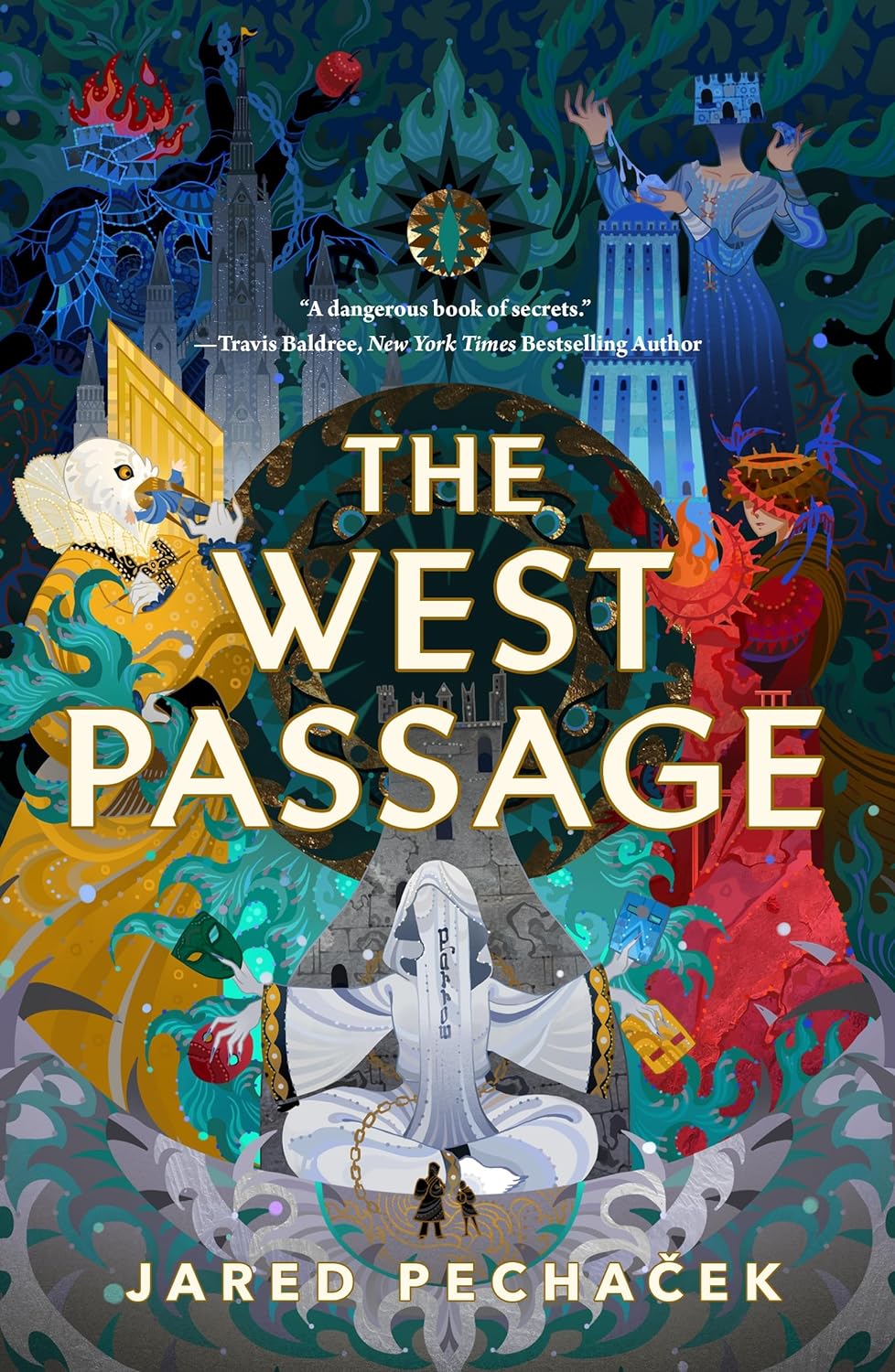
The West Passage by Jared Pechaček

Wildly imaginative world-building, a spellbinding plot, and profoundly weird characters make this fantasy debut a memorable adventure.

The West Passage by Jared Pechaček introduces a marvelously strange cast of characters struggling against outsized forces in a world both reminiscent of medieval Europe and unlike anything readers will recognize.

Pechaček’s teenaged protagonists are Pell, an apprentice to the Mother of Grey, and Kew, apprentice to the Guardian. One has trained in stories, songs, history, and rituals for births and deaths, the other in protection from the Beast. They live in Grey House, one of the five towers in an enormous palace that can take days to cross. Gargantuan, monstrous Ladies rule over the looming, decaying towers. The Ladies and their roles have changed and shifted slowly over many eras, their origins almost beyond all memory. Upon the deaths of the Mother and the Guardian, both Pell and Kew are thrust into positions they aren’t quite prepared for. Before the Beast rises again, for the first time in an era or more, they must each quest beyond Grey to save the world they know.

Kew departs first, striding fearfully with his books and little else down the West Passage. In just the early pages of his adventure, he meets a sort of trout-person and a creature with rabbit ears, battles with jackals, and rides in a lantern that moves to a whistle. Pell encounters apes and a crazed tutor, befriends a Butler Itinerant riding a hollowman, and collects an unlikely stowaway. Genders are changeable, and Ladies as well as wheelbarrows can hatch from eggs. Political machinations dating back to the “time of songs” are still at work in ways difficult for these protagonists to comprehend. “Was there no transfer of power that did not involve destroying the old? It seemed now that everything he knew about the palace’s history was the merest thread in a tapestry bigger than his mind could encompass.”

Pechaček provides detailed descriptions of otherworldly creatures: “Three corresponding shoulders sprouted beneath them, leading to three arms, though one was severed just above the elbow and capped with chased gold. The parts of her that were not talon-like were the same glassy material as her hands.” The effect is often disorienting but always fascinating, and despite extreme variations from the “real” world, questions about power structures and agency remain relevant. Pell and Kew have been brought up to uphold tradition and ritual, but to save the world, they must grapple with the possibility of change, and of choice.

The West Passage is an absorbing tale of political intrigue, touching comings-of-age, and a mind-bending phantasmagoria.


This review originally ran in the May 3, 2024 issue of Shelf Awareness for the Book Trade. To subscribe, click here.


Rating: 7 leaves.

The Dallergut Dream Department Store by Miye Lee, trans. by Sandy Joosun Lee

Sleepers shop for dreams at a very special department store, where dreams may come true not only for customers but for employees as well.

With The Dallergut Dream Department Store, Miye Lee explores the nature and power of dreams, the possibilities created by choosing them, and human nature itself. Whimsical and sweet, this debut novel translated from Korean by Sandy Joosun Lee will leave any reader musing and looking forward to a good night’s rest.

“For centuries, Penny’s hometown has been famous for its sleep products. Now it has evolved into a metropolis…. The locals, including Penny, who grew up here, are used to seeing outsiders roaming around in sleepwear.” Penny is terribly excited to interview at the Dallergut Dream Department Store, the crown jewel in a town devoted to sleepers’ needs. She has studied the mythology and history, but meeting Dallergut himself is intimidating. However, he turns out to be nothing but nice, forgiving her learner’s errors and prioritizing the sale of the right dream to the right customer, even over profits. Penny fangirls over the greatest dreammakers, whom she gets to meet in her new job: Nicholas, who specializes in seasonal dreams; Babynap Rockabye, who creates conception dreams; Maxim, who does surprising work in a dark back-alley studio; and Bancho, who cares for animals.

Penny has so much to learn, from bank deposits to the Eyelid Scale, not to mention the power of precognitive dreams. Purchased dreams are paid for only after they have had an effect on the sleeper, and payments come in the form of emotions experienced, so no one pays in advance or for a dud. Dreammakers can get fabulously rich and famous, but their best reward is helping people (or animals). Nap dreams differ importantly from longer ones. “Bad” dreams may serve a purpose, too. And there is, perhaps unsurprisingly, an important link between dreams, in the sense of aspirations and ambitions, and dreams as in the images and sensations that visit sleepers.

Penny is an innocent, wide-eyed disciple of Dallergut and his good works, as well as the celebrity dreammakers. Through her perspective and her refreshing tone, readers encounter an appealing, absorbing, imaginative world with rules for who designs experiences for whom. In her translator’s note, Sandy Joosun Lee calls The Dallergut Dream Department Store “a story that is both fun and deep… unpretentious yet full of life,” and keeps Penny’s observations disarmingly enthusiastic and earnest. The pleasing tale, while simple on its surface, asks questions about self-determination and the mysterious power of nighttime imaginings to impact one’s daily, “real” life. With a Calm Cookie or a Deep Sleep Candy, or just the right dream, all things are possible in Lee’s captivating world.


This review originally ran in the April 19, 2024 issue of Shelf Awareness for the Book Trade. To subscribe, click here.


Rating: 7 cups of forest-scented tea.

The Talented Mrs. Mandelbaum: The Rise and Fall of an American Organized-Crime Boss by Margalit Fox

In the late 1800s, a female crime boss ruled New York City, as colorfully detailed in this exhilarating narrative history.

Margalit Fox (Conan Doyle for the Defense; The Riddle of the Labyrinth) brings a lively storytelling style and a flair for conveying personalities to a history that’s stranger than fiction with The Talented Mrs. Mandelbaum: The Rise and Fall of an American Organized-Crime Boss.

“‘You are caught this time, and the best thing that you can do is to make a clean breast of it,’ one of the Pinkertons… advised Mrs. Mandelbaum as she was led away. In reply, Fredericka Mandelbaum–upright widow, philanthropic synagogue-goer, doting mother of four, and boss of the country’s most notorious crime syndicate–whirled and punched him in the face.” To the modern mind, attuned to Scarface-style organized crime, Mandelbaum was an unlikely candidate for her role: Jewish, female, an immigrant, penniless upon her arrival in the United States in the mid-1800s. But through shrewd business practices and motivated by her desire for her family’s survival and comfort, the woman known as Ma, Mother, and Marm Mandelbaum established what would become a multi-million-dollar empire. She backed her staff of shoplifters, pickpockets, and bank burglars with training, supplies, project funding, bail money, and lodging–indeed, mothering them while setting a standard for criminal organization, including a highly specialized school for safebreakers.

Fox successfully tells this story by letting colorful characters stand out. “About six feet tall and of Falstaffian girth (she was said to have weighed between 250 and 300 pounds), pouchy-faced, apple-cheeked and beetle-browed, [Mandelbaum] resembled the product of a congenial liaison between a dumpling and a mountain.” She is pursued less by the New York police departments (multiple, corrupt, and at odds with one another) and more by the detectives of the nascent Pinkerton Agency who were hired to bring her down in a changing world. Both police and Pinkertons provide memorable characters to boot, on top of the regular and freelance lawbreakers Mandelbaum employed. Fox has a sharp eye for humor: “At the interment, it was reported afterward, some mourners deftly picked the pockets of others. Whether they did so in tribute to their fallen leader or simply from occupational reflex is unreported.” And she sets this wild narrative in the context of its time, Gilded Age America, aglitter and crooked and facing massive economic and social change. The world of Herbert Asbury’s Gangs of New York both provided the long shot for a Jewish matron, and punished her for her nerve.

With copious notes and research, Fox offers a tale as madcap and thrilling as it is illustrative of American history and culture. The Talented Mrs. Mandelbaum is riveting for fans of both history and entertaining storytelling.


This review originally ran in the April 16, 2024 issue of Shelf Awareness for the Book Trade. To subscribe, click here.


Rating: 7 diamond stickpins.

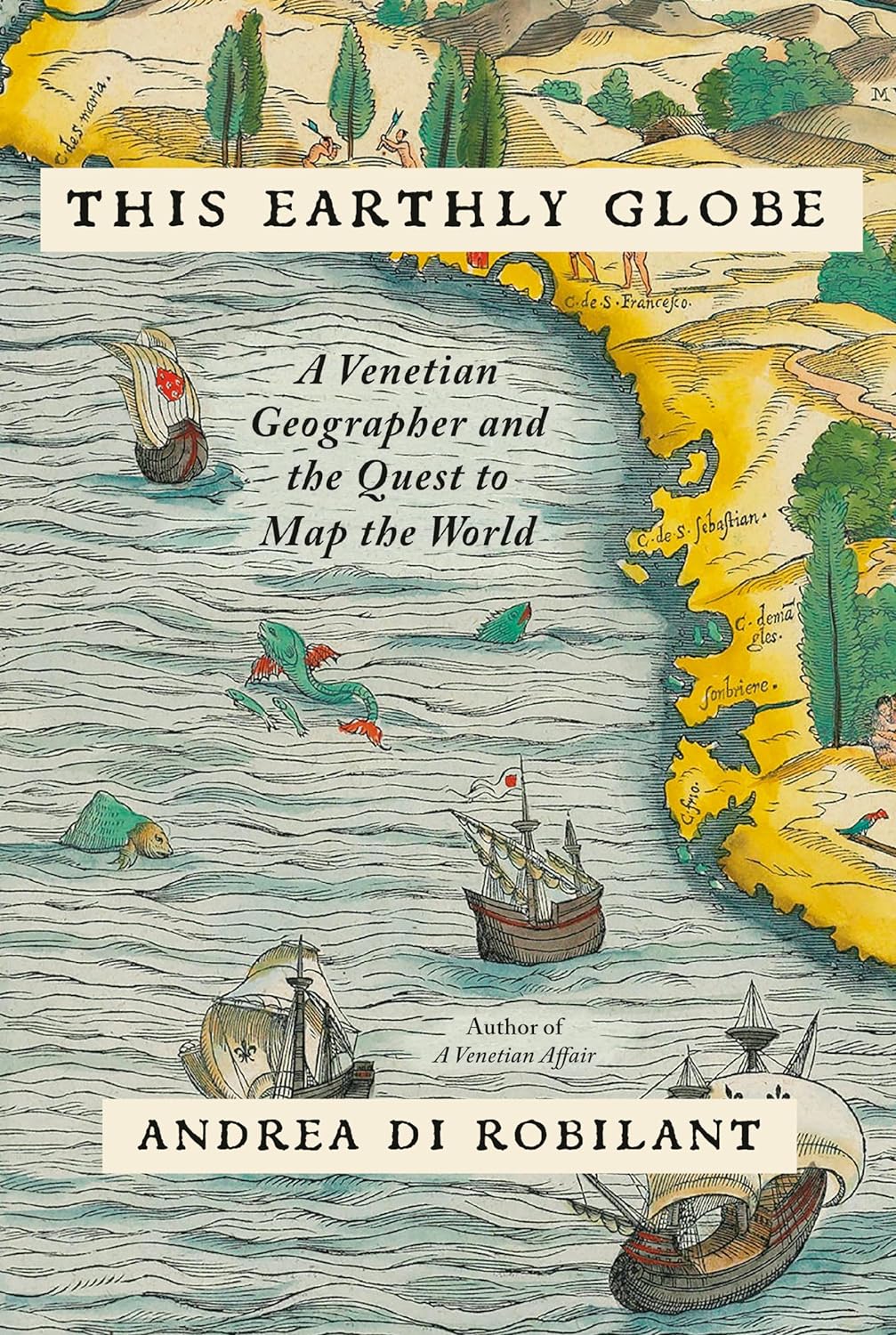
This Earthly Globe: A Venetian Geographer and the Quest to Map the World by Andrea di Robilant

This romp through history relates the lives and adventures of many travelers whose stories were compiled by a self-effacing Venetian civil servant in an extraordinary publishing feat.

With This Earthly Globe: A Venetian Geographer and the Quest to Map the World, Andrea di Robilant takes a convoluted but purposeful journey through history as well as geography to follow a remarkable achievement: the publication in the 1500s of an unprecedented three-volume collection. Navigationi et Viaggi, or Navigations and Journeys, was the life work of Giovambattista Ramusio, a career civil servant in Venice, but his name was not at first attached to “this remarkable collection of travel narratives, journals, private letters and classified government reports.” Humble and hardworking, Ramusio spent a lifetime compiling documents and notes from an impressive assortment of travelers. He found an early version of Marco Polo’s travel writings, corresponded with contemporary European explorers, and nurtured sources for long-secret documents; he was a dedicated editor, translator, and collector responsible for “one of the great publishing feats of the sixteenth century. It played a vital role in the final emancipation from a vision of the world still anchored to antiquity and became an indispensable source for the great cartographers of the second half of the sixteenth century.”

The world travelers whose notes, journals, drawings, and maps informed Ramusio’s work provide most of the color for di Robilant’s lively history. Ramusio’s own life is described, but it is Marco Polo, al-Hasan ibn Mohammad al-Wazzan, Antonio Pigafetta, Andrea Navagero, and many others whose adventures brighten these pages. Di Robilant (A Venetian Affair, Chasing the Rose, Face to Face) recounts their stories in vibrant detail. Marco Polo, in the region of present-day Afghanistan, saw “the landscape… stark against the deep blue sky: steep barren mountains, silvery green poplars along the banks of the river, the occasional mud village, and always a few flocks of sheep here and there nibbling at the rocky terrain.” Al-Wazzan, a “careful observer and diligent note taker… amassed a wealth of information on everything from the price of grains to particular weaving techniques to the quality of local wines in the places he visited.” He and Ramusio shared a “notion of what geography should be: not just maps and place-names but a more encompassing description of territory that might include observations on local crops, on manufacture, on trade patterns, on systems of transportation, irrigation and communication, on the social and political organizations of villages and towns, on religious practices.”

Di Robilant unfolds centuries of history, a dizzying array of characters, and a wide world of geography and culture in an easy storytelling style without falling into a dry recitation of facts and dates. This Earthly Globe offers a broad, accessible narrative about a publication that changed the world as it helped define it. Obviously for fans of history and geography, this sparkling story will also please general readers.


This review originally ran in the April 12, 2024 issue of Shelf Awareness for the Book Trade. To subscribe, click here.


Rating: 7 pomegranates.

Fire Exit by Morgan Talty

On the boundary of Maine’s Penobscot reservation, a solitary man wrestles with questions of truth, family history, and what is owed to the next generation.

Fire Exit by Morgan Talty (Night of the Living Rez) centers on one man navigating issues of family: the death of his father figure, his mother’s lifelong and worsening health conditions, the daughter he knows only from afar and who doesn’t know who he is. In hardscrabble circumstances, surrounded by poverty, alcoholism, and family violence, he wishes to give his daughter a meaningful gift: the truth. Stark and tender, Talty’s debut novel compassionately addresses tough choices in matters of family and love.

Charles Lamosway has grown up on the Penobscot reservation in Maine, but does not have Native American blood. Although very close to his Native stepfather, Frederick, whom he generally refers to as father, his biological parentage meant he had to move off the reservation when he came of age. Frederick purchased land and helped to build the house where Charles lives now, just across the river. Largely isolated with few friends, Charles watches from his porch the family on the other side: Mary, Roger, and their daughter, Elizabeth. Charles is Elizabeth’s biological father, a secret he has kept at Mary’s request. But as he ages, and as his mother Louise’s health worsens, he feels increasingly that Elizabeth, now an adult, must know the truth.

Charles insists, “Maybe her body and mind know something is missing.” This urge becomes a fixation, a bodily need. Elizabeth faces medical problems, and he is convinced she needs the truth–including Louise’s medical history–to survive: “I felt she should know her body was special, and she should know its history, especially the one it would not tell her and the one she could not see. And I decided to tell what I knew, because she deserved to know it.” But it is just possible that what Charles sees as necessary will have an entirely different outcome from what he intends.

Fire Exit is concerned with bodies, with visceral needs not only for food and shelter but for truth. Louise’s failing body and mind are wrapped up with unresolved questions about Frederick’s death. Talty’s tersely poetic, descriptive prose grounds this story in the physical: “Between the river’s flow and the summer breeze rippling hard-to-see leaves and the sound my scraping shoe made on the porch, I heard night silence. I heard the workings of my inner body, the pump of my heart and the expanding of my lungs.” In Maine’s harsh winters, Talty’s characters face elemental as well as human dangers.

This first novel grapples with family issues and hard choices about love and responsibility; blood, culture, and belonging. It is an utterly absorbing story, always firmly rooted in the corporeal; tough, honest, but not bitter.


This review originally ran in the March 28, 2024 issue of Shelf Awareness for the Book Trade. To subscribe, click here.


Rating: 7 loads of laundry.

Cactus Country: A Boyhood Memoir by Zoë Bossiere

This hard-edged, incisive memoir of gender-fluidity in a desert trailer park offers an essential perspective.

Memoirist Zoë Bossiere writes, “I see a lone, barefooted boy with short blond hair walking along the road in Cactus Country… looking for something despite feeling uncertain it could ever be found.” At age 11, Bossiere moved with their parents to a trailer park on the outskirts of Tucson, Ariz. Before leaving Virginia, Zoë gets a short haircut “like a boy’s.” “I’d thought I might need to go by a new name to pass as a boy in Tucson. But it quickly became apparent I was the only Zoë most people I encountered had ever met… so I kept it.” Cactus Country: A Boyhood Memoir tells of living as a boy in the desert, struggling with gender, class, and a shortage of options for self-expression, and eventually taking a great leap in leaving for a wider world.

Although Bossiere’s father introduced them as a daughter, they were on the whole able to make a fresh start in Cactus Country, inhabiting a long-held dream of boyhood. The version of masculinity they found in the desert is characterized by stoicism, camaraderie, and violence, as they learned from the trailer park’s revolving cast of boys and men how to perform toughness through acts of cruelty and self-defense. Especially as their body entered puberty, Bossiere struggled with gender expression in a world where they never encountered the concept of transgender, and the only queer role model they met insisted on a gender binary and harbored suspicions about bisexuality. Bossiere for a spell accepted the feminine identity assigned by the outside world, without settling into a self-identity that felt right. After a troubled childhood and young adulthood, it was by studying creative writing that they eventually saw a way out of the Tucson area and into new spaces, geographic and otherwise, including the concept of genderfluidity.

Cactus Country is a wise and wonderfully crafted memoir, treating its characters and subjects with compassion in the face of assaults, addictions, dysfunction, and violence. The desert and Bossiere’s experiences there are stark and severe but also include earnest attempts at connection. They must leave Cactus Country to grow and to find their truest self, but it’s only by returning in memory that their journey begins to feel whole. After a childhood as harsh as the desert sun, they write tenderly about place and a past “where broken boys with sunburned faces could be beautiful, kings worthy of inheriting the place they called their home. A place where a Cactus Country boy would always be a Cactus Country boy.”

Gorgeously written, thoughtful, and tough, this memoir of gender and a hardscrabble coming-of-age in the American Southwest excels at nuance.


This review originally ran in the March 19, 2024 issue of Shelf Awareness for the Book Trade. To subscribe, click here.


Rating: 7 paloverde beetles.

Nothing’s Ever the Same by Cyn Vargas

With a remarkably true-to-life adolescent narrator, this novella charts the large and small traumas that accompany a girl’s coming of age.

Cyn Vargas’s Nothing’s Ever the Same is a starkly honest coming-of-age story told in the disarming voice of its 13-year-old protagonist. Simple but moving, this novella documents events that are traumatic but not unusual, thus marking the kinds of pain that are heartrending, as well as common, for a child approaching young adulthood.

“The first time I saw my mom cry was after my dad’s heart attack,” Itzel begins in the opening chapter, “Angioplasty and Piñatas.” The heart attack comes during preparation for her 13th birthday party. After a brief hospital stay, he comes home and improves quickly. But this event, coming at an important symbolic point in Itzel’s adolescence, is the first of a number of upheavals, as Vargas’s title suggests.

Itzel’s beloved father recovers from his heart attack, but something feels off. “Dad was different, like moving the lamp… the light and shadows hit in a different way that made all that I was used to seem a little strange.” The family suffers one loss and then another. Itzel explores new feelings for her best friend. And then she sees something that will change the course of life for her entire family. “I shut my eyes tight to make it go away like erasing the wrong answer on a test, but I still saw… the wrong answer etched into the paper though the lead was brushed away.” What to do with her new knowledge? Who to blame? As the known routine is uprooted for Itzel and her parents, she has to navigate redefining relationships. While the circumstances of these changes for Itzel are specific and acute, her experience reflects universal elements of being a teenager: disappointment, betrayal, discovery, acceptance, and always, unavoidably, change.

Vargas (On the Way) gives Itzel a straightforward storytelling voice, often naïve but also sharp-eyed. She is clever, thoughtful, and quick to question what she or others have done wrong to bring pain and difficulty to her family. Her father, mother, Tia Amelia, and best friend Fred are characters sketched only briefly in Itzel’s telling, but each has personality and redeeming qualities even when making mistakes. The author behind the narrator commands this story with a quiet compassion. Nothing’s Ever the Same is a work of restraint and understatement, its young narrator capable of stoic relating of events as well as emotional reaction. The effect is deeply moving.


This review originally ran in the March 14, 2024 issue of Shelf Awareness for the Book Trade. To subscribe, click here.


Rating: 7 cups of orange soda.

The Witches of Bellinas by J. Nicole Jones

In this atmospheric and suspenseful novel, an exclusive coastal California community is either the best thing to ever happen to an unhappy newlywed, as her husband believes, or a frightening trap.

J. Nicole Jones’s The Witches of Bellinas sets a newlywed couple in a vibrant small community–a lovely wealthy commune, or a cult?–and watches the fallout, in an atmospheric, suspenseful experiment involving witchcraft, love, and dividing loyalties.

Tansy and Guy have been married mere months, although they’ve been together for a decade, when they move from New York City to the hamlet of Bellinas on the coast of northern California. Wealthy, health-oriented, idyllic, and highly exclusive, Bellinas is led by the charismatic Manny, or Father M to his followers, a business mogul turned self-styled guru, and his wife, Mia, a former model. Guy falls easily and head-over-heels into the lush, indulgent lifestyle: surfing, diving for abalone, carousing. Tansy, expected like all the wives to serve her husband’s whims, finds Bellinas a bit suspicious. But the town’s high shine, like its perfect weather, is hard to resist. She so wants things to work out with Guy: “I let the happiness I felt in that moment of renewed closeness grow taller than the forest of disappointments we had collected in the course of years together.” So she goes along. “Everything would be fine. How could it be otherwise? Bellinas was so perfect-looking.”

The Witches of Bellinas is narrated by Tansy in hindsight, from an apparent confinement in the town schoolhouse, after something has gone awry. With her academic background in the classics (a vocation sacrificed for Guy), she flavors her conversations and her narrative with literary references that increase her story’s sense of deep foreboding, frequently comparing herself to Cassandra. The reader must wait, however, to discover the precise nature of the trouble in paradise. Is the creeping dread about the neighboring forest fires? The ocean’s force? The local blend of calming tea? Are the powers at work in Bellinas magical or cult leadership at work?

Jones (Low Country) gives Tansy a strong sense of the wrongs done women at the hands of men, from both her scholarly work and her experience. “The plans of women have been called plots, schemes, murder, but if we do not claim the future as our bodies are claimed by men, then both are gobbled up by husbands and historians.” She writes, it seems, for her life. “Do not discount the truth of the old wives’ tales…. What is this history if not a wife’s tale? A truth revealed by unlikelihoods does not make it less true.”

At the intersection of the supernatural and simple human ugliness, The Witches of Bellinas gives its readers chills and thrills along with a profound sense of wrongs done, but no heroes or villains. This is a novel for anyone who’s wondered if the picturesque might be too good to be true.


This review originally ran in the March 8, 2024 issue of Shelf Awareness for the Book Trade. To subscribe, click here.


Rating: 6 crackers.