Valentine by Elizabeth Wetmore (audio)

This audiobook, also part of my cross-country travels, was a birthday gift from my mom. Thanks, Mom!

Valentine is a powerful novel. It’s set in Odessa, Texas in 1976: a central West Texas oil town in a harsh environment filled with hard-edged, struggling people. The setting is definitely part of the appeal, as I know Odessa a little and its region a little better, and Elizabeth Wetmore’s striking writing about place I found very affecting and authentic. Mostly, this place comes across as rough, stark, unbeautiful; but a close read will reveal appreciation for the natural world and the people who find something to love in it. These characters are really well done, too. Chapters shift between the points of view of a number of them, with a firmer focus on three or four. All are women: men are only viewed through their eyes. As a woman, in a world of books historically over-focused on men, I appreciated this, too.

Let me get in a content warning before we go too much further: the event the book opens with, which is also the event that the entire narrative centers around, is a brutal and violent rape. It’s described in what I’d call moderate detail, which is plenty disturbing. Readers for whom this may present a problem should avoid the whole thing.

This rape and its aftermath affects all our characters in various ways. Even those who are initially unsympathetic become three-dimensional and complicated when they get their own chapters, in that way that I love: all people are complex, no one all good or bad, no perfect heroes or villains. I love a complication like nothing else. There is even a brief – failed – attempt to understand the perpetrator of the rape; that impulse and its failure both feel real and right to me.

Gloria, or Glory, Ramirez rightfully opens and closes the book. Fourteen years old, the US-born child of an undocumented Mexican immigrant mother, Glory’s life brings race and racism into the story. Valentine is centrally concerned with women’s lives and violence against women, but this layer is important and (of course) related. Then there is Mary Rose Whitehead, young mother of a young daughter, drawn into Glory’s life by circumstance. She rebels against many of the structures of the world around her, in ways that we applaud, but this is no fairy tale, so she will not necessarily triumph. Next comes Corrine Shepard, an older woman, recently widowed and handling her grief with booze, cigarettes and not giving two sh*ts what you think about any of it, which serves her well, to a point. I think of these three women as the core, although there are probably other interpretations – I haven’t counted chapters. Again, there are others who get less spotlight but make important contributions: I’m thinking of the bartender/babysitter/waitress we get to hear from near the very end.

This book covers so much. Race and racism and immigration, women’s lives and violence against women, economics patterns and the dire straits it puts all kinds of people in; the cultural and ecological milieu of a particular place, in a particular time, including what it looks like for an oil boom to hit a town like Odessa, which my friends who live in the region today tell me about: it sounds like it looks awfully the same after more than 40 years. Valentine‘s contents contain a lot of ugliness, brutality, violence, hate, tragedy: beware. But it’s also a beautifully rendered novel. And I appreciate its glimpses of beauty even in Odessa in 1976. It’s masterful, in other words. I’m very impressed, and I’ll be thinking about these characters for a long time.

Thanks again, Mom. Good pick.


Rating: 8 pistols in purses.

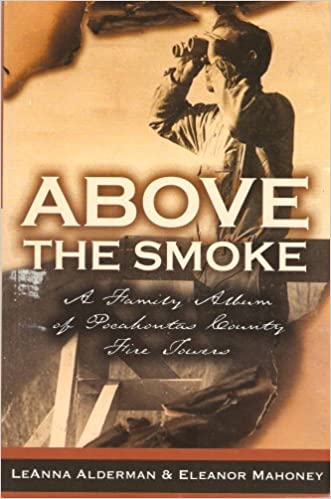
Above the Smoke: A Family Album of Pocahontas County Fire Towers by Leanna Alderman and Eleanor Mahoney

Loaned by a friend who found out I’m into fire towers, this book has a particularly local focus, and I dug it. This project began when LeAnna Alderman, as a VISTA volunteer at Allegheny Mountain Radio, interviewed a retired fire lookout, and was so absorbed that she pursued more such interviews. She left the station before she could finish the collection, which was continued by Eleanor Mahoney (also a VISTA volunteer) until this book was built and eventually published some six years after Alderman’s first interview. It consists of three main sections: background on fire lookouts and fire suppression efforts in the US and in Appalachia, including the Depression and the CCC; information on each of the twelve towers in Pocahontas County; and best and finally, twelve interviews with retired towermen and one towerwoman, and their family members.

I think this slim book would serve as a good introduction to the idea of lookout towers; I didn’t need that introduction, but found it fascinating as a look at one small region’s relationship to the system. In comparison to the Gila out west (an example I know pretty well), this story involves considerably more emphasis on the Depression and the CCC, and tower use ended precipitously and much earlier in these parts. It was interesting to see the lookouts’ opinions of what came after (smoke spotting via aircraft! which was shortlived) – most were not impressed. And it was interesting to see a small community’s impression of the lookout system in general. As part of a larger network of forestry and roads/infrastructure operations, the lookout towers provided critically needed employment and developed a relationship with the forests, and an understanding of fire prevention a la Smokey the Bear. I did find it interesting that Above the Smoke didn’t deal with the idea that fire is both natural and necessary for healthy forests – a relatively recent idea in the officialdom of forestry (etc.), but important to Fire Season, for example.

I loved learning about a forgotten chunk of old growth: “The 140-acre tract of virgin red spruce forest located near the tower was named the Gaudineer Scenic Area. This tract was never logged because of discrepancies between competing land surveys – this tiny slice of old growth forest survived because it wasn’t on any company’s map!” (I like to think that there may have been some intention in this ‘error’.) And mention of the Thorny Mountain tower was noted – “Hopefully, one day, Thorny Mountain will reopen to the public.” Well, it has, although it’s awfully hard to book. I hope to snag a couple of nights there myself next year.

This book is short and modest in its scope. The interviews themselves remain faithfully in the vernacular, which I enjoyed. They provide a glimpse of life in a particular time and place, and I’m super grateful to the folks who collected these memories for us all. Thanks for the loan, DB.


Rating: 7 cans of peaches.

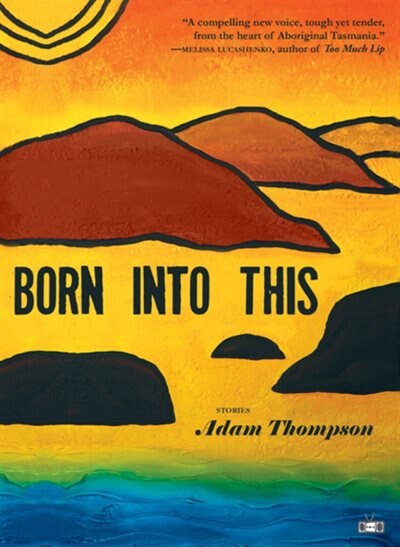
Born Into This by Adam Thompson

These cunning, clever, piercing stories of marginalized indigenous Australians are both compelling and illuminating.


Adam Thompson’s Born into This is a striking collection of hard-edged, penetrating stories set primarily in the Australian state of Tasmania and wrestling with issues of race, colonialism and individual agency. Every story features Aboriginal characters, generally in the central role; the various experiences and complexities of this identity (which the author shares) form the heart of the stories’ combined impact. The collection is loosely linked by recurring characters and settings: an act of angry protest at the center of one story reappears as a minor annoyance in another. An island on the Bass Strait is home to a family over generations.

The collection opens with “The Old Tin Mine,” a story about a bitter, aging guide at a “survival camp” for city youth, who may be nearing the end of his career. “Honey” offers a cold, brutal, satisfying justice in the face of hate. In “Aboriginal Alcatraz,” a man wrestles with a life-changing decision in the midst of a storm, building to an ironic conclusion. Some stories lead with forceful blows, others sneak in to nag at the back of the reader’s mind: an alcoholic recalls the worst thing he’s ever done; a young man views a current love affair with cynicism. In the title story, a young woman fights an inherited losing battle involving eucalyptus plants. Working in the woods “was like looking into a mirror.” In “The Blackfellas from Here,” a young activist proposes an extreme and perhaps unrealistic, but also perfectly reasonable, resolution to a controversy. These punchy tales question family ties, infidelity, superstition and who has the right to claim Aboriginal ancestry.

Thompson’s characters are stoic, taciturn, often blue-collar. They struggle with racism, exploitative economic systems, class tensions and the disappearing natural world that a culture once depended on. Their reactions to these challenges range from rage to lethargy; their stark stories are frequently, quietly, brutal. The lives and attitudes of these characters vary, offering a revealing set of perspectives on the contemporary landscape. It is not all bleak: Born into This contains as well dark humor and even slim strands of hope. Thompson’s prose style appears blunt at first glance but shows nuance. His 16 stories are unyielding in terms of their values, yet somehow deft, even delicate in their storytelling and various voices. The overall effect is understated: simple, unglamorous lives and events crescendo toward a thought-provoking and memorable whole. Even (or especially) in its quietest moments, this is a haunting debut collection by a skilled writer.


This review originally ran in the June 11, 2021 issue of Shelf Awareness for the Book Trade. To subscribe, click here.


Rating: 7 eucalypts.

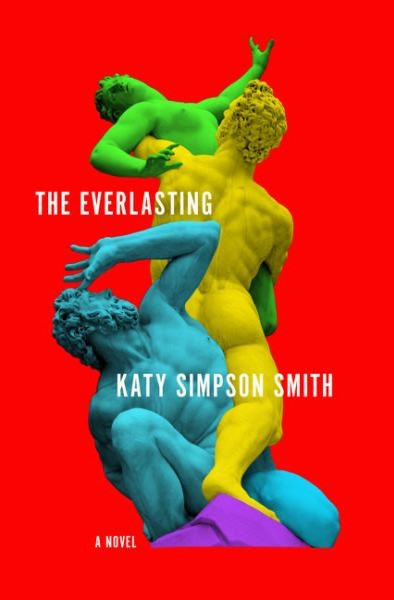
The Everlasting by Katy Simpson Smith

My friend and editor at the Shelf, Dave Wheeler, recommended this book to me. “It did not get the attention it deserves, in my opinion,” he writes. “And it has one of my favorite voices for Satan that I have ever read–this earnest, wry epicurean seductiveness.” If that line didn’t catch my attention! I don’t actually have any other voices-of-Satan in literature that I can easily call to mind, but that is Dave for you: well-read.

The quality he wanted to call my attention to in this novel is the way it shifts its scope back and forth from the miniscule to the cosmic. It has a most interesting structure, beginning with its epigraph from Percy Bysshe Shelley’s Adonais:

Go thou to Rome, –at once the Paradise,
The grave, the city, and the wilderness.

The novel is then set in Rome, in eight sections: the wilderness, the city, the grave, and the paradise (and repeat).

“The Wilderness” takes place in 2015 and centers on an American scientist on semester-long fellowship in the ancient city, to study the effects of chemical pollution on aquatic crustacean populations. He is passionate about his ostracods, but also glad to escape his marriage, if only for a few months – the only thing he misses in California is his daughter, who has just begun to lose her confidence as puberty looms. “His worst failing as a father would be if she meekened into him. A moth. A snail.” The scientist is also a bit of a poet, which is seen as a liability in the scientific field, “but Tom didn’t understand how you could avoid them: either the microscope or the poem.”

“The City” is set in 1559 and stars a Medici princess with a disturbing (to the men in her life) irreverence and independent streak. Giulia seems determined to pick fights and clear her own paths; I adore her, and miss her now. When angry Romans begin burning churches and Giulia smells the smoke “snaked in her hair,” she thinks: “Rome had never smelled so nice.”

“The Grave” takes place in 896-897 and introduces us to Felix, a monk assigned to the putridarium, and this delightful place (if it is new to you as it was to me) is where the monastery’s dead are seated upright to decay and self-destruct slowly under Felix’s watchful eye, until their dry skeleton is ready for the sarcophagus. “His tasks were to defend the bodies from desecration in case of heathen raid and to mark carefully the progress of the bodies’ purgatorial decay so he might converse with monks who had fears about mortality.” Felix was a joy for me, as well, with his quietly morbid interests, his sense of humor and play, his contemplations and anxieties. (Considering his fellow monks’ mismatched hairstyles, Felix comforts himself, “Once dead, they’d match up better.”) I never would have expected a monk to feel so like someone I’d like to befriend.

“The Paradise” is set in 165, and its protagonist is a girl of twelve named Prisca, and by the time we meet her for the first time on page 121, we have begun to recognize her name: Santa Prisca is the monastery where Felix lives in 896, where a minor cardinal serves whom Giulia offers to patronize in 1559, and where Tom will stumble through in 2015. Prisca’s faith has a grandiosity to it that might distance her from me, but she is oh so human, and also a very relatable tomboy frustrated by her own adolescence and the world’s blindness: “Don’t be worried; they won’t come for you,” she is reassured. “Then they’re fools,” she replies.

Prisca is the child martyr who in part ties these stories together – there are other threads connecting them, as well. Back to editor friend Dave: the pond in which Tom collects his ostracods “is the axis that the novel spins on, traversing time and space in extraordinary ways.” And there is an object (you know I love these), a fishhook that over these millennia will be handled by each of our four protagonists in turn. “That this was once treasured by somebody – by anybody – was enough to endear it to Felix.” And to me. A novel in four sections, then, in four times, in one place; four protagonists connected by a location and a thing. The zooming of scope from microscopic crustacean to profundities: the meaning of suffering, the tension and wrestling between God and Satan, love. This is a glorious, impressive book.

I loved the ways in which The Everlasting surprised me. Tom, being of my own time, was the character I most related to on first glance, but he was the one I least sympathized with in the end. Giulia was a brash, take-no-prisoners, badass feminist Medici, hiding and deciding how to handle a secret of her own. Felix and his brothers in the monastery are playful and silly. Prisca is both brave and delightfully snarky: a child in 165 is still just a child after all. Also that voice of Satan was just as Dave promised, and I don’t think I can put it any better than he did: earnest, wry, epicurean, seductive. Loving. Wronged.

The mind of Katy Simpson Smith amazes me; how does one conceive of such a story? I love it and its deceptively simple, all-encompassing structure. I am awed. Thanks for the recommendation, Dave!


Rating: 8 fishtanks.

Hot Stew by Fiona Mozley

Within a London apartment building in some disrepair, diverse lives intertwine in an absorbing story of connections and change.

On a nondescript block in London’s Soho district stands a 17th-century building with a decades-old French restaurant on the ground floor. The specialty of the house is snails in garlic butter. On the rooftop, two women bicker and smoke. In the cellar, an encampment of squatters scrapes out a home. On the middle floors, sex workers entertain clients in apartments where some of them also live. Myriad and motley, these characters and their sordid and sympathetic lives form Hot Stew, a compelling, compassionate novel by Fiona Mozley (Elmet).

Precious is an immigrant mother and grandmother. “Everyone assumes ‘Precious’ is the name she adopted on entering the trade,” but it’s her real name. She shares her apartment with her maid and life partner, Tabitha, retired from the trade. One of the brothel’s customers, Robert, an older man retired from a life of crime, drinks at a nearby pub with his friend Lorenzo, a young actor. The pub is also frequented by two of the cellar squatters: a man who does magic tricks and a woman with a heroin problem and a mysterious past. A young man of wealth and privilege reconsiders old connections as he explores the Soho building that ties them all together. Looming dangerously over all their lives is the formidable Agatha Howard, born of a Russian teenager and a fabulously wealthy crime boss septuagenarian. Agatha owns the building where these lives intersect, and she wants to gut it for renovations to increase her profits. But Precious and Tabitha are disinclined to leave, and once the thread of gentrification is tugged, it becomes clear how complex is the weave of an unassuming building in Soho.

Hot Stew is concerned with class, history, legacies, how each person ends up where they do and the degree to which they hold agency over their futures. Mozley’s character sketches are delightful and engaging: detailed, complicated, flawed and beautiful. As the stakes rise for each and as their apparently disparate stories come together, a sense of menace threatens the interconnected human stew. “The men behind the masks aren’t men. They are a natural disaster: a hurricane, a flood.” Just a few of these variously disreputable but lovable characters feel the tremors that have begun to tease at Soho’s underbelly, until it seems that the fates of the building, its inhabitants and all of Soho are one fate. This is a novel of empathy, shared histories and hope in the most unlikely of places.


This review originally ran in the April 6, 2021 issue of Shelf Awareness for the Book Trade. To subscribe, click here.


Rating: 8 sighs.

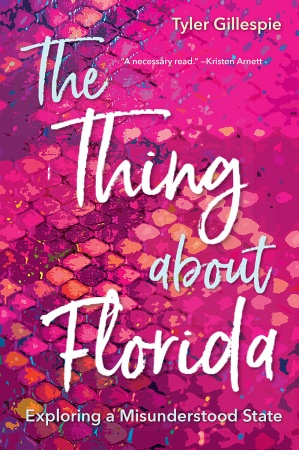
The Thing About Florida: Exploring a Misunderstood State by Tyler Gillespie

Disclosure: I was sent a digital ARC of this book by the author in exchange for my honest review.


Tyler Gillespie’s essay collection The Thing About Florida: Exploring a Misunderstood State has just this week been released, and I’m happy to share it with you here. This book was indeed a good match for my reading tastes! It’s about a misunderstood or maligned place (Texas transplant to West Virginia here: I sympathize), and it’s about place, which I always gravitate towards. It’s a collection of essays that roam widely in theme, and I found Gillespie’s voice very appealing: he can be hilarious and self-deprecating, but also serious and earnest; he considers important questions, as in the painful experiences of the LGBTQ+ queer community in Orlando especially following the mass shooting at the Pulse Club in 2016.

One of the audience members near me asked her friend if the alligators were animatronic. The area’s theme parks seemed to make people question reality. Florida, in general, has a way of doing that.

Essays cover a range of topics: “Because Florida” jokes and “Florida Man”; hurricanes; Civil War reenactors (and the question of how ‘southern’ Florida really is); cattle ranchers; a gay resort/campground, which relates to aging issues for queer folks; alligators! and those who wrangle, wrestle, and love them; snakes, including breeding and smuggling and the escaped ones thriving in Florida; reptile people (that is, those who love them and attend reptile conventions); and the Joy Metropolitan Community Church, where queer Floridians find an open-minded home. “Joy MCC stood less than ten miles away from some of Orlando’s theme parks like The Holy Land Experience. Those attractions gave visitors pyrotechnic performances and larger-than-life experiences. People could escape their daily lives there, while Joy MCC–and places like it–let people come home. They gave Floridians a second chance to be who they already knew they were.”

There is opportunity for humor in some of these topics more than others. I appreciated Gillespie’s stark discomfort with the Civil War reenactors, his (perhaps surprising) affinity for the cattle ranchers (“Marcia’s food almost made me want to sign up to work as a cowboy-for-hire until I remembered the wild hogs and all the broken bones and who I generally am as a person”), and his relationship with his grandmother as it played out in hurricane prepping. He’s most concerned with human culture and history; the scope of this book does not extend very far into the natural world (except in its role as host to those alligators and snakes, etc.). He does evoke some of the landscape, though: “Sawgrass stretched for years, and gnats pestered us like siblings.” I guess I was a little surprised to find Florida characterized as a homophobic place, as my picture of Florida stereotypes involved large numbers of retirees and gay men; but there’s plenty of rural space there as everywhere, and it is the South. (Is it? There are a few perspectives, and again as a Texan, I sympathize – we run from Deep South to TexMex to the southwest. But I certainly thought of Florida as the South, however arguable that idea may be.) Which is to say, totally unsurprisingly, that I learned something from this book.

The best part, though, is definitely Gillespie’s voice. I feel like I made a friend reading this. That’s a way to say: the narrator is personable, intimate, funny, accessible, approachable. It’s pretty rare to feel this way after reading a book, and that’s okay, because not every book sets out to make its reader feel like a friend, but this one certainly accomplishes it. Perhaps the greatest victory Gillespie wins here in arguing for Florida as a real place (not a cartoon landscape) lies in his own relatability. Florida, like every other place you might name, is not any one thing. It contains the city and the country, a wide range of politics and educational and lifestyle backgrounds, and all kinds of different people. Summing up anyplace too easily would be a disservice, and Gillespie does his home state a service here by complicating it. He doesn’t argue that it’s perfect, or the best place, and he readily acknowledges its weirdness, but he makes it variable and diverse and flawed and weird and real. Somebody should commission a series of The Thing About books for the other 49 states, and keep going from there.

Thanks for thinking of me, Tyler.


Rating: 7 burgers.

Bluebird, Bluebird by Attica Locke (audio)

I reviewed Heaven, My Home, which comes second in this series. My father reviewed the highly-regarded first novel Bluebird, Bluebird, and now I’m finally catching up.

Pops did a good job with the high points of this one, and I remember Heaven very fondly (I rated it 8 fingers). There’s no question in my mind that Locke is at her best in handling the complex, nuanced, contradictory nature of Texas history and relationships (particularly in regards to race, but of course there’s more there too). The social justice questions, with no easy resolutions, are Locke’s greatest strength. I found the murder mystery part of this novel less compelling. And I should acknowledge that this audiobook took me way too long to finish, so maybe I didn’t give it the fairest shot in terms of my slow reading (listening) pace. It did get a little draggy for me in the middle; I think the contemplative interiority of Ranger Mathews’ thought processes and turmoil was a mite slow for my personal tastes. Which is related to my bigger concern with the book: I had trouble believing in Mathews (as a fictional character who ‘rings true’), and I had trouble caring deeply about his problems, because he exasperated me.

I had trouble with some of his unprofessional behaviors. Not morally, but in terms of believability: does he really get away with it? The drinking on the job, and the blurred boundaries with the murder victim’s widow, and with Geneva, a powerful matriarch in the small town where he’s investigating a couple of murders. It often felt to me like he was amateur at his job – I expected him to have it together more, or at least be better about hiding his boozing. He sure does rush off half-cocked. And while the widow’s character also made me a little impatient, I bought that this is who she would be. Everyone else feels believable; it’s just Mathews. I’m familiar with the self-destructive, loner, problems-with-authority police detective in fiction – it’s a type, and one I rather specialize in. But this one feels like he’s not very high-functioning in his self-destruction, if that makes sense, and it just rang less true for me.

I do not require that I like a character in order to care what happens in a plot. But there has to be some stakes that I can engage in, and I struggled with that here. My problems with Mathews were distracting.

More compelling was the conflict Mathews feels about the law, nicely encapsulated in his two role models, twin uncles who respectively work(ed) as a lawyer and a Texas Ranger. He’s been drawn in both directions, and still feels the pull of the law, although most of all in the pressures applied by others.

It made him sad, the degree to which this kind of credit hogging mattered to Greg, that three years behind a desk had made him so desperate for the climb that a double homicide was seen as an opportunity first and a crime against nature second. But wasn’t Darren a little guilty of this, too?

…Maybe justice was messier than Darren realized when he’d first pinned a badge to his chest; it was no better or worse than a sieve, a cheap net, a catch-as-catch-can system that gave the illusion of righteousness when really the need for tidy resolution trumped sloppy uncertainty any day.

And,

He got it confused sometimes, on which side of the law he belonged, couldn’t always remember when it was safe for a black man to follow the rules.

Point very well taken. Although, Mathews can occasionally feel like a mouthpiece for these musings, rather than a fully human character.

I did really enjoy the local culture of Lark, Texas, the blues and the home cooking at Geneva’s. And the complex relationships, which Pops refers to in his review, were well drawn (and feel very real).

Narrator J. D. Jackson has a nice voice but sometimes plays this one with a hair more drama than I needed – again, a little distracting.

Some good stuff here, but a lot that bothered me, too. If I’d started here I wouldn’t have read Heaven, My Home, which I think is a superior book. It’ll be interesting to see what comes next for Ranger Darren Mathews.


Rating: 6 plates to go.

Sophomores by Sean Desmond

A boy begins to find himself as his parents face private battles of their own in this poignant and searching novel.

With Sophomores, Sean Desmond (Adam’s Fall) evokes late-1980s Dallas and its suburbs with eerie precision. A nuclear family–father, mother, son–and the worlds they navigate are full of anxieties, choices and possibilities. Spanning just one school year, this is a novel to get lost in.

In the fall of 1987, Dan Malone is a sophomore at the Jesuit College Preparatory School of Dallas. He belongs to a tight foursome of boys who support each other at school and in their forays with the girls of Ursuline Academy. A bit tortured by his shyness in both areas, Dan’s interior workings are self-consciously earnest but endearingly real. “Dan felt a sudden awareness, a shimmering sense of discovery, that his journal, the newspaper, music, writing, reading, it was all connected with some hidden purpose… The hour when he would take part in the life of the world seemed to be drawing closer, and Dan wanted to think and write and listen to his heart and find out what it felt.”

Dan’s father, Pat, is an airline executive facing a serious industry downturn, culturally Irish Catholic and miserably estranged by his displacement (for work) from his native Bronx. He drinks too much and hides it poorly from his family. He struggles with a recent diagnosis of multiple sclerosis.

Mother and wife Anne provides an essential counterpoint to Dan and Pat’s heavily male worlds. As a devout young woman, Anne had been a novice at Sisters of Charity, but she grew into a worldly, quietly feminist woman, inclined to be contrary in her internal monologues. Still a serious Catholic, Anne argues with the pastor both in her head and via anonymous phone calls.

These three perspectives triangulate to offer a rich, subtle story of family grief and love, teenaged seeking and adult angst. Desmond places crises in the classroom, where Dan strives for growth and recognition from a teacher “legendary for rigor and Socratic curveballs,” on equal footing with the murder trial where Anne serves as juror. Flashbacks to Anne’s and Pat’s pasts illuminate their characters and provide nuance and empathy. Events vary from the absurd (an ill-fated swim team trip) to the profane (one particularly colorful episode in Pat’s fall from grace), but throughout this narrative there is a sense that all of this is somehow serious, important, holy.

Sophomores is a sharp, crystalline look at a few months in the lives of a “regular” family. With a keen gaze, it captures a city in transition and a boy just coming of age. Dan and his parents will stay with the reader long after the story is finished.


This review originally ran in the January 8, 2021 issue of Shelf Awareness for the Book Trade. To subscribe, click here.


Rating: 8 sticks.

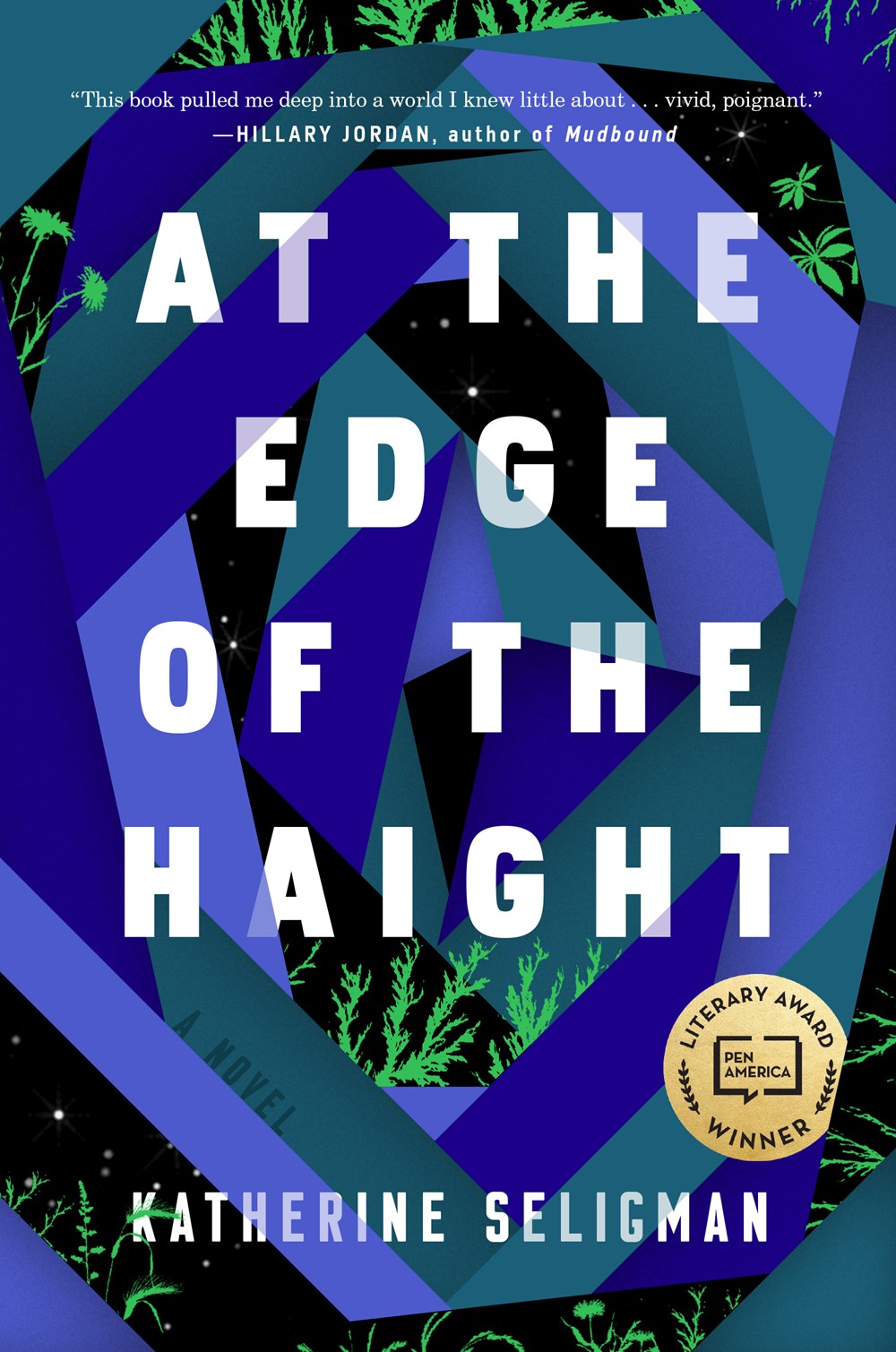
At the Edge of the Haight by Katherine Seligman

In this quietly compassionate novel, a young homeless woman stumbles into a crime scene on the edge of Haight-Ashbury, and eventually reconsiders how she got there.

Katherine Seligman’s gripping debut novel, At the Edge of the Haight, explores a community on the edge of a historic setting and on the edge of getting by, with a compelling protagonist and an array of issues to wrestle.

Twenty-year-old Maddy Donaldo lives in present-day Golden Gate Park, after Jerry Garcia and Janis Joplin are long gone, with a sort of chosen family. There’s Ash, “a skinny upside-down triangle” of a young man, “the most no bullshit guy around” with a talent for effective design of cardboard panhandling signs. Quiet, gentle, strawberry-blond Fleet has a pet rat named Tiny. Spike-haired Hope talks to everyone; she’s good with the tourists, but a bit of an instigator, too. And, most importantly, there’s Root, Maddy’s devoted dog. Together the friends scavenge food, find shelter, protect one another and navigate their tricky streets. It is Root who leads Maddy into the bushes in the first pages of this absorbing novel, where she stumbles upon a young man taking his last breath, and a man standing over him.

Maddy knows immediately that this sight will haunt her, that she is danger. She’s been handed a problem she didn’t earn; quickly the death of the boy named Shane follows her. The cops have questions. A man shows up at the local shelter and identifies himself as Shane’s father and asks for Maddy’s help. She gets to know Shane’s parents, Dave and Marva, and finds her loyalties beginning to split. Dave is a birdwatcher; Maddy observes the creatures, human and nonhuman, who live with her in the park. She investigates Shane’s murder, and along the way alienates her friends and finds herself nudged toward her own past, which she most wants to avoid.

At the Edge of the Haight is told in quiet prose from Maddy’s first-person point of view, so the reader is privy to her thoughts and fears, including an interiority that both protects and isolates her. All other characters are secondary, but this is a novel captivating in both its story and its characters. It is concerned with the social ills of homelessness, including addiction, mental health challenges and economics, without becoming polemic. The mystery of Shane’s death is a side plot, not the central focus; rather, it’s the situation that pressures the tenuous life Maddy has set up in the park. Seligman’s San Francisco is colorful and detailed. Readers are drawn into a challenging world with sympathetic characters, but it is Maddy’s internal turmoil that makes this novel memorable.


This review originally ran in the December 11, 2020 issue of Shelf Awareness for the Book Trade. To subscribe, click here.


Rating: 7 green apples.

Chicago by Brian Doyle (audio)

On the last day of summer, in the year I graduated from college, I moved to Chicago, that rough and burly city in the middle of America, that middle knuckle in our national fist, and rented a small apartment on the north side of the city, on the lake.

This novel is everything I love best about Doyle: joy and celebration even where there is tragedy and pain; minutia and multitudes; exuberance and multiplicity… but where I am accustomed to seeing these elements applied to natural settings (even when peopled), here we have it in an urban setting, which I found surprising. But not disappointing: I’m originally a city girl (even if I have an affinity for greener spaces), and I really appreciated the celebration of the urban here. (Also, Chicago is a setting I have encountered in a lot of fiction lately, and I appreciated having it shown to me again from yet another angle. It’s beginning to feel familiar.)

I have a hard time saying anything new or intelligent about Doyle’s writing, which I love so much. This novel spans just a year and change, which is the length of our protagonist/narrator’s residence in the titular city, although he is clear – from a distance of years – that he’s never loved any other city so well. A good chunk of the action takes place in the apartment building where he lives, and all the significant characters live there. This is less our narrator’s story, in fact, than it is the story of the building’s occupants and of the city itself. Those occupants include: the man who’d invented children’s propeller hats; two young women from Arkansas who work in advertising; an Armenian librettist; two hermit brothers; four dapper businessmen; a retired movie actress; a man who had once raised cheetahs; a Trinidadian cricket player; Mrs. Manfredi, who makes transcendent empanadas; a Scottish tailor and a detective; and old Mr. McGinty, who never loses when he bets on the horses. Even more central are Mr. Pawlowsky, the loveable maintenance man (retired from the Navy and a great fan of Abraham Lincoln); an even bigger fan of Lincoln’s, the wise and knowing dog Edward (who lives with Mr. Pawlowsky although no one could say either “owned” the other); and Miss Elminides, Greek heiress and owner of the building, artistic and benevolent and mysterious. This list already has the flavor of Doyle in it: wide-ranging, delightfully detailed, wondrous, mostly real but a little bit magical.

In Third Coast Review, Susannah Pratt writes, “To the extent that Chicago is a three hundred-page love letter to the city… it is fair to ask whether the book is a worthwhile read for those without firsthand knowledge of it. I am the wrong person to ask…” (she’s from there), but here I am, the right person to ask! (I’ve been in Chicago just once, for a professional conference, and saw almost none of it.) I loved this book. It’s not especially plot-heavy. Events certainly happen, most importantly to the narrator, Mr. Pawlowsky, Edward, and Miss Elminides; but if I were to detail them as plot the book would feel a little thin. No, rather this is a series of character sketches, with the city of Chicago as important a character as any; and it is a list, in joyous Doyle fashion, of the kinds of people who are in the world and the kinds of things that happen to them, both surprising and everyday (which are often the same things), and it is a celebration that these things and people are in the world. I don’t know what else to tell you.

Here are some of my favorite lines and passages, because that’s the best way to know what Doyle is up to.

You cannot edit your life, and even if I was today offered the chance to never meet her, and so not leave the city I loved, I would decline, for life is a verb, life swerves and lurches no matter how cautious and careful your driving, and I would not be who I am, surrounded by those I love most in this world, had I not left Chicago when I did.

You cannot edit your life. We can’t go backwards, only forwards. Life is a verb? Well, it is decidedly a noun, whose verb form is to live, but I will accept this from Doyle (who likes to say that lots of words are verbs, actually).

I have wandered through and marveled at many cities since my years in Chicago–cities all over the world, from the ancient seethe of Rome to the glinting brio of Sydney; cities on the shoulders of mountains, cities by the lip of the sea; so very many cities astraddle rivers, or camped for centuries where two rivers meet; cities looming out of the flat plains like huge shards of light and glass, cities insisting on themselves amid inhospitable deserts, cities huddled defiant and disgruntled against endless ice and snow, cities wrapped like long urban shawls around the curving shores of bays; and each of these cities had a flavor and a character all its own, formed of more than merely locale and climate, and the accident of its original economic or military excuse.

What lover of cities could resist this long exultant sentence?

I decided not to reproduce a lovely bit where the detective calls a certain baseball game for a gathered group of neighbors, but it actually made me cry, around 100 pages in.

And then there is a poem which is read aloud by a teacher to her classroom of students. I have searched for this poem online and can’t find it in the world outside this novel, so I think it’s Doyle’s own work, although his fictional teacher character attributes it within that fictional world (to an unnamed poet) – if anyone knows differently, please correct me.

The day that I turned thirty was a wintry
Day with summer and apples and hawks
In it and I realized that every day was an
Epic birthday if you think about it so I’m
Thirty today and ten and ninety and love
Finds me and there is a mink in the creek
And everything is happening all the time
Including backwards and we had best be
Attentive which I will try to be every hour
Henceforth and you too and let us burble
To each other about what we see, cousins
And sisters and brothers as we all are yes

Summers and apples and hawks in it.

This audiobook is delightfully performed by Wayne Mitchell, and I love the voices he does – like Mr. Pawlowsky, whose S’s are generally Sh’s, so that the ‘city’ is always the ‘shitty,’ which never ceased to amuse me. I was lost in this novel the entire time. But that said, I need it in print form too, because there were too many wonderful lines that I didn’t grasp as well as I’d liked. This is one I’ll definitely read again.

I know I’m just raving. The brief version of this review is: it’s like everything Doyle writes, wonderful and whimsical, but about a city instead of a forest or an ocean or a town this time, which is also awesome. You should read it.


Rating: 9 rooftops.