The Same River Twice by Chris Offutt

First book I’ve read in the new year and it is a big winner. I read Offutt’s No Heroes some years ago, and I have a few clear memories of it – and I gave it an 8 – but I have to say it’s faded some since then. This one, I think, will be different. From the first pages he had me nodding along in recognition and agreement, when I wasn’t laughing til my sides split. This is a remarkable book in several ways.

For one thing, as an example of craft and structure in memoir, I appreciated the format: alternate chapters switch between two timelines, one (the narrator’s present) in which his wife is pregnant (with the courtship & marriage compressed at the start), and an earlier one in which the younger man leaves his home in the eastern Kentucky hills and travels for more than a decade around the country as an itinerant, not to say bum, short-term laborer and modestly aspiring artist. In the end, this is a memoir of becoming a father. The younger Offutt’s travels, bumbles, attempts at self-destruction eventually make him the man (for better or worse) who meets Rita, marries, and enters on purpose but somewhat reluctantly into the pregnancy that defines the narrative present. When the two timelines meet at the book’s end there is, again, heavy compression, rushing us through Rita-to-pregnancy; I can sense some readers protesting at that rush, but I think it suits the scope of this book. True memoirists have at least several memoirs in them; there’s a piece of Bernard Cooper wisdom on this topic. The Same River Twice is about Offutt becoming a father within himself. It’s not so much about Rita, who in these pages is a lovely and likeable person but mostly remains off-page.

In his roamings of the country, Offutt recalls Blue Highways (maybe even On the Road) but with perhaps more angst – or at least angst that felt more familiar to my own – and definitely more laughs. I could hardly breathe at Offutt’s first couple of sexual encounters, and his adventures in the Florida swamp had me pretty riveted. This is some of the best humor writing I’ve seen in some time.

And on the other hand, in the later timeline, a more mature and serious-voiced narrator (who nonetheless self-deprecates) walks alone in the floodplain woods near his and Rita’s rental home on a dirt road on the Iowa River. This man is contemplative and highly observant of the natural world. He’s struggling with pending fatherhood; he always wanted children but felt less ready than Rita. She worried about her age, while he worried that he still lacked stable employment (he’s trying to sell his writing) and general responsible adulthood. When Rita becomes pregnant, he feels pride, relief, and happiness that she is happy; he feels terrified of the responsibility, and selfishly (he’d say) sorry to lose his freedom. He’s afraid he’ll damage his child; his father has always said he comes from a long line of bad fathers. Fear, in fact, is paramount. “I fear the loss of independence although I didn’t do so well alone.” He’s on a journey to learn about pregnancy and babies, partly through library books and an ill-fated hospital-based Lamaze class, but also via walks in the woods, where he watches the natural world cycle through life and death. Seamlessly integrated facts about biology and natural and human history add to his musings. If the earlier hapless-bum episodes are woeful and hilarious, the older man is quietly thoughtful and wise (even if he denies it). I thought there were some fascinating observations about what it means to be a parent. (I am not a parent. I did call up a few friends to discuss their experiences.)

Let me also note, I found Offutt because of my connection to writing in Appalachia. Relatively little of this book is set there: we see young Offutt leave as a teen, with two brief returns (one for recuperation from injury, one under great duress for his brother’s wedding); otherwise he is all over the country or settling in Iowa. But eastern Kentucky looms throughout; it’s what he’s escaping and it continues to define him, most obviously in the accent that other people feel marks him as a type.

Where I’m from, the foothills of southern Appalachia are humped like a kicked rug, full of steep furrows. Families live scattered among the ridges and hollows in tiny communities containing no formal elements save a post office… Our hills are the most isolated area of America, the subject of countless doctoral theses. It’s an odd sensation to read about yourself as counterpart to the aborigine or Eskimo*. If VISTA wasn’t bothering us, some clown was running around the hills with a tape recorder. Strangers told us we spoke Elizabethan English, that we were contemporary ancestors to everyone else. They told us the correct way to pronounce “Appalachia,” as if we didn’t know where we’d been living for the past three hundred years.

This is a narrator who then travels to, of all places, Manhattan, where he has to relearn how to walk to accommodate the traffic of other people doing the same thing near him. After some hours on a bench watching New Yorkers walk near each other, he concludes his stride is too long and regular for the environment; the locals use quick, short steps, like dancing. “As long as I concentrated, everything was jake, but the minute my attention wavered, my gait lengthened and someone’s legs entangled with mine.”

Offutt makes repeated references to Kentucky’s Daniel Boone and explorer-to-America Christopher Columbus, as he styles himself also an explorer and a frontiersman, but without the aggrandizement that implies. “Two hundred years back, someone asked Boone if he had ever been lost. He answered no, but that he’d once been bewildered for three days. I knew exactly how he felt.” On returning home for the brother’s wedding: “After Columbus’s third trip across the sea, he was brought home in manacles and chains. I knew how he felt.” The aspiring-writer Offutt is a funny thread: he journals compulsively, copiously, but despite defining himself as a poet for a long stretch, writes no poetry. (He also decides to be a painter and a screenwriter at different points without actually producing any art.) I loved this bit:

My adherence to the jounal slid into a strange realm where I viewed my immediate interactions as a form of living diary. If riding a bicycle through a snowstorm sounded like good material for the journal, I borrowed a bike in a blizzard. The actual ride didn’t matter. What I did was try to observe myself as carefully as possible, while simultaneously imagining myself writing everything down later.

If that doesn’t sound like a social media obsession before its time, I don’t know what does.

Offutt is a gorgeous writer of prose. The subject matter – family dynamics and stress, the natural world, travel and restlessness, the meaning of life, place and particularly Appalachia, the angst of trying to be a writer – certainly speaks to me. An entire chapter is devoted to the importance of names (a special interest of mine). But the writing is notable for its own sake. Check out this metaphor-to-simile turn: “The sky was a gray flannel blanket like a watercolor background with too much paint.” And metaphor plus anthimeria: “The riverbank is a crouching porcupine, bare tree limbs quilling the sky.” This is probably my favorite travels-in-America chronicle yet, and I’ve read a few. I’ll be thinking about this one.


Rating: 9 tracks.

*this book was published in 1993.

Maximum Shelf: House of Cotton by Monica Brashears

Maximum Shelf is the weekly Shelf Awareness feature focusing on an upcoming title we love and believe will be a great handselling opportunity for booksellers everywhere. The features are written by our editors and reviewers and the publisher has helped support the issue.

This review was published by Shelf Awareness on January 4, 2023.


Monica Brashears’s House of Cotton is an engrossing coming-of-age novel about ghosts, mothers and the struggle to survive. It is also a novel of the lingering challenges of race and class. Brashears’s prose style is sharp and incisive, and the entrancing, distinctive voice of her protagonist is by turns weary, sardonic and yearning. A haunting story and unusual perspective make this a memorable and thought-provoking debut.

Magnolia Brown is 19 years old when her grandmother, Mama Brown, dies. Her absent mother struggles with substance abuse and an abusive partner, so that leaves Magnolia more or less alone in the world, fending off a lecherous landlord (who is also deacon at her grandmother’s church) and struggling to get by. She works the night shift at a Knoxville, Tenn., gas station, where she tries to care for Cigarette Sammy, the muttering man who goes through the trash outside (“the only other Black person I see on this side of town”), between one-and-done encounters executed by her Tinder persona, Carolina Nettle. It’s a tenuous living, and she misses Mama Brown terribly. One night “a whistling man with blood-smeared hands” walks into the gas station. “Hearing a man whistle when he walks in a place he don’t own ain’t natural. Like finding a chipped tooth on concrete. An omen.” When he returns from the bathroom after cleaning his hands, she sees the man is polished, manicured, smooth-talking, wearing good cologne. Cotton offers Magnolia a modeling job, but she’s wary; Magnolia knows omens. But she’s also broke, and quite possibly pregnant.

At the address he gives her, Magnolia finds the Weeping Willow Parlor, a funeral home run by Cotton and his gleefully friendly, drunk Aunt Eden. The pair is eccentric: Cotton needs to constantly finger a piece of pocketed twine to remain calm; Eden is something of an alcoholic and firmly does not believe in ghosts. They are wealthy, and culturally foreign to Magnolia.

Cotton and Eden Productions offers Magnolia a most unusual modeling job: they provide families with lost or missing loved ones a final contact, a side business something like a séance. With Eden’s uncanny funeral-home makeup skills and Magnolia’s amateur acting, Magnolia will play the part of the dead. She’s used to pretending; it has long been her coping mechanism: “When I get this way, when I feel like kudzu is wrapped tight around my ribcage and I’m bleeding a bright heat, I like to slip inside my head.” She slides smoothly into Cotton and Eden’s world and their comfortable, decadent habits: cocktails at all hours, joyriding in the hearse. She moves into the funeral home, lets Eden apply pale body paint to allow her to become missing white women and men, and begins saving her money. The ghost of Mama Brown checks in with Magnolia: knowing, comforting, but judging as well. Reading a letter Mama Brown left her, Magnolia knows “[S]he ain’t left me. I ain’t seen her, but she sits by me. Unseen but real as humidity.” Soon the ghost will be seen as well.

Magnolia’s life becomes split. At the Weeping Willow, she lives in ease and has money to spare, but feels estranged from the very different world Cotton and Eden come from. The relationship is transactional, and she’s always acting, even when the makeup is off. And then there is Mama Brown’s home, where the garden (the place Magnolia still meets her Tinder dates) grows out of control. By tending the needs of the rich white folks who help support her, Magnolia has literally let her own house get out of order. Her caretaking of Cigarette Sammy has become disrupted. Cotton’s requests get weirder and weirder, and Mama Brown’s ghost expresses concerns about Magnolia’s choices, which have affected Mama Brown in the afterlife. The worldly and otherworldly pressures mount.

Set in the grand Weeping Willow Parlor, complete with secret passageways and haunted by Magnolia’s much-loved but literally disintegrating grandmother, House of Cotton pits traditional gothic elements (the haunted castle, women in distress, death and decay) against contemporary questions about race and class and the persistent legacy of slavery. It shares the genre’s sense of suspense and foreboding, but Magnolia’s struggles are very realistic. Her first-person narration brings an immediacy to the events, and an intimacy that’s advanced by her frank voice and turns of phrase. On its face, this is an intriguing ghost story with a compelling, beleaguered protagonist. In its layers, there is much more at stake.

“I am a tattered quilt of all the women before me. I am a broken puzzle,” Magnolia states, but she is clearly a survivor as well. Despite her many fears, she is somehow fearless in pursuing the truest version of herself. Brashears excels in strong characters and deeply felt emotions, and in a robust sense of place: Knoxville shines as both urban and cultural setting and in the details of its natural world. Brashears offers a fresh new perspective on Appalachia and the American South, and Magnolia’s rich voice will echo with readers long after the pages are closed.


Rating: 7 missing fingernails.

Come back Monday for my interview with Brashears.

Brutes by Dizz Tate

A group of 13-year-old girls tries to deal with another teenager’s disappearance alongside their own coming-of-age in an unattractive Florida town beset by increasingly adult threats.

Dizz Tate’s first novel, Brutes, is set in Falls Landing, Fla., a small town formed of theme parks, mall food courts, gated communities and swampland. At its center is the mystery of a missing teenage girl, and the group of younger girls who adored her: the narrative voice is the unusual first-person plural “we,” which perfectly suits a girlhood of conformity and togetherness. The 13-year-old narrators yearn for individual recognition but also fear separation. Their collective voice slips into the singular only when the girls speak from their adult perspectives, looking back. This narrative “we” contributes greatly to the haunting atmosphere of a story about loss, secrets and the costs of growing up.

“Where is she?” the girls imagine Sammy’s parents asking the morning after her disappearance, and this question will echo. They worshipped, followed and watched Sammy on the nights when she climbed over the wall of her exclusive community to meet her boyfriend, Eddie; they share her love for Eddie and, after she’s gone, shift to attach themselves to Sammy’s best friend and rival, Mia. “We wanted to be like them, to become ever louder and brighter, but we could feel their futures slipping through our fingers, because we were not stupid.” Sammy and Mia had both been affiliated with Star Search, the local talent agency, and everyone in town wants to be selected, to be seen as special, to be given a business card or a plane ticket to L.A. “We squashed our faces against the glass of our own lives. Is this it? we asked. Are we having fun like they have fun? Are we in love like they are in love? We filled up our days following them, watching them, waiting to be invited in.” The girls come from the apartment towers of Falls Landing, not the desirable neighborhood behind the white walls that they watch obsessively. Their mothers are harshly portrayed with both love and derision by the daughters they call “brutes” for their childish cruelties.

Brutes offers stark and unlovely characterizations, but with moments of striking beauty. The girls (and their mothers) are grasping, even desperate, but capable of compassion. Tate’s Florida is steamy and thickly rank, with blinding sunlight and shadowy depths, not least in the lake that many residents believe houses a monster–maybe the monster that took Sammy, although the human monsters in this community are plenty sinister. This is a dark coming-of-age tale and meditation on childhood and the cusp of adolescence: authentic, often grim, but with glimmers of hope.


This review originally ran in the December 16, 2022 issue of Shelf Awareness for the Book Trade. To subscribe, click here.


Rating: 6 fire ants.

The Ballad of Black Tom by Victor LaValle

People who move to New York always make the same mistake… They come looking for magic, whether evil or good, and nothing will convince them it isn’t here.

The year is 1924, and Charles Thomas Tester wouldn’t call himself a con man; he thinks of himself as an entertainer. He’s not much of a musician, unlike his beloved father, but he knows how to put on the right look and scrape a living where he can. It helps to leave Harlem, where he supports his father and himself in a tenement apartment, and travel to the likes of Red Hook and Flushing. There’s risk there for a Black man, but more to be gained, too. Charles plays off wealthier New Yorkers’ search for magic–until he gets into more than he’d bargained for. In Flatbush he meets a wealthy eccentric named Robert Suydam with ideas about how to change the world. An anxious, sensitive police detective and a burly bully of a private investigator are on the tail of the unlikely allies, Charles and Suydam; between them they will certainly change the shape of the world, in unexpected ways.

The Ballad of Black Tom has magic and race and racism and wishes and love and violence and simple street entertainers’ illusions. There are characters from different walks of life – I love the varieties of ethnic foods available in the Victoria Society. Charles Thomas Tester is both a straightforwardly relatable character – loves his father, just wants a little financial wiggle room – and a dangerous enigma. This book is short, but it casts a spell. Victor LaValle continues to intrigue me. Recall that I loved one book of his and couldn’t finish the next. This one is compelling. I have The Devil in Silver waiting on my shelf. We shall see.

Meanwhile, Black Tom will keep me thinking for a while – not least with its final prophecy.


Rating: 7 pages.

Gone Missing in Harlem by Karla FC Holloway

This one’s a bit genre-defying. I really enjoyed it. Gone Missing in Harlem looked like a mystery at its outset, but it turned out to be broader than that. Historical fiction, clearly: it’s set in Harlem during the Great Depression, with flashbacks to Carolina (North or South, I’m not sure we ever know), highlighting the Great Migration of Black Americans from the rural South to northern cities. It handles mental health issues in several threads, and the challenges of parenting through traumas and breaking cycles. It ranges widely.

We see the title event in the very first chapter. A young mother, Selma, parks her pram just outside a grocery for a very short time while she pays for some apples; when she comes out, it is discovered that her baby is gone. An uproar immediately ensues. Harlem’s residents are horrified, excited, titillated, and incensed at the lackluster response from the police department: the city is still reeling from the disappearance and death of the Lindbergh baby, and Harlem can easily see the difference in how a poor baby from their community is treated. We do have the city’s first Black policeman on the job (and with a fresh Black cadet in tow), and he is both clever and committed. But weeks and months pass, and Selma’s baby Chloe is not recovered.

One of the things I loved best about this book was the constant shifting of perspective. While I’m fairly certain we never get a first-person point of view, chapters switch focuses in close third person perspectives between a large number of characters: Selma; the police officer; Selma’s brother Percy (aka June Bug); their mother (a central figure), DeLilah, aka Lilah, Mama Lil, or Mrs. Mosby; several members of the wealthy white family Lilah works for; the social-climbing Black woman she works for later; a neighbor down the hall; and others. (The policeman and his apprentice form a delightful Holmes-and-Watson pair – indeed with reference to their famous counterparts – and appreciate libraries, librarians and book research most pleasingly.) This multiplicity of perspectives enriches the narrative like nothing else might have, and help take this story from the (deceptively simple) mystery it might have been to a whole complex tapestry of questions, in the best way. Class is arguably as important as race, and race is complicated by colorism. Several generations address the difficulties of parenting; the complexities of love, fear, and aspiration; and the importance of making a plan. As for that deceptively simple mystery, there is a big surprise near the novel’s end that had me entirely, literally slack-jawed. I did stumble upon a handful of grammatical errors that I wish had been caught in editing, but that’s a small issue (and likely only for a few readers). I’m very impressed at the absorbing story, the wealth of those multiple POVs, and the tender handling of a broad range of issues.


Rating: 7 needles.

The Last Karankawas by Kimberly Garza

Another very fine one on Liz‘s recommendation.

The Last Karankawas has a lot going for it. And yes, for me personally a significant part of the appeal is personal: it’s set in Galveston, Texas (the beach town nearest my hometown of Houston, so a place where I spent a lot of time growing up), with ventures into the Texas Hill Country (where I lived last in my home state). These familiar locations are really well done (Garza’s bio note says “born in Galveston, raised in Uvalde,” giving her greater cred than my own): detailed, specific, absolutely recognizable. You know I’m a sucker for a strong sense of place in any location, but when that place also feels like home, you can bet this won my heart and gave me some homesickness (also a theme of the novel). So, sense of place and detailed execution of setting are objectives strengths here; my personal connections give me a more subjective love on top of that.

It’s a striking novel, not least in form. It could be considered a novel-in-stories: twelve characters each get chapters in their perspective (some first-person, some close third), plus the first chapter told in that unusual first-person plural “we” voice, by the Filipino-American women of Galveston’s Sacred Heart Catholic Church; one chapter focuses on two characters together. As the following image shows, the story centers on one in particular: Carly Castillo is the heart of the story. (I quibble mildly with this graphic because I think those people who relate to Carly through Jess, or others, should be graphically shown as connecting through those other names. Small issue.) Carly and Jess are the only characters who get more than one chapter’s perspective (and Jess only barely, with a second, very short one). Sometimes the connections back to Carly are tenuous, but they’re there. And the book ends with “A Glossary & Guide for the Uninitiated Traveler” to Galveston, which is a delightful piece of hermit-crab-style formal play, and includes the best definition of “state of Texas” I have ever read – hint: it includes multiple entries, some strikethrough text, “none of the above” and “all of the above.” To return to an earlier point, the evocation of place in all its complications and contradictions is absolutely one of my favorite things in literature.

Carly is born in Galveston to a Filipino immigrant mother and a first-generation Mexican-American father. Both parents leave when she is still small; she is raised by her paternal grandmother. We meet her first when she is a small child through the eyes of the church ladies where her maternal grandmother and mother attended. We know her as a teenager and young adult. Carly and the surrounding, orbiting characters are diverse, appropriate for the setting: Filipino and Mexican immigrants and their descendants, mostly. They work in nursing, in restaurants, on shrimp and oyster boats, or driving buses. They navigate class, race, immigration, family ties and ties to place; many wrestle with the opposing pressures to stay and to leave. The novel’s action comes to a head around 2008’s Hurricane Ike, which is catastrophic for Galveston and life-changing for our characters (and which I remember well in its lesser but still significant effects in Houston). It even visits with Isaac Cline, whom some readers will know from Erik Larson’s book Isaac’s Storm: A Man, a Time, and the Deadliest Hurricane in History. The title refers to the Karankawa Indians who were native to the Texas Gulf Coast region. Yes: there is a lot going on.

It’s a novel with things to say about many themes – class, race, immigration, family, place, community, coping with disaster – but also an emotionally evocative novel about people and relationships. Detail and voice are gorgeously rendered, including the tricks of bilingual culture. It is beautifully done and I won’t forget it anytime soon. Strongly recommend.


Rating: 9 pitches.

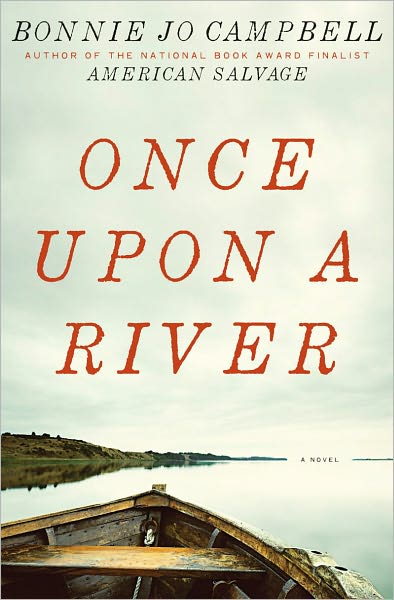
rerun: Once Upon a River by Bonnie Jo Campbell

Pulled from the depths of October 2011, please enjoy this rerun review.

Once Upon a River is a beautiful book. The story is not joyful, let me say that right off. But it’s beautifully wrought, and in fact, when I finished it and stepped back and viewed it as a whole, I decided that the story has a certain beauty, too. A sad beauty, but a beauty that’s true to life.

This is the story of Margo. She grows up in a little town on the Stark River in Michigan, hunting, fishing, and living and breathing the river. She is close to her grandfather, and lives in the outdoors; school and social situations are difficult for her. She’s a very skilled outdoorswoman, and an especially good shot; Annie Oakley is her hero. Bad things happen. Margo’s mother leaves, and as her situation further deteriorates, she takes off upstream in the boat her grandfather gave her to look for her mother. Margo lives off the land and the river, mostly. She makes a few alliances but they all fall apart. People and relationships are not as reliable as the river and the outdoor world in which she feels safe and comfortable. More bad things happen. She grows up some, learns about people, and learns more about the natural world. She moves upstream and downstream, learns how to survive with her hands, a few tools, and her skills, along the lines again of Annie Oakley (she will eventually own two biographies, among her few prized possessions).

This story is painful in more than a few spots. Plenty of bad things happen, including several rapes and quite a bit of death. There’s no shortage of young people having sex, to which your reactions may vary. (Consensual? In itself a “bad thing”?) You will cringe. But like many books that are both sad and realistic, the cringing might be worth it. Margo’s story actually looks skyward, hopefully, at the end. She finds and makes some good things, too.

Campbell has full grasp of metaphor. The river flows on, and Margo learns its rhythms, and how to assert herself while following its current. She finds the river to be a more constant (if not predictable) force than human nature. Campbell has full grasp of language, too; she writes beautifully, lyrically, symbolically. In the end it’s a gorgeous book and I recommend it wholeheartedly. So, to recap: bad things happen, but beautifully. It’s a book about life.

I shan’t attempt a retrospective rating at this distance of more than eleven years, but I still remember this one fondly.

Factory Girls by Michelle Gallen

Amid the Troubles in Northern Ireland, a scrappy young woman comes of age in this inspiring, humorous and moving novel.

With Factory Girls, Michelle Gallen (Big Girl, Small Town) delivers a heartrending, funny, blistering and beautiful novel of foreboding and hope. In the summer of 1994, Maeve Murray and her two best friends are on the cusp of escaping their small Northern Irish town for bigger, better and safer things. Maeve is a child of the Troubles: “neighbours shooting neighbours was just the way things had always been for her.” She comes from a poor Catholic family and has been taught to expect little, but she has hopes that her exam results will move her beyond the background that, in her world, defines her. “Nobody as poor as Maeve could afford to have notions about herself. Which was why she treasured them.” Maeve and her friends Caroline and Aoife find summer jobs at a shirt factory in town, hoping to save a bit before going away to college. Exam results loom all summer, in this novel organized by a countdown beginning “74 days until results.”

Caroline has a loving family, and Aoife is downright privileged compared to Maeve’s rather stark upbringing, not only in poverty but with the death of her sister (unexplained for much of the novel) shadowing all her family’s interactions. “Maeve sometimes wondered if [her sister]’d still be alive if she’d failed and stayed in the town.” Factory work is a bit of a miracle in this depressed town, but it comes with unforeseen challenges, like working alongside Protestants, while outside the gates a never-ending war of retaliation is played out by paramilitary groups on both sides. Maeve worries about losing her kneecaps or her life before she ever makes it to London. “The news reports had said the children were ‘lucky,’ for despite being packed together in the parish hall, they’d received only minor injuries…. She didn’t feel lucky when she felt the slap of the explosion.” Alongside wrestling with grueling work making shirts that nobody she knows can afford and fending off her slimy English boss, Maeve will find still greater challenges spring from the factory floor. “It was the factory workers–both Prods and Taigs–who were at the bottom of a very long and merciless food chain.”

Factory Girls takes on class, corruption and the Catholic/Protestant and English/Irish divides; gender and labor rights; female friendships; family disappointments; the specter of opportunity and the puzzle of how to transcend one’s roots without leaving part of oneself behind. This may sound like a heavy, ambitious group of subjects, but Gallen draws delightful, richly rendered characters and imbues her narrative with a vernacular voice that will charm readers and keep them firmly rooted in time and place. This novel is as hilarious as it is heartbreaking: not to be missed.


This review originally ran in the October 25, 2022 issue of Shelf Awareness for the Book Trade. To subscribe, click here.


Rating: 8 crisp sandwiches.

rerun: The Barbarian Nurseries by Héctor Tobar

A deceptively quiet story, with swift currents running deep beneath its surface, considers the fate of an unprepared Mexican housekeeper in Orange County left to care for her employers’ young children.

Pulitzer Prize-winning journalist Héctor Tobar’s second novel tackles the ambitious goal of characterizing Southern California’s multicultural schizophrenia and achieves it admirably.

Araceli is quietly comfortable in her role as housemaid to the Torres-Thompson household in Orange County, one of three Mexican domestics; but when the gardener and nanny are suddenly dismissed, she is puzzled to find herself expected to care of three children she considers strangers. Worse, she wakes up one morning to find both her employers gone with their baby–-leaving her alone in the house with two young boys. In desperation, she sets off with them on a daunting trek through diverse and unfamiliar Los Angeles to try to find their estranged paternal grandfather.

Tobar creates an intriguing juxtaposition of cultures, as the Torres-Thompson children are thrust into a huge, unfamiliar, multiethnic city. Most observations are from Araceli’s perplexed, amused, lyrically bilingual perspective. At other times, we look through the boys’ eyes, with all the wonder of the new, including evidence of poverty they’ve never before encountered. The older boy (age 11), in particular, has a unique way of clinically interpreting new experiences through books he’s read, imbuing the world with fantasy. The adventure with the boys is a comedy of errors–-Araceli becomes suddenly famous as a symbol of racial politics, and her fate depends upon forces outside her control.

The Barbarian Nurseries is a beautifully written, contemplative and thought-provoking view into Southern California’s diversity and contradictions, as well as a fascinating and well-presented story.


This review originally ran in the September 23, 2011 issue of Shelf Awareness for Readers. To subscribe, click here, and you’ll receive two issues per week of book reviews and other bookish news.


I decided to skip the post-dated rating on this one, as it’s been a while and I’m genuinely curious as to how it’s aged. I did call it one of the best books of the year. Anybody have a more recent reading to report?

rerun: Fire Season: Field Notes from a Wilderness Lookout by Philip Connors

Trying something new here, friendly readers. Without getting too far into it all, the last weeks have been a stressful time for me, for both personal and work-related reasons. I’ve been a bit overwhelmed, and I’m in danger of getting behind here at the blog. Of the irons in my fire, this is not one I really want adding to the stress. So, an experiment. On occasional blog-post-days, I’m going to rerun old content. We are nearly 12 years old here at pagesofjulia! My hope is that some newer readers may be exposed to reviews they’ve not seen before, and I get another chance to expose you to (or remind you of) some of my favorite books. If this is old news, obviously, skip it, as you please. (Bonus: I had fun going way back to look for reviews to rerun.) I’ll try to keep the editing of my original reviews to a minimum.

Naturally we’re beginning with one of my all-time favorites, Phil Connors’ brilliant first book, Fire Season. I first reviewed this book in May of 2011. You can also read my father’s review, and friend Tassava’s, of same.

Please enjoy.


This is an amazing book. The first sentences immediately grabbed me. Connors works summers in a teeny, tiny tower room way up in the sky in the Gila National Forest in New Mexico, as a fire lookout. His job is to spot smoke and call it in for control or “management” of the fires. But his “field notes” tell so much more than the story of his career as a lookout. This is the story of his time alone in the Gila, and of the visitors he receives and the visits he pays back to town; it’s the story of his and his dog Alice’s interactions with nature. It’s the story of fire and smoke and the Forest Service’s management of fire. It’s a history of fire, of the Forest Service, of the Gila, of so very many aspects of our nation’s history, and the natural history of the southwest. Connors discusses the varied reactions the government has had to fire: the policy of fire suppression, consistently and in every case, versus the concept of “controlled” or “prescribed” burns, and the ongoing debates. He contemplates society, its benefits and our occasional desire to escape it. He discusses his unique model of marriage, in which he spends some five months a year living alone and mostly out of touch. He also relates ecological issues like fire as a natural control mechanism, erosion, and the preferences of flora and fauna. And more.

I found Fire Season astounding and important. There’s a zen-like balance in it. Connors is a rather balanced man, in that he still craves human contact; he’s not an entirely back-to-the-wild isolationist, nor does he fail to appreciate cold beer and a variety of media. But he achieves a special and rare state of commune with nature, too. His writing, for me, parallels this balance. He can wax philosophical, crafting lyrical, beautiful odes and hymns of reverence to nature, fire, and life; but he never gets overly wordy, tempering the poetry with (still beautifully written) narrative history.

Connors tells so many little stories I would love to pull out of this book and share as vignettes. For example, the story of Apache Chief Victorio’s last stand (that lasted over a year) in the vicinity of the lookout tower where Connors is stationed:

That September day in 1879, on the headwaters of Ghost Creek, marks a peculiar moment in America’s westward march: black soldiers, most of them former slaves or the sons of slaves, commanded by white officers, guided by Navajo scouts, hunting down Apaches to make the region safe for Anglo and Hispanic miners and ranchers. The melting pot set to boil.

Or the history of the smokejumpers, which I didn’t know before – the parachuting firefighters who pre-date paratroopers and taught them their trade. Or the tale of the Electric Cowboy. Or the story of the little fawn. I cried, mostly because I empathized. Really, it could be read as a series of anecdotes; but the whole is greater than the sum of its parts. The larger story is important, too. I even glimpsed traces of the training I’ve received in trail-building and (more broadly) land management.

The history, the lore, the anecdotes, the author’s relationship with nature, his relationship with his wife, the landscape of the Gila, the details about local species of bird, fish, and game… there are so many gems in this thoughtful, loving, lovely book. I am not doing it justice. It’s a very special book and I strongly recommend this to everyone, no matter who you are. But I especially recommend it if you are… a nature lover, a hiker, a dog lover, a government bureaucrat, a pyromaniac, an environmentalist, a city dweller, a romantic, a firefighter, a skydiver, a cribbage player, a whiskey drinker, a writer, a loner, a philosopher, a historian, a student, or a teacher.

This review originally ran before I instituted a rating system, but obviously –


Rating: 10 phobias.