The Big Sleep by Raymond Chandler (audio)

I know Chandler as the mystery author who inspired, among others, Michael Connelly. Connelly is one of my favorite genre authors and cites Chandler as an influence on his work. In fact, Shelf Awareness quotes him (as their Book Brahmin on April 22, 2011), in answer to a question of the book that changed his life: “The Long Goodbye by Raymond Chandler. I was a casual reader of genre fiction. This book made me want to write it.” Thank goodness for that!

I read The Long Goodbye first (and before the above quotation!), and found it to be delightful. I recognized Connelly in his writing style and Harry Bosch in the style of his lead detective. (Of course obviously the influence went the other way around.) So when I saw The Big Sleep on audio – unabridged, necessarily – I snapped it up. I believe the latter was actually his most-renowned work.

You can’t help but like a guy who doesn’t write that “time passed slowly”, but rather writes

Another army of sluggish minutes dragged by.

That’s pretty great. And this:

‘It’s goddamn funny in this police racket how an old woman can look out of a window and see a guy running and pick him out of a lineup six months later, but we can show hotel help a clear photo and they just can’t be sure.’

‘That’s one of the qualifications for good hotel help,’ I said.

You see my point, right? There are some awfully clever, funny, classic moments in this story; Chandler is a fine writer with a distinct style.

The actual story qualifies, too, as clever, funny, and classic. It’s easy to see that this man is one of the fathers of the genre I love. I’m a bit ashamed to note that I’ve read mostly recent authors, and neglected their heritage.

In this novel, Philip Marlowe, PI, is asked to look into a little matter of blackmail for General Sternwood, who has two young, beautiful, highly deviant and troublesome daughters. Marlowe is a man of relatively few, but quite witty words. He fends off both sisters at various point or another while looking into the missing husband of one, unasked. He’s a classic PI; he drinks alone in the morning; I’m pretty sure he wears one of those pulp detective hats – a fedora? At any rate, he releases the Sternwoods from the blackmail and pulls all the pieces together at the end to explain the missing husband too. It’s a tidy little ending, crowned by some grumbled musings on The Human Situation and The Big Sleep.

I liked this book very much and recommend it to readers of detective fiction who want to go back to the genre’s roots.

Do you read in the present or in the past? Do you miss the past, if you read in the present? I know I love my current genre authors (Lee Child, Michael Connelly, James Lee Burke, Elizabeth George) but it’s important and definitely enjoyable also to appreciate the pioneers. I’ve enjoyed Agatha Christie, Raymond Chandler, and one little gem from A.A. Milne; I’ve got a P.G. Wodehouse waiting in the wings. What are YOU up to?

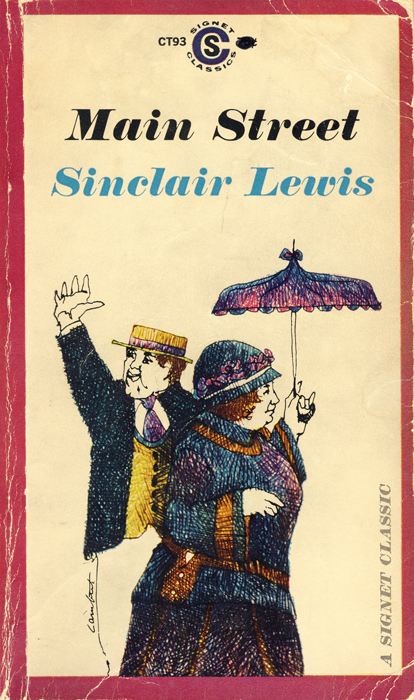
Main Street by Sinclair Lewis

This is a real star. I’ve been so pleased to take in this witty, bitingly satirical story of small-town life. The setting is the fictional town of Gopher Prairie, Minnesota, based on Lewis’s hometown of Sauk Centre; but as he says in the introduction, “the story would be the same in Ohio or Montana, in Kansas or Kentucky or Illinois, and not very differently would it be told Up York State or in the Carolina hills.”

This is my first experience with Sinclair Lewis, and I’m sorry I waited so long. Certainly his other work is now on my long list TBR.

It’s the story of Carol Kennington (née Milford), who as a college student has some vague and lofty ideas of improving small towns, before she marries and settles in Gopher Prairie. This small town (patently representative of small towns everywhere – Lewis all but beats us over the head with this statement) does not want to be improved, does not believe it needs improving, and disapproves of Carol on every level. It’s a painful story, and it drags along, not becoming boring, but definitely oppressive in Carol’s pain. She’s no pristine heroine, repeatedly distracted from her lofty goals of uplifting Gopher Prairie and the human race; she’s decidedly flawed. And yet I don’t think the reader can help but sympathize with her.

She tries to implement her idealized improvements but is rejected in her theater group, her improvement of the town library, her crossing of social, economic, and class lines. She tries to escape in a few cheap flirtations, but none is consummated – her choices of love are disillusioning. She finally makes her husband take her on a trip to leave behind the doldrums, but her relief is temporary. From page 393:

Yes. She was back home! Nothing had changed. She had never been away. California? Had she seen it? Had she for one minute left this scraping sound of the small shovel in the ash-pit of the furnace? But Kennicott preposterously supposed that she had. Never had she been quite so far from going away as now when he believed she had just come back. She felt oozing through the walls the spirit of small houses and righteous people. At that instant she knew that in running away she had merely hidden her doubts behind the officious stir of travel.

Finally, just when I thought we were going to wallow forever, Carol up and leaves town with her three-and-a-half-year-old son for Washington, D.C., where she starts a new and relatively satisfying life. But she is still not ultimately fulfilled… Relatively quickly, she ends up back in good ole GP with good ole Will Kennicott. The book ends with Carol resigned to GP, with an oddly comfortable but not entirely content feeling. I found this a ending a little strange. So much of the book had been writhing discomfort and dissatisfaction and dreaming and planning for something different. Then we finally – very late in the game (by which I mean the book) – saw Carol go to DC for a life that I do see was not entirely suited to her, but also seemed very much an improvement. And then she went back… home? Do we call it home? She makes a few final defiant statements at the end of the book; but her defiance is in spirit and not in action or even, I feel, in emotion. I’m not disappointed with the ending. I suppose I’m a bit surprised. I’m awfully removed from Carol’s world. I will see my 30th birthday a good 95 years after hers; and I’m if anything a bit independent in my own time. Her life in DC looked pretty interesting to me but I realize that I am not Carol. And who on earth could I have been in her day? But I digress.

Lewis’s criticism of Gopher Prairie and by extension, all of the U.S., is almost cruelly biting, but also wonderful, witty, and funny. I was entertained from the first page. Besides American hypocrisy, or maybe even before it, its largest social issue is definitely feminism and women’s place in the home. But there is also tangential treatment of war (World War I), communism, workers’ rights, religious hypocrisy, class structures… and Carol doesn’t escape criticism, either. Lewis reserves a sneer for the out-of-touch artsy do-gooder in her. But in the end I think he retains something of a loving touch for most of his characters at the same time.

The writing was delightful. I laughed out loud and I felt Carol’s pain, and I felt for the ridiculous Will Kennicott (who mostly, I did not like) when he stoically handled Carol’s infidelity-in-spirit. But I also gloried in the turns of phrase. I loved “that amiable contempt called poise” and that Carol “picked [the book] up carelessly, with a slight yawn which she patted down with her fingertips as delicately as a cat.” Does that not paint a portrait?

I was interested to find, in the Afterword (by Mark Schorer of the University of California, in my Signet Classic paperback edition of 1961), discussion of this book in relation to Madame Bovary. Apparently my repeated comparison of the two, while I was reading, has a strong precedent. Schorer writes,

Madame Bovary is more than a study of provincial manners in a certain time and place in France; that much is only the setting for a highly dramatic presentation of human catastrophe. But Main Street cannot be lifted out of its historic setting, which is, in effect, the whole of it.

Perhaps this is what I was saying above, about trying to put myself in Carol’s shoes. At any rate I found the Afterword to be a few thoughtful pages, worth the time I spent on it.

I picked this up as a casual read and it was very enjoyable and worth my time and interest. I’m going to apply it towards the Classics Challenge at which I am so miserably far behind, so there we go. More to come!

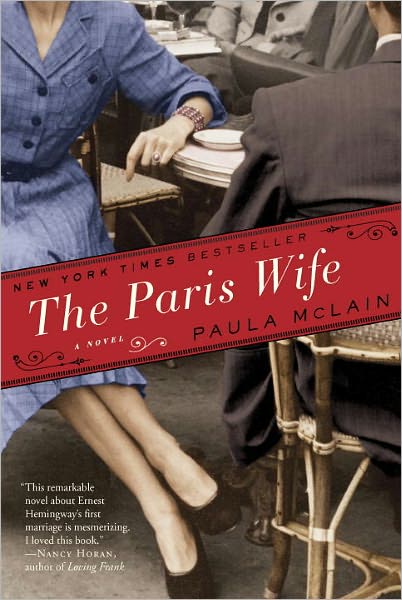
The Paris Wife by Paula McLain

Ahhh. This was really a joy and a pleasure to consume. I’m just sorry it’s over.

(Let me apologize in advance for a lengthy post today, but I have a lot to say about this book.)

Ernest Hemingway is my greatest literary obsession; I’ve certainly loved, and returned to, and reread, and studied other authors, but Hemingway has been the love of my reading life. Certainly, that was a large part of the appeal of this book: to come home to familiar and much-loved territory. We all know that feeling, I think: visiting an old neighborhood, hearing a song from one’s happy youth, telling old friends the same old stories of shared memories.

So, as I’ve said, part of the luxuriant pleasure of this book was all the intertwining threads of familiarity. I have recently been reading By-Line: Ernest Hemingway, a collection of his newspaper and magazines stories and dispatches, many from the Hadley era of his life. I’ve read 3 or 4 biographies, and piles of his novels and short stories, and nonfiction/memoirs like Death in the Afternoon (about the bullfights he saw) and A Moveable Feast (about his life in Paris with Hadley). And I just yesterday purchased The Garden of Eden, a novel published posthumously (and controversially edited by his surviving family), about a couple who becomes a triangle on the beaches of France and in Spain. I read it years ago but wanted to own my own copy. I remember really loving this book, although it’s surrounded by critical ambivalence and debate; this is where Hemingway most directly ventures into gender-changing, gender ambiguity, cross-dressing, bisexuality, threesomes… and all sorts of interesting and disturbing subjects linked by some biographers to Hemingway’s mother’s tendency to dress him up as a little girl when he was young. I find it all fascinating.

my Hemingway library at present


Hadley Richardson was Hemingway’s first wife; they married when he was just 22, and she was 29, and surprised at herself for landing such a vibrant, popular, ambitious young man. They took off for Paris quickly, and shared the early years of Hemingway’s career, including the publication of Three Stories and Ten Poems, In Our Time, and The Sun Also Rises, his first novel and the one that really launched his career. They also shared poverty and insecurity, a number of hardships, an unstable but scintillating circle of famous friends, and an unplanned pregnancy. Their story ends (I’m not giving anything away here, it’s history) when Hemingway begins an affair with Pauline Pfeiffer, who will be his second wife (who will be thrown over for the third, who will be thrown over for the fourth, who will hear the gunshot when he commits suicide just before his 62nd birthday).

So, as I’ve said, a large part of the joy of this book for me was sharing so intimately in the life of someone I feel I know well, and whose work I love. But there was a real danger there; for if it had been done badly or in poor taste (overly sentimental or maudlin, or vindictive towards Hem the womanizer) or inaccurately, imagine my upset! With this subject being so near to my heart, the standards were very high.

Paula McLain has my gratitude and admiration, because she’s done beautifully! This is a gorgeous novel. Her writing style (in Hadley’s voice, in first person) is a bit like Hemingway’s, although not quite so sparse. She paints pictures with short brush strokes. Hadley’s character is an interesting blend of strength and weakness (which is an observation she makes about Hem, too); she repeatedly bemoans her un-modern tendency to obey and bow to her difficult husband, compared with the women around her and their new-age relationship rules. She “lets him go” to Pauline without a fight, from the perspective of several mutual friends. But I think she maintains a certain dignity, and not just in her defeat at the deceitful Pauline’s hands. And at any rate, her voice is clear and authentic and emotionally revealing without being sappy. She seems to be honest with herself, and with the reader. In many ways this is a novel about a woman struggling to find and maintain her own identity in the unique setting of 1920’s expatriate Paris, and while being a loving wife and mother. In this sense it wouldn’t need to be about Hemingway; it’s a woman’s story, and it’s important without the celebrity. It reminded me a little of Kate Chopin’s The Awakening, or The Painted Veil by W. Somerset Maugham.

I loved how McLain (or Hadley) used some of Hemingway’s own rhetoric about truth and turned it back around on him. For example, on page 230, Hadley is dealing with her feelings about being completely left out of the book, The Sun Also Rises, when all the others present made it in as characters (none flattering):

I was incredibly proud of him and also felt hurt and shut out by the book. These feelings existed in a difficult tangle, but neither was truer than the other.

Hadley was a complex and mostly sympathetic character; I got frustrated with her here and there for not standing up for herself a bit more, but she was so authentic and real and human, I mostly was able to take her as she was. Hemingway was not so sympathetic, which is also very authentic and real. He was a cad towards the men and women in his life, pretty consistently. He was also very lovable, which is why so many men and women came back to him over and over for more fun and abuse. He was, as Hadley says on page 311,

such an enigma, really – fine and strong and weak and cruel. An incomparable friend and a son of a bitch. In the end, there wasn’t one thing about him that was truer than the rest. It was all true.

Again with the truth of the thing, which Hem himself loved to cite.

What a work of art this book was, and how evocative of emotions. It was exhausting and cathartic. Is my reaction colored by my love of all things Hemingway? Yes. But my standards were also raised almost impossibly high, so please take me seriously when I give McLain an A+, and thank you, ma’am.

finished Faithful Place

I finished this novel last night, and was sad that it was over. That’s always a compliment. I think author Tana French did a great job of creating a world and putting me in it. I don’t know Dublin, or the neighborhood Faithful Place, but I feel like I know it now. The crazy Irish-Catholic family culture was really evocative; although I can’t speak to the accuracy it certainly felt real. And I’m a big fan of Frank as my newest Bosch-style detective. (As I told the Husband the story last night: “there are a lot of Bosch’s, aren’t there?” Excellent observation dear.) And as predicted, French did throw another loop in, after I thought I knew whodunit. This was a great read, and right up my alley: strong sense of place, gory but also sentimental, with the romance between Frank and Rosie, family drama, and all that; and Frank is my kind of detective character. I will definitely look for more of French. I would like to see more of Frank, too, and maybe more of Stephen – it sure felt like he was being established to play more of a role, so I hope he’ll continue in a later book. It looks like French’s first two novels, In the Woods and The Likeness, kept the same detective, so maybe we can hold onto Frank for a little longer. In the meantime I’m going to keep my eyes open for those two earlier titles.

Karma, I was surprised several times over; did she get you too? What were the big surprises for you? I know you’re not done yet. I really cared about Frank and was really upset about Rosie and the death of the ideal. Was it that real for you? Keep me posted. Valerie, I recommend this one when you find the time…

finished The Tin Roof Blowdown

Burke sure does know how to be poetic. Check the final paragraph of the epilogue, which I have decided to include here in its entirety (not really so much of a spoiler at all because it is Robicheaux’s *fantasy* ending):

“In my fantasy, I see Bertrand far out on the water, pulling on the oars, his arms pumped with his task, the ruined city of New Orleans becoming smaller and smaller in the distance, a great darkness spreading across the sky just after sunset. The blisters on his hands turn into wounds that stain the wood of the oars with his blood. As the wind rises and the water becomes even blacker, he sees hundreds if not thousands of lights swimming below the surface. Then he realizes the light are not lights at all. They have the shape of broken Communion wafers and the luminosity that radiates from them lies in the very fact they have been rejected and broken. But in a way he cannot understand, Bertrand knows that somehow all of them are safe now, including himself, inside a pewter vessel that is as big as the hand of God.”

I call that rhythmic, lyrical and hopeful, and even I, with my failure to grasp biblical allusions, can see the significance of blood staining the wooden oars.

I find it notable that Robicheaux deals somewhat sympathetically with a character who is a rapist. Some might be offended, I suppose (especially if you take my statement straightforwardly, which would be a mistake), but it’s not simple at all. Robicheaux is disgusted with this individual and the pain he’s caused. But in a very realistically, human, ambivalent way, he recognizes that we are all at least a little bit a product of our environments, and that perhaps everything is at least a little bit relative. The character in question makes some form of amends, at least within the structure of his own understanding. It’s complicated. I’m not particularly sympathetic with rapists myself (!!) but I appreciate that Burke portrays everything to do with human nature and sin and redemption as being complex and not black-and-white (no pun intended, in a book definitely charged with racial tension as all Burke’s books are – probably unavoidable considering the setting).

I confess that Cadillac Jukebox let me down just a bit, but The Tin Roof Blowdown has been so outstanding that I think I’m ready to make a James Lee Burke crusade like I did on Michael Connelly a few months back – and try and read everything he’s written.

But then again, there are so many good books in the world…

Lee Child’s Echo Burning, and some more nonfiction: The Spirit Catches You and You Fall Down

Sorry I’ve been absent for a bit. But I have been doing some good reading.

Last week, my workday reading was Lee Child’s Echo Burning. Child and his character, Reacher, were recommended to me in my RA class, and I picked up Echo Burning because it’s set in the vast west Texas desert, an area I’m a little bit familiar with.

Child’s series starring Jack Reacher was compared by my classmate and teacher to Connelly’s series starring Harry Bosch, of which you might have noticed I’m a fan. I really read Connelly to get more of Bosch, and Reacher does share some resemblance. Bosch, while an anti-authority loner type, does actually work for the authorities as a police detective, although he’s always at odds with his bosses and occasionally leaves the fold just to make things interesting. Reacher is a former military policeman (MP) turned rogue do-gooder, in a violent sort of way. Neither has a great deal of respect for authority or the rules that dictate the way they should go about solving crimes or problems, although Harry grudgingly plays along, most of the time, at least in the clues he leaves behind, because he has to present a prosecutable case to his DA.

Reacher doesn’t have a mission like Bosch does; in this book, and I get the impression in all, he’s merely drifting, moving through town, and gets caught up in problems he then goes about solving. Bosch has a job to do, and does it well and willingly; Reacher is just taking what comes up. Actually, in many ways the Reacher story reminds me of a western, especially with this setting; he’s the lone ranger rolling through town, taking care of business and moving along. He has an endearing, chivalrous care for the ladies, but he’s awfully rough around the edges, and starkly violent.

I loved it. It was just similar enough to Connelly to get me excited – the characters were similar but different, and would probably respect one another, although they wouldn’t stick around to get to be friends. I enjoyed the setting and recognized it, which is always fun (we all enjoy realistic settings in our own hometowns, right?). I guess it had a number of my requirements: strong sense of place; moody, gritty, dark tone; and a certain “type” of main character. I think I’ll be looking for Reacher again.

This weekend I got involved in another work of nonfiction, and I have to say, I find it remarkably similar to a recent read (but I’ll tell you about that another day, so as not to ruin it). I’m about two-thirds of the way through, now, with The Spirit Catches You and You Fall Down, by Anne Fadiman. (There’s an excellent chance I’ll finish tonight.)

This book is about a little girl and her family’s experience: Lia Lee is a Hmong child, born in Merced, CA to recent immigrants from the Hmong people’s extended journey through China and Laos. She has severe epilepsy, and the book centers around the conflict between her family and culture, and western medicine, in their two very different understandings of what her illness is, what causes it, and how it should be treated. In addressing Lia’s story, Fadiman gives us a brief history of the Hmong people’s culture and history. It is absolutely fascinating, and for me, the cultural aspects make this book special.

It’s an educational book because it provides lots of information and facts, properly cited, about medicine and epilepsy, as well as about the Hmong people in history (and the U.S. involvement in Vietnam and Laos), their immigration here, and the treatment of refugees by our welfare and other systems. But like I said, the cultural interactions are most interesting to me. The local hospital and medical system struggle to treat Lia and give her the best possible life; her parents likewise want her to be happy and healthy. But they have such fundamental differences… it’s not like two doctors debating two courses of treatment; we’re talking about two absolutely non-compatible, to the extent that they’re not really translatable, understandings of what’s wrong with her and the causes of her disease. Translation is almost not possible in the traditional sense because of cultural norms that don’t allow for direct translation. Californians and the Hmong have so recently met that there’s no precedent for much of a need for translation; there hasn’t been time for much bilingualism to develop, nor has their been much interest, on either side. (I should note this book is more than ten years old, so the current situation is a little different.)

I’m totally engrossed in the story of Lia and her family, but equally so in the story of the Hmong people in history. I’m also intrigued by the involvement of the author/narrator and her experience in researching the book. One lesson or concept that I’m coming away with is the ease with which we can condemn someone as having done the Wrong thing, and the difficulty with which we can come up with the Right thing. This is something that always occurs to me in politics. I can clearly see policies or politicians with whom I disagree because they’re Wrong; but in such a big, complicated, diverse world, with such intertwined goals, interrelated causes and effects, and various goals, I have an awfully hard time clearly seeing The Right Way. This is why I am not running for public office! Anyway – Lia’s story might well make you realize that nobody was entirely right or entirely wrong (certainly not wrong in their intentions and best efforts) and yet, Lia did not get optimal care. These cultural exchanges are, whew, hard.

I recommend this book and hope you’ll join me in enjoying it. If you haven’t already guessed what recent read I’m comparing it to, stay tuned. To me it’s just as obvious as anything but we’ll see. Feel free to post your guess here… Til soon, enjoy your week and your books.