The Black Box by Michael Connelly

Harry Bosch’s investigation into a 20-year-old murder linked to the Rodney King riots and the first Gulf War is set to a moody jazz soundtrack.

The Black Box, Michael Connelly’s 25th novel, comes 20 years after his first, The Black Echo, which introduced readers to Los Angeles detective Hieronymus (Harry) Bosch. These days, Bosch is working with the LAPD’s Open/Unsolved Unit, and he decides to pursue a 20-year-old case that was originally his: the murder of Danish photojournalist Anneke Jespersen during the 1992 riots. Bosch never got a chance to investigate thoroughly–but, as regular readers know, Bosch never gives up. As he pursues the reason Jespersen came to Los Angeles in the first place, he finds himself investigating war crimes dating back to Desert Storm. Searching for the “black box” that will reveal the recorded secrets of Jespersen’s murder, Bosch also lands (not unusually) on the wrong side of the police department’s leadership.

All the strengths that Connelly’s readers have come to expect are on display. He employs an expert sense of place in evoking a gritty, stark Los Angeles, and the mood of the novel is dark and brooding. The pacing is taut, the characters well developed. Bosch’s side interests in jazz artists like Art Pepper and baseball greats like Casey Stengel provide depth and layers to his personality. Series readers will enjoy the updates on ongoing story lines, as Bosch’s daughter, Madeline, continues to mature and his relationship with girlfriend Hannah struggles along. But like all Connelly’s atmospheric, fully realized novels, The Black Box can also be read as an entirely satisfying stand-alone mystery.


This review originally ran in the December 14, 2012 issue of Shelf Awareness for Readers. To subscribe, click here, and you’ll receive two issues per week of book reviews and other bookish fun!


Rating: 6 furrowed brows.

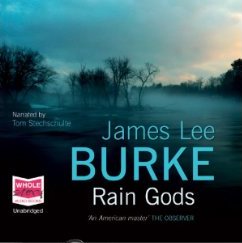
Rain Gods by James Lee Burke (audio)

raingodsJames Lee Burke is best known for his series of mysteries starring Detective Dave Robicheaux, who makes his home in New Iberia, Louisiana and whose adventures mostly take place there (or in New Orleans, or – in one case that I know of – in Montana). But he does write other books: I read a western a while back. Rain Gods is the first Burke I’ve read that stars Hackberry Holland, sheriff of a small Texas border town that I am pretty sure remains unnamed.

As the book opens, Hack has just discovered a shallow grave filled with illegal immigrants behind a church, and a young man named Pete Flores, a veteran of the war in Iraq, flees town with his girlfriend Vikki. They fear the team of professional criminals that were involved with the shooting, but the threads of the case are quickly so thoroughly intertwined that Pete himself doesn’t know who they’re running from. Between a New Orleans crime boss, a bumbling Texas strip club owner, a psychopathic hit man who thinks he’s the left hand of God, and a couple of young lackeys whose loyalties are yet to be tried, Hack and his deputy Pam Tibbs have their hands full in trying to solve the murder and protect Pete and Vikki. And they may still be working out the relationship they share, to boot.

As in any good mystery story, some subplots come out sooner than others. The man they call “Preacher,” who somehow thinks God is supportive of the mayhem he creates, is an enigma of pure evil; but he’s not the only one whose motives are unclear (or irrational). The romance that Pete and Vikki share is a welcome sweet note; and Hackberry’s storied past and accumulated guilt are a familiar but still satisfying facet. The fact that both Pete and Hack are still processing their experiences in war (Iraq and Korea, respectively) is a sobering note of reality that draws the two generations together effectively.

I don’t feel that Rain Gods is Burke’s finest work; I found it a little bit slow-paced. But it had all the hallmarks that I come to Burke for. Our hero is damaged and has committed great wrongs, but is essentially good. The setting is strongly evoked – and I liked it particularly, as the plot mostly takes place in West Texas borderlands, a location I’m fond of and fairly familiar with. And Preacher’s character is quite frightening – as he was intended to be.

The audio narration by Tom Stechschulte is excellent. I love the different voices he does – especially because there’s such a collection of characters featured here, with different accents and tones of voice that express emotions and pain and insanity. This audio format deserved a fine portrayal, and it got one.

I will be reading more James Lee Burke. But I may prioritize the Robicheaux novels.


Rating: 6 delusions.

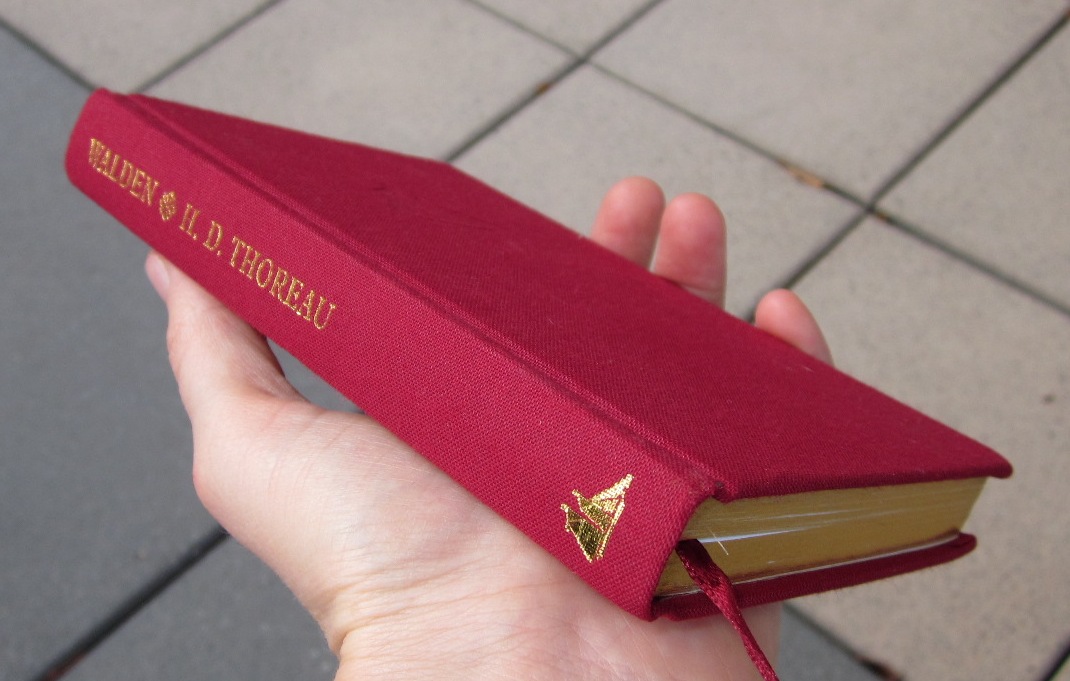
Walden by Henry David Thoreau

my charming little copy of Walden


I have been thinking this review over carefully. Walden is an “important” book. I had some troubles with it, particularly about midway through, when I stalled for several days and was sure I was going to give up. This was while visiting Concord and Walden Pond, no less! I think I owe my father credit: he recommended that I just read it through, with less attention to note-taking and interpretation at every page along the way. And on my long travel day home, I got back into it.

What is it that made this book a little difficult for me? Well, the language is somewhat dated, and the sentences tend to be long and rambling. Picture several long clauses strung together, and then having to look back up half a page to see what the subject was that this verb, finally, is acting upon. That will slow a person down. And the subject matter, the thoughts being communicated, are often quite dense. When Thoreau writes descriptions of his natural surroundings, I can settle into the imagery and the poetry, and float along pleasantly. But when he philosophizes, I am often in trouble. Large ideas are presented here, regarding our relationship with the natural world, politics, and religion. Thoreau jumps around between these subjects. Perhaps this begins to help you understand my trouble.

The first chapter, “Economy,” is lengthy. In my edition it occupies 80 pages, of 350. And no later chapter runs longer than 20 pages. I enjoyed “Economy”: I sympathize with the points Thoreau makes therein. But maybe I was wearied by it. It wasn’t until 200+ pages that I stalled badly. And once I got back into it, I enjoyed it again. I can’t entirely explain that pattern, and I’m sure yours was/will be different. I think the biggest help I got was visiting Walden Pond. This is obvious, no? When my mother and I toured The Wayside, our park ranger/tour guide quoted Nathaniel Hawthorne (and I wish I could find the quotation) on visiting authors’ homes. The gist was that visiting the home of an author is the best way to better understand his or her work, and my (limited) experience visiting authors’ homes certainly backs this up. In this way, walking around Walden Pond enriched my appreciation of Walden and renewed my interest in it.

Walden is a memoir; a political tract; a geographical study; a fine piece of nature writing; and a poetic rambling by a unique sort of Renaissance man. I found it rather effortful reading, but worth it in the end. For those who enjoy thought-provoking, challenging, lyrical writings (and longish sentences), it should be a big hit. For those who find these characteristics a little daunting, but are interested in the legacy of Henry David Thoreau, I recommend giving it a go just the same. I’m glad I did. And go see the place in question if you can, too!


Rating: 6 fallen leaves.

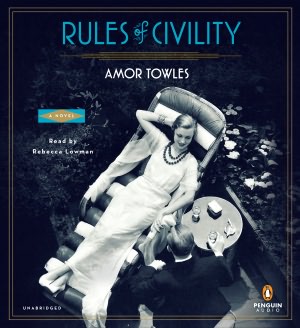
Rules of Civility by Amor Towles (audio)

I have one to proselytize for, friends. Rules of Civility will certainly make the list of the greatest books I discovered in 2012.

The book opens with the story’s narrator, Katey, and her husband Val at an art opening in 1966. A few pages set the scene and the style of this book – and oh, the style! – before we’re whisked back into Katey’s reminiscences, beginning just a few hours before the new year of 1938 will be rung in. She and her best-friend-and-roommate, Eve, are out on the town, and they meet a man who buys them champagne for the toast at midnight. And then we follow Katey through the year.

Katey’s life changes a great deal in 1938, in all its aspects: career, home life, relationships, love, aspirations, her understanding of herself and of her world. I don’t want to mention any more of the plot, because I found such joy in discovering its twists myself, and you should too.

This book has many strengths. Its story is interesting: a single year, 1938, in the life of an ambitious young woman in New York City. And there are such surprises that I dropped my chin on my chest more than once. But the plot alone would not have made the book what it is. The characters are strong as well: Katey is pretty fabulous, as are a number of others. But neither is this the shining facet that draws the eye. I think the real victory is in the writing. You may have noticed (and I hope you’ve forgiven me) that I used not one but three teasers to whet your interest (here and here). It’s very evocative: I could see, hear, smell the New York City described; and further, I felt all the emotions Towles wrote. Driving to and from work and listening to this story (and Rebecca Lowman’s masterful, perfect narration), I arrived at my destination confident and optimistic, hopeful for the future, downcast, flabbergasted, or whatever that chapter called for. It was one of those very rare books that engaged me completely, made me lie awake at night worrying, wishing for certain events to transpire, caring deeply about fictional characters. It was amazing. And of course I have no great understanding of 1938 New York City; but Towles (and Lowman) have me utterly convinced that it sounded and looked and smelled and tasted exactly as described here.

And while I’m praising the writing, the style with which Katey’s voice comes alive, I must praise the reading of this audio version as well. Lowman has a frank, languid tone that feels precisely right for Katey; I love that she slows down. Her pacing is sometimes indolent and sometimes despairing, but it always adds to the sense of nostalgia in the beautiful piece of art that is Rules of Civility.

Oh, and it’s worth adding too that Katey is a reader, and literary references abound, which enriches the overall effect considerably for me and perhaps for you too.

Without having given away much plot, then, I assure you that the setting, the sense of style, and the writing on display in Rules of Civility are all remarkable. This will definitely be one of the best books I read this year, and the audio version is superb. Run out and get a copy.


Rating: 9 martinis.

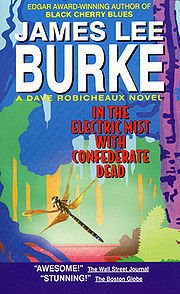
In the Electric Mist with Confederate Dead by James Lee Burke

As noted recently in my book beginning, Burke is an old favorite. Between this book’s title and its colorful cover, I felt especially drawn to it. The electric mist and the Confederate dead are some of the odder, more alluring moments in this story, too, but they are not its center.

Detective Dave Robicheaux is the star of Burke’s bestselling series. In this installment, he’s at home in New Iberia, a small community on the Gulf Coast of Louisiana. There’s a movie production in town, which brings with it various complications of the local scene: a group of gangsters come in from New Orleans; the Hollywood actors drive drunk and make trouble; several girls turn up dead in what looks like the work of a serial killer; and a body surfaces that relates to an event in Robicheaux’s own distant past. He continues to attend AA meetings and his alcoholism continues to be one of the sources of conflict in the story. There are some weird, almost paranormal forces at work – or are they just the manifestations of his alcoholism? – and that keeps things interesting and colorful.

This book shares certain themes with all Burke’s work, including racial injustice that persists in the South; a love of nature (and some outstanding, lovely writing conveying the natural beauties of south Louisiana); struggles with alcoholism; and corruption in positions of authority, manifested in the conflicts Robicheaux has with his workplace superiors. One of Burke’s greatest strengths, in my opinion, is the strong sense of place that he conveys with his lovely, lyrical writing. He waxes poetic about the beauty of nature; and both the natural setting and the cultural references evoke south Louisiana unmistakably. His stories, it seems, could be set nowhere else. (This is not true. Swan Peak is set in Montana and is equally successful. But my point about a strong sense of place stands.) While his plots are interesting and his mysteries do indeed keep the reader on her toes, Burke’s beautiful writing and obvious care for natural and cultural settings are the best and most unique parts of his work. I feel that his closest readalike author is Michael Connelly. Connelly’s writing is not nearly as lyrical, but his strong sense of Los Angeles, and Detective Bosch’s love for jazz and LA, and the dark, brooding mood both authors create, make them a matched pair in my view.

In the Electric Mist with Confederate Dead is vintage (1993), classic James Lee Burke, and thus strongly recommended.


Rating: 7 crawfish poboys.

Broken Harbor by Tana French

I consider this to be another great hit from Tana French, author of The Likeness, In the Woods, and Faithful Place. Her mysteries are atmospheric, have a strong sense of place (that place being Dublin and the surrounding suburbs), and look back toward the past. Ireland’s economic depressions and the inheritance of related difficulties with employment and housing also play a role in each book. These four books are a series, loosely, in the sense that certain characters overlap; but each stands alone so well it’s almost a disservice to link them together. By no means would I recommend worrying about reading them all, or reading them in order.

In Broken Harbor, Mike “Scorcher” Kennedy is the reigning bad-ass murder detective on the Dublin squad, but the mistakes of a recent case, never described in detail, have him under a shadow; so he’s relieved and excited to get the latest gruesome, media-intensive case. He’s got a partner, Richie, a brand-new rookie from the wrong side of the tracks, which suits Scorcher because he’d just as soon work alone, and an easily-led rookie is the closest thing to working alone. A family of four named Spain – mom, dad, and two little ones – have been attacked in their home; three are dead, and the mom is in intensive care. Their home is in Brianstown, a fancy new development that got left unfinished in its earliest stages by the failing of of the housing boom; it’s not a pretty place after a few years’ decomposition since construction ceased. And, importantly, Brianstown used to be the seaside village of Broken Harbor, where Scorcher vacationed as a child with his family.

The important elements are several. The mystery of who nearly wiped out the Spain family is, on the face of things, the central plot, and it does keep Scorcher, Richie, and the reader busy for the entire book; the solution isn’t revealed until the final pages. A mystery within the mystery is what’s made all these holes in the walls of their home, and what force was haunting the Spain parents, otherwise poster children for a perfect life, right down to the magazine-worthy interior decor. The economic recession that killed Brianstown before it got out of the gate is an important detail that we attend to throughout, and is part of what makes Dublin & its suburbs the only place this story could be set. And then there are Scorcher’s demons: as we’ve seen in French’s other novels, his childhood connection to Broken Harbor will follow him through this seemingly unrelated case. This is a thriller not just because of the awful fate of the Spains, but also because of Scorcher’s family drama, still playing itself out. His training of the rookie, Richie, is poignant: the detective who never wanted a partner finds himself yearning for the camaraderie he’s observed in other partnerships, wondering if Richie could be “the one.” And finally, Scorcher is forced to do some philosophical questioning. The deal he’s made with the universe, his understanding of the source of the world’s evil, will be challenged.

The tone of this novel is one of my favorite parts. It’s dark, lush, and almost dreamy. Scorcher feels real to me even as he approaches caricature (hey, call me credulous, I’m enjoying this). He’s fatalistic, relying in part upon physical feelings that tell him when he’s getting close; we get hints that he knows what’s coming. His tortured persona, his tendency to distance himself even when he’d like to get close, is a recognizable genre type, but well-done all the same. I always appreciate French’s evocation of Ireland, its culture and the impact its economy continues to have. And the psychological drama of the Kennedy family had me on the edge of my seat. Certain elements are a little formulaic, sure, but beautifully wrought; and the lovely writing puts it in such a package that I don’t mind a bit. This is a great example of why I love Tana French.


Rating: 7 unpleasant memories.

The Warmth of Other Suns: The Epic Story of America’s Great Migration by Isabel Wilkerson (audio)

I didn’t really know what this book was about when I picked it up – only that it was well-regarded. I’m so glad it found its way into my hands. Isabel Wilkerson has taken on a large-scale, ambitious subject here, and rendered it beautifully. And the audio reading by Robin Miles is lovely to boot.

The “great migration” in the subtitle refers to the movement of black Americans out of the South and into the northern and western United States in 1915-1975. Wilkerson starts from the very beginning, looking at the experiences of former slaves just after Emancipation in an impoverished region struggling to rebuild with a new order of things. The creation and expansion of Jim Crow laws designed to hold blacks down took time after the end of the Civil War to take effect. In the new caste system, former slaves and their descendents were unable to move up in the world and were in constant fear for their lives if they were to misstep around Southern whites. By 1915, they had begun to move out of the South, in what became a mass migration along lines so distinct that enclaves of blacks from specific towns and states were recreated in new locations.

Wilkerson shifts between two ways of studying the Great Migration. Sometimes she takes a broad view of history, in which she cites her own interviews (she states that she did over 1,200) with migrants and their descendents as well as a number of historical sources, to render the story of the Migration generally. And sometimes she follows the specific personal stories of three individuals who she interviewed at great length over a long period of time, traveling the country with them and becoming part of their lives. (In this respect, the journalist/author becoming part of the family of her subject, I was reminded of Rebecca Skloot’s amazing The Immortal Life of Henrietta Lacks.) George Swanson Starling moved from Eustis, Florida to New York City, later sending for his wife Inez to join him there. He had to leave Florida suddenly because a friend tipped him off that a lynch mob was coming for him; he had been involved in organizing his fellow citrus pickers to demand higher wages. Ida Mae Brandon Gladney moved with her husband George and their two children, with a third on the way, from Mississippi where they had been sharecroppers. They would eventually end up in Chicago, by way of Milwaukee. And Robert Joseph Pershing Foster was an ambitious surgeon and veteran from Monroe, Louisiana, with his heart set on Los Angeles. Known as Pershing in Monroe, he would resettle as Robert (or Bob, or Doc) in LA and send for his wife and daughters to join him there, where he built a new life in high society with the big house and booming practice he’d always wanted.

I found this shifting back and forth between the broad view and three personal histories extremely effective. Anecdotes from the lives of Southern blacks drove well home the misery of their bottom-rung status there; some of these stories are horrific, but important to show the desperation some migrants felt when they left their homes in the South. National trends played a role – for example, during WWII demand for Florida’s citrus was high while the supply of labor to pick the fruit was low, with everyone off at war, and this imbalance led to George Starling’s ability to demand higher wages. And the history of Chicago’s race relations and residential segregation puts Ida Mae Gladney’s home ownership into the proper perspective. You get the point. The history is well-documented and, I’m convinced, well-researched; and the personal stories make it all, well, personal. I was deeply involved with our three representative individuals by the end of the book and, yes, I cried.

I love that Wilkerson brought such a large-scale, important trend, that has had such huge effects on American history, to life the way she did. I also like that she examined the broad effects of the Great Migration, in terms of the cultures of both white and black residents of the North and the South, and took the time to show that black migrants were really far more like immigrant groups in history than like migrants within their own country. I recommend this book as part of a study of American history – but one need not be an academic to appreciate it. The story of the Great Migration is made accessible here, and I’m glad I know more about it now. This 19-disc audiobook (over 600 pages in print) went by easily. This is how I like to take my history lessons. Check it out.


Rating: 8 train rides north.

The Perfect Storm by Sebastian Junger (audio)

In October 1991, a number of factors converged to create a storm of inconceivable strength off the Massachusetts coast. Vessels large and small struggled in its path, and a few didn’t make it out. Sebastian Junger follows a few of the men, women and boats involved in this remarkable work of nonfiction. He begins by introducing us to Bobby Shatford and his girlfriend Chris, and their town of Gloucester, Mass. Bobby and Chris wake up hungover – Bobby has a black eye – and drive around town, visiting with friends and Bobby’s mother Ethel, bartender at the Crow’s Nest, and making final arrangements for Bobby’s departure on the Andrea Gail, a small fishing boat with a crew of six. We then follow Bobby’s path and that of his fellow fishermen: the two men who get funny feelings and refuse to sail with the Andrea Gail, and the five who join him on her for an intended 4-week fishing trip. We track their fishing, the decisions made by their captain Billy Tyne, the radio communications between Tyne and other fishing boat captains. We watch the storm approach, checking in with meteorologists and getting quick lessons in storm formation, and we visit other boats as well, including the Satori, a 32-foot sailboat, and the Eishin Maru, a Japanese longliner, both fated to have complications and exciting moments. We also get to know two rescue crews, made up of Air National Guard pararescue jumpers and Coast Guard rescue swimmers. I won’t give too much away (although, all of this being a matter of historical record, it’s out there), but not all of the characters introduced survive the storm.

That’s about all I want to say about the events detailed here; you can find out more by reading the book yourself (or listening to the audio, as I did – more on that in a bit), which I highly recommend. And here’s why. This is an incredibly adrenaline-pumping adventure tale. There are sad endings for some of the men and women involved, yes, but there is also great heroism, amazing skin-of-your-teeth survival, drama, even a love story or two mixed in. The human interest, in other words, is huge. For excitement, really, could you ask for more than rescue swimmers jumping out of a helicopter into the storm of the century to rescue men and women from sinking ships or from the open ocean? I submit that you could not.

In addition, the story is told in a unique way. Junger jumps subjects throughout: we meet a few characters in Gloucester, then we review the fishing history of the town of Gloucester, then we study up on commercial fishing for a bit, back to the characters… eventually we get lessons in meteorology, the physics of boat building, wave formation, and what exactly happens when a person drowns. As I wrote before, Junger is fairly strict and journalistic in following the facts. Where parts of the story he tells are unknown, he doesn’t claim to know, but he does interview people who have been through similar scenarios and survived; so we get an educated estimation of what the players might have been through, while making nothing up. It’s a method I respect; I found it both dramatic and fully-wrought, and reliable.

The audiobook I listened to is excellent, too. Read by Richard M. Davidson, it has all the taut, tense action it needs without ever feeling over-dramatized. And as a bonus, it includes a recording of the author speaking about the making of the book. This flows like his-side-only of an interview; I imagined someone in between asking specific question. Like the foreword, I found this a substantial addition. At the time of the storm, in 1991, Junger was working as a high climber, taking trees down for a tree company, and selling freelance magazine articles for a living. The storm inspired him, and he wrote a chapter about it, initially for a book he conceived about various dangerous jobs: the commercial fishermen of Gloucester would have been joined by loggers, smokejumpers, forest-fire fighters and the like. But his agent landed him a deal for a whole book about “the perfect storm” – whereupon Junger became anxious. How would he fill a whole book with just the storm? he wondered. (I loved hearing the author, in his own voice, discuss his nerves! And the whole process, really.) So he decided to follow all the sub-plots and related topics he could, to flesh it out, and this is why we are treated to the lessons in weather, boats, the fishing industry, etc. What struck me about this is that it is a rather Moby-Dick method, and ironically, while that classic work of fiction is notoriously difficult to read (come on, even its fans admit this, right?), this work of nonfiction – even though readers often fear nonfiction will be dry or cumbersome – flowed delightfully and effortlessly. Those subplots mightily enriched the whole. Even the questions left unanswered, about the fates of those who disappeared and whose remains were never found, Junger turns to advantage. As he says, because he investigated the experiences of others who lived through similar situations, we get a richer, more layered story than had he interviewed a sole surviving fisherman.

Sorry for another long review! (Usually this means I really liked the book.) In a nutshell: moving, emotional, adrenalizing, scientific, faithful, thrilling! Check it out.


Rating: 8 swordfish.

EDIT: I also reviewed the movie, here.

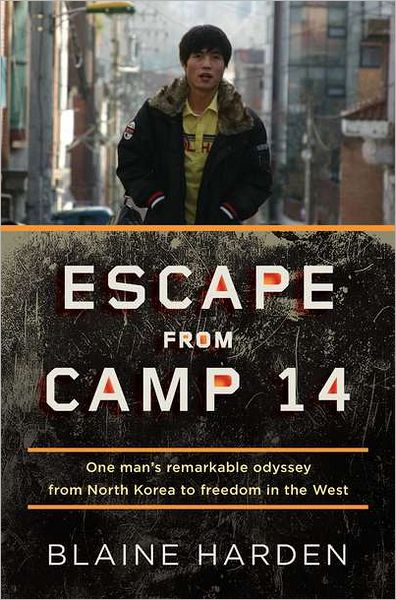
Escape From Camp 14 by Blaine Harden (audio)

Shin Dong-hyuk was born in 1982 inside Camp 14, one of North Korea’s no-exit political prison labor camps. He was raised in the camp, starving, ill, beaten, and forced to work for his life. His education was meager and consisted of the bare understanding of camp politics necessary to make him a compliant worker; he was trained from birth to snitch, to betray his classmates and relatives, to serve his masters. The concepts of love, kindness, trust, and familial relationships were unknown to him. At age 23, he escaped the camp and traveled on foot out of North Korea, into China, and would eventually make his way to South Korea and later, the United States. As far as we know, Shin is the only prisoner ever born in one of these camps to escape.

Blaine Harden is an experienced journalist, who covered North Korea for years, as well as other declining nations. He tells Shin’s story in a professional manner. Many of the details of Shin’s life, and camp life generally, cannot be confirmed or denied, because we have so few sources of information on the subject. (North Korea maintains that there are no such camps, although they are visible on satellite photographs.) Harden treats this information as a professional journalist, researching and confirming where possible, and giving his well-thought-out reasons for believing (or not) those details that are not confirmable. More difficultly, in this book, Shin recants an important fact about his life as he had claimed it for years. I felt that Harden made a reasoned case for believing the later story given. I was impressed with how he handled the problems of his source’s reliability, which I found an interesting issue. Additionally, Shin does not speak English, so Harden conducted his many interviews with interpreters; this of course raises new questions. When Harden says Shin chooses a certain word to describe a certain time in his life, I wonder who in fact chose that word. Naturally it was the interpreter who chose the word, and not knowing Korean, I can’t know how literal a translation it was, or whether there were several English words that might have been used. I don’t mean this as a criticism of Harden’s (or the interpreter’s) work; I just want to note that I’m always intrigued by the questions raised.

Shin states that Kim Jong-Il (and his successor) is worse than Hitler, because while Hitler tortured and killed his enemies, North Korea does so with its own people. This book makes that argument: the atrocities committed at these labor camps are appalling. It’s true, I was not well educated on North Korean conditions before I found this book. I suspect there are many of us who could learn a lot on this subject. I am not sure I can communicate to you here how shocking the details are – I’d really rather you go out and get a copy of this book – but I will tell you that no one is spared, no human dignities are allowed, there is murder and torture. These details are not spared, either, so be prepared for the graphic explanation of the torture Shin endured leading up to his mother’s execution. It’s not an easy book; but I do think it’s important that we know, so still I recommend it.

Shin’s story is mind-boggling. It is perhaps too obvious to state, but he had terrible luck to be born in the camp, and terrible things happened to him there; but his escape began a run of rather astonishing good luck. Harden puts the escape, and Shin’s overland journey (as well as many other parts of this story) in perspective by interjecting the accounts of other escaped prisoners and scholars on the subject. In this case, he describes the political climate at the time of Shin’s escape, showing how much luck it took for him to make it out of the country as he did. His good luck, though, mostly applies to his physical escape. Not surprisingly, his mental, emotional, psychological escape is still underway. As Harden points out at the beginning, most survivors of the Nazi death camps, the Soviet labor camps, and other centers of atrocities tell a story that has three parts: a relatively good life before capture; horrors on the inside; and then attempts at recovery after escape or release. Shin’s story is fundamentally different. Having been raised for 23 years on the inside, from birth, his release was to a world unknown. The trauma he is still trying to repair is staggering, unimaginable to the rest of us. Apparently Shin is like many North Korean defectors in being inclined to refuse psychological treatment – related to difficulties with trust – and his road has never been an easy one. His story as told here does end with a modicum of hope. But he is still struggling.

Again, this is a deeply disturbing book to read (or in my case, listen to), but I think it’s important to know what Shin and other North Koreans are going through. Please look out for Escape from Camp 14. I recommend the audiobook, which Harden reads himself. His delivery is matter-of-fact but that serves his story well.


Rating: 8 grains of rice.

City of Ravens: London, the Tower and Its Famous Birds by Boria Sax

A bird’s-eye view of the Tower of London’s famous raven residents and their role in history and myth.


The Tower of London combines commercial tourism, history and myth in a single site, and its iconic ravens are a part of all three functions. Legend has it that when the ravens leave the Tower, Britain will fall. Boria Sax’s City of Ravens blends a highly readable narrative style with academic research into Britain’s history, the study of birds and Sax’s own interest in animal-human relationships. Sax examines the ravens’ changing significance in London’s imagination, from being harbingers of death and doom as they fed off the bodies of those executed at the Tower to being heralded as guardians of Britain’s Empire–likely due to their role, during the Blitz, of warning of incoming bombs.

Sax’s research largely dispels the popular belief that ravens had been pets at the Tower since medieval times, and he is ambivalent about the accuracy of the historical raven record. After highlighting a few individual ravens’ personal histories, he finishes by considering the ecological questions raised by the captive birds whose wild counterparts have begun to repopulate London, weighing the options for protecting both the ravens and their mythical standing.

These musings, admittedly conjectural at times, draw on diverse resources including newspaper archives, popular literature, early tourist guides to the Tower and other historical sources–as well as fictional accounts. Part history, part deconstruction of myth, part bird study, always lovingly respectful of the birds themselves, City of Ravens is a whimsical, entertaining and informative journey into London legend.


This review originally ran in the July 13, 2012 issue of Shelf Awareness for Readers. To subscribe, click here, and you’ll receive two issues per week of book reviews and other bookish fun!


Rating: 5 wings.