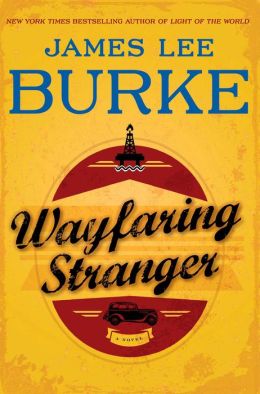
Wayfaring Stranger by James Lee Burke

Beautifully composed and tragic, James Lee Burke’s 35th novel is a sweeping historical epic of war and the American dream.
stranger

James Lee Burke is famous for a long-running mystery series starring detective Dave Robicheaux and Clete Purcel; two series centered on Billy Bob and Hackberry Holland; and stand-alone novels and story collections that all evoke the beauty, heartache and social injustice of Louisiana and Texas (among other locales). His 35th book, Wayfaring Stranger, tells a historical and sometimes fantastical story of the birth of Big Oil, the legacy of World War II and the far-reaching influences of Bonnie and Clyde.

In the opening pages, young Weldon Holland fumes at his grandfather, Hackberry, who was a poor parent to Weldon’s mother and is now poised to have her locked away and electroshocked. It’s the early 1930s, and Weldon’s father is gone, looking for work. Four trespassers in a 1932 Chevrolet Confederate challenge Weldon and Grandfather on their ranch, and the confrontation ends with Weldon firing a shot through the back windshield at Bonnie Parker, Clyde Barrow and two of their associates. This interaction casts a long shadow over the rest of Weldon’s life.

His story resumes in 1944 when he ships out for England as a second lieutenant. Weldon sees action in Normandy, particularly Saint-Lô, and the Ardennes; he digs Sergeant Hershel Pine out of a collapsed foxhole in the snow after an attack, and together they rescue a beautiful Spanish Jew named Rosita from an abandoned death camp. The three walk across enemy territory, lose toes to frostbite, fight tuberculosis, and are eventually separated. After the war, Weldon finds and marries Rosita, and Hershel turns up on Grandfather’s Texas ranch.

Together they establish the Dixie Belle Pipeline Company, using Nazi tank technology, Hershel’s welding skills and nose for oil, and Weldon’s family connections to build a minor empire. But the old money in Houston’s exclusive River Oaks neighborhood is offended–by their success and their humble upbringings, and particularly by Rosita’s heritage. And thus enter two of Burke’s favorite subjects: the evil lurking in the everyday, and the hero’s struggle to repress the evil within himself. Hershel’s wife, Linda Gail, creates more conflict: her actions endanger both business and family success, especially when she gets “discovered” and shipped out to Hollywood.

Burke’s fans will recognize his lyrical strengths regarding the themes of social justice and class struggle, violence set to a stunning backdrop of natural beauty and destruction, and a Gulf Coast region that includes historically accurate details to delight Texas and Louisiana natives. He creates strong and convincing characters on the sides of both right and wrong, and through them writes a compelling American history. Weldon investigates his father’s disappearance, Linda Gail’s unfaithfulness, and the evil forces that have targeted the well-being of his and Hershel’s families; but this is not a mystery. In fact, perhaps more than any of Burke’s previous work, Wayfaring Stranger is a tender love story, proving yet again his versatility and skill in creating gorgeous, luscious, painful stories of the American experience.


This review originally ran in the June 26, 2014 issue of Shelf Awareness for the Book Trade. To subscribe, click here.


Rating: 8 pipe joints.

“The Place, the Region, and the Commons” by Gary Snyder

This is the second essay in Gary Snyder’s collection, The Practice of the Wild. The first was “The Etiquette of Freedom.” I am proceeding, very, verrrry slowly.

wildI found this essay much more accessible than the first, which you may recall I found a little bit dryly academic and theoretical and less useful for reclaiming or repurposing our real world. This one jumps right in with a discussion of what a place means to us, and what it used to mean to us. In human history, there was a time when we were defined by our physical, geographical surroundings; culture was inextricable from the place in which it was set, with mythical explanations for a nearby mountain or a nearby stream, and close cultural understandings of native plants and their uses, etc. This really got me thinking about how disconnected we are now from our place – which of course is Snyder’s point. For instance, pardon my getting personal here, but I have wondered about my own cultural identity in terms of place…

I was born in Texas and have lived here all my life: just shy of 32 years at present. My mother is a native Texan, too, and lived here over 60 years before she left. My father’s parents moved around a lot when he was growing up, so in a way he’s from nowhere; but the family roots have always been in New England (Vermont, mostly), and he clearly identifies with that past, despite having lived in Texas for the majority of his years, too. I’m from the South (maybe not the “Deep South”; under many folks’ definitions, Texas doesn’t generally qualify, or only East Texas does), but I’m also from the fourth-largest city in the country, so I’m no country girl. And I’ve been brought up by radical leftists, so I am politically very much a minority in my home region. As a city girl, I’m also guilty of the removal from my local plants & trees that Snyder cites. I have sometimes had the odd feeling that my father is surprised to find that he’s raised a Southern girl – but he raised his daughter in Texas for all her life, so whence this surprise? I think he thinks of himself as somehow not a Southerner despite all his years here. He was born in the region; spend a few years of elementary, high school, and college years here; he raised his daughter here. Is he not “from” the South because he doesn’t think of himself that way?

Sorry to have gotten sidetracked. What I’m trying to point out is that we no longer have our fingers in the dirt where we were born or live, figuratively or literally; but we used to. And that’s what Snyder is getting at. No wonder we’re confused or distressed; we don’t know who we are any more.

He talks about bioregions, about the naturalness of conceiving borders based on ecosystems, or the area in which a certain plant grows or a certain animal roams. Why draw county lines so that one county stretches over a high mountain pass that allows no travel for part of the year? Better to use that high ridgeline as a boundary line. Etc.

I stood with my climbing partner (Allen Ginsberg) on the summit of Glacier Peak looking all ways round, ridge after ridge and peak after peak, as far as we could see. To the west across Puget Sound were the farther peaks of the Olympic Mountains. He said: “You mean there’s a senator for all this?”

And then he talks about the concept of the “commons,” which ruled for much of human history worldwide. The commons were that land that was usable by all for shared grazing, gathering firewood, building materials, and general foraging; it served as a buffer zone between the absolute wild and the village, therefore allowing the wild to exist in itself, and contributing to the health and well-being of both wild and village. I love the line, “the parts less visited are ‘where the bears are.'” It reminded me of that old-time phrase seen on maps where the known world ends: “here be dragons,” which is charmingly fantastical and filled with possibilities. (There is also a good book by that title.) The commons are about the wild; but they’re also about human society, culture, our relationships with each other – as much as they are about our relationships with the rest of the world, the parts that aren’t human. He writes, “The commons is a level of organization of human society that includes the nonhuman.”

This segues nicely into a discussion of a human compact or contract not only with one another (what we call “society” – the agreement that we won’t kill each other [except in times of war… don’t get me started]), but with the nonhuman world. The idea that we owe something to that nonhuman world, that flowers and trees and newts and grizzly bears and even dirt are entities that we should, must, respect is an idea that I find self-evident; but clearly that isn’t the majority opinion, or we wouldn’t be where we are today. Derrick Jensen knows what I mean.

Of course then Snyder is compelled to tell us about the death of the commons, the enclosing of those common spaces around the world and how and when it took place, and its economical and ecological toll. In search of ever-increasing profits and the famous “growth” we worship, we fenced in the commons, made them private land (or exploitable “public” land), stripped them of resources and exported those resources for money. Now we have less wild, fewer resources, and the rural homeless were sent to the cities to work for wages. Again, I find these arguments easy to agree with – I’m nodding throughout – but not everyone will react that way. Finally, he debunks the “so-called tragedy of the commons,” the idea that if it’s free to all, some will abuse it. He points out that commons are properly not ungoverned, but are governed by the community, and that this model worked for a great many years.

A survival of commons practice in Swedish law allows anyone to enter private farmland to pick berries or mushrooms, to cross on foot, and to camp out of sight of the house.

Can you just imagine!! I can’t, not living in Texas, where we shoot people for setting foot on our property.

I love the bioregional perspective, and I certainly agree that “we need to make a world-scale ‘Natural Contract’ with the oceans, the air, the birds in the sky.” I think he speaks to the beautiful idea of the commons – community-based, in a community that is larger than humankind – articulately and passionately and sensibly. I wish more people would read his work.

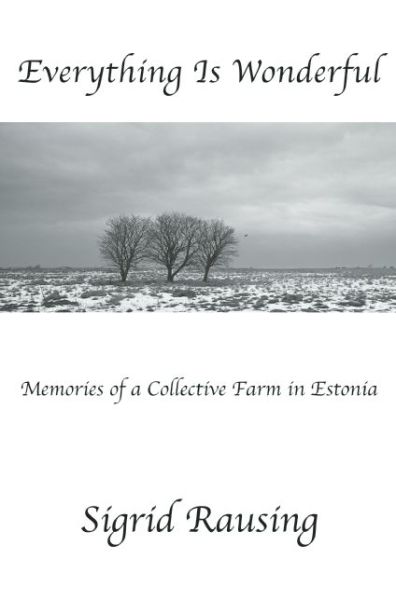
Everything is Wonderful: Memories of a Collective Farm in Estonia by Sigrid Rausing

The personal side of an anthropologist’s year in post-Soviet Estonia.

wonderful

Sigrid Rausing spent a year on a collective farm on the west coast of Estonia in the mid-1990s, doing fieldwork for her Ph.D. in social anthropology. Her time there yielded an academic book, History, Memory, and Identity in Post-Soviet Estonia: The End of a Collective Farm. “Much as [that book] excluded the personal,” she writes, “this book excludes the academic.” Everything Is Wonderful contains Rausing’s remembrances, after nearly 20 years, of time spent in an unusual cultural landscape and the questions that remain with her.

The tone of this slim memoir is quiet and unobtrusive; engaging in participation observation is the anthropologist’s aim. Rausing contemplates the legacies of the Soviet Union in Estonia as a country and a culture, and in the village she lived in. As a parallel, she considers her own cultural identity as a Swede living in England who finds herself at home in a place where Estonian Swedes once made up a sizable and powerful minority, before the Nazis sent them to Sweden in a “perhaps overly collaborative” evacuation.

Rausing’s subjects include the everyday tedium and alcoholism of a small village in a deeply depressed region; they include dream interpretations, and loving descriptions of natural settings, despite the monochromatic winter that occupies most of the year. Interactions with her neighbors and friends are rendered with an eye for irony. Yet for all its bleak detail, Rausing’s work resonates with nostalgia as well. “I was tired, and often hungry,” she recalls, “but even now, twenty years later, I miss those long quiet walks in that melancholy and restful landscape.”


This review originally ran in the March 7, 2014 issue of Shelf Awareness for Readers. To subscribe, click here, and you’ll receive two issues per week of book reviews and other bookish fun!


Rating: 7 “cocktails.”

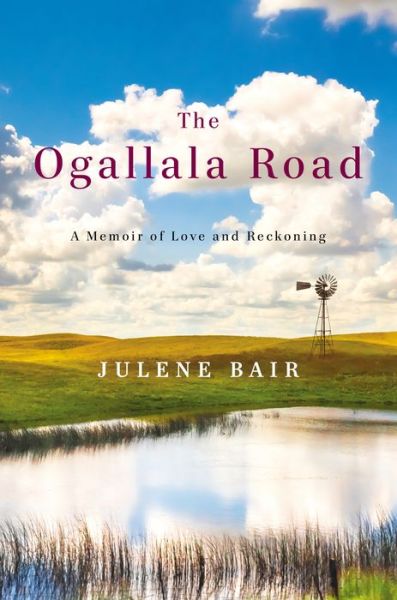
The Ogallala Road by Julene Bair

An environmentalist revisits the family farm with mixed feelings about water shortages, and finds a love story along the way.

ogallala

Julene Bair left the family farm in the high plains of Kansas for the bigger world of San Francisco, then the solitude of a rock house in the Mojave Desert. She returned pregnant, worked with her father on the farm for as long as she could stand it, then found security in a cowboy town in Wyoming, where she raised her son alone. She returned again to tour the ever-diminishing creeks and springs on foot and to study the Ogallala Aquifer, which the United States relies upon for 30% of its irrigated crops. Next to a big cottonwood, she meets a cowboy who admires Cormac McCarthy–and falls in love.

For most of The Ogallala Road, this cowboy, Wade, accompanies Bair as she struggles to reconcile the wilderness-loving, liberal-minded, Subaru-driving writer she’s become with her roots as a farmer’s daughter of Kansas’s conservative rural plains. The memoir clearly began as the story of a shrinking aquifer and a nation’s (or a world’s) self-destructive hubris, and one suspects Bair is as surprised as readers will be that romance takes so much of the spotlight. Wade embodies everything that both nourishes and infuriates her about Kansas, which is a challenge to their love story.

The farm that has sustained generations of her forebears retains a strong hold on Bair’s heart, and her family’s–and her own–role in depleting the aquifer becomes a central source of conflict. The Ogallala Road meanders through the history of the Cheyenne Indians’ longtime residence in the region, seeking insight into a more balanced relationship with earth and water. “Hang on to your land!” Bair’s father exhorted his children, but under the pressures of a changing world, they’ll consider selling. Bair comments on the difference between growth and progress, and a feeling of connection to the land that she suspects her father would have snorted at, while wrestling with her own guilt. In the end, it is the water, not Wade, that causes her the most pain–but the memoir closes with a tentative note of hope.

In its combination of nature writing, environmental concern and love story, The Ogallala Road is unusual. Bair’s contemplative praise of the high plains and the western deserts, her yearning for a father for her son and her lament for a dying way of life will strike chords for diverse readers.


This review originally ran in the March 7, 2014 issue of Shelf Awareness for the Book Trade. To subscribe, click here.


Rating: 8 million gallons.

The Gods of Guilt by Michael Connelly

The Lincoln Lawyer returns to the courtroom to solve a friend’s murder from years past.

gods of guilt

Mickey Haller is back at work in The Gods of Guilt, the fifth Lincoln Lawyer novel from Michael Connelly (also author of the Harry Bosch series). When Andre La Cosse requests Haller’s representation on murder charges, Haller approaches it with weary cynicism about his client’s probable guilt. But then he learns who referred La Cosse to him: the victim, a prostitute Haller represented for years, and whom he thought had left the game. It quickly becomes clear this case is bigger than it looks, involving the DEA and organized crime and stretching back nearly a decade, and that La Cosse may be that rare thing: innocent.

At stake for the Lincoln Lawyer: not only his client’s freedom, but also his relationship with his daughter, who has stopped speaking to him because of the results of an earlier case. The murdered prostitute, an old friend, plays an important role as well; Haller thought he’d saved her, only to find that he may have contributed to her death.

The Gods of Guilt is a gripping courtroom drama with strengths that Connelly’s fans will recognize: fully-wrought, likable characters, absorbing action, sympathetic relationships and the exploration of right and wrong and the gray areas in between. The title refers to Haller’s understanding of jury members: that they are gods sitting in judgment of guilt and innocence. These gods of guilt also sit in judgment of Haller’s own choices, and The Gods of Guilt reflects Connelly’s sensitive handling of morality and consequences.


This review originally ran in the December 17, 2013 issue of Shelf Awareness for Readers. To subscribe, click here, and you’ll receive two issues per week of book reviews and other bookish fun!


Rating: 7 men in hats.

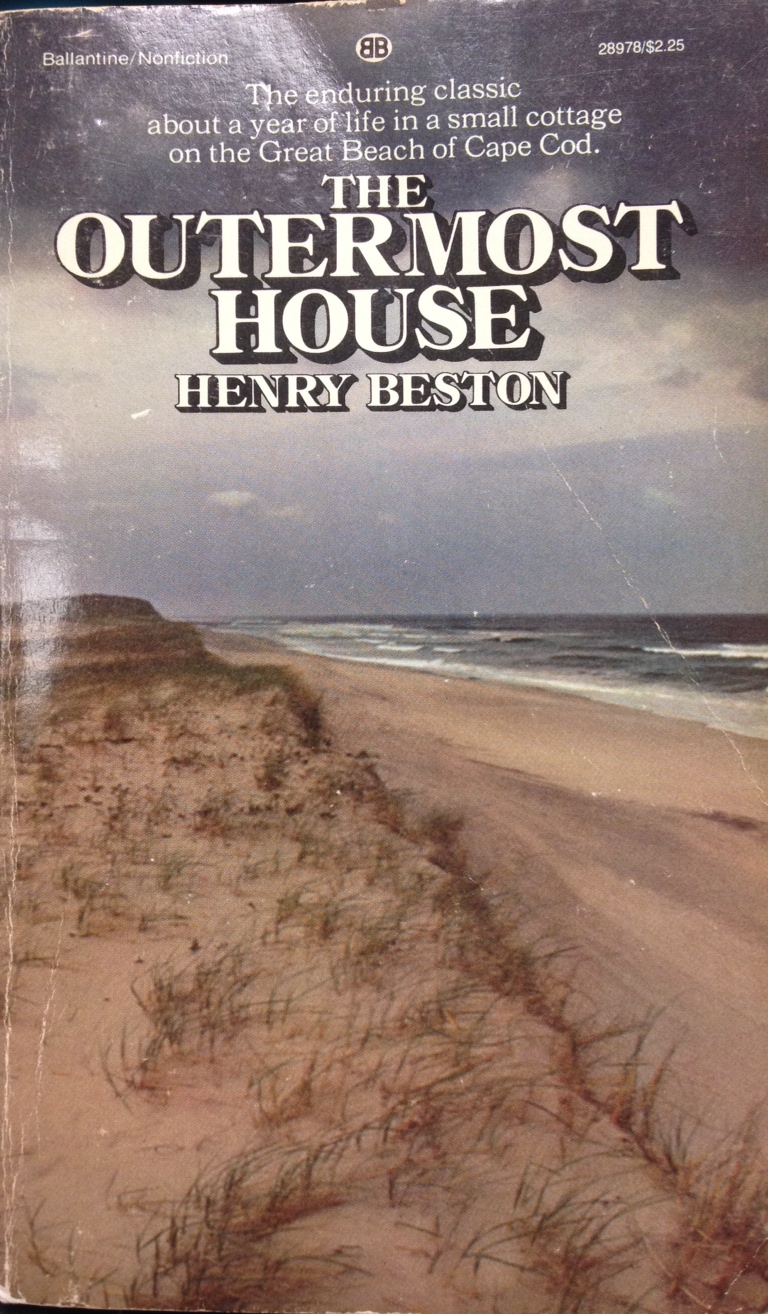
The Outermost House by Henry Beston

photo (1)This book came to me recommended by Rachel Carson. I’m relatively sure that I came up with this title in my reading of On a Farther Shore, a recent biography of the author of Silent Spring. And by that convoluted path, here we are.

The first thing that struck me about The Outermost House, and certainly the most striking overall, is its similarity to Thoreau’s Walden. I have been describing it as “Walden Pond on Cape Cod.” Henry Beston wrote this book in 1928 about a year he spent, rather by accident, on the island; he had a small, humble cabin constructed on a remote dune for the purpose of visiting more often, and moved in in the fall, thinking he’d be there only a matter of weeks but staying a full year. (My edition also contains a new foreword from 1949.) That Thoreau would be well-known to Beston, his literary descendant of just a few decades in the same region, is clear, even if he weren’t mentioned by name around page 100. The similarities are many (more below), but I don’t mean that to take away from Beston’s work. I think Walden bears some imitation, and Cape Cod is different enough from the Concord locale to justify its own study.

The next thing that struck me is Beston’s comfortable observation that, although “man” has altered & damaged the world mightily, “Nature” is overall impervious, and Cape Cod in specific remains untouched. I congratulate Beston that in 1928 (and ’49) he was able to feel such confidence. Today, sadly, he would not.

Like Thoreau, Beston describes his home in some detail, for its details are hugely relevant to his year on the outer beach. Like Thoreau, he sees his fire as a friend and companion, a major force in withstanding solitude. And like Thoreau, he overstates that solitude, first writing of how very, very alone he was – how very rare was a human face in his year out there in the wild – and in the next breath, shamelessly, noting that he saw his Coast Guard buddies from up the beach almost daily, and walked into town for groceries once or twice a week. Having come to terms with this dissonance in Walden, I just smiled at it. Solitude is clearly relative, and he’s enjoyed far more than I have experimented with.

The Outermost House is perhaps most lyrical and pensive in its contemplation of bird life and waves, and equally thoughtful in its treatment of the Cape Cod locals and the solidarity they feel with wrecked vessels on its shore. He seems to refer to a “god,” although not by name; he is very concerned with “man”‘s relationship to Nature (always the capital N), and how sick we get when we disconnect. These themes are timeless and not dated at all.

For those who enjoyed Walden, this will undoubtedly be a great pleasure. If anything, Beston is less pretentious and self-congratulatory than Thoreau was. His descriptions of the migratory birds of Cape Cod’s seasons are lovely and, I imagine, useful for scientists & natural historians. It’s well-written, short (under 200 pages), and solid.

I will let Beston himself close, with a few of my favorite lines.

Glorious white birds in the blue October heights over the solemn unrest of ocean – their passing was more than music, and from their wings descended the old loveliness of earth which both affirms and heals.

…today’s civilization is full of people who have not the slightest notion of the character or the poetry of night, who have never even seen night. Yet to live thus, to know only artificial night, is as absurd and evil as to know only artificial day.


Rating: 6 tseeps.

Weeds: A Farm Daughter’s Lament by Evelyn Funda

A memoir about the loss of the family farm, and everything it means to the child of immigrant farmers–and to us all.
weeds
Evelyn Funda’s mother escaped Nazi-occupied Czechoslovakia in a wine barrel, eventually landing in the United States. Her father was the son of Czech immigrants, early homesteaders who sought to make farmland of the Idaho desert. The family farm never felt like it would be Evelyn’s: this “farm daughter,” unwelcome among the tractors and irrigation pipes, would leave to become a college professor. Her musing memoir opens in the fall of 2001 with a triple tragedy: the sale of the family farm; her father’s cancer diagnosis; and her mother’s death, closely followed by her father’s.

Weeds is an elegy, an academic’s personal tale of research and disillusionment, and Evelyn’s own story–with hints of a botanist’s or social historian’s study. (The chapters are named for weeds, beginning with dodder, which she long misheard as “daughter,” when her father cursed the unwelcome growth.) The pursuit of her mother’s joyful youth in a series of cities and countries, of the truth of her grandfather’s apocryphal tales, of her parents’ romance and of the history of her own hometown takes Evelyn to dusty library stacks and to small Czech villages, where she meets dozens of cousins and examines old bones.

Meditative and lyrical, Weeds smoothly braids weeds with family. Funda is sometimes frustrated along the way, but finally satisfied with the personal history she builds for herself–and the conclusion that, even in exile, one can find a sense of place and of belonging.


This review originally ran in the September 6, 2013 issue of Shelf Awareness for Readers. To subscribe, click here, and you’ll receive two issues per week of book reviews and other bookish fun!


Rating: 7 kolaches.

The Other Typist by Suzanne Rindell (audio)

typistThis book reminds me very much of Rules of Civility by Amor Towles, with similarities extending to the audio narration, as well. And considering how much I loved that book, and narration, this is a high compliment. They share a setting in New York City early in the 20th century (in this case, Prohibition era), a concentration on class differences, a slinky sensual tone, and an appreciation for the finer things in life. The final shared characteristic is a major plot twist late in the book, here subtly foreshadowed from early on. And that is where I struggle a little with this review: I don’t want to spoil the surprise for you, because it makes the book. Read on safely; I’ll be careful.

Meet Rose Baker, our narrator. She was raised in a Catholic orphanage and now works as a typist in a precinct office of the New York Police Department. The book opens with a discussion of the controversy surrounding young women working as typists at all, let alone in the “rough” environs Rose inhabits: she frequently witnesses and transcribes the confessions of murderers and rapists (gasp). That opening passage helps establish the setting, along with a following reference to the Volstead Act (which prohibited alcohol in the United States).

And now, meet Odalie Lazare, the “other typist.” There were already two typists besides Rose at the precinct, but Odalie is a different sort. Glamorous, seductive, and strangely well-off for someone who would work as a police department typist, Rose is bewitched from the first. The two become “bosom friends,” and Rose becomes… devoted? obsessed? It all depends upon your definitions, of course.

Suzanne Rindell’s construction and development of Rose Baker as an unreliable narrator is delicious. We know Rose for a great many pages as a sober, morally upright young lady and professional; she describes Odalie’s entrance into her life with a sense of foreboding, but with no clue as to what has happened between them. And then there is the first, very brief, reference to Rose’s doctor. Later, there is another flashing reference to the “incident.” Thus, our sober and reliable narrator is undermined, but just so swiftly and for just a moment – did we even see it at all? And I’m left, as the reader, wondering about this incident and why Rose needs a doctor; and then I’m back in Rose’s story, seeing her as the responsible character again. It is a masterful building of tension and questions; I ate it up.

One of the many strengths of this story is in its strong sense of time and place. Prohibition New York is colorful; one can hear and smell and taste its flavors. I will have to leave it to another, older reader to speak to its authenticity, but I am certainly convinced. The writing style, and Gretchen Mol’s reading style, contribute to the feel of an earlier time; sentences are a little long and formal, in a way that just creates more atmosphere.

Rindell’s fine sense of pacing, the doling out of detail and prolepsis, is adept. It is not everyday that I am this drawn in and enchanted by a story; I couldn’t wait to hear what would happen next; I was guessing and second-guessing. As a thriller, The Other Typist evoked some of Tana French’s best work (as here).

Although I was captivated by the swirling mists of speakeasies and Odalie’s wily ways as the femme fatale, I think my favorite part of this experience was the buildup to the big reveal, and the mystery left therein. The Other Typist was a pleasurable rush and romp, and has left me wanting more of Suzanne Rindell’s magic. Reader Gretchen Mol was perfect and not to be missed: do find this one on audio if you can.


Rating: 8 champagne cocktails.

Light of the World by James Lee Burke

Dave Robicheaux and Clete Purcel are joined by their daughters as they battle evil in the hills and valleys of Montana.

lightoftheworld
Light of the World, James Lee Burke’s 20th novel starring Louisiana detective Dave Robicheaux, returns to the Montana hill setting of 2008’s Swan Peak. Fans will be thrilled to find Robicheaux and Clete Purcel joined by their respective adult daughters in a hard-hitting, intense battle between good and evil. Burke’s writing is poetic–reverential in praise of natural beauty, contemplative of human nature–and invokes a strong sense of place. Clete, the rough-and-ready, hard-drinking, softhearted private investigator, is lovable as ever; Robicheaux is the flawed hero who has charmed us from the first, fighting his demons and protecting his clan.

Years ago, Dave’s daughter, Alafair, visited serial killer Asa Surette in prison to interview him for a book she never wrote. Instead, she published a condemning series of articles advocating the death penalty. Later, Surette was killed in a collision with a gasoline tanker. So why is he now lurking around the cabins in Big Sky Country where Robicheaux, Clete and their families are trying to relax? The evil in this powerful story of suspense has supernatural undertones, as wolves skulk in the woods above the ranch and planes fall out of the sky. Alafair teams up with Clete’s daughter, the reforming New Orleans hitwoman Gretchen Horowitz, and they make as remarkable a pair as their fathers. As the story unfolds, a rodeo cowboy who speaks in tongues, a serial killer who should be dead, ex-cons, rapists, bear traps and evil that dwells in caves in the hills all come together in perhaps the greatest showdown of Burke’s career.


This review originally ran in the July 30, 2013 issue of Shelf Awareness for Readers. To subscribe, click here, and you’ll receive two issues per week of book reviews and other bookish fun!


Rating: 8 howls.

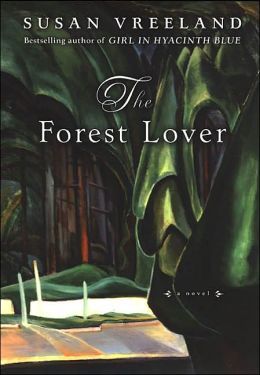
The Forest Lover by Susan Vreeland

forestloverWhat a lovely book. I recently read and enjoyed Scott Elliot’s Temple Grove enough that I attended to his “Note on Sources,” and requested several from my local library. This was one of those – aided by my enjoyment of Vreeland’s Girl in Hyacinth Blue and Clara and Mr. Tiffany.

Like those two of her books, this is historical fiction dealing with a female artist. [Also think of Tracy Chevalier’s Girl With a Pearl Earring.] The three historical periods, geographic locations, and women in question are quite diverse, but there is a very clear thread connecting them all as female, artists, and historical; I appreciate that showing of diversity in her subjects and also of a singleminded interest. I am safely a Vreeland fan now. Fairly naturally, considering that they deal with female artists of earlier times, her books also address women’s struggle for independence.

Emily Carr, like the subject of Clara and Mr. Tiffany, is a real-life historical figure about whom we don’t know everything; this is a fictionalization of her life. She was born in British Columbia in 1871 to British parents. She showed an inclination for sketching and painting early on, which hobby was encouraged by her father at first, but he expected her to grow out of it in favor of more womanly pursuits (like marriage), and she didn’t. We meet Emily or “Millie” when she’s struggling to make ends meet and trying not to depend too much on the trust fund she shares with 4 sisters, teaching art for a living and befriending local Native Canadian Indians. The sisters mostly do not approve this association. Her favorite subjects are natural scenery and native people and their lifestyles; she travels to islands and outposts for these subjects; again, this is not appreciated by her family. She does enjoy some good female companionship, though: Sophie is an Indian woman and fellow artist (a basketmaker) who befriends her in broken English; Jessica is a less adept painter but rather saucy lady friend; Alice is her “good” and friendly sister; and after Emily musters the courage to travel to Paris to study the “new” art (see below), she meets fellow painter Fanny, a New Zealander and kindred soul.

To give you an idea of the Paris of Emily’s experience, as a moment in time, I share these lines.

“Van Gogh’s been in his grave for twenty years, Cezanne for four, yet art collectors still don’t buy them, and despise what’s new now.”

“What is new now?”

“Their offspring. Léger, Picasso, Braque, Matisse, Modigliani, Derain, Rouault. Many directions.”

Momentous times, then!

Back in Canada, Emily ages as we watch her struggle with art and life. She wants desperately to represent the native people’s lives and art, and the powerful forest surrounding her. Or, as she comes to learn, she wants to more than represent or copy: she wants to communicate what these things make her feel. Her study in Paris under various teachers advances her practice, but still doesn’t get her there. We follow Emily through a series of lifestyles and decisions that form a crooked path but ultimately continue to move her toward a higher form of the art and communication she desires.

There is one man who begins to be a love interest for Emily; but as the title implies, she finds herself unable (for various reasons) to participate in physical, person-to-person, romantic or sexual love with this man. She is not the forest’s lover in a carnal sense – this book is not that weird. And Emily does continue to relate to people. Jessica and her sisters, and most importantly Sophie, retain a hold on her heart; and she forms a new (platonic) relationship with a damaged white man who understands Indians better than whites. But in a very real way, her relationship with the natural world is the most magnetic in her life.

I often observe that I like an author’s earlier (or lesser known) work better than the later. (I hope this is not just me being contrary. I don’t think I do it on purpose.) In this case, though, I think my favorite of her books is still her most recent, Clara and Mr. Tiffany. The earlier two I’ve read are both wonderful; but I sometimes felt this showed its earlier origins. It is occasionally less graceful. While she is mostly “on,” there are some awkward phrases, too. Observe these two single sentences, on two facing pages. I find one smoothly appealing, and the other a bit effortful.

Emily felt as if smelly white scum had eked out her pores.

versus

A breeze shifted the ends of foliage, like the tips of fingers moving.

Do you make the same observation I do? (Which one is which?)

Criticisms aside, though, this novel is far more graceful than not; and while I could pick apart lines like the one above, the sum of its parts is glorious. Vreeland’s greatest strengths are those I recognize from her other books. She understands art, and the artist’s struggle to get it just right. She addresses women’s issues compassionately as a natural part of the story of one woman in history. And unique to this work, the natural world and its beauty, value, power, importance, and scale play a deservingly large role.

Another success for Susan Vreeland.


Rating: 8 smears of viridian.