The Gallagher Place by Julie Doar

In this moody debut novel, new and old crimes on her family’s estate in upstate New York force a quietly struggling woman to confront loyalties and conflicts among family and friends.

Julie Doar’s first novel, The Gallagher Place, investigates old and new mysteries within a compelling family drama set in a striking landscape.

Protagonist Marlowe Fisher is an illustrator living on the Upper West Side and a loner, even surrounded by her powerful family and their estate. When she and her two brothers, as adults, discover a body on their property, the case reopens old wounds. Decades earlier, Marlowe’s childhood best friend vanished without a trace. The freshly murdered man and the long-missing teenaged girl do not initially appear linked, but the surrounding community has long harbored suspicions about the wealthy Fishers. Marlowe has always yearned to know what happened to Nora, although that desire presents new conflicts, having come under investigation once again.

The Fishers have always used the Gray House in upstate New York as a weekend and holiday retreat, “a wholesome family sanctuary to escape the crowded city life and the bittersweet pain of growing up too fast. A haven, her father sometimes called it. If that was the case, why did bad things still happen?” And bad things do happen, especially the disappearance of Nora Miller. Marlowe has never had another relationship as meaningful as her friendship with Nora, a local girl and an honorary, if part-time, fourth Fisher sibling, who wished desperately to escape her rural roots. Marlowe feels strongly: “Nothing mattered as much as the two of us.” The loss of Nora has shadowed Marlowe’s life ever since, culminating in a carefully hidden drinking problem.

The recent murder, and accompanying investigation into Nora’s disappearance, is both galvanizing and disturbing. As Marlowe embarks on her own inquiries, more thoroughly than ever before, she not only refreshes old pains but discovers new risks. To search for Nora means to interrogate her own memory, to learn uncomfortable truths about herself and her family, to confront class differences, privilege, and inheritances. This discomfiting process takes place in two timelines, against the backdrop of Dutchess County, N.Y., in the summers of the 1990s (when Nora and Marlowe were teenagers) and in the present winter of 2018. The Fisher property defines Marlowe’s greatest trauma and coming of age; she remains devoted to “the spirit of landscape” that inspires her art. A strong sense of place is central to this chilling novel about old secrets and what one might choose to uncover or keep hidden. The Gallagher Place is dramatically atmospheric, expertly paced, and haunting.


This review originally ran in the October 10, 2025 issue of Shelf Awareness for the Book Trade. To subscribe, click here.


Rating: 7 gifts.

The El by Theodore C. Van Alst Jr.

Young gang members in 1979 Chicago take public transportation across the city on a single, important day in this shape-shifting, kaleidoscopic novel of big risks and dreams.

Theodore C. Van Alst Jr. (Sacred Smokes; Sacred City) offers a love letter to the city of Chicago via a single-day odyssey in The El, an expansive novel featuring young gang members on a circular journey through an urban landscape. With strong imagery, dreamlike sequences, and gritty considerations of family, love, spicy potato chips, and gun violence, this unusual story will capture and hold the imagination.

On an August day in 1979, teenaged Teddy wakes up early, eats a few buttered tortillas, and gets ready for a momentous event. He will lead 18 fellow members of the Simon City Royals across town via Chicago’s elevated train (the El) to a meeting with another “set” of the gang and many others, where a new alliance formed in prison would be applied on the outside. The new Nation will include old enemies, but Teddy is a team player. It is a day of high stakes, and while they all share trepidations, not everyone shares Teddy’s hopeful outlook. “Jesus, Coyote, Al Capone… I was sure all of us prayed to them equally.”

Teddy narrates as he sets out with his best friend, Mikey. Then the perspective switches to Mikey’s. Teddy remains the protagonist and most common narrator, but a broad variety of players cycle through, providing different angles on the potential impacts of the Nation alliance as well on as the scenes themselves: a fire on an El platform, an attempted murder, various deaths, moments of beauty. Teddy’s Native identity matters because race is a question for the new Nation, spoken of but not exactly on the official agenda. Teddy can see a character he knows to be Coyote, “walnut brown and wiry, wearing a pair of mirrored Aviators,” who “tends to hum in and out of focus.” This character, or force, plays an important role in the day.

The El is utterly intriguing at every turn, shifting pace from high-drama action scenes to contemplative minutes and hours spent rocking in rhythm with public transit and the city itself. Van Alst portrays a strong sense of both time and place as his characters grapple with race, class, and culture in a very particular big city. The novel is about cusps: of the season, the turning of the decade, the gangs’ political shifts, the move away from “skins-only” violence and toward more guns, and comings of age. Van Alst gives us tragedy as well as beauty, and a sharp, loving portrait of a place, with Teddy “riding all the way back toward the neighborhood, window wide open, warm wind howling in, and me in love with everything we could ever be.”


This review originally ran in the June 24, 2025 issue of Shelf Awareness for the Book Trade. To subscribe, click here.


Rating: 7 Jay’s Hot Stuff chips.

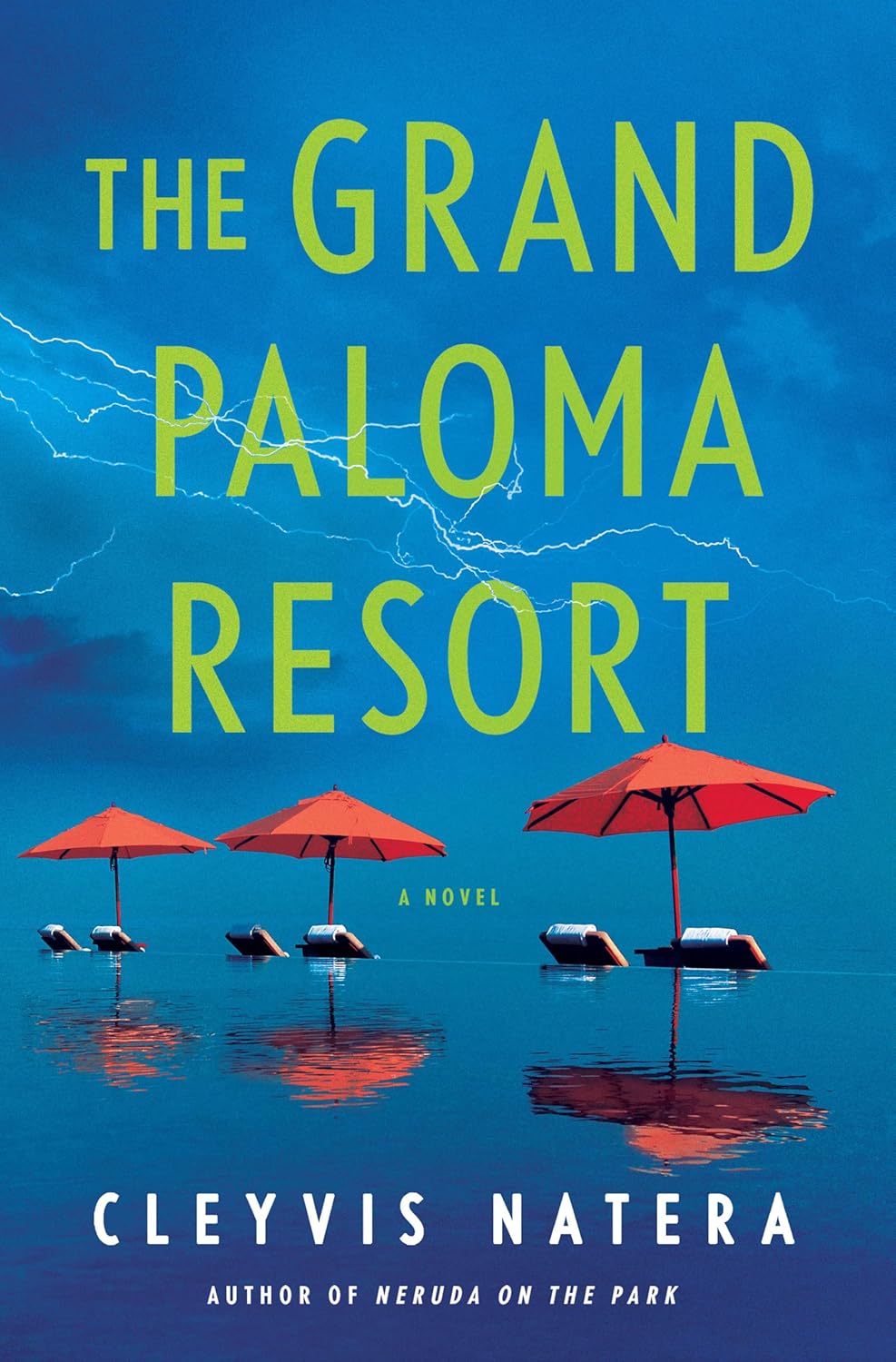
The Grand Paloma Resort by Cleyvis Natera

Missing children and a category-five hurricane converge in desperate circumstances at an exclusive luxury resort in the Dominican Republic in this heart-wrenching novel.

The Grand Paloma Resort by Cleyvis Natera (Neruda on the Park) is a novel of race, class, secrets, and striving, set within a luxury resort staffed by struggling locals amid the natural beauty of the Dominican Republic.

Sisters Laura and Elena have only each other and the Grand Paloma Resort. Laura has been her sister’s caretaker since they were 14 and four years old, when their mother died. The Grand Paloma has been Laura’s career and lifeline. Through her work, she was able to send Elena to a global academy, meant to secure the younger woman’s future. But Elena persists, in Laura’s eyes, in slacking, taking Ecstasy and partying while working as a babysitter at the resort. In the novel’s opening pages, a young child in Elena’s care–from a family of great wealth and privilege–has been badly injured. It falls to Laura, yet again, to clean up: Elena must be protected from criminal charges, and the resort from bad press.

But this time, despite Laura’s experience in saving the day, a bad situation spirals. Elena thinks she sees a way out by accepting a large sum of money from a tourist in exchange for giving him access to two young local girls. Although she initially believes the girls won’t come to harm, the crisis worsens when the children go missing. All of that–with a frightened Elena and Laura at maximum stress and frustration–coincides with an approaching category-five hurricane. A larger cast of already marginalized resort employees are endangered in a ripple effect, and Laura’s career is at risk. Over the course of seven days, it becomes increasingly clear that these various lives will never be the same.

Natera deftly splices into this narrative the history of the Dominican Republic and the plight of Haitian workers. The Dominican Republic is a beautiful paradise beset by poverty and racial stratification, emphasized all the more when locals intersect with the extraordinary wealth and power of the Grand Paloma’s guests. One of those guests sees it as “a humanitarian crisis so large, so seemingly without end, that there was little to do but look the other way.” At the heart of the novel’s conflict is the question of what each character will do to survive.

With a propulsively paced plot and heart-racingly high stakes, The Grand Paloma Resort interrogates capitalism and exploitation through a community’s concern for two little girls. The result is exhilarating, entertaining, and thought-provoking.


This review originally ran in the June 17, 2025 issue of Shelf Awareness for the Book Trade. To subscribe, click here.


Rating: 7 cocktails, obviously.

Mailman: My Wild Ride Delivering the Mail in Appalachia and Finally Finding Home by Stephen Starring Grant

Within the high highs and low lows of rural mail delivery, a laid-off white-collar worker builds new relationships with place, with his neighbors, and with himself.

In 2011, Stephen Starring Grant moved his wife and two daughters back to his hometown of Blacksburg, Va. In early 2020, Grant, the family’s primary wage earner, was laid off from his consulting job. He found himself unemployed at the start of the pandemic in a town that had limited employment options, and with a recent cancer diagnosis to boot. Unable to find anything in his field, he took a job as a rural-route carrier for the United States Postal Service. Mailman: My Wild Ride Delivering the Mail in Appalachia and Finally Finding Home offers his stories and reflections on a year spent in a position he’d never thought much about before.

Grant began with a bit of an ivory-tower complex, as he imagined his intellectual background overprepared him for the simple drudgery of mail delivery (which turned out to be untrue), but he ended with a profound respect for postal and other service workers, and balanced thoughts on class and background. These pages vary in tone, by turns hilarious and thoughtful. Grant describes religious experiences, being threatened at gunpoint, bonding with strangers over their deliveries and finessing their political differences. He discusses types of incompetence (a few months in, he “graduated to the consciously incompetent stage, lost in the burning wasteland of self-awareness that I was really not very good at delivering the mail”) and the intense discomfort involved with learning new things, with great effort and limited success, in adulthood. Musing on the origins and purpose of the USPS, he expresses a nuanced patriotism: “America is the greatest country in the world… America is a steroidal monster… Both versions of America are true.” And, he notes: “Our delivery vehicles were like democracy, the worst of all possible vehicles, except for the alternatives.”

Between indulging in fantasies of delivering the mail with Barack Obama at his side and performing neighborly services like basic car maintenance for favorite people along his route, Grant brought his kids for added help and dropped in on his parents for pancakes. Along the way, he informs the unschooled reader of the process that mail carriers undertake to sort, order, and “case” the mail for delivery, and the hazards: backbreaking labor, the ergonomic disaster of right-hand drive (especially in a left-hand-drive vehicle), extremes of heat and cold, and dog attacks. Via an adventure with unfamiliar blue-collar work, Grant discovered new values, new people, and a new relationship with home. Mailman is a classic memoiristic blend of whimsy, storytelling, and insight.


This review originally ran in the May 22, 2025 issue of Shelf Awareness for the Book Trade. To subscribe, click here.


Rating: 7 Slim Jims.

Girls with Long Shadows by Tennessee Hill

Identical triplet girls are linked to tragedies across generations in this evocative first novel set along the swampy Texas Gulf Coast.

Tennessee Hill’s first novel, Girls with Long Shadows, is a dreamy, atmospheric tale of sisterhood and coming-of-age in the fictional town of Longshadow, on the Texas Gulf Coast. Nineteen-year-old triplets Baby A, Baby B, and Baby C were orphaned when their mother died in childbirth; their father’s identity remains a mystery. But they have always known family in the form of their loving but distant Gram (“Manatee” to the townsfolk, for her swimming prowess) and their adopted, nearly deaf younger brother, Gull. The whole town looks askance at the girls, spookily identical and associated with their mother’s early death. The family’s golf course, Bayou Bloom, provides respite, and the bayou itself (where Gram takes a daily swim, joined sometimes by one or more of the girls) offers a connection to nature, its fecundity and floods. Then one fateful summer, an act of violence, combining desire and objectification, ruptures the triplets, the family, and the town.

A tautly plotted Southern gothic, Girls with Long Shadows takes a distinctive perspective in Baby B’s elegiac narration. “That weekend something gurgled beneath, rattled us where we stood.” And: “Even before the worst of what that summer would bring was upon us, I began to mourn the girls we had been.” Baby B speaks as “we” as often as “I.” Only a few people other than themselves can tell the girls apart; even the boys they date may not make the effort. And intermittently the perspective shifts to a “Front Porch Chorus,” in which the town speaks collectively, observing the girls from without: “They’re a blur we never bothered to untangle.” This lack of distinction is both a wound for the triplets and an indelible part of their identity. They feel each other’s sensations and know that this is a boon. Without that link, they would be less themselves. In the eyes of the town, however, they are less human for being undifferentiated, more object or mirror. “All those boys touching all of us at the same time, hands on hands on bodies on hands. It wasn’t even that Pete was the one touching me, it was all of them, their inability to leave us be.”

Encompassing a single summer in the dripping, humid South, Hill’s haunting debut deals in lyricism and tragedy as it considers the harm done to young women by the outside gaze.


This review originally ran in the March 31, 2025 issue of Shelf Awareness for the Book Trade. To subscribe, click here.


Rating: 7 bikini tops.

North Woods by Daniel Mason

A gift from a dear friend, this novel is different. It could be categorized as a collection of linked shorts, in various formats (formally playful, you might say), including epistolary. The stories that make up North Woods are connected across history by place: together, they track a single location, a small valley in what will become western Massachusetts, from early colonial America until the more-or-less present and into the future. We are used to novels and stories being connected by character or plot. We are familiar with stories that center place heavily – I’m thinking of Rebecca, Housekeeping, The City We Became, The Rope Swing. This one felt a bit more… kaleidoscopic.

They had come to the spot in the freshness of June, chased from the village by its people, following deer path through the forest, the valleys, the fern groves, and the quaking bogs.

Fast they ran!

So opens the novel, and it takes several paragraphs until the reference to ‘harquebuses‘ (I had to look it up) gives us a clue as to setting in time. I loved how the fens and meadows, bramble and thickets, bear caves and tree hollows could have been anywhen. The couple who run remain nameless, and we learn very little of their story in their four-page chapter, but we see them stop in a valley: “a clearing, beaver stumps and pale-green seedlings rising from the rich black ash.” “Here,” says the man, and there they stop with their chicken and their squash and corn seeds and fragments of potato. And scene.

Subsequent residents – most of them human – find the log and stone hut built by this original couple, experience joys and hardships there, and add to that structure. A veteran of the American Revolution establishes an apple orchard. His twin daughters, after his death, grow old preserving his legacy and bickering with each other, unto a shocking end. A mountain lion briefly occupies the abandoned dwelling, hoarding her kills. A slave catcher hunts other prey in the area, eventually homing in on the house in the overgrown orchard, but will not find what he seeks. A painter finds a haven there, in a gorgeous valley where he can observe nature and work on landscapes and studies of birds nests, fungus, and trees; he pursues a forbidden love. In his old age, a nurse comes to assist him, and finds a love of her own that will fare no better. (It begins to feel like the home in the valley, at this point with many additions and “improvements,” might be a site of bad luck.) A mystic plies her trade, claiming to drive out a haunting, but has bitten off a bigger haunting than she’s realized. The chestnut blight settles in. A mother struggles to care for her disturbed son, who is schizophrenic, or haunted, or maybe both (?). The son wrestles with his delusions, or, his heightened knowledge of reality; his sister, an academic on the west coast, grapples with her brother’s life’s work. A newlywed couple lives out a fantasy, and a bark beetle expresses its lusts in parallel, in one of the weirder sections of this novel (and that’s saying something). (The chapters that feature nonhuman characters – spores, beetles, panthers – are delightfully immersive, but also somehow inherently creepy, in a way that feels anthropomorphic.) A lonely old woman narrowly avoids a dangerous con artist, a crime writer discovers an ancient grave, a metal detectorist goes seeking evidence, and a graduate student searches for spring ephemerals but encounters a ghost. The world turns.

It was a fascinating experience to sink into this place. There were not many characters or episodes to like or even especially enjoy; there was often a sense of watching something disquieting take place. I definitely loved the consideration of place over time, the natural world, and the different ways we interact with it. I loved the orchardist, the painter, and the graduate student most of all. I do love a zoom in on a procreative beetle. It was a disjointed experience, one I’ll not soon forget, but also don’t feel a firm grasp of. Maybe I need more time out of this book to figure out what it did for me. Maybe this is an instance of the author demonstrated prowess for its own sake. (As ever, your mileage may vary.) If you get into it, please do let me know what you think.


Rating: 7 antlers, turtle shells, and bird eggs.

rerun: The Lacuna by Barbara Kingsolver (audio)

I know there have been a lot of these lately, friends; please bear with me, and know that I have a backlog of review still to come at the Shelf – I’m not slowly down, just having some funky timing. For whatever it might be worth, I do find it stimulating to revisit old standouts. Happy holidays! Year-in-review and best-of-the-year posts are coming!

Now, please enjoy this rave review from 2012.

Another long review – sorry – but one of the best books I’ve read this year, so consider sticking it out with me. Or, go to the very bottom for my two-sentence review. Many thanks.

Reviewing The Lacuna daunts me. How to capture the enormous world that is this book in a brief (readable) blog post? I have only read three other of her books* (liked The Bean Trees and Animal Dreams; not so much The Poisonwood Bible; all pre-blog, unfortunately) but from what I know, this is by far her best. (Her own website calls it her “most accomplished novel”). It is a Big Thing.

I shall take this one step at a time. Plot summary. A young boy named Harrison William Shepherd is born in 1916 to an American father, a bean-counter for the government in Washington, D.C., and a Mexican mother, Salomé. He spends his childhood mostly in Mexico, with a brief interlude at a military school in the US, and ends up working in his teens for Diego Rivera and Frida Kahlo, first as Diego’s plaster mixer, then as a cook and secretary and Frida’s companion. When Lev Trotsky arrives as a political exile from Soviet Russia, he acts as secretary and cook to him, too, following Trotsky when he splits from the Riveras; he is at Trotsky’s side when he is assassinated. Shepherd (who goes by various names depending on who’s talking) never considers himself exactly an ideological follower of the communist cause, but his sympathies are naturally aligned with those of his famous employers, for whom he has great respect.

Following the assassination, he begins a new life in Asheville, North Carolina, becoming a famous author of novels set in ancient Mexico; but the trauma of Lev Trotsky’s bloody demise, Shepherd’s sexual orientation, and his extremely shy and self-effacing demeanor keep him isolated from an American world that feels foreign. He closely follows international politics through the second World War, the United States’ sudden reversal of regard for Stalin, and the Dies Committee (which contacted Trotsky when Shepherd was with him) becoming the House Unamerican Activities Committee – which eventually begins to investigate Shepherd himself. This turn of events shocks our protagonist, who sees himself as an insignificant and apolitical player, but whose new Jewish-New-Yorker lawyer is alarmed at the skeletons he hides in his closet: to the point, an association with the late Trotsky and the still-active Kahlo and Rivera. The Asheville era in Shepherd’s life yields new and likeable characters in the lawyer, Artie Gold, and Shepherd’s secretary-companion, Appalachian native Violet Brown. (I think Kingsolver had fun with these *colorful* names, ha.) The FBI’s investigation of Shepherd threatens to tear down the precariously balanced, agorophobic life that he has so carefully constructed in Asheville; and here I’ll stop. I liked the ending, despite its considerable sadness.

Violet Brown is an important part of the story in terms of format. The story is told almost entirely in Shepherd’s own voice. As presented, he wrote the first chapter of his memoir and then quit; this chapter opens the book, and then we get Mrs. Brown as “archivist” explaining the reversion to Shepherd’s journals starting at age 14. The rest of the book is pulled from these (fictional) journals, with interjections from our archivist here and there, as well as a number of newspaper and magazine articles (Kingsolver notes which are real articles at the beginning of the book for your reference; my impression without checking each one is that most are real) and assorted samples of Shepherd’s correspondence. It is a very interesting format, raising all kinds of questions about voice and the progression of voice. I wondered, upon that first shift from an already-published 30-year-old author’s writing to a 14-year-old’s journal, whether Kingsolver didn’t trust her audience to start off that way? But I ended up feeling that this shifting voice felt very real; I enjoyed it. Violet’s role in Shepherd’s life was ambiguous quite far into the story, which kept me wondering, in a good way.

Another aspect of format I must mention is the audio version I listened to – narrated by Kingsolver herself, and to great effect. I loved her work here; every character had a voice, an accent, a lilt, a manner of speaking, and these were important in a story peopled by Mexicans with various backgrounds, a cross-bordered Mexican-American confused about where he might belong, an Appalachian-hills woman who worked hard for her education, and a New York Jew. Shepherd’s speech cadence as performed by his creator was remarkable and memorable; it increased my enjoyment of this story. The only drawback to the audio format is that I am always driving, or washing dishes, or in the gym, etc., when I’m listening, and therefore failed to mark down for you any number of remarkable lines I would have liked to share.

I was completely drawn into Shepherd and his world. I found Frida Kahlo compelling, which I think is faithful to her real life. The Mexico Kingsolver paints is so real, so filled with sensory stimulation, and in some ways familiar – the foods I eat, the places I’ve visited – which I think always gets a positive reader reaction. And the linguistic nuance of a boy (and man) who speaks both his languages with an accent, who brings Spanish structures into English, was so authentic, I just ate it up. (Like Hemingway’s For Whom the Bell Tolls, one of my most favorite books ever.) And then the politics – the evocation of such a complex, rapidly changing, schizophrenic period in our history, through the Bolshevik Revolution, the Roaring Twenties, the Great Depression, Hoovervilles, WWII, Roosevelt’s death, HUAC… it was so very dense. I was reminded of Stephen King’s 11/22/63 (which is the more recent work), another novel set in real historical events that successfully evoked a vivid time and place; but The Lacuna built a bigger world, was more literary and flowery, and in my opinion was better (sorry, Stephen).

Part of this book’s fascination for me lay in its explanation of the hatred and fear of communism, Communism, and its various permutations and misunderstandings during an era before my birth. Kingsolver’s characters helped me work through some of my questions about this time and this perplexing, unreasonable fear; Shepherd shares my confusion, and the lawyer Artie Gold does a fair job of helping him think it through (as does Violet Brown, for that matter). Coming near on the heels of A Difficult Woman which I loved so much, and which raised so many questions for me, The Lacuna’s further exploration of the anticommunist era and my reading of it was very timely.

I’m sorry I’ve gone on so long; it’s only out of my enthusiasm for this dense and complex story that brought me so many emotions and questions. In a few words, The Lacuna is beautifully constructed and beautifully written, a story about artists and the power of art, about Frida Kahlo and Lev Trotsky and American anticommunism. I highly recommend it.


Rating: a rare 10 Mexican murals.

*I have since read Flight Behavior and gave it a 10 as well! I have not read Demon Copperhead and don’t believe I will, but yes, I’ve heard.

rerun: The Warmth of Other Suns: The Epic Story of America’s Great Migration by Isabel Wilkerson (audio)

Now seems like a fine time to revisit Isabel Wilkerson’s excellent 2010 work, in my 2012 review here. (For later reads, also check out Caste and a corresponding interview I was lucky to get.)

I didn’t really know what this book was about when I picked it up – only that it was well-regarded. I’m so glad it found its way into my hands. Isabel Wilkerson has taken on a large-scale, ambitious subject here, and rendered it beautifully. And the audio reading by Robin Miles is lovely to boot.

The “great migration” in the subtitle refers to the movement of black Americans out of the South and into the northern and western United States in 1915-1975. Wilkerson starts from the very beginning, looking at the experiences of former slaves just after Emancipation in an impoverished region struggling to rebuild with a new order of things. The creation and expansion of Jim Crow laws designed to hold blacks down took time after the end of the Civil War to take effect. In the new caste system, former slaves and their descendants were unable to move up in the world and were in constant fear for their lives if they were to misstep around Southern whites. By 1915, they had begun to move out of the South, in what became a mass migration along lines so distinct that enclaves of blacks from specific towns and states were recreated in new locations.

Wilkerson shifts between two ways of studying the Great Migration. Sometimes she takes a broad view of history, in which she cites her own interviews (she states that she did over 1,200) with migrants and their descendants as well as a number of historical sources, to render the story of the Migration generally. And sometimes she follows the specific personal stories of three individuals who she interviewed at great length over a long period of time, traveling the country with them and becoming part of their lives. (In this respect, the journalist/author becoming part of the family of her subject, I was reminded of Rebecca Skloot’s amazing The Immortal Life of Henrietta Lacks.) George Swanson Starling moved from Eustis, Florida to New York City, later sending for his wife Inez to join him there. He had to leave Florida suddenly because a friend tipped him off that a lynch mob was coming for him; he had been involved in organizing his fellow citrus pickers to demand higher wages. Ida Mae Brandon Gladney moved with her husband George and their two children, with a third on the way, from Mississippi where they had been sharecroppers. They would eventually end up in Chicago, by way of Milwaukee. And Robert Joseph Pershing Foster was an ambitious surgeon and veteran from Monroe, Louisiana, with his heart set on Los Angeles. Known as Pershing in Monroe, he would resettle as Robert (or Bob, or Doc) in LA and send for his wife and daughters to join him there, where he built a new life in high society with the big house and booming practice he’d always wanted.

I found this shifting back and forth between the broad view and three personal histories extremely effective. Anecdotes from the lives of Southern blacks drove well home the misery of their bottom-rung status there; some of these stories are horrific, but important to show the desperation some migrants felt when they left their homes in the South. National trends played a role – for example, during WWII demand for Florida’s citrus was high while the supply of labor to pick the fruit was low, with everyone off at war, and this imbalance led to George Starling’s ability to demand higher wages. And the history of Chicago’s race relations and residential segregation puts Ida Mae Gladney’s home ownership into the proper perspective. You get the point. The history is well-documented and, I’m convinced, well-researched; and the personal stories make it all, well, personal. I was deeply involved with our three representative individuals by the end of the book and, yes, I cried.

I love that Wilkerson brought such a large-scale, important trend, that has had such huge effects on American history, to life the way she did. I also like that she examined the broad effects of the Great Migration, in terms of the cultures of both white and black residents of the North and the South, and took the time to show that black migrants were really far more like immigrant groups in history than like migrants within their own country. I recommend this book as part of a study of American history – but one need not be an academic to appreciate it. The story of the Great Migration is made accessible here, and I’m glad I know more about it now. This 19-disc audiobook (over 600 pages in print) went by easily. This is how I like to take my history lessons. Check it out.


Rating: 8 train rides north.

Case Histories by Kate Atkinson

Unusually for me, I watched the television series first, and it is a striking series, and obviously colored my imaginings while reading this novel. It might have been desirable (for the usual reasons) to do it in the other order, but gosh, I think this is a rare case of each enriching the other. (Also, it has been long enough that I was still able to find surprises while reading. It pays to be forgetful if you read and reread mysteries.)

This is a brilliant novel. I love everything about it. It feels a touch genre-bendy, with the title and the three different cases intertwined, although it is of course not unheard of to see a PI or detective involved with multiple cases at once. Case Histories introduces three distinct mysteries before we meet Jackson Brodie, a retired military policeman and regular copper now working on his own. He has a grumpy receptionist, a recently remarried ex-wife, and an eight-year-old daughter he’s crazy about. He runs, off and on smokes cigarettes, and listens to moody American female country music stars (Emmylou Harris, Lucinda Williams, Allison Moorer). He’s from the north of England but now lives, and the novel is set, in Cambridge, a location with lots to contribute to the story. (I looked it up and confirmed my confusion about location: the TV series is set in Edinburgh. Also an impactful setting, but boy, they threw me off with that one. Cambridge does so much work here though! Was it too challenging to film there?) Jackson has enough to worry about with his divorce and entirely real dental problems–he’s become a regular with a heavy-breathing, magnetic dentist named Sharon, although it’s unclear if she is in on the sexual tension between them–but some earlier traumas are also at work upon our protagonist, that the reader will only find out about late in the book.

I called Jackson the protagonist and I do feel that way (although maybe, again, influenced by the TV show), but there are a few other issues percolating too. Mr. Wyre mourns his younger (and undeniably favorite daughter), murdered in his office while he was briefly away, several years ago. The crime remains unsolved. A woman with a shadowy past makes yet another fresh start. The Land sisters, Julia and Amelia, go through their father’s house after his death and find a clue in the long-ago disappearance of the youngest sister, Olivia. (They consider themselves the two remaining Land sisters of four, even though Sylvia is alive and well, in a convent.) Steve Spencer believes his wife is cheating on him. A wealthy, obnoxious elderly widow named Binky Rain is convinced someone is stealing her cats. A young homeless woman with yellow hair crosses paths repeatedly with multiple characters, asking “Can you help me?” All of these large and small worries, crimes, puzzles will become Jackson’s problem in one way or another. He is long-suffering (and the toothaches don’t help), a bit hapless, but good. His relationship with his daughter Marlee is very sweet.

I think one of the things I love about this book is the layers of personality that the main characters and even some of the less-central ones exhibit. Jackson’s dental troubles, the country music he prefers, his frustrations with his ex, his running (which I think played a larger role on television than it does here), fill him out. The Land sisters are both pathos-ridden and hysterically funny. Marlee is a gem. Jackson’s old buddy Howell remains mostly theoretical, off-screen, but appears for a brief, funny scene in the hospital, where Jackson concedes, “he supposed his daughter would be pretty safe on a sheep farm in the middle of nowhere, surrounded by Russian gangsters.” Case Histories is like that: off-kilter, random, funny, emotive in the still-waters sort of way, concerned with profound ills but also basically good folks. Steeped in the kinds of details that make these things work. I can’t wait to read more Jackson Brodie.


Rating: 9 sweets.

The Axeman’s Carnival by Catherine Chidgey

Told in the voice of a magpie, with humor and wisdom, this unflinching portrait of nature picks at the thin veil between the elemental violence and drama of both human and animal worlds.

Catherine Chidgey (Pet; Remote Sympathy) offers a singular combination of compassion, desperation, dark humor, and slow-building terror with The Axeman’s Carnival, set in rural high-country New Zealand. The story is told through the unusual perspective of a magpie fallen from the nest and rescued by a woman named Marnie, who lives on Wilderness Road with her husband, Rob, a sheep farmer and competitive axeman. They’re “under a lot of pressure,” a refrain that contributes to a general sense of foreboding: a drought threatens their livelihood; Marnie mourns a lost pregnancy; she is isolated from the world beyond their farm. An ominous thread runs through their lives in ways that readers gradually become aware of.

The narrator shares memories of being in the eggshell, occupying the nest with his sister and brothers. “She lifted me into her pillowed palm” and a relationship begins. Marnie releases the magpie to his flock, but he chooses to return to the woman he adores; she names him Tama, and posts his pictures to the Internet, which gains Tama a following. The sheep station suffers setbacks, and Rob’s temper and drinking become increasingly menacing, even as he trains for the annual competition where he hopes to win his 10th golden axe, which will offer both the affirmation he craves and a badly needed monetary prize. Tama’s Internet fame presents a financial opportunity for the family, but also puts them in the public eye, with new risks. Tama’s view of events is curious, in both senses of the word; “that was how houses worked,” he repeatedly notes, with each strange or sinister observation.

Magpies are very smart birds. Tama relates the story with humor and wisdom. He mimics human speech and understands it well enough to communicate, and the reader benefits from his viewpoint as he describes events, with grim foreshadowing. “When I think about what happened later, I remember that day,” he says, of various small violences. “Rob honed an axe with his honing stone…. He ran the blade through the hair on his forearm to test the sharpness, and we watched his crime show about shapely murdered women with torn-off clothes who’d let their attackers in their front doors.” Rob’s temper, his taste for crime shows and murdered women, his axes and admirable strength, his jealousy and Marnie’s fear, all contribute to the reader’s trepidation of what is to come. But The Axeman’s Carnival has tricks up its sleeve, and Tama himself should not be underestimated.


This review originally ran in the June 18, 2024 issue of Shelf Awareness for the Book Trade. To subscribe, click here.


Rating: 8 cashews.