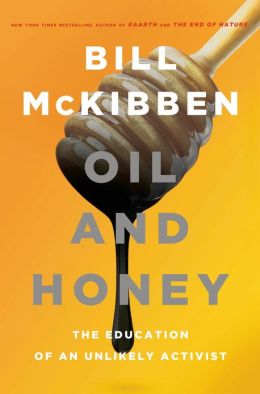
Oil and Honey by Bill McKibben

Highly literate and expert musings on climate change, from home to the global theatre.

oil
Oil and Honey centers partly on climate change, a subject on which Bill McKibben (The End of Nature; Eaarth; founder of 350.org) is expert; but it is also personal in nature, a dualism reflected by the title. McKibben is concerned simultaneously with oil–representing fossil fuel industry practices and climate change–and honey. Having entered into a land-share agreement with his friend, beekeeper Kirk Webster, McKibben finds his home and Webster’s apiaries exerting a gravitational pull just as his political activism draws him far and wide. These two sides of his life–personal and political, local and global, analog and digital–are the focus of this combination memoir and call to action.

The subtitle refers to his journey from writer to activist, by way of 350.org and the Keystone Pipeline–a trip he did not intend but found obligatory. Activist though he may be, McKibben remains a fine writer, evocative, articulate, clever and humble in examining his mistakes. In piercing prose, McKibben unites his longstanding authority on climate change with his novice stature in the world of beekeeping. He muses on the small-scale and private implications of our changing world, which incline him to work with his family and Kirk’s bees in his beloved local community in Vermont; and likewise on the necessity for global action to combat the continuing quest for fossil fuels. Oil and Honey travels the world but always cycles back, like the seasons, to McKibben’s Vermont home, likening global systems to beehives in a manner both profound and lyrical–and important.


This review originally ran in the – issue of Shelf Awareness for Readers. To subscribe, click here, and you’ll receive two issues per week of book reviews and other bookish fun!


Rating: 8 degrees.

Pilgrim at Tinker Creek by Annie Dillard, part the second

pilgrimattinkercreekI’m afraid I am continuing with my mixed feelings here, as in my first review. Pilgrim at Tinker Creek, for me, comes in sections, or in three parts. As I wrote, the early bits were difficult for me, a little too metaphysical and spiritual. And then, remember how I said that chapter 7 blew me away? Well, chapter 8 is even better.

Chapter 8 is entitled “Intricacy,” and addresses the amazing, extraordinary intricacy, complexity, tiny detail and huge scale and huge scale of tininess in the natural world. Dillard relates statistics that are mind-boggling: “the average size of all living animals, including man, is almost that of a housefly.” “There are… two hundred twenty-eight separate and distinct muscles in the head of an ordinary caterpillar.” “Six million leaves on a big elm.” She writes about the Henle’s loop in the human kidney, the lower lip of the dragonfly nymph. Tiny, infinitely complex things that make our world so strange. She uses this phenomenon to explore the idea of a creator – and here Dillard and I will disagree a little, but that’s okay. “Look… at practically anything… and see that not only did the creator create everything, but that he is apt to create anything. He’ll stop at nothing.” She takes the strange and prolific nature of our world to be proof of a creator – “no claims of any and all revelations could be so far-fetched as a single giraffe” – and I don’t. It’s all right, though; this book is plenty safe for atheists; she’s not preaching. She’s just exploring. And I love the science, all that tiny tiny trivia, the explanations of the human kidney and the aquatic horsehair worm.

Next is chapter 9, “Flood,” and here I am going chapter by chapter – that’s how good this book is. “Flood” addresses Hurricane Agnes, and hurricanes are something we’re increasingly familiar with, not only in Houston but in New York City these days as well. (Which leads me to point out that Dillard is blissfully unaware of climate change and ecological collapse; happy her in 1974.) There is more of what I love in Dillard: detail, observation, science, and a glorious, joyful celebration of the world.

And then it falls off again, descending (or ascending, depending on your feelings) into the spiritual once again. My level of detail falls off here, too, because what can I say? I paid less attention when she zoomed back out into the mistiness. The last few pages of this book were an effort, and I didn’t retain anything I can tell you about now.

Verdict? Rather a difficult one. Liz said, great, I’ll just read those middle chapters! But of course that’s no way to go unless you know your tastes are mine.

I am glad I read this book; it yielded some inspirational moments and great quotations (as you will see). But those came overwhelmingly from the middle portion of the book. Others, I have no doubt, will swoon over the “patting the puppy” and the tree with the lights in it. Discover for yourself; but I do think it’s worth the effort, in the end. If I were to do it again, I would just read the middle parts. Rather like Walden, then, in my final conclusions – just as I thought at the beginning.


Rating: in an attempt to be fair, 6 mushrooms.

Pilgrim at Tinker Creek by Annie Dillard, part the first

Clearly I will need to publish this review in two parts, for the sake of your patience with my long-windedness. Actually I fear three posts. This is a fascinating book about which I have mixed feelings and many tangential thoughts; also at about halfway through, I’ve filled three bookmark slips of paper with notes rather than the average one-or-less-per-book, so there you are. This is my review of roughly half the book.


pilgrimattinkercreekDespite a promising beginning, I am not sure that I love Annie Dillard as much as do many of my favorite authors. Odd, that. In fact, I enjoyed Christine Byl’s Dirt Work far more. And she hasn’t won any Pulitzers (yet).

For one thing, there is too much theology for my taste, and too much metaphysical rambling metaphor: seeing visions, entering the past and seeing the future. Too much philosophy, man’s (“man”! too much “man”! 1974 this was published, by a woman, and still the universal creature is “man” rather than person or even woman for goodness’ sake) …man’s self-consciousness, relativism… and not enough just being. I’d rather spend more time in the picture and less time examining the frame and the picture-maker, if the picture is our world.

Wikipedia brought some interesting thoughts to mind. [I take Wikipedia with salt; but I still find it a useful starting point for general knowledge.] For example: “The author has described [Pilgrim at Tinker Creek] as a ‘book of theology’, and she rejects the label of nature writer.” What is up with people “rejecting the label of nature writer”? Edward Abbey did, too, which rejection I think in turn his readers reject. Of course, Dillard’s point – that this is more theology than nature writing – helps explain part of my problem with it. But then, there is excellent nature writing within it: I love the finely detailed discussion of insect habits. Oh, and while we’re mentioning him: “Edward Abbey in particular deemed [Dillard] Thoreau’s ‘true heir’.” Both these quotations from Wikipedia come sans specific reference, although there’s a solid-looking reference list at the end of the article. So, take that with salt, as I said.

Dillard did remind me of Thoreau, which is both a compliment (obviously) and a qualification, for me personally, as I struggled a little with Walden, too. Walden was apparently the subject of Dillard’s master’s thesis, so we can expect some parallels there. I would call these two books a readalike pair, and recommend the one if you liked the other.

Now, on the Annie Dillard Wikipedia page, I found more useful phrases: “one critic… call[ed] her ‘one of the foremost horror writers of the 20th Century'” for her apt descriptions of the natural world (I imagine that critic had the mating practices of the praying mantis in mind!), which I find delightful, and true in a most positive sense. And “In The New York Times, Eudora Welty said the work was ‘admirable writing’ that reveals ‘a sense of wonder so fearless and unbridled… [an] intensity of experience that she seems to live in order to declare,’ but ‘I honestly don’t know what [Dillard] is talking about at… times,'” which is, again, a great way to put it, and I couldn’t agree with you more on all counts, Ms. Welty. Both these quotations are attributed, by the way: the first, to Dillard’s website, and the second, to the NYT review in question. Not attributed, however, is the assertion that “In 1971 she read an old writer’s nature book and thought, ‘I can do better than this.'” This would seem to belie the phrasing of the Wikipedia Pilgrim article that she “rejected the label of nature writer.”

But oh, then I got to chapter 7, “Spring.” I am entranced! She writes about learning languages and yearning to decode birdsong, about the mockingbird that sings from 2am til 11pm in her chimney in springtime; about newts, to whom “no one pays the least attention… except children”; more about trees (I love it); and then the part about the duck pond, which is hilarious, wise, and again hilarious. This is where we meet the plankton about whom she is rather passionate, and she studies them under the microscope.

I don’t really look forward to these microscopic forays: I have been almost knocked off my kitchen chair on several occasions when, as I was following with strained eyes the tiny career of a monostyla rotifer, an enormous red roundworm whipped into the scene, blocking everything, and writhing in huge, flapping convulsions that seemed to sweep my face and fill the kitchen.

Rather, she does it as a “moral exercise”, because “if I have life, sense, energy, will, so does a rotifer.” In chapter 7, I love this woman and this book. It was in chapter 7 that I got up from my lunch – during my lunch break, I walked away from lunch – to find Liz, who was on duty at the reference desk, to read her a page aloud. (That was the page about the duck pond and the frogs.) So along with my complaints, there is much to love in this book. Take for example the section on the mating habits of the praying mantis: Dillard portrays these practices as horrifying, hilarious, and disturbingly like our own; it is a feat. I think I like her best when she digs into the science and minutia of the natural world, and exclaims in joy, fear, disturbance, or wonder at it. In other words, when she is a nature writer (wink).

Stay tuned for my review, part the second, and we will all find out together what my final feelings for Dillard will be.

Flight Behavior by Barbara Kingsolver (audio)

flightAnother beautiful, thought-provoking book from Kingsolver; and another outstanding narration by the author herself. Like The Lacuna, which I called one of the best books I read in 2012, this will be a standout. I fear this will be one of those longer reviews, as I have so much to say…

We open with a young mother of two in a less-than-thrilling marriage, named Dellarobia Turnbow, hiking up a mountain to meet a man for adulterous purposes. On her way there, she’s distracted by an amazing sight. The hills appear to be aflame, but there is no sound and no heat. She is amazed, and disturbed, and stands up her would-be lover and goes back home; it’s something like a religious experience, although she’s not particularly religious. She does, however, attend church – one of many compromises for the sake of her mother-in-law, who terrifies her.

Dellarobia lives on her in-laws’ sheep farm in Tennessee and rarely gets to leave the property. Her husband is kind but dull. She is frustrated. The strange thing happening up on the mountain, however, will expand her world: it has implications for climate change, and is variously interpreted as an event of an environmental as well as a religious nature.

The cool orange flame on the mountaintop is a mass migration of Monarch butterflies, pushed out of their normal overwintering site in Mexico by a mudslide that killed a village, caused in turn by clearcutting and climate change. Dellarobia doesn’t have the context to begin to comprehend such happenings, so she has to learn slowly; aiding her in this process is the amazing Dr. Ovid Byron, an entomologist who has written the book (many of them) on Monarchs who shows up to park his camper on the Turnbow farm and study their special mountain. Ovid is a striking figure – physically, as a black man, he is of such a minority in the rural mountains of Tennessee as to be exotic to Dellarobia; audibly, his accent (similar to Jamaican) is mellifluous and musical; and intellectually, he boggles Dellarobia’s mind and pushes her to new ways of thinking. This is a young woman who would have gone to college if she hadn’t gotten pregnant, and her thwarted ambitions are sparked by Ovid’s presence.

Meanwhile, the local religious community becomes convinced that Dellarobia prophesied the Monarchs’ arrival, that she had a vision; she is tentatively treated as a hero or religious figure, which doesn’t sit well with her feared mother-in-law, Hester. The media – local, and then national – blows things out of proportion, highlights the sensational, and alternately threatens to turn her into a sex symbol or accuses her of suicidal tendencies. Her marriage – which we learned in the opening scene was not strong or happy – is predictably strained by all the activity and attention. And perhaps most poignantly, her small son Preston is told by Ovid that he is a scientist, and begins a new way of thinking, himself.

As a family story or the story of one woman, alone, this would be an extraordinary masterpiece. Dellarobia is a remarkable woman, and I think she is probably representative of many young women who have greater abilities than they end up exploring, trapped (in Dellarobia’s case) in rural and familial circumstances that limit her. Just as in The Lacuna, one of Flight Behavior‘s greatest strengths is Dellarobia’s realness: her quirks, her frustrations, her fantansies, her day-to-day life and thoughts. We get to experience this story inside her head, and the inside of Dellarobia’s head, all by itself, would be a glorious gift for Kingsolver to bestow upon us. The other characters too, all of them, are fully realized, more real than the people I know in the real world; they’re complex, and even the initially unlikeable ones (I’m looking at you, Hester) are multi-faceted and deserving of our sympathy in the end.

But! That’s not all! There’s more to this story than Dellarobia and her family of wonderfully real, odd people. The Monarch butterflies, climate change, the complexities of farming in a changing world, the environmental movement, 350.org, and academia are all explored and examined in a wonderfully nuanced way. Idealistic young – and old – environmentalists show up on the scene as well, and there’s a lovely scene in which one of them quizzes Dellarobia on her commitment to leave a smaller carbon footprint. As it turns out, being rural and poor puts her in a pretty good place footprint-wise already, a fact which humbles (not to say embarrasses) her interlocutor.

Dellarobia turns out to be the perfect vehicle for teaching us all the science of Monarchs, of migration, of weather patterns and geography, of climate change, and of relationships among people and cultures. She’s ignorant, but not unintelligent, and once she learns how to open her mind, she is an inquisitive student; and Ovid Byron is a wonderful teacher, and let me add, his dreamy accent, so well performed in this audio edition, is to die for. [I do recommend listening rather than reading, upon which more in a moment.] However, this is never a polemic, and Dellarobia is far, far more than a vehicle; you remember I was terribly bothered by that issue in Sophie’s World, and a little bothered by it in Ishmael, but there is no trace of it here. As I wrote above, Dellarobia is very, very real. Instead, this is a moving, complex story, starring sympathetic, believable characters, that also handles some large, important questions: like, what are we doing with our world?

I have a quick note to make on the ending, mostly for my father. Pops has noted that where Derrick Jensen is brutally honest about our future, Bill McKibben tends to draw intelligent conclusions and then inexplicably end on what feels like an unrealistically optimistic note. Well, in the same vein, Kingsolver may end things a trifle more hopefully than is realistic – it feels good, you understand, but it’s a McKibben ending rather than a Jensen one, if you follow. And then she thanks McKibben in her Author’s Note, so that’s fitting.

The Author’s Note also includes a brief discussion of what in this story is true to life (and how she found it out), and what is fiction. This is a well-researched book, and I appreciate her delineating the boundary between fact and fiction, as I always do.

The audio narration by Kingsolver herself could not be improved upon. Dellarobia has an Appalachian twang and darling figures of speech. Her BFF Dovey is even cuter and mouthier; she collects jokey church billboard sayings, some of which Dellarobia is sure she makes up (“Moses was a basket case”). Dellarobia’s in-laws have their own audible personalities; her husband Cub is nothing in life if not sloooow in all respects including speech. And Ovid Byron! Oh, the accent. Swoon. Kingsolver does all these beautifully. If you have to read this book rather than listen to the author read it, then fine, but I pity you. Get the audiobook!! Do it!


Rating: without question a perfect 10 newborn lambs.

This book is so wonderful – particularly in Kingsolver’s masterful narration – that I wonder if I should go back and try some of her earlier work again. I remember being decidedly nonplussed by The Poisonwood Bible, and I know I’ve read The Bean Trees but have no impression of it (which is not a good sign); I can’t decide if I’ve read The Prodigal Summer or Animal Dreams or not (also not a good sign). But The Lacuna and this one are both so grand, I feel I should delve more deeply. Also, while I’m pondering past readings, I wonder why I keep getting Kingsolver crossed with Margaret Atwood in my mind? I wanted to attribute The Robber Bride (which I enjoyed) to Kingsolver. Maybe it’s that I’ve found them both a little hit-or-miss; I was less impressed with The Year of the Flood and ambivalent about Oryx and Crake and The Blind Assassin; have no impression from Surfacing; but loved The Penelopiad, and found The Edible Woman mindblowing.

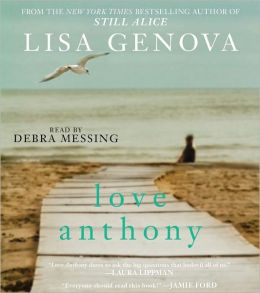
Love Anthony by Lisa Genova (audio)

This whole post below the book cover image is mildly spoiler-y. So, briefly: Love Anthony concerns two unrelated women and their respective pursuits of personal fulfillment and happy family lives. One has a little boy with autism. There is pain, and some redemption. If those few lines appeal to you, consider reading the book before you read this review.

loveantThis is Lisa Genova’s most recent novel, and I have now run out. (Her earlier works are Left Neglected and Still Alice.) This is not my favorite of her novels – that would be Still Alice. But it might be the one I found most thought-provoking.

The story jumps back and forth between the lives of two women who are connected only tenuously for most of the book. First we meet Beth. She lives on Nantucket Island year-round, and has three young daughters and a husband named Jimmy, who we learn even before we meet him is having an affair. She tells him to leave, and he does. For the bulk of the book, one of the central conflicts of Beth’s life is her struggle to deal with his infidelity and decide the future of their marriage and family. And then we meet Olivia. She is newly living year-round on Nantucket, in the cottage that she, her husband David, and her son Anthony have for years used as a summer home or rented out to vacationers. Olivia has recently experienced a series of personal tragedies, and she’s struggling just to hold it together. First, her son has autism, and the knowledge that he would never do all the things she’d imagined him doing – making friends, playing sports, dating, working, moving out of the house – would never happen, is devastating. Next, her son dies. And then her marriage falls apart, in the stress of dealing with Anthony’s autism and Anthony’s death.

Both Beth and Olivia, then, are working to cope with the unfairnesses that life has thrown their way. And here’s a twist: Beth is a writer, something she’d almost forgotten in her years of marriage and motherhood; but when Jimmy leaves, she pulls out her writing materials and begins working on a novel. Olivia is a former editor of self-help books, now working as a photographer (taking beach portraits for all those vacationing families on Nantucket). When the two women meet and discover this synchronicity, Olivia reluctantly agrees to read Beth’s novel when it’s finished. Are you ready for the big play? Beth’s novel is about a little boy named Anthony who has autism.

Beth and Olivia were both well-developed characters with realistic lives and problems. Both experience quite a bit of personal growth. I struggled for a time mid-book, because I didn’t really like either character; Beth was too much a perfectionist, sort of bitchy in her desire for the perfect family portrait in matching outfits, unconcerned with her children’s lives as long as they match and are unstained. And Olivia couldn’t love her son as he was, couldn’t get past her desire for a “perfect” or “normal” child. I was exasperated with both of them. But then they both changed, grew, and if I have had strong feelings about these characters then maybe the author reached her goal. I think there’s been a longer arc in this story than in Genova’s past books, which I loved more unequivocally, but which got me less involved. By the end, both women have changed enough that I liked them better. But they changed by becoming more perfect, which I cannot entirely buy into, so I retain some hesitation.

The friendship Beth shares with a group of women on the island (Jill, Georgia, Courtney, and Petra) is another area where I’m ambivalent. These women are diverse and likeable; but they feel like types more than real people, at least when assembled as a group. And they’re so good! There’s no cattiness, no back-biting. It’s a tight-knit, loving, supportive group, and call me cynical, but *I* have certainly never had a group of girlfriends so awesome; it’s all I can do to find one at a time, at best. They are a lovely part of this story, if they can be believed; but I am not sure they can be believed.

My central concern, however, is in the unscientific nature of the melding and meshing of Beth and Olivia’s lives, and the novel that they share. Beth’s novel turns out to be about Olivia’s son Anthony; the character in the book not only shares Anthony’s name, but his whole world. There is a metaphysical or otherworldly subplot. Is the dead boy Anthony speaking through Beth? I lost my patience here. Lisa Genova writes about hard science, and reliably – she is a neuroscientist by training – and that’s one of my favorite things about her work. So, then, for her to shift into this realm of possibly communing with the dead was jarring for me, and not what I was looking for. I have nothing against a good ghost story, but her work feels to me like it’s aspiring to realism, and I was bothered by the supernatural element. It didn’t fit.

On balance, I really enjoyed Beth’s and Olivia’s stories. Moment to moment, I was totally caught up in their lives and rooting for them. I was fully engaged, and I take my hat off to Genova who took me from not really liking either of her protagonists, to sympathizing fully; there was real growth and development. But when I zoomed out a little, I was unconvinced by and frustrated with several elements of the plot, and the type-casting of certain characters. For my money, her earlier novels were far more persuasive and easier to love wholeheartedly. That said – I am anxious for more. Lisa! Get to work!

As a side note, I found it curious that one of our characters is a woman writing a novel about a boy with autism, because Lisa Genova is of course a real-life woman writing a novel about a boy with autism. I can’t help but wonder how much of that is autobiographical, and I love the journey that line of thinking can take me down. Additionally, Beth’s writing process was fascinating to me, and I expect anyone else who dreams of being an author will feel the same. (I suspect that many avid readers fall into this category.)

Debra Messing, who plays Grace on the tv show Will and Grace, reads this audiobook convincingly, with the shifts, sighs, and varying volumes that represent speech vs. thought; she communicates emotion; a fine job. I recommend the audio version.


Rating: 6 white rocks.

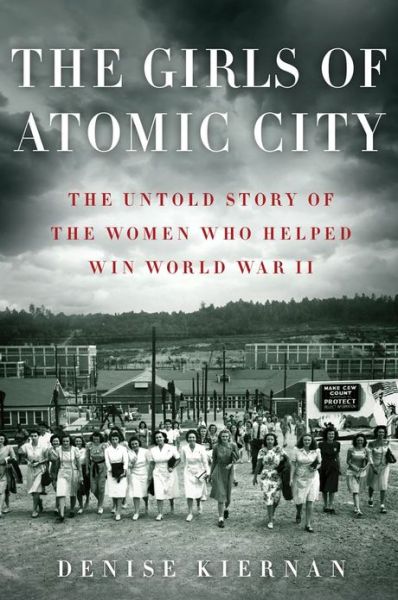
The Girls of Atomic City by Denise Kiernan

An evocative view of the Manhattan Project through the eyes of the women who worked and lived in the secret city of Oak Ridge, Tenn.

atomic

Oak Ridge, Tennessee was born in the fall of 1942, but would remain unknown until August 6, 1945, when the United States dropped the atomic bomb on Hiroshima. Oak Ridge, or “Site X,” housed factories for the enrichment of uranium. The workers at those factories at their peak numbered some 75,000, living in a secret city and working on they knew not what.

Diverse young women traveled from around the country fill the jobs needed to help win a war. Denise Kiernan’s The Girls of Atomic City is a unique glimpse into their strange experience of working on a project whose nature was kept from them. Most expected to leave Oak Ridge as soon as the war was won, but many stayed on for decades. Due to the fine supply of handsome young men in uniform, a number of Kiernan’s subjects would make families and homes there.

Based on interviews with their now-elderly subjects, the stories of Jane the statistician, Virginia the chemist, Kattie the janitor and many more are vivid and human in Kiernan’s telling. The focus of the book briefly zooms out for the dropping of the bomb, visiting Truman’s White House during the decision-making process, but then plunges back into Oak Ridge, where women who tested for leaks in pipes and kept tanks clean were rocked by the revelation of what they’d contributed to. Kiernan melds hard science and history with the moving stories of women caught in events bigger than themselves, whose experiences and whose work changed the world irrevocably. The result is a compelling and unusual new perspective on the Manhattan Project and World War II.


This review originally ran in the March 5, 2013 issue of Shelf Awareness for Readers. To subscribe, click here, and you’ll receive two issues per week of book reviews and other bookish fun!


While I am always constrained by the limited space available for reviews in Shelf Awareness (you know I can get wordy!), this book was especially difficult to boil down, touching as it does on women’s issues, history, science, working conditions, civil rights, war and ethics… It could be compared to Soundings or The Immortal Life of Henrietta Lacks in its intersection of hard science with the creative, feeling portrayal of women’s lives. Additionally, Kiernan’s use of primary sources – interviews with survivors of the era – made me pause to think of my grandfather, a WWII veteran who’s over 90 years old now, whose memories will someday be lost to us. This is a fine book on an interesting subject and I just had to say a few more words to that effect.


Rating: 8 acronyms.

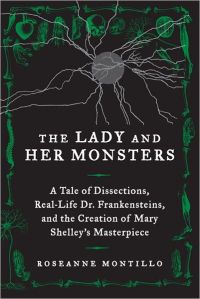
The Lady and Her Monsters by Roseanne Montillo

A spirited investigation of the bizarre times that inspired Mary Shelley’s Frankenstein.

monsters

On its surface, Roseanne Montillo’s The Lady and Her Monsters is an exploration of the genesis of Mary Shelley’s Frankenstein. But Montillo clearly rejoices in meandering through the volatile times that gave life to Shelley’s gothic classic, and her multifaceted literary study expands to include discussions of anatomy and alchemy, suicides, ghoulish dissections of men not quite dead and the dramatic death of Percy Shelley at sea.

In the early 19th century, Europe grew increasingly fascinated with life, death and man’s ability to control nature. Grave robbers known as “resurrectionists” provided subjects for human dissections that were conducted both in medical schools and for the general public’s entertainment. Scientists and imposters experimented with the capacity of electricity to restore life. Into this environment, Mary Shelley was born to Mary Wollstonecraft (A Vindication of the Rights of Woman) and William Godwin, a famous reformer of the day. Percy Bysshe Shelley was her lover and eventual husband; her sister was lover to Lord Byron. The foursome were traveling in Italy, telling the ghost stories with which Percy Shelley was obsessed, when–as Mary Shelley and legend have it–a human monster appeared to Mary in a waking dream. It was also in Italy that she may have first heard the surname Frankenstein, tied to the inspiration for Bram Stoker’s Dracula, as well as to Sir George (he who killed the dragon). In Montillo’s enthusiastic prose, such diverse and macabre subjects make for a lively survey, not only of Shelley’s masterpiece, but of an odd and colorful time in European history.


This review originally ran as a *starred review* in the February 8, 2013 issue of Shelf Awareness for Readers. To subscribe, click here, and you’ll receive two issues per week of book reviews and other bookish fun!


Rating: 5 volts.

Still Alice by Lisa Genova (audio)

stillaliceI have a favorite book of the year so far, you guys. Still Alice is one of the most remarkable books I’ve read in some time. I enjoyed Lisa Genova’s second novel, Left Neglected, very much. (I listened to that one as an audiobook, too.) But Still Alice gripped me from the first lines, and never let me go – I was riveted. Let me tell you more.

The two books have more than a few threads in common. Both feature married women, with three children, in male-dominated fields with all the requisite toughness and work ethic but also with plenty of feminine soft spots, struggling to reconcile the two; both live in Boston. One could easily surmise that these are attributes shared by the author, a Harvard-educated neuroscientist-turned-novelist. Where Sarah of Left Neglected had young children, though, Alice Howland has grown children: one lawyer trying to get pregnant, one doctor just finishing his medical training, and one relatively wayward daughter who has scorned college in favor of acting. Alice is a Harvard professor of psychology, and her husband John is also a Harvard doc, working with human cells & a possible cure for cancer. She is nearing her 50th birthday when the book opens, and shortly after it, she is diagnosed with early-onset Alzheimer’s disease. The story is concerned with the progression of her disease, the changes it wreaks on her life and the lives of her husband and three children, and their struggles (independently and as a family unit) to handle these changes. It is also centrally about Alice herself, as a person, what Alzheimer’s does to her and her reactions & dealings with that disease. Again, the author is a neuroscientist, so while I (thankfully) don’t have any experience with Alzheimer’s disease by which to judge this portrayal, I trust Genova’s ability to tell it truly.

I became deeply engrossed in this story from the very beginning. Although told in the third person, we are very much inside Alice’s head (call it third person limited, for which I like this explanation because of the example chosen!). Alice felt very much like a real, flawed-but-likeable person. I was occasionally exasperated with her choices: to fight with Lydia over her acting career, to fail to appreciate her, and to put off telling her husband about her diagnosis. But I always sympathized, and liked her throughout. I would like to spend a day or a week with this woman. In fact, in telling Husband about this story as I listened to it, I referred to her as my friend. This is not something I normally do with fictional characters.

I was deeply emotionally involved. If I was angry with Alice for not telling John she had Alzheimer’s right away, I was even angrier with John for his reaction, and his repeated failures to be supportive. I wanted to cry when they began considering their future. And I did cry, often, as the disease progressed and Alice’s family was – still flawed and imperfect, but earnest and effortful and loving in their handling of these events. I hope it’s not too much of a spoiler to say that I was charmed by the silver-lining aspect, where Alice’s relationship with Lydia grew stronger in this time of sickness. I pondered whether it was a bit too fictional-happy, to insert such a silver lining, and decided it wasn’t.

This is a sad story, certainly, and I cried more than a few times. (I finished this book in the gym, and it took great effort not to weep on the elliptical machine. What would people have thought?) But there is love, and hope, and strength; Alice keeps a certain dignity that made me love her more as she got sicker. I can see how this would be a painful read for someone whose own life has been affected by Alzheimer’s, but I’m inclined to think it might be worth the pain for the beauty it expresses.

If you’ve read the book or don’t care to, highlight the white text to read my spoiler-y discussion below; but if you intend to read this book, don’t.

I was saddened by Alice’s decision to plan her suicide, but I respected it. When she got so sick that she couldn’t execute her own plans, I found that sadder still. I wondered a little at Genova’s decision to end the story the way she did, with Alice fading into gray; I would have liked to know her final fate, when and how she died, whether John moved her to a place she never wanted to be (a “home,” or New York), but I think this way was for the best. That fade-to-gray is probably most like the end of Alice’s own understanding of things – most like Alzheimer’s disease.

Unlike Left Neglected, this book is read by the author, and when I heard that I was thrilled, because my author-narrated audiobook experiences have so far been 100% wonderful. Still Alice is no exception. Genova’s goodreads page tells us she’s an actress as well as a neuroscientist and novelist, so perhaps it’s no surprise that she delivers her characters feelingly (or that she wrote a lovely, passionate actress character into this book). For the record, I really enjoyed the audio reading of Left Neglected, too, but I would never pass up an author-read version, and highly, highly recommend this audio version of Still Alice.

This is without a doubt going to make my list of best books read in 2013. I am so relieved to see that Genova has a third novel out already, Love Anthony, and is working on a fourth – whew! I can’t say enough good things about this book. I love Alice.


Rating: 9 thingies.

book beginnings on Friday: The Lady and Her Monsters by Roseanne Montillo

Thanks to Rose City Reader for hosting this meme. To participate, share the first line or two of the book you are currently reading and, if you feel so moved, let us know what your first impressions were based on that first line.

monsters

The Lady and Her Monsters: A Tale of Dissections, Real-Life Dr. Frankensteins, and the Creation of Mary Shelley’s Masterpiece is a fascinating title, isn’t it? I was attracted immediately. It begins:

Camillo’s footsteps echoed loudly as he crossed the empty cobblestone streets of Bologna toward his uncle’s house. The afternoon was hot, and the scorching heat, coupled with that lazy midafternoon spell between noon and evening, allowed him to go by virtually unnoticed.

Although this is a work of nonfiction, I think these atmospheric opening lines are appropriate, since its subject is something of a gothic ghost story.

Happy reading to you this weekend!

This quotation comes from an uncorrected advance proof and is subject to change.

On a Farther Shore: The Life and Legacy of Rachel Carson by William Souder

Rachel Carson was born in 1927 and by the 1950’s was the author of several bestsellers, a national hero for her lyrical, literary, scientifically accurate books about the ocean. She also published myriad magazine and newspaper articles, both as a government employee and as a freelance writer. In 1962 she published a somewhat different kind of book. Silent Spring retained the literary style for which she was well loved, but its subject – while still the natural world – took a different tone. Carson wrote about the then-widely-used pesticide DDT and its sinister effects, not just on the insects it claimed to target, but on wildlife generally including many fish and birds (hence the title) and even human life.

The immediate reaction to her book was mixed. Critical reviews were more positive than negative, but the government (to varying degrees) and the pesticide industry (predictably and totally) offered less praise. Carson came under attack as a hysterical nature faddist and Communist sympathizer, even as Silent Spring topped bestseller lists and initiated federal investigations. Today, the ecology and environmental movements credit Rachel Carson and Silent Spring with helping to establish what is now a central issue of our times.

William Souder’s new biography of Carson, published on Silent Spring‘s 50th anniversary, begins with the conjecture that Carson’s name is now “unknown to almost anyone under the age of fifty.” There are a few of us, of course (although I confess my personal poll may not constitute a random sampling), but his point is well taken: in 2012, Carson is less on our minds. But even if DDT is no longer sprayed on kids playing at the beach and the rivers we catch our fish out of, environmental issues are among the most pressing of our day. (I am thinking of climate change, overpopulation, water tables, land use, urban sprawl, species extinction…)

That’s the argument for Carson as a biographer’s subject. Now, how did Souder do? As observed yesterday, his style is rather a traditional one. Souder himself does not enter into the story as a character; he doesn’t give us his own impressions (unless you delve into the Notes at the back of the book, on which more is coming in a later post). I am a fan of the newer style of “creative nonfiction” exemplified most recently at pagesofjulia by Soundings, but that doesn’t mean the straightforward sort of biography is necessarily dry, either.

Souder brings his subject to life. His plentiful research (again see those Notes) clearly and exhaustively outlines Carson’s background and personality, and enigmas. For instance, he notes the weekend in college when she went one two dates with a boy from another school, and then as far as we can tell, never dated again. He writes eloquently of her strange single-mindedness, for example in reading Henry Williamson for his nature writing (which she loved) while totally ignoring his frank Nazi sympathies.

I will mention one angle that I noted as absent: there is nothing in Souder’s book about Carson suffering for her sex in the field of science. This seemed like a natural obstacle for her to have faced as a science writer in the 1950’s and 1960’s, and I wonder at its absence, particularly in comparison to Soundings, where Tharp’s professional limitations as a woman are one of the central issues. Did Carson not feel that she was held back? Did Souder miss something? His work feels thorough. I am hesitant to think he missed such an important angle, but it makes me wonder. There are a few references by her contemporaries to her status as a “spinster,” but even these don’t feel particularly biting. And apparently her critics entirely missed the lesbian question. Carson had a very close female friend for the final 10-12 years of her life with whom she exchanged ardent letters. Whether they had a sexual relationship is not known, although Souder makes the case that it’s unlikely; but that’s irrelevant in looking for contemporary criticism of her for it. It seems like such an obvious way for her detractors to attack her. I just wonder.

Despite my questions about the role sexism might have played in Carson’s career, this biography feels well-researched, thoughtful, and finely wrought. It can also serve as a fairly good quick introduction to the history of ecology, environmentalism, and nature writing: Aldo Leopold, John Muir, and Teddy Roosevelt all get put into context. In fact, context is one of its strengths (again, see yesterday’s post). I feel like I know Carson much better now, which is of course what I was looking for, but it was also an enjoyable read. I recommend On a Farther Shore, because Rachel Carson is every bit as relevant today as ever.


Rating: 7 birds’ eggs.