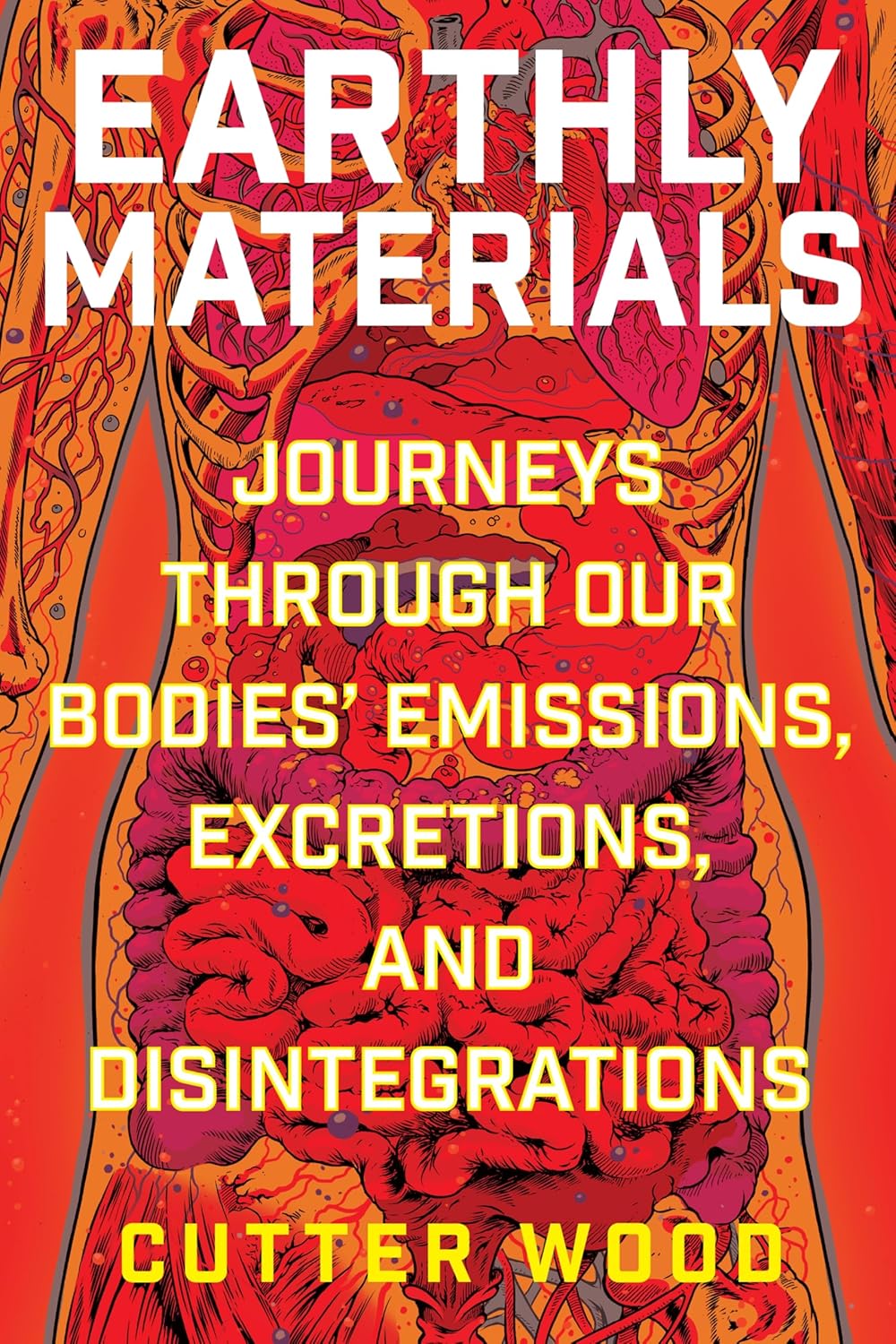
Earthly Materials: Journeys Through Our Bodies’ Emissions, Excretions, and Disintegrations by Cutter Wood

This weird, wonderful exploration considers the social, cultural, and political implications of bodily emissions as well as their science, but shines brightest in its empathetic storytelling.

Cutter Wood (Love and Death in the Sunshine State) offers a spellbinding collection of facts, observations, and musings in Earthly Materials: Journeys Through Our Bodies’ Emissions, Excretions, and Disintegrations. In 12 chapters that might be termed “essays” and Wood calls “stories,” he considers mucus, urine, blood, semen, menses, milk, flatulence, breath, feces, vomit, hair, and tears. While readers will certainly gain new and fascinating scientific knowledge, what makes Earthly Materials so special is storytelling: Wood’s compassionate, funny, earnest explorations through unexpected subject matters adjacent to bodily fluids.

At a lab at the Massachusetts Institute of Technology, he meets impassioned graduate students and views beautiful stellar-like magnifications of mucus, which resemble Hubble Telescope photographs. He discusses the political and financial implications of donating blood and delves into the discomfiting r/NoFap Reddit forum. In the absorbing true-crime case of Formula Mom, a Florida woman is investigated and sentenced to prison for creating a large-scale business that bought and sold infant formula.

Tongue-in-cheek, Wood describes the flatulence customs and practices of the preadolescent male in the Commonwealth of Pennsylvania. To explore vomit, he joins the Soul Quest Ayahuasca Church of Mother Earth and takes its sacrament. These experiences and studies often yield hilarity in Wood’s expert prose: dryly witty, comically verbose, and poignant. Wood finishes with the inexplicable tears of a Wimbledon finalist, in this thought-provoking philosophical study that exemplifies human interconnectedness through the rather surprising lens of bodily fluids and expulsions. Earthly Materials will change the way readers think about the mundane in unanticipated and transcendent ways.


This review originally ran in the May 2, 2025 issue of Shelf Awareness for Readers. To subscribe, click here, and you’ll receive two issues per week of book reviews and other bookish news.


Rating: 7 stills in the brambly Appalachian holler.

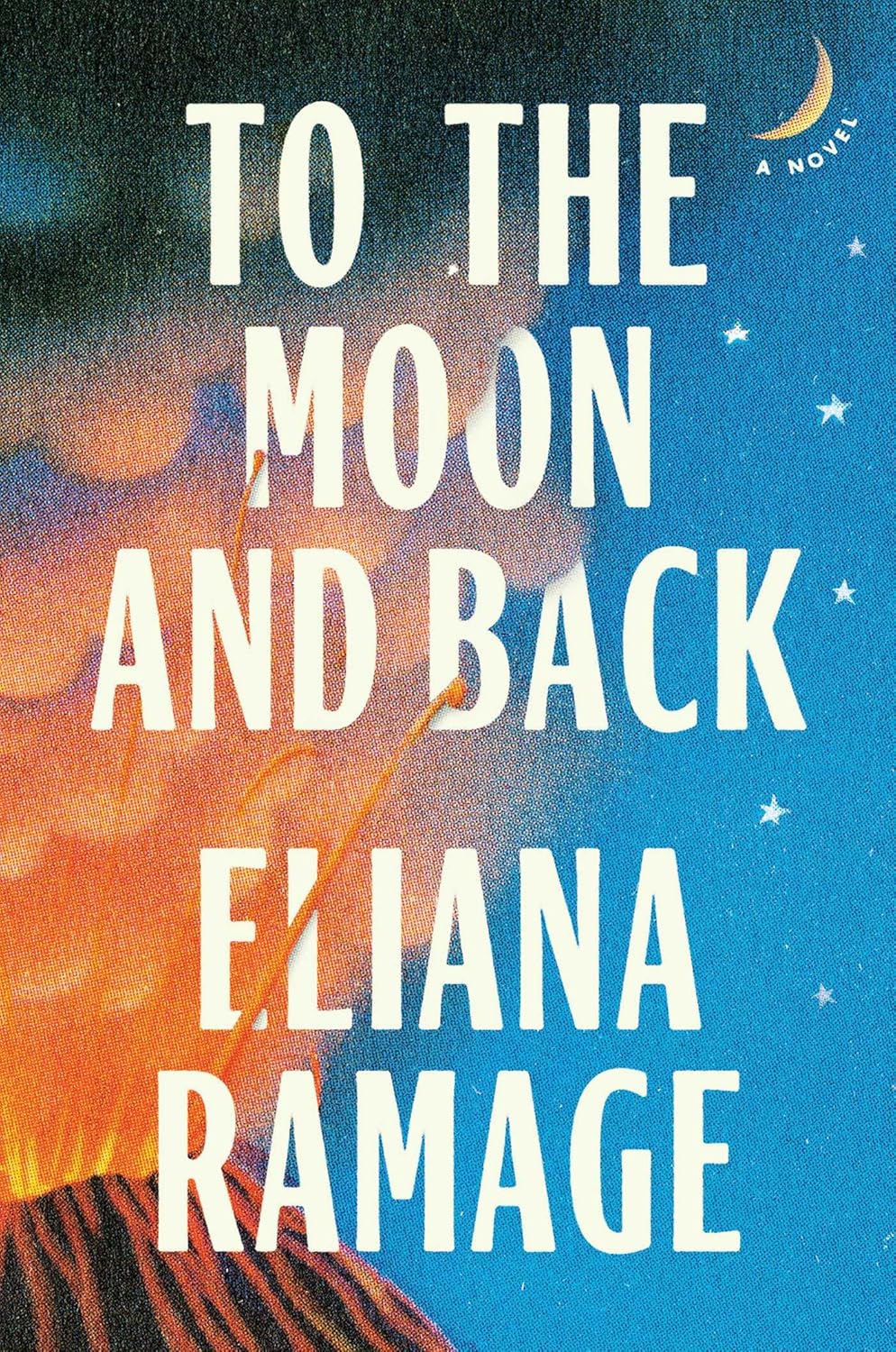
Maximum Shelf: To the Moon and Back by Eliana Ramage

Maximum Shelf is the weekly Shelf Awareness feature focusing on an upcoming title we love and believe will be a great handselling opportunity for booksellers everywhere. The features are written by our editors and reviewers and the publisher has helped support the issue.

This review was published by Shelf Awareness on March 25, 2025.


Eliana Ramage’s debut, To the Moon and Back, is a far-reaching, ever-surprising, intricate novel about identity, family, ambitions, career, romance and, yes, astronomy.

When readers meet Steph Harper, she is almost six years old. “I imagine her terrified. Our mother. Two children in the backseat. She drove like a woman followed, even after we left him at the foot of that tall hill. There was blood there, back in Texas, and tiny shards of glass still covered my sister.” Their mother, Hannah, is in flight from a vague threat–abuse, trauma–with her two little girls in tow. Precocious Steph is already developing her obsession with astronomy. Kayla is just a baby, sparkling in broken glass but unscathed by what haunts the others: “Our mother would never have Kayla’s confidence because Kayla had no memory of another self. Of another place. Of what was possible, here on earth. Maybe what was wrong with our mother was also wrong with me.”

From Texas, the fragile family resettles in the Cherokee Nation, in Tahlequah, where Hannah hopes to recover community and reclaim her heritage. Steph and Kayla learn to speak Cherokee. Steph watches the sky and fine-tunes her plans to become an astronaut: when readers meet her for the second time, she is 13 and concerned only with getting into Exeter Academy, which she hopes will put her on course for Harvard and then NASA. She studies the biographies of astronauts and the hard science she will need, with the help of a telescope gifted to her by her mother’s new boyfriend, Brett. “It had been my goal to understand the origins of earth, the universe, and everything in it by my fourteenth birthday. I was behind schedule.” This dream is what gives Steph’s life focus; she needs this to live. “I’d picture an astronaut watching me back. Some astronaut would call his daughter through mission control and she’d say tell me what you see and he’d say oh, the Northern Hemisphere, North America, and that would be true, but also true was Oklahoma, a field, a tree. A girl alone, looking up.” It is also true that the dream, which in some ways saves her, may be what keeps her from finding happiness in relationships on Earth: with her mother, her sister, or the love of her life.

Distracting her along the way are her feelings for girls, which she suspects will not be appreciated in Tahlequah: “If I could figure out the money and the applications and the getting myself to college, I decided I would be gay. Or bi, maybe? At schools like Harvard, they let you figure that out.”

As Steph moves from Tahlequah to Hollis College in rural Connecticut, a parallel character is introduced. She was named Della Owens at birth, when she was adopted by a Mormon couple in Provo, Utah. But as the center of a legal case resting upon the Indian Child Welfare Act, she became known as Baby D. Many Native Americans believe she belongs with her people. Della’s path intersects Steph’s when they find themselves at Hollis together, and they will intertwine from there, coming of age in parallel and navigating romance, Native heritage, and ambition.

For a portion of the book, Della’s first-person voice alternates chapter-by-chapter with Steph’s, which otherwise dominates. Later, these perspectives are joined by various epistolary elements: e-mails, social media posts, text messages. To the Moon and Back excels in surprise; these points of view are only one area in which Ramage takes her reader in unexpected directions, geographically and otherwise. The novel is gloriously expansive, epic, and sweeping. It covers just a couple of decades, from 1995 to 2017, although the history of previous generations certainly comes to bear on the present timeline. But like Steph herself, the story keeps reaching beyond its expected limits. It is not only a coming-of-age story, but also about a variety of Native American experiences, and about queer experiences and those intersections. It’s about lofty goals, astronomy, and yearning. Just when readers grasp the enormity of Steph’s single-minded focus on becoming an astronaut, she reaches further, to becoming a better human being. The events of Steph’s life are often sensational, but always, in Ramage’s expert storytelling, believable.

So many threads would be too much for a less skilled writer to wrangle, but these characters are developed with such steady pacing, depth, and perfect detail that they always feel natural. A plot summary with spoilers would sound, perhaps, absurd. But To the Moon and Back is anything but. It is a complex, absorbing, thought-provoking novel, compulsively readable. Steph is exceptionally eccentric, and her story is also universal, all-encompassing. Her impressive character arc comes, eventually, to wisdom and an unlikely peace: “I want to love the universe, even if I don’t know what it is. I do not have to know what it is.” Readers will be enriched for having shared these pages with her.


Rating: 9 M&Ms.

Come back Monday for my interview with Ramage.

rerun: Soundings: The Story of the Remarkable Woman Who Mapped the Ocean Floor by Hali Felt

Please enjoy this time capsule from August of 2012.

I’m so glad I picked this book up (and bought it for the library where I work). It sounded like just the sort of thing I appreciate: a biography of a little-known historical figure who made an important contribution to the world as we know it but was herself forgotten. In this case, the “remarkable woman” of the subtitle is Marie Tharp, whose meticulous study and cartography of the ocean floor established the concept of plate tectonics that science now recognizes as fact, but was at best a blasphemous and ridiculous notion before Tharp came along. Her achievements, however, were minimized by a scientific culture in which women did not belong. This biography is additionally appealing to me for its mood: author Hali Felt takes a whimsical, dreamy, almost fanciful tone at times. She describes her own attraction to Tharp’s story (born in part of Felt’s mother’s, and her own, fascination with maps) and the relationship she felt to her subject. She dreams of Tharp coming to her to explain the mysterious and unspoken parts of her life. This book is nonfiction, but it’s honest, personally related, and warm.

There is also an enigmatic love story of sorts hiding within Soundings: Tharp’s career and life were both tied to a man named Bruce Heezen. Heezen was her coworker, then her technical superior; but they shared a partnership in work, in science, in discovery, and apparently in all things. It is known that they were a couple, although they never married and the details of this side of their relationship are very few.

Felt follows Tharp from her childhood with a science-minded father she adored, through her education in English, music, geology, and mathematics, and to her first job in the oil & gas industry (oh, how familiar to this Texas girl). But she was held back: this was the 1940’s, and women in science were mostly expected to make copies, compute numbers, and brew coffee. Eventually Tharp found her way to New York, to Columbia University and the Lamont Geological Observatory. This is where she would meet and work with Heezen and quietly make history.

The science in this book is very friendly and accessible to a general reading public; the story that Felt set out to tell is more that of a woman’s life and accomplishments despite the limitations of her society, than that of tectonic plates per se. For that matter, Felt shows that it was Marie’s combined backgrounds in art as well as science that made her perfectly suited to play the role she did in history. Her meticulous re-checkings of data and attention to detail were indispensable – but so was her interest in visually representing the data available in a way that would show the general public (not just academics) what she’d discovered. So her achievement was artistic as well as scientific. Soundings does make the science side clear, but doesn’t dwell, and is never dry. Rather, Marie Tharp comes to life: she is a precocious child; an ambitious, able, frustrated student; a dedicated scientist; a life partner; an eccentric aging woman caught up in her own past, campaigning to honor and preserve the legacy of her other half.

Hali Felt was honest about the role she plays in the story she relates. She begins in her Introduction by briefly describing her own attraction to maps, and then follows a chronological format, beginning with Tharp’s childhood and following her life, and eventually her death. And then Felt returns to the story: her discovery of Marie Tharp’s existence, her interest, her decision to follow that interest, her research, her relationships with the living descendents of Tharp and Heezen’s world (the “Tharpophiles”), and in the Acknowledgements at the end, she even hints at the process by which she came to write and publish this book. I found all of these Felt-related details interesting too.

In a word, this is a lovely biography, and the style and tone of it may be my favorite part.


Rating: 9 double-checkings of data.

I remember it fondly.

The Giant Golden Book of Biology: An Introduction to the Science of Life by Gerald Ames and Rose Wyler, illus. by Charles Harper

My mother got me this lovely book for the illustrations of Charley Harper, who it turns out was a native of the place I now call home, Upshur County, West Virginia. She tells me he was also a chief illustrator for Ranger Rick magazine. I remember the magazine well, but I’m not sure Harper’s illustrations ring a bell there. They are certainly lovely.

This is an entry-level science book for kids. The foreword, by Harvard biology professor George Wald, claims it isn’t ‘just’ a child’s book, which is true in that I also enjoyed it; but the text has a clear audience in mind. Concepts are plainly presented, although the authors (a married couple) don’t shy away from rather complex ones, such as the work of various scientists to classify living things or run experiments to figure out the principles of dominant versus recessive genes. Content ranges throughout the science of life: small and large living things; microscopes; air, food, fluids, building blocks of cells and protoplasm; growth, sex, and mating; genes; the theory of evolution, the origins of life and development from sea to land and from single-celled to more complex beings; the possibility of life on other planets. It takes us all the way to “the problem of how the earth began”!

I was supposed to be here for the illustrations! but found the text distracting because it was interesting and (I think) surprisingly well-written. Also, despite publication in the 1960s, it didn’t feel terribly dated to me. It does persist in referring to ‘man’ or ‘mankind’ and the ‘he’ pronoun; that’s an out-of-date set of usages. It also leaves us with this very hopeful idea… “Before explorers set off for other worlds, biologists must solve these problems of life in space. And they will be solved, thanks to growing knowledge about life on one remarkable planet, the earth.” Strikes me as awfully optimistic.

I noticed a few spellings that are out of favor now, or Britishisms: ameba for amoeba and oesophagus for esophagus. Also, admittedly, I am not at the cutting edge of science and may have missed something, but I have the general (layperson’s) perspective that not much has changed in our understanding of science at this elementary level. I’m impressed on the whole.

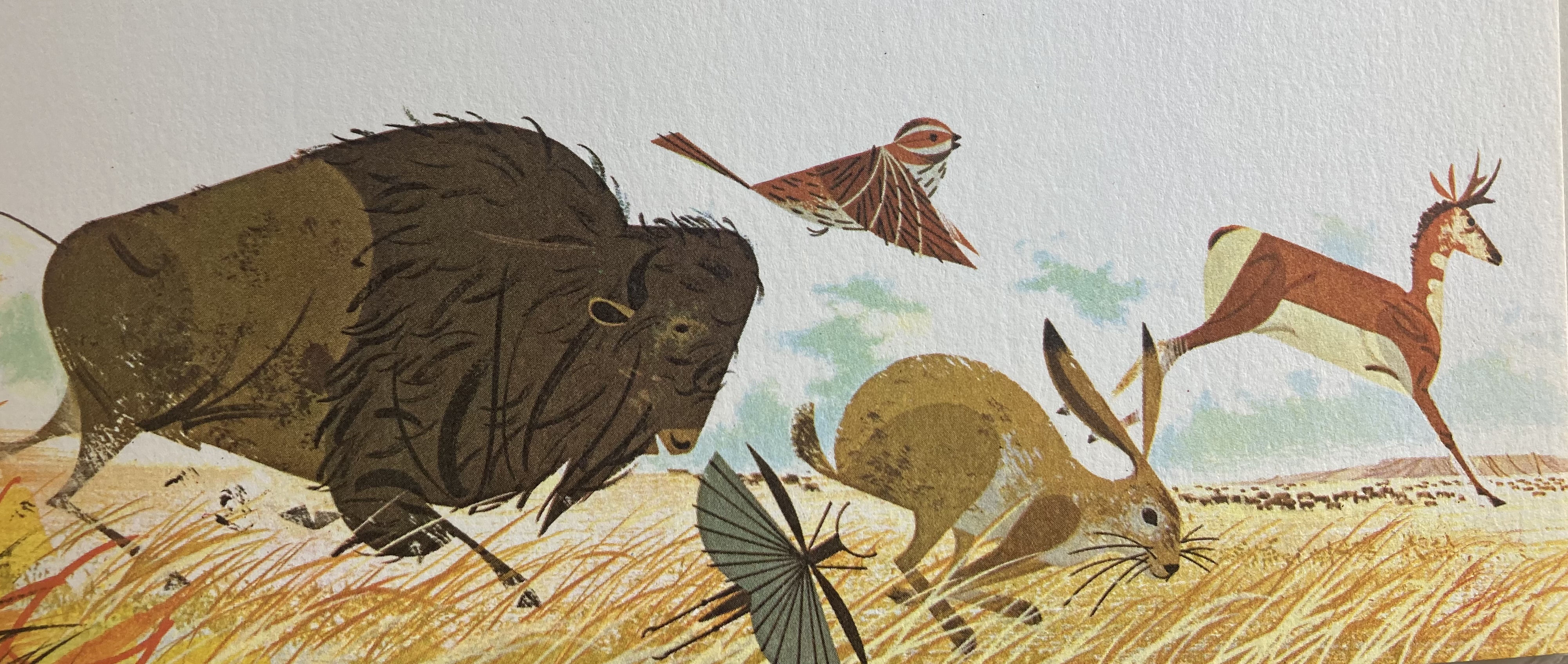
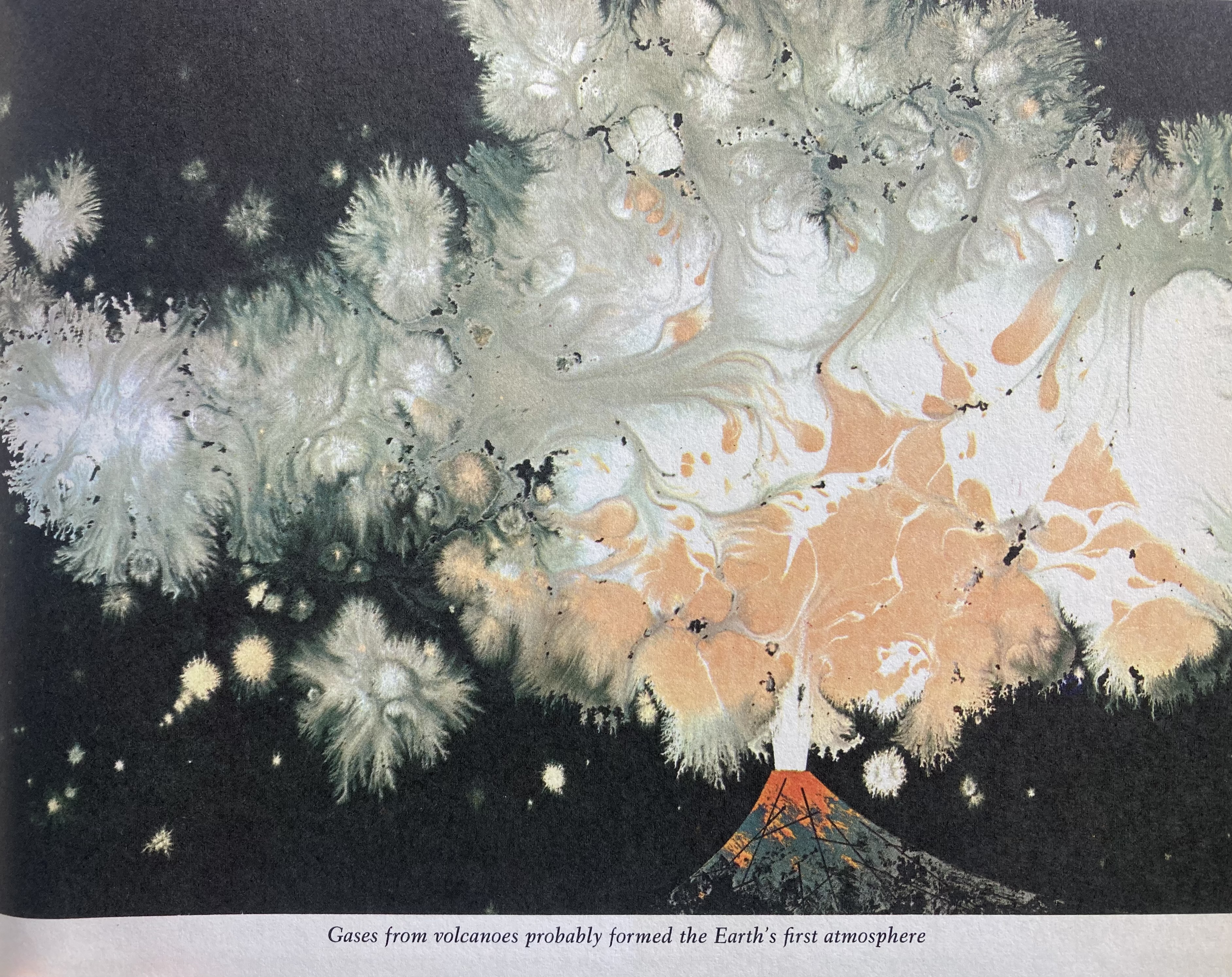
But what we’re really here for: those pictures. I really did appreciate Charley Harper’s illustrations, and from this relaxed-pace read* and the other Harper work I’ve looked at with Mom recently, I’ve definitely come to recognize his distinctive, often geometric style. I’ve pulled out a few of my favorite images here for your enjoyment. (Click to enlarge.)

I am amused at this creeper version of Darwin

*I took my time with this one, not least because it is an older book, rather precious, I think expensive? and visually lovely. I didn’t take it with me on any of my recent travels and was careful around food. Especially since I’ve been traveling a fair amount lately, it took me a long while to get through this book, but that felt good.

Final verdict? Definitely recommend for the visual art; still passable for the science. Thanks, Mom.


Rating: 8 cowbird eggs.

Why Fish Don’t Exist: A Story of Loss, Love, and the Hidden Order of Life by Lulu Miller

Another one hit way out of the park by Liz. I no longer remember what she said, but I think it involved some superlatives; I bought the book and finally got around to it and now have some superlatives of my own. It was just early April when I read this book, but I’m confident stating this will be the best book I read all year.

Why Fish Don’t Exist is one sort of book I love, in that it involves several threads woven together. In her prologue, Lulu Miller pits our most precious loves against the force of a capitalized Chaos. “Chaos will crack them from the outside–with a falling branch, a speeding car, a bullet–or unravel them from the inside, with the mutiny of their very own cells. Chaos will rot your plants and kill your dog and rust your bike. It will decay your most precious memories…” Etc. Then we first meet David Starr Jordan, as Miller did. He was a taxonomist specializing in fish. An earthquake destroyed his collection of thousands of specimens, dashing them in their glass jars to the ground, separating them from their identifying tags. To which he responded by hand-stitching tag to fish specimen, and starting over. Miller is entranced by this “attack on Chaos.” She struggles herself with the forces that tend to defeat us, and wonders of Jordan: “Who are you?… A cautionary tale? Or a model of how to be?

From here we accompany Miller on her study of Jordan – his life and his thoughts – in search of a model for how to be, how to live with joy and be indefatigable in the face of all frustrations, all forms of Chaos. Why Fish Don’t Exist is thus partly a biography of Jordan and a layperson’s introduction to fish taxonomy and its principles. (The title is not a joke. There are existential arguments and philosophies to be discovered, too.) It’s also part memoir, as we get to know Miller better, the demons she’s faced and the tools she’s used to try to mend herself. Her father is a delightedly nihilistic scientist, with some parallels to Jordan, which is of course fascinating. The book is perhaps most of all an inquiry into Miller’s original concern: how to live and not despair, not choose to die, in such an overwhelmingly imperfect world as this one.

Miller’s writing style is colorful, phantasmagoric, impassioned, with high highs and low lows. She sees beauty and desolation in the world, and describes them evocatively. Among Jordan’s discoveries are

A small lantern fish with glowing spots, “which had risen from the deeps in a storm.” A tiny, rainbow-scaled fish that was found inside the belly of a hake, which was found inside the belly of an albacore. A crimson fish with yellow stripes that they nicknamed “the Spanish flag.”

The only fish he ever named after himself, “breathtaking, absolutely, but frightening, too, in the way of an M.C. Escher drawing.” “Its fins look like dragon wings, serrated and sharp.”

Without ruining too much of the story, I will say that Jordan, like all our heroes, is not purely heroic. He turns out to be in fact profoundly problematic, as our heroes tend to, and so Miller must wrestle with that, too. Chaos again. His methods are ruthless –

He began inventing more aggressive techniques for capturing fish. Blowing them out of the water with dynamite, hammering them out of coral, and perhaps most ingenious, for the “myriads of little fishes” that hid inside the tiny cracks in tide pools: poison.

and he’s harder on people than he is on fish. In more than a few ways I won’t give away here he will disturb our modern sensibilities. He disappoints us, as he disappoints Miller – horribly – but her own perspective never disappoints.

Illustrations by Kate Samworth open each chapter and advance their contents; these lovely black-and-whites resemble woodcuts (if that’s not in fact what they are) and will be part of what makes this book memorable for me. I think Samworth deserved to have her name on the book’s cover.

Transcendent. Best book of the year. Wrecked me, but in the best way. I’ll be thinking about this one for a long time.


Rating: 10 holotypes.

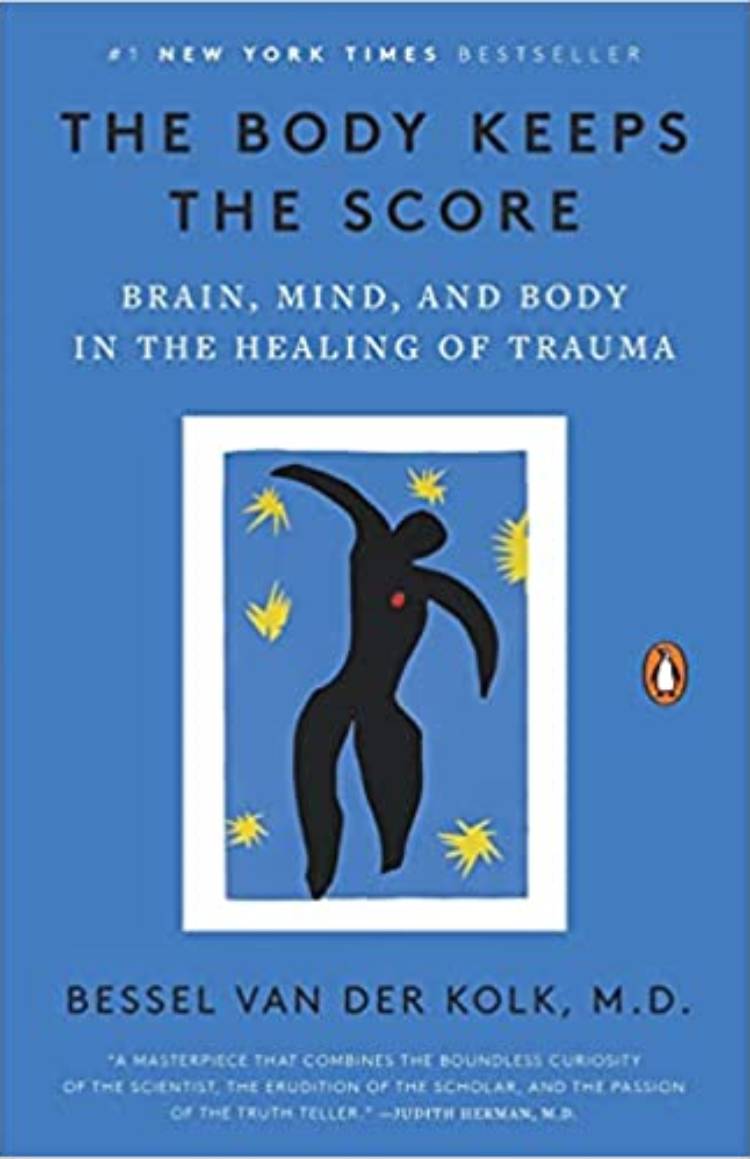
The Body Keeps the Score: Brain, Mind, and Body in the Healing of Trauma by Bessel van der Kolk

This is Bessel van der Kolk’s treatise on the physical manifestations of trauma, and the enormous implications of trauma on our society. The Body Keeps the Score is for a mainstream audience, not a scientific one, but van der Kolk (a psychiatrist) does take the time to teach neuroanatomy and brain function – to a greater extent than this reader needed, so that I let some of it flow by, but no criticism there.

Van der Kolk also maintains a narrative voice throughout that I appreciate: he is always a character in the story of (re)discovering and studying trauma and seeking treatments for it. He begins with veterans returning from Vietnam, when he began work as a psychiatrist at the Boston VA in 1978. He then introduces us to the children he’s worked with who live with trauma of many kinds, and the adult survivors of childhood trauma; these adults, he shows, suffer differently than those who encounter trauma in adulthood (car crashes, violence, natural disasters) (and are different again from military vets). Throughout the book, he outlines what we know about how each of these groups’ brains operate, including the different between the rational and emotional parts of the brain. He moves us through time, outlining research studies and how we’ve learned what we know about trauma and its manifestations in mind and body. He points out that the words ‘heartbreaking’ and ‘gut-wrenching’ are not entirely metaphoric. Emotions, and reactions to trauma, play out physically. He also makes clear that traumatized people actually reexperience their traumas: that until the brain can integrate these events as memory, they remain present, and can take over the individuals’ present. Those suffering from these flashbacks are truly living their trauma again.

Van der Kolk feels strongly that developmental trauma, which takes place in childhood, is a “hidden epidemic” that exacts enormous costs on society, even just purely in the monetary sense (sufferers “end up filling our jails, our welfare rolls, and our medical clinics”). When he gives presentations on trauma and treatment, he writes, “participants sometimes ask me to leave out the politics and confine myself to talking about neuroscience and therapy. I wish I could separate trauma from politics, but as long as we continue to live in denial and treat only trauma while ignoring its origins, we are bound to fail.” I didn’t find the book very political at all, in fact, but maybe I just don’t think it’s radical to suggest we devote public resources to universal health care – including mental health care – and extend a little compassion and shared responsibility to others, especially kids, who are essentially defenseless. He notes that the trendier discussions of trauma tend to focus on military vets and survivors of splashy, violent single events, while the more everyday (child abuse, intimate partner violence, rape) don’t get as much attention, although they affect many more people.

He also devotes a healthy chunk of the book to treatment options, written (he says) both for trauma survivors and for their therapists. These include talk therapy, EMDR (eye movement desensitization and reprocessing), yoga, rhythmic movement and theatre, neurofeedback (as from Bewilderment, in fact!), and more. “Communicating fully is the opposite of being traumatized.” Van der Kolk stresses the importance of language throughout. (And I love the idea of Shakespeare in the Courts!) He does not love medication for trauma survivors; drugs can mask or deaden symptoms, but don’t address the root of the problem or begin to help the patient integrate trauma into memory, so as soon as they go off the meds, they’ll be in just the same position again. He also does not love the DSM (Diagnostic and Statistical Manual of Mental Disorders), which persists in excluding a diagnosis for Developmental Trauma Disorder despite decades of research and statistics and the support of expert practitioners. He includes as an appendix “Consensus Proposed Criteria for Developmental Trauma Disorder,” the inclusion of which in DSM would enable clearer diagnoses, better funding for research, insurance coverage, and more.

I find The Body Keeps the Score to be a very thorough explanation of extreme trauma, how it works on its sufferers, and what we might be doing about it – as individuals and as a society. It is coherent, credible, compassionate and evidence-based, and accessible to a regular sort of reader, like me. (Again, I let some of the hard science go by.) I think this is a book for everyone, especially the traumatized among us and those who love them – in other words, considering the prevalence of trauma in our world, everyone. I found it interesting reading, if sometimes dense, and sometimes difficult to read – I took this one a little slower than usual, but it was worth all my time. Recommended.


Rating: 7 drawings.

For a much more in-depth summary and review, check out this excellent article from Brain Pickings.

When We Cease to Understand the World by Benjamin Labatut, trans. by Adrian Nathan West

Wide-ranging, mystical, crazed and inspired, this singular novel explores theoretical physics through a series of weird, engrossing human stories.

Benjamin Labatut’s When We Cease to Understand the World is an astonishing historical novel of physics, war, human weakness and quantum physics. In a lovely translation from the Spanish by Adrian Nathan West, the fictionalized histories of Albert Einstein, Werner Heisenberg, Erwin Schrödinger and more come alive to disquiet and intrigue readers.

The book opens with Hermann Göring’s addiction to dihydrocodeine and the suicides of many Nazi leaders by cyanide in the final months of World War II. It gets only a little less grim from there. But even with such bleak subject matter, Labatut’s imaginative evocations of disturbed minds from the rarified ranks of mathematics and physics are thoroughly captivating and strangely lovely, joining science with mysticism in surprising ways. “In the deepest substrate of all things, physics had not found the solid, unassailable reality Schrödinger and Einstein had dreamt of, ruled over by a rational God pulling the threads of the world, but a domain of wonders and rarities, borne of the whims of a many-armed goddess toying with chance.”

Labatut’s narrative travels in time and space, covering the development of pesticides, chemical weapons and Prussian blue pigment; painting, literature and opera; the existential angst of particle and quantum physics; eroticism and fever dreams. A young Heisenberg interrupts Schrödinger’s lecture to argue about the nature of subatomic particles. Later the reader sees Heisenberg feverish, ill, madly dreaming of spectral lines and harmonically bound electrons while reading Goethe’s poems inspired by the Persian mystic Hafez. Schrödinger also raves, theorizing and obsessing over the adolescent daughter of his physician. Lesser-known scientific figures include Karl Schwarzschild, the soldier who first exactly solved Einstein’s equation of general relativity and died shortly after; Shinichi Mochizuki, who revolutionized mathematics and then withdrew from the field; Alexander Grothendieck, who fled society to live as a hermit and also gave up mathematics entirely; and the seventh duc de Broglie, a “timid prince” whose Nobel Prize did not help him stomach the infighting among scholars of theoretical physics. These are the figures and the stories that have shaped major advances in science in the modern era; they also verge on insanity.

This astonishing novel blends forms: lyrical, inventive and also rooted in history, concerned with the overlaps of genius and madness, innovation and destruction. “The physicist–like the poet–should not describe the facts of the world, but rather generate metaphors and mental connections…. That aspect of nature required a completely new language,” writes Labatut, and likewise he offers a new way of writing about science and history. The vision of reality painted by When We Cease to Understand the World is terrifying but finely wrought, and will live long in readers’ minds.


This review originally ran in the August 30, 2021 issue of Shelf Awareness for the Book Trade. To subscribe, click here.


Rating: 7 cats.

In the Field by Rachel Pastan

A Nobel-winning scientist holds the focus of this lovely, contemplative, completely absorbing novel.

“What if Cinderella had asked her mother’s tree to give her a microscope instead of a ballgown?” With In the Field, Rachel Pastan (Alena) offers a compassionate, clear-eyed story of self-determination, love and science. The novel begins in 1982, when Dr. Kate Croft receives a phone call from the Nobel committee, then rewinds to 1923, when Kate is a first-year student at Cornell University, to the disapproval of her family, male professors and classmates.

Kate is entranced by biology, if not obsessed: “The cell was an uncharted country, and she was an explorer newly landed on shore… that was part of the joy of it: the promise of richness that lay ahead. The sense she had of undreamed-of discoveries–unimagined systems and structures–waiting there in the dark to be found.” Socially challenged and estranged from her family, she grows up with a single-minded devotion to her work, despite the struggles of being a woman in a male-dominated field and her difficulties in love.

An author’s note acknowledges that Kate Croft is based on Barbara McClintock, but Pastan makes clear that this is a heavily fictionalized account of the geneticist’s personal life, while remaining accurate to the science. Kate is a “corn man,” in the parlance of the day, studying maize genes at Cornell’s College of Agriculture. Her colleagues accept and respect her to varying degrees: one reports, “People say either you’re a genius, or else you’re off your rocker.” Kate’s greatest joy is in carefully tending her corn, her slides and her data. Other scientists profit off her discoveries (she is a gifted researcher) and deny her credit; she has difficulty accepting help. Meanwhile, she wrestles with her secret love affair with a woman, and maintains a lifelong friendship with a fellow corn man.

The curiosity that drives Kate’s research fuels her love for humanity, too. “Couldn’t people change their natures? Couldn’t they change, the way her corn had changed in the middle of the growing season, suddenly producing leaves with different frequencies of streaks? Something switched on, something else switched off, deep inside the cells.” These questions of free will are as important as those of heredity or meiosis. In the Field excels in its multifaceted view of a complex woman: scientist, lover, friend, student of life in both biology and philosophy. Readers will be better for time spent with this patient, tender, loving examination of a life devoted to examination of life. Kate will stay with readers for a long time.


This review originally ran in the July 15, 2021 issue of Shelf Awareness for the Book Trade. To subscribe, click here.


Rating: 8 chocolate walnut cookies.

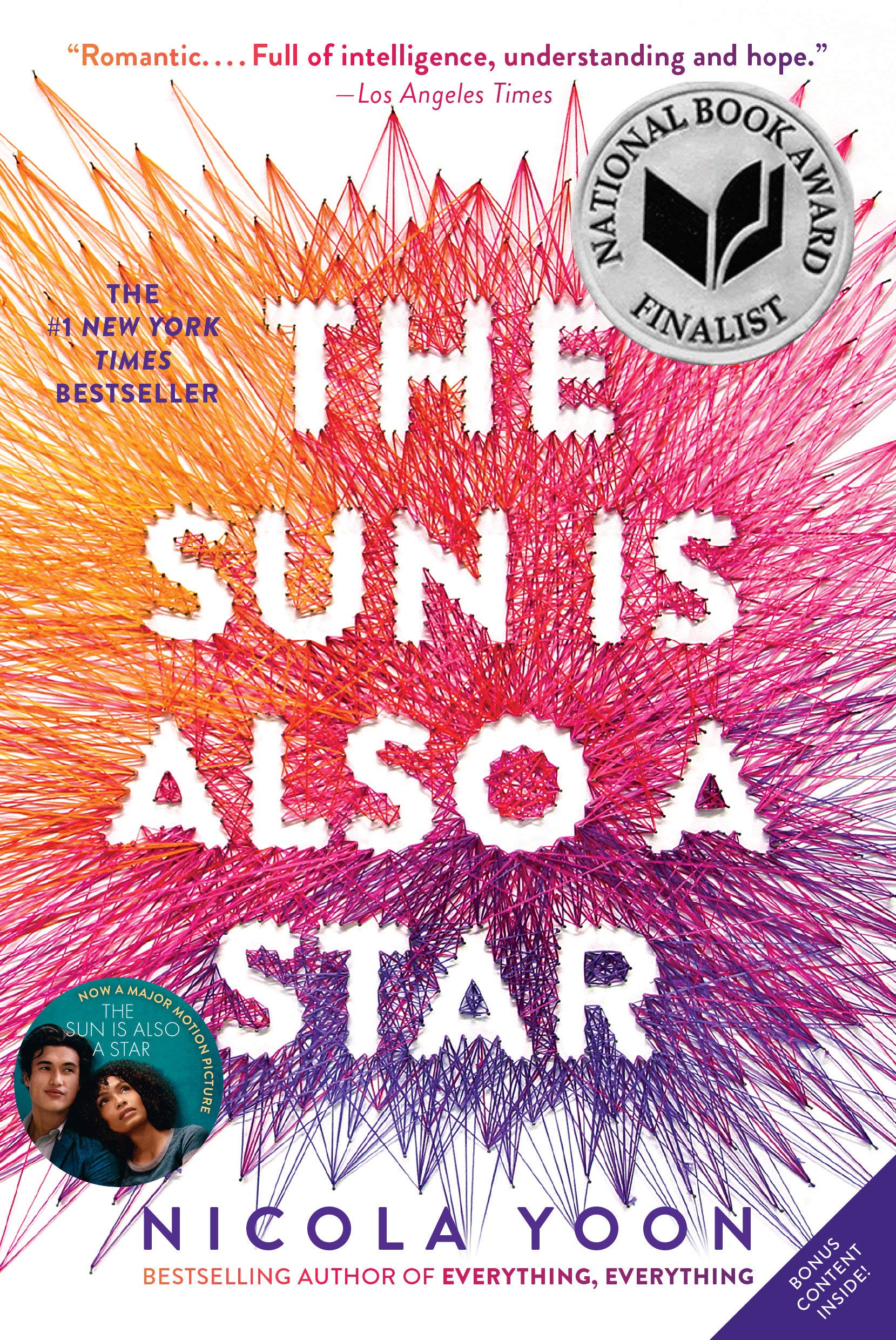
The Sun Is Also a Star by Nicola Yoon

Another great one that threatened to keep me up all night long. Keep ’em coming.

The Sun Is Also a Star is a YA novel of romance, fate, science, race, and more; 98% of it takes place in a single day in New York City. It stars two delightful and very different teenagers. Natasha is a serious science geek and impassioned fan of 90s grunge music, who firmly believes in provable facts and none of that gooey bubblegum stuff about love. She came to the United States when she was eight as an undocumented immigrant, like both her parents; only her little brother was born in the country, and now – thanks to her father’s unbelievable idiocy – the family is just hours away from deportation to Jamaica, a country that definitely does not feel like Natasha’s home.

Daniel is the younger son of Korean immigrants. His high-achieving older brother is their parents’ darling (of course), and a bully, and objectively a serious asshole; he’s just been kicked out of Harvard (Best School), though, so that’s something. Daniel has his Yale interview today (Second Best School), because he’s trying to follow the intended path and become a doctor, but what Daniel really wants to be is a poet. He is all dreams.

You can already see the drama setting up: Natasha and Daniel run into each other on this momentous day, as she attempts a last-minute legal defense against deportation and he approaches the Yale alum he’s meant to impress. They couldn’t be more different, but they’re drawn together nonetheless. Daniel intends that they will fall in love. Natasha, naturally, is having none of it. There are only hours to spare. Chapters shift between the points of view of Natasha and Daniel as well as a handful of others: side characters we’ll see for just glimpses, or a more omniscient view, including ‘future histories’ and etymologies (‘irie’), a ‘history of naming,’ a ‘history of decay.’ The effect is kaleidoscopic, and transcendent. The cumulative tone is frequently hilarious – both teens’ voices are darling, and Daniel especially is a riot; it is poignant in the ways of teenaged love; and, as established by a Carl Sagan-infused prologue, there is an all-encompassing, cosmic-scale sense of gravity and wonder.

This is a pitch-perfect story, lightning-paced as Natasha’s last day in the States and frenzied as young love, but serious as death, too. It’s absorbing, a world to get lost in. On one level it’s very much about race, racism, immigration and culture. Daniel’s father owns a Black beauty shop, like so many Korean-Americans do, and the book pauses to discuss the global forces that have set up this odd truth. Natasha wears her hair natural – which for some is a political statement, but (again the novel pauses to note, in one of those neat asides) it can also be simpler than that. “In the future, she may make it straight again. She does it because she wants to try something new. She does it simply because it looks beautiful.” I love this narrative voice: here is “an African American history” of hair; here is some of the weighty meaning that accrues; and also, here is a young woman who just wears her hair like she likes it. All of these at once.

The romance story that is the heart of this novel is very sweet and engaging. The topical content is well done and not preachy. The conversation between hyperrationality (Natasha) and dreaminess (Daniel) could have been cutesy and pat, but it’s not: it’s thought-provoking, expansive, and smart. I am, again, impressed with what YA can be. And I am therefore now interested in Yoon’s previous novel, Everything, Everything. I really think there’s something in this book for everyone. I am completely charmed. What a beautiful, book-filled world.


Rating: 8 little notebooks.
Curious Atoms: A History with Physics by Susanne Paola Antonetta

Full disclosure: the author was a professor and mentor of mine at Western Washington University.

Curious Atoms is an essay chapbook, 50-some pages in length, dealing with physics and the author’s own life experiences: part memoir and part science, told by a serious reader of physics but with no formal training in the hard sciences (as far as I can tell). “A History with Physics” feels like an apt subtitle.

There is a certain density to this subject matter. For one thing, admittedly I neither much understand nor much care about the theoretical physics discussed here; I had to let it go by, try to meet it where I found it and move on. But it didn’t hinder my appreciation for the writing, because a great writer can carry us through any subject. (Although I might have gotten more out of this had I been more comfortable with quantum whatnots.) The physics might challenge you as it did me. The personal material is heavy in a different way; Antonetta delves into her experience with bipolar disorder, with mental health and treatment, stigma, medication, and more. She’s also a deeply intelligent and well-read narrator, ranging widely. It’s not an easy read in a few ways, but a rewarding one. I love that wide-ranging headiness, and I loved feeling like I could hear the voice again of a woman I got to hear speak in a classroom a few days a week – that was a real privilege.

Here are a few lovely, thought-provoking, representative lines.

To bring to the lyric the mind and body that I have, and speak from the lyric soul, I cannot. I’m not sure what of mine can be called mine, body or mind; the lyric, with textbook definition of “the personal emotions and thoughts of a single speaker,” wants a warm hand, not mineral. I am not an individual, quite, but a chemo-dual.

That “our bodies of difference,” as Stephen Kuusisto writes, “offer crucial ways of knowing” I do believe. I can only give the cellular knowing of my chemical history, with the punctuation of what I suppose I really am, unmixed: hysteria under the bed, glitter. I can talk about 1970s psychiatry, the time I first encountered as a girl patients preyed on sexually, the awful, always visible electroshock machine, used as treatment and threat, its aftermath a gelled amnesia. I do not think, however, that such memoirizing would get to the question.

Gifted memoirist writes that memoirizing is not the solution. Note the interest in the idea of dualism or multiplicity, as in the multiverse, as in bipolar, as in the highs and lows of minds and lives.

Better still – I apologize that this review is half quoted text, but David Lazar’s brief introduction is too perfect to pass up. I think he describes the collection perfectly, and I couldn’t agree with his final statement more.

Susanne Paola Antonetta’s essays are full of erudition and stunning self-appraisals, hair-pin turns between metaphysics and splintered pieces of autobiography, dark energy and light asides, tossed off like hand grenades. These essays are sculpted – I’m tempted to say forged (so necessary is each sentence, even each word one feels). Yet in the midst of work so exorbitantly cooked, the raw springs of the felt occasion drive the essayist through her thought-projects. I loved being in the company of this mind.

You can view the entire chapbook here, and you really should.


Rating: 8 sides.