Abraham Lincoln: Vampire Hunter by Seth Grahame-Smith (audio)

Abraham Lincoln: Vampire Hunter is an alternative history with fantasy/paranormal elements thrown in. It reexamines Abraham Lincoln’s life, his presidency, and the American Civil War, with a twist: the US is overrun with vampires, mostly unknown to the public, who are secretly pulling the strings that shape Abe’s life, the institution of slavery, and war. The book opens with a charming sequence in which a would-be novelist in a small town on the Hudson Valley meets a new resident and gets a book idea from him. The foreboding sense in the idyllic setting reminded me of Stephen King, which is a compliment.

It is a rather fascinating concept. I had my doubts at first – again, the whole vampires-in-pop-fiction trend gave me pause; it’s not a trend I have bought into in the past. But as soon as I began the book, I was drawn in. So full points for intriguing me early on. I loved the parts about Abe’s early life; the atmosphere, the mood of tension, of Abe’s efforts against long odds, his determination in the face of tragedy, are all well executed.

But I think the middle section of the book dragged on far too long; it’s a great concept that Grahame-Smith indulged in for too many pages. All of which is to say, it probably made a great movie! That may be the proper format.

Another concern: I had some misgivings about the use of vampires to explain some of the evils in our national history. Slavery, secession, civil war, all belong to vampires in this book (with a quick mention of WWII’s genocide apparently coming from the same source). While Grahame-Smith struck me as careful to always treat these heavy topics with due sobriety, it still makes me a little uneasy to play with them in this way. Slavery and civil war are unsettling, terrifying, gruesome, disturbing enough in fact; it rather feels like diminishing their somber import to make them the fictional playthings of entertainment in this way, no matter how carefully treated. And again, the tone of this book is serious and in always respectful. But I’m just not entirely sure. It gives me pause.

Late in the book, I really missed our narrator of the beginning section: the writer, that is, who is approached by the mysterious stranger and given the lost diaries of Abraham Lincoln. The quick sketch of small-town life and the birth of this novel was a definite strength, and I regret that we never returned to that early narrator at the end of the book. I was looking forward to revisiting him.

So I have my criticisms, as you can see; but I really did enjoy this audiobook, and never considered putting it down. I think Grahame-Smith could have executed his rather genius story concept in less space: my audio ran to 9 CDs, and he could have kept it under 6, in my opinion. But again, this only makes me more interested in the movie version. Apparently the screenplay is written by Grahame-Smith as well, which is a good sign; and hopefully that format will push for a little more condensed action, which the book could have used as well. Call this a rare case where I am excited for the movie after reading the book.

The audio narration by Scott Holst was good. He emphasizes mood as a narrator should; he varied the voices of his characters a little, was not overly theatrical, but lent atmosphere where it belonged.

As always when I read historical fiction, I found myself contemplating the line where fact meets fiction. In this case, I’m sad to say (and it’s far too often that I’m sad to say this!) I don’t know the subject well enough to judge for myself; but here are a few notes of interest. At the end of my audiobook is a short interview with the author, in which I learned: first, that he was in fact quite purposefully following the aforementioned trend of vampires in pop fiction; and secondly, that he had great respect for his subject and did a fair amount of research. Now, this is a subjective measure (and he’s judging himself, which makes the judgment even more subjective), but I still find it encouraging. Finally, he mentioned a particular source of nonfiction inspiration: Doris Kearns Goodwin’s Team of Rivals, which I have in my iPod just waiting my attentions. And that was the most encouraging detail of all. 🙂


Rating: 6 fangs.

Teaser Tuesdays: Abraham Lincoln: Vampire Hunter by Seth Grahame-Smith

Teaser Tuesdays is a weekly bookish meme, hosted by MizB of Should Be Reading. Anyone can play along! Just open your current read to a random page and share a few sentences. Be careful not to include spoilers!

I confess I thought this looked a little silly. Maybe it’s the whole vampires-in-pop-fiction trend? But I confess, I like it. And there’s a movie, you know… Here’s a teaser.

I shouted after him: “Why haven’t you killed me!” His answer came calmly from the next room. “Some people, Abraham, are just too interesting to kill.”

And maybe that’s how the book is striking me, too. Too interesting to kill. 🙂

What are you reading this week? Do share.

Critical Wit Podcast interview: Amy Sisson, science fiction fan

Here’s the latest installment! Check out my interview with Amy Sisson. Amy is a librarian, book reviewer, writer, science fiction fan, and personal friend. In this episode, we chat about sci fi books that appeal to a more general audience (specifically in most cases… me) and a few others to check out too. Don’t forget to check out her website here. And now the interview!

Amy

me


In a funny twist, Shelf Awareness alerted me to this list just after Amy & I did this interview. I guess we should have just picked apart that list. 🙂 Maybe that’s a blog post to come…

did not finish: The War of the Worlds by H.G. Wells (audio)

The War of the Worlds is a classic, and H.G. Wells is a respected name. I guess I’d only read his The Invisible Man, as a very young (I had assumed, too young) girl; it didn’t resonate much with me. I thought I’d give him a second chance with this sort of landmark work in early science fiction, and I selected the audio version because of the story attached to its original radio production that caused all that panic when people thought the Martians were *really* attacking. But this one was a fail for me. I quit about halfway through.

First, I’ll give you a partial plot synopsis: Our unnamed narrator-character (not to be confused with the narrator of the audiobook, who will be discussed shortly), a resident of the English countryside, describes what seemed to be falling stars but turn out to be giant cylinders fired from a rocket on Mars. These land, every 24 hours, around London and disgorge Martians, who turn out to be better-armed than the locals, technologically superior, and unfriendly. They operate giant tripod-machines that shoot fire and destroy land, crops, vegetation and people. The Brits try to fight back with their inferior weapons but are getting their butts kicked. And then I stopped listening.

The style of narration was dry. I was easily bored; my mind wandered. I think the audio-narrator, Bill Weideman, was part of my problem. For one thing, he has the odd habit of dropping the occasional leading consonant, like so: “we are ‘ill waiting” (for “still waiting”) and the like. I am perplexed at why you would choose someone with such a strange habit of speech to narrate an audiobook; I was frequently confused as to certain words he pronounced in this manner. Another oddity involved accents. This story is set in England, and when the narrator quotes other characters he gives them an English accent (which by the way seemed excessively nasal and frankly annoyed me), but in the voice of the main-character-narrator, no accent was used (meaning, he sounded American to me). I did not learn, in the half of the book I listened to before giving up, if the narrator was in fact American. But perhaps most generally, Weideman and Wells between them created a monotonous, even soporific effect on me. I couldn’t seem to focus on following the story, as the narrator (in both senses) felt emotionless to me. I can understand how the idea of “total warfare,” total destruction of acres upon acres of land and men and women and children were demolished wholesale in a single sweep of the Martians’ weapons, was shocking to this book’s original audience (1898) and that of the radio drama (1938). But in a world that has seen an atom bomb dropped on Hiroshima, perhaps the impact is lessened.

Of course, as is always the case when I read a Great Classic and do not find myself moved, there is the question of whether there’s something wrong with me: what did I miss? I do not discourage you from trying out this well-known and well-respected book (although I might discourage you from trying Weideman’s audio narration). I hope you like it. I did not.

book beginnings on Friday: The War of the Worlds by H.G. Wells


Thanks to Rose City Reader for hosting this meme. To participate, share the first line or two of the book you are currently reading and, if you feel so moved, let us know what your first impressions were based on that first line.

I am listening to this classic on audiobook, read by Bill Weideman. It begins, somewhat philosophically:

No one would have believed in the last years of the nineteenth century that this world was being watched keenly and closely by intelligences greater than man’s and yet as mortal as his own; that as men busied themselves about their various concerns they were scrutinised and studied, perhaps almost as narrowly as a man with a microscope might scrutinise the transient creatures that swarm and multiply in a drop of water. With infinite complacency men went to and fro over this globe about their little affairs, serene in their assurance of their empire over matter. It is possible that the infusoria under the microscope do the same.

I admit I’m finding it a tad slow, but here we go. Have you read this one? I was attracted by the audio format because of the stories of its original radio broadcast, in which people panicked, thinking it was a real-life news story! What an exciting time that must have been.

What are you reading this weekend?

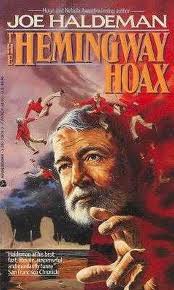
The Hemingway Hoax by Joe Haldeman

This was a delightful short read. The Hemingway Hoax was loaned to me by my friend Amy, librarian (newly, my coworker librarian! yay!), science fiction enthusiast, and science fiction author to boot. (I wrote briefly about one of her short stories here.) After my recent raving about Hemingway’s Boat (my review to come at Shelf Awareness), she lent me her signed, personalized copy, ooooh. It’s an easy read at 150ish pages; I ran right through it at one sitting.

David Baird is a college professor and Hemingway scholar. He and his (much younger, former student) wife are summering in Key West, where they meet a con man with a scheme to “find” the manuscripts of Hemingway’s early short stories, and a partial novel, that H’s first wife Hadley lost on a train in their Paris days. Baird, with his expertise, should be able to successfully forge them. In so doing, however, he gets wrapped up… transported through times… to parallel universes… meets the Hemingways of various eras… or does he? I won’t ruin the whole surprise, but there is time travel and questions about What Is Real. Some bad things happen. Or do they?

I enjoyed the Hoax. It had suspense, interesting characters, intrigue. It had Hemingway! And the Hemingway parts were well done; Haldeman knows his Papa well enough to pull this off without offending the armchair Hemingway scholar. (I didn’t pick it apart or check references or anything but it held together.) And that would have been a deal-breaker for me, of course. Not for the first time, I say: this is sci fi? I thought I didn’t like sci fi! Well done, Amy. You may keep lending me books. Thank you!

vacation reading: a series of short reviews

The Strange Case of Dr. Jekyll and Mr. Hyde by Robert Louis Stevenson. Still a good story! Spooky and short, it’s a bit reminiscent of Poe. Action-packed and efficient. I would not have sworn I had read this before, but now I recognize that I have. What a classic. I highly recommend this as a bang-for-the buck, action-packed, early sci-fi spookster with a bit of meditation on the human condition. Not sure if I should count this for the Classics Challenge as its a re-read. :-/


Worth Dying For by Lee Child. (audiobook) Surprisingly good as audio. I wasn’t sure. I’m such a BOOK purist that audio doesn’t always work for me; but it can’t be argued with on a road trip. Part of what made it special, too, is that I got to share it with the Husband, who doesn’t normally read. He got really into it, and we shared this suspenseful adventure together. That’s priceless.

Classic Jack Reacher! He’s such a Rambo. It’s a bit comical in the over-the-top violence and general bad-ass-ness, but I eat it up. It’s great fun. We both enjoy the slight absurdity of it, while also appreciating that we can count on this guy to get it right. And I finally begin to understand, at least a little bit, what was so frustratingly up-in-the-air at the end of 61 Hours. This may be my favorite Reacher novel yet.


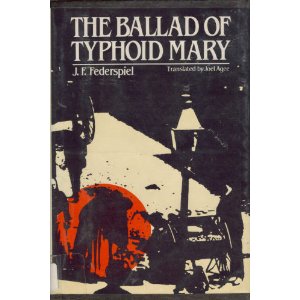
The Ballad of Typhoid Mary by J.F. Federspiel. Opening quotation: “Life is strange and the world is bad.” (Thomas Wolfe) This sets the tone.

This is another creepy story. It’s historical fiction, and I have made a note in large letters to read up on the concept of Typhoid Mary and how much we know about her in the real world. She was a carrier of typhoid fever: she never got sick herself, but she made people around her sick, to the tune of several hundred at least. She was a cook, passionate about cooking for people, despite seeming to understand that she was killing them. She wasn’t a serial killer; she didn’t do it on purpose; she just didn’t let it stop her. What can we expect, in an age with poor understanding of hygiene and the spreading of disease, of a poor, uneducated, abused & orphaned young woman with no opportunities who suspects she might, in some way, be responsible for all these deaths around her? This was a fascinating read, and another very short one, too.


The Man Who Mistook His Wife for a Hat by Oliver Sacks.This is a collection of case studies, or short stories, or essays, by a neurologist who also fancies himself a philosopher with literary leanings. It was quite attention-grabbing, and I had to keep putting it down to tell the Husband stories. Reading about brain injuries or anomalies of the brain is infinitely more interesting to me since I had my bad wreck and experienced some brain injury and healing of my own. The most interesting thing about a number of these cases is that these patients often don’t realize that anything is wrong!

Sacks’s approach is to contemplate the relationship between mind, body, and soul, which perhaps too few of our hard scientists do. It still ended up a bit on the hard-science side for me, perhaps; he made a number of references (unexplained) to other hard scientists, which made it a bit less accessible to us laypersons. But I loved the stories, the concepts, possibilities, complexities of the human mind.


In the Woods by Tana French. I’ve been hankering for more of Tana French since reading Faithful Place. I really fell for that Frank Mackey! This one opens with immediately recognizable poetry-in-prose, stark, gritty, and strongly Irish. Then I was disappointed to recognize a familiar story: grown male detective forced to confront unsolved childhood trauma of missing friend(s). Argh! But I guess why mess with a good thing…

Oh man. I stayed up nearly all night to finish this book. (and this, in a place where I LIKE to get up to watch the sun rise!) Same story my head; it did have its plot similarities but it was so gripping and spooky, like a ghost story, except even spookier because there was nothing supernatural at all, just creepily realistic human nature. I can’t wait to get the next book!

Side note: the beautiful, tragic, doomed, perfect friendship reminded me somewhat of One Day by David Nicholls, which had an entirely different tone to it.


Echo Park by Michael Connelly. (audiobook)Another highly enjoy audiobook! This one unabridged, thank goodness. (I realized AFTER we listened to Worth Dying For that it was abridged, and now have to go back and read the book.) Connelly, for all that he’s sort of stark and black-and-white, also strikes me as a poet; I love that Bosch “educates” his ice with vodka. That’s unique! I’ve read this book before, but it’s been long enough that I still enjoyed the mystery. I like all the background or frame elements in Connelly, like the jazz (and I like that the Library of Congress, and some clever librarian there, make an appearance in relation to the jazz), and the audio format took advantage and gave us a few jazz riffs in the background here and there, which was a nice touch. I hadn’t really thought about using music on on audiobook, and actually, there were some other snippets of music added that I didn’t think worked so well; but jazz behind Connelly is a strong choice.


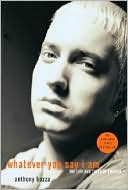
Whatever You Say I Am (the life and times of Eminem) by Anthony Bozza.I put this in the same category as the Hefner biography, actually. These are some highly controversial men, offensive to many if not to all, who have impacted our world; without making a value judgment, I can say I find them interesting to read about. My feelings about Eminem are complicated, just like with Hefner. (I was talking with my Pops the other night along these lines and we put Reagan in the same category but that’s a whole new can of worms.) I haven’t finished this book, am less than halfway through, but I can say I really enjoy the way Bozza puts his reader fully into a time and place. For example, to help place us in the year in which Eminem was working to release his first album, he gives us a full rundown of the musical hits and award winners of the year in various categories, as well as what movies and television were hot. Now, I’m not generally all that up to date on pop culture, but this worked for me; it really evoked a time in my life. I think that works for all of us, because isn’t sound or music second only to smell as a mnemonic? Doesn’t hearing a particular song take to you a time and place? At any rate, I’m enjoying this biographical study of a controversial figure.


And finally, By-Line: Ernest Hemingway. As I’ve said, I’m enjoying reading Hemingway’s usual tone and style, that I know so well, used in journalism. I hadn’t read any of his journalism before. I guess the nonfiction I’ve read would be Death in the Afternoon and A Moveable Feast, and then all that fiction that’s so heavily autobiographical. Any Hemingway I can get, I like.


I’ll keep you up to date on the books I still have to finish; and I have a few Maisie books waiting for me. I might finally be caught up!

A few new books: sci fi, and a Houston Heights mystery

Well! I know I’ve been a bit distant (and boring, since I’ve been reading the same book for what feels like weeks!) but I have some new tidbits to share.

Still very busy with my exciting Database Searching class and the rest of life, but I have cheated on Mr. Playboy and read a few other quick bits.

The other night I sat down and read my friend Amy Sisson’s Suicide Club, published in Sybil’s Garage No. 7, a collection of sci fi short stories. Now, you will recall that I do not consider myself a reader of sci fi. I actually really enjoyed Orson Scott Card’s Ender’s Game, which I read for a reader’s advisory class last fall; it just didn’t strike me as what I think of as sci fi. It was a story about people, relationships, morals, and worlds; it didn’t geek me out with computer bits or robots or things like that. (I’m not up for that.) Well, this is the second of Amy’s short stories I’ve read, and both have been very accessible – no geeking out, again. Maybe I need to rethink sci fi. I’m still not up for the geeky stuff, but apparently there’s more to the genre than that. Although she did point out a collection of Star Trek stories, including one of hers, that she told me I would *not* like (and I still haven’t braved it.) Amy? Any recommendations for further reading? I enjoyed Suicide Club; it gave an interesting and yes, decidedly creepy take on our future, spinning off of Fight Club. (Kind of fun along with being creepy.) I enjoyed the other worldview. Thank you Amy! 🙂

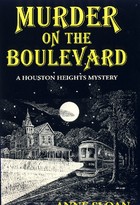
Next I began reading a short mystery I was given a few months back. It came as one of two Houston Heights historical mysteries, and they’re by a local Heights author, Anne Sloan. (For those who aren’t local, the Heights is a neighborhood in Houston, and at the time the books are set, was a suburb. It’s an artsy, historic, trendy neighborhood marked by old families in houses for generations, but also young people, dog walkers, runners, cyclists, bars, beautiful old houses, and well-maintained historical structures in general.) I’m reading the first one, called Murder on the Boulevard; next is The Apothecary’s Demise. This book is set in the 1910’s, in a time when Houston (3 miles away from the suburb of Houston Heights) is just developing; Jesse Jones is in the process of building the 18-story Rice Hotel. Times are a-changing. Our protagonist, Flora Logan, is an adamant women’s suffragist and general feminist. She falls out permanently with her father, for example, over her opinion that she should be allowed to study and pursue a career rather than aspire to marriage as her loftiest goal. Her interest in study and career is botany, and we get some good local, historical details there, too.

Flora leaves Houston for New York City after her parental conflict, and finds a more equal environment, a college degree, and a job in the Botanical Gardens there; she is called home when her father dies suddenly, and begins investigating what looks like his murder. (Given the title, perhaps we can take that for granted.) I’m maybe 3/4 through this book, and despite early misgivings, I’m enjoying myself. It should probably be said that this book is not a feat of literary accomplishment or crime novel styling, although it does adequately well at the latter. Its greater achievement is in historical detail, which here and there is a little bit too obviously wrought, but really I think we all have a weakness for our home town/city/neighborhood in fiction… I have lived in the Heights and currently live very close (in another beautiful historic neighborhood), and anyone from inner-loop Houston could appreciate the familiarity of the landmarks described and their history. It’s very enjoyable, it’s just not… poetic. It makes me want to go look at each building again with new eyes; it makes me proud to be part of this heritage.

And the mystery is developing nicely. We may have started a bit slowly with Flora’s doomed trip to the Big Thicket near Beaumont (another familiar area!) but the intrigue is fun; her characters are either likeable, or not (meaning Sloan successfully convinces us of who the villains are!), and I’m engaged in what seems to be a burgeoning romance. (Flora is an extra challenge because her feminism makes her resistant and suspicious. This is a “type” I daresay we’re all familiar with, at least in fiction, past and present.)

So with a few stumbles, I’m really liking this Houston Heights mystery. And I get to put a pin on my map for the Where Are You Reading? Challenge, too! 🙂

I’m looking forward to maybe finally finishing Mr. Playboy this weekend – I’m not bored with the book, in fact I’m still fascinated and still convinced that I was *right* that Hefner is a fascinating and contradictory guy! – but I’m a bit bored with being in one book for this long. I’m ready to move on, and I have some tasty books waiting for me in stacks on my desks (yes plural, work and home), yum. So perhaps on Monday I’ll have some new books to report on again! Til then, thanks for stopping by.