Fugitive Telemetry by Martha Wells

This is book six, the final to date, in the Murderbot Diaries series. I am very relieved to learn that there are three more books to come, because I am not done with this fascinating character.

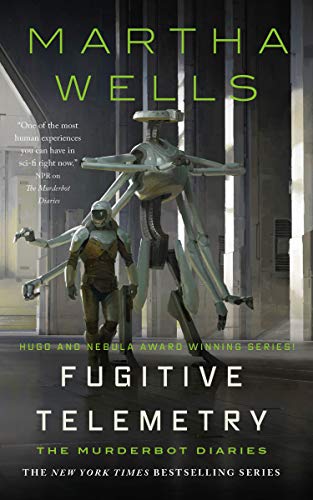
Fugitive Telemetry takes place between Exit Strategy and Network Effect, and I was not prepared for this and really missed getting the next installment in the story as developed in the latter, but there’s still a lot to love here. Murderbot is living uneasily on Preservation Station, and there has been (gasp) a murder, which never happens here, and therefore the regular security forces aren’t really equipped for an investigation. Our favorite bot construct gets drafted (that is, asked nicely by Dr. Mensah) to help out, but (predictably) it doesn’t love working with the security forces, and the feeling is mutual. Murderbot has also been asked to not hack any systems, a promise I’m a little surprised it keeps; this hamstrings its investigative efforts somewhat, and takes us into the realm of more classic detective work. That’s the premise of an excellent review by NPR of this book, and indeed they’ve done so well with it that I’m linking you there in lieu of my own longer review. Check it out: “Murderbot meets Miss Marple in Fugitive Telementry.”

I love everything that happens here, but I remain anxious for a sequel to Network Effect. I want more Amena and more ART and more Murderbot in general. I’m just glad it’s happening.


Rating: 7 limbs.

Network Effect by Martha Wells

I love the promo copy from Tor’s publishing page enough to let it kick off this review:

You know that feeling when you’re at work, and you’ve had enough of people, and then the boss walks in with yet another job that needs to be done right this second or the world will end, but all you want to do is go home and binge your favorite shows? And you’re a sentient murder machine programmed for destruction? Congratulations, you’re Murderbot.

Come for the pew-pew space battles, stay for the most relatable A.I. you’ll read this century.

I’m usually alone in my head, and that’s where 90 plus percent of my problems are.

When Murderbot’s human associates (not friends, never friends) are captured and another not-friend from its past requires urgent assistance, Murderbot must choose between inertia and drastic action.

Drastic action it is, then.

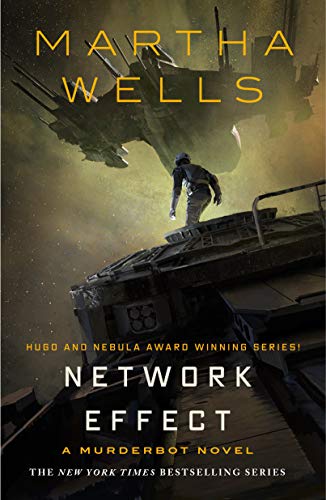
Here it is! This, the fifth in the Murderbot series, is a full-length novel, some 350 pages instead of 150-175. Wells delivers: this is everything that’s good about books one through four, but bigger and more of it. No, that’s not to be taken for granted. Sometimes the novelist can’t wrangle the short story or vice versa. But Murderbot is every bit as compelling for a novel as it was in novella form, and this scale offers more room for the plot (in both senses!) to grow in some excellent ways.

Murderbot is back on Preservation Station with its new …family? of humans. (It would never use that word, but I will.) It’s still working out its feelings about humans, and its own humans in particular, and trying to figure out where it fits into the world and the human society it’s presently allied with. It still doesn’t know what it wants out of life, which is one of the drawbacks of self-determination. And the human society, and the (real) human family, are still working out how Murderbot (or SecUnit, as they call it) fits in, too. Dr. Mensah, from book one, is Murderbot’s closest human friend, and also its patron (legally, in fact, its owner), and the two of them have a pretty good understanding, but not all of Dr. Mensah’s family has accepted the bot construct’s role. There are some tensions. Dr. Mensah has a teenaged daughter, Amena, who offers another set of challenges: Murderbot’s own eye-rolling attitude up against that of a teenaged human makes for some pleasing gentle conflict; and they share as well an earnest sweetness that they like to hide behind rough edges.

Murderbot and some of Dr. Mensah’s family and friends find themselves on a ship that gets kidnapped, basically, and taken through a wormhole… the space-science stuff can get a little away from me, but it’s okay. There’s a mystery; there are unknowns. There are bad guys – the corporates, as usual, but again unknowns as well, including possibly alien remnants. Murderbot is as usual (in its exasperated tone) having to try to save the day and keep everyone safe, even those who are dismissive of its abilities or foolhardy or otherwise frustrating. What’s gradually changing, though, is Murderbot’s relationships with these humans. It really cares; they care about it. Some of them even trust it.

Spoiler-free: the stakes rise when we begin to suspect that another character from a past novella is behind the kidnapping. Also! Near the end, a new character enters the scene who I am very excited about.

The character Murderbot remains the best part of these books, which is a fine strength to have, since these are the Murderbot Diaries and its first-person POV is the voice of the series. Our hero is sarcastic, bitter, both immature and ultra-competent; soft-hearted but outwardly prickly; it is simultaneously scornful of humans and (in the entertainment media series it so loves) sort of adores them. Its voice is often hilarious, self-deprecating and petty. “I wanted to pick it up and have an emotion over it like a stupid human.” “Target Two whispered something, which FacilitySys rendered as ‘What are you?’ I said, ‘I’m a Shut Up or Get Your Head Smashed.'” It’s interesting what it does and doesn’t know; it finds some words baffling, like foolproof (why isn’t it smartproof?), and gets anagram and acronym confused. When it has emotions, it sometimes has to go face a wall for a little while.

Murderbot still has trust issues, and who can blame it? Many of its humans are just now learning how bad things can be for a SecUnit. “(If there’d been a SecUnit in the colony, there probably would have been a compelling reason why it had to stay behind on the dying planet.) (I don’t actually believe that.) (Sometimes I believe that.)” It learns that “the organic parts of my brain were doing a lot more heavy lifting than I gave them credit for.” And it’s learning some significant lessons about trust and friendship (which will give it emotions).

Some reviewers see Murderbot as being possibly edging toward a romantic entanglement. I do not read it that way. But book six will take us where it will.

This was a really good installment in the series; I was very pleased to spend more time with our grumbly construct, and equally pleased to see Wells’s competence with the longer form. Psyched for book six; just sorry that that one is, to date, the last of the series.


Rating: 8 lines of code.

Exit Strategy by Martha Wells

Book four of the Murderbot Diaries is proceeding pretty much as I’d hoped. We’ve got some returning serial characters, and further development of the idea that bots are people, too. Check out that blurb from the front cover: “One of the most humane portraits of a nonhuman I’ve ever read” (from Annalee Newitz). I wholly agree, and think that that’s one of the great victories of this series. Murderbot is drily funny, self-deprecating, sarcastic, deeply feeling and resistant to the truths of its own emotional self, and who among us hasn’t wished we were a little more stoic, a time or two?

[Side note: something new has just occurred to me. I think Murderbot and Reacher have a few things in common. Both try to mind their own business, but both are helpless to resist helping dumb humans in need, even as they feel exasperation about it. Both have superhuman abilities, not only in physical fighting but in quick calculations on the fly and strategic thinking. (Only Murderbot has a good explanation for these qualities.) Both have a tendency to be delightfully deadpan. Both try to slip out into the night when things get wrapped up. They’re both sort of knights-errant, preferring not to hurt innocent bystanders but reasonably quick to upgrade (downgrade?) a person’s status to hostile as situations develop. These are qualities I appreciate, and I think there’s a definite parallel here that helps explain my love for both rogue elements.]

“Ship’s drones gathered to watch me, confused as to why I was going out the wrong door and beeping sadly about it.” Even the drones are given emotions: confused, sad. The idea of humanizing the nonhuman feels like a helpful step in rehumanizing each other, too. These books star a murderbot who is not human though it has ‘organic parts,’ and who is not legally recognized as a person in most of the worlds it travels in, but it has human friends from a world where bots and human/bot constructs are legally recognized. Can it even see itself living in this new way? In the midst of a fight to the death, our protagonist offers a deadly CombatBot the option to be free from outside control. “…dodging projectiles, it was hard to come up with a decent argument for free will. I’m not sure it would have worked on me, before my mass murder incident. I didn’t know what I wanted (I still didn’t know what I wanted) and when you’re told what to do every second of your existence, change is terrifying.” These are weighty questions, and Murderbot is an excellent guide to them: snarky, hard-shelled, but soft and melty on the inside.

I continue to love the thread in which Murderbot is an entertainment media addict, too. Aside from being unexpected and hilarious, as it was from the outset, it also offers opportunities to think about its future career options (recall I just recently noted its wisdom in critiquing narratives), as well as how stories and characters speak to us, and what they can stand in for. Here, a human friend asks Murderbot what the media does for it, why it loves its favorite show so much (that’s The Rise and Fall of Sanctuary Moon, which I sincerely hope will appear as a spinoff someday). This allows it to think about its own possible personhood, and empathy. There is a lot going on in this series of slim scifi novellas, a lot of reach. I am increasingly excited about the progress to come. (I am also feeling pleased with some of my own predictions.)

I hope Martha Wells is off somewhere writing more Murderbot right now. I expect to get through the last two books soon.


Rating: 8 hard currency cards.

Rogue Protocol by Martha Wells

Book three of the Murderbot Diaries keeps us right on track, and they’re so slim and easy to read, it takes willpower not to binge them. Our murderbot takes on a new name for this adventure, and a new self-designed mission; both of these are outside the normal range for murderbots (or SecUnits, for security units). But our SecUnit is special. In some ways, this episode resembles the last, in Artificial Condition: the murderbot hitches a ride, hoping to quietly take in some shows and maybe a little light reading and be left alone until arrival at the next place where it hopes to do a little research, solve a mystery. But it gets 1. recognized by a bot it didn’t anticipate and 2. tangled up in the plans and lives of a group of humans it regrets feeling something for, and therefore 3. roped into protecting them – like in its old life, but on its own terms.

The pattern here continues to develop an important point: bots and SecUnits are rather closer to being “people” than we are originally led to believe, meaning they have loyalties, feelings, and personalities. This allows for some ideas about liberties, responsibilities, and “human” rights (which in this world may need to apply to some beings that are not strictly human). It also makes me look forward to what is to come. Our murderbot (of the several names, now) will carry on, growing into its own. It will continue to meet more characters that will test its understanding of bots (etc.), and eventually I imagine it will have to redefine that understanding, as I am doing as reader. I can’t wait for more adventures. And I love the murderbot’s sense of humor and irony as much as ever.

Another fun twist in this novella was the murderbot – an avid consumer of serial entertainment shows, remember – forming some opinions about what would and wouldn’t make good entertainment feed narrative. I’d love to see it get into the writers’ room!

This was book three and there are only six; I’m already sad. One of these is a full-length novel, though? That will be fun!


Rating: 7 core samples.

Artificial Condition by Martha Wells

These Murderbot Diaries are going down way too easily; Martha Wells is not writing quickly enough! Wonderful fun. After book one, All Systems Red, it felt great to see our murderbot again, still addicted to entertainment media and wishing it could just be left alone to take in its favorite shows and not have to communicate with humans. (“I liked humans, I liked watching them on the entertainment feed, where they couldn’t interact with me. Where it was safe. For me and for them.”) There was never such a loveable, socially awkward creature. It’s the genius of this series that this protagonist is not human, but has all the personality and foibles we want in our favorite human characters. “When constructs were first developed, they were originally supposed to have a pre-sentient level of intelligence, like the dumber variety of bot. But you can’t put something as dumb as a hauler bot in charge of security for anything without spending even more money for expensive company-employed human supervisors. So they made us smarter. The anxiety and depression were side effects.” “I wish being a construct made me less irrational than the average human but you may have noticed this is not the case.”

In this installment, the murderbot has its own agenda for the first time ever, arranging for its own travel (only a little bit under false pretenses) and going looking for answers to a mystery it wants solved for its own sake. It runs into trouble when the research transport ship it hitches a ride with turns out to be a bit smarter and more sentient than our hero had bargained on. This is either going to be the murderbot’s first friend or next enemy. Also, to get onto the moon it’s headed for, it needs an employment pass, and so it needs employment, which (again) it’s never arranged for itself. This is how it ends up with another group of humans to care for, which raises some of the same concerns that it did in book one.

Where it took me a little while to get into All Systems Red, this one had me in its grasp from minute one (maybe because I understood the world I was stepping into). I’m smitten. These stories are short, funny, and moving. I want them all.


Rating: 8 facial expressions.

All Systems Red by Martha Wells

Thanks Liz for this fun recommendation, a bit off my usual path, but right in line with The Expanse (remember that series?!). The Murderbot Diaries is a series of sci-fi novellas; book one, All Systems Red, was an easy single-sitting read. I found it took me a little while to engage. The story begins in media res, which has its advantages, but in this case left me a little murky on some of the situational details and I think delayed my reader-brain clicking into gear. Partly this feels like a sci-fi issue (in media res maybe works less well here, where the reader needs to learn the rules of your world?) and partly, as usual, I’m sure it’s a me issue, because I’m not a very experienced sci-fi reader and it’s been a while since I’ve read any.

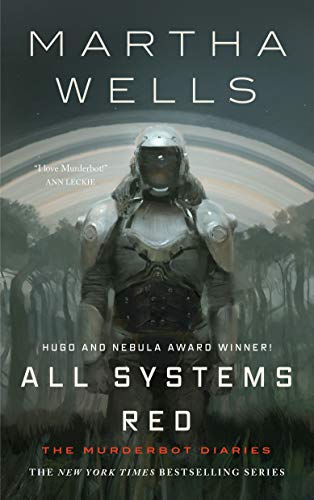
But once I clicked in I was decidedly engaged. The story is told in first-person (something of the ‘diary’ effect) by a creature who calls itself Murderbot. It’s a SecUnit (security unit) for ‘the company,’ which has been rented out to a survey team doing scientific work on an unsettled planet. (Some features of this world are very similar to that of The Expanse.) It opens quite intriguingly:

I could have become a mass murderer after I hacked my governor module, but then I realized I could access the combined feed of entertainment channels carried on the company satellites.

What is special about Murderbot is this fact, that it has hacked its governor module and therefore has personal agency, which is unusual among its kind. The humans and augmented humans that it works for don’t know this. It has to remember to appear to be following the rules. But the first odd surprise is contained in that first sentence, too: rather than undertake some evil genius scheme, our Murderbot is most interested in vegging out and binging some telenovelas. (It is forever waiting for the humans to take a break so it can watch tv, basically.) This is unexpected, endearing, a little absurd, and very human, despite the Murderbot being not human. It is a ‘construct,’ containing both organic and inorganic parts; perhaps roughly half human and half bot, although it resists that framing. “It makes it sound like the halves are discrete, like the bot half should want to obey orders and do its job and the human half should want to protect itself and get the hell out of here. As opposed to the reality, which was that I was one whole confused entity, with no idea what I wanted to do.” Again, sounds awfully human. “I know I said SecUnits aren’t sentimental about each other, but I wished it wasn’t one of the DeltFall units. It was in there somewhere, trapped in its own head, maybe aware, maybe not. Not that it matters. None of us had a choice.”

In fact, Murderbot’s kind of lazy and a little negligent. “I don’t know… because it’s one of those things I’m not contractually obligated to care about.” When its assigned team of humans gets into trouble, it has to admit that it didn’t even read the info packet that came with this contract, and has no idea who its team is. (It deleted that file to free up storage space for entertainment files. I am tickled by our tv-addicted SecUnit.)

There is an adventure with the humans; there is danger and action and intrigue. But this is all backdrop for the human drama, by which I mean the humans on the assigned team and, primarily, Murderbot navigating its relationship to the humans. We get to know the protagonist a little bit, begin to see it reveal personality (very begrudgingly) and loyalties, even perhaps desires. This world has more than a few elements in common with that of The Expanse, but also, that human drama at the heart of things is what appeals to me in both cases. At the end of this very quick read, Murderbot has an opportunity open up; and then cliffhanger. I’m absolutely in for the next one.


Rating: 7 little hoppers.

Auberon by James S. A. Corey (audio)

Early in listening to this novella, I was pleased to be returned to the world of Corey’s imagination (and guided by the familiar reading voice of Jefferson Mays, thank goodness). By the time I looked up and saw that it was half over, I felt a little perplexed by the failure of the plot to draw me in. By the end, I felt frankly disappointed. It was a mildly entertaining return to the worlds of The Expanse, and I do not regret it, but this installment is not a stand-out. I recommend it for completist fans only; Auberon is not a good representation of the extraordinary power of this series.

Auberon is a recently settled planet, even more recently under the control of the far-reaching arm of Laconia. The novella begins when Laconian Governor Rittenaur arrives to take power, hoping to establish a firm but not abusive government. His wife, Dr. Mona Rittenaur, is to take over research operations. In an early scene (and one of the more gripping ones), a sinister older man named Erich with one bionic arm threatens the new Governor, referring to an old Earth western frontier tale: “silver or lead?” he asks, meaning will this leader be purchased by bribe or take a bullet? In the end it is a different vulnerability entirely that will expose Rittenaur to the forces on Auberon.

I found Erich’s scenes (and the bionic arm itself) the most compelling parts of this story. The characters of Governor and Dr. Rittenaur, and the moral challenges they each face, were perhaps meant to be the central and most moving bits, but I found they both fell a little flat, perhaps for lack of development. The original/central foursome of The Expanse–Holden, Naomi, Amos and Alex–captured my heart completely (and make the whole series work), because they are complex, loveable but conflicted, deeply, fully developed as characters with backstories. A little more investment in the Rittenaurs might have made this novella work, but such is the challenge of the novella-length story. (For the record, Corey has sometimes knocked this shorter format out of the park. Just not here.) For me, Auberon didn’t really work. It was a fine few hours, but like I said, I don’t especially recommend it. I’m looking forward to the next Expanse novel or novella, though! This one just whetted my appetite again.


Rating: 6 automatic movements.

The City We Became by N.K. Jemisin

What a glorious book. N.K. Jemisin is a wonder.

I loved the fantasy/sci fi version of our world presented in The City We Became. When cities have achieved something like a critical mass of culture or soul, they sort of come to life in the form of a human avatar, a preexisting person who best possesses or encapsulates the qualities of that city. It takes a long time, a lot of history and life, for a city to become. There have only been a few in the Americas to get this far. New Orleans and Port-au-Prince were stillborn. Sao Paolo, as the newest city in the worldwide community, is on hand to help with the next birth to take place: that of New York.

New York is unique in that it has multiple souls, one for each of the boroughs as well as one for the city as a whole. Like London; except that something went wrong in London. So New York’s becoming is unprecedented and fraught. The novel opens with the perspective of the unnamed man who will, hopefully, be New York: “too slim, too young, and entirely too vulnerable,” Black, talented, homeless. His voice blew me away in these first pages, before I had any idea what was going on. (It also reminded me of the voice of a friend of mine, a talented young writer. You’re in good company, B.) Here’s the thing: in the birth moment of every city, the Enemy is near at hand, threatening. This is why some cities don’t come to life at all. It’s why some are killed: Pompeii, Tenochtitlán, Atlantis. Oh, yes: it’s not that Atlantis wasn’t real. It just isn’t real anymore.

Something is different about New York: the city’s main avatar may be precocious, but the Enemy (“squamous eldritch bullshit”) is much stronger here, too. The risk seems greater than ever. Luckily, New York (and his helper, Paolo) has the boroughs to rely on. Or does he? Manhattan has never set foot in the city before. He can’t remember his name–the name from before–or what he did, but he thinks it wasn’t good. Brooklyn grumbles that she is “too goddamn old to fight transdimensional rap battles in the middle of the night,” but she’ll do it anyway. The Bronx is always ready to rumble; her people have been here since before there was a New York. Queens would rather return to her studies (she hates financial engineering, “which of course is why she’s getting a master’s degree in it”). Staten Island is a real mess, downright antagonistic to her fellows. And what is Jersey City doing here?

As you may have realized, the idea of a place being personified in an individual is right up my alley; I bought into this concept immediately and whole-heartedly. I love the challenges it presents the author. To choose an individual means choosing a gender, a race, personality traits. It means committing: Brooklyn to be contained within one woman? If she’s a rapper, or a city councilwoman, that’s a commitment to one way of expressing all of Brooklyn: it sounds like a losing proposition from the start, but Jemisin knows her stuff. Here’s where I say that I know little of New York and the personalities of its boroughs; but I know how tricky it is to try and sum up a place, and I respect the complexities of The City We Became. (Also, I can attest that this story works even for the reader unfamiliar with New York.)

This book introduces a rich panoply of fascinating characters, with backstories, histories, cultural and ethnic heritages, professions, personalities, sexualities and gender expressions, to represent a richly varied New York. It is completely absorbing. The science and fantasy of the world in which cities become struck the right balance, for me, between sufficient explanation and satisfying mystery. (I don’t show up to sci fi for the science.) The whole thing is fully-fleshed, compelling, the kind of story to lose yourself in, both clearly related to the one I live in and weird enough to take me out of this one. Jemisin gives each character their own compelling voice, and plenty of sensory lushness to her settings–which are, pretty literally here, characters unto themselves. They are all, in their own ways, so smart. “There’s a lot to consider: particle-wave theory, meson decay processes, the ethics of quantum colonialism, and more.” Lovecraft is often present, “equal-opportunity hater” though he was. I had a fabulous time. And this is just the first in a trilogy! I’m so excited.

Unqualified recommendation: if you appreciate imagination, or a person’s connection to place, or cities, or cultures, or fine writing, get to know The City We Became.


Rating: 10 brigadeiro.

Tiamat’s Wrath by James S. A. Corey (audio)

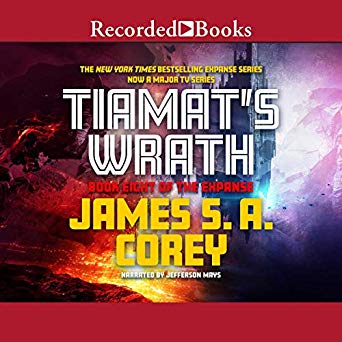
Tiamat’s Wrath is a terrific addition to the trilogy of trilogies that comprise The Expanse which, though never less than entertaining, have waxed and waned in their proximity to greatness since the publication of Leviathan’s Wake. (from Tor.com)

I concur: Tiamat’s Wrath is one of the better installments in an uneven but generally scintillating series. (Also, bonus at Tor.com: I learned a new word in the author bio. “Niall Alexander is the manager of an extra-curricular education centre, and also, increasingly occasionally, a reader and a writer. He lives with about a bazillion books, his better half and a certain sleekit wee beastie in the central belt of bonnie Scotland.” I love learning new words.)

Several decades after the end of Persepolis Rising, James Holden remains a prisoner of High Consul Winston Duarte, emperor of all the known worlds. Chrisjen Avasarala has recently died. Naomi lives in isolation in a shipping container, surrounded by tech, where she plays an important advisory role in the Resistance but rarely sees another human. Bobbie captains the captured ship Storm (also Resistance), with Alex as her pilot. Clarissa is no more (see previous book); Amos went on a high-stakes mission years ago, deep in enemy territory, and has never been heard from again. It’s a very somber opening.

Our beloved central characters are getting gray, but those living are still fighting, in their various ways, dispersed across galaxies. Aside from the core, we see Elvi Ocoye return (from Cibola Burn), performing on Duarte’s scientific team but having already, by the time this book begins, figured out she’s on the wrong team. And a new addition to the perspectives that tell this story is Teresa Duarte, the High Consul’s only child, at fourteen his protégé and, well, a teenager pushed to rebel.

A little hint here: it helps to have read The Churn before this book.

The science seems to matter a little more here than usual, or maybe it’s just that it makes more sense? At any rate, I was able (and motivated) to follow it more than I’ve been in a couple of books, and I found that rewarding. One relevant detail is that Duarte has been made immortal by protomolecule technology and with the help of sociopath Dr. Cortázar. But one thing about poorly understood technologies is that you don’t always know what you’ve signed up for.

My engagement with the science part of the science fiction helped me enjoy this book even a bit more than usual. But even more so, I think the plot and the action were at their best. And still more, separating our characters out into their own mini-stories (something that doesn’t always reengage fans, ahem, The Walking Dead) – with only Alex and Bobbie remaining a team – was a great choice here, in my opinion. We got to see each protagonist take on their own challenges, make their own choices, redefine their own values and belief systems. Naomi, in particular, had to expand her self-conception in the best of ways. I love love loved seeing everybody operate on their own, against a bare background if you will.

Our team – the Rocinante‘s crew, even if she’s in long-term storage – experiences surprising losses and surprising gains in this book. We are heading into the final novel of the series from here. I already feel a sense of loss that it will be over (although there are still several novellas and short stories for me to track down). But I also feel like the massive scale, physical, narrative, and moral, that have been undertaken by this series is being honored here in the penultimate installment, and that feels good. Boy, I’m exhausted just thinking about it.

Fan til the end here, me.


Rating: 8 whining dogs.

Gods of Risk by James S. A. Corey (audio)

Another novella in The Expanse series, this one only glancingly including one of our main characters. David Draper is sixteen years old, a gifted chemistry student working long hours in the lab waiting to find out what career/study path he’ll be placed on next. He’s also gotten himself involved with some less savory types, manufacturing illicit drugs in his spare lab time, for spending money but even more for the connections and sense of belonging. One connection he makes will end up getting him into a boatload of trouble, of course. And when things really get serious, surely you can guess who will be there: his Aunt Bobbie, who’s mostly been present in his life as an annoyance, hanging out in his house watching the news feed and lifting weights. (This novella falls between the timelines of Caliban’s War and Abaddon’s Gate.)

Gods of Risk is not one of Corey’s greatest works, but it’s an absorbing short tale, and it was amusing to see Bobbie through the eyes of someone who doesn’t know how to value her. I listened to the whole thing (read by Erik Davies, but less annoyingly than usual) on the way to and from a bike ride, in a single day, and it held my attention; it’s not much of a contribution to the larger world of The Expanse, but that’s okay. David is a convincing teenager, making poor choices and underestimating certain adults, worshiping the wrong gods, if you will; but his heart is essentially in the right place, as a (slightly over-sappy) final talk with Aunt Bobbie points out. This novella also gives us a bit more background into one of the Martian worlds. Worth the time? Of course! if you’re a completist series fan like me. I’m glad for every bit of this world that I can get, as I head into the eighth novel (for now, the last full-length edition in the series).


Rating: 7 issues with mass transit.