A Spark of White Fire by Sangu Mandanna

A very fun sci fi novel and first in a trilogy. Aimed at younger readers, it still has plenty of plot and character to engage us kids-at-heart.

I’d call this ‘light’ sci fi in that the science isn’t ‘hard’ and doesn’t contribute crucially to any plot points. You might call it speculative fiction instead: political and familiar intrigues, with coming-of-age issues and romance, set in a world that is not quite like our own. Esmae has grown up in the spaceship kingdom of Wychstar, but she belongs on Kali. By winning an archery contest, and therefore winning a gods-blessed undefeatable warship, she is able to return to the home she’s never known; but reuniting her fractured family and putting the rightful heir back on the throne may be a bigger job than she’s realized.

Esmae is a teenager who’s lived most of her life appearing as an unremarkable orphan, although she also enjoys the close friendship of Wychstar’s youngest prince Rama. He’s a true and lovely friend. Secretly, she has also enjoyed training under a famous warrior named Rickard, who is bound to teach no one but the offspring of Kali’s late king. Rickard and the gods are the only ones who know Esmae’s true identity at the novel’s start.

So, like I said: speculative fiction, at the juncture of fantasy and sci fi, with political intrigue and the challenges of coming of age. Esmae’s troubles winning a kingdom may be outside the experiences of most young readers, but exploring the larger world and finding one’s place in it, struggling to find one’s truest identity, making friends and feeling attraction and navigating conflicting loyalties – all these are absolutely universal. I think it’s a very accessible story for young readers.

I read this book for my own pleasure, absolutely, but also because I was hoping to pass it on to my favorite almost-12-year-old, and for that reason I paid more attention than usual to anything that might cause concern for the younger set. There’s some very mild bloodshed, and some intro-to-sexual content: basically a quick but passionate kiss, and some reference to wanting hands on one’s body and feelings of warmth. By my standards, this is plenty appropriate for a middle schooler. I pointed these passages out to my friend’s parent, and we agreed that she’d be fine. (You know I’m not inclined to censorship, and I was reading far spicier stuff at a younger age. And sometimes confused by it! I also appreciate that this kid is doing other reading about bodies, and doing a fair amount of reading with her parents. All solid.)

Fully invested in books two and three. I’ll read more by this author, too.


Rating: 7 birds of feathers and buttons.

Witchmark by C. L. Polk

I really enjoyed this magical alternative history or speculative fiction, with mystery, intrigue, romance, and bicycles! What a treat. Happily, it’s first in a trilogy. I’ve already purchased books two and three.

I was calling this setting Victorian-esque, in my head; the back of the book calls it Edwardian, which is a smallish distinction (the two eras abut), and this is not really my area of expertise, and anyway this is an alternative world, without an Edward or a Victoria at the helm. In a British-type major city called Kingston, Miles Singer, a veteran of the ongoing war, works as a psychiatrist at a veterans’ hospital. We meet him as he’s asked to send 16 patients home to free up their beds for the next round of returning soldiers. This is an impossible task for Miles; his patients are suffering and cannot yet care for themselves. He’s been working to discover the nature of the dangerous sickness that plagues them. And oh yes, he has to hide his magical powers and his true identity. Miles has been on the run for years from his powerful family of mages, who would enslave him to use his lesser powers to support those of his sister. They are involved in some national- and world-scale political connivings that he’d rather have nothing to do with, although he does miss his sister. A strange man brought to the hospital on the brink of death, a handsome stranger, and an unfortunate surprise at a donors’ dinner together offer a major disruption to Miles’s quiet life. He has a dangerous mystery to solve, patients to care for, his own need for privacy to attend to. But there might be more still.

Miles rides a bicycle! And the rules and etiquette for bicycles on the busy Kingston streets are elaborate. There is one remarkable bicycle *chase* that I’m still thrilled about. This feels like a period-appropriate detail and obviously pleases me immensely.

I love the world-building here, and how class plays into the significance of different types of magic. And the slow-burn love affair is stimulating, both for plot and world-building and for the reader who simply wants to see good-hearted Miles happy and comfortable. The story has momentum; I could easily have stayed up all night in a delicious binge session (instead I took three rapid days). Witchmark ends on a high, hopeful note, leaving me excited for book two. C.L. Polk is one to watch. Please join me.


Rating: 8 egg knots.

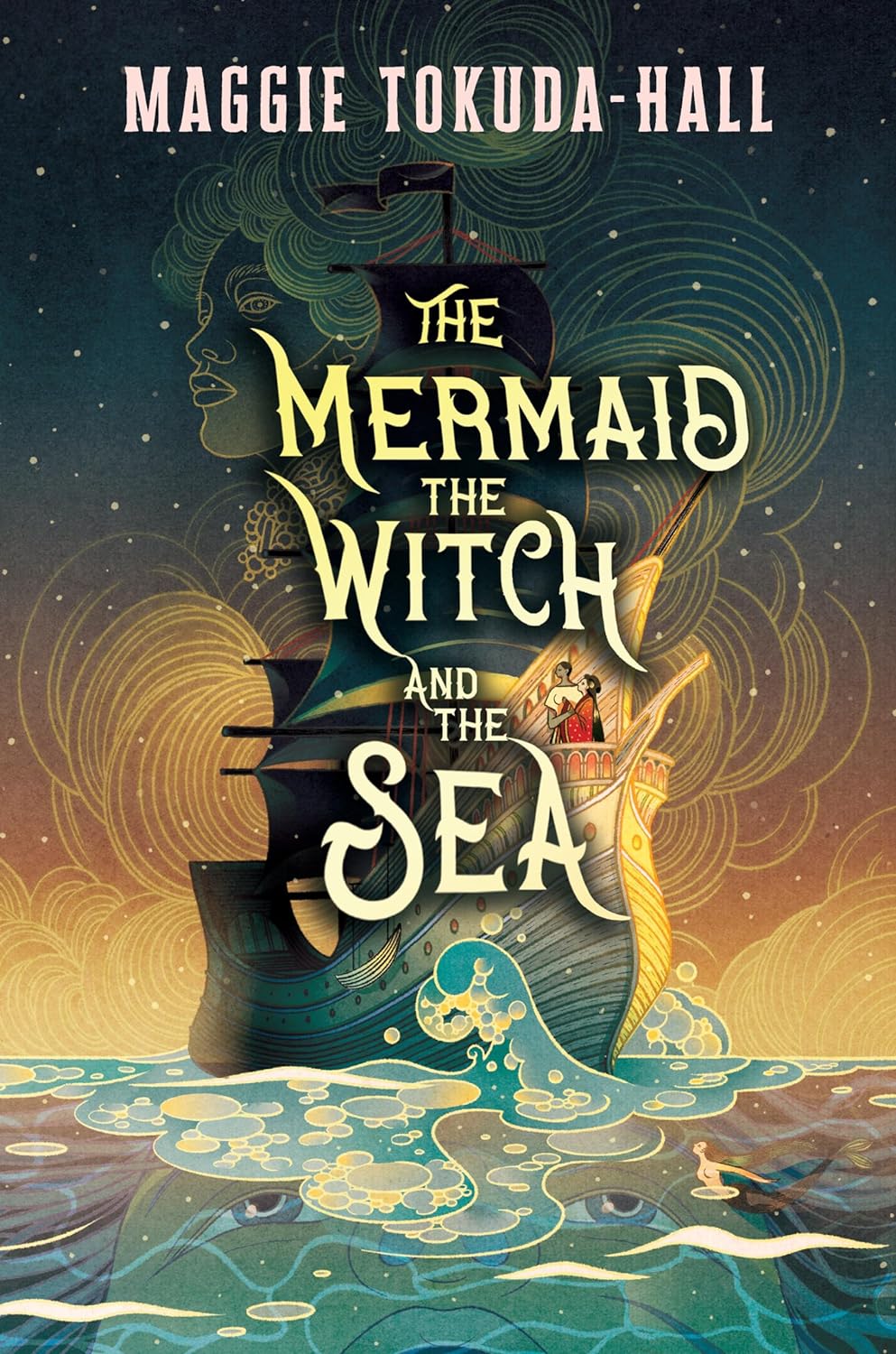
The Mermaid, the Witch, and the Sea by Maggie Tokuda-Hall

There’s a little bit of everything in this unusual fantasy novel for older kids or young adults (or any of us, obviously). Sweet, heartwarming, and surprisingly bloody, The Mermaid, the Witch and the Sea offers mermaids, pirates, and young love. Imagine a bit of Treasure Island, but gender-bending and with a greater emphasis on political workings and class divisions. And magic.

We open with a murder on a pirate ship, then shift to high tea in a house of wealth and privilege. In the first scene, a teenaged boy named Florian earns his keep, having gambled on a life of piracy to save him and his brother from a life of deprivation and scant survival on the streets of the Imperial capital city. In the second, a girl named Evelyn chafes at the bounds of her household, where she enjoys status but not the love of her parents, who plan to send her away to be married to a man none of the family has ever met. Evelyn winds up on the same ship as Florian, where loyalties are split between factions supporting the Empire (who have colonized almost all of the known world, to the discontent of many) and the Pirate Supreme, who serves the Sea. “The Pirate Supreme’s forces were the only thing standing in the way of complete Imperial rule on the open sea. If pirates could still disrupt the merchants, still stymie the trade routes, then the Imperialists could not claim full control. Every robbery, every kidnapping, every galleon destroyed was a protest against the Emperor.” Some loyalties have yet to reveal themselves. And oh, Florian is also Flora, whose pronouns and identity as ‘boy’ or ‘girl’ shift throughout the story. “Both, maybe, but not neither.” “Both were equally true to her” (or him); “neither told the whole story.” Florian is Black and Evelyn is something like Japanese, although these seem to be descriptive details rather than identities that affect status or prejudice in their world.

Flora has lived life on the margins, making hard choices, fighting for life in the most basic ways. Evelyn has suffered a different kind of privation, unloved and lacking agency, but has never imagined the kinds of challenges Flora has faced. The two have much to learn from each other. And I haven’t even mentioned the effects of mermaid blood or its price on the open market, the scarcity of witches in Imperial colonies, or the far-seeing powers of a conscious Sea.

Delightful, weird, fanciful, queer coming-of-age with murder and magic. Violence, rather than sex, may recommend a readership in their teens more than their tweens, depending on blood tolerance, but the themes are solid: finding oneself, living one’s truth, navigating ethical puzzles, being a good friend. And it’s a page-turner to boot.


Rating: 7 haircuts.

Starling House by Alix E. Harrow

I still love Alix Harrow! Starling House has been much anticipated, and I think it fits neatly into her body of work, combining fantasy and whimsy with darkness and grit, as well as romance and a touch of sweet, but not so much that you don’t still feel the hard bite underneath. This protagonist reminds me quite a bit of Chuck Wendig’s Miriam Black; she’s hard-edged and a resolute loner, even though her heart is much softer than she’ll allow. She’s rough and dirty and antisocial, damaged but so strong.

I’m a cheat and a liar, a trickster and a tale-teller, a girl born on the ugly underside of everything. I’m nobody, just like my mother before me.

Her name is Opal. No last name, or whichever one she’s chosen for herself in the moment, like her mother before her. Her mother died when Opal was fifteen, and she’s been parenting her little brother–who was only five–ever since. Jasper is her only priority in life.

I’m a high-school dropout with a part-time job at Tractor Supply, bad teeth, and a brother who deserves better than this dead-end bad-luck bullshit town… People like me have to make two lists: what they need and what they want. You keep the first list short, if you’re smart, and you burn the second one. Mom never got the trick of it–she was always wanting and striving, longing and lusting and craving right up until she wasn’t–but I’m a quick learner. I have one list, with one thing on it, and it keeps me plenty busy.

Jasper is smart and talented, and his debilitating asthma is a bad match for the coal town of Eden, Kentucky. Opal is determined to get him out.

But she is distracted by the magnetic pull of the Starling House, a mysterious old haunted mansion that you can’t see from the road, but this doesn’t stop Opal from dreaming about it. One day she just sort of allows her body to take her there, and she meets its latest enigma of an owner/resident: Arthur Starling, an unkempt, haunted man about her own age. They both know Opal should steer clear of the House, but the House has a consciousness of its own, and once the seal has been cracked–contact made–her life is irrevocably intertwined with Arthur’s, and the House itself, and its weird and inexplicable history. The Starling House, it seems increasingly clear, is all bound up with the town of Eden and the terrible bad luck and sin and crime and hopelessness that Opal wants so badly to free Jasper from.

This is a novel that focuses on place, history, what it means to belong, to stay or to leave, and the meaning of home. Eden’s history includes coal mining, slavery, exploitation, and class divisions. The Starling family has been around for generations, and their role is ever-changing and unclear; the Gravely family has been around just as long, and they are the wealthy coal and power magnates, handing out favors around town or made of pure evil, depending on your perspective. There are a host of other compelling characters, including a loveable motel owner and an even more loveable librarian and a country cop who, again, falls somewhere between doofy and evil. I quite like Jasper, too. Harrow is good with characters, although not all of these are equally well developed.

So, a strong sense of place and a big role for place to play in the narrative. Great characters, with cleverness and snark and grit. And an emphasis on the power of storytelling, and questions about story versus history. “I told myself that writing down somebody else’s story wasn’t as bad as making up my own, the way repeating a lie isn’t as bad as telling one.” “I know that part of the story must be made up, because there’s no such thing as curses or cracks in the world, but maybe that’s all a good ghost story is: a way of handing out consequences to the people who never got them in real life.” “I saw this old map of the Mississippi once. The cartographer drew the river as it actually is, but he also drew all the previous routes and channels the river had taken over the last thousand years. The result was a mess of lines and labels, a tangle of rivers that no longer existed except for the faint scars they left behind. It was difficult to make out the true shape of the river beneath the weight of its own ghosts… That’s how the history of Starling House feels to me now, like a story told so many times the truth is obscured, caught only in slantwise glimpses. Maybe that’s how every history is.”

Finally, at the heart of Starling House is a mystery about power dynamics and the very nature of reality–as well as monsters, imagination, dreams and hopes and hopelessness, family, connections and home, and even romance. It’s a wild ride of a good time. I’m enchanted.


Rating: 8 Ale-8s.

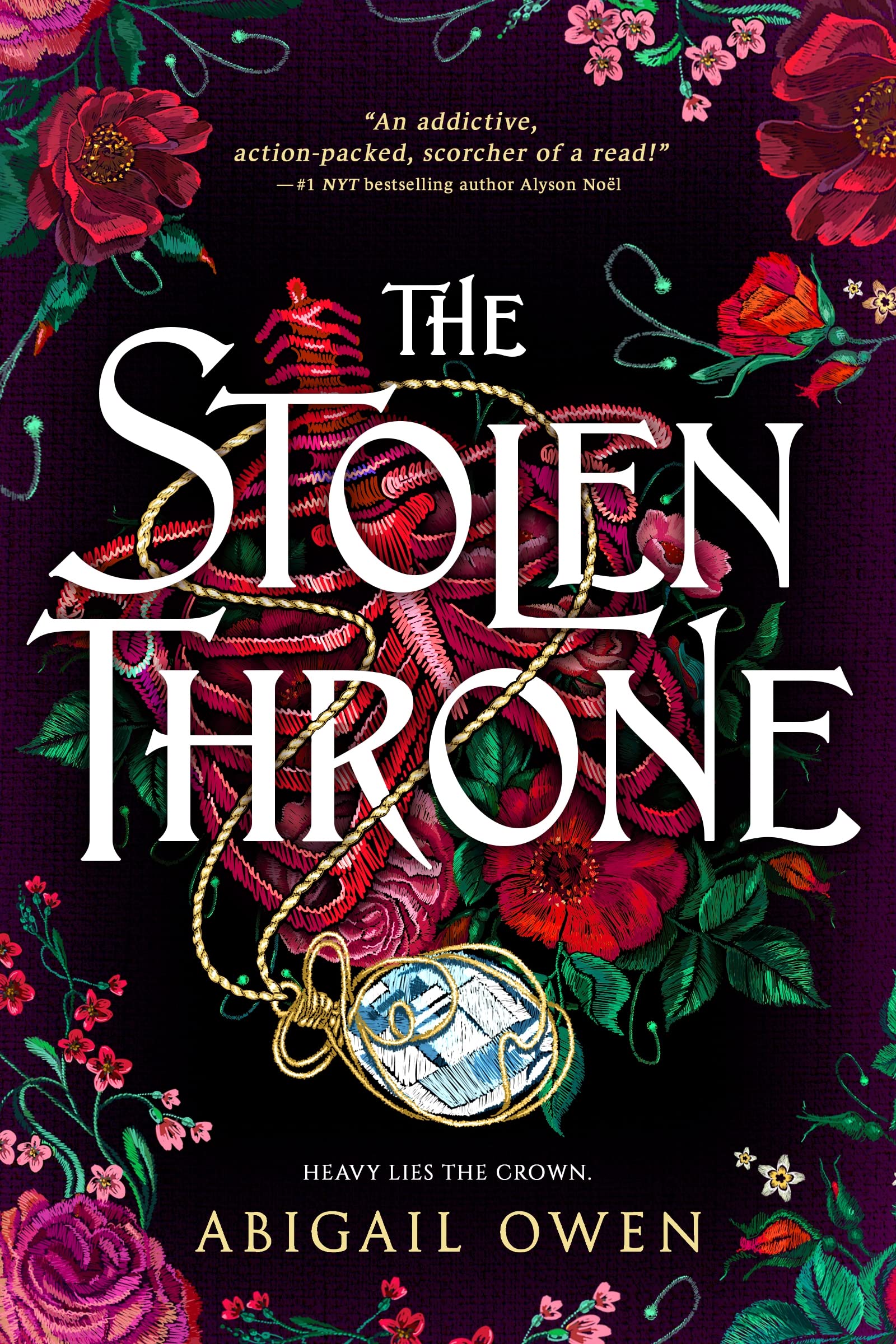
The Stolen Throne by Abigail Owen

Book two in the Dominions trilogy picks up where The Liar’s Crown left off. Meren continues to carry the weight of great responsibility, even over her twin, Tabra, who is ostensibly the “real” princess – now queen – half of their twinship. Tabra carries the privileges and Meren the hard work. We don’t resent Tabra for this, however, because she is so sweet. In fact, I’m inclined to say she’s a bit too sweet – a little boring and a little less realistic than our hero, because if Meren is sometimes frustrating, she’s also a realistic teenager, as well as a brave, hard-working young woman, fighting for the good of all the people in her world, and growing up at the same time. In this installment, she realizes what good friends she has – even if some of them betray her. And she’s still navigating love, romance, and sex. There are still the two young men in her life. One is her lifelong best friend, Cain, who wants to marry but whose love tends toward overprotection and limitation. And then there is Reven, who represents risk and danger to Cain’s security, but for whom Meren feels actual fireworks; also, the two of them are bound (magically) by their trauma and having saved one another’s lives. That drama progresses here, as does the larger drama of risk to Meren’s very world and the people she (or is it Tabra?) rules over and is responsible for.

I find the interpersonal dramas more compelling than the magic in this series; the amulets, goddesses, monsters and political machinations are trappings, or framing, for the interactions between people (and gods, Shadows, monsters, etc.) that interest me. Which is not especially a criticism, but an observation. I returned to this world in search of a comfort read, and in spite of danger and death and violence and all that, I absolutely find it here. I appreciate Meren’s struggles and the push/pull she feels with Reven, especially. I remain invested in these characters and am looking forward to book three, which is promised for April of 2024.


Rating: 7 glimpses of golden thread.

In the Lives of Puppets by TJ Klune

In the Lives of Puppets is TJ Klune’s third adult standalone novel, in a similar vein to The House in the Cerulean Sea and Under the Whispering Door. These are the only three of his I’ve read, although there are more, and I may still get to those.

I said about Whispering Door that Klune excels at “the juncture of sweetness, fantasy, profundity, inclusivity, wisdom and pure silliness.” Puppets continues in that style. Rather than magical orphans or a magical afterlife, here we have a decidedly sadder challenge. The story begins with a lovely forest. A man (“who wasn’t actually a man at all”) approaches an old, falling-down house in the forest. He builds a life there, a crazy network of add-on treehouses and laboratories a la Swiss Family Robinson. He has a son, Victor. Flash-forward: we meet adult Victor with his two companions, a nurse-robot named Nurse Ratchet (that’s an acronym for Nurse Registered Automaton To Care, Heal, Educate, and Drill, and yes, think One Flew Over the Cuckoo’s Nest) and a vacuum-robot named Rambo. Victor’s father Giovanni is still around, and much-beloved; they have a happy family, although Victor is the only human member of it. Like Giovanni, he is an inventor, builder, creator. He spends many of his days combing through the Scrap Yards, where the Old Ones deposit their detritus, some of which turns out to be useful to Victor’s little forest-dwelling family. It’s where he found Nurse Ratchet and Rambo, both of whom he’s patched up to become the wacky friends they are today. (Nurse Ratchet is forever hoping to murder someone or something, slowly, and document their agony. Rambo is crippled by anxiety, restlessness, and his ceaseless need to clean. He loves the old movie Top Hat.) One day, at the Scrap Yards, Victor finds a new potential friend, one who will change everything.

This book assailed me with literary allusions, some of them less obvious than the two I’ve named already. Epigraphs refer to Pinocchio; Victor’s first name and some other plot elements remind of me Frankenstein; the goofy-sidekick robots make me think of R2D2 and C3PO from Star Wars as well as The Wizard of Oz. Which is to say, Klune is not working with brand-new material here (nor does he think he is). The world of robots gets a decided Klune twist, though: sweet, silly, romantic, hopeful. There are a few big reveals I won’t name here. As I already mentioned, this world feels a bit less hopeful to me than the worlds of Whispering Door and Cerulean Sea. The romance felt a full step less believable to me, somehow, although I can’t quite say why – it’s not like the pairings-off in those first two novels made perfect sense in any real world, but this is fantasy. Something about this one just didn’t go off the same, for reasons I can’t articulate. Possibly (is this too obvious?) it is that difficult to write robots (or androids) as relatable humanish characters. Maybe it’s as simple as where we were left with this love affair.

I really enjoyed this read: I was absorbed, engaged, tickled, and concerned for the characters I’d come to love. It is a good book. I just think it’s less awesomely good than the two previous ones by this author that I’ve read. I will certainly buy the next standalone novel he publishes in this same vein.


Rating: 7 butterflies.

Vera Wong’s Unsolicited Advice for Murderers by Jesse Q. Sutanto

This is a very cute, sweet, pleasurable story: a cozy mystery, a loving family tale, with rom-com style matchups and a loveable amateur sleuth. Vera Wong is an older lady – in the world of this novel, she’s just sixty but also an ‘old lady,’ all things being relative, I guess. (Despite Vera’s starring role, the rest of the perspectives are decidedly youthful.) She’s widowed, and she misses her beloved husband, but it is in her personality (and, implied, part of her ‘Chinese mother’ culture) to soldier on. She has a small business she’s very proud of: Vera Wang’s World-Famous Teahouse, in San Francisco’s Chinatown. (Yes, she’s taking advantage of the more famous Vera Wang’s name recognition.) She lives upstairs, and wakes every morning precisely at four-thirty to start her day with a brisk walk and a text to her adult son, Tilly, who receives a number of these texts every daily, exhorting him to proper behaviors; he rarely responds. The voice of Vera’s chapters (in close third person) is resolute and cheerfully bossy; but we understand that she is very lonely. Despite its name, her teahouse is far from famous. She knows it will soon have to be shut down.

Then something terribly exciting happens: she comes downstairs one morning to find a dead body in the teahouse. Vera is thrilled! She calls the police, but they do not seem nearly as worked up about the possible murder as they should be, and they are not at all appreciative that she has helpfully outlined the body for them in Sharpie. “Vera knows they won’t do anything… but… nobody sniffs out wrongdoing quite like a suspicious Chinese mother with time on her hands, and what does Vera have but time?” And so the nosy, overbearing, but somehow magnetic Vera is on the case. If there is a case – the dead man, Marshall Chen, is originally ruled an accidental death. But Vera won’t let this stop her.

Soon other characters (suspects!) surface: there is Julia, Marshall’s widow, worn into submissive passivity by his years of verbal abuse, and her sweet toddler daughter, Emma. There’s Oliver, Marshall’s twin (who gives everyone a start when he first shows up on scene), long estranged from his bully of a brother. And then there are Sana and Riki, both of whom pose as reporters but who are each hiding a secret connection to the dead (murdered?) man. In her usual domineering manner, Vera takes each of these younger people under her wing, even charming the somewhat troubled Emma into calling her Grandma. It helps that Vera never stops cooking up wild, wonderful feasts of traditional Chinese food anytime they gather. Even as she’s befriending them and improving their lives (with a little insistent advice, not to say pushing), Vera is investigating each of the foursome as murder suspects. But as they come together to form an unusual little family of their own, she is less and less pleased at the thought of turning one of them into the police (incompetents!), especially as it is increasingly obvious that the late Marshall was not a nice man at all.

Vera Wong’s Unsolicited Advice for Murderers trades rather heavily on stereotypes about Chinese mothers, to an extent that I think would be problematic if the author did not herself come from that culture. She pokes fun in a loving manner. Does her in-group status excuse using stereotypes as the punchline? I don’t consider myself qualified to make a firm call on this, especially as I am not in-group; I’m cautiously okay with this case, but mine is not perhaps the final judgment that matters most. I will say the book is intended in good fun and comes off as such. Jesse Sutanto has published an impressive number of adult, young adult, and middle grade novels, and the writing style of this one leans toward the cute rather than the literary. Some constructions feel quickly slapped off. It’s fine for an easy, entertaining read, and this one hits the mark.


Rating: 7 bowls of congee.

Emily Wilde’s Encyclopaedia of Faeries by Heather Fawcett

This was a fun one. Emily Wilde is an academic, and a bit of a type: grumpy, antisocial, deeply socially awkward and mostly unbothered about it; she is passionate about her work in the field of dryadology, which is faeries, or the Folk. Her hair is absolutely without exception a mess, even under the influence of magic. We meet her en route to do a season of fieldwork in the very remote, far northern village of Hrafnsvik, whose faeries, known as the “Hidden Ones,” are poorly documented. The research she hopes to accomplish here will complete the work of a decade or more, her Encyclopaedia of Faeries, whose publication should cement her academic reputation and finally get her out of adjunct work and into a position with tenure. (Those of you who know my personal life these days will hear me chuckle in bitter recognition.) This book takes the form of her journal entries, intended as notes for her professional work and as “record for those scholars who come after me should I be captured by the Folk.” Which, mild spoiler, she will be.

Emily arrives in Hrafnsvik with her loyal dog Shadow but fails to immediately thrive, because of her clumsiness with the locals (whose help she needs, whether she acknowledges it or not) and unfamiliarity with the climate (very cold). A few small quibbles with the novel’s consistency here: Emily is proud of her past expeditions into the field, which have ranged far and wide; she is far better with fieldwork than she is at working with other mortals. “I am used to humble accommodations and humble folks–I once slept in a farmer’s cheese shed in Andalusia.” But she’s also never started a fire (?!) and doesn’t know where to begin, and can’t figure out how to split wood (certainly an acquired skill; but her inability to jump in and begin feels like it belies an experience ‘in the field’). She is assessed as an ‘indoors type’ by a sneering local, at which she bristles but doesn’t disagree. And yet she does some massive mountain hikes in the course of her research; she estimates that her daily limit is twenty miles, and in precipitous conditions. In a word, these feel like inconsistencies in the character: is she an indoors type who is unable to light a fire? or is she an intrepid mountain hiker and experienced field researcher? (There is also a woman who mourns the loss of her husband. But then her daughter comes home to both parents.) Small details, perhaps, but they catch my brain distractingly. There is still much to love, however.

After Emily’s early struggles in Hrafnsvik, she is both assisted and further irritated by a new arrival: her colleague Wendell Bambleby. Famous, handsome, and well regarded in the field – if a bit academically lazy, in Emily’s view – he decides inexplicably to crash her fieldwork party, tidying up her lodgings, charming the locals, and generally causing trouble. (To highlight their different personalities, one of his first nights in town was “the most enjoyable evening I have spent in Hrafnsvik, as the villagers largely forgot about my existence amidst the gale-force winds of Bambleby’s personality. I was delighted to sit in the corner with my food and a book and speak to no one.”) The challenging local community, the region’s mysterious and intoxicating Folk, and Bambleby – both obnoxious and somehow appealing – combine to offer Emily chances she’s never really had before, in terms of research, friendship, and romance.

The result is funny, fun, frequently silly, and also suspenseful. Emily is definitely a type (the well-meaning but curmudgeonly professor), but still charming; her new acquaintances include mortals and faeries and at least one frightening faery king. Even Shadow, the loveable loyal hound, is more than he at first seems. I loved the worldbuilding aspect of dryadology, for example, the concept of oíche sidhe, a housekeeping faery driven mad by disorder. The device of Emily’s journal means we get appended faery tales, which was fun. While the Hrafnsvik story is neatly wrapped up, Emily’s own ends on a bit of a cliffhanger; this novel is book 1 in a series, and despite some small quibbles, I’m in for book 2.


Rating: 7 needle-fingers.

The Very Secret Society of Irregular Witches by Sangu Mandanna

I no longer remember where I got this recommendation, but it was a *great* one.

In the opening pages we meet Mika Moon, a young Indian-born witch living in modern-day England. She was raised by a quickly-turning-over series of tutors and nannies, who were in turn employed by an elder witch named Primrose. Primrose is the keeper of the Rules for witches: in a nutshell, witches live in secret and in minimal contact with one another, because witches together mean too much magical dangerously combining in small spaces. Mika is lonely. As a relief valve for her enthusiasm for witchiness, she releases videos on her YouTube channel in which she brews potions and casts spells: it’s not meant to be taken seriously, of course. So she’s alarmed to be caught out by a strange offer to tutor three young witches at a mysterious estate called Nowhere House.

Mika struggles to balance her own strong desire for companionship, community, even family, and her passion for her work, with her grudging respect for Primrose’s Rules. Three little witches in one space should be very dangerous indeed, especially because (like young skunks!) they’re not yet in full control of their powers. Nowhere House turns out to be magical in many ways for Mika, though. She is just beginning to find the kind of kinship she feared would never be an option for someone like her – someone different – when it turns out there are still more layers of secrets than she’d realized.

The Very Secret Society of Irregular Witches is a lovely book. With themes involving outsiderness and the search for belonging, the risks of relating to other people, built families, passion for one’s calling, and every kind of love, it’s a beautiful, affirming study in humanity. Central characters show a nice diversity in age, ethnicity and sexuality. Especially with its realistic, fully-formed child characters, it feels like it wants to be friendly to young adults (such positive messages!), and I was going to classify it as such for nearly 300 pages – at which point there occurred a pretty heavy sex scene, so keep that in mind.

I’d recommend this to anyone – even kids if you’re ready to expose them to sex! – and am anxious to see more from Mandanna. I am so charmed.


Rating: 9 star fragments.

The Storied Life of A. J. Fikry by Gabrielle Zevin

Another winner from Liz. It felt for a split second like it was going to be a bit too easy a meet-cute, but things got immediately complicated for the better.

The first thing the reader sees at the start of Part I is a brief annotation to Roald Dahl’s story “Lamb to the Slaughter,” by an A.J.F. (we assume, the title character). These annotations begin each chapter, but it takes a while to discern their intended destination or use.

Next is a chapter starring Amelia Loman, whom we meet painting her nails yellow on a ferry ride from Hyannis to Alice Island. She has a mild hangover but still feels upbeat about the appointment she’s ferrying toward: she’s a new publishing sales rep going to call on A.J. Fikry, proprietor of Island Books. Amelia is a likeable character, but A.J. – first encountered through her eyes – is prickly. I was surprised to learn that he is just thirty-nine years old, because my first impression was of a crusty old curmudgeon of a shopkeeper (a ‘type’ I recognize from bike shops, but bookstores will do just as well). He certainly fits the type, just younger than I’d originally guessed. And after that first chapter, Zevin wisely takes us from Amelia’s focus (in the close third person) to A.J.’s. I love a jerk whose bad behavior is suddenly complicated and made sympathetic by backstory.

A.J. has suffered a major loss, and he is a jerk – or at least he’s coping poorly – but then the unexpected strikes. It’s not Amelia, as I’d originally thought. It’s something a little different, and my synopsis stops here.

The Storied Life of A.J. Fikry is delightful. It has grumpy but endearing book nerdiness; earnest, messy human emotion; the complications of grief and loss and family; whimsy and mishaps; and yes, a little romance. Also, a bookshop in a small town, with all the social drama and love and support that that can entail. It’s definitely on the sweet side, approaching precious, but never saccharine; I’m pretty sure when Liz recommended it she acknowledged that it would be best read in a mood for something sweet and light-ish, but it’s not the least bit fluffy, and even involves a sequence about the line between fiction and memoir and does it even matter? I read it in a single day and wish it had lasted longer. I could sink into the world of A.J. et al much further. I am off to see what else Zevin has written. Do recommend.


Rating: 8 vampires.