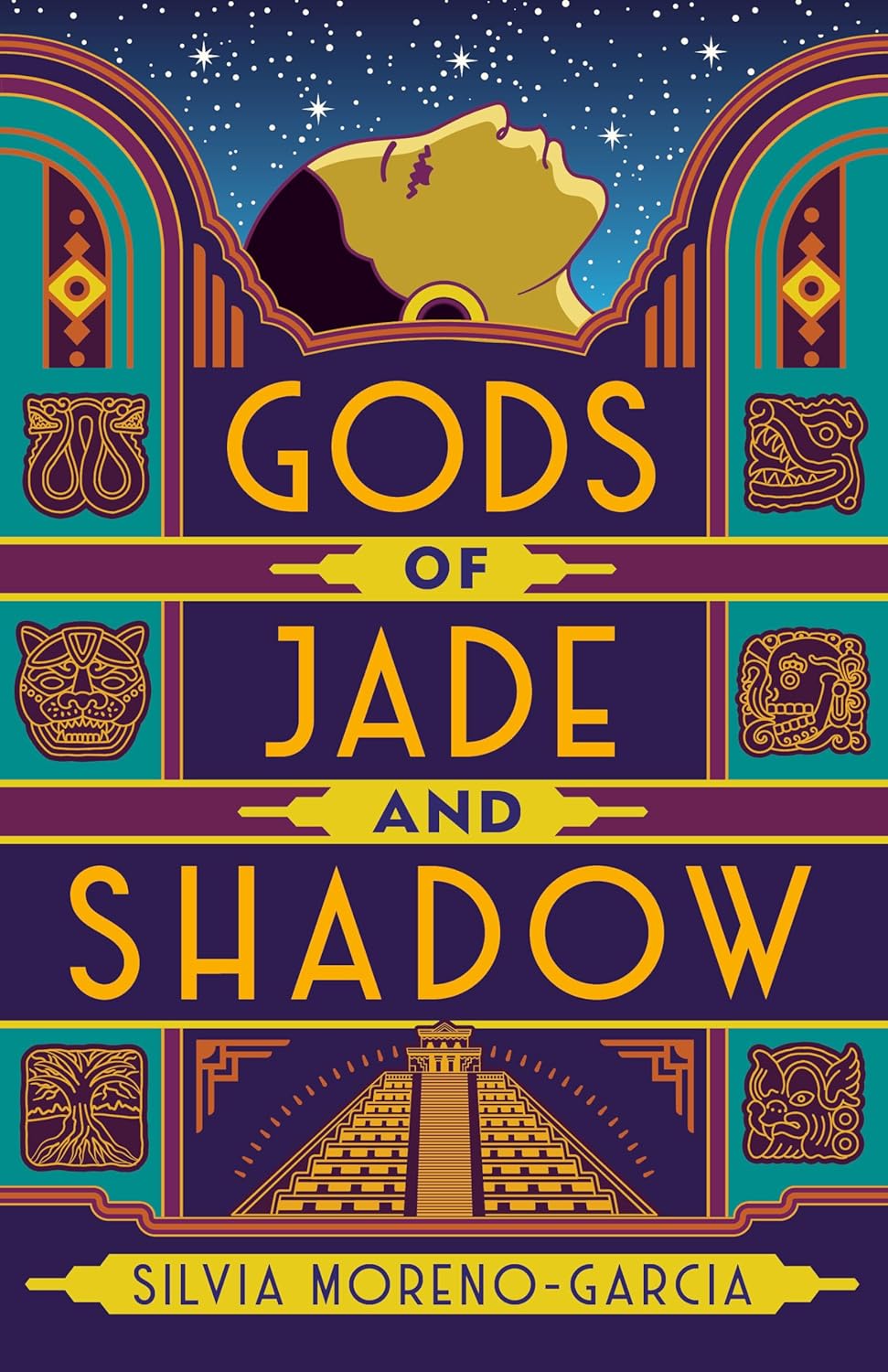
The Order of the Pure Moon Reflected in Water by Zen Cho

“There was a brief lull in the general chatter when the bandit walked into the coffeehouse.” It was not because he was a bandit; this was fairly commonplace. It was because he was extremely attractive. Nevertheless, chatter eventually recommences, until a fight breaks out – waitress, belligerent customer, manager, the beautiful bandit, and then a homelier bandit #2 – smashing the place to bits. It’s an appropriately exciting first chapter, setting up a cast of characters that we will follow well beyond the bounds of the coffeehouse. In fact, the majority of this short, lively book is set in the jungles and on the roads of a kingdom in turmoil.

The waitress is quickly recognized by her shaved head as a nun in the Order of the Pure Moon Reflected in Water. She is clever, resourceful, quick-witted, and highly trained in combat, but also a bit innocent. She follows our bandits (who are lucky no one noticed they appeared on a Wanted poster in the coffeehouse) and part-forces, part-cajoles her way into their gang, otherwise all male; the men are variously intrigued by the idea of a woman cooking for them (she turns out to be a terrible cook) or being available for sex (she sweetly informs them she would have to castrate them afterwards), or annoyed by her presence. Her devotion to the goddess she serves is very strong. As our nun-waitress-bandit and the rest of the gang get to know each other and pursue their banditry, conflicts arise in their approaches to religious fervor, history, and interpersonal relations, but they will find common cause.

At just 158 pages, The Order of the Pure Moon Reflected in Water was easy to devour in an evening. It combines playful humor with very real tragedy, political messiness, the truest of friendships and the beginnings of romance. It’s a swashbuckling series of escapades with ideologies, justice, religion, relationship issues, and more. With some twists on gender and sexuality, this thrilling, silly-yet-earnest adventure tale is definitely a readalike for Upright Women Wanted, although it feels a bit more fully realized in its small package. Absolutely recommended, and I’ll take more from Cho.


Rating: 7 jade prayer beads.

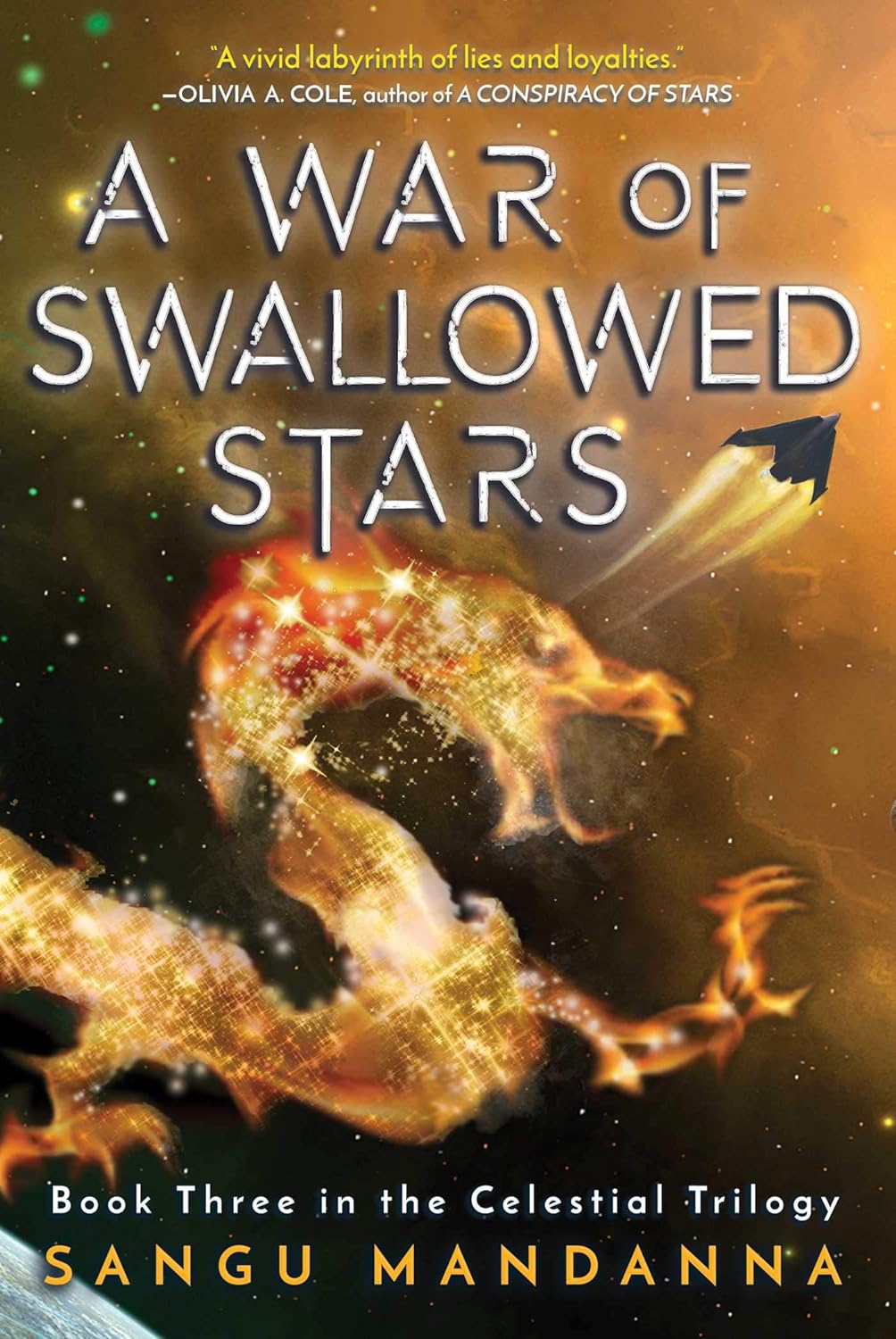
A War of Swallowed Stars by Sangu Mandanna

This review contains spoilers for books that precede it in the series, but is spoiler-free for this book.


This is the third in a trilogy, following A Spark of White Fire and A House of Rage and Sorrow. And it had me pretty rapt, y’all. I was on the edge of my seat throughout, and I cried at the end, but in a good way, which makes me feel glad for the newly-12-year-old I’ve just gifted it to for her birthday. (I teased her that she had to wait because these books are labeled 12 and up!) The world we have come to care about over three books is in great peril, as are the relationships we’ve invested so much in. And it’s not that nobody we love is lost in this book; but it all ends in a way that feels right.

The Celestial Trilogy has featured magical weapons, gods and monsters, murderous family members, and friends where we’d least expect them. Esmae has experienced great and intense trauma, and weathered some very real depression. “I don’t know how to make my way through to the other side of it… I can’t see anything but the dark. I feel like I’ve fallen down a cold, dark hole and I’ll never get out.” Whew. But she has good friends. And she has good on her side. Hang in there, readers.

Mandanna took us through a lot in this series, but the emotional roller coaster has been well-earned, and it pays off in a big way. I can’t wait to hear what my young friend thinks. And you all.


Rating: 8 moments of eye contact.

A House of Rage and Sorrow by Sangu Mandanna

As I’ve decided will be my regular procedure around here, this review contains spoilers for books that precede it in the series, but is spoiler-free for this book.


Following A Spark of White Fire is A House of Rage and Sorrow, book 2 in the Celestial Trilogy by the author of The Very Secret Society of Irregular Witches. I love it.

Esmae is still reeling from the loss of her best friend at the end of book one. Also quite painful is the fact that Rama was killed by her twin brother in a duel, as he thought he was fighting Esmae herself: not only did Rama die, but her brother meant to kill her. Esmae’s anger is beyond description. She wants to burn it all down. She is also carefully avoiding a burgeoning romance, because (I judge) she is as angry with herself as with anyone, and doesn’t think she deserves it.

She is also, however, making friends. Surly Sybilla has cracked open and become as loyal to Esmae as to Max; beloved Rama’s sister Radha has appeared on the scene and begins making her way into the group, not without hiccups. There is a small, new, perhaps fragile, but very real family of friends forming around the girl who has always mourned not having a family.

Then again, the political intrigues and betrayals surrounding her flesh and blood keep multiplying, and the revelations and bad news keep coming. Just how much can one teenaged girl go through? A House of Rage and Sorrow ends on a cliffhanger, not unlike book one; but unlike that finish, this time I had the next installment at hand. Stay tuned for book three in this trilogy.

I love that romance keeps developing (and not just for Esmae!) alongside anguish and intrigue, and a very real and believable coming-of-age arc in which Esmae tries (at least a little) to balance her rage against her better wishes for her loved ones and her wider world. I can’t wait to see where we’ll go next.


Rating: 7 lions.

Soulstar by C. L. Polk

Book three of the Kingston Cycle does not disappoint. It did feel somewhat like a shift in tone for me, and changed up my pacing. But I am a big fan of Polk and hope they’re at work on more like this.

In this installment we see a new protagonist again: Robin Thorpe, who we knew in the first two books as a nurse, Miles’s dear friend, and a witch of the less-privileged, illegal sort. She is also an activist and an important member of the movement to free the witches from asylums and gain some basic human rights for all citizens. She was suspicious of Grace at first (for which I don’t blame her), but also a big enough person to remain open-hearted and learn to trust. (This process we also saw with Grace learning to accept Tristan over her original prejudices.) We’re building communities and coalitions: Robin working with her people, including the Solidarity movement, and their elected official; Robin, Miles, Tristan, and Grace working together and with the Amaranthines for the good of Aeland and its people. Trust has to develop slowly and naturally in several of these relationships; the process is slow and messy, but it’s working.

Early in the book, we have a bit of a revelation. One of the freed witches is Robin’s spouse, Zelind. Mere kids when they married in secret, they are now reunited, but only after decades of separation and trauma. Robin will now navigate the political activist roller coaster she’s entered into, while also trying to reintegrate a longed-for relationship with some profound challenges. Zelind of course turns out to have some talents to offer as well, aside from being Robin’s love.

It was my feeling that Soulstar takes a darker turn than the previous two books. The stakes are getting higher, or the problems the reader is aware of are getting bigger – they’re not new, but we’re getting deeper into this world and learning more. As I’ve said before, this world’s problems are easily seen as analogous to our own.

Grace led us through the gilded reception hall, looking neither left nor right at the people lifting priceless works of art from the walls. It pricked my conscience until I turned my face up to behold our reflections in the mirrored tiles in the ceiling fixed together by gold moldings. Solid gold, I remembered from the time we trooped into the palace as schoolchildren to stare at all the finery I now understood to be hoarded wealth. The taxes of five hundred clan houses held those mirrors together. The wealth in that ceiling could fed the entire country for a year. This ostentation and greed had to end.

The dream team our leaders are putting together is up for this dismantling if anyone is, but the bad guys’ power is considerable and they’re not giving up easily. There was one special challenge mounted late in the book that about broke my will, although luckily these characters are tougher than I am.

Race has been a sort of understated issue throughout the trilogy. Class and privilege make up an obvious one, and climate change, and politically, we’re moving towards self-determination and communal systems of support. The issue of race is less clear: characters are sometimes noted as being Black or white, or described in terms that imply race (blonde, dreadlocked, dark skin), and privilege sometimes lines up with race, but I think not always. I’m not certain how this is meant to be read, whether we’re looking at a mostly-race-stratified society or simply a diverse one. Queer relationships have also been centered throughout. Book one saw a romance between two men, book two featured one between two women, and in book three, Robin is rejoined to her nonbinary spouse. (We also see a triangle marriage buck against Aeland’s societal norms, although it’s not unusual in Samindan culture.) Queerness seems to encounter some raised eyebrows, but not enormous resistance (the triangle marriage is much less accepted).

As another note, now that I’ve got all three books in me, I want to appreciate the covers, which are visually pleasing and offer some clue as to setting, and feature modes of transportation associated with the protagonist of each: a man on a bicycle for Miles on the cover of Witchmark; two figures in a coach for Grace (Stormsong); and now a couple skating for Robin in Soulstar. It’s a neat nod to the world Polk has built here.

As a trilogy: fantasy, world-building, romance, allegory, lovely writing and beautiful details, easy immersion. This writer is a great talent. I hope there is so much more to come, whether in Aeland or anywhere else Polk chooses to take me.


Rating: 8 sweaters.

Stormsong by C. L. Polk

Book two in the Kingston Cycle is every bit as riveting and delicious as the first, and I immediately opened book three upon its conclusion, so fair warning there. As is my practice, this review will contain mild spoilers for book one but not this book.

Witchmark‘s narrator and protagonist was Miles, but having seen him through danger and triumph and into the beginning of a delightful new romance, we are moving on to a new central character: Miles’s sister the indomitable Dame Grace Hensley narrates and stars in Stormsong. I was only sad for a moment; Grace is an exciting woman to follow, and anyway Miles is still on the scene, and his partner Tristan plays at least as big a role. (Miles is recuperating from injuries sustained in the big crescendo finish to Witchmark.) Many common threads continue: political intrigue as well as familial, as Grace and Miles’ family is one of the most powerful in the land. Romance, as Grace finds her own love, although she must navigate it amid all that intrigue. Self-actualization. “You make me want to be better… you know exactly who you are, even if it’s not what you’re supposed to be.” There are some neat instances of thinly veiled reference to our real world, as with worsening weather patterns (and the people demanding the government control the weather – which in this case is possible, because witches), and labor and civic unrest. Crime and punishment, just government and revolution, compromise and how to best run a country: it’s huge stuff, but it’s also still a sweet story of relationships, romantic love and siblinghood and respectful alliances. Oh, and I think I failed to say with book one, Polk writes really tantalizing food and the details of things like fashion which don’t usually interest me but do here. But especially food.

These books have momentum and atmosphere. The world-building is well thought out, which I think is evident for any series that shifts its focus between protagonists with each novel. They are sumptuous stories to get lost in, while dealing with serious themes. I’m impressed. And I’m already well into book three, so stay tuned.


Rating: 8 outfits on the bed.

Emily Wilde’s Map of the Otherlands by Heather Fawcett

This is book 2 in a series, following Emily Wilde’s Encyclopaedia of Faeries.


This review contains spoilers for book 1.


Having wrapped up adventures in Hrafnsvik, Emily has returned to Cambridge and a more comfortable *tenured* position there. Her nineteen-year-old niece, Ariadne, has arrived on the scene as a student, as Emily’s self-appointed assistant, and as a fan and annoyance. Wendell remains nearby, also a fan: his proposal (from near the end of book 1) remains an open question. Now we know his own courtly-faerie identity, it also transpires that would-be assassins have begun to hound him, to reduce his threat to a distant and fearsome fae crown. Meanwhile, an antagonistic department head (ha) is also hounding Wendell and Emily both, seemingly out of some combination of suspicion about their academic integrity and a sense of late-career threat. Obviously, then (that is sarcasm), the whole troop winds up traveling together – Emily, Wendell, Ariadne, and the grumpy Dr. Farris Rose – to a tiny village in the Alps where a controversial dryadologist named Danielle de Grey disappeared some 50 years ago.

This returns readers to a little-populated setting Fawcett clearly favors. Not quite a closed room, the village and surrounding natural world still offer a useful limitation on outside distractions. Compared to Hrafnsvik from the last book, the residents of St. Liesl play a smaller role in this novel’s cast. It keeps that character list neat: Emily (still curmudgeonly, genius, deeply socially awkward, and more caring than she’d like us to know), Wendell (hedonistic, lazy, compulsively neat, and in love), Ariadne (enthusiastic and committed, but oh, young), and Rose (who may have something to offer, if he could get past his own unpleasantness), as well as the famed de Grey and the lovelorn scholar who has chased her, in turn, into misty faerie worlds. With this limited cast, Fawcett does well with humor and the tension Emily feels about her good friend and would-be lover. The fae creatures she studies continue to be a diverse and diverting bit of world-building. Action and development occasionally felt a bit rushed to me, more than I remember from book 1, but it was still a good time, and this is a book with momentum, that motivates the reader to stay up for just one or two more chapters. Also, I’m still pleased by the mild snark about academia, and the quirk of Emily’s character that she’s always thinking about what a good paper or conference presentation her current adventure will make, no matter how dire as it happens. I’m in for book 3.


Rating: 7 carrots.

A Spark of White Fire by Sangu Mandanna

A very fun sci fi novel and first in a trilogy. Aimed at younger readers, it still has plenty of plot and character to engage us kids-at-heart.

I’d call this ‘light’ sci fi in that the science isn’t ‘hard’ and doesn’t contribute crucially to any plot points. You might call it speculative fiction instead: political and familiar intrigues, with coming-of-age issues and romance, set in a world that is not quite like our own. Esmae has grown up in the spaceship kingdom of Wychstar, but she belongs on Kali. By winning an archery contest, and therefore winning a gods-blessed undefeatable warship, she is able to return to the home she’s never known; but reuniting her fractured family and putting the rightful heir back on the throne may be a bigger job than she’s realized.

Esmae is a teenager who’s lived most of her life appearing as an unremarkable orphan, although she also enjoys the close friendship of Wychstar’s youngest prince Rama. He’s a true and lovely friend. Secretly, she has also enjoyed training under a famous warrior named Rickard, who is bound to teach no one but the offspring of Kali’s late king. Rickard and the gods are the only ones who know Esmae’s true identity at the novel’s start.

So, like I said: speculative fiction, at the juncture of fantasy and sci fi, with political intrigue and the challenges of coming of age. Esmae’s troubles winning a kingdom may be outside the experiences of most young readers, but exploring the larger world and finding one’s place in it, struggling to find one’s truest identity, making friends and feeling attraction and navigating conflicting loyalties – all these are absolutely universal. I think it’s a very accessible story for young readers.

I read this book for my own pleasure, absolutely, but also because I was hoping to pass it on to my favorite almost-12-year-old, and for that reason I paid more attention than usual to anything that might cause concern for the younger set. There’s some very mild bloodshed, and some intro-to-sexual content: basically a quick but passionate kiss, and some reference to wanting hands on one’s body and feelings of warmth. By my standards, this is plenty appropriate for a middle schooler. I pointed these passages out to my friend’s parent, and we agreed that she’d be fine. (You know I’m not inclined to censorship, and I was reading far spicier stuff at a younger age. And sometimes confused by it! I also appreciate that this kid is doing other reading about bodies, and doing a fair amount of reading with her parents. All solid.)

Fully invested in books two and three. I’ll read more by this author, too.


Rating: 7 birds of feathers and buttons.

Witchmark by C. L. Polk

I really enjoyed this magical alternative history or speculative fiction, with mystery, intrigue, romance, and bicycles! What a treat. Happily, it’s first in a trilogy. I’ve already purchased books two and three.

I was calling this setting Victorian-esque, in my head; the back of the book calls it Edwardian, which is a smallish distinction (the two eras abut), and this is not really my area of expertise, and anyway this is an alternative world, without an Edward or a Victoria at the helm. In a British-type major city called Kingston, Miles Singer, a veteran of the ongoing war, works as a psychiatrist at a veterans’ hospital. We meet him as he’s asked to send 16 patients home to free up their beds for the next round of returning soldiers. This is an impossible task for Miles; his patients are suffering and cannot yet care for themselves. He’s been working to discover the nature of the dangerous sickness that plagues them. And oh yes, he has to hide his magical powers and his true identity. Miles has been on the run for years from his powerful family of mages, who would enslave him to use his lesser powers to support those of his sister. They are involved in some national- and world-scale political connivings that he’d rather have nothing to do with, although he does miss his sister. A strange man brought to the hospital on the brink of death, a handsome stranger, and an unfortunate surprise at a donors’ dinner together offer a major disruption to Miles’s quiet life. He has a dangerous mystery to solve, patients to care for, his own need for privacy to attend to. But there might be more still.

Miles rides a bicycle! And the rules and etiquette for bicycles on the busy Kingston streets are elaborate. There is one remarkable bicycle *chase* that I’m still thrilled about. This feels like a period-appropriate detail and obviously pleases me immensely.

I love the world-building here, and how class plays into the significance of different types of magic. And the slow-burn love affair is stimulating, both for plot and world-building and for the reader who simply wants to see good-hearted Miles happy and comfortable. The story has momentum; I could easily have stayed up all night in a delicious binge session (instead I took three rapid days). Witchmark ends on a high, hopeful note, leaving me excited for book two. C.L. Polk is one to watch. Please join me.


Rating: 8 egg knots.

The Mermaid, the Witch, and the Sea by Maggie Tokuda-Hall

There’s a little bit of everything in this unusual fantasy novel for older kids or young adults (or any of us, obviously). Sweet, heartwarming, and surprisingly bloody, The Mermaid, the Witch and the Sea offers mermaids, pirates, and young love. Imagine a bit of Treasure Island, but gender-bending and with a greater emphasis on political workings and class divisions. And magic.

We open with a murder on a pirate ship, then shift to high tea in a house of wealth and privilege. In the first scene, a teenaged boy named Florian earns his keep, having gambled on a life of piracy to save him and his brother from a life of deprivation and scant survival on the streets of the Imperial capital city. In the second, a girl named Evelyn chafes at the bounds of her household, where she enjoys status but not the love of her parents, who plan to send her away to be married to a man none of the family has ever met. Evelyn winds up on the same ship as Florian, where loyalties are split between factions supporting the Empire (who have colonized almost all of the known world, to the discontent of many) and the Pirate Supreme, who serves the Sea. “The Pirate Supreme’s forces were the only thing standing in the way of complete Imperial rule on the open sea. If pirates could still disrupt the merchants, still stymie the trade routes, then the Imperialists could not claim full control. Every robbery, every kidnapping, every galleon destroyed was a protest against the Emperor.” Some loyalties have yet to reveal themselves. And oh, Florian is also Flora, whose pronouns and identity as ‘boy’ or ‘girl’ shift throughout the story. “Both, maybe, but not neither.” “Both were equally true to her” (or him); “neither told the whole story.” Florian is Black and Evelyn is something like Japanese, although these seem to be descriptive details rather than identities that affect status or prejudice in their world.

Flora has lived life on the margins, making hard choices, fighting for life in the most basic ways. Evelyn has suffered a different kind of privation, unloved and lacking agency, but has never imagined the kinds of challenges Flora has faced. The two have much to learn from each other. And I haven’t even mentioned the effects of mermaid blood or its price on the open market, the scarcity of witches in Imperial colonies, or the far-seeing powers of a conscious Sea.

Delightful, weird, fanciful, queer coming-of-age with murder and magic. Violence, rather than sex, may recommend a readership in their teens more than their tweens, depending on blood tolerance, but the themes are solid: finding oneself, living one’s truth, navigating ethical puzzles, being a good friend. And it’s a page-turner to boot.


Rating: 7 haircuts.

Starling House by Alix E. Harrow

I still love Alix Harrow! Starling House has been much anticipated, and I think it fits neatly into her body of work, combining fantasy and whimsy with darkness and grit, as well as romance and a touch of sweet, but not so much that you don’t still feel the hard bite underneath. This protagonist reminds me quite a bit of Chuck Wendig’s Miriam Black; she’s hard-edged and a resolute loner, even though her heart is much softer than she’ll allow. She’s rough and dirty and antisocial, damaged but so strong.

I’m a cheat and a liar, a trickster and a tale-teller, a girl born on the ugly underside of everything. I’m nobody, just like my mother before me.

Her name is Opal. No last name, or whichever one she’s chosen for herself in the moment, like her mother before her. Her mother died when Opal was fifteen, and she’s been parenting her little brother–who was only five–ever since. Jasper is her only priority in life.

I’m a high-school dropout with a part-time job at Tractor Supply, bad teeth, and a brother who deserves better than this dead-end bad-luck bullshit town… People like me have to make two lists: what they need and what they want. You keep the first list short, if you’re smart, and you burn the second one. Mom never got the trick of it–she was always wanting and striving, longing and lusting and craving right up until she wasn’t–but I’m a quick learner. I have one list, with one thing on it, and it keeps me plenty busy.

Jasper is smart and talented, and his debilitating asthma is a bad match for the coal town of Eden, Kentucky. Opal is determined to get him out.

But she is distracted by the magnetic pull of the Starling House, a mysterious old haunted mansion that you can’t see from the road, but this doesn’t stop Opal from dreaming about it. One day she just sort of allows her body to take her there, and she meets its latest enigma of an owner/resident: Arthur Starling, an unkempt, haunted man about her own age. They both know Opal should steer clear of the House, but the House has a consciousness of its own, and once the seal has been cracked–contact made–her life is irrevocably intertwined with Arthur’s, and the House itself, and its weird and inexplicable history. The Starling House, it seems increasingly clear, is all bound up with the town of Eden and the terrible bad luck and sin and crime and hopelessness that Opal wants so badly to free Jasper from.

This is a novel that focuses on place, history, what it means to belong, to stay or to leave, and the meaning of home. Eden’s history includes coal mining, slavery, exploitation, and class divisions. The Starling family has been around for generations, and their role is ever-changing and unclear; the Gravely family has been around just as long, and they are the wealthy coal and power magnates, handing out favors around town or made of pure evil, depending on your perspective. There are a host of other compelling characters, including a loveable motel owner and an even more loveable librarian and a country cop who, again, falls somewhere between doofy and evil. I quite like Jasper, too. Harrow is good with characters, although not all of these are equally well developed.

So, a strong sense of place and a big role for place to play in the narrative. Great characters, with cleverness and snark and grit. And an emphasis on the power of storytelling, and questions about story versus history. “I told myself that writing down somebody else’s story wasn’t as bad as making up my own, the way repeating a lie isn’t as bad as telling one.” “I know that part of the story must be made up, because there’s no such thing as curses or cracks in the world, but maybe that’s all a good ghost story is: a way of handing out consequences to the people who never got them in real life.” “I saw this old map of the Mississippi once. The cartographer drew the river as it actually is, but he also drew all the previous routes and channels the river had taken over the last thousand years. The result was a mess of lines and labels, a tangle of rivers that no longer existed except for the faint scars they left behind. It was difficult to make out the true shape of the river beneath the weight of its own ghosts… That’s how the history of Starling House feels to me now, like a story told so many times the truth is obscured, caught only in slantwise glimpses. Maybe that’s how every history is.”

Finally, at the heart of Starling House is a mystery about power dynamics and the very nature of reality–as well as monsters, imagination, dreams and hopes and hopelessness, family, connections and home, and even romance. It’s a wild ride of a good time. I’m enchanted.


Rating: 8 Ale-8s.