The Bones Beneath My Skin by TJ Klune

Just out from TJ Klune, The Bones Beneath My Skin is a standalone adult novel with loneliness, yearning, darkness, sweetness, queer love and sex, and discovery of new forms of family. There is a bit of a formula here in terms of the combination of those elements, but I don’t intend any of the negative connotation that often accompanies the idea of a formula. I appreciate that I can turn to Klune for a familiar blend of heartbreak and happy ending with characters who are messy but also the kinds of people I’d like to call friends.

In his Author’s Note, Klune calls this an ‘action movie in book form.’ A former publisher accused this manuscript of being different and weird: “but then, I’m the guy who made a socially anxious vacuum cleaner named Rambo into a main character” (check it out).

Nate Cartwright is on the road. The reader learns gradually: that he is driving the old truck recently inherited from his father, to the cabin recently inherited from his mother, both of whom just died of a murder-suicide after a lengthy estrangement from Nate, who they disowned when they discovered he was gay. He has lost his job and everything else that mattered to his old life in Washington, D.C. (not much); he’s headed to the cabin, lakeside in rural Oregon, without much of a plan but to unplug and regroup. But when he arrives at Herschel Lake, the cabin is not unoccupied. Instead, he finds a huge, intimidating man with a huge gun, accompanied by a tiny, lovely, friendly, extremely strange little girl. The man is Alex. The little girl is Art, short for Artemis Darth Vader. Nate tells her that’s not a real name. She corrects him.

This odd trio joins up. Art and Alex have already bonded firmly as allies, against long odds; Nate is late to the party, but fits in, as a lonely oddball with a tendency toward deeply felt loyalties. In a series of extremely unlikely events, Nate learns that his new… friends?… may not be all that they appear. But still he chooses to go all in.

With hints of Men in Black and ET, Nate, Alex, and Art go rocketing across the country, fleeing shadowy government forces and conspiracy theorists, harboring secrets beyond the theorists’ imagining, wanting only to be safe and together with those they love. Klune’s website calls it “a supernatural road-trip thriller featuring an extraordinary young girl and her two unlikely protectors on the run from cultists and the government.” I love Klune’s rather trademark focus on protecting kids as a central, undeniably wholesome focus, even amid some very adult concerns (and passions). As with other recent novels of his that I’ve enjoyed, this one left me looking for more featuring these flawed but loveable characters. I really loved the ending. Still following this author anywhere.


Rating: 8 slices of bacon.

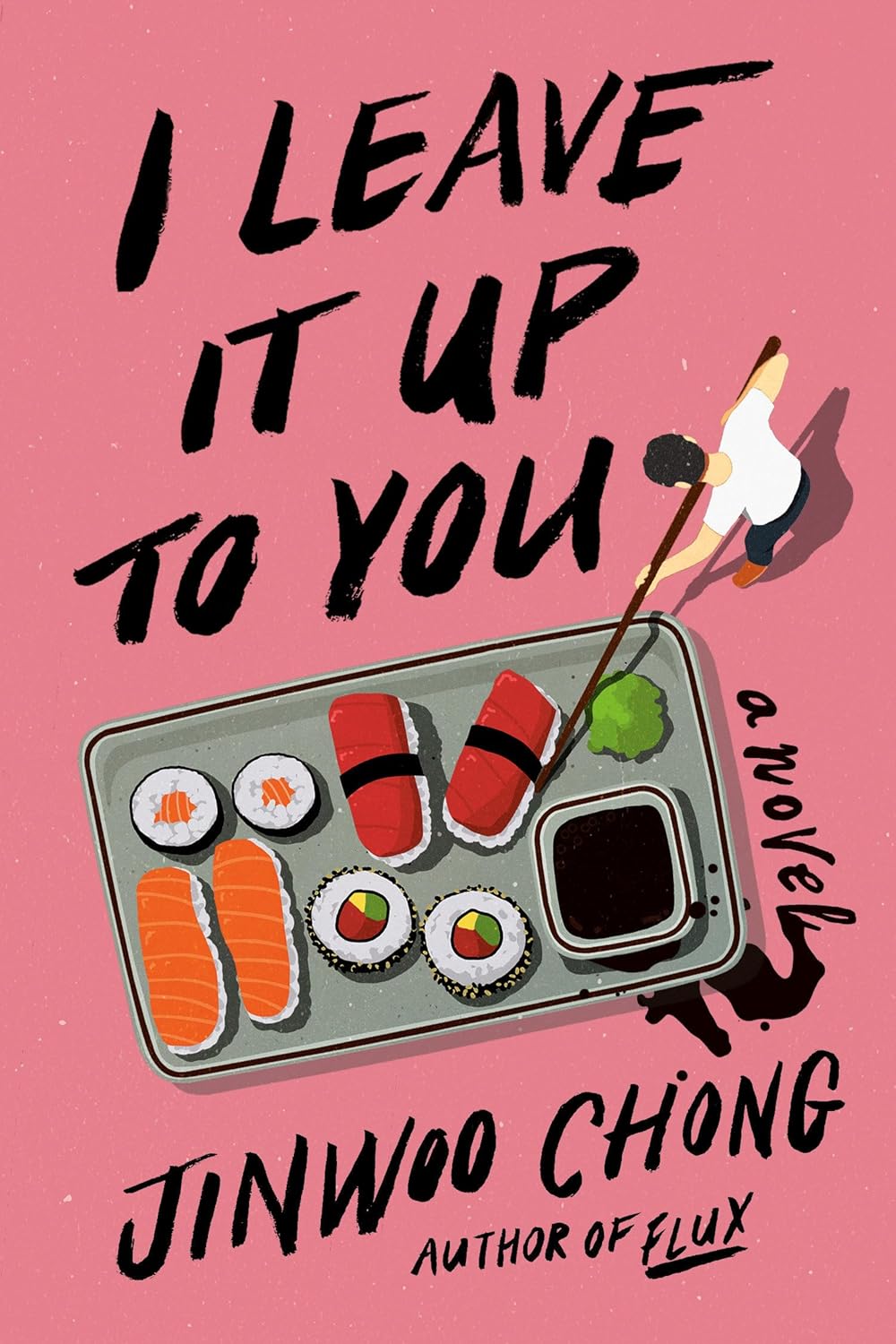
I Leave It Up to You by Jinwoo Chong

A young man wakes up from a coma and returns to the family, and the family sushi restaurant, that he’d left behind, with comical, heart-wrenching, hopeful results.

I Leave It Up to You by Jinwoo Chong (Flux) is a funny, bittersweet, heartwarming story about family, love, and making every minute count.

Readers first meet Jack Jr. in what he is slow to realize is a hospital room. He wakes up intubated and gagging. He’s confused about his whereabouts and circumstances, and he asks for his husband. His nurse is thrown into a full panic: Jack Jr. has been in a coma for 23 months and was not expected to regain consciousness.

No one will answer when he asks for his husband. Jack Jr. has missed his 30th birthday and the first 18 months or so of the Covid-19 pandemic. A few weeks into this remarkable recovery, he returns home, not to his Manhattan apartment, but to his father’s home in New Jersey. He goes back to the family business, a struggling Korean-Japanese sushi restaurant, which was once meant to be his life’s work and which he has not seen in 12 years. Jack Jr. has lost everything, and he finds himself in an unfamiliar, masked world. For much of the narrative, the old wounds he was avoiding–that he will now have to face–remain shrouded from the reader.

Jack Jr.’s kind and loving Appa (father) is a passionate sushi chef and workaholic; his Umma (mother) is private, reserved, and fiercely loyal; his especially estranged brother, James, is a recovering alcoholic with a dear wife and a new baby to join the teenaged nephew that Jack Jr. barely knows. Wise, gawky, 16-year-old Juno is perhaps the member of his family that Jack Jr. best connects with. And then there is Emil, formerly Jack Jr.’s nurse, and now potentially poised to become something more. Through these endearing characters, Jack Jr. considers that perhaps “there was more to loving something than smiling at it.”

In Jack Jr.’s first-person voice, these mysterious, painful new challenges are wrenching, but his love for his wacky family, and theirs for him, are unmistakable throughout. Alongside the flavors of carefully prepared nigiri, dak juk, soy, ponzu, and plenty of pork belly, humor and off-kilter love shine brightly in this tale of realizing what’s really important and making the most of one’s own time. The title of I Leave It Up to You refers to a translation of omakase, the Japanese dining tradition of asking for the chef’s choice, and also nods to the novel’s sweet attention to the care of self and others. While recovering from his physical injuries, Jack Jr. must also navigate old fractures with a family he hasn’t seen in years, let go of a relationship with no closure, and remain open to a surprisingly promising future. The story winds up delightfully warm and soothing, for all the bumps along the way.


This review originally ran in the January 31, 2025 issue of Shelf Awareness for the Book Trade. To subscribe, click here.


Rating: 8 bowls of juk.

The Shadows Rule All by Abigail Owen

The Shadows Rule All is the final installment in the Dominions trilogy, following The Liar’s Crown and The Stolen Throne. It continues the work of the previous two in an anticipated fashion, which is not a criticism. I was just talking with a friend about the expectations set up by a series, and what it means to meet or thwart them, and how much of the latter might be tolerated by a fan base. When I say Owen has met expectations with this one, I mean that in a good way. In the previous two books, she taught me to look for action; intrigue; humor; teenaged awkwardness; the challenges of split loyalties (both for teens and for monarchs, worse for teenaged monarchs); youthful navigations of romance and sex; familial love; loss and grief and magic and more. All of those elements were present, while leaving room for surprises in terms of plot. For the most part, I feel this upholds the contract set up by the first two books in a trilogy. It will be a rare series (let alone trilogy – perhaps a more tightly bound subset of series) that subverts reader expectations without pissing them off. And there was still plenty to keep me engaged and guessing.


Beginning here, a reminder: as I’ve done before with series reviews, this review will contain spoilers for the previous two books. Just one nice, vague one for this title.


As is probably appropriate for the finale in a trilogy, Owen goes big. The stakes are higher than ever. Some very big issues in Meren’s world must be resolved: various forces are working to release the goddesses who’ve been locked in the amulets for many generations; the Shadows that haunted Reven and now haunt Meren must find their final destinations; the dominion of Aryd which is Tabra’s (and/or Meren’s?) to rule must find its ruler and its peace. Eidolon will, hopefully, be dispatched. There will be a huge, pitched battle, with all the consequences, action sequences (including magic), and some serious losses. As much as it hurt to read, I applaud Owen for being brave enough to kill off a few characters who have been central and loved. That’s what a book like this calls for.

A love story has been brewing in previous books, between Meren and Reven, originally her kidnapper (who assumed she was her twin, Tabra), although he had his reasons. In the previous book they were “bound,” in a magical ritual that means they will always find each other even in later lives, and that they can communicate nonverbally and feel one another’s feelings, among other things. In this book, Reven returns from a terrible trauma without any memory of Meren. Most inhabitants of their world find this unprecedented for a bound couple, but assume as he recovers his memories they will come back together. Worse and stranger, the physical manifestations of their bond – lines that light up under the skin – are absent. Worst of all, Meren can still feel the bond, although she cannot access his mind and feelings. These are often the most powerful elements of fantasy or absurdist stories: literalizations of concepts we already know in our ‘real’ world. So: Meren feels the loss of her traumatized, amnesiac lover physically, as literal pain, while he is oblivious, or confused by an explicable magnetism. The Meren-and-Reven push-pull feels to me like the most important thread in the story, although there are many that matter, not least the rule of Aryd, the sisterly bond between Meren and her twin Tabra, the righting of the entire world via goddesses and climate, and various other love stories. Tabra has a sweet one of her own, and by the way, my previous concern that she was too sweet has been entirely corrected here: a dear friend to those she loves, yes, and good-hearted, but with her own priorities and stubborn points and a backbone of steel.

This novel and this series contains action, gore, and loss, hard decisions and monsters and deaths. For all that, it is still an upper YA or “new adult” book with coming-of-age themes: relationships, responsibilities, finding oneself. And it is a comfort read (for those of us who take some blood with our romance). I was surprised at what a fairy-tale, happily-ever-after ending Owen granted us in the end, not that she didn’t put us through some pain on the way there. I enjoyed every minute of it.


Rating: 7 petals.

I Made It Out of Clay by Beth Kander

As Eve’s life devolves into crisis, she creates a golem to solve it all, in this lovely, absorbing novel of grief, dark humor, and love and friendship, with a dash of magic.

Beth Kander’s I Made It Out of Clay is a lovely, absorbing novel of grief, dark humor, and love and friendship, with a dash of magic.

In contemporary urban Chicago, as the holiday season approaches, Eve is struggling: she’s about to turn 40 years old, and she’s nowhere near done grieving her beloved father, who died just over a year ago. Eve and her father always loved Christmas–a guilty pleasure in their Jewish family not shared by the surviving members. Layoffs are threatened at work, her best friend has been distant, she’s had some disturbing encounters on the train recently, and she’s begun hallucinating her dearly departed grandmother, a Holocaust survivor who seems to be trying to warn Eve of something. Eve is not close to her mother (overbearing) or her younger sister Rosie (overly perfect), who’s scheduled her wedding for Eve’s 40th birthday weekend. Eve has (foolishly) promised to bring a plus one to Rosie’s wedding, but she’s so far failed to find a date. Unfortunately, her neighbor crush doesn’t seem to get her jokes or her cringeworthy attempts at flirtation.

In desperation, late at night and rather drunk, Eve recalls a story told by her grandmother, ventures into the dank corners of her apartment’s basement, and builds herself a golem out of foundation clay. A golem serves as protector and companion in Jewish tradition, and she feels in dire need of both. The next morning, a hungover Eve wakes up to find a handsome (and very naked) man in her apartment. She is horrified, in disbelief, attracted to him, and a little disgusted with herself. Is Eve’s golem a figment of her imagination? A monstrosity? Or the answer to her fondest wishes? Heading into Rosie’s wedding, all of Eve’s crises–work, friendships, the absence of romance, family strife, civil unrest in the wider world–crash and crescendo together. A golem is either the best or worst idea she’s ever had.

I Made It Out of Clay is a charming rework of a traditional tale. Frequently grim, it explores some of the darker elements of modern life: depression, loneliness, grief, bigotry. But it’s also sweet and very funny, especially in the moments when Eve lets her friends and, eventually, family into her life, and finds that they may have some of their own struggles. Kander gifts her readers with a novel that is often serious and sad, but ultimately uplifting, as Eve learns, “This isn’t the end of anything. It’s just one more beginning, like every damn day can be if we just let it.”


This review originally ran in the October 4, 2024 issue of Shelf Awareness for the Book Trade. To subscribe, click here.


Rating: 7 bagels.

The Greatest Lie of All by Jillian Cantor

A young actress takes on the role of a glamorous romance author and gets more mystery–and romance–than she’d reckoned for.


The Greatest Lie of All by Jillian Cantor (Half Life; The Hours Count; Margot; The Lost Letter) is a propulsively paced story of intrigue, romance, and suspense starring two women a generation apart navigating family, love, secrets, and art. In one of their several parallels, each uses a professional pseudonym, so that four names delineate these two character arcs.

Readers meet the young, up-and-coming actress Amelia Grant just after the death of her beloved mother, and in the moment when she discovers her actor boyfriend in bed with his costar. At this low, Amelia is primed to accept her biggest role yet: to play the fabulously successful romance author Gloria Diamond in a biopic. Gloria had been Amelia’s mother’s favorite; it feels like a sign and a way to be close to the mother she’s lost, the only person who had called her by her birth name, Annie.

Heartbroken but determined, Amelia travels from Los Angeles to Gloria’s remote Seattle-area home to get to know her subject before filming begins. But “the Gloria Diamond” is distinctly unfriendly, cold, and dismissive. Even as Amelia finds a tentative friendship with Gloria’s son, Will (“cute, in an academic kind of way”), she despairs at ever understanding what makes the older woman tick. Gloria’s career was built on her famous, brief romance with her late husband, Will’s father. But the more Amelia learns, the less convincing that story is. She embarks on an informal investigation fueled by shadowy motives: her desire to play a “true” Gloria Diamond; her curiosity about the nature of love, especially as her mother so appreciated it in Diamond’s fiction; and Will’s reluctant desire to understand his mother. As she pursues the history of the author once known as Mary Forrester–Mare to her friends–Amelia begins to wonder about her own role in the drama unfolding before her.

In chapters that shift between Amelia’s perspective and that of the young Mare, The Greatest Lie of All shines in its plot twists and surprises, and, most of all, its pacing, which accelerates from a slow burn to a heart-thumping momentum. The tension increases, stakes rising as Gloria/Mare and Amelia/Annie must reckon with their pasts to chart their shared present. Danger accompanies every possibility of romance, and family history matters more than it originally appears. Cantor’s experienced hand shows in this classically crafted thriller, which will keep its readers tautly engaged to the final scene.


This review originally ran in the September 24, 2024 issue of Shelf Awareness for the Book Trade. To subscribe, click here.


Rating: 6 glasses of wine.

The Lost Girl by Sangu Mandanna

I am a creature, a girl, life stitched from nothing. I am eerie and frightful. And I’m stronger than all of them. I can’t allow any hunter, or Weaver, or betrayal to defeat me. Believing that is all I have. It’s all that might save me.

I have been a fan of Mandanna’s witchy book and this YA trilogy. I’m jumping back in time here to her debut novel, a YA sci fi with some romance elements, naturally enough a coming-of-age story, with some pretty neat philosophical questions. It’s quite good, but she’s gotten better since.

Eva is an echo, as opposed to a human: she was not born but made to order by the Weavers for a family who requested her. Echoes are sort of spares: Eva is based on her ‘other,’ or her original, a girl named Amarra who lives in Bangalore. Eva lives in a small English village where she is heavily guarded and tutored and trained in how to be Amarra. She reads what Amarra reads, consumes the same music and movies and foods, wears the same clothes. As far as possible from Bangalore to the English countryside, she is supposed to mimic Amarra, to be prepared to be Amarra if something should happen to the valued human girl. But something has gone awry with Eva: she has a personality of her own. She is not as agreeable as Amarra seems to be. She is strong-willed and stubborn, has interests that different from those of her other. She asks too many questions. Even to have taken a name of her own is a serious crime. [Can I just say how remarkable I find it that she’s taken the same name as in Peter Dickinson’s YA novel that I loved so much?!] And then, of course–this would be necessary for the story’s sake–Amarra dies. And Eva is up for the role of a lifetime, that for which she has been designed.

With obvious parallels to The New One, and a classic we’ll discuss shortly, The Lost Girl examines concepts that humanity has considered before; but that’s certainly not a criticism, nor am I alleging unoriginality. (This book predates The New One, for the record.) Rather, I guess I’m observing that the questions Mandanna is playing with here are of perennial interest. What power do we have to design the people or have the babies we want? Is it appropriate or moral to play with technology that would do so? (There are some efforts at work too in pursuit of immortality, that other perennial human preoccupation.) Eva literalizes the idea of a young person coming of age under the constraints of society or family’s expectations; but on some level every young person wrestles with similar bounds, and necessarily rebels against them. Is Amarra a better girl, or just a different one? Does Eva have a right to self-determination? Many people in their world see Eva as less-than, an abomination. What makes someone human, or a person, or deserving of respect? How do we combat prejudice that’s based on ignorance? How are we to navigate grief? (Hint: maybe not by having a copy of our beloved daughter made to spec, and then demanding she live up to impossible ideals.)

Eva is in a difficult spot. She has to be someone she’s not, both for the sake of her literal survival (echoes are destroyed if they can’t do their jobs) and because she genuinely wishes to comfort Amarra’s bereaved family, who seem like decent people. But she isn’t Amarra. And even dead, the ‘other’ looms large. “Maybe that’s what the dead do. They stay. They linger. Benign and sweet and painful. They don’t need us. They echo all by themselves.”

Mandanna, and the system of echoes, and Eva, are all clear on the reference to Frankenstein here. Echoes are firmly forbidden access to the book, which Eva rightly senses is because there’s something there. Who is the monster–the scientist or his creation? What if you let the Creature set his own path?

Eva’s first-person voice is spot on, the rules of this world are well established for most of the novel, the questions it asks are compelling and thoughtfully explored. The characters are complex and sympathetic, the stakes are high, the whole thing is absorbing. There is a romantic subplot, with tension between Amarra’s boyfriend and Eva’s potential (and obviously highly forbidden) love interest. It’s all really well done, and this novel was headed for a higher rating, but it gets a bit out of control towards the end. The action is a bit unwieldy and the rules of the world collapse a bit, for me, in terms of believability. A certain promise is asked to carry an awful lot of weight in the plot denouement, as if promises are more binding than we know them to be in our world, at least, and indeed it seems to come down to a villain keeping their word, which feels doubtful at best. In an invented world like this, Mandanna could have made a rule of some sort about how promises work–they could have been literally binding–but she didn’t, and the importance of the promise didn’t work for me. I suspect I’m seeing Mandanna’s evolution as an author here, and I’m not mad about it and will still be seeking out her work. My rating of 7 is still solid! But it looked even stronger for a while. I think this author has grown a great deal since her debut.

Great premise, and well done through most of the book; fell off a bit at the end. I am still a fan.


Rating: 7 scones.

The Crescent Moon Tearoom by Stacy Sivinski

This entrancing debut stars triplet witches who can see the future, but must work together and individually to grasp their own.

Stacy Sivinski’s first novel, The Crescent Moon Tearoom, is a sweet, wise balm of a story about family, change, and coming into oneself.

The Quigley triplets, Anne, Violet, and Beatrix, have always been close. Their beloved mother was a powerful Diviner, able to read the future in various signs. Her daughters put the same skill to use in the Crescent Moon Tearoom, where the three young witches sell magical teas and delectable baked goods and tell fortunes to hordes of Chicago’s women and witches. The tearoom (run out of the family home, itself an endearing character with a will and magic of its own) does a booming business, but all is not well with the Quigley sisters. A challenge comes from the Council of Witches: the younger three must help three older witches discover their Tasks, which is a witch’s very reason for existence and is imperative to complete before a witch passes, or she’s “doomed to linger as a spirit for all eternity.” If they fail, the Council will close their shop. The events entwine with a potential curse on the sisters, threatening to undo everything the sisters love.

Although nearly identical in appearance, the Quigleys are quite different individuals. Their mother used to say, “Violet has her head in the clouds, and Beatrix’s nose is in a book. But [Anne’s] feet are always planted firmly on the ground.” While Violet (the family baker) is volatile and in constant, foot-tapping motion, Beatrix is shy and dreamy. Anne is the caretaker, the brewer of teas, and has secretly been holding back her own magical powers so as not to surpass her sisters. They “had been locked in their web of affection and dependence for so long now. Their bonds had taken shape during childhood and seemed to be coated in bronze.” As they struggle with the ominous Council’s extraordinary demands, their differences are highlighted, even as each sister finds opportunities for new growth.

Sivinski’s droll telling details the lovable Quigleys with all their quirk and charm, each with their own moving emotional arc. Chapters are headed with signs and symbols, as one might find in tea leaves at the bottom of a cup, with brief descriptions of their meaning: a fan suggests flirting with temptation; a bat foreshadows a fruitless endeavor. Each line captivates: “As seers, the Quigleys had long ago accepted that questioning what they saw in the remnants of their customers’ tea was about as useful as trying to wash cherry jelly out of a silk blouse.” With its sweetness, realistic challenges, and satisfying resolution, The Crescent Moon Tearoom is a rare pleasure. Readers will miss the Quigley sisters at this novel’s end.


This review originally ran in the July 26, 2024 issue of Shelf Awareness for the Book Trade. To subscribe, click here.


Rating: 8 petals.

In the Vanishers’ Palace by Aliette de Bodard

This fantasy novel(la) comes billed as a reimagined, queer retelling of Beauty and the Beast. Perhaps I’m just working at a great distance from that original, but it didn’t recall it strongly for me. There is definitely a young girl kept captive in a palace by a being that’s understood to be a monster, and their relationship changes. The palace itself may have some powers. I see the parallels, but would never have thought of Beauty if I hadn’t been told to.

All of which is neither here nor there and has no bearing, for me, on enjoyment of the book. (Novella? At almost 200 pages, it might be pushing novella-length – these things are so tricky to define! – but it felt that contained, to me.)

Yên and her mother live in a somber village in a post-apocalyptic world, in which creatures called the Vanishers have (yes) vanished, but their legacy lingers: mysterious viruses, illnesses, and spirits, dangers lurking everywhere. Yên has failed as a scholar; her mother has value to the village as a healer, but as her mother’s just-mediocre assistant, Yên’s future is not assured. It does not surprise her to be sold away to pay off the village’s debts, to a frightening dragon: everyone expects she will be tortured to death by her new master, Vu Côn, but it turns out that Vu Côn (who can shape-shift between human and dragon forms) has other needs. She is the mother of intelligent, willful twins. And Yên, who had been teacher to her village’s children (apparently this was not judged a value??!), finds herself with new pupils.

Vu Côn and her children live in an abandoned Vanishers’ palace, a place of disconcerting, Escheresque, physically impossible dimensions and movements. The twins, Thông and Liên, possess powerful magic, and being nonhuman, as well as the children of her master, they give Yên different challenges than she’s faced with the village children. But they are children, nonetheless, clever and respectful of their new teacher (if headstrong), and she does care for them. Her feelings for Vu Côn are more complicated, blending desire with fear and resentment, and it appears this conflict is mutual.

The dragon’s eyes were a light grey, the color of storm clouds gathering. She was looking at Yên with an expression that was half-irritation, half-hunger, as if she would gobble Yên whole, given half a chance.

And what scared Yên most? This might, in the end, be just what she longed for.

Yên is dissatisfied living in the frightening Vanishers’ palace. She misses her mother and fears for her mother’s safety in their village; she misses home and knows it is unavailable to her, as the village elders who sold her away would never allow her return. She doesn’t know where to turn. And the readers understand before Yên does that there are deeper, darker secrets in the Vanishers’ palace than she’s yet discovered. But there are opportunities, too.

It’s a curious fantasy world, offering familiar elements (as they do) of our human desires and conflicts, but always with a twist – shape-shifting dragons, sure, but also, for example: Vu Côn has a magnetic sex appeal for our protagonist, but where I’m accustomed to seeing this expressed as heat, Yên experiences Vu Côn’s dragon-body as cold, wet, briny, and very sexy in these elements. That’s a new one for me, and I don’t find it easily accessible: “sea salt and cold, tight air, and a faint aftertaste like algae,” “wet cold creeping up her skin like fingers” – slimy, even! It’s an interesting twist, and one where I have to just trust in Yên’s tastes for Yên. But that’s what fiction asks of us, in different ways, right?

This was a fascinating adventure for me, in the ways that it did and did not fit into my expectations. And in the end, it calls upon some useful universals: big thinking about right and wrong, the way we relate to lover, friend, family, and community, the yearning for self-actualization and belonging. Dragons? Sure. I find Aliette de Bodard a lively imagination and I liked this punchy tale.


Rating: 7 strokes.

The Twilight Garden by Sara Nisha Adams

From the author of The Reading List comes a pleasingly similar, sweet novel of unexpected connections. In a shared garden in London, two sets of neighbors in two timelines (2018-19 and the 1970s and 80s) navigate conflict, build community, share love and struggles, and grow flowers, food, and strong bonds. It’s an optimistic story, which I perhaps don’t get enough of in my life.

I’m thinking of both this and Adams’ first novel as sort of meet-cute, enemies-to-friends stories, with rom-com sweetness but where the relationships that form are not romantic. Rather, neighbors and community members come together, across diversity in age, gender, sexuality, and race, and form deep and meaningful friendships and built families, caring for each other in profound but not romantic ways. There are romances among the cast of characters, but not in the relationships whose trajectory defines the novel. I’m thinking of these as non-romantic love stories, a genre I’ve not thought about before but am trying to define here.

We first meet two neighbors in contemporary London. Winston is a young Indian immigrant who has lived in his rental home for some years with his partner, Lewis, although their relationship seems to be drawing to a close. He’s lonely, disconnected, and a bit depressed, although his work in a nearby convenience store offers a wholesome and healthy dose of community connection. “He was always chatting to customers in the shop, but when it came to the neighbors on his road, he barely knew faces, let alone names.”

Bernice has just moved in next door, newly divorced, with her ten-year-old son Seb. She is white, well-off, privileged, uptight. Because chapters alternate between their perspectives, the reader knows that each is suffering their own private pains, but to one another, Winston and Bernice are each the nightmare neighbor. Their conflict centers around a shared garden, which Winston has treated as a private sanctuary and Bernice views as a death trap for her son. This garden, now in disrepair, transports readers back to the earlier timeline and two additional protagonists.

Maya first moved in (to what is now Winston’s home) with her husband Prem when they were newly arrived from India. They were soon joined by a daughter, Hiral. Next door (in what is now Bernice and Seb’s home) an older woman named Alma lived in the house she’d been raised in. Initially prickly, and permanently ornery, Alma becomes a dear friend to Maya’s family, a relationship that began in the garden. Alma is a very serious gardener and a bit of a control freak, but Maya encourages her to accept help from their community, and they wind up very much a neighborhood hub for food, fellowship, work, mutual support. In Winston and Bernice’s time, mysterious missives inspire the feuding neighbors to attempt reawakening the rich shared garden of years past, and the bonds of community come, slowly, along with it.

This story is deeply sweet, perhaps approaching what my mother would call ‘precious,’ but never getting there. There are no bad guys, although there are some bad behaviors; instead, these are humans who suffer and sometimes handle it poorly, but feel badly about it and try harder next time. The loves (familial, friendly, and romantic) are real and deep. I cried several times. It felt wholesome and good. There is tremendous diversity here in several senses, and closeness is possible across all those lines when humans reach out and make efforts, or when there is real need. It’s a lovely, hopeful version of the world, and I’m here for more of it.


Rating: 9 banana leaves.

Gods of Jade and Shadow by Silvia Moreno-Garcia

A little bit of a fairy tale retold, relying more on Mayan mythology, recast in 1920s Mexico: culture, myth, and universal coming-of-age. I found it absorbing and will read more by this author (helped along by the teaser chapters at back of book from one of her other novels!).

We meet Casiopea when she is in her teens. She still thinks often of her father, a sensitive poet who taught her about the stars and named her for a constellation. Since his death, she and her mother have returned to her mother’s family home, where they are very much treated as poor relations, Casiopea doing a lot of scrubbing on her knees while harshly spoken to. Her grandfather is harsh, her aunts dismissive, but it is her cousin Martín who is cruelest. She is well aware of the Cinderella story and would prefer not to be framed this way–“she had decided it would be nonsense to configure herself into a tragic heroine”–but the reader sees it too. Instead, she resist self-pity, aims to never let her tormentors see her cry, and dreams secretly of escaping her small-minded small town and returning to her father’s city of Mérida.

She gets there by the most unexpected of paths: she accidentally releases a god of death, Hun-Kamé, who has been long imprisoned in a chest in her grandfather’s bedroom. With a fragment of his bone imbedded in her thumb, they are bound together. Hun-Kamé, dethroned and locked up by his twin brother, is missing a few key components–eye, ear, finger, and necklace–without which he cannot be. In his weakened state, Hun-Kamé needs the connection with Casiopea to move and live and make a bid for redemption, although this bond will make him increasingly mortal over time. And Casiopea will weaken and die if he does not remove the bone. But in the meantime, she gains a traveling companion, a meaningful quest, an adventure.

As a traveling companion, Hun-Kamé can be irksome; he has a tendency to boss her around, like everyone else in her world does, and servitude and submissiveness have never come easily to Casiopea. She is not afraid to work hard, but does not respond well to peremptory orders. She has to remind herself that this is a god–especially when traveling companion begins to feel like friend, something she’s really never had, and then even like something more. For his part, Hun-Kamé makes an effort to treat his traveling partner with respect. They have something, surprisingly, in common: both know the world mostly only at a remove, she from books, he from a distant deity’s omnipotence.

There is a lot to love about this story, several layers. Casiopea is a fun heroine: plucky, exasperated, curious about the world and yearning for fresh new experiences, yet concerned about breaking free of the rather conservative lessons she’s been taking in for a lifetime. The wider world is in flux: especially the cities she visits, like Mérida, Mexico City, and Tijuana, are full of music, fast dancing, and short-haired women in short dresses, all considered scandalous in the dusty village where Casiopea has spent her Cinderella years. In the company of a god who can pick up rocks off the ground and make them appear as coins, she suddenly has access to (for example) good things to eat, and I really enjoyed the repeated scenes where the mortal teenager is hungry and the god sort of sighs and patiently visits one café or restaurant after another even though food is not really his thing.

So we have a good-hearted, mature, responsible teenager–who is still a teenager–on a very important quest, the implications of which she and we learn only gradually, but also learning about the world, which is filled with cars, nice clothes, appealing snacks, flappers and ballrooms, and oh yes, a handsome god who is becoming part-mortal and therefore increasingly relatable. But also, because we’re drawing on Mayan myth, plenty of blood and monsters and decapitation and the highest of stakes. (Casiopea is as horrified as you are). Romance, mythology, violence, humor, dances and dresses, and family drama: in a fitting parallel, Hun-Kamé’s rival twin chooses as his own mortal champion the bumbling, cruel Martín, who is unlikeable but only human in his own struggles, to face off against Casiopea. It gets harder and harder to see how these characters will fight their way out of a pickle that involves fate and gods and a truly horrifying underworld, but read on til the end.

I love every bit of it, and got lost in this unique world. Can’t wait for more.


Rating: 7 waves.