A Marvellous Light by Freya Marske

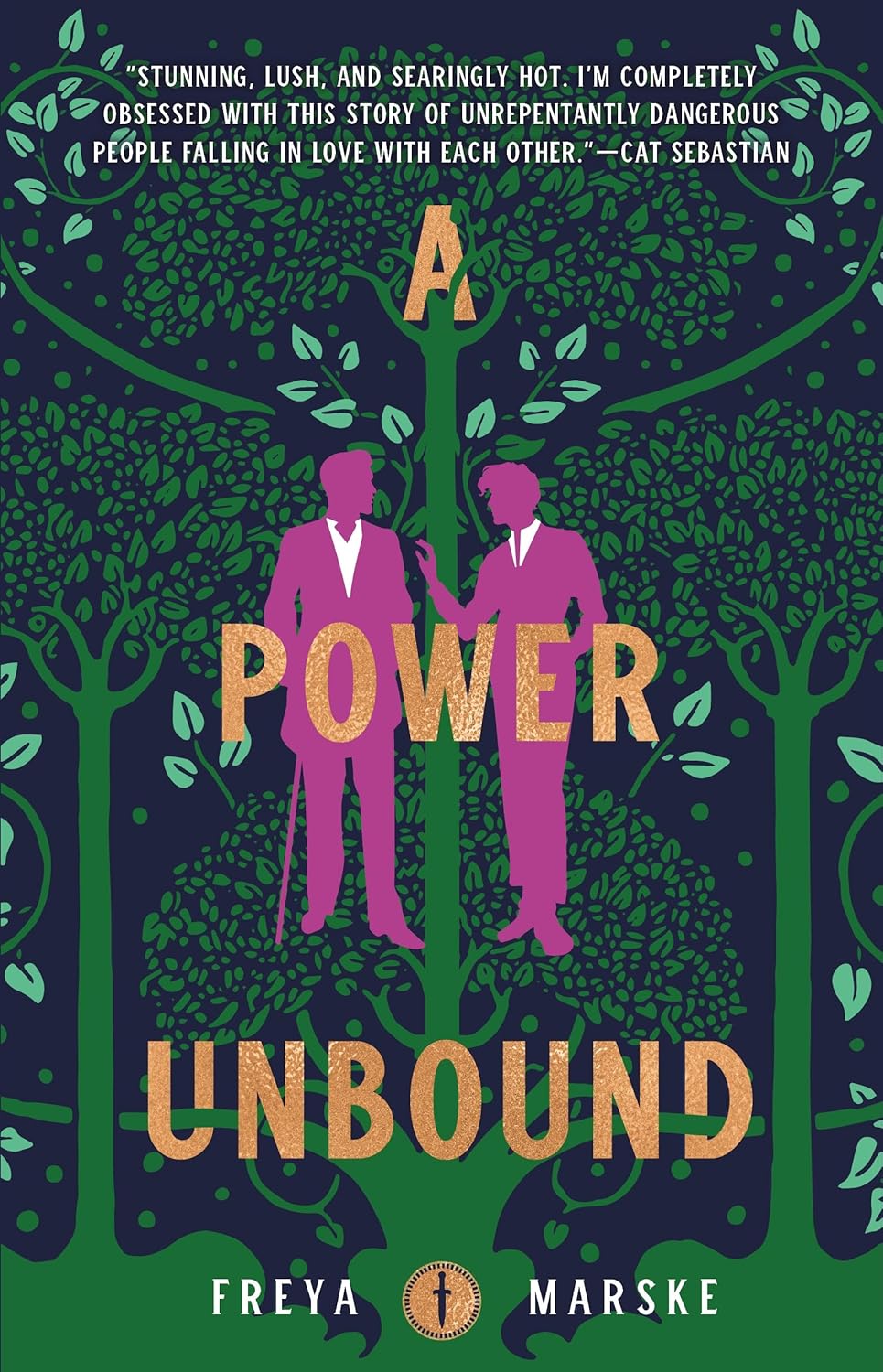
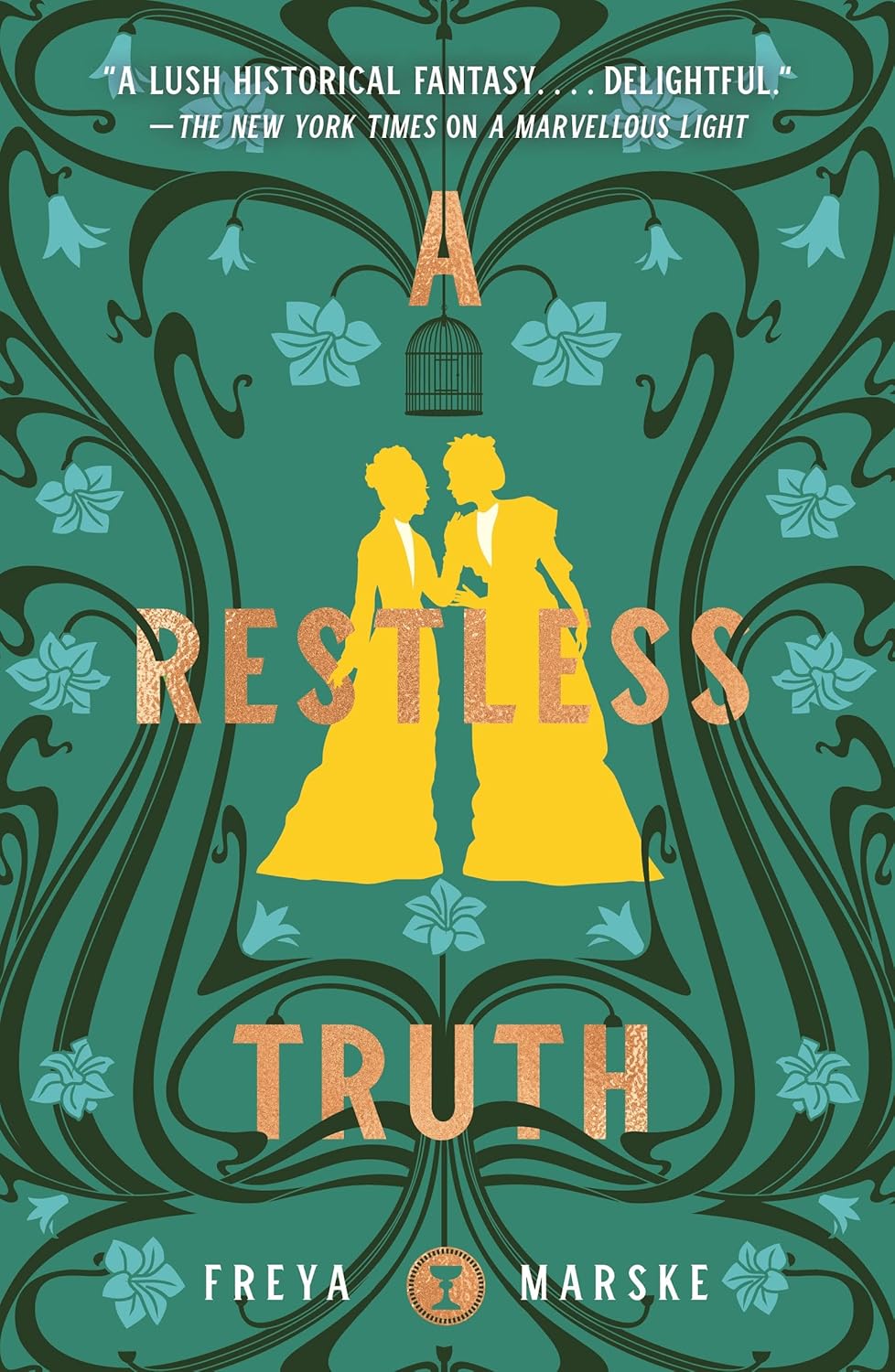
Billed as historical fantasy, with a strong thread of queer romance, this was an absolutely delightful and fun read – not always joyful in the moment-to-moment struggles of its protagonists (whom I loved), but ultimately deeply satisfying. There was romance (and sex), intrigue and angst, wonderful humor, and a complex magical world. I’m excited for book two, and beyond.

We first meet Reginald Gatling in his final moments, and witness his torture and death by magical means at the hands of assailants unknown. They want to know where something is, and all they get from him, past a secret-binding spell, is the location: his office. In the next chapter, we meet Sir Robert (Robin) Blyth, who is irritated and mystified by his new job replacing the missing Reggie – in Reggie’s office. (Here we also meet the indomitable Miss Morrissey, assistant to Reggie and now Robin. As both a woman and a person of Indian descent, she is exceedingly rare in British civil service, and will prove to be one of the most capable, awesome, and entertaining characters in this story, although a relatively minor one.) And in bursts Edwin Courcey, who had been Reggie’s special liaison and is now to be Robin’s, although they do not get off to a good start. For one thing, Robin has no idea what his job is supposed to be.

What quickly follows is Robin’s “unbusheling,” which is what the magical world calls it when a nonmagical person is let in on the big secret that magic does in fact exist. Turns out that in Britain’s already heavily stratified society, there is a yet another distinction between magical and nonmagical families, and even the former can have the odd, unfortunate nonmagical individual – like Miss Morrissey, whose sister is a very capable magician. And then there is Edwin, who comes from a powerful, wealthy, magical family, but is the bullied younger son, and though an enormously accomplished academic student of magic, has vanishingly little power of his own. Robin is an athlete, a jock, not a scholar, and though he has a title, his estate is nearly bankrupt, and he has a much-beloved younger sister to care for on his civil servant’s salary. Add to all of this the mystery of the missing Reggie, a curse soon (and violently) set upon the freshly unbusheled Robin, Edwin’s own family traumas, and an enigmatic threat to the magical world as we know it – indeed, maybe the world overall – and Edwin and Robin may need to figure out how to get along with each other even if it does not come naturally.

Phew. I’ll stop here, with much left unsaid. This was a completely absorbing, page-turning adventure, and when we finally got to the sex-and-romance (after a long slow burn) it was a great relief. (Fully realized sexual content, if that’s a concern.) This magical world and its rules are complex, even sometimes a bit overwhelming – but that’s Robin’s experience too, so we’re just wrestling with it all by his side, and will probably survive as he does.

This book is pretty heavily male, but I cannot understate the value of Miss Morrissey, who may not have magic but outdoes all the powerful men who surround her in cleverness and the ability to get things done, including some scathing (and hilarious) observations about gender in society. I would follow Miss Morrissey anywhere. Book two does promise to be centered on women, although (from a glance) unfortunately not Miss Morrissey. I’m still 100% in.


Rating: 9 swans.

Dandelion is Dead by Rosie Storey

A grieving sister finds that hope, silliness, angst, and even love may be possible amid loss in this astonishing first novel.

Rosie Storey’s debut, Dandelion Is Dead: A Novel About Life, is a glittering riot of grief, laughter, missed connections, absurdities, and the joys and pains of life’s many facets. From one unexpected turn to the next, this story will keep readers emotionally engaged and yearning alongside its protagonist.

Poppy Greene is 37 years old and deep in mourning. It has been 231 days since her older sister, Dandelion, died “and, somehow, it was spring again.” Dandelion had been wild, irrepressible, author of all the sisters’ adventures; without her, Poppy (a professional photographer, ever the observer) is unmoored. Going through her sister’s phone, she clicks on a dating app and, on a whim, answers a message from a year-old match. When Jake asks for a date on Dandelion’s 40th birthday, it feels like fate, or magic, or Dandelion’s mischievous hand from beyond the grave. Poppy does not set out with the purposeful intention of impersonating a dead woman (nor of cheating on her longtime boyfriend, Sam), but she finds Jake incredibly magnetic, and soon begins a romantic relationship in her sister’s name. Dandelion Is Dead alternates between Poppy’s close third-person point of view and Jake’s, revealing his own intense attraction to the woman he knows as Dandelion, and his own past traumas. Poppy and Jake are both awkward, ungraceful, and heartfelt in their romance; both commit dishonesties that threaten everything they value.

The aptly named Storey excels at whimsy, delightful comedy, and pathos. Her plot is composed of debilitating losses, madcap adventures, treacheries, secrets, love, and striving. The profound charm and appeal of Poppy and Jake lie in their contradictions. They suffer terrible losses and make poor choices; they are capable of both sweetness and betrayal. The cast is enriched by Poppy and Dandelion’s lifelong friend Jetta (and her loyal husband); the young son Jake is devoted to, and his masterfully nuanced ex-wife; Poppy’s unsympathetic boyfriend; and of course, the mythic Dandelion herself. While its subtitle feels accurate, this debut is also clearly a novel about grief. Poppy learns that if she is going to find a fulfilling life after losing her sister, she must grapple with her own mistakes and those of her loved ones, even those she’s lost. Dandelion Is Dead is a scintillating achievement in emotional range, humor, and wisdom. Poppy Greene thinks she is the less magnetic sister, but no one who meets her will easily forget her.


This review originally ran in the November 7, 2025 issue of Shelf Awareness for the Book Trade. To subscribe, click here.


Rating: 8 Twisters.

The Midnight Bargain by C. L. Polk

As much as I loved the Kingston Cycle, it’s tempting to say this is my favorite Polk yet. I am really digging the combination of historical setting (including lots of lush clothing detail – not really my area but it’s surprising, richly enjoyable in Polk’s capable writing hands), romance and strong feeling, with a fantasy / speculative framing but around very approachable values. This author has mastered that combination, and it is extremely satisfying to this reader.

In this case, please meet Beatrice Clayborn, the elder daughter of a banker father who has squandered the family’s wealth, and a magician mother who has been collared, literally, so that she cannot practice magic. This is the cost of marriage for female practitioners in the culture Beatrice has been born into. Men have the opportunity to study and improve their practice; women are bound. Beatrice chafes at this rule; she has been practicing her magic in secret, searching for the coded grimoire that will allow her to become a mage. If she succeeds, she will make herself unmarriageable, thereby disappointing her father, but she will also be able to help him improve the family’s financial situation. If she fails, she will be married off to a man of her father’s choosing, collared, denied her true self. We are introduced to Beatrice on the cusp of the bargaining season: she is being presented to high society as an ingenue (read debutante), for the purpose of attracting a suitor (preferably several) and eventually an advantageous marital match.

Bargaining season involves all the primping (clothes! and maquillage), dancing, preening, and social chess you can possibly imagine. It is profoundly not Beatrice’s scene; but it is very much Harriet’s. Harriet is Beatrice’s younger sister, and although she can be a little hard on Beatrice’s nerves, she is also one of the elder sister’s greatest concerns. Beatrice knows that if she fails at bargaining season – if she reveals herself as a “difficult woman,” undesirable, fails to make a match – she will cost Harriet her own chance at the same. Harriet is actually good at these games, and likes them, and deserves her own shot. Beatrice needs to become a mage and prevent her own marriage – but not appear to fail at the social game. It’s complicated.

So she’s struggling to be attractive but not too attractive, and never objectionable (even when the most objectionable men are thrown at her, and even when they are unspeakably rude), and meanwhile she’s struggling to train herself to a very high level of magical performance – and she’s made a new enemy, who might be becoming a friend, and whose brother is interesting. Powerful, wealthy, gorgeous, a capable magician – and he shows a surprising capacity to listen to Beatrice’s opinions on women’s rights. But if Beatrice marries, even for love, even to a man of her own choosing, she will lose her magic forever. She might just wind up facing a lose/lose set of options. But what if there were another way?

I appreciate that Polk’s alt-historical setting feels accurate and real, and the issues at stake – women’s rights, mostly – are both modern and at home in her setting. (Feminism is not new, is it, nor the need.) And I guess part of the reason I find all those period-clothing details so interesting is that they are, in fact, about class and gender and those bargaining season politics. And maybe it’s just a little bit fun to read about the frills and lace and stomachers and fichus and other things I had to look up – I have no time for it in my real life, but part of the fun of reading is to experience other lives, isn’t it? At any rate. This novel was fun and wrenching and powerful and just absorbing, and I would read another twenty-five of them by this author; I hope they are writing furiously and keep doing it for a long time. What’s next??


Rating: 9 picnic baskets.

Even Though I Knew the End by C. L. Polk

I’m a big fan of C. L. Polk.

Even Though I Knew the End is romance amid magic and determinism wrapped in a PI novella. (It’s actually a bit of a much-less-dark cousin to last week’s Harmattan Season.) When we meet Helen Brandt, she’s in a Chicago alley attempting an augury, for which she’ll be paid a whopping $50, which she can add to the nest egg she’ll leave her beloved, Edith, on this their last weekend together. The murder she’s meant to investigate turns out much uglier than originally understood, and besides, her augury is interrupted by two members of the Brotherhood of the Compass, a sort of magical professional society from which she’s been barred. Oh and one of them is her long-lost brother (literal). Same-sex love in 1941 Chicago is a challenge unto itself (Helen has friends who have disappeared into insane asylums, for example), as is being a woman in that same setting. Add to that mix angels, demons, souls sold and stolen and earned back.

I loved the historical setting (but plus magic), and the queer speakeasy and community; I loved the femme fatale / gorgeous-but-dangerous-dame sort of character, and found Edith’s religious devotion an unexpected twist. Again (and in such a short time span for this reader) I met some classic or traditional elements of a noir tale, mixed up with new ones. I heard echoes of Chuck Wendig’s Miriam Black. But where Harmattan Season was grim, Polk offers hope – however bittersweet and limited – for a happier ending. As smoke-shadowed as this world is, Even Though I Knew the End is also deeply sweet in its romantic element.

I felt that those Polk shorts I read recently offered varied degrees of success with the shorter format – meaning, some felt a bit more complete or fully realized than others. Many writers, I’d venture, get trained in the novel-length form, and/or have the most reading experience in that length; masters of the short story seem fewer than masters at the novel. (Am I reaching? Do you agree?) I don’t know if that shorter form is harder, or just a place where we tend to get less experience. At any rate. If Polk was experimenting with highly enjoyable but imperfect success in those shorts, here I feel they have achieved something pretty perfect, fully realized, in these 133 pages. Which is not to say I don’t want more of Helen (and Edith) – I very much do. But Helen’s days were always numbered; maybe this is all we get.

Plenty gritty but still sweet, masterfully complete in a small package, with period detail and imaginative flair–I love this story and will follow Polk wherever they may lead next.


Rating: 9 perfect cups of coffee.

The Bookshop Below by Georgia Summers

This dark fantasy about the magic of books and the power of love is both heartrending and inspiring.

Georgia Summers (The City of Stardust) renders an enchanting world of self-sabotage, romance, deadly ink magic, and dearly beloved bookstores in her sophomore novel, The Bookshop Below. London was once full of shops where books and the magic they held could be exchanged for the priceless: self-extracted teeth, a lock of hair, a firstborn child. In contemporary times, the force that imbues books and bookshops with their power, through the particular magical workings of booksellers, is fading. Now Cassandra, a disgraced former bookseller, is drawn back into the life that exiled her, just in time to die along with the world she reveres–or, perhaps, to save it.

She’s been living as Cass Holt for years, getting by (and keeping her hands on the books she loves) in the most ignoble fashion: Cass is a book thief. She is also one of the most talented readers–wielders of the magic within enchanted books; now she sells that gift without scruples to whomever can pay. But Cass once had another name: “Cassandra Fairfax, named after a woman whose words melted into thin air no matter how truthful they were, with the surname of a character in disguise from a novel by a long-dead author. Layers upon layers of insubstantiality.”

Summers’s enchanting fantasy opens with Cassandra in great danger, called to return, reluctantly, to the bookshop where she was raised, trained, and then banished by her mentor, Chiron. She was once his protégé, destined to become an owner one day. Now, just as suddenly, she finds herself reinstated, struggling to rehabilitate Chiron’s decayed shop “and all its finicky, unpredictable moods.” She is in over her head, wrestling with her considerable guilt over past crimes against bookshops, against the underground river that powers the bookshop systems in ways Cassandra has yet to understand, and against Chiron himself. She is in danger from enemies who know about her deeds as Cass Holt, and whatever is threatening the bookshops. Cassandra must manage a bookseller she feels lucky to hire, a wonderfully capable woman named Byron; a handsome, magnetic rival named Lowell Sharpe; and the duty she feels to solve the mysteries of what happened to Chiron and why the magic bookshops are disappearing. Cassandra is not sure she wants to be here at all, let alone on the hook for saving everything she knows from destruction. But she feels she owes a debt. She finds she cares about people she never expected to. And she uncovers an enormous secret about her own origins that upends the stakes entirely.

The Bookshop Below offers a delicious combination of shadowy, sinister magic, wistful romance, propulsive action, and the utter reverence one holds for the right book. Summers excels at transporting her readers to a dreamy otherworld where anything is possible.


This review originally ran in the September 26, 2025 issue of Shelf Awareness for the Book Trade. To subscribe, click here.


Rating: 8 mugs that say “I slay comma splices.”

All the Wandering Light by Heather Fawcett

This one follows Even the Darkest Stars, with similar darkness, coming-of-age growth and learning and complication, and love. As is my usual practice, this review will contain spoilers for that previous book but not for this one.

So, on with the spoilers: at the end of book one, we had been hit with the shocking news that River himself was secretly a witch, and therefore obviously (to Kamzin and those of her world) a natural enemy. He has broken the binding spell that stole the witches’ power generations ago, and now their powers are restored, and the Empire is in danger. We learn quickly, though, that River is not so much motivated by wanting to overthrow or hurt anybody; rather, he wanted the freedom of possessing the powers he was born to. He wants to be himself. But by releasing all witches, he has enabled those who have crueler goals than he does, including revenge. His brother Esha intends to be the next emperor of the witches, and desires power enough to destroy the humans’ Empire, including Kamzin and everyone she loves.

In similar fashion to book one, a race is on, this time to get to a fallen star that is said to offer unimaginable power to whomever wields it: the human Emperor or the witch one. Kamzin travels with her friend Tem, her sister Lusha (and the two sisters offer nearly infinite messy siblinghood), and for part of the way, Mara, who was once a member of River’s crew. In the other camp, River reluctantly, even half-heartedly, helps his brothers. The plot of the book follows these two groups, centered on our protagonist, Kamzin–angry and hurt at her betrayal by the magnetic River, who had been a bit of a romantic interest–and her counterpart, River himself, who is likewise confused at the way the world reshapes around him and the power struggles that involve him even without interesting him much. This conflict will build to affect (again) the very fate of the world, and hinge upon the ability of the humans, in particular, to reconsider old prejudices.

Along the way, the part of this book that I struggled most with was the detail in some of the fighting or conflict scenes. Maybe it’s just this reader, for whom the fighting (in its minutia) will never be the most interesting part of the story. But especially with the ethereal, ghostly sort of enemy (and other only-halfway-there monsters), the shadowplay violence is a bit abstract, and doesn’t hold my attention well enough to sustain the way some of those scenes dragged on. I got a bit impatient. I think where Fawcett excels is, yes, worldbuilding, but most of all relationships: the way people (or witches, or stars!) interact and communicate and treat each other. And/or, this is where I’m most engaged with any story. There was lots to love here, just a little that I wished moved a bit more quickly. It’s worth noting that the two books in this duology were Fawcett’s first two. It’s clear to me that she’s improved from here.

I have just two more middle grade books of hers to read and then we have to wait for her to write more. Fawcett remains one of my favorite authors of the last year or two, so I hope she’s hard at work!


Rating: 7 beautiful ball gowns (what?!).

Trouble the Saints by Alaya Dawn Johnson

Trouble the Saints is bewitching, mesmerizing. It begins mid-scene, a move that is always risky but can have big rewards: the writer asks the reader to wade through a little confusion in favor of action and immediacy, trusting her to wrangle the context clues and have patience with the pace at which details and secrets unfold. It’s well done here. There are cards, and dreams, and magic hands – saints’ hands – and a violent backstory for a protagonist who is however strongly committed to her own concept of justice. The reader finds out as she does how she’s been betrayed – and by the one she loves the most.

Phyllis, or Pea or Sweet Pea to those she is close to, is a paid assassin for a Russian mobster in early 1940s New York City. She is known as Victor’s knife, or Victor’s angel – because she only agrees to kill when the victim deserves to die. She is also a ‘high yellow’ woman of color passing for white in a pretty high-stakes setting. Her years-ago lover, Dev, is a Hindu man guided by karma and reincarnation; he could not abide Pea’s work. His current partner is also one of Pea’s dearest friends, the singer/dancer/entertainment manager Tamara, who is Black enough to suffer the full weight of prejudice and discrimination when Pea can sometimes skirt it. So: violence, organized crime, race and racism and colorism, oh and Hitler’s on the rise, and also Pea’s immaculate skill with her knives is owing to her saints’ hands, which manifest in different ways for different individuals. Dev can sense threats with his. Tamara doesn’t have the hands, but she is an oracle: with her great-aunt’s cards she can read fortunes, or the future, or both – the rules are revealed slowly, to us as well as to these characters. There are others, with different backgrounds, skin tones, and degrees of magic or understanding. Danger and hauntings are everywhere, but there is also romance and the kind of connection that transcends that label.

Trouble the Saints is an astonishing book that keeps surprising, not least with its changes in perspective. These subjects range widely and never feel overambitious for the remarkable Alaya Dawn Johnson, who imbues even the gruesome with poetry. She’s a new name to me but one I’ll be looking for. It took me a day or two to recover, and I’m still thinking about love, friendship, and what we carry on with us. Whew.


Rating: 8 letters.

Etiquette for Lovers and Killers by Anna Fitzgerald Healy

A bored townie in 1960s Down East Maine comes into her own when both romance and a series of murders enter her orbit.

Anna Fitzgerald Healy’s debut novel, Etiquette for Lovers and Killers, is a darkly humorous, lighthearted romp of a mystery set in mid-1960s Down East Maine with an unusual heroine. Billie McCadie is a townie in Eastport, on Passamaquoddy Bay, where “fishermen squatting in trailers” abut “Vanderbilts languishing in mansions.” She’s never felt at home with the other locals, who fail to appreciate her sarcasm or her ambition to study linguistics and work in a museum. “I’ve grown up listening to their sock-hop hopes and Tupperware-party dreams, but my aspirations don’t fit in a casserole dish.” Since the tragic death of her parents, Billie, a “twenty-six-year-old virgin,” lives with her grandparents and works as a seamstress at Primp and Ribbon Alterations. Her great thrill, aside from the novels, dictionaries, and etiquette manuals she loves, is checking her post office box for rejection letters responding to her many employment applications to museums around the country.

But then comes the fateful summer when Avery Webster notices her. Billie receives an envelope containing a love letter to an unknown Gertrude, along with an engagement ring. She is invited to a solstice party at the fabulously wealthy Webster family’s estate, where she discovers a freshly murdered corpse–Gertrude. Avery has the potential to be Billie’s first taste of romance, but the strange communications pile up, along with the bodies, in sleepy, previously crime-free Eastport. And Billie leaps into all of it, because “Who needs a life when you’re busy investigating a murder?”

Billie’s wry narration of these events is peppered with wordplay and the occasional footnote commenting (still in Billie’s voice) upon the etymology of “home,” “love,” and “tuxedo.” Chapters are prefaced with relevant quotations from the book of etiquette that belonged to Billie’s mother, which emphasize that even amid a murder case, a sex scandal, and a budding romance, in 1960s Eastport, one must be mindful of appearances and manners. Billie’s never been in such danger, but she’s also never had as much fun, finally coming into herself, gaining confidence, and learning what she might want from life aside from a museum job: “So what if I’ve ended up in a Highsmith rather than an Austen? I’m the main character, and I need to start acting like it.”

Stylish, playful, and more than a little tongue-in-cheek, Etiquette for Lovers and Killers blends intrigue and romance into a perfect cocktail. Billie herself offers a delightful combination of bookishness, wit, and questionable decision-making that will keep readers on edge until the final pages. Healy’s debut is good, not-so-clean fun.


This review originally ran in the May 19, 2025 issue of Shelf Awareness for the Book Trade. To subscribe, click here.


Rating: 6 stilettos.

Even the Darkest Stars by Heather Fawcett

I just went ahead and followed Ember and the Ice Dragons with another Fawcett book for younger readers. This one is a bit darker than that; I see that Ember is catagorized as middle-grade where this one is young adult, for what that’s worth.

Even the Darkest Stars is set in a magical-world version of the Himalayas, with yaks and butter tea and very high, very cold mountain climbing. But a parallel world to our own, in which an emperor rules over a huge region, keeping everyone safe from the witches of a bygone time. Our protagonist is Kamzin, a teenaged girl in the village of Azmiri, which is far from the emperor’s Three Cities. Her father is the village Elder; her mother was a great explorer in service to the emperor, but she’s been dead for years. Her older sister Lusha will be the next Elder. She studies astrology. As the younger daughter, Kamzin’s fate is to be the village’s next shaman. She is apprenticed to the current shaman, but is a poor student. Instead, Kamzin has always felt a strong pull to travel, to climb, to run, to map, to explore. When the emperor’s Royal Explorer, the famous River Shara, comes to the backwater of Azmiri, Kamzin knows she must stop at nothing to become a part of whatever has brought him here.

And after some brief intrigue and machinations, we wind up with a race. Lusha, the obnoxious older sister, takes to the road with one of River’s own retinue, aiming to beat the Royal Explorer himself to the top of Raksha – the highest mountain in the world, never climbed by a human, which defeated even Kamzin and Lusha’s late mother. Kamzin succeeds in joining up with the great River Shara, a handsome young man – younger than she’d expected – whom she finds bewitching. Also in their small party is Kamzin’s best friend, Tem, a far more accomplished (though untrained) shaman. And a stowaway: Kamzin’s familiar is a fox (or foxlike critter) named Ragtooth. They share a close bond but also he is apt to bite her. Oh and there are dragons: they are more tangential here than in the last book, but your standard ‘house dragon’ will eat just about anything remotely edible and in response, their bellies put out light. So an alternative to a lantern is to feed your scraps to a dragon. Part pet, part appliance, sometimes a nuisance. It’s quite fun. There’s a lot that is fun in this imaginative world… but also, Kamzin’s world and everyone she loves is in grave danger. It takes a while for the true nature of River’s quest to Raksha to be revealed, but once it is, the stakes couldn’t be higher.

This is a compelling story, populated by mystery, magic, fun creatures, breathtaking landscapes, true friendship, the germ of romance, and a tortured coming-of-age made harder by the possible end of the world. There is also great adventure, death-defying climbs, races for fun and for life-or-death… bit of a Princess Bride list there. My favorite part is that it ends with a clear nod to a sequel, which I’ll have my hands on in a day or so. But yes, also darker than Ember. More bad things happen here, and more is at stake. I may not hand it off to the thirteen-year-old yet. But I am so in for book two.


Rating: 7 sour apples.

Emily Wilde’s Compendium of Lost Tales by Heather Fawcett

This is book 3 in a series, and this review contains spoilers for the first two books.


What I love about the world of Emily Wilde is, first, the imaginative nature of this world and character. Emily Wilde is an academic scholar in the field of dryadology, or the study of faeries; but if that sounds dreamy, check again. Emily is capable of being lost in thought, yes, but those thoughts are generally dry, serious, and certainly research-based. She has an avid, academic passion for her field of study. She has read it all, and will be affronted to discover any theory or study that she’s unfamiliar with. She has no time for sentiment or romance (in either sense); when we first met her, in book one, she didn’t really have friends, other than her companion Shadow, who is a Black Hound (a fae creature) glamoured to look like a very large, intimidating black dog to regular humans. Emily and Shadow live in a regular-human world with decent access to the fae world, if you know where to look. She lives for her work.

In books one and two, we saw her social life expand somewhat, although not without growing pains. She has made friends, however uncomfortable she may be with that fact, and she has a love: formerly an academic colleague with whom she did not get along (one of those enemies-to-lovers tropes), Wendell has turned out to be a long-lost faerie prince, which explains why he seems so lazily disinclined to academic work. Emily had long suspected he faked his work, and this has been proven correct: he’d been skating by on what he knew of faeries by other means. They have a sweet relationship, clearly based in genuine mutual regard, although only one of them is much capable of romance, and it’s not Emily.

Here in book three, Wendell has been returned to his realm, and become a faerie king, by the surprising work of a mortal – Emily herself – in overthrowing the evil queen, Wendell’s stepmother, who had murdered much of his family as other potential heirs. Faeries, it turns out, are quite murderous types, especially those of Wendell’s realm. So in this installment, Emily navigates becoming a sort of queen consort (they haven’t technically married yet, solely because of her cold feet), living full-time in the faerie world (she likes to study them but they don’t necessarily make her feel comfortable), and seeing dear Shadow become frail in his old age. The part of this she’s most excited about is the opportunity for study; she sees research questions and papers she might write all around her. (“If Wendell’s stepmother has us slain before I have a chance to contribute to the scholarly debate, I will be very disappointed.”) She feels only dread at the glamourous and magical queenly gowns she is given, and likewise the other trappings of court. Luckily for Emily (?), nothing ever goes smoothly in Fae, and there will be problems to solve. With research! of course.

So. First, what I love is the imagination at work in this worldbuilding, which is satisfyingly thorough. The various kinds and functions of faeries, and their intrigues and class divisions, are all fascinating in themselves. Second, what I love is Emily’s character and voice. These books are told as Emily’s journals, complete with the (sometimes slightly awkward, but they do feel believable) explanations for how, in the middle of great danger and adventure, she has come to be writing journals entries. (Answer: writing is how she processes and self-soothes, and, research über alles; these notes could become a paper or conference presentation! Once we get to know Emily, this actually checks out.) Getting to hear these adventures in her own voice emphasizes Emily’s droll character. She never really gets over her sense of awkwardness at how much she loves Wendell; the bits she glosses over (sex) are as telling as those she sinks deeply into (footnotes!) – also, Heather Fawcett has been a YA and middle-grades author prior to this series, so keeping the sex off-screen and vague is probably a comfort zone. These books are just really fun, and wholesome even when they get a bit gruesome. It is comforting to see that even when terrible things happen they can be undone.

I was genuinely very sad when I finished this book, which I fear is the last in an intended trilogy. I need there to be more from this delightful author. I guess I’ll do some YA reading soon.

On the other hand, this book (which ends in a library) does leave room for a sequel. Fawcett! We could have more Emily!

Do recommend.


Rating: 8 ornate, bespoke notebooks.