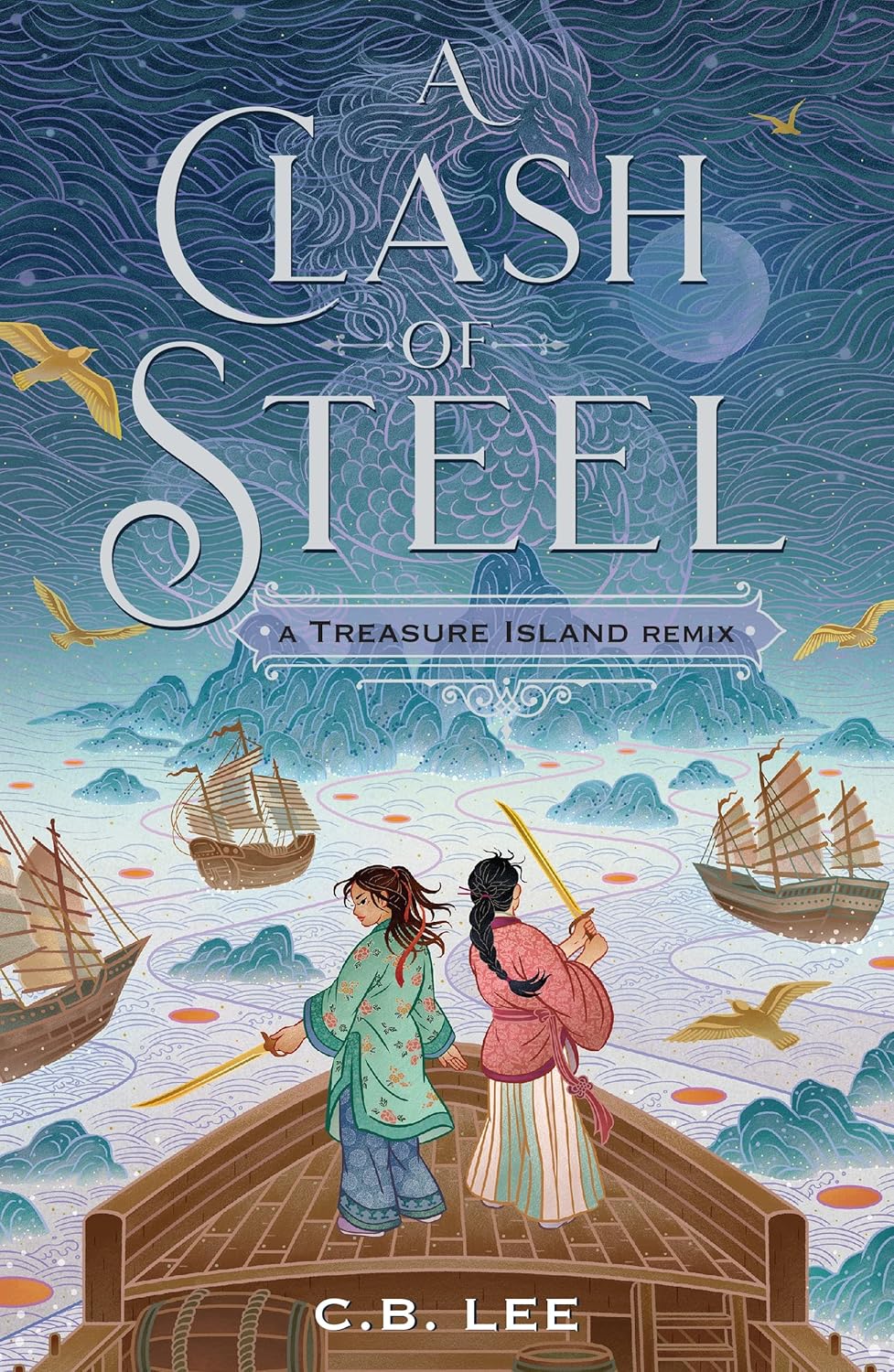
Clash of Steel: A Treasure Island Remix by C. B. Lee

I think this is my favorite of the remix series. Clash of Steel follows Treasure Island perhaps a bit less closely than some, but the broad strokes are there. I love the way that C. B. Lee has adopted their own personal history, and really substantive research into world history, to reset Stevenson’s classic tale of adventure, pirates, hidden treasure, family, loyalty and betrayal (etc.) in the South China Sea in piracy’s golden age. In this process, they offer protagonists who are girls and women, queer, and Chinese and Vietnamese. None of this is cut to fit Stevenson’s story; it’s a riff, set to history, in a time and place where it fits naturally. I loved the whole story. I also loved the supplemental materials at the back of the book, but let’s go in order.

We begin with a prologue set in 1818 South China Sea in which we meet an eight-year-old girl named Anh, aboard a small fishing vessel with her mother (the captain), her little brother, and a small crew. We get a glimpse of dangers at sea, a tight-knit family group, a daring young girl, and an interest in tales of hidden pirates’ treasures. Then we fast-forward to 1826, a small village in China’s Guangdong province. Sixteen-year-old Xiang has never left her village, not for lack of desire. Her father is long dead at sea; her mother is a successful salt merchant and proprietor of several teahouses, including the one where Xiang lives in this backwater, locked away, kept ‘safe’ but unhappy. She dwells in the stories she reads of travel and adventure, and on the high point from where she can view the city of Canton, and dream.

An opportunity comes when she convinces her mother to take her to the city, to visit the larger teahouse there, to see the commercial center–Mother wishes to marry her off to a young man from an appropriate family, but Xiang intends to show enough prowess that she might be permitted to run the teahouse someday. She has always yearned for her mother’s approval, which has never come. If only she could prove herself worthy, she might win that approbation as well as a chance to have a wider life than the village can ever afford. In her brief hours in the city, she meets a magnetic girl her own age–Anh–and gets a snatch of an idea of the kind of life that might be possible: adventure, gumption, authenticity, more. Then a series of events forces her hand. Faced with being shipped peremptorily back to the village forevermore, Xiang takes a chance and runs away. See Xiang on a fishing ship that is also a trade vessel that is also a smuggling ship; see her learn to sail and fend for herself; see her forming closer relationships than she’s ever had before. For a time, it seems all sorts of things might be within reach: family, love, riches, independence. Or violent death and the end of everything she thought she knew about her own background.

Xiang’s story calls on Lee’s own history (descended from Vietnamese refugees of the fall of Saigon, with Chinese roots “tangled together in past generations in conflict and trauma,” and yes, with pirates appearing in that story as well) and the documented history of Zheng Yi Sao, a “pirate queen” who commanded over 70,000 pirates and over 1,200 vessels. I was so pleased by not only the author’s note and acknowledgments, but also language notes, pronunciation guide, and extended historical notes. Finally, we were gifted with an alternate prologue, which (I agree with Lee’s editor) would have revealed too much of the plot if it had appeared at the beginning of the book; but coming where it did, offers intriguing character insight. I wonder if it might have made sense as a sort of flashback late in the story. At any rate, all this extra material enriched my experience of this story, and I loved having the extended historical notes in particular, because I knew nothing of this era of world history in which a Chinese and Vietnamese empire of pirates controlled the South China Sea and subdued all Chinese, British, and Portuguese naval efforts. Thrilling! Oh, and the normalcy of same-sex relationships in this time and place setting, which was apparently disrupted only by Western influence during the Qing dynasty. These references to history make the imaginative adventure tale all the more engaging, at least for this reader.

This story was captivating, and I loved having enough background to appreciate it on several levels. I’ll be looking out for C. B. Lee and am definitely in for more remixed classics.


Rating: 8 baos.

Most Ardently: A Pride & Prejudice Remix by Gabe Cole Novoa

I wasted no time after Into the Bright Open in getting into the next remix. Here, Pride and Prejudice retains its setting in time and place and the essentials of characters, with one great exception: the individual we know in the original as Elizabeth Bennet is here a trans boy named Oliver. Only a few people know his truth: his older sister Jane, his aunt and uncle, and two dear friends, Charlotte and Lu, who are, secretly, a same-sex couple and not the close friends their community believes them to be. He has arranged a workable system for going out as himself, sometimes climbing out the bedroom he shares with Jane at night in clothes stored under his bed, and sometimes going to Charlotte’s to change into clothes she keeps there for him. When he meets Darcy for the first time, he finds him handsome, but is repelled by his poor social graces and Darcy’s obvious disdain for the young person presented as Elizabeth.

Gabe Cole Novoa opens this novel with a note acknowledging that Oliver is frequently misgendered, and his deadname used, by his community and his own family, “though never by the narrative.” Novoa observes that this will be painful for some readers, and gives them fair warning: the author has done his best to handle the issues with sensitivity, but the book centers in some ways around Oliver’s dysphoria. As a reader who does not share this experience, I can only say that I thought Oliver’s dysphoria, misgendering, and seeking against convention for his authentic self were represented with nuance and grace, and accurately as far as I can see from here. Indeed, I thought the portrayal was of a sort to help other cis people like myself empathize with something we haven’t experienced for ourselves, in the best ways, which is some of the best work fiction can do for us.

Beyond that good work, Most Ardently is as sweet and transporting a love story (and a mess of misunderstandings) as the original it’s based on. Oliver presenting as ‘Elizabeth’ versus himself, to the same groups of people – and most importantly Darcy – offers some Shakespearean scenes of confusion, although these are less comedic because the Elizabeth character is a painful lie Oliver is forced to tell. There is one scene when Darcy laughs and laughs at an ironic turn that I do find nicely funny. And there is a parallel to the expected happy ending that is so oh satisfying – perhaps more so for its unlikeliness. (Novoa includes a historical note speculating on trans people who have ‘passed’ undetected in history. By definition, these are unknown to us. Novoa takes a hopeful stance.) I found the whole result sweet, entertaining, sympathetic, and wholly rewarding in the end. This was an easy and fulfilling read, and I’m ready for more in the series. I’m so glad this book is in the world.


Rating: 7 pairs of trousers.

Into the Bright Open: A Secret Garden Remix by Cherie Dimaline

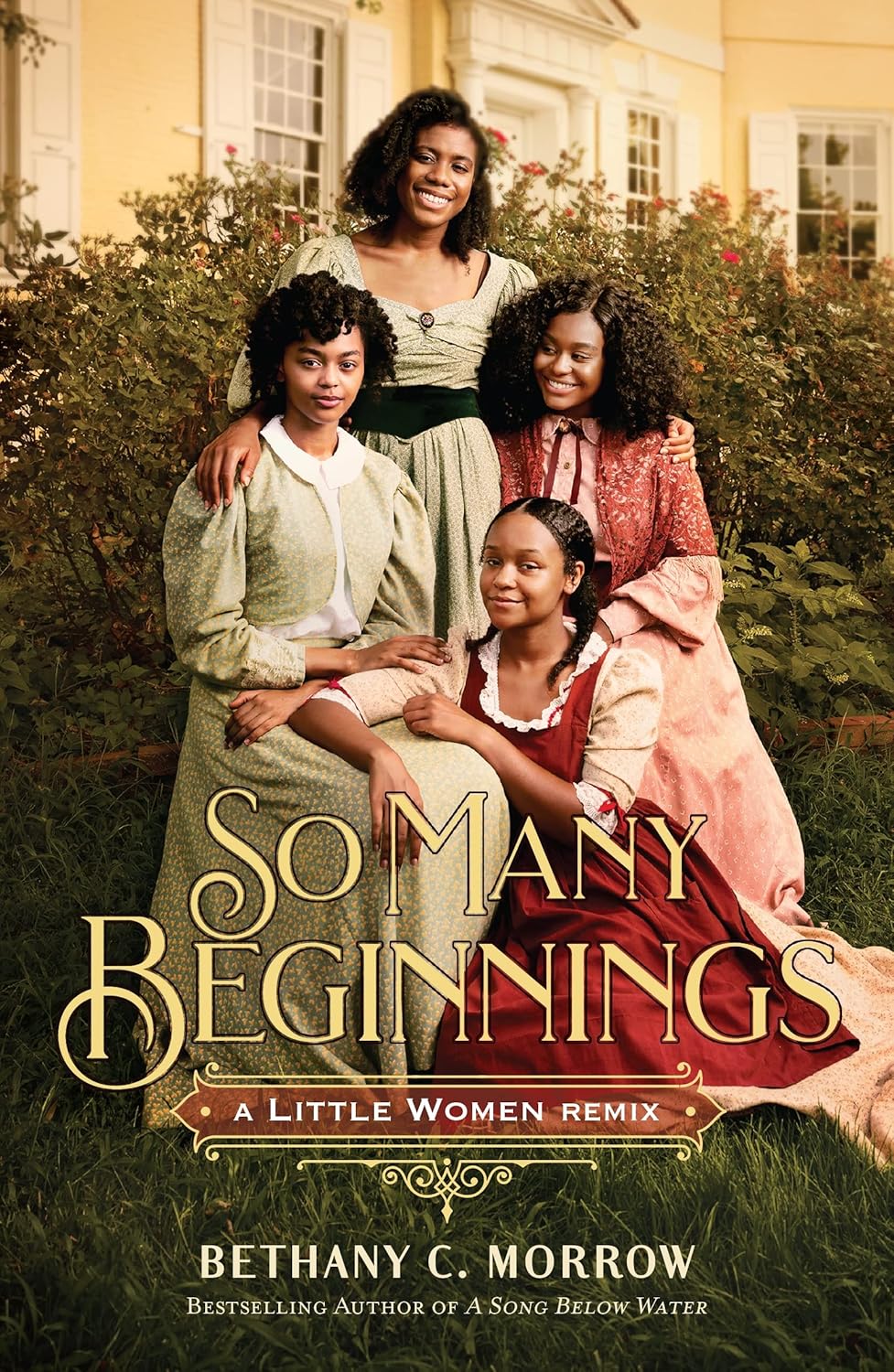
I stumbled into this book because I was following Cherie Dimaline (VenCo), but am glad to have discovered the “Remixed Classics” series from Square Fish, in which “authors from marginalized backgrounds reinterpret classic works through their own cultural lens.” I’m looking into a few of those, including Clash of Steel (Treasure Island), So Many Beginnings (Little Women), and Most Ardently (Pride and Prejudice). I love a daisy chain like this.

Into the Bright Open retells Frances Hodgson Burnett’s The Secret Garden, but in 1901 Ontario. Mary Craven is the unpleasant, lonely, spoiled-and-simultaneously-neglected child of a wealthy, important couple in Toronto, raised mostly by a nanny she does not like who does not like her, when her parents are killed in a car crash and she is shipped off to the Georgian Bay to live with an uncle she’s never met. He is not present when she arrives; she is greeted instead by household staff who treat her with more familiarity than she finds appropriate, but she quickly rethinks her stance as she finds them also warm, even friendly. Her uncle’s estate is grand, but by Mary’s standards, wild. Gardens border upon woods, and the ocean is an untamed thing. Native people and “half-breeds” initially offend her snobbish sensibilities, but Mary is just fifteen: young enough, and lonely enough, to change her mind. This version of Mary struck me as more introspective and more capable of self-criticism than I remember the original Mary Lennox to be. It also got me thinking: while readers are certainly accustomed to accepting flawed and imperfect protagonists, Mary Lennox might be an unusually unlikeable one. This Mary Craven, though: she definitely does unlikeable things, but with the benefit of access to her thoughts & feelings (this is told in a close third person), I find her quite sympathetic. She’s learning. She’s growing.

So. At the uncle’s house, Mary of course discovers the expected (if you know the original): the secret garden, and the secret child, a new friend for the friendless orphan girl, hidden away. There is a neighborhood friend as well, here a girl with wondrous comfort, confidence, and skills in the outdoors. There are further parallels to the original novel, but also a sinister twist.

This version, though set at the same point in history, feels more modern in its perspective, and I suspect would feel a bit more accessible to the modern young reader. I’m excited about the “Remix” series, and still excited by Dimaline.


Rating: 7 lines of poetry.