a collection of destinations for you

Today I wanted to share with you how I start my day, and where it takes me. Maybe you’ll come along.

When I get to the library in the morning, one of the things I try to do as it fits into other necessary morning tasks, is read my Shelf Awareness email. This is a daily digest for booksellers (or, in my case, librarians) with bookish news. A lot of the news regards the bookselling industry specifically – how Barnes and Noble and Borders are doing, profiles of small or family-owned book stores, market trends, and whatnot. These items are not terribly interesting to me, usually, but I skim them and am sometimes interested. I read it, more, for the book reviews and interesting links. Generally, bookish trends are of interest to me and help me do my job. It does pay for me to know what people want to buy because I buy the books for my library and obviously I try to provide what people are wanting these days. If you’re interested in the emails, you can sign up here.

Today, for example, I learned from Shelf Awareness of the renaming of the Boscobel Aerodrome in Orcabessa, Jamaica as the Ian Fleming International Airport. Ian Fleming wrote the James Bond books, reportedly at a “scenic retreat” nearby. That’s a fun fact.

I also found this teaser: “the Guardian asked readers to check their literary balances with a ‘banking in literature’ quiz”, and I thought, oh boy a literary quiz! but it turned out to be quite specifically a quiz about banking in literature, which turns out to be something in which I am not an expert, so that was kind of a flop, for me personally. Maybe you’ll do better.

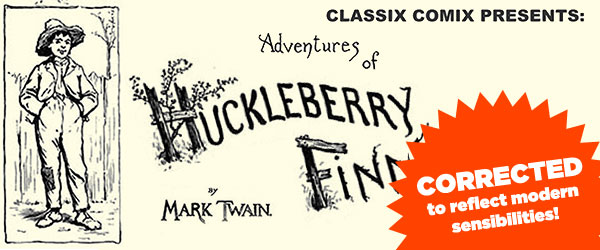
But then I found Tom the Dancing Bug’s classix comix version of the Adventures of Huckleberry Finn (Corrected to reflect modern sensibilities). If you’re reading my reading blog you’re probably the sort of person who is also aware of the general furor regarding NewSouth‘s republication of Mark Twain’s The Adventures of Tom Sawyer and The Adventures of Huckleberry Finn without use of the n-word or “injun”. I will say very briefly that I am scandalized and strongly against this move, for the oft-cited reasons that a) we respect Mark Twain for his original genius and no one should be re-writing him, b) he put those words in on PURPOSE for goodness sake and with a purpose, which included satire and the bringing to our attention that these words are and were overused and wrong, and c) that the use of these very words always incites discussion (as evidenced by this recent furor), which is a good thing. YES these words are offensive, and this offense is still relevent; that’s why we still need Mark Twain’s work as he originally, thoughtfully created it. So. See the above cartoon for what I think is a very clever satire of the republication.
Next, Shelf Awareness tells me that David Nicholls’ book One Day is moving forward and being made into a movie, which was predicted from the very start. I read this book when a patron loaned it to me, and I enjoyed it fine, although I definitely agreed with Publishers Weekly’s view that it was made for the screen. I don’t watch a lot of movies (largely because the Husband doesn’t like to) but I do like Anne Hathaway, who’s in this one, so I may find a way to see it (without the Husband).

Something else I got out of today’s Shelf Awareness email – and this is a little embarrassing – but when I followed the above link to that ‘banking in literature’ quiz, I found mention of Watership Down as “bucolic children’s fiction”, which didn’t sound familiar to me. I mean, I know the name Watership Down (by Richard Adams), but didn’t think it was a children’s book; I think I had it crossed up in my head with Fahrenheit 451 or Slaughterhouse 5 or something. So I had to go look up Watership Down, and it sounds lovely (and also it turns out that at least somebody on wikipedia agrees with my vague impression that it’s highly allegorical), and now I am determined to read this book because it sounds great. So there you go, after clicking several links and looking things up, I have a new book TBR, and I guess that’s part of what Shelf Awareness is all about.
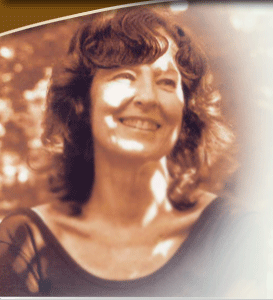
Finally, in my blog explorations, I came across a really, really delightful post today from author Sharon Kay Penman, in which she discusses historical accuracy, her dedication to it (hear hear! something I blogged about earlier), her responsibility to us readers, and some specific challenges. For example, the personalities she writes about, from the Middle Ages, have significantly different values from ours, regarding women’s rights, animal cruelty, conduct in warfare, etc. I highly recommend taking a few minutes to read this post from an author I deeply respect. (Sharon Kay Penman–>)

You’ve just taken a tour through my morning ramblings on the interwebs; hope you’ve found something interesting. 🙂 What do you play with on the internet to find bookish news or tidbits?

Midweek bookish transitions.

Well folks, today is the sad day that saw the end of When Christ and His Saints Slept. It’s always a good book that leaves me mourning its close. I can still remember finishing Wuthering Heights in high school and moping on the couch for days, just so sad that there was no more.

Moment of silence.

The story of Maude/Henry and Stephen/Eustace’s 19-year battle for the English crown ended a little bit anticlimactically, which is no judgment on Penman’s part since she stuck to history! But wasn’t a let-down, or anything. She finished on a hopeful note, with Ranulf and Rhiannon heading happily home to Wales with baby Gilbert; and I came away with the feeling that justice was more or less served all around, which is a strange coincidence when dealing with historical fact. Her afterword and author’s note were gold to me, by the way; definitely worth the 5 minutes or so it takes to read these few pages. She ties up the historical endings for myriad characters, and then discusses historical accuracy (thank you!!) and where she chose to take liberties, and where she chose between different accounts. This is where I learned that Ranulf was an invention; I really appreciated what Penman wrote about enjoying playing god with this one character, which is an unusual experience for her. What fun! I guess that’s how she was able to give us such a happy, hopeful ending, that we get to finish for ourselves. Ahhhh.

So unlike in the case of Wuthering Heights, there are sequels; this book is the first in a trilogy, and there are still a number of Penman novels that await me. That earns another Ahhhh.

Next up: I’m watching the poll below for a tiebreaker betwixt Room and Still Missing. Help a girl out; at this time tomorrow I will have started one or the other! Thanks for your time.

admiring Sharon Kay Penman; and, a discussion of historical accuracy

As I near the end of this masterpiece, I’m marveling at author Penman’s ability to keep everything straight. The number of people, castles, battles, the family relationships, the sequence of events, the shifting loyalties – I’m doing okay as the reader at staying clear, but only because I allow myself to drift and be re-seated by my gracious guide every so often; and of course because she’s created strong enough characters that it’s easy to follow each personality. (No one would ever get Henry and Eustace confused.) I wonder just how close to true history she stays? Clearly there’s an unbelievable amount of research involved; but I wonder how truly accurate this novel is. Of course, the devil’s advocate might wonder how truly accurate our “history” books are on this time, too, considering how long ago (the 1100’s) and that history is written by the victor, and all. At any rate, this book has encouraged me to do some research of my own: into Penman herself.

First I went looking for the author’s website; these are often my favorite resources in answering questions about a series, like series order and years of publication, as well as what’s coming out. (I figure generally an author has an interest in promoting upcoming work and in keeping them straight.) Penman lists her books both alphabetically and chronologically, isn’t that helpful of her. And wouldn’t you know, she has a blog! What fun.

The first thing I learned on her website is that I lied when I said I’d only read one book of hers before this one. I read The Queen’s Man several years ago and forgot who the author was. Now that it’s been pointed out to me I do recall that book as being in her style, but call me suggestible. I’m such a haphazard reader: I read the third in one Penman trilogy and am now reading the first in another… no respect for series order. You know, I kind of think it’s the mark of a good book that it stands alone even if it is part of a series. I’m generally not bothered by spoilers or out-of-order reading. Maybe I’m just fortunate to have a short memory; I have certainly reread books (like mysteries) that benefit from surprise plot twists, and been surprised all over again! (I consider this a gift, allowing for repeated enjoyment of the same revelation.) I love Penman and would love to read more; but I’ll most likely just fall upon whatever crosses my path next, without regard for order. With so many wonderful books in the world, I rarely find myself seeking out particular ones; it’s so easy to just read the wonderful book that lands on my desk next.

But my purpose in seeking Penman out was to look into her research methods. The first thing I came upon was her research recommendations, sort of an annotated list with discussion of resources. But I had a lot more fun reading her medieval mishaps, where she confesses to mistakes in historical accuracy, including a number of anachronisms that I, for one, would never in a million years have spotted. Remember, I read historical fiction in part because it teaches me history! …which I love, but I also want to remain aware of the inherent risk of learning something incorrectly as fact. So again, how closely researched? If Penman is concerned about whether or not Stephen’s hunting hawks wore hoods, or the expected life span of an Irish wolfhound in the 1400’s, I can’t believe she’d get the sequence (or victors!) of major battles wrong. But let’s not make assumptions.

According to her blog, Penman’s normal contract for a novel is three years, during which she does research that she repeatedly calls obsessive-compulsive. This is promising. But I’m not sure that reading her own characterization of her research is a fair way to judge; surely any author of historical fiction would claim exhaustiveness? This leads me to look for similar information about Philippa Gregory, another author of historical fiction I’ve enjoyed. A few minutes of internet research makes it easy to see that the internet, at least, gives Penman much more credit for accuracy than Gregory. This doesn’t surprise me too much, as Penman’s books read a bit more “seriously” than Gregory: P spends more time on historical details while G is a bit fluffier, a bit more romance-novel.

I fear that the final conclusion I’m coming to, is that one would have to do considerable research, nearly become an expert oneself, to best judge how accurate Penman’s (or Gregory’s) fiction really is. I’m not interested in that much research just now! Short of such an investment myself, I can only look at the statements made my other readers, who are themselves experts to greater or lesser extents, unknown to me. I found an interesting discussion here from librarything that sort of illustrates my point: it’s open to interpretation, depending on your level of expertise. I guess what I’d most like to read is an article of literary criticism written by an academic scholar of the era of history under discussion; but I don’t think those sorts of scholars tend to spend their time critiquing Sharon Kay Penman.* sigh.

Does it matter how historically accurate a work of fiction is? Yes and no. Historical accuracy does not effect my enjoyment of this book, because I don’t know any better. (If I know better, we’re in a whole new topic; see below.) As a work of fiction, it can be very very strong, both as literary achievement and as entertainment, without being very accurate at all. At some point, of course, it might be best to let it stand as “fiction” rather than claiming to be “historical”; but you get my point. However, there is a real danger in educating ourselves through fiction. Using fiction to learn history requires vigilant attention be paid to historical accuracy. So, it depends on what your purpose is in reading. But awareness is always important in life and in reading: awareness of our purposes in reading; awareness of historical accuracy; awareness of what our reading is convincing us of, regardless of our original purpose.

I especially appreciated a comment on that same librarything discussion, made by margad in message 28: “sometimes small inaccuracies can completely spoil one’s trust in an author.” This is a real concern. I deeply disliked a book called Sophie’s World, by Jostein Gaarder, for a number of reasons, but immediately off the bat I disliked it for a reference to what Homer “wrote.” Homer was prehistory; there was no writing; this is incredibly important in appreciating what he achieved, grumble grumble. Get a fact that I know wrong in the early pages, and you will lose me, immediately and probably irreconcilably.

Have I gotten far enough off topic? My original purpose in writing today was to say wow, Ms. Penman, hats off to you for writing such a lengthy and detailed novel that keeps everything so straight – whether it’s perfectly accurate or not, that’s an achievement, and I’ve enjoyed it mightily, and have no idea how true to fact it is. 🙂


*I did find a little smidge of such criticism, of all things, about Gregory here:

Internationally renowned novel critic Dr. James Higgins (who has a PhD in Historic Literature from the University of Australia) said of Gregory when he reviewed The Other Boleyn Girl: “Philippa Gregory has created a mesmerising work of fiction, seamlessly intertwined with historical fact. While her list of sources may give some reason to believe her novel contains more fact than fiction, it is quite clear to me that Gregory has gained a knowledge of the basic storyline, as well the culture and customs of the Tudor Court, and embellished and dramatised it even more (if that is possible).”

Conclusion? She writes historical fiction. Thank you Mr. Higgins. At least I know such a scholar exists!

edits on an education from James Lee Burke

I need to edit my claim that mysteries don’t make me do research.

First I realized that I’ve needed a reference source a few times while reading Lee Child, on all the guns he writes about and their functions and ability to, for example, withstand torrential rain. However, the Husband has filled this role sufficiently to date, so far, so I haven’t actually *looked up* anything.

I also did some research on the painter Hieronymous Bosch, while getting into Michael Connelly’s series starring a detective protagonist by the same name. This became particularly important when I read A Darkness More Than Night, which deals with painter-Bosch’s work fairly extensively. So here I am coming up with examples that refute my earlier statement; ah well, that’s life.

an education from James Lee Burke

While I am neither the most or the least well- and widely-read person in the world, I do have a graduate degree and do a fair amount of reading; I have a fairly strong vocabulary. I can generally hold my own amongst educated folks. I’m pretty weak on religion, though, which is where most of my questions have come up in The Tin Roof Blowdown. Credit to Burke for making me look up a number of references – something I’m not afraid to do and occasionally relish doing; but it doesn’t happen every day, and very rarely when reading genre fiction!

Today I looked up the Garden of Gethsemane, for example. From page 3, in the intro to the novel and the horrors it offers: “But as I watched Jude grow into manhood, I had to relearn the old lesson that often the best people in our midst are perhaps destined to become sojourners in the Garden of Gethsemane. Ordinary men and women keep track of time in sequential fashion, by use of clocks and calendars. The residents of Gethsemane do not.” What is this garden? Apparently it’s the place where Jesus prayed to his father the night before his arrest and crucifixion. When delving into the symbolism and significance of locating certain characters in Gethsemane I’m a little stumped; it’s like the class on biblical references starts at a higher level than I’m prepared for; I didn’t take the prerequisite. It is suggested that Gethsemane is a symbol for Christ’s controlled and willing submission to his father’s will. It’s also compared and contrasted to that other biblical garden that even I have heard of, Eden. But I find that my internet research (from Wikipedia to the Encyclopedia Britannica and quite a few religious sites) doesn’t yield me a satisfactory understanding of Burke’s mention above.

I also had to look up the Great Whore of Babylon, which Burke writes is the city of New Orleans. This is another enigma to me and I didn’t do much better. Apparently the bible states that the whore offers us false gods and other alternatives to Jesus and what he represents; it’s a Christian allegory for evil and decadence and pleasurable sin. Yep, that sounds like New Orleans, which could be an alternative object of worship, too. But again I think I’m missing some nuances that would require much deeper bible study than I’m interested in right now. I don’t remember this much biblical allusion in Burke.

The next one was secular: John Ehrlichman, used as an example of why military honors do not an honorable man make. Ehrlichman is an easy icon to dissect: he was a Nixon aid and was involved in Watergate. These are symbols I’m familiar with.

Any bible scholars out there who care to explain the first two references to me, please do…

I always find it a refreshing challenge when a book makes me take notes and look things up later. Of course there’s a comfortable limit; running to an encyclopedia or dictionary for every page of text disrupts the flow. But in general I appreciate learning new things when they’re presented to me. It’s not a common experience in mystery novels though! Well played, Mr. Burke.

What have you had to look up lately in conjunction with your reading? Don’t be shy. None of us knows everything.