“fact vs. artistic license”

Thanks to Pops for today’s prompt (and post title). He sent me this article, from the New York Times. I hope that link works! If it doesn’t, it’s called “The Fact-Checker Versus the Fabulist”, written by Gideon Lewis-Kraus, published February 21, 2012, so hopefully you can find it online. In a nutshell, it discusses the following situation:

“Hi, John. I’m Jim Fingal. I’m the intern who’s been assigned to fact-check your article about Las Vegas, and I’ve discovered a small discrepancy between the number of strip clubs you’re claiming there are in Las Vegas and the number that’s given in your supporting documents.” To which [John] D’Agata responded: “Hi, Jim. I think maybe there’s some sort of miscommunication, because the ‘article,’ as you call it, is fine. It shouldn’t need a fact-checker; at least that was my understanding with the editor I’ve been working with. I have taken some liberties in the essay here and there, but none of them are harmful.”

The article under discussion, called “What Happens There,” is purportedly nonfiction, but takes liberties, as its author says, with the facts. Lewis-Kraus discusses what it means to take liberties with fact in nonfiction writing. D’Agata makes a case for the higher purpose of “art” taking precedent over facts. I think we can probably agree that this concept, taken to an extreme, is bad for nonfiction. But the fact (heh) is that much nonfiction, arguably most nonfiction, even more arguably, perhaps, all nonfiction leaves some room for concern over absolute truth. I mean, come on, truth is relative, in the eye of the beholder, and always subject to some argument.

Pops expresses concern over

the view of any given writer that s/he is creating art or entertainment, and therefore an obsession with extreme fact-checking just gets in the way (100% fact checking is exhausting & distracting from the writing process) – and it doesn’t matter because readers understand artistic license. It hadn’t occurred to me that writers could so knowingly & sincerely take this approach with eyes wide open.

And indeed, the attitude of D’Agata as expressed in Lewis-Kraus’s article is alarming. He seems pretty cavalier about the importance of facts (and fact-checking). But I was already aware of the blurry lines, even within “nonfiction”, between fact and… liberties. How do we tell the difference between pure fact and all the nuances that then follow, along a continuum, between pure fact and pure fiction? It’s an interesting and concerning issue. I’m not bothered by fiction, nor am I bothered by the many hybrids, but I think understanding what it is that we’re reading is important. If a reader forms a world-view based on a book, it’s pretty important that that reader be clear on where fact ends and personal opinion, interpretation, or imagination begins.

So how do we tell? Ideally, fiction is easy to identify. It’s in the realm of nonfiction – which label tends to be liberally applied – that we can get into trouble. Memoirs are famously vague in terms of fact, and I think that many readers are aware of that vagueness, but I’m sure many aren’t. And there is likely to be a very large portion of what we think of as nonfiction – that is published as such – that has some questionable areas of “fact.” Who polices these things? In theory, publishers do, at least to avoid embarrassment a la James Frey or Greg Mortenson. But how much of your life savings would you bet that every detail in that latest personal narrative is factually truthful?

We could impose a ratings system, I guess. But even if we were prepared to deal with the censorship threat implied, who would do the fact-checking and rating? The authors themselves? Editors? Publishers? A newly established institution subject to corruption and favoritism, and imposing a new cost on publishing? No, that’s not going to work.

I think the best solution – as is often the case – is to be responsible consumers of nonfiction. Reading authors’ notes, afterwords, acknowledgements, introductions, and footnotes should, in theory, assuming thorough and honest authors, give us an accurate idea of how much fact and how much author impression we’re getting. I love Sharon Kay Penman for her detailed author’s notes, in which she makes clear what is researched fact, what is educated extrapolation, and what is fiction. If all authors of historical fiction and nonfiction followed her lead, I would feel safer. But in practice, we’re pretty far from this standard.

I’ve blogged about this concept before, and I still don’t have an answer. And yet I still love to read historical fiction, and I read a lot of nonfiction, too. I’m sure I’m a more informed consumer than many; but I’m a long way from perfect. What advice would you give to me, or any reader of nonfiction and historical fiction, in keeping our facts straight? Is there anything we can do? Does the slippery slope of fiction vs. non bother you too?


A few authors’ notes:

Though this is not a work of fiction, it has some fictionalizing in it. Its facts are factual and the things it says happened did happen. But I have not scrupled to dramatize historical matter and thereby to shape its emphases as I see them, or occasionally to change living names and transpose existing places and garble contemporary incidents. Some of the characters, including at times the one I call myself, are composite. People are people, and if you put some of them down the way they are, they likely wouldn’t be happy. I don’t blame them. Nevertheless, even those parts are true in a fictional sense. As true as I could make them. —Goodbye to a River, by John Graves

The Edward Abbey of my books is largely a fictional creation: the true adventures of an imaginary person. The real Edward Abbey? I think I hardly know him. A shy, retiring, very timid fellow, obviously. Somewhat of a recluse, emerging rarely from his fictional den only when lured by money, vice, the prospect of applause. –Edward Abbey, from his journals, as quoted in The Life of Edward Abbey, by James M. Cahalan

What reactions do you have to these statements? Do these ambiguities about fact or “truth” compromise the integrity of the “nonfiction” works in question, or is their integrity somehow solidified by these explanations? Have you seen any interesting authors’ notes or statements of nonfictionality to share with us?

looking back on early 2012… looking forward to a new trend

As I wrote at the beginning of the calendar year, I am moving away from challenges and lists and readalongs this year, hoping to follow more truly my reading urges, ideally with an emphasis on my TBR list(s) and shelf (shelves). Well, here we are two months (more or less) into 2012, and I see my reading urges taking shape. I wanted to share what I’m observing, and what I’m looking forward to.

First, what’s happened in the last eight weeks? I’ve read 25 books (wow! that many? really?), but I haven’t had really excellent luck. I really loved eight of them, which is a scant third: not very good stats. I loved:

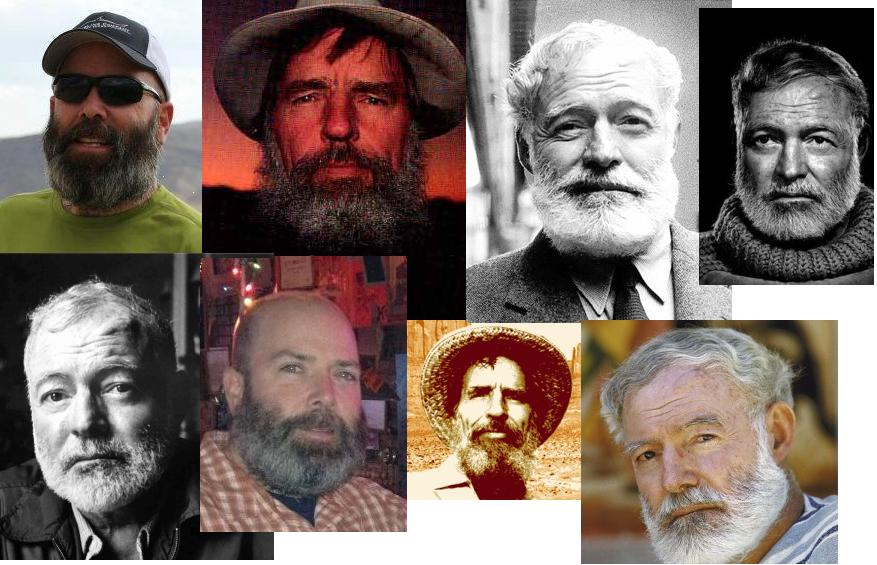
If you have noticed a pattern above, so have I: I am leaning heavily towards a certain two bearded men whose first names start with ‘E’. (On a personal note, I have been toying pictorially with the three bearded men in my life…)

Ernest Hemingway, Edward Abbey, and my Bearded Husband


My newfound (or newly recovered) interest in Abbey has come out of my love of Philip Connors’s Fire Season, which I called my favorite book of 2011. I’m still not done being moved by it; Husband is actually reading it himself (a truly momentous occurrence), I am planning a reread at the earliest available moment, and we’re planning a summer trip to the Gila National Forest itself, possibly even to meet the author who has graciously been corresponding with me and overlooking my rabid fandom. The unfortunate coincidence of Fire Season‘s publication with the worst drought in Texas’s history, and a series of wildfires including one that touched my family, has had me thinking about some of the themes involved. I’ve read a few other pieces of nature writing this year (Liebenow’s Mountains of Light and March’s River in Ruin – both lovely, and both reviews to come in Shelf Awareness). But mostly I’ve been revisiting Abbey himself, who represents the epitome of nature writing, at least for me in my not-very-well-read experience. I can’t begin to go into what his writing does for me at this moment; that’s another blog post. But he makes me laugh, and cry, and think and feel, and plan trips. I am trying to take to heart his exhortation to “get out there and hunt and fish and mess around with your friends, ramble out yonder and explore the forests, encounter the grizz, climb the mountains, bag the peaks. Run the rivers, breathe deep of that yet sweet and lucid air, sit quietly for a while and comtemplate the precious stillness, that lovely, mysterious and awesome space. Enjoy yourselves…”

And Connors, and Abbey, are shaping my reading, too, of course. I’m working on building my collection of Abbey’s books, and a few books about him; I have Aldo Leopold’s A Sand Country Almanac coming to my local library; and I have my eye on Muir, although with a few reservations. (I did love his Stickeen as a child. If you see it, grab it.) I have a few books on New Mexico and the Gila coming, too, to help plan our trip this summer.

Again, my thoughts on Abbey are large and evolving, and I’m not feeling worthy of trying to communicate them today. But I’m working on it.

And then there’s the other bearded man. I do have still a handful of Hemingway works on his little shelf that I haven’t read; and I have several biographies of him and other related fiction and nonfiction. My love for Hemingway has not faded yet.

So I guess what I’m trying to say, very long-windedly, is that I am finding great joy in my reading these days by focusing on a few areas that are holding my interest: mainly, two authors I greatly respect, and the writings about and surrounding them. I hope to delve more deeply into Abbey (and similar) and Hemingway, as 2012 rolls on by. Of course my reviews for Shelf Awareness continue; but they take 3-4 reviews a month from me, and that makes up a minority of my reading, so I have time to do my own thing. There will always be some variety, too – this weekend I checked out the new Girl Reading by Katie Ward just because it looked good – but I am doing pretty well at putting down the books that don’t work for me, because I know there’s lots more Abbey et al out there for me.

vocabulary lessons: Turn of Mind

One of the things that caught my attention while reading Turn of Mind, about a woman with dementia, was Dr. White’s clarity regarding medical terms and concepts. Get her talking clinically, and she’s 100%. I am very fortunate to have no experience with Alzheimer’s and its effects in my own personal life, so I know relatively little. I found it really interesting what parts of her life were easily and consistently accessed (work-related) and what regularly escaped her (family and friends). At any rate, Dr. White taught me some new medical terms:

brachycephalic: having a short broad head with a cephalic index of over 80 (read more here)

hemangioma: an abnormal buildup of blood vessels in the skin or internal organs. In this case, she’s talking about a birthmark that helps her recognize one of the caregivers in her new “home.”

And also gave me some artists to look up. She says of her husband, “our eclectic tastes in art amused the people around us,” which immediately had me looking up the artists named:

Gorky (google images here),

Rauschenberg (which of course had me erroneously thinking of Rorschach tests – does anyone else think the inkblots always look like ovaries?? what does that say about me?) (google images here), and finally

Dubuffet (google images here). And here is where I was surprised and excited: I know this guy’s work! The sculpture in downtown Houston that I grew up climbing all over is immediately recognizable as a Dubuffet, and sure enough, there he is. (Images here.) I feel certain my parents have a picture somewhere of toddler-sized me climbing into its upper nooks after a Jingle Bell Run in the 1980’s or some such. Isn’t it interesting where we find connections?

fiction as politics

No, I’m not going to talk about the fiction of Bill O’Reilly or Glenn Beck.

Shelf Awareness reports:

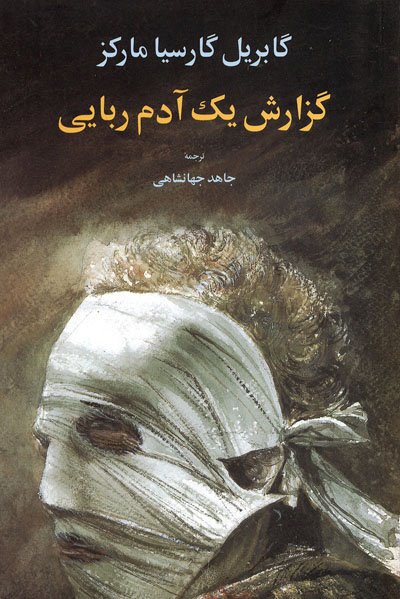
García Márquez Novel a Bestseller in Iran

Copies of Gabriel García Márquez’s 1996 novel News of a Kidnapping have sold out in Tehran’s bookshops this week “after detained opposition leader Mir Hossein Mousavi said the book’s description of Colombian kidnappings offers an accurate reflection of his life under house arrest,” the Guardian reported. Mousavi and opposition leader Mehdi Karroubi have been under house arrest since calling for mass protests last February in solidarity with other pro-democracy movements in the Arab world.

Last week, Mousavi was permitted to meet briefly with his daughters, and told them: “If you want to know about my situation in captivity, read Gabriel García Márquez’s News of a Kidnapping.” Word spread quickly online, “prompting hundreds of opposition supporters to seek out the book. Queues formed in some bookshops, and copies of the book sold out within days,” the Guardian wrote.

The news was also shared on García Márquez’s Facebook page, which linked to a Radio Free Europe blog post reporting that Mousavi’s supporters had launched their own Facebook page, “News of a Kidnapping, the status of a president in captivity,” and that “a number of Iranian websites and blogs have made an electronic version of the book in Persian available for download.”

I find this very exciting and interesting in so many ways. Marquez wrote a work of fiction in 1996 that has become incredibly relevant and interesting to a demographic he may have never originally specifically intended; it’s speaking to modern events that he couldn’t have foreseen (again, at least not specifically). Let this be an rebuttal to those that argue that fiction has no real-life important purpose! Commercially speaking, it can’t be a bad thing from Marquez’s perspective that he’s selling more books; but I’d wager he is more pleased that his work is speaking to current events and, hopefully, helping the cause of democracy.

Another interesting aspect of this short news piece, as reported by Shelf Awareness, is in the rapid-fire social networking/media communication of Mousavi’s recommendation, and the distribution of the Persian translation. As in the recent Egyptian protests, these relatively new media are aiding social and political causes. I think it’s interesting to see media technologies changing the way we do the business of the world. And to see these lessons tied back to BOOKS is kind of inspirational for me.

I’m no expert in Iranian politics and don’t claim to be. But the power of the media, communications and social networking, and most especially, 15-year-old works of fiction on today’s political turmoils is worth noting.

Does this catch your imagination as it does mine?

fiction vs. non

I’ve talked a few times recently here at pagesofjulia about fiction and nonfiction. (See for example my discussion of the value of fiction.) Most recently, in my review of In Cold Blood, I ponder the fine line between the two. Sometimes it’s difficult to tell. How do we draw the line? Here at the library, for cataloging purposes, I use OCLC’s bibliographic record; but there is often room for debate. Ernest Hemingway (obviously) is my go-to example of an author of fiction which is so highly autobiographical as to raise eyebrows; and for that matter, he was also an author of nonfiction that may have fudged here and there (i.e. his journalism in times of war in which he claimed a heroic or brave role for himself). And then there are the James Freys and Greg Mortensons of the world, who claimed to be writing nonfiction and later were accused of either smudging their facts or wholly making things up. So, my point is, the line between fiction and nonfiction (a) can be fuzzy and (b) is an important line to be aware of – even when we can’t draw it firmly.

I came across a short article the other day that I want to share it with you here. Robert Gray’s column at Shelf Awareness, is called “Deeper Understanding.” He recently wrote Conquering Our National Fear of Fiction, in which he notes that President Obama has been criticized for reading fiction. He then makes arguments – and quotes studies – in favor of reading fiction for education, and for improving ourselves. His message is one I definitely get behind (again, see my discussion of the value of fiction).

I love reading nonfiction. I think I love it more every year. There’s so much in the history of our world – and in what’s happening in our world today – that’s fascinating and that we should be aware of. Of course, I’m not doing an exceptional job of keeping up on everything. There’s too much to know. But I do enjoy nonfiction. In fact, I feel like I’ve read an awful lot of it this year – but when I look back at my Books Read log, I see that fiction still massively outnumbers nonfiction. Maybe I had a misconception because so much of the fiction I read is very short, and some of nonfiction is quite long, so the time spent on each might be closer to equal… maybe I’m making excuses. My point is, I have nothing against nonfiction, and should read more than I do. But! Fiction! Not an ugly stepchild at all!

So, for discussion here if you please: Do you read mostly fiction, or non? What is the value of each? In other words, is fiction frivolous and nonfiction valuable, or does fiction have a great deal to offer us as people, as a society? Why? What authors have you come across who smudge the line between the two? How strongly do you feel about defining the line, and how do you go about it? For example, is In Cold Blood fiction or non? Or some strange hybrid?


For your reference, I’ve linked here to a few of my favorite nonfiction reads of the last year or two…
Around the World on Two Wheels: Annie Londonderry’s Extraordinary Ride, Peter Zheutlin
Dethroning the King, Julie Macintosh
The Devil in the White City, Erik Larson
Fire Season, Philip Connors
Heroine’s Bookshelf, Erin Blakemore
Iphigenia in Forest Hills, Janet Malcolm
Mr. Playboy, Steven Watts
Hemingway’s Boat, Paul Hendrickson
Newspaper Titan by Amanda Smith

the value of fiction

I want to share with you something that I wrote, oh, in 2007 or thereabouts. (I am resisting the urge to edit myself. It is a strong urge.) And then I think I will respond to myself. And hopefully you will share your thoughts, too.

My best friend is self-educated, and claims that he reads only non-fiction because he sees no value in studying fiction. He thinks that fiction’s purpose is entertainment, and he wants to learn new facts and better understandings of the world, and thus needs to read non-fiction. I like to counter with, for example, Harriet Beecher Stowe’s Uncle Tom’s Cabin. This book is fiction, but I think it’s pretty clear that its purpose is to teach and educate and hopefully to change minds about one of the most important issues of the last century.

One of my favorite books is Ernest Hemingway’s For Whom the Bell Tolls. This book is fiction, but closely based on the author’s experiences. It served an important purpose: it taught readers that the Spanish Civil War, and by extension war in general, is not one-sided and has no “right” side to it; once violence has begun, innocents on both sides will suffer and everyone finishes with blood on their hands. (I hope Hemingway will forgive me for brutally simplifying this masterly work for my purposes here.)

Upton Sinclair’s The Jungle is another great example of fiction that performed important social functions. Although Sinclair’s concerns began by centering on social issues, food safety turned out to be an enormous beneficiary of his work, as public response was enormous. Historical perspective on this book in its time helps us to understand its significance; however, just reading the novel without context would give a person new respect for the purposes of fiction.

The question of whether Mark Twain’s The Adventures of Huckleberry Finn should be taught in high schools strikes me as a parallel to my friend’s complaint about fiction. It is clear to me that this work should be taught to high school students because, while it is fiction, it brings to light some extraordinarily important and very real questions. For example, Huck’s relationship with Jim and the development of their friendship addresses the humanity of slaves and the moral rectitude of this American institution. The racial slurs need to be read by high school students – with the right guidance – to teach beyond the idea that they are wrong, to why they are wrong.

Thus, the question of whether to teach Huck Finn is the same as the larger question, why read fiction? (For that matter, if it’s not worth reading, why write it?) I find the study of literature (fiction and otherwise) to be pleasurable as well as important, so I take it upon myself to argue on its behalf. My assertion is that just because a story is not true, does not mean it can’t hold massive significance on wildly important issues. For that matter, if fiction were truly and solely for entertainment as my brother asserts, one could argue that there is value in this purpose as well. Humans need entertainment to draw their minds off of the problems of our world; to blow off steam; to relax and/or exercise our minds. If fiction served no higher purpose than these, it would still be worthwhile to write, and read, and study, fiction. However, I find that fiction can serve the purposes of, for example, bringing a nation’s and a planet’s attention to dire social issues: the enslavement of blacks by whites; the wage slavery of many white and nonwhite immigrants to the United States; the corruption and lack of hygiene in a meatpacking industry; and the damage inflicted by massive violence on a people. I continue to bring my friend works of fiction to read.

Urges to edit this piece of writing aside, I stand by my original position. On the other hand, I’ve also written before about the perils of reading historical fiction for educational purposes. While my friend has not specifically used this argument (that I recall), I think it’s an important concern. If we read really convincing, accurate, moving, memorable historical fiction, I think we run the risk of taking it as fact. Even the most discerning and aware reader (even me!) could end up with blurred lines in her subconscious about what she learned in a nonfiction vs. a fiction book. Once I learn a “fact,” it can be hard to call up its source, especially years later. This is especially concerning for someone like my friend in question, who is a highly intelligent man and who likes to have serious debates. I think he feels the importance of being able to cite one’s sources.

So I acknowledge the dangers of confusing high-quality historical fiction with fact. And even more confusing are the books that are billed as nonfiction and get questioned years after the fact (ahem, James Frey and Greg Mortenson). How’s a person to keep it all straight? Don’t even get me started on the library patron who was SURE, and could not be convinced otherwise, that John Grisham only writes nonfiction books. Everything in The Firm happened, she says. I couldn’t talk her out of it. (This is why the front of the book says, “This is a work of fiction…”)

So I do respect some of the challenges. My position hasn’t changed; if anything, I feel more strongly than ever that fiction is important. Some of the fiction I see doing good work in my day-to-day job is not even what we might call Important Fiction – it’s a lot of Louis Lamour, Danielle Steel, Debbie Macomber, and James Patterson, in fact. I work in a cancer hospital where my little library provides leisure reading for people experiencing incredible difficulties, great pain, or great fear. If reading Nora Roberts/J.D. Robb improves their day, I rate the value of even this pop/genre/fluffy/call-it-what-you-will fiction very, very high. My favorite examples are still Huck Finn, The Jungle, and the like. (Also Slaughterhouse-Five…) But it goes beyond such Important Books. Fiction can be beneficial, enlightening, world-changing, and uplifting in so many ways. Also, it can be fun. What’s so bad about that?

I’m not the first to ask this question or to try to answer it; and I’m certainly not the most eloquent, articulate, thorough, or exhaustive. Have you seen any great examples of answers to the question, “what is the value of fiction?” Do you have a great answer? I would love to hear (read) it. Do you disagree? I would be interested to read your argument on either side.

On a related note, I’m still hoping to find time to tackle Mightier than the Sword: Uncle Tom’s Cabin and the Battle for America by David S. Reynolds. Maybe I’ll have something new to contribute soon!

the WSJ-YA uproar to which I am late

I had a patron approach me in the library to ask my feelings on this issue.

The background is… more than a month ago, the Wall Street journal published this article by Meghan Cox Gurdon, which immediately became a huge deal. I would encourage you to go read it, because that’s the best way to know what it says, but in a nutshell, this children’s-book-reviewer lady notes an increase in “darkness” in young adult (YA) literature, and comments that darkness is not good for our young adults. While she has some supporters, there was overwhelming indignation among bookish/literary/librarianlike internet dwellers. They have mostly said, in a dark world, kids can actually benefit from reading about situations that are like those they are facing. Also, you shouldn’t censor. The author of the original, offending article has since published, also in the WSJ, a rebuttal.

I resisted entering the fracas, mostly because I feel my opinion is unnecessary (because I’ve read some other excellent responses) and because I don’t feel terribly well-qualified to have an Important Opinion, not being a YA librarian or really much of a reader of YA. Even when I was a YA. But on the other hand, this blog rather exists for the publication of my Not Very Important Opinions, and so I’ll throw it out there.

So. I had a patron approach me here in my (definitively adult) library and ask for my thoughts. I tried to tell her why I’m not qualified to have one but she pushed. So, I told her I agree with those opinions that say, children in rough positions need to read about said rough positions. The cited instances of “darkness” include stories about rape, prostitution, violence in general, poverty, and cutting (self-mutilation). Young people living these situations are in a position to benefit from having them handled wisely in literature, and I appreciate that such things are available. My patron turned out to be (as I understood her position) arguing that children living in darkness need to read about light – happier, brighter situations – to which I say, sure! Great! Let them read that stuff, too! She proceeded to argue that there is too much dark and not enough light; the proportions are wrong; at which point I have to beg off, because my very limited knowledge of current YA doesn’t allow me to debate this point. I don’t know the proportions, quite frankly. I support the idea of diverse options, for sure – in all things, in fact. (For example, there should be more than two political parties in our electoral system.) Lots of options, please. But if you prefer for your YA to read only happier, lighter books, I don’t think that should necessarily limit others – who might be interested in those “darker” ones – in their access to those choices.

I have to take issue with one of Gurdon’s conceptions (from the original article).

In the book trade, [guiding what young people read] is known as “banning.” In the parenting trade, however, we call this “judgment” or “taste.”

I’m afraid she’s confused about “banning.” Or maybe she’s just being imprecise in the phrase, “guiding what young people read.” There are several ways in which parents, guardians, or whoever can guide what young people read. For example, they can pay attention to what their children read, and direct those choices. The Maryland mother whose personal experience begins Gurdon’s article was doing just this. She wasn’t banning anything; she was exhibiting judgment and taste, and guiding her daughter’s reading choices. This is the kind of guidance I recommend; I encourage parents who are concerned about what their children read to pay attention to what their children read, and limit it as they find appropriate. Banning, on the other hand, is what parents and various community members attempt when they submit complaints to public libraries (for example) requesting that certain books be pulled off the shelves. I am in favor of “judgment” and “taste” – I may not agree with yours, but that’s fine as long as your judgment applies only to your child. I am against “banning,” which involves limiting other people‘s access to books. See the difference? Banning is not synonymous with parenting.

I don’t think rape or cutting in books leads to rape or cutting in life. I think it has the potential to offer some relief or catharsis or therapy. Certainly some children don’t need therapy for these traumas; absolutely Gurdon is correct that not all teens are rape victims, thank goodness! But I’m not sure that reading about even those traumas that are outside their experience isn’t necessarily instructive and good, too. (I wasn’t involved in teen violence or gangs, but still found S.E. Hinton’s oft-cited The Outsiders amazing; it was one of my favorite books.) I won’t push these books on your child, certainly, but I fail to see how the availability of these options is a bad thing. Again, I’m all for more options. If I accept my patron’s thesis that there is too much dark and not enough light in YA today, then by all means, let there be more light, in the interest of a multiplicity of options.

But, the vampires I could take or leave, actually.

vocabulary lessons: South Texas Tales

I thought I’d share a few more words I was inspired to look up by my recent read: a Mexican-American collection of short stories.

Cuatro Milpas is both the name of a cantina (bar) and the bartender/owner’s favorite song. Apparently a milpa is “a small field in Mexico or Central America that is cleared from the forest, cropped for a few seasons, and abandoned for a fresh clearing.”

anaphora: “a rhetorical term for the repetition of a word or phrase at the beginning of successive clauses.” From the story Dona Porfiria Comes Calling, “Their father was a prolific reader and whenever he spoke to them using anaphora, they knew from past experience that they were doomed.”

Shibboleth: “any distinguishing practice that is indicative of one’s social or regional origin.” In its usage in the story by the same name, the Shibboleth (capitalized in the story, but this does not appear to always be the case) is basically a secret handshake.

menso: “someone who is stupid and/or annoying.” Used in dialog: “Hey! Jou’re not so ‘Mr. high and mighty’ now, eh rich boy? Jou’re daddy’s not aroun’ here, menso!” I like this phonetic expression of accents, a la Twain in Huck Finn and so many more (although I believe Twain was the first).

dècimas: defined in the story itself. Let me just share with you a short passage:

Sebastian remembered the dècimas and their complicated forty lines. A man would challenge another to a verbal duel by nailing a quatrain to the front door or a fence post. The challenged had to answer within a week by producing a complicated forty line poem with four ten line stanzas. Not only that, but the poem had to have a strict octosyllabic beat with an ‘abbaaccdde’ rhyme scheme. Many a man had tried and failed to meet the verbal challenge, but the CÌsneros men were fine ‘dècimeros’ and always relished the competition.

Isn’t that an awfully cool tradition? And so literary! I would be very impressed to observe one of these challenges being met.

merienda: context clues tell me that this is something like a late-afternoon meal of dessert. In my interwebs-searching for a definition, I found a source of information that I especially appreciated. (You may observe that I vary my sources: Wikipedia, About.com, online dictionaries including the urbandictionary.com, or whatever seems most appropriate to my need.) I found a blog that nailed this one, in a surprisingly close-to-home post about eating in the Med Center, where I work. Dr. Ricky defines the term for me:

Although loosely translated to mean snack, merienda cuisine is markedly different from what Americans consider snacks (which appear to me as extended desserts). They aren’t simply sweet items meant to provide a quick spike of blood sugar – merienda foods are proper filling small versions of regular meals, more often savory than sweet.

…and so on, discussing the food he (I think it’s a he? I could be wrong) is accustomed to seeing at meriendas in different countries.

These little cultural learning moments were great fun for me. Have you learned any new words lately?

vocabulary lessons: The Great Night

Sometimes I learn a lot of new words from a book. For bookmarks, I don’t use pretty bits that were designed for use as bookmarks; I use scraps of paper (usually, something that’s been printed on one side and discarded, which I then cut into quarter-pages for just this purpose). I try to carry a pen, and I take notes on the bookmark about questions I have, or passages I might want to come back to later. This way, I can look up that reference to a book, movie, or person I wasn’t familiar with; I can quote a passage in a blog post; or I can look up the meaning of unfamiliar words and go back and reread the sentence with a new understanding.

The Great Night was full of learning opportunities – so much so, that I thought I’d share them here.

Monchhichi – okay, maybe everyone knew this one but me. Apparently a Monchhichi doll is a Japanese stuffed monkey with a certain “look” to it, thus the usage: “…might… run into a girl with a Monchhichi hairdo who could demonstrate that it didn’t matter at all…”

cosmesis – the preservation, restoration, or bestowing of bodily beauty. (very appropriate for fairy-land?) “So she did magic instead, scene by scene, working a sort of dual cosmesis upon the players and the play…”

irenic – tending to promote peace or reconciliation; peaceful or conciliatory. “…her wild spasms contrasting with the irenic strains of the music.”

capacitous – having large or exemplary capacity. “How odd, she thought, and how horrible to see them still there, slosh full of tears and regret, but no more capacitous, and perhaps not as full, as her own.”

These were all so very new to me! (And I had to look up the movie Soylent Green, too. Fairly integral to the plot, actually.) I love learning while I read. Have you spotted any new words lately?

The Heroine’s Bookshelf by Erin Blakemore

I have a delightful little book to share with you today! I mightily enjoyed Erin Blakemore’s The Heroine’s Bookshelf: Life Lessons, from Jane Austen to Laura Ingalls Wilder.

Blakemore’s message is this: we are all heroines in our daily lives, or at least we can and should be; and we have a wealth of heroines to learn from. These are the women of our favorite books. She organizes her book by chapters which each deal with one lesson or attribute (including dignity, happiness, and simplicity), represented by one author (all are women) and one female character, from one book or series. I would love to list them all here for you but feel I should leave you something to discover when (not if!) you pick this book up yourself; so I shall tease you with Alice Walker and Margaret Mitchell, on top of the two authors Blakemore names in her subtitle.

It’s a very sweet, comforting, and comfortable little book. Twelve chapters explore twelve women’s literary impact on our world. Eleven of them I definitely call classics; one I’d never heard of! but of course I don’t know everything. Blakemore’s approach is intimate and loving and a touch incisive. It’s not an academic or intellectual book, but it’s not what you might call “fluffy”, either. She did do some research, I’m sure, as she discusses not only what’s between the pages of the books in question, but also notes biographical details about the authors and draws some conclusions. For instance, I didn’t know about the 2008 revelation by the descendants of Lucy Maud Montgomery about her death. This book is not too serious – a light read – but an important one, at the same time.

I am absolutely inspired to read, and re-read, the books examined here. I share Blakemore’s love for Jo March, and I wonder at her selection of Jane Eyre over Wuthering Heights, but we’re all unique, individual heroines, aren’t we. I marvel at her call to compare Frances Hodgson Burnett to Britney Spears and Amy Winehouse! but I admire her for it, too. Again, the adjectives that come to mind are comfortable, almost warm-n-fuzzy.

I need to own this book; the library’s copy will not suffice. And I think YOU should own it, too. Who am I talking to here? Well, I readily accept that many of these books are “girls’ books” (or women’s). But some are absolutely essential to us all: A Tree Grows in Brooklyn, for example, is an important book all around. This book is directed at women, but is not necessarily to be enjoyed by them exclusively. I’m sure you know who you are.

I can almost see a book club (or reading blog) project coming out of this. I would be very happy to shelve this book, in my home library, next to its twelve objects of study, and read them all in a streak of thirteen, with a mind to discussion. This would be a lovely thing to share with other women – and a willing man or two if they could be located. I don’t have the energy to put this together at this time, but do invite me if you decide to. 🙂

I’m so glad I found this little jewel. I hope you’ll find it, and enjoy it, too.


Edit: My mother asked who this author is, and I had to go looking for the answer, so here it is, Mom: she calls herself “a writer, entrepreneur, and inveterate bookworm” on her website, and I was immediately drawn in to her blog and have added it to the list of blogs I follow.