Songbirds by Christy Lefteri

Set in the old capital city of Cyprus, this is a beautiful, sad novel about human relationships and hard choices, who is seen and unseen.

With Songbirds, Christy Lefteri (The Beekeeper of Aleppo) shines a light on social issues through the story of one woman’s disappearance. The central character is absent from the beginning and remains a mystery until the novel’s final pages.

“One day, Nisha vanished and turned to gold.” Nisha is a Sri Lankan immigrant to Cyprus, where she works in the capital city of Nicosia as maid to Petra, a widow, and her nine-year-old daughter, Aliki. Petra’s upstairs tenant Yiannis is Nisha’s secret lover (maids are not permitted lovers). This absorbing novel opens after Nisha has gone missing, and is told in chapters that alternate between Petra’s and Yiannis’s points of view as they mourn and search for Nisha.

Nisha is representative of numerous migrant worker women in Cyprus, largely from Vietnam, Nepal, the Philippines and Sri Lanka. Petra observes, “The maids here did everything–they were hired and paid (lower than the minimum wage) to clean the house, but ended up being child-carers, shop assistants, waitresses.” Also: “I had started to see the rhythm of these women with new eyes–how the whole neighborhood pulsed with their activity. They had been invisible to me before Nisha had gone missing.”

Although her neighbors are quick to write off the disappearance as abandonment, with the assumptions of casual racism, Petra knows this is out of character. Nisha is devoted to Aliki, and besides she’s left behind her passport and most precious possessions, relics of her late husband and her own daughter in Sri Lanka. The police won’t help. Petra mounts her own investigation, eventually teaming up with a distraught Yiannis, who is facing challenges of his own. He feels trapped by his involvement in the criminal poaching of songbirds, and especially conflicted because he’d grown up feeling so close to nature.

Lefteri deftly weaves Yiannis’s pain at his illegal work and the loss of his love with Petra’s growing realizations about her own culture and Aliki’s attachment to her missing caretaker. Nisha, “a dark and beautiful shadow, who rattled around in old sandals and with fire in her eyes,” is the center of this story, but an absence; the two speaking characters triangulate the third, and readers don’t hear Nisha’s own voice until the very end. Moving human characters and careful depiction of natural spaces contribute to a contemplative tone. Songbirds is quietly urgent in its treatment of Nicosia’s maids, lyrical in its descriptions, and thoughtful, compassionate and important.


This review originally ran in the July 12, 2021 issue of Shelf Awareness for the Book Trade. To subscribe, click here.


Rating: 7 makeshift oars.

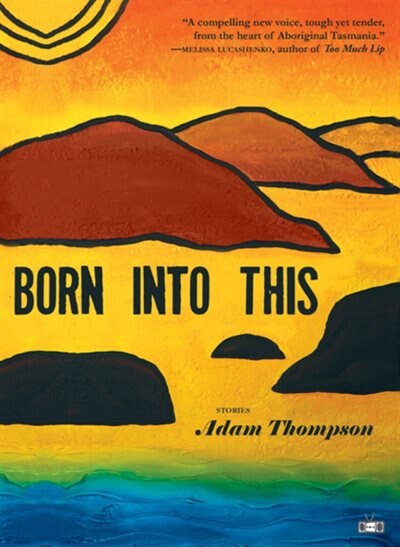
Born Into This by Adam Thompson

These cunning, clever, piercing stories of marginalized indigenous Australians are both compelling and illuminating.


Adam Thompson’s Born into This is a striking collection of hard-edged, penetrating stories set primarily in the Australian state of Tasmania and wrestling with issues of race, colonialism and individual agency. Every story features Aboriginal characters, generally in the central role; the various experiences and complexities of this identity (which the author shares) form the heart of the stories’ combined impact. The collection is loosely linked by recurring characters and settings: an act of angry protest at the center of one story reappears as a minor annoyance in another. An island on the Bass Strait is home to a family over generations.

The collection opens with “The Old Tin Mine,” a story about a bitter, aging guide at a “survival camp” for city youth, who may be nearing the end of his career. “Honey” offers a cold, brutal, satisfying justice in the face of hate. In “Aboriginal Alcatraz,” a man wrestles with a life-changing decision in the midst of a storm, building to an ironic conclusion. Some stories lead with forceful blows, others sneak in to nag at the back of the reader’s mind: an alcoholic recalls the worst thing he’s ever done; a young man views a current love affair with cynicism. In the title story, a young woman fights an inherited losing battle involving eucalyptus plants. Working in the woods “was like looking into a mirror.” In “The Blackfellas from Here,” a young activist proposes an extreme and perhaps unrealistic, but also perfectly reasonable, resolution to a controversy. These punchy tales question family ties, infidelity, superstition and who has the right to claim Aboriginal ancestry.

Thompson’s characters are stoic, taciturn, often blue-collar. They struggle with racism, exploitative economic systems, class tensions and the disappearing natural world that a culture once depended on. Their reactions to these challenges range from rage to lethargy; their stark stories are frequently, quietly, brutal. The lives and attitudes of these characters vary, offering a revealing set of perspectives on the contemporary landscape. It is not all bleak: Born into This contains as well dark humor and even slim strands of hope. Thompson’s prose style appears blunt at first glance but shows nuance. His 16 stories are unyielding in terms of their values, yet somehow deft, even delicate in their storytelling and various voices. The overall effect is understated: simple, unglamorous lives and events crescendo toward a thought-provoking and memorable whole. Even (or especially) in its quietest moments, this is a haunting debut collection by a skilled writer.


This review originally ran in the June 11, 2021 issue of Shelf Awareness for the Book Trade. To subscribe, click here.


Rating: 7 eucalypts.

The Travelers by Regina Porter

Looks like I need a new way to talk about novels like this: huge and sweeping in its scope, but in a neat, tidy package, right at 300 pages. The Travelers opens with a Cast of Characters, like a play, which made me a little nervous, and indeed I needed to use it some throughout, although less so in the second half once I got situated. These characters come from a few families over a few generations. Cast of Characters is followed by Time (“from the mid-fifties to the first year of President Obama’s first term”), Settings of Note (Amagansett, Long Island; Buckner County, Georgia; New York; Memphis, Tennessee; Portsmouth, New Hampshire; Brittany, France; Berlin, Germany; and Vietnam”) and Background, which discusses Rosencrantz and Guildenstern Are Dead, which made me still more nervous; what is this book I am entering? But it turned out wonderfully.

Where to begin? Clearly I cannot tell you about all these characters and happenings on several continents over several decades. I’m still not sure how Porter has managed to do it in 300 pages. Among my favorites, though, are definitely Agnes and Eloise, who were lovers as young women in Buckner County, Georgia, but who go on to live long, full, well-traveled lives, while never ceasing to circle each other at least in their minds and at least a little. (“Just because you couldn’t stand someone didn’t mean you no longer loved them.”) The man Agnes marries has an obsession with Rosencrantz and Guildenstern that begins when he is serving in the Vietnam War, and remains ties to a trauma from that time period; his odd relationship to an odd play, and its impact on his and Agnes’s two daughters, was a fascinating through-line for me. There are plotlines that are linked to race, as well as gender and sexuality, another expansive dimension to the novel that I appreciate. I think what I’m most marveling at here is the compression: now that I’m trying to tell you about this book, I’m amazed at how much was in it, at how much American history got slipped into a story about regular people.

It’s absorbing. There are some problematic characters that I still felt for, and some downright entrancing characters (like Eloise, who trains as a pilot in homage to her hero, the real-life Bessie Coleman) who I already miss. The overall impression is spellbinding, really. I like that settings recur, and characters appear and reappear in new arrangements with each other – new relationships. These threads form a weave that help this somewhat sprawling plot and cast to cohere. It could have been too much to keep together, but it makes just enough sense, with the recurring connections. Oh, and photographs: chapters are headed by small black-and-white images, and there are a few more within the text. A ‘photo credits’ section is a great bonus. The images come from true history, while the novel is of course fiction, but they add historical authenticity; so this Black soldier in Vietnam is not the one I’m reading about (because the latter is a fiction), but it adds a layer.

I think I’m going to be thinking about this enormous, deceptively slim novel for a long time.


Rating: 8 pieces of pecan pie.

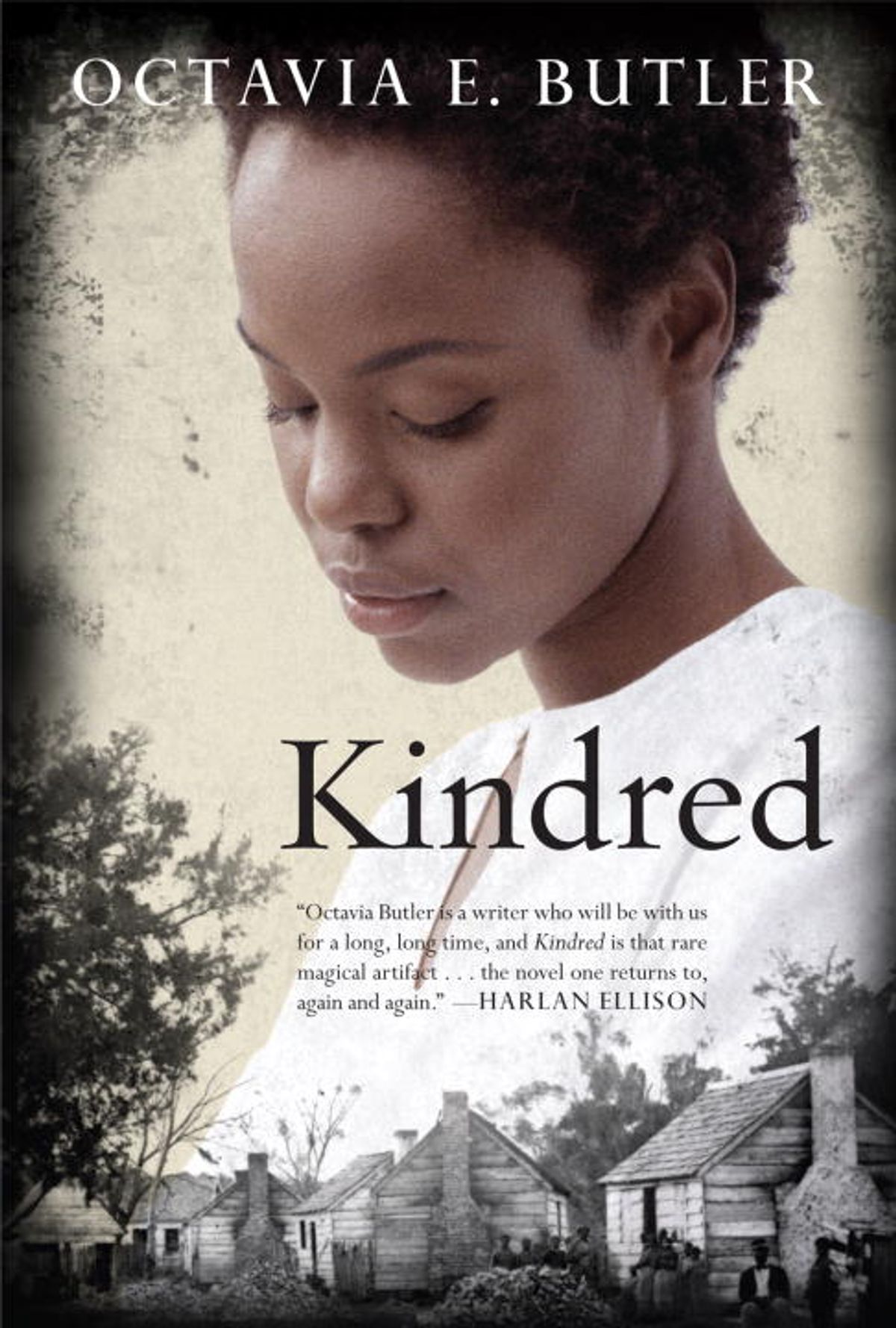
Kindred by Octavia Butler

Kindred is interesting to me in several ways. First, Octavia Butler stands out as a Black woman in a genre – science fiction – that is still awfully short on non-men and non-white writers, and was practically devoid of either when she began publishing scifi in the 1970s. This novel, her bestselling and I think best-known, might be more easily classified as fantasy than scifi, although I’m not going to get caught up in that labels argument. (I’ve tagged it as horror, here, too.) Either way, it is also very much realism and well based in history. Our protagonist, Dana, is a modern 1970s Black woman who suddenly finds herself time-traveled into the 1810s. “Time travel was science fiction in nineteen seventy-six. In eighteen nineteen–Rufus was right–it was sheer insanity.” Rufus is a young red-headed boy who she quickly understands has the (unwitting) ability to “call” her to his time when he is in danger; she seems bound to protect him. Because… it turns out he is her ancestor.

So we have the grandfather paradox, which ironically was just the other day explained to me by the character Natasha in The Sun Is Also a Star. Rufus grows into a deeply problematic white man and slaveowner, but she must preserve his life, even facilitate his relationship with the enslaved woman Alice who will bear his children, to ensure her own birth. Talk about tough subject matter and moral relativism. Back “home” in the 1970s, Dana is married to a white man, one of the good ones, named Kevin. But even the good ones may turn out to be a little troubling, especially when Kevin manages to get transported back in time with his wife. In the 1800s, Kevin can help protect Dana by posing as her master, but that only leads to more lines to be blurred.

This scifi/fantasy plot draws heavily on history. My paperback edition includes a critical essay at the back by Robert Crossley, who points out that Kindred is a sort of fictional memoir, following the traditions of slave narratives, which Butler studied closely. Aside from the time travel element, this story could be considered strict realism. And the time travel could be considered a literalization of a more metaphoric need to enter into another time – one far less distant than we are sometimes tempted to feel – and understand it better, because the forces of racism (and sexism) are alive and well. (While race is the forefront issue here, gender is absolutely at play as well, in the dynamics within slavery as well as the modern marriage of Dana and Kevin, among other places.)

Butler’s skills are on display. Dana’s first-person narrative voice is compelling and immediate; we experience panic, fear, rage, helplessness, and more along with her. Her relationships with Kevin and with Rufus, with Alice and with other enslaved people, are complex; the society of slaves offers a few apparent ‘types’ which Butler then immediately complicates, and Dana’s own biases are exposed in the process.

Topically, this is an important book to read and to think about. ‘Purely’ as a novel, it’s a hell of a ride, fast-paced and high-stakes and absorbing. Dana’s voice is compelling and intimate; she’s flawed and complicated and completely believable. It’s one of those stories it’s hard to look away from. Butler’s reputation is well deserved.


Rating: 8 aspirins.

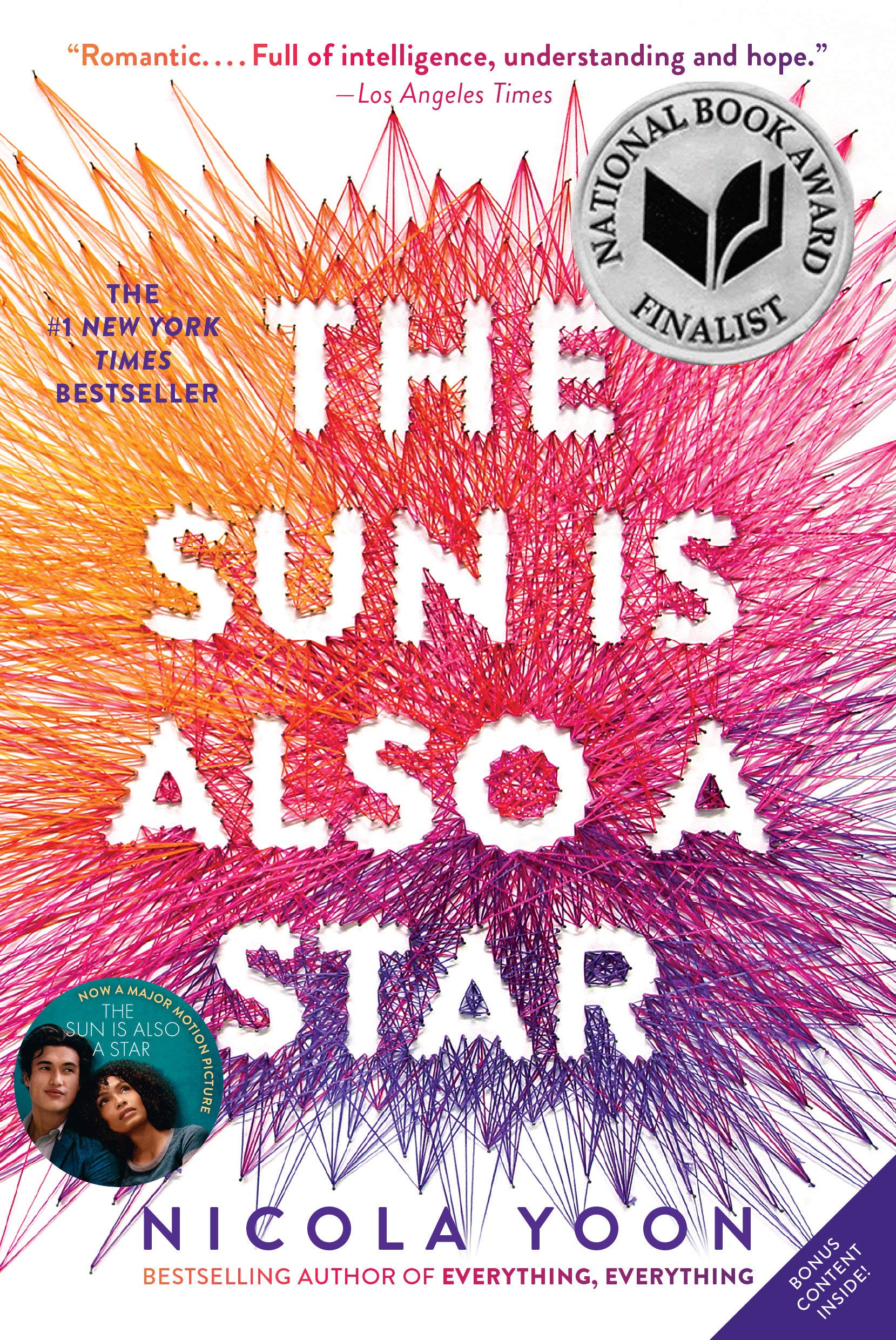
The Sun Is Also a Star by Nicola Yoon

Another great one that threatened to keep me up all night long. Keep ’em coming.

The Sun Is Also a Star is a YA novel of romance, fate, science, race, and more; 98% of it takes place in a single day in New York City. It stars two delightful and very different teenagers. Natasha is a serious science geek and impassioned fan of 90s grunge music, who firmly believes in provable facts and none of that gooey bubblegum stuff about love. She came to the United States when she was eight as an undocumented immigrant, like both her parents; only her little brother was born in the country, and now – thanks to her father’s unbelievable idiocy – the family is just hours away from deportation to Jamaica, a country that definitely does not feel like Natasha’s home.

Daniel is the younger son of Korean immigrants. His high-achieving older brother is their parents’ darling (of course), and a bully, and objectively a serious asshole; he’s just been kicked out of Harvard (Best School), though, so that’s something. Daniel has his Yale interview today (Second Best School), because he’s trying to follow the intended path and become a doctor, but what Daniel really wants to be is a poet. He is all dreams.

You can already see the drama setting up: Natasha and Daniel run into each other on this momentous day, as she attempts a last-minute legal defense against deportation and he approaches the Yale alum he’s meant to impress. They couldn’t be more different, but they’re drawn together nonetheless. Daniel intends that they will fall in love. Natasha, naturally, is having none of it. There are only hours to spare. Chapters shift between the points of view of Natasha and Daniel as well as a handful of others: side characters we’ll see for just glimpses, or a more omniscient view, including ‘future histories’ and etymologies (‘irie’), a ‘history of naming,’ a ‘history of decay.’ The effect is kaleidoscopic, and transcendent. The cumulative tone is frequently hilarious – both teens’ voices are darling, and Daniel especially is a riot; it is poignant in the ways of teenaged love; and, as established by a Carl Sagan-infused prologue, there is an all-encompassing, cosmic-scale sense of gravity and wonder.

This is a pitch-perfect story, lightning-paced as Natasha’s last day in the States and frenzied as young love, but serious as death, too. It’s absorbing, a world to get lost in. On one level it’s very much about race, racism, immigration and culture. Daniel’s father owns a Black beauty shop, like so many Korean-Americans do, and the book pauses to discuss the global forces that have set up this odd truth. Natasha wears her hair natural – which for some is a political statement, but (again the novel pauses to note, in one of those neat asides) it can also be simpler than that. “In the future, she may make it straight again. She does it because she wants to try something new. She does it simply because it looks beautiful.” I love this narrative voice: here is “an African American history” of hair; here is some of the weighty meaning that accrues; and also, here is a young woman who just wears her hair like she likes it. All of these at once.

The romance story that is the heart of this novel is very sweet and engaging. The topical content is well done and not preachy. The conversation between hyperrationality (Natasha) and dreaminess (Daniel) could have been cutesy and pat, but it’s not: it’s thought-provoking, expansive, and smart. I am, again, impressed with what YA can be. And I am therefore now interested in Yoon’s previous novel, Everything, Everything. I really think there’s something in this book for everyone. I am completely charmed. What a beautiful, book-filled world.


Rating: 8 little notebooks.

The Vanishing Half by Brit Bennett

The only difference between lying and acting was whether your audience was in on it, but it was all a performance just the same.

I’m on a roll: here’s yet another book that threatened to keep me up all night. When I finished reading this novel, I went immediately to buy Brit Bennett’s first book, The Mothers. So far there are just the two; I hope she’s writing right this minute.

The Vanishing Half begins in a curious town called Mallard in Louisiana, just two hours west of New Orleans, founded by a man whose father once owned him and whose mother hated his lightness. “He’d married a mulatto even lighter than himself. She was pregnant then [1848, when he thought up the town] with their first child, and he imagined his children’s children’s children, lighter still, like a cup of coffee steadily diluted with cream. A more perfect Negro. Each generation lighter than the once before.” And so Mallard, “a town for men like him, who would never be accepted as white but refused to be treated like Negroes. A third place.”

This colorism suffuses the novel, which is about family and secrets and the identities we inherit and choose for ourselves and those we cannot, and so much more, but always about race and color too. From that founder, generations later, are descended a pair of girl twins who watch their daddy get lynched and then run away from Mallard to New Orleans, where they part ways. One lives her life as a Black woman, and eventually returns to Mallard with a child “blueblack… like she flown direct from Africa.” The other crosses over, and becomes White.

You could drown in two inches of water. Maybe grief was the same.

Usually I get nervous when I read about ‘multigenerational sagas’ that I’m looking at a 500+ page book. This one is just 343 in my hardback edition, but does span generations – chiefly the twins and their daughters – and the country, from Louisiana to Hollywood to New York City, with other brief stopovers. It went by quickly (again, I had to force myself to sleep and finish it on day two). And yet it feels enormous. I’ve traveled so far, I feel like, with these women (centrally) and men. The plot centers on problems of race and of colorism within the Black community, but it also handles gender, sexuality, class, art, personal agency, and especially and in several forms, questions about family and love and hurting those we love, keeping secrets (as a form of love and wounding), and those questions about chosen identities (gender as well as race). I do love these Big Questions. But Bennett is also astonishing at plot, scene, and character – there are so many characters here whose stories, even briefly, captivate. I mourn closing this book (which is why I instantly ordered Bennett’s other one). Don’t even wait: do yourself a favor and get into The Vanishing Half, if you haven’t already. I wish I could read it again for the first time.


Rating: 9 worn calculus textbooks.

Ring Shout by P. Djèlí Clark

Ring Shout is a most interesting, slim, swashbuckling adventure story about hunting and fighting the monsters of the Ku Klux Klan. Here, those monsters are literal: ‘regular’ (human) Klan members are called simply Klans by our narrator Maryse, while those who have ‘turned’ are Ku Kluxes, horrifying beasts who love dog meat and wear human skins but are visible to those – like Maryse and her friends – with ‘the sight.’ What we learn alongside Maryse in the course of this story is that Ku Kluxes are not the only, nor even the worst, monsters in this world.

Ring Shout is set in 1922 and begins on the Fourth of July in Macon, Georgia, where Maryse, Sadie and Chef have set up a trap for the demonstrating Klan: a stinking dog carcass laced with explosives. We begin mid-scene and then slowly get to know our heroines. Sadie is an ace with her Winnie (Winchester 1895), and Chef carries a German trench knife, taken off the enemy when she fought in World War I; but she’s earned her nickname through her expertise with bombs. Maryse Boudreaux is from just outside Memphis, where she experienced a trauma as a young girl that has set her on the path she walks now: she hunts monsters. Maryse, Sadie and Chef are backed up by other talented and badass women at a cabin in the woods outside Macon: Nana Jean is an old Gullah woman with powers of prophecy and root magic; Molly is a Choctaw scientist experimenting on the body parts of Ku Kluxes that the hunters bring her; the German widow Emma Krauss is a folklorist and ardent socialist. It is a motley and formidable crew, backed up by a few male allies who mostly serve as helpers and sexual partners but lack the sight. (This novel attacks racism head-on, while its feminism is inarguable but resides in the background. I love it.)

My editor & buddy Dave didn’t love this book, reporting, “It felt like much more of the action-packed, wise-cracking, zombie-slaying kind of horror story than I’d hoped for. I like my menace to be a bit more subtle.” And I think his description is accurate, but it worked for me. Subtlety is not the language of Maryse or her friends; they are in-your-face angry, foul-mouthed, and unapologetic about their rage, passions, and needs.

Chapters are often preceded by ‘notations’ referring to the Shouts that give the book its title. (“A shout or ring shout is an ecstatic, transcendent religious ritual, first practiced by African slaves in the West Indies and the United States, in which worshipers move in a circle while shuffling and stomping their feet and clapping their hands,” says Wikipedia.) These notations are credited as transliterated by Emma Kraus – differently spelled but the same name as the character in the book. I was fascinated, when I looked up the author P. Djèlí Clark, to find that “Phenderson Djèlí Clark or P. Djèlí Clark is the nom de plume of American science fiction writer and historian Dexter Gabriel; he chose to publish his fiction and his nonfiction under separate names so that readers of one would not be disappointed or confused by the other.” (That’s Wiki again.) This leaves me moderately confident that Kraus and her notations are historical truths, but I can’t confirm that with anything I’ve found between the pages of this book.

Clark’s Acknowledgements paint an intriguing picture of his influences for this story, citing

The 1930s ex-slave narratives of the WPA. Gullah-Geechee culture. Folktales of haints and root magic. A few Beyoncé videos. Some Toni Morrison. Juke (Jook) joints. Childhood memories of reading Madeline L’Engle under the shade of a cypress. Juneteenth picnics. New Orleans Bounce. A little DJ Screw. H-town that raised me…

and more. (Yes, the Screw and H-Town shout-outs please me immensely.) I added one book and one album to my list, and went looking for a book I remember from childhood that plays a role in this story. In other words, Ring Shout ranges widely. It is indeed a rollicking mad adventure story, and in that sense easy to read – under 200 pages and action-packed. Entertaining and horrifying. It is a tale of the memory of slavery and of the Klan and violence. It is quietly feminist. (It is also being made into a television series.) I think I’ll be looking for more by this author.


Rating: 7 juleps.

movie: 17 Blocks (2019)

A filmmaker meets two brothers – Emmanuel, 9, and Smurf, 15 – at a pickup basketball game in southeast Washington, D.C. They strike up a friendship. Film footage from the following twenty years, shot by both filmmaker and the family members themselves, eventually yields this documentary: 17 Blocks, in reference to the distance between the Sanford family home (at the film’s opening) and the nation’s capitol building. Count that as a not-completely-subtle cue to consider certain contrasts.

The Sanfords and Durants are poor and Black and plagued by social ills including addiction, gun violence, and incarceration. They live through terrible tragedy. Their lives are presented here seemingly unmediated: they speak directly to the camera; raw footage is edited together. (All narratives are mediated, of course. And it’s worth nodding to the feat of culling 1,000 hours of footage to create such an intelligent narrative in 90-something minutes.) There is plenty of opportunity to think through larger issues, beginning with the commentary implied by the title. What is most horrifying about this movie is the pain in the lives of the Sanfords; what is perhaps even more horrifying is that they are representative of so many lives, that their pain is so common.

There’s a quite good review over at Rogerebert.com (although it gets the Sanford kids’ birth order wrong), to which I’ll refer you for a deeper look; reviewer Matt Zoller Seitz makes some good points that I agree with about why the film is excellent, as well as a few mild criticisms. I appreciate his point that the film “probably doesn’t push hard enough against reactionary, Puritan, possibly racist readings of the Sanford family’s misery as it should have.” He also warns viewers of how hard 17 Blocks is to watch, and he’s right: it’s awful, discomfiting stuff, and the discomfort one feels watching it is only appropriate and reasonable. There’s another layer for me, though, too. The first half or so felt awfully close to ‘poverty porn’ (a term I may have first learned when I first started to get to know Appalachia). The problem is that in order to recognize problems in communities, in systems, we have to look at people’s suffering. But there’s something inherently problematic about the looking at – something voyeuristic – that’s discomfiting in a different way. I haven’t quite sorted my feelings about this. Possibly, if we are to make a movie of the Sanfords’ lives and look at it like this, we have a responsibility to work harder to do the work Seitz mentions, the pushing back, “in order to guard it more righteously against bad faith interpretations.” I’m not sure. This is not properly a criticism I’m offering, but a question. Also, it is very relevant that Sanford matriarch Cheryl was an active part of the production and promotion of the movie; the family is on board and involved, which we should keep in mind in considering the complicated situation with this (white) filmmaker and any potential question of exploitation.

I don’t know. But I do know that the film is artful, wrenching, visually intriguing and deeply affecting, and I’ll be thinking about it for some time. If you check it out, please let me know what you think.


Rating: 7 t-shirts.

Bluebird, Bluebird by Attica Locke (audio)

I reviewed Heaven, My Home, which comes second in this series. My father reviewed the highly-regarded first novel Bluebird, Bluebird, and now I’m finally catching up.

Pops did a good job with the high points of this one, and I remember Heaven very fondly (I rated it 8 fingers). There’s no question in my mind that Locke is at her best in handling the complex, nuanced, contradictory nature of Texas history and relationships (particularly in regards to race, but of course there’s more there too). The social justice questions, with no easy resolutions, are Locke’s greatest strength. I found the murder mystery part of this novel less compelling. And I should acknowledge that this audiobook took me way too long to finish, so maybe I didn’t give it the fairest shot in terms of my slow reading (listening) pace. It did get a little draggy for me in the middle; I think the contemplative interiority of Ranger Mathews’ thought processes and turmoil was a mite slow for my personal tastes. Which is related to my bigger concern with the book: I had trouble believing in Mathews (as a fictional character who ‘rings true’), and I had trouble caring deeply about his problems, because he exasperated me.

I had trouble with some of his unprofessional behaviors. Not morally, but in terms of believability: does he really get away with it? The drinking on the job, and the blurred boundaries with the murder victim’s widow, and with Geneva, a powerful matriarch in the small town where he’s investigating a couple of murders. It often felt to me like he was amateur at his job – I expected him to have it together more, or at least be better about hiding his boozing. He sure does rush off half-cocked. And while the widow’s character also made me a little impatient, I bought that this is who she would be. Everyone else feels believable; it’s just Mathews. I’m familiar with the self-destructive, loner, problems-with-authority police detective in fiction – it’s a type, and one I rather specialize in. But this one feels like he’s not very high-functioning in his self-destruction, if that makes sense, and it just rang less true for me.

I do not require that I like a character in order to care what happens in a plot. But there has to be some stakes that I can engage in, and I struggled with that here. My problems with Mathews were distracting.

More compelling was the conflict Mathews feels about the law, nicely encapsulated in his two role models, twin uncles who respectively work(ed) as a lawyer and a Texas Ranger. He’s been drawn in both directions, and still feels the pull of the law, although most of all in the pressures applied by others.

It made him sad, the degree to which this kind of credit hogging mattered to Greg, that three years behind a desk had made him so desperate for the climb that a double homicide was seen as an opportunity first and a crime against nature second. But wasn’t Darren a little guilty of this, too?

…Maybe justice was messier than Darren realized when he’d first pinned a badge to his chest; it was no better or worse than a sieve, a cheap net, a catch-as-catch-can system that gave the illusion of righteousness when really the need for tidy resolution trumped sloppy uncertainty any day.

And,

He got it confused sometimes, on which side of the law he belonged, couldn’t always remember when it was safe for a black man to follow the rules.

Point very well taken. Although, Mathews can occasionally feel like a mouthpiece for these musings, rather than a fully human character.

I did really enjoy the local culture of Lark, Texas, the blues and the home cooking at Geneva’s. And the complex relationships, which Pops refers to in his review, were well drawn (and feel very real).

Narrator J. D. Jackson has a nice voice but sometimes plays this one with a hair more drama than I needed – again, a little distracting.

Some good stuff here, but a lot that bothered me, too. If I’d started here I wouldn’t have read Heaven, My Home, which I think is a superior book. It’ll be interesting to see what comes next for Ranger Darren Mathews.


Rating: 6 plates to go.

Copperhead by Alexi Zentner (audio)

I was quite entranced by Touch and so I jumped into Copperhead with nothing but the author to go on. It’s quite a different book, ambitious, and good, but flawed. This novel takes on the timely – not to say trendy – topic of race and racism in contemporary America. I don’t question Zentner’s earnest commitment to the topic, but it’s a tricky thing to execute seriously in fiction without getting a little overwrought.

Our protagonist is 17-year-old Jessup, a high school senior in Cortaca, New York (a thinly disguised Ithaca, with Cortaca University obviously Cornell). He’s a talented football player and excellent student, but still wrong-side-of-the-tracks because of his family’s hand-to-mouth existence, the trailer they live in, and the fact that his brother and step-father are serving prison sentences for the deaths of two Black college students in what was either self defense or a hate crime, depending on who’s telling the story. Jessup’s mother and sister still attend the Blessed Church of the White America. Jessup would tell you he’s not a racist; his girlfriend is Black. He resents that people judge him for his family history and their association with the white supremacist church.

This is all background information; the novel’s action takes place over four days, Friday night’s football game through Monday night’s protests, but it is action-packed. What might be called a series of unfortunate events explodes into increasing posturing, grandstanding, violence. Jessup is pressured to choose sides. Zentner’s greatest accomplishment is the empathy his reader feels for this kid. We don’t like to spend much of our compassion on white supremacists, but this novel ticks boxes for two intellectual puzzles I’ve long been interested in: 1, the concept that bigots are made or taught, not born, and there’s somebody there, at some early-enough point, that I do feel for. And 2, the question of when we begin to hold a person responsible for his own crimes – the abused child we feel for, but when he grows up to be an abuser we don’t; at what age or stage is the cut-off? I feel like Jessup’s character begs both these questions. He is in some ways a good kid. And while he’s far more fair-minded than some of his family and church, he’s also a white supremacist, by default rather than by hate. The puzzle of Jessup himself I think is well-expressed; we stay with his close third-person perspective throughout the novel, and I find it easy to like and sympathize with him, even though he’s problematic too. I find it realistic that (especially) a 17-year-old boy with such a troubled past would have the kinds of blind spots that Jessup has. That doesn’t mean I think it’s all okay, but I think it’s realistic.

The events that kick off (no pun intended) the weekend’s action are a bit contrived, in terms of narrative: a perfect-storm sequence. Sometimes life really does work in such strange ways, but it is also clearly a novelistic device to get the issues moving that Zentner needs to address. That’s more or less okay with me, but the mechanics of plot here are showing a bit more than some might like. Characters other than Jessup are less well developed than he is (also understandable; a lot has been put into this protagonist, and there’s less left over for everybody else). Things get a little ham-fisted with the stepfather, David John, who is just such a great guy aside from the white supremacist business… and this allows Jessup to wonder how it’s possible for a racist to be such a deeply decent dude? (The answer, staggeringly obvious to everyone but Jessup, is that he’s deeply decent to white people. But honestly, I do buy Jessup’s blindness on this account – again, as one of those believable blind spots. Seventeen years old!) Where the novel goes most wrong is in the final events and epilogue: wrapping up this complicated and fraught story is a challenge, and Zentner was maybe a little overcommitted to a redemption narrative. Only in the final pages (minutes, in my audiobook) does the novel, which excels in drawing out my sympathies, descend into morality tale. It gets a little graceless. Again, Zenter’s earnest good intentions are not in question, and it’s a pretty good morality tale, one that will yield good discussions in classrooms and book clubs. But as a novel, the last bit is a bit cringey.

There are some beautiful, moving, thoughtful moments, and absolutely memorable images, and I think Jessup’s character is all win. The complexities of family, legacy, and the taught-and-learned nature of hate are well illustrated. Copperhead took on an ambitious mission, and as a novel, doesn’t quite stand up to that tall order, but it gives us plenty to think about. I think its greatest accomplishment was in how much I empathized with Jessup, and how uncomfortable I felt with my own empathy – not always a pleasurable experience, but an instructive one. I was certainly engaged throughout, and I do recommend this read, with a few caveats. I respect Zentner’s work here, and I’ll look for more from him.


Rating: 7 text messages.