“How Long ’til Black Future Month?” (essay) by N.K. Jemisin

After reviewing the story collection on Friday, I felt the need to go find the essay which gave the collection its name. I’ve decided to just repost it here for your pleasure rather than muddying it with my own words. I think it’s important. Please take the time to visit Jemisin’s site for…


How Long ’til Black Future Month? by N.K. Jemisin

This book took me on such journeys and brought me so much joy and enjoyment and laughter and more difficult but also rewarding feelings; I have long felt that Jemisin is a rare master, but this may be the pinnacle. I love this book. I was once mildly disappointed with novella-length versions of her world; but here she clearly perfected the short story. And I was so pleased with the wide variety of worlds we got to dip into. Every story is unmistakably Jemisin, but each is also so different. They range in the impressions they give of settings in time and in space, from recognizably referring to our world to being fairly far afield; some are set in the worlds of her novels, some stand alone, and a few closely answer another author’s work (more on that in a minute). Some, similarly, seem to fit into a timeline of our own world, while others stand apart. But they all have the flavor. I went back to immediately reread one story in particular as soon as I finished the book, and that’s a rare move.

How Long opens with an author’s introduction in which she shares her coming-of-age as a writer, her growth as a short story writer, and the struggle of being a Black woman in fantasy and science fiction, among other things. “The stories contained in this volume are more than just tales in themselves; they are also a chronicle of my development as a writer and as an activist.” For this reader, at least, it felt right to come to this collection after having read all the novels (I haven’t read all her work as published in various places, but I’ve read all the books); I felt familiar with the writer now offering a look back across those years. Such a treat. Also, I hope she lives to write many books for a long, long time more.

The first story in the collection is “The Ones Who Stay and Fight,” which is quite explicitly a response to Ursula Le Guin’s “The Ones Who Walk Away From Omelas.” This was, again, a real treat for me; I’ve read “Omelas” for a couple of classes in which I was a student and also taught it for several years, so I’ve looked pretty closely at its concepts as well as its sentences, and that was an excellent preparation to appreciate Jemisin’s strong response in both its concepts and its sentences. To match the voice and style of another writer is not ‘mere’ imitation but a serious accomplishment in itself, and this story does that well. Jemisin has a fiery answer to Le Guin’s troubled false utopia; her Um-Helat is not “that barbaric America” nor “Omelas, a tick of a city, fat and happy with its head buried in a tortured child.” She’s got a different idea, and exhorts the reader to come along, “get to work.” (The direct address comes from Le Guin, but Jemisin grasps it firmly.) I was so delighted with this opening story, I could hardly stand it.

Other favorites include “Red Dirt Witch,” “L’Alchimista,” “The Effluent Engine,” “The Evaluators,” “Henosis,” and “The Elevator Dancer” – is Orwell just this much in our society, or in my head (recently Julia), or is this an explicit play on 1984? To emphasize the range of these stories, I will attempt a few one-line description/summaries:

  • “Red Dirt Witch”: The White Lady threatens Emmaline’s family, but she knows the red dirt of Alabama, and the magic it holds, too well to go down easily.
  • “L’Alchimista”: As a professional chef, Franca has fallen far, but she can’t resist a challenge; when a mysterious stranger shows up at her little kitchen in Milan, she will discover her art holds even greater power than she knew.
  • “The Effluent Engine”: In historical New Orleans, a Haitian spy looks for technological advantage and finds also love. (Jemisin’s website calls it “a swashbuckling adventure-romance set in 1800s New Orleans with secret societies, derringers, and bustles.” Love!)
  • “The Evaluators”: Human contact with alien species is highly regulated; why is this one trade contract being rushed? Danger! (Strong hints of Octavia Butler’s Lilith’s Brood series.)
  • “Henosis”: In out-of-order chapters, a famous author is kidnapped by his biggest fan.
  • “The Elevator Dancer”: Security guard secretly, shamefully, watches a subversive act of dance.

Bonus: many of these stories are available elsewhere, linked from Jemisin’s site, if you’d care to go hunting that way.

This book has left my mind changed, and I’ve stepped away and back to it. Strongly recommend.


Rating: 10 frava roots.

In the Pines: A Lynching, A Lie, A Reckoning by Grace Elizabeth Hale

A historian with personal connections to its players expertly researches a specific lynching case in this razor-sharp report.

In the Pines: A Lynching, a Lie, a Reckoning is a story with personal significance for Grace Elizabeth Hale (Making Whiteness), who tackles some of the greatest race-relations demons–historical and continuing–in the United States. In this thoroughly researched account, Hale investigates the 1947 murder of a man named Versie Johnson in rural Jefferson Davis County, Miss. The author’s beloved grandfather served as sheriff at the time, and her mother originally offered this tale as one of righteous heroism: her white grandfather stood up to a mob and refused to release his Black prisoner, who was somehow nevertheless removed to the woods where he died. But Hale learns that her grandfather’s involvement was neither innocent nor heroic.

In her thoughtful narrative, Hale places the death of Versie Johnson in layers of context. She works to find personal information about Johnson, with limited results: one theme of her book is the lack of recorded facts about people judged inconsequential by the record-keepers. She struggles to reconcile very different accounts of Johnson’s alleged crime (rape of a white woman). She studies the history of lynching in the United States, by its various definitions; the history of Jeff Davis County and Mississippi; and a handful of similar cases in nearby counties before 1947. By the end, she reconstructs a passable version of events: possibilities about the life of Versie Johnson and an estimation of her grandfather’s decision-making on the night he was among the group that drove his prisoner from the town’s jail out to the field where a crowd of white locals witnessed Johnson’s murder.

A historian of American culture, Hale began her research for this book as she finished a doctoral dissertation on southern segregation, Jim Crow, lynching, and white supremacy. She brings this expertise to a subject about which much information has been lost. “Family trees, genealogies filled with relatives’ names and the dates when they were born and died, depend on archives. And official repositories of documents in turn depend on a society’s ideas about who matters.” Research skills and informed guesses (always clearly indicated) do, however, yield a story. “The past does not have to be ancient to be made of splinters and silence,” Hale writes, and what she reveals is important for a national reckoning as well as Hale’s personal one.

In the Pines is elevated by lovely writing: “Family trees are metaphors. They share with pines both a basic structure and a tendency to flourish only when conditions are right.” It is also marked by incisive thinking about race in history and in the present. Hale’s work is a significant contribution to that larger conversation.


This review originally ran in the September 18, 2023 issue of Shelf Awareness for the Book Trade. To subscribe, click here.


Rating: 7 unrecorded details.

Trace: Memory, History, Race, and the American Landscape by Lauret Savoy

It felt right to follow the outstanding Soil with Trace, which my father recommended some years ago. I wondered if this might be one of the books Dungy was looking for. It’s not in fact “radically domestic” enough, I think, to fill the void Dungy located–she did so well to write the book she wanted to see in the world. But Trace has its own special offerings that are equally rare and needed.

I am inclined to read this as a collection of closely linked essays, rather than chapters in a memoir or nonfiction monograph. It combines human history, natural history, studies on race, memoir, and nature writing; it ranges across the United States but always interrogates from a personal perspective what it means to be a non-white American in the natural world. [The author is Black and Native American.] Savoy is a gifted and lyric writer, to boot, investigating literal landscapes as well as figurative ones, keeping metaphor handy. I loved her consideration of the book’s title, which is a word that recurs.

The landscapes she travels and studies include the Grand Canyon’s Point Sublime; the Canadian Rockies; Oklahoma’s “Indian Territory”; a Wisconsin island; Washington, D.C.; Arizona’s border with Mexico, and more. She interacts with a wide range of literary voices, including Victor Frankl, Aldo Leopold, Homer, Thoreau, and Louise Erdrich. The front cover offers a New York Magazine reference to John McPhee meeting James Baldwin in Savoy’s voice; I was reminded of Eula Biss in how she pulls seemingly disparate threads together (those places and voices) to make exactly the point she needs to make. It’s impressive, precise, gorgeously written, and smart. She’s a professor of environmental studies and geology, well equipped for this exploration. A few of the ideas that really resonated with me I’ve collected here:

If the health of the land is its capacity for self-renewal, then the health of the human family could, in part, be an intergenerational capacity for locating ourselves within many inheritances: as citizens of the land, of nations even within a nation, and of Earth. Democracy lies within ever widening communities.

How a society remembers can’t be separated from how it wants to be remembered or from what it wishes it was–that is, if we believe stories of ancestors reflect who we are and how we came to be. The past is remembered and told by desire.

There’s a lot here that I’m still thinking about.


Rating: 7 chickadees.

Soil: The Story of a Black Mother’s Garden by Camille T. Dungy

Whether a plot in a yard or pots in a window, every politically engaged person should have a garden. By politically engaged, I mean everyone with a vested interest in the direction the people on this planet take in relationship to others.

This is the best book I’ve read this year.

Soil has an appropriate subtitle, succinctly naming some of the most important elements of what it offers. Camille Dungy is Black, a woman, a mother, and she is determined to grow a garden in the backyard of the home she moves to with husband Ray and daughter Callie in 2013. Their new home is in Fort Collins, Colorado, an overwhelming white city in an overwhelmingly white state*, which is also Dungy’s home state. “Black people are, and always have been, planted everywhere in this country.” They come from California, where Callie was born; Ray is from New York.

Dungy, a respected poet and academic, comes to Fort Collins to teach at Colorado State University. She has always appreciated gardens, gardening, flowers; she comes from gardeners. As a Black person, and as a woman, she has no choice but to track the unjust and frightening trends in the world around her. As a mother, she must balance her work life – her entire life – against the needs of a child. These intersections of identity define the experience she describes in this book, which is a memoir of gardening, as a Black mother, in Fort Collins, in the United States, in a time that includes the 2016 election, the COVID pandemic, numerous murders of Black Americans by police and vigilantes, climate change and environmental degradation, and increasing wildfires in the American West. These are a few of her concerns. In the same sense that every space is political and every person with an interest in humanity’s direction is politically engaged… of course gardening is about race. Everything is about race. “One thing always leads into another here,” she writes, but that’s everywhere, too.

I see this book as a braided essay, in chapters. Dungy chronicles her life, and snippets of Ray’s and of Callie’s, mostly in terms of her garden; but gardening is inextricable from the history of Fort Collins, of Colorado, of the country, of Black Americans. She interrogates history and also literature, particularly nature writing, whose tradition is overwhelmingly white, nearly as overwhelmingly male, and largely free of domestic details, as in, do any of these people ever do laundry? Did you know John Muir had a wife and kids? “What folly to separate the urgent life will of the hollyhock outside my door from the other lives, the family, I hold dear. My life demands a radically domestic ecological thought.” Annie Dillard receives special attention, as does poet Anne Spencer. Dungy writes about the fear her family feels on the night of the 2016 election, and the fear they feel–achingly, that her young child feels–when they hear yet another story like that of Elijah McClain, a 23-year-old Black man who was killed by police in Aurora, Colorado in 2019. It’s all interconnected.

The craft of Dungy’s braid is exquisite, and her points are razor-sharp, wise, true. Because she’s a poet, her writing is obviously strong, too, lyric and imagistic and color-saturated and lovely. She wields metaphor to great effect. “Some large part of gardening, like some large part of living, is figuring out what to cut and when.” It’s just an all-around beautiful book. It made me cry, and it made me pause; it wasn’t always joyful, because nothing true is. Whew.

“I am no angel,” writes Dungy, about her own failure to live flawlessly with regards to “build[ing] a more equitable and sustainable world.” Nobody’s getting it exactly right, but we should still try. Similarly, she wrestles with being a gardener and nature lover when there’s so much she doesn’t know–but she’s learning. “When I told Ray I didn’t know the proper name for the broken digging tool, he didn’t laugh at me. He accepted the fact that I am still and always learning.” (This is one of the attributes I love most in a human: to be still and always learning. Also, there are some sweet notes about a good marriage in this book, too.)

On the simplest literal level, I loved Dungy’s writing about her garden. She works to reclaim the yard of the house they purchase from sedately manicured garden plots, lots of lawn, and river rocks over plasticized landscaping fabric. The aim is to restore more native plants and those that will be drought-resistant, pollinator-friendly, and friendlier to more wildlife in general. These are goals I share in principle, at my own little house, but in practice I’m pretty daunted by the work involved. I do not love the work of gardening nearly as much as Dungy does, and she is honest about how much work it is. I wish I were more like her, in this respect and others. It’s inspirational.

Thank you, Liz, for the recommendation. Like its lovely dust cover and endpapers (I had to go back and tell Liz, who listened to the audiobook, to get a print copy!), this is just a gorgeous book.


Rating: 10 blooms.

*84.5% and 86% “white alone,” respectively, according to the 2022 US Census Bureau QuickFacts sheets for city and state.

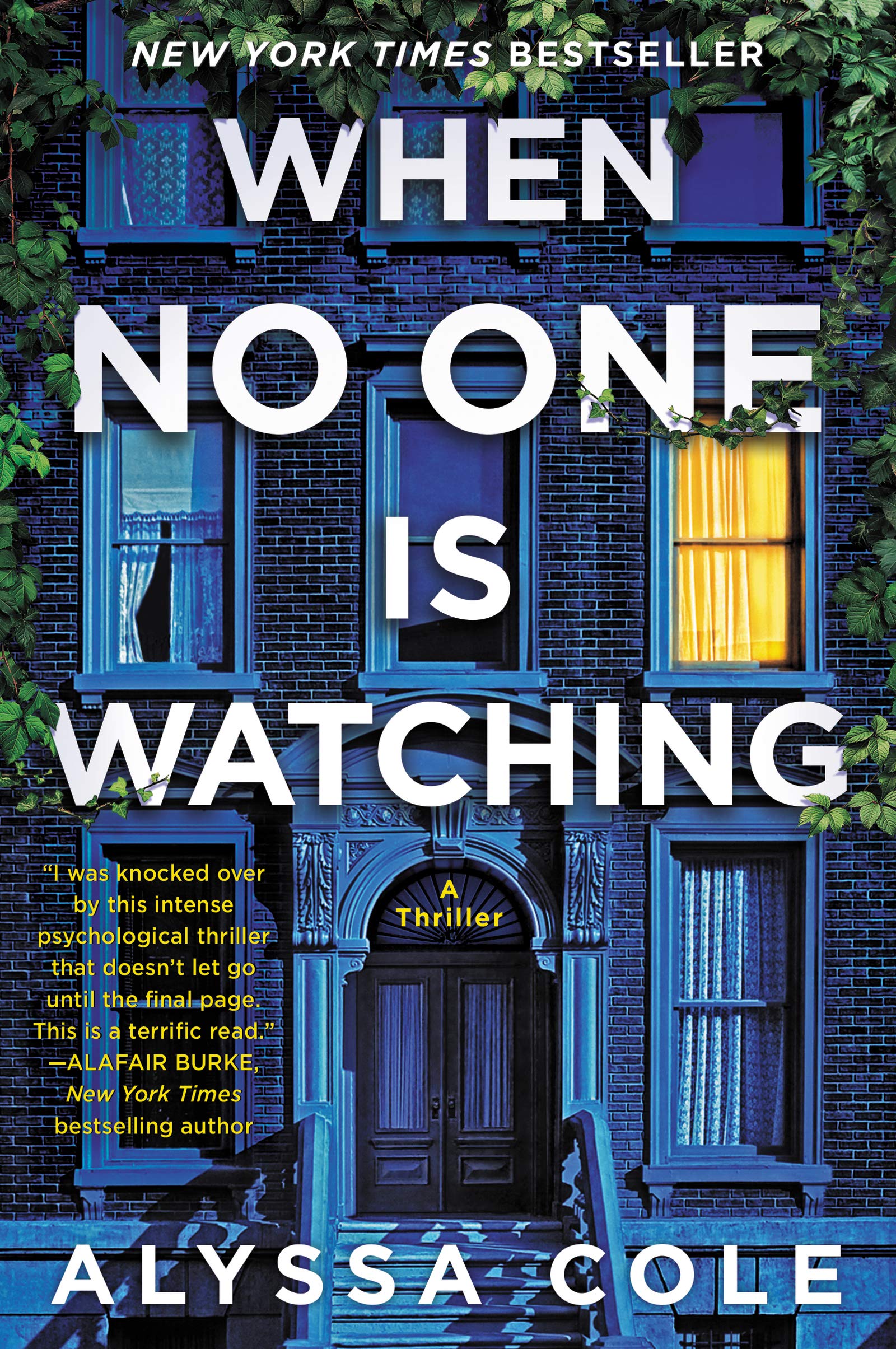
When No One Is Watching by Alyssa Cole

While it takes its time getting to the ‘thriller’ part, this novel does pack a punch once the thrills begin. Told in two points of view, a romance builds alongside the terror.

Following a nasty divorce, Sydney has recently moved from Seattle back home to the fictional Gifford Place neighborhood in Brooklyn, NY. Her mother’s health has taken a turn for the worse, and it is a relief anyway to return to her childhood home, a handsome brownstone building where Sydney’s lifelong best friend Drea also lives in an apartment. The neighborhood is changing quickly, though: gentrification is coming hard for Gifford Place, a traditionally Black neighborhood, and neighbors Sydney’s known all her life are disappearing right and left, along with the businesses she frequents, and being replaced by white residents. The book opens with a brownstone tour emphasizing only the neighborhood’s distant white history, which Sydney interrupts to interject a truer version, before leaving frustrated for comfort food at her favorite bodega. The tour guide’s snotty advice that Sydney should start her own tour gets her thinking, though.

With the annual block party approaching, Sydney works on her research for the tour. Meanwhile, a new white resident, Theo, struggles in a failing relationship with his absolutely toxic racist girlfriend Kim. She is one of several of Sydney’s new white neighbors who move well beyond micro- into macro-aggressions and overt racism, while hapless Theo appears to be having the first eye-opening of his life all at once. I’m leery of this device. Theo volunteers to be Sydney’s assistant in tour research, offering us a rather too obvious didactic opportunity: Sydney explains history to Theo who also, on his own, researches patterns of white flight, redlining, real estate scams, and the reaches of slavery beyond Confederate borders. Gasp, northern bankers benefit from cotton planting too! This is a bit transparent for my tastes. Where has Theo been hiding all these years that he’s so ready for his awakening but has just never been exposed to truth before? [I thought it was a good detail, on the other hand, that Theo is white but also comes from poverty and crime. I felt this offered a subtler and therefore perhaps more clever avenue to explore why poor white people, though facing certain disadvantages, still experience an absence of the obstacles that face Black people of any socioeconomic background.] There are however some fun moments, like when they come up with a safe word (‘Howdy Doody’ – Theo’s idea) for when he gets into his “little white feelings.”

This is the weakest part of the novel, for its didactic feel and slower pacing. Then we move into a quickening of the dangers. Theo and Sydney uncover the dirt, historical and contemporary, the widespread conspiracy to take over Gifford Park for great profits and throw longtime residents out on their asses or to an undisclosed location. Banks, hospitals, real estate agencies, medical research facilities, tech scams and plain intimidation–is it a conspiracy theory if it’s all true? Where have Gifford Park’s disappeared residents been going, anyway? Why would Mr. Perkins take off in the final days before the big block party? Sydney’s past traumas make it difficult to trust her new friend, who is admittedly slow to some punches. (It is funny, if also sad, when he figures it out: “Not being able to call the police when you need help really sucks, I’m learning.”) Once the action shifts into gear, When No One Is Watching rockets along. Horror, fight scenes, sex, drama, and relevant social issues: it’s haunting but also fun. If a few plot threads get dropped along the way, so be it.

Possibly Cole got a bit ambitious with the combination of capital-I Issues and thriller intrigue. It was rough in spots. But she also accomplished a lot, and kept me engaged (if occasionally a little impatient), and I’d encourage more efforts like this one.


Rating: 7 loosies.

Maximum Shelf: Let Us Descend by Jesmyn Ward

Maximum Shelf is the weekly Shelf Awareness feature focusing on an upcoming title we love and believe will be a great handselling opportunity for booksellers everywhere. The features are written by our editors and reviewers and the publisher has helped support the issue.

This review was published by Shelf Awareness on May 17, 2023.


Two-time National Book Award-winner for Fiction Jesmyn Ward (Men We Reaped; Navigate Your Stars; The Fire This Time; Sing, Unburied, Sing; Salvage the Bones) takes a different direction with her fourth novel, Let Us Descend: it’s her first historical narrative. Beautifully written and heartrending, Ward’s story sensitively handles grief, love, and recovery. On a rice plantation in the Carolinas, an enslaved teenager named Annis narrates as she works alongside her beloved mother. Mama is a source of comfort and strength even as her finger bones are “blades in sheaths.” Annis says, “The first weapon I ever held was my mother’s hand.” This steely woman teaches Annis lessons of combat learned from her own mother, one of thousands of warrior wives to an African king, tasked with both protection and elephant hunting. “In this world, you your own weapon,” she tells her daughter, and Annis will need to be.

Annis’s father is the plantation owner who owns her and her mother. Annis has half-sisters in the big house. “My sire’s house hulks; its insides pinned by creaks,” and her “sallow sisters” have a tutor to read to them, to teach them the texts of ancient Greece, about bees and wasps and Dante’s Inferno: “The tutor is telling a story of a man, an ancient Italian, who is walking down into hell. The hell he travels has levels like my father’s house.” Let Us Descend‘s title is a nod to Dante, and a cue to the reader to notice hells, descents, and journeys south. Annis listens and learns. Through her natural gifts, her own interest, and with her mother’s help, she becomes skilled in foraging: herbs, mushrooms, medicinal plants, and simple foods. She learns to befriend the bees she hears her sisters’ tutor speak of.

Then Annis’s father chooses to sell her mother south. The “Georgia Man” takes her away in a line of stolen people for the long walk to market. Annis falls into a near-fatal grief at being left without the most important person in her life, until a kind friend pulls her back to the surface. But soon, Annis and Safi, her friend-turned-lover, are sent on the same walk with the Georgia Man. From the plantation where she was born, Annis makes a death march to a New Orleans slave market and is sold to a cruel lady whose Louisiana sugar plantation marks a further descent, into a new level of hell. Others will uplift her along the way, but she never shakes the excruciating grief for her mother.

Along the way she gains and loses friends, and meets a spirit: Aza controls the storms and winds, and has stolen the name of Annis’s maternal grandmother, the warrior Mama Aza. “Aza’s hair a living thing: scudded clouds, the setting sun lighting them on fire. She leans forward and a breeze blows from her. Feels like the slap of a freshly washed linen on my face, snapping in a cool wind.” The spirit seeks her own identity and self-importance in relation to others, and has locked onto Annis’s maternal line as a way to achieve this: she models herself after the grandmother Annis never knew, and her use of the name Aza represents both connection and theft. That Annis refers to enslaved people like herself as “stolen” adds a layer to Aza’s use of the name.

Less centered around plot and character than Ward’s previous novels, Annis’s story is more elemental and thematic, dealing primarily with grief, forces of nature and human evil, villains and allies. The spirits she meets–chiefly Aza, but others as well–are closely associated with natural forces. “Another spirit, white and cold as snow, walks the edge of the river; it hungers for warmth, for breath, for blood, for fear, and it, too, glances against the enslaved stolen and feeds. Another spirit slithers from rooftop to rooftop before twining about wrought iron balconies outside plaçage women’s bedrooms, where it hums, telling the bound women to portion out poison in pinches over the years, to revolt, revolt, revolt.” These spirits can help but also harm, offer but also take away; they may represent another form of attempted ownership, as Aza has taken Mama Aza’s name. In a magical-realism twist, Annis finds these spirits widen her world beyond her immediate suffering to other timelines and possibilities.

Just as Ward’s title refers to Dante’s story of a descent into ever-deeper levels of hell, her hero makes a parallel, nonconsensual descent into the deeper South, into pain and suffering and sorrow, and into the worsening and worst of humanity. The novel moves with Annis from the Carolinas to Louisiana, and in story, back to Africa, where Mama Aza established the fighting spirit she would pass on.

Ward gives Annis’s voice a raw strength and musicality. After she is imprisoned in an underground cell by a particularly sadistic plantation owner, Aza tells her, “When you were up north, your sorrow choked your song. Swallowed it down. Even so, it hummed. But the walk changed it. The further you went, the more it rose until the woman put you down in the earth. Then it shrieked.” Attention to descriptive detail emphasizes Annis’s close relationship to place, and the importance of the land itself (not least in supplementing the enslaved people’s painfully meager allotted diet). “The water reaches in every direction, duckweed bright and green, floating on the murky wet. Cypress, fresh with rain, shimmers.”

As much pain, struggle, torture as there is in these pages, there are also various forms of love, and great strength, power, and personal reclamation. Let Us Descend ends with surprising hope. “How the whitewash of starlight would buoy them along. How they dance with the rocking deck. How them sing.” With this novel, Ward’s talent continues to deepen and glow.


Rating: 6 broad, glossy leaves.

Come back Friday for my interview with Ward.

Maximum Shelf: My Name Is Iris by Brando Skyhorse

Maximum Shelf is the weekly Shelf Awareness feature focusing on an upcoming title we love and believe will be a great handselling opportunity for booksellers everywhere. The features are written by our editors and reviewers and the publisher has helped support the issue.

This review was published by Shelf Awareness on May 10, 2023.


My Name Is Iris by Brando Skyhorse (The Madonnas of Echo Park; Take This Man) is a chilling near-reality dystopian novel, set in an unnamed state that resembles California (and is called the “Golden State”). Protagonist Iris Prince is a second-generation Mexican American whose parents view her birthright as a gift and use the refrain “you were born here” to shame her whenever they feel her bad behavior shows a lack of gratitude. (“I am a second-generation Mexican-American daughter of Mexican immigrants, meaning that of course I was ungrateful.”) Born Inés Soto, she was glad to have her first name simplified by white schoolteachers, and then to take her husband’s last name. Iris is proud to be a rule follower, her highest ambition to blend in.

When the novel opens, Iris Prince has just left Alex, her husband of 16 years, and is determined to finally build the sanitized, magazine-cover life she’s dreamed of: a new house in a suburban neighborhood on a cul-de-sac, a new school for her nine-year-old daughter, Melanie. She has shunned her parents’ low-income home in a Spanish-speaking neighborhood (where her younger sister still lives, annoying Iris with her activism) and avoids Alex’s overtures at co-parenting or getting back together. Iris feels that her real life–coffee clubs, gardening, and white picket fences–is about to begin.

Then one morning, she looks out of her lovely new bay window to find that a wall has sprung up in her front yard. It seems permanently fixed, and no one but Iris and Melanie can see it. Her realtor and contractors claim the wall must have been there all along, until gaslit Iris wonders, “Who was I to say otherwise?” And, impossible as it is, the wall seems to be growing.

Meanwhile, a new piece of wrist-wearable tech called “the band” is sweeping across the state. Iris herself voted in favor of the proposition that established this technology as a paper-saving, easy identification to “facilitate paying for and receiving state and public services, act as a drivers’ license,… help users regulate a household’s water usage and garbage output, serve as proof of residency for your child’s enrollment in school, and potentially save the state millions of dollars.” But it turns out that, regardless of citizenship, one must have a parent born in the United States to qualify for a band. Iris’s confidence in her place in society is shaken. “Wear your bands and prove you belong here,” says the propaganda. Hatred, bigotry and intolerance quickly swell into violence. “Somehow, in an overnight or two, my social contract had been renegotiated. Politeness vanished.” Iris’s loyalties are challenged: she has long associated herself with law and order and the establishment, but those forces have turned against her, despite all her rule-following. Each morning she drops her daughter off at school, the band’s seductive glow encircling Mel’s slim wrist–due to Alex’s birthright, Mel qualifies for the privileges of the band. But Iris fears for her home and her job; her mother has been fired for her bandless status, and the family is in jeopardy. Under these pressures, Iris will have to consider just what she’ll risk to protect her hard-won sense of identity.

Skyhorse seeds his text with plenty of Spanish-language dialogue, especially with Iris’s parents and sister; non-Spanish-speaking readers will easily use context clues. In addition to this lovely linguistic texture, Skyhorse imbues his all-too-lifelike novel with fine details–Iris’s anti-nostalgia for a defunct supermarket, her love for bland ritual–and judicious use of highly impactful notes of the mysterious or the surreal. These twists of magical realism include a ghost from a childhood trauma who haunts Iris in her vulnerable moments, and of course the wall itself, which grows and morphs overnight. The wall is ever-present, at one point “almost like a co-parent,” even as it literally deprives her home of the sun’s light and heat, as well as her sense of security: “Later, when I would dream, I dreamed of walls.”

My Name Is Iris is terrifying with its proximity to reality. Iris is perhaps preoccupied with labels and appearances (as the book’s title forecasts), and not the most likable protagonist, initially; but her flaw is simply in seeking the American dream as it’s been advertised. Despite her obedience–teaching her child to always trust the police, adhering strictly to HOA rules–the world she’s trusted has turned on her. What can one woman do to fight a state security regime or a magically self-constructing wall?

This gripping dystopia poses difficult but important questions about the world as we know it and the few small steps it takes to slide into horror. Intolerance and xenophobia lurk in the most seemingly benign corners. My Name Is Iris is part social commentary and part thoughtful consideration of themes that include family, identity, transitions, perspectives, and hope. In addition to being an engrossing, discomfiting tale, this will make an excellent book club selection and fuel for tough conversations.


Rating: 6 chanclas.

Come back Monday for my interview with Skyhorse.

Maximum Shelf: All the Sinners Bleed by S. A. Cosby

Maximum Shelf is the weekly Shelf Awareness feature focusing on an upcoming title we love and believe will be a great handselling opportunity for booksellers everywhere. The features are written by our editors and reviewers and the publisher has helped support the issue.

This review was published by Shelf Awareness on February 13, 2023.


From S.A. Cosby, author of Blacktop Wasteland and Razorblade Tears, All the Sinners Bleed is a lushly dark mystery set in fictional Charon County in Southeastern Virginia and starring a Black sheriff in a town that’s not at all sure it’s ready for one. Recently elected Sheriff Titus Crown is out to right some wrongs from the inside: police corruption, racism and profiling, law enforcers living above the law. He’s also dodging a few traumas of his own. Having come home to Charon County means he gets to live with and help his aging father, but it also means he’s reminded of his beloved late mother. His brother lives in town but rarely comes around. Titus has a local girlfriend who’s very sweet and good for him, but sort of unremarkable; he has a sense he should love her more. He’s haunted by the events that ended his FBI career in Indiana. Running a small staff of deputies in a small Southern town has its own challenges, mostly manageable ones; he hopes to redeem himself in this way from wrongs only hinted at.

But then there’s a call about an active gunman at the high school in town. In minutes, Titus is looking at a popular teacher of decades shot to death in his classroom, and a young Black man killed by deputies while the school–and via their cell phone videos, the entire Internet–watched. Before Latrell Macdonald died, “with a wolf’s snout in his left hand and cradling a .30-30 like a newborn in the crook of his right arm,” he spoke of crimes that make Titus’s blood run cold. The ensuing investigation will crack Charon County wide open, and challenge to the core Titus’s plans to clean up his hometown and make amends for things that happened in Indiana.

Titus is no investigative slouch. “His instructors at the Academy had their own version of String Theory. The way they explained it, there were invisible strings that vibrated unseen in the liminal spaces between sunrise and secrets, between rumor, shadows, and lies. Strings that pulled all this together. All you had to do was find the seam and unravel it. Or rip it apart.” His years with the Bureau and training under his friend and mentor there give him an edge on profiling and pursuing an enemy who seems determined to toy with him. He finds the remains of badly tortured and murdered Black boys and girls; as he investigates, the body count only rises. An old girlfriend from his FBI years appears, asking to interview him for her crime podcast; his father pleads with him to come back to church. The Sons of the Confederacy are planning a march at the upcoming Fall Fest, and a strange story surfaces about a reclusive fire-and-brimstone snake-handling preacher. Increasingly distressed at his inability to keep his county safe, Titus is plagued by memories and the present evil attacking his home. On less and less sleep, he doggedly puts in work. “He went over a few other emails, reviewed the gas expense reports, checked the arrest log from last night, updated the Sheriff department’s social media page…. It felt strange to attend to the mundane and the profane at the same time but that was a defining aspect of the job.”

All the Sinners Bleed is noir with a particular American Southern twist. Place figures heavily. “The soil of Charon County, like most towns and counties in the South, was sown with generations of tears…. Blood and tears. Violence and mayhem. Love and hate. These were the rocks upon which the South was built.” Cosby deals in timely themes: returning home and reckoning with old wounds and crimes; the unsavory histories of the places we love; the legacies of Confederate statues, of slavery and racism; the darkness within all of us, even those playing the good guys; the role of police and policing. His prose is gruff, poetic but stark: “The clouds gathered like young men on a corner getting ready for a fight.” Titus has a code like that of Michael Connelly’s Detective Harry Bosch: “Either we all matter or no one matters. Everyone deserves to have someone speak for them.” He believes that something hard and mean dwells in every heart–and in a few, true evil. What has beset Charon County is not supernatural. It is merely the wages of sin (as his churchgoing neighbors might say), or the county’s bloody past coming back around. There is something of the lone gunslinger–damaged but virtuous–in Titus Crown, who stands against the worst elements of human nature. Like Cosby’s previous novels, All the Sinners Bleed is often grim, but it lands on a surprisingly hopeful, even joyful ending.

For fans of gritty, dark mysteries with an interest in the very real and contemporary demons of United States culture and history, Cosby’s work offers a sinister but satisfying voyage into the best and worst of returning home and starting fresh.


Rating: 7 sheep.

Come back Monday for my interview with Cosby.

What Happened to Ruthy Ramirez by Claire Jimenez

This debut novel about a family still searching for a long-missing daughter and sister brims with voice, attitude and yearning.

Claire Jimenez’s first novel, What Happened to Ruthy Ramirez, brings to life a close but troubled Puerto Rican family in Staten Island, N.Y., carrying on but rocked by loss. “The five of us seem normal for a while, up until Ruthy turns thirteen and disappears…. Draw my mother sixty-two pounds later. Give her diabetes. Kill my dad. Cut a hole in the middle of the timeline. Eliminate the canvas. Destroy any type of logic. There is no such thing now as a map.” No one ever figured out what happened on the day Ruthy didn’t come home from track practice on the S48 bus as expected.

More than a decade later, Nina, the baby, is “blessed with the brilliant luck of graduating [from college] into the 2008 recession,” the first in her family to attend college but now returned home to live with her mother and work at the mall selling lingerie. Jessica, the eldest, lives with her boyfriend and their baby; she works as a patient care technician at the hospital, harried and tired but proud of her work. Their mother, Dolores, depends on her relationship with God and the church. What Happened to Ruthy Ramirez unfolds in alternating chapters, through the first-person perspectives of these four central characters: Nina, Jessica and Dolores in the late 2000s and the stormy, troubled 13-year-old Ruthy in 1996 when she disappeared. The latter is all attitude: You really want to know what happened to Ruthy Ramirez, she asks? Most people “think they got it all figured out, about who I am and what happened. Whatever, who cares? Not me, I promise you.” She describes the day it happened, the schoolgirl dramas and fights, whose pain appears superficial only from the outside. Years later, her sisters and mother struggle with everyday life and with moving on–until the day Jessica believes she sees Ruthy’s face on a sordid reality TV show: the woman shares the missing girl’s beauty mark, her laugh, the toss of her head, a couple of key phrases. And the remaining Ramirez family is off on a mission to recover their lost member.

One of Jimenez’s greatest achievements lies in the individual voices of her narrators, crackling with life, wit, humor, pain and personality. Jessica and Nina wrestle with the complicated love they feel for their family; Dolores rants in a well-meaning but frustrated one-sided conversation with her God; Ruthy oozes teenaged bravado and angst. Readers will be tugged by hope and despair alongside these true-to-life characters. In the end, What Happened to Ruthy Ramirez offers observations about race, class, family and the fate of missing girls beyond its title character.


This review originally ran in the February 7, 2023 issue of Shelf Awareness for the Book Trade. To subscribe, click here.


Rating: 7 grilled cheese sandwiches from the school cafeteria.