





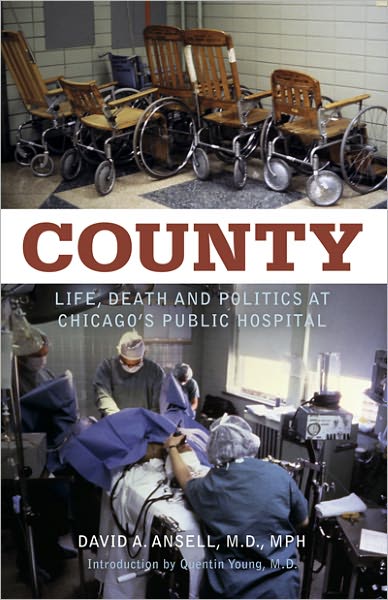
 I read ~150 of County‘s ~200 pages in one night, and forced myself off to bed. Finished the next day. Ansell is no professional writer; I itched to get out my red pen here and there. But his story is powerful and evocative, and his passion for the injustices he describes absolutely screams off the page.
I found myself swept away in the story of “County,” as Ansell refers to the Cook County Hospital in Chicago where he spent the bulk of his career. As a med student, he and his friends suspected they wanted to go to County, famous for its overcrowding, underfunding, racial disparity, and incredible challenge. His group was concerned about social injustice. Fresh off antiwar protests and sensitive to racism, these idealistic young med students drove down from New York to Chicago to visit the hospital and interview with Quentin Young, then Chairman of the Department of Internal Medicine, famous pioneer of desegregation and human rights in health care. They were shocked at the squalor and disorganization, even having come in with some impressions. Ansell & friends, eventually known as the “Syracuse Group,” conspired to become residents at County, precisely because of the challenges it presented.
Ansell is strongest when telling his personal story. Residents at County in his day (he started in 1978) had little to no supervision or assistance from their attending physicians; he describes an environment in which the residents all muddle through together, cooperatively, learning as they went. This was a great education but often resulted in less-than-optimal care for the poverty-stricken patients. From resident, he goes on to a position as an attending physician at County, although his original plan had been to head back east after completing his residency. He was immediately hooked, though, by the neediness of County, the organization, and his patients. He was also involved in politics and activism from his first moment on campus – literally. He attended a meeting on the day of his scheduled interview for residency.
Over the years, Dr. Ansell would serve in various positions in the ER and in the outpatient clinic, and be part of the birth of the Breast Cancer Screening Program and County’s AIDS Clinic. His patients, and their problems, made deep impressions on him. He was active in trying to right the wrongs of the health care system and of County’s management and underfunding in particular. When the politics really get going, Ansell can get a little bit soap-boxy. I have mixed feelings about this aspect of the book. While unquestionably passionate, righteous, and well-informed, he can tend to come on a little strong. Preachy, even. My concern here is the one my old buddy Gerber expressed about Barbara Ehrenreich’s Nickled and Dimed: On Not Getting By in America, years ago: the author’s personal political starting point is so overtly obvious that the (actually very strong) point of the book may be dismissed because of the author’s prejudice. Speaking as someone who DOES share Ansell’s politics, and who still feels that he can get a little preachy, I have concerns about the book achieving its goal of education and perhaps even changing minds.
But the stories about Ansell’s experience learning and working as a professional doctor, the stories about his patients and their troubles, and the stories about the challenges of County… its politics, the underfunding, the horrific and inhumane conditions… these are where Ansell shines. It’s a powerful, emotional, evocative book. It makes good points: it argues that access to health care is a human right, and should not be dependent upon health insurance or employment status. It is definitely a political book. I recommend it, just with a few reservations. Because it is short and engrossing, you can almost read this book in one sitting or two. And I think it is absolutely worth your time.
Filed under: book reviews | Tagged: end of life, health/hospitals, nonfiction, race | 3 Comments »

