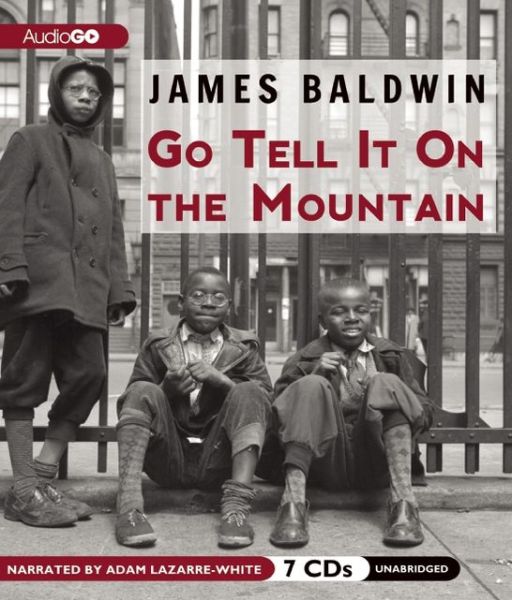
Teaser Tuesdays: Go Tell It on the Mountain by James Baldwin

Teaser Tuesdays is a weekly bookish meme, hosted by MizB of Should Be Reading. The idea is to open your current read to a random page and share a few sentences. And try not to include spoilers!

go tell it

I just couldn’t pass up the opportunity to share this passage with you.

He left Fifth Avenue and walked west towards the movie houses. Here on 42nd Street it was less elegant but no less strange. He loved this street, not for the people or the shops but for the stone lions that guarded the great main building of the Public Library, a building filled with books and unimaginably vast, and which he had never yet dared to enter. He might, he knew, for he was a member of the branch in Harlem and was entitled to take books from any library in the city. But he had never gone in because the building was so big that it must be full of corridors and marble steps, in the maze of which he would be lost and never find the book he wanted. And then everyone, all the white people inside, would know that he was not used to great buildings, or to many books, and they would look at him with pity. He would enter on another day, when he had read all the books uptown, an achievement that would, he felt, lend him the poise to enter any building in the world.

Libraries; books; the intimidation of buildings, books, and the grandeur of the New York Public Library; and the power available to a young man who could read all the books uptown. Lovely, and moving.

book beginnings on Friday: Go Tell It On the Mountain by James Baldwin

Thanks to Rose City Reader for hosting this meme. To participate, share the first line or two of the book you are currently reading and, if you feel so moved, let us know what your first impressions were based on that first line.

go tell it

I had a heck of a time getting this electronic audiobook from my local public library onto my iPod, but I have succeeded and thus well earned this listen. I started off with James Baldwin’s Notes of a Native Son, which I enjoyed; but it made me want to go back to the beginning of his work, and Go Tell It On the Mountain is his most famous novel, so here we are. It begins:

Everyone had always said that John would be a preacher when he grew up, just like his father. It had been said so often that John, without ever thinking about it, had come to believe it himself.

I think these are strong starting lines. They tell us who our protagonist is; they tell us his family background, and they both name an expected fate for John, and imply that this expectation will not be fulfilled. It also bears noting that on the first page, there is also reference to John’s father fondling one of his daughters, implying that this preacher is not as virtuous as we’d expect. It’s a very casual mention, downplaying the import of this fact. To me, this says that the family doesn’t think much about it; or maybe they don’t know yet. At any rate, it’s disconcerting to have molestation treated so lightly, and I think Baldwin makes a real impact by introducing such disturbing information so off-handedly.

Please note that I have only just begun this book, so I don’t know yet if my interpretations here are correct! Stay tuned…

Ramblers: Loyola Chicago 1963: The Team that Changed the Color of College Basketball by Michael Lenehan

A dynamic, emotional study of one college basketball team’s role in the civil rights movement.

ramblers
Michael Lenehan’s Ramblers chooses one college basketball team, and one season, to illustrate a sea change in the sport–and in the United States. The Loyola Chicago team of 1963 was not the first to send black and white players out on the court together, but Lenehan makes an excellent case for the significance of this particular team’s actions at a key moment in the national struggle for civil rights. He examines their competition over the course of the season, focusing on two teams in particular: Mississippi State, whose players had to sneak out of state due to a ban on playing teams with nonwhite members, and Cincinnati, which was also an integrated team, but one with an increasingly antiquated playing style.

Relying on primary sources and interviews to study a handful of individual players, coaches and administrators, Ramblers passionately evokes the beauty of a great game in a time of great change, and works as a metaphor for changes taking place across the nation as well. Lenehan handles the game with an ease and comfort that indicate his expertise, and Ramblers combines his passion for basketball with an intimately detailed history–including a deeply moving digression into the 1962 riots at Oxford, Miss. Lenehan eventually follows each of his subjects through to the present (or the ends of their lives), giving Ramblers a feeling of completeness. Throughout, he maintains a sense of fun appropriate to a book that’s ultimately about the antics of college kids.


This review originally ran as a *starred review* in the March 19, 2013 issue of Shelf Awareness for Readers. To subscribe, click here, and you’ll receive two issues per week of book reviews and other bookish fun!


Rating: 7 fast breaks.

Speaking Truth to Power by Anita Hill, second half review

anitahillI am pleased to report that I had a different experience with the second half of this book, in all the right ways. You will recall (or, I will direct you to) my first half review of same: I thought it was a wonderful book but such a painful story that I had to put it down for a little while. Well, in a nutshell, the second half is: still painful, tragic, and true, but also uplifting, far more hopeful than I expected; and equally well-written and impressive. I wholeheartedly recommend it.

Anita Hill continues to be thoughtful and thorough – I definitely see the mind of a lawyer at work, as she discusses the what-if’s, the precedents, the niceties of the law. She is quite cerebral in her theories on society and stereotyping; far from being a simple revelation of her experiences, this is a treatise on gender & race. She examines the relationship between issues of gender and of race, and the indivisibility of feminism from the fight for racial equality, and the relationships between race and sexism. Hill is clearly an extremely intelligent women! She is also warm and loving about her family, and always seeking privacy, not eager to be a symbol or a leader. In other words, she comes firmly across as a “just regular” person, and someone I’d like to know.

Her story is also entirely convincing. It is beautifully put together and well-written: not lyrical, but methodical, structured, can I say thorough and lawyerly again? And she preaches more hope than I felt in my first-half review. However, the battle is still not over, and I still feel upset & angry that Hill’s experience reads so familiarly more than 20 years later. On that note, I’ll refer you to Jessica Valenti’s lovely speech to my local Planned Parenthood group, here. Well said, Jessica. You give me hope, too.


Rating: 9 strong women, please.

Speaking Truth to Power by Anita Hill, first half review

anitahillFor reasons I’ll discuss below, I have had to put this book down at about the halfway point, through no fault of Anita Hill’s absorbing story or lovely, clear, honest writing. This first review will be more about my emotional reactions and reason for pausing in my reading; soon I will publish my second-half-review which will be more about the book itself. Briefly, for the record, it’s a great book.

Anita Hill was a young black female lawyer from the south in the early 1980’s, when she found herself employed as an assistant to Clarence Thomas, then an aspiring government official looking for an appointment under President Bush (Senior). She was largely successful in leaving behind her unpleasant experiences in his employment as she moved onto other lines of work, teaching law back in her home state of Oklahoma, where she could be closer to her family and further from the nasty environment Thomas created for her in Washington, D.C. When Thomas was nominated to the Supreme Court in 1991, however, she reconsidered her silence on his sexual harassment, and ended up traveling to D.C. to testify at his confirmation hearing as to his behavior nearly 10 years earlier. She was excoriated for her decision and her actions; every piece of her life, her morals, her “virtue” were picked apart. This book is her attempt to set the record straight.

Most Americans know the name Anita Hill, in my (limited) survey. When I mentioned this book, a coworker spoke of having horrible, vivid dreams, set in the Senate, as the hearings went on; she sympathized with Hill’s unfortunate position. I am young enough that I don’t remember these events (I was 9 in 1991 and not paying much attention to sexual harassment and Supreme Court nominations, for which I suppose I’m glad); it’s history to me. However, the name Anita Hill did mean something to me, and it means much more now.

I am reading this book because my father raved about it and felt it was important reading for me, which I easily believed. And it’s a lovely book. But it so happens that I picked it up during a time when my personal life was in upheaval in a few ways. I don’t want to share too many personal details here (I’d rather get personal when the news is good!) but it involved my loved ones being spread around the globe dealing with various trauma, and I was distracted, worried, and depressed. And unfortunately, one of the central truths of Hill’s book, based on events in 1982 and 1991 and published in 1997, holds true today: that most women will be sexually harassed; that most will choose not to accuse their harassers; and that few harassers are sanctioned. Again, without revealing too much of my personal story, I know this firsthand. And reading about Hill’s experiences, both being harassed by Thomas, and then being harassed by her national media and political representatives, was entirely too painful to me. I felt physically sick to my stomach reading it, and I had to put it down.

I still agree with my father’s statements that this is a very good book, and that it’s an important book for me to read. I look forward to picking it back up – as I write this, personal-life issues are mostly resolved, and (thank goodness!) Husband is home here with me. Hill writes like a lawyer: she makes statements of what she knows to be true, and is careful to note where she speculates, while providing evidence to support her speculations. She speaks strongly where she is sure that she is right; and (as one would expect) she has a very sure and confident grasp of legal issues in their minutia, and is capable of making those legal details understandable to her reader. I also really enjoy her gentle, loving treatment of her family history; that background adds to her story immeasurably.

I wanted to give you this first-half-review of this book where I’ve paused in my reading of it, to note the painful emotional impact it’s had on me. Make no mistake, it’s a fine book and I will finish it and tell you more very soon. But for now, know that this story is rather excruciating.


Rating: 8 brave public statements.

Team of Rivals by Doris Kearns Goodwin (audio)

teamofrivalsMostly I read books first and then (maybe) watch the movie, later. This time I did it backwards: I recently saw the new movie Lincoln (with Daniel Day Lewis), and then began listening to this book on audio, on which the movie was based. Not that there’s any shortage of Lincoln histories out there; but this is the one Spielberg turned into film. So please forgive me if this review is a little heavy on comparisons to the movie…

Beginning with which, the movie begins on the eve of the battle to ratify the 13th amendment, but the book starts much earlier, with Lincoln struggling to get the Republican Party’s nomination for presidential candidate. We follow Lincoln through his nomination, his campaign, and the setting up of his cabinet. The title of the book, appropriately, describes its subject: not Lincoln himself so much (as in the movie), but his skillful political alignment of his rivals for the Republican nomination in his cabinet. We get to know these other characters much better in the book than we did in the movie (which was also appropriately titled. Its focus was different). As this book effectively communicates, one of Lincoln’s political strengths was in placing his rivals where their strong points could best play to his administration’s advantage, and where their animosity toward him could best be neutralized.

Just as with the movie, I worried a little about an overly patriotic, positive portrayal of Lincoln. As in the movie, he is depicted as being strongly concerned about the black man or woman’s natural right to liberty; and while this is a sentiment we applaud today, I am afraid it was not at the center of the Civil War or Lincoln’s personal priorities. In other words, it’s something we love to think about our lauded 16th president today, but it’s not entirely historically accurate. Along these lines, I noted repeatedly that Goodwin uses rather many superlatives, which decreased my confidence in her neutrality slightly.

These concerns aside, I enjoyed the story. Not only Lincoln and his wife and children, but the characters (along with their families) of Bates, Chase, and Seward are evoked, and it made this critical moment in my nation’s history come alive. It was an absolutely entertaining story to listen to; and Goodwin’s great reputation (she has a Pulitzer to her name) and the reasoned pace & structure give me confidence that this is a responsible piece of historical writing… but I still felt that there was some positive slant, as above.

The audio narration by Richard Thomas was everything it should have been. This is a fine book, very readable, which makes Lincoln’s White House history accessible and makes the story come alive. But it might not be hard-edged journalism, for what that’s worth.


Rating: 6 machinations.

book beginnings on Friday: Team of Rivals by Doris Kearns Goodwin

Thanks to Rose City Reader for hosting this meme. To participate, share the first line or two of the book you are currently reading and, if you feel so moved, let us know what your first impressions were based on that first line.

teamofrivals

After recently seeing the movie Lincoln, I have been ready to finally listen to this book, upon which the movie was based. It begins:

On May 18, 1860, the day when the Republican Party would nominate its candidate for president, Abraham Lincoln was up early. As he climbed the stairs to his plainly furnished law office on the west side of the public square in Springfield, Illinois, breakfast was being served at the 130-room Chenery House on Fourth Street.

Simple enough, yes, but I think this is an example of slipping details and impressions upon the reader in what reads like a straightforward few sentences. Picture a man who’s up early on this day: is he nervous? That would be understandable. His office is plainly furnished, and they’re serving breakfast elsewhere. He’s a man of the people rather than an aristocrat, perhaps.

I’m excited about this read. I will say that Goodwin uses rather many superlatives, so far, and there’s a danger, when someone is portrayed as being masterful, expert, the most and the best, of wearing me out a little. But I’ll wait and see. It’s easy to get excited about Abraham Lincoln, of course.

That’s my new read – and what are you reading this weekend?

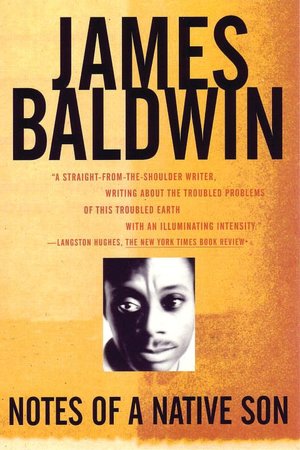
Notes of a Native Son by James Baldwin

Notes of a Native Son is a 1955 collection of James Baldwin’s essays and articles, all previously published elsewhere as I understand it. Their subjects range over books, movies, personal history, and social commentary; what each piece has in common is a consideration of race relations in the United States. He is concerned with the American “Negro” (this is no longer considered the right word, but I’m tempted to use it here, because he did) and the relationships amongst Americans, white and black. A persistent question he ponders is that of the black man’s search for identity in a nation that variously rejects him, resents him, or feels guilt over its treatment of him, made more difficult by the loss of his own personal history pre-slavery.

There are some heavy bits here, unsurprisingly. While not exactly academic, some of it is definitely on the philosophic side of things. When Baldwin dives deeply into literary criticism, he loses me (I guess I’m rusty on literary criticism; I used to find such articles much easier to read!): “Everybody’s Protest Novel” and “Many Thousands Gone” nearly made me quit the collection. In “Carmen Jones: The Dark Is Light Enough,” he discusses a movie, and actors, so unfamiliar to me that I was only reading on the surface – where I rather enjoyed the essay, it is true, but where I certainly failed to understand fully what he had to say. On the other hand, “The Harlem Ghetto” struck me as intelligent, occasionally amusing, and relevant today. And as you know, I am always thrilled to make connections across seemingly unrelated books I’ve read or historical figures I’ve studied. Before I was halfway through this book, I’d seen mention of Lillian Hellman (see a recent biography, one of my favorite books of the year) and the Patterson family (another), not to mention of course threads that take me back to The Warmth of Other Suns, which is how I got to this book in the first place. Ah, the circularity of things: it amazes and thrills me.

My favorite pieces in this collection were the autobiographical ones. I like Baldwin’s voice very much: he is wry and funny even when discussing the serious and the tragic. And I was most interested in learning more about him. My edition begins with a “Preface to the 1984 Edition” followed by “Autobiographical Notes,” both of which set the bar high. The titular essay comes about midway through and is also excellent. But my very favorites were the last two. “Equal in Paris” relates Baldwin’s experience being arrested in Paris and tried for possessing a bedsheet from the wrong hotel. It was hilarious, and ended chillingly. And “Stranger in the Village” covers his time spent in a tiny Swiss village where the residents had never seen a black man before, and is where I felt he made his most sweeping and hopeful statements about our present and our future. It was tragic, but forward-looking.

I really enjoyed Notes of a Native Son, although there were a few moments where I got bogged down. Baldwin’s voice charmed me. I recommend him.


Rating: 7 blocks in Harlem.

Teaser Tuesdays: Notes of a Native Son by James Baldwin

Teaser Tuesdays is a weekly bookish meme, hosted by MizB of Should Be Reading. Anyone can play along! Just open your current read to a random page and share a few sentences. Be careful not to include spoilers!

In this striking collection of essays by James Baldwin, I found several noteworthy passages, truths, maxims; but I chose this one especially for you, because of its unique and arresting imagery. He’s describing various categories, by age, of the inmates he encounters in a Parisian prison.

And men not so old, with faces the color of lead and the consistency of oatmeal, eyes that made me think of stale cafe-au-lait spiked with arsenic, bodies which could take in food and water – any food and water – and pass it out, but which could not do anything more, except possibly, at midnight, along the riverbank where rats scurried, rape.

If that doesn’t paint a picture and send a shiver up you, I don’t know what to say.

Master of the Mountain by Henry Wiencek

The sad but enlightening story of Thomas Jefferson, a dedicated slaveowner masquerading as an emancipationist. Henry Wiencek studied George Washington’s convoluted relationship to slavery in An Imperfect God; with Master of the Mountain, he turns his attention to Thomas Jefferson. As one would expect, Sally Hemings is a crucial part of the story, but Wiencek also meticulously records the experiences of many others among the more than 600 slaves Jefferson owned in his life, offering a detailed portrait of daily life at Monticello.

After speaking out eloquently about the need for emancipation early in his life, Jefferson not only let pass several opportunities to push for abolition but worked to maintain the existence of slavery, noting the profits to be had–even though in public writings and correspondence with anti-slavery activists, Jefferson continued to claim a devotion to human rights and disgust with the “peculiar institution.” Wiencek appears briefly to consider the forgiving popular characterization of Jefferson’s relationship with slavery as “compartmentalized” or “complex.” But as Jefferson devolves from a youthful, idealistic opponent to a staunch defender of slavery, Wiencek firmly condemns Jefferson’s pretense of virtue, put to the lie by the abuses at Monticello. Master of the Mountain is well-documented and detailed without being tedious. The stories of real people come alive, making Jefferson’s wrongs all the more painful and his hypocrisy the more outrageous. The final chapter calls this founding father to account in no uncertain terms.


This review originally ran in the October 26, 2012 issue of Shelf Awareness for Readers. To subscribe, click here, and you’ll receive two issues per week of book reviews and other bookish fun!


Rating: 6 advantages taken.