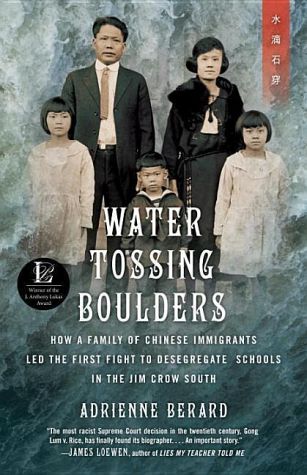
book beginnings on Friday: Water Tossing Boulders: How a Family of Chinese Immigrants Led the First Fight to Desegregate Schools in the Jim Crow South by Adrienne Berard

Thanks to Rose City Reader for hosting this meme. To participate, share the first line or two of the book you are currently reading and, if you feel so moved, let us know what your first impressions were based on that first line.

I am of course intrigued by what the back of this book calls a “vital, hidden chapter of America’s past.”

water tossing boulders

Water Tossing Boulders concerns a Chinese immigrant family in Mississippi, where the children were denied public education in 1924. It begins:

As with all rumors, the stories grew over time, in the long months between June and September, when the air is so thick that gossip is all that circulates. The new students wouldn’t bathe. They didn’t have money to buy books. They didn’t care about learning. They had so many brothers and sisters, their mothers didn’t even know their names.

I guess I’m fascinated to see how a tragic but familiar story of Southern segregation and separate-but-equal schooling applies to a community we don’t normally associate with that story. Stick around.

This quotation comes from an uncorrected advance proof and is subject to change.

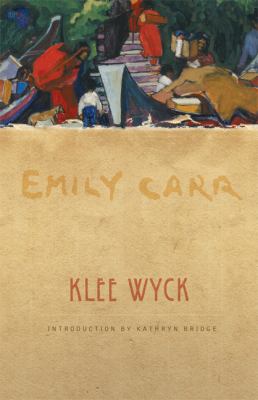
Klee Wyck by Emily Carr

klee wyckKlee Wyck is a collection of short stories–fragments, really, many of them–begun in Emily Carr’s youth and then polished and published in her old age. I’ve written a little about some of these fragments here and here.

First and most importantly, I need to emphasize the story revealed in Kathryn Bridge’s fine introduction. If you are at all interested in this book, it is imperative that you get this edition of it. Here’s why.

Emily Carr is best-known as one of Canada’s finest painters. She was passionate about depicting her home environment of west coast British Columbia, which as she explored it in her teens and twenties in the late 1800s was still mostly unspoiled big forests; but perhaps she was most passionate about the lives, traditions and plight of the Indian or First Nation people she knew there. Their totem poles were among the central themes of her work. She also wrote extraordinarily well, and her writing was concerned with the same issues. The collection Klee Wyck serves largely as an indictment of the white settlers, especially the missionaries, who worked so hard to destroy native cultures. After a first edition by Oxford University Press, publishers Clarke, Irwin and Company purchased the rights to Klee Wyck, and put out an educational version thereof that thoroughly whitewashed Carr’s words and intentions. Bridge details the tragically extensive cuts and edits. And that’s the version of Klee Wyck that was available to so many for so long.

As it stands now, the restored & complete collection I’ve read is lovely, understated but firm. As I said in the teaser posted earlier this week, Carr had a keen eye for clean, tight prose, rather like Hemingway I’d venture. Her sentences are clear and direct, but often glittering with word choice and turns of phrase.

The grating of our canoe on the pebbles warned the silence that we were come to break it.

The sockets had no eye-balls, but were empty holes, filled with stare.

The tent full of sleep greyed itself into the shadow under the willow tree.

(She also has a knack for anthimeria, or the usage of one part of speech for another.)

The tips of the fresh young pines made circles of pale green from the wide base of each tree to the top. They looked like multitudes of little ladies in crinolines trooping down the bank.

The story “D’Sonoqua” about a character in the Indians’ mythology, and the striking, horrifying, awesome totems she inspires, is as striking as the totems Carr describes. In other words, I read her skill with language as parallel to the skill of the carver when she writes

The power that I felt was not in the thing itself, but in some tremendous force behind it, that the carver had believed in.

That clean transfer of force from the thing itself to the receiver is Carr’s gift, too.

And then in contrast is the story “Wash Mary,” a scarcely 2-page sketch of a woman Carr knew when she–Carr–was very small. Its simplicity is its accomplishment; I love that everything we see is everything the child Carr saw, nothing more, and with no added translation of meaning. It’s powerful nonetheless, perhaps because it shows how much a child can see without understanding.

Klee Wyck does address nature and the visual arts, the subjects for which Carr is known. But this book is firmly about people, not trees or totem poles. It’s about a human tragedy, for example the Indian children taken from their parents and villages to Indian residential schools (as I read about in Wawahte). This is why it’s so important to get this edition. Also: gorgeous, clean, precise writing. Emily Carr was a master of several forms. Do check it out.


Rating: 8 strong thoughts.

Teaser Tuesdays: Klee Wyck by Emily Carr

Teaser Tuesdays is a weekly bookish meme, hosted by MizB of Books and a Beat.

Teaser

In Cascadia, you’ll recall that I was much impressed by a few snippets of writing by Emily Carr (subject of the novel The Forest Lover). Now I have here, on loan from Pops, the longer work from which those snippets were snipped.

klee wyck

Klee Wyck is delightful. See for example these lines.

They were in a long straggling row the entire length of the bay and pointed this way and that; but no matter how drunken their tilt, the Haida poles never lost their dignity. They looked sadder, perhaps, when they bowed forward and more stern when they tipped back. They were bleached to a pinkish silver colour and cracked by the sun, but nothing could make them mean or poor, because the Indians had put strong thought into them and had believed sincerely in what they were trying to express.

Kathryn Bridge’s introduction and two forewords (to two different previous editions) by Ira Dilworth all note Carr’s style: painterly, minimalist, precise; each word in its place. Bridge quotes Carr on her two rules for writing, similar to those she used in her painting: “get to the point as directly as you can; never use a big word if a little one will do.” I think she’s done beautifully.

The Fire This Time: A New Generation Speaks About Race edited by Jesmyn Ward

Poems and essays by a range of writers address race in the United States.

the fire this time

Responding to the deaths of Trayvon Martin, Michael Brown, Eric Garner, Tamir Rice, Sandra Bland and so many others, the subsequent Black Lives Matter movement and a feeling that not much has changed, Jesmyn Ward (Salvage the Bones; Men We Reaped) felt moved to build a collection of words to counter the pain and injustice she saw. Essays and poems, many of them solicited by Ward, make up The Fire This Time: A New Generation Speaks about Race. Its title, of course, answers James Baldwin’s 1963 The Fire Next Time, which addressed the same questions of being black in the United States.

Led by Ward’s powerful introduction, contributions from Natasha Trethewey, Isabel Wilkerson, Edwidge Danticat and more consider past, present and future–Legacy, Reckoning and Jubilee. Honorée Jeffers writes in defense of Phillis Wheatley’s husband, a man apparently wrongfully denigrated, and honors Wheatley’s legacy while questioning the way it’s been written by others. Kevin Young muses on Rachel Dolezal’s interpretation of race. Garnette Cadogan writes movingly of what it looks like to walk through U.S. cities as a black man. And Ward offers an essay on her own ethnic heritage.

These powerful words from a range of sources vary in specific subject matter, but all make the same vital demands: for black citizens to have true equality. The entries in the collection are a little uneven, but each is stirring in its way, and the finest among them offer poetry as well as truth.


This review originally ran in the August 9, 2016 issue of Shelf Awareness for Readers. To subscribe, click here, and you’ll receive two issues per week of book reviews and other bookish news.


Rating: 8 names.

guest review: The Fire Next Time by James Baldwin, from Pops

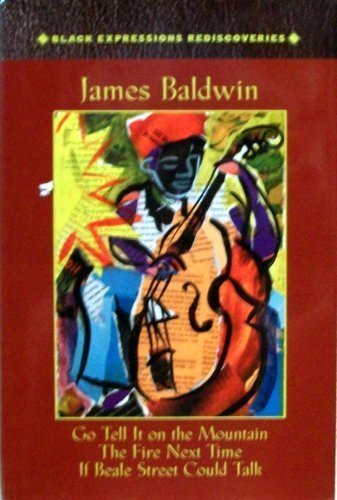
Pops sent me this guest review – unexpected, unsolicited, but very welcome – with the note, “you will likely find it easy to tie this into your own readings.” Certainly; but he had no idea how timely, as I’ve just recently reviewed Jesmyn Ward’s forthcoming The Fire This Time, a collected of essays and poems Ward solicited from today’s minds, to answer Baldwin’s 1963 book. I read Baldwin’s Notes of a Native Son and Go Tell It On the Mountain, and so have some idea of his voice & power, but I hadn’t read this title, so it’s excellent to have Pops’s perfectly-timed review. Synchronicity, we’ll call it.
the fire next time

I recently finished James Baldwin’s The Fire Next Time, which is a strange bird in form as it consists of two essays that are pretty different: a short personal letter to his 14 yr-old namesake nephew, and a much longer autobiographical, contemplative ramble, a sort of musing, largely about religion. My book’s dust cover says it “caused a great stir upon publication in 1963 and landed its author on the cover of Time [magazine]” – while he was on a Civil Rights speaking tour of the US south. (He lived mostly in France beginning in 1948 at age 24.) In 1963 Baldwin was an established author, an “accepted” spokesman for the Black experience. His call in these two essays for integration & reconciliation during the outbreak of angry & nationalist activism is the likely source of that “great stir.” Indeed, the great value in reading these today is in appreciating the issues of that pivotal time in our history.

The short piece has a long title: “My Dungeon Shook: Letter to My Nephew on the 100th Anniversary of Emancipation.” This is the one recently associated with the book title, compared to numerous other public letters by Black authors to the next generation. (This is a comparison where context is again important, as we are challenged to appreciate the Black Lives Matter movement as it matures.)

Baldwin describes his great-grandfather’s “terrible life; he was defeated long before he died because, at the bottom of his heart, he really believed what white people said about him.” This begins a two track theme: an unbridled (almost bitter?) depiction of the oppression & tragedy of racism, with also a sober appreciation of the need for reconciliation & even love. On the former: “You were born into a society which spelled out with brutal clarity, and in as many ways as possible, that you were a worthless human being.” Yet, after more of such clarity, he says, “The really terrible thing, old buddy, is that you must accept them… and accept them with love.” In spite of all, he advocates for integration, “this is what it means: that we, with love, shall force our brothers to see themselves as they are, to cease fleeing from reality and begin to change it.”

With this in mind, he closes by reminding young James that he is prepared for the future: “you come from sturdy, peasant stock… [who] in the teeth of the most terrifying odds, achieved an unassailable & monumental dignity. You come from a long line of great poets, some of the greatest poets since Homer. One of them said, The very time I thought I was lost, My dungeon shook and my chains fell off.” This of course ties us back to the essay title; but oh, there is much more.

The words Baldwin quotes in italics are from a traditional spiritual. In fact, in his “I Have a Dream” speech, when MLK Jr. says “in the words of the old Negro spiritual…” he is referencing the same source, a spiritual now generally known under the title “Free at Last!” but also appearing under different titles and with varying lyrics. Here is the pertinent section of an “accepted” version that agrees with Baldwin’s quotation:

Free at last, free at last,
Thank God Almighty, I’m free at last.
The very time I thought I was lost,
Thank God Almighty, I’m free at last;
My dungeon shook and my chains fell off,
Thank God Almighty, I’m free at last,
This is religion, I do know,
Thank God Almighty, I’m free at last;
For I never felt such a love before,
Thank God Almighty, I’m free at last.

Further, MLK delivered his speech on Aug 28, 1963; Baldwin’s essays were published in book form in 1963 but had earlier been published in The New Yorker in 1962. Did MLK have occasion to read Baldwin during those turbulent months? Though I find no record in a quick search, it is quite likely; they ended close friends and Baldwin was widely read in the movement. In any event, I am quite satisfied & comforted just thinking in terms of “like minds.” And this is not the last time Baldwin invokes religious and musical references, both an essential part of the Civil Rights movement.

The second & longer (~90 page) essay is the autobiographical “Down at the Cross: Letter from a Region in My Mind,” the main title taken from a hymn quoted after the title page. It begins with the author at age 14 (same as nephew James, above) and describes how his abusive stepfather drives him to join a Pentecostal church, where he is successful as a preacher. In long and rambling paragraphs, suitable for exploring those “regions in his mind,” he relates his mixed experience with religion – and racism – up through adulthood, concluding, “the Christian world has revealed itself as morally bankrupt and politically unstable.”

His narrative path arrives at his moment of writing as he tells of his recent audience with Elijah Muhammad, which opens a lengthy account of his perspective on the Nation of Islam and racism as seeks a path to reconciliation, consistent with the first essay. As he does for young James, here again he closes with a measure of hope and a call for action, as he considers the prospect for continued racial strife: “at the center of this dreadful storm, this vast confusion, stand the black people of this nation, who must now share the fate of a nation that has never accepted them, to which they were brought in chains. Well if this is so, then one has no choice but to do all in one’s power to change that fate… I know that what I am asking is impossible. But in our time, as in every time, the impossible is the least that one can demand.”

His final line provides a caution for those who hesitate at key moments in history, and the title for the book, as he quotes a spiritual, a “slave song” called “O Mary Don’t You Weep”: “If we do not now dare everything, the fulfillment of that prophecy, re-created from the Bible in the song by a slave, is upon us: God gave Noah the rainbow sign, No more water, the fire next time!”

Notes from No Man’s Land by Eula Biss

notes from no man's landI am terribly grateful that I got to read this book with a class to help me along. That is, the same class that read Bernard Cooper’s wonderful Maps to Anywhere, about which likewise. I was once in a book club, not for very long, which I wished would go much more deeply and intellectually into very serious books. My father said back then, “it sounds like what you really want is a graduate school classroom.” I see now that he was right. This is “just” an undergraduate class, but a good one.

Notes from No Man’s Land is an essay collection that I think is most obviously about race in the United States, but it is about much more than that, too. The writer is a white woman (albeit one from a remarkably diverse family, not at all a white family), and in writing about race she takes on the voice of “the other,” always a nearly impossible thing to do sensitively, smartly and with authority, but she does it.

Like Maps to Anywhere, this is also a masterpiece of organization; we could pick apart the ordering and titling of Biss’s essays in several ways and still not be through with all she’s done here. The first and last (or next-to-last, depending on interpretation) essays are fragmented contemplations of apparently disparate subjects, that wrap this collection up intelligently. If I had to choose one word to characterize Biss, the writer, as I’ve come to know her on these pages, I would choose “smart.”

The language is poetry, too. Every word choice was considered and weighed. The connecting images are so many and complex that I can hardly begin to see how many levels this book might be read upon. Oh, and she works heavily with a sense of place: what else could I ask for? I will share a few lines, several pages apart:

I fell asleep to the distant sound of drums, which I was not always entirely sure was the distant sound of drums. Rain, blood in the body, explosions in the quarry, and frogs are all drums.

I know now that I left home and I left the drums but I didn’t leave home and I didn’t leave the drums. Sewer plates, jackhammers, subway trains, cars on the bridge, and basketballs are all drums.

And just as a sample (not to bore you), I’ll share a little of the analysis I wrote for class of Biss’s opening essay, “Time and Distance Overcome.”

I appreciated both the braided form, and all the white space.

There are three sections separated by a centered line. The longest single paragraph is about half a page long (wraps pages 5-6, about the sabotage against telephone poles that took place in Sioux Falls, SD and Oshkosh, WI). Mostly the paragraphs are just a few sentences long; five contain just one sentence each. These short, punctuated passages feel almost staccato, almost list-like. This works well for the subject matter, which begins benignly but quickly turns dark.

Biss begins with Bell’s invention of the telephone, and the reader has one expectation for the meaning of “time and distance overcome,” the title which tops this first page, where the telephone is introduced. The first section of the essay moves smoothly from telephones to telephone poles, and the resistance early telephone poles encountered. After that first break, though, the lynchings begin coming fast and thick, in short sentences that echo the choppy effect of Biss’s short, double-returned paragraphs. The first lines of this second section read:

“In 1898, in Lake Cormorant, Mississippi, a black man was hanged from a telephone pole. And in Weir City, Kansas. And in Brookhaven, Mississippi. And in Tulsa, Oklahoma, where the hanged man was riddled with bullets. In Danville, Illinois…”

This jarring delivery emphasizes the nasty jolt of the sentences’ content. Likewise, the direct leap into the new subject – no transition – increases the reader’s shock. Lynchings are shocking: this is appropriate. The short sentences and feeling of litany continues, from lynchings through race riots and from the South to the North, making clear a general rather than geographically specific trend.

The final, shortest section, at just half a page, mirrors the work of Notes from No Man’s Land as a whole. That is, it turns back around to an earlier time, Biss’s childhood, family history, and innocent view of telephone poles; there are no lynchings in this section, but there is reference: “Nothing is innocent.” Then there are the telephone poles in Nebraska that, after a heavy rain, grew small leafy branches. This image prefaces “All Apologies,” the concluding essay of the book which echoes this one in form, and concerns itself with regret, apology, the duality of responsibility/guilt, and what is owed. There is a small measure of hope in those green branches.

The most obvious thread or theme that holds this essay together is the telephone pole; the reader is prompted by the cover image. But the less obvious, more sinister themes are those that hold the book together: race relations, the complexities of varied perspectives. “The world was not waiting for the telephone.” “Even now it is an impossible idea, that we are all connected, all of us.” “But nothing, I would like to think, remains unrepentant.”

I think Biss’s opening essay shapes in miniature the work of her entire book; presages the final essay, which so nicely wraps up by recalling the opening; and uses form to emphasize subject matter. It’s an extraordinary essay in these layers of function, and I’m so glad to have her “Notes” to shed some light into her process.

I am impressed throughout with what Biss is confident enough to leave out, or point obliquely towards. I think it must take a lot of courage and self-trust (or is it trust in her reader?) to leave such subtlety on the page and not direct my gaze. “You can get it or not, all the same to me,” she seems to be saying.

This is the kind of work I very much want to study, forever.


Rating: 10 circles.

guest review: Between the World and Me by Ta-Nehisi Coates, from Pops

between the worldPops sent me this guest review on March 4, 2016.

Ta-Nehisi Coates’ second book, Between the World & Me, forcefully rises to the high standard suggested by Toni Morrison’s full-throated endorsement on the cover. As she says, he fills

the intellectual void that plagued me after James Baldwin died… The language… like Coates’ journey, is visceral, eloquent and beautifully redemptive.

And all this in a mere 152 pages.

Published by chance in the heat of a rising Black Lives Matter! movement, he writes of his own 15-year journey, as the painfully concerned father of a son, himself a fully engaged son of 60’s Black Panther activists, the thankful student of a grandmother with instincts of a genius, and as a “damaged” black man and budding intellectual, forced to survive the trials of Baltimore’s mean streets. By writing so artfully and from the heart, as he relentlessly probes his world, Coates provides an indispensably human extension to essential history & analysis begun by Isabel Wilkerson (The Warmth of Other Suns) and Michelle Alexander (The New Jim Crow.)

Written as a letter to his 15yr old son, his tone is direct but his narrative voice is not simple or simplistic, as he avoids established and inflammatory rhetoric. Instead, he employs the unusual device of creating metaphorical coding for concepts he develops with challenging and sometimes changing meanings. These multiple and interlocking codes begin with the title itself, taken from Richard Wright’s poem of the same name. The World is Coates’ evolving perception of a life entirely outside his own, defined by a concept of Race that is itself parsed and examined in some detail. Coates’ book describes his life’s quest to understand all the implications of that vast space between the World and his own experience.

Wright’s work is quoted at the book’s start with only the first stanza, but a full reading of the poem reveals the raw visceral meaning: for Wright, that space perniciously encompasses the breadth of Jim Crow experience, evoked in verse as a quiet forest, the scene of a most hideous lynching, which rises to threaten the observer’s own Body (which is yet another code Coates uses.) Both title and poetic source are well chosen for Coates’ book.

The World apart from Coates’ own experience is constructed by Dreamers, who are “White – or believe themselves to be white,” as America’s vaunted, inclusive melting pot is exposed to be a muddy “anything but Black” with no cultural identity of its own that is not associated with power.

Race is a convenient contrivance enabled by this insidious fallacy about whiteness, in one of the most demographically and culturally diverse nations in the world. It is a frame that is based in the power relationship of oppression. The Dream is the ideology of that World apart, evoking prosperity, security, possibility – promoted by images that are everywhere around him: TV programming, advertising, schools, churches; the Dream does not appear on the Streets in his Baltimore neighborhood. This entire construct serves to threaten his Body in every moment, as it has for centuries, as the Streets’ death rate rises, infecting his mind and very existence.

The Mecca is the promise he does find – in knowledge, in books, in a vibrant and diverse Black culture, in his father’s radical heritage, in Malcolm X – fully bursting to fruition with Howard University in D.C. (a many-branched family tradition.) His exploration is unbridled, the evolution of his thought continuous and insightful, always delving deeper. A studied understanding of the 1960s overlays his parents’ own experience, becoming almost contemporary for him. (Here, the recent Black Panther documentary is also relevant.) He examines the history of slavery and its neverending web of consequences.

Coates’ concept of community expands steadily as he observes Howard’s international palette of “black.” In one extreme, he is dismayed to find gay & lesbian culture is an accepted part of this Mecca, so far from his Streets. His young family moves to New York City and he is staggered by the spectrum of cultures, from opulent Dreamer Broadway to Harlem, yet some black faces pretend to jump the gap. He takes his son on visits to Civil War battlefields as he seeks to understand. He spins out of his urban northeast orbit with a visit to Paris, and his mental landscape shudders again; yet still there is that space “between the world and me.”

The book begins and ends with the Black Body metaphor, which includes a complex relationship with his father and reoccurs throughout as his existential fear jumps between himself, his son, his friends and his people. When an affluent Howard acquaintance is later murdered by a black cop, the fear is crystallized and colors his perception.

Some years later, his visit with the friend’s mother is compelling and unwinds into a staggering 3-page finish for the book. Above all, with the death of her son in spite of her life’s efforts and “success” at providing him every opportunity, she wishes only that the entire Dream that produced his death fail in some “national doom.” Coates reflects on his culture’s age-old hope that the Dreamer plague would somehow be punished, an idea encouraged from Marcus Garvey to Malcolm X. But his outlook has become too expansive; “I left the Mecca knowing that this is all too pat, knowing that should the Dreamers reap what they had sown, we would reap it right with them.”

His maturing eye spans a wide view of Dreamer destruction, now-unbridled:

[progress] freed the Dreamers to plunder not just the bodies of humans but the body of the Earth itself. The Earth is not our creation. It has no respect for us. It has no use for us. And its vengeance is not the fire in the cities but the fire in the sky. Something more fierce than Marcus Garvey is riding the whirlwind. Something more awful than all our African ancestors rising with the seas.

So what of the future? For a capsulized message to his son, one may well look earlier in Coates’ story, to this statement of purpose directed to his son:

The [Dreamers] who must believe they are white can never be your measuring stick. I would not have you descend into your own dream. I would have you be a conscious citizen of this terrible and wonderful world.

Between the World and Me – and Coates’ singular literary voice – are indispensible for those interested in the ever-unfolding lineage of African-American commentary and literature. He does not provide answers; he challenges us with new ways of seeing our heritage with eyes wide open, even as his own exploration continues. He is only now 40 years old and there is no sign his seeking is complete, so we may expect more from him.


Pops’s rating: 9 revelations.

I don’t know about you, but I want to read it now.

Hannah Mary Tabbs and the Disembodied Torso: A Tale of Race, Sex, and Violence in America by Kali Nicole Gross

In this shrewd historical study, a salacious murder trial in 1887 Philadelphia offers insights on criminal justice, violence, race and gender.

hannah mary tabbs

When Kali Nicole Gross (Colored Amazons) came across the case of an unusual 1887 Philadelphia murder, she found a story with many layers. In Hannah Mary Tabbs and the Disembodied Torso: A Tale of Race, Sex, and Violence in America, she explores the intricacies of that case and its implications on criminal justice, a culture of violence and conceptions of race and gender.

Hannah Mary Tabbs was an unusual post-Reconstruction black woman–she unabashedly pursued sex outside of marriage and used violence and physical threats to make a reputation for herself in her black community in Philadelphia’s Seventh Ward. In the white community, meanwhile, she upheld the idea of womanly virtue and subservience to her white employers. Gross argues that this manipulative, variable representation of herself allowed Tabbs to almost get away with a serious crime. Tabbs had a lover whose headless, limbless torso turned up on the edge of a pond outside of town. The man convicted for that murder was, Gross contends, a patsy. The skin tones of the various players in this love triangle appear to have played as large a role as their guilt or innocence.

In prose that demonstrates careful research and offers a realistic reconstruction of the crime, Gross comments on social standards for morality and relationships between races and genders. The case of the disembodied torso is not only a sensational piece of true crime, but an opportunity to reflect on these continuing complexities.


This review originally ran in the February 9, 2016 issue of Shelf Awareness for Readers. To subscribe, click here, and you’ll receive two issues per week of book reviews and other bookish news.


Rating: 6 assumptions.

The Family Tree: A Lynching in Georgia, a Legacy of Secrets, and My Search for the Truth by Karen Branan

A journalist’s research uncovers her own family history and connections to a horrifying hate crime.

family tree

In researching her family history in the little town of Hamilton, Ga., investigative journalist Karen Branan was surprised to find connections to a 1912 lynching. A nephew of her great-grandfather, the sheriff, was murdered. Days later, a local mob killed three black men and a black woman. Branan digs deeper, expecting to find her forebears innocent of violence. The evidence is far more complex in The Family Tree: A Lynching in Georgia, a Legacy of Secrets, and My Search for the Truth.

In a town where nearly everyone has been related by blood or marriage for generations, Branan’s family variously turned a blind eye to the murders, or directly participated. She finds herself related not only to the white mob, but to at least one of the black victims as well. Every new piece of information complicates the story and startles her further, until she has to address her most basic understanding of the world. “I began this journey believing myself to be an unflinching investigative reporter and a nonracist,” Branan writes, but must confront a bias in favor of her own family. Admirably, she examines herself and the preconceptions she brings, even to the pursuit of racial justice.

The Family Tree offers an in-depth study of the history of Southern race relations, particularly in Georgia. The narrative of the lynching is told thrillingly, the background more dryly, but it is Branan’s personal perspective and soul-searching that makes this history insightful, relevant and memorable.


This review originally ran in the January 19, 2016 issue of Shelf Awareness for Readers. To subscribe, click here, and you’ll receive two issues per week of book reviews and other bookish news.


Rating: 6 liaisons.

Alex Haley: And the Books That Changed a Nation by Robert J. Norrell

History and literary criticism enrich the first biography of Alex Haley, author of Roots and Malcolm X’s Autobiography.

alex haley

Alex Haley wrote The Autobiography of Malcolm X (as told to him), and Roots, the story of his family from Africa through slavery and the Civil War. Separately, these books had a profound impact on how the United States viewed race relations and its own history. Together, their influence could hardly be overstated, and that is what Robert J. Norrell argues in Alex Haley: And the Books That Changed a Nation, the first biography of Haley and a study of his two seminal works and the controversies they fostered.

Norrell covers Haley’s forebears and Tennessee childhood, his three marriages and a writing career growing from the Coast Guard (where ghost-writing personal letters led to public relations assignments) to magazine work, which led to his interviewing Malcolm X for Reader’s Digest and Playboy. The process for Malcolm’s Autobiography (1965) was dynamic, as Haley walked the fine line between Malcolm’s voice and Haley’s more moderate political position, and as Malcolm’s views on race relations evolved. The Pulitzer Prize-winning Roots (1976) was even harder won, as Haley drew a short book contract out over more than 11 years of research and travel. The effect of the book, and its accompanying television miniseries, was astounding. And yet the rest of his life and work would be shadowed by accusations of copyright infringements and invention in what Haley called a work of nonfiction.

With sensitivity and careful study, Norrell examines Haley’s embattled life and extraordinary achievements. His final conclusion about this “likeable narcissist” is that despite Haley’s imperfections, his influence was prodigious and deserves our respect and continued study today.


This review originally ran in the December 18, 2015 issue of Shelf Awareness for Readers. To subscribe, click here, and you’ll receive two issues per week of book reviews and other bookish fun!


Rating: 7 pieces of gossip.