Maximum Shelf author interview: Koren Zailckas

This interview was published by Shelf Awareness here in an abridged format due to space constraints. This is the full interview.

Following Monday’s review of Mother, Mother, then, here’s the lovely Koren Zailckas!


Koren Zailckas: On Mothers

Koren Zailckas is the author of two memoirs, Smashed and Fury, and lives in New York’s Hudson Valley with her husband and three children. Mother, Mother is her first novel. She recently tweeted: “33 with 3 books and 3 kids. #birthdaysymmetry.”

Where did you get the idea for this distressing mother figure?
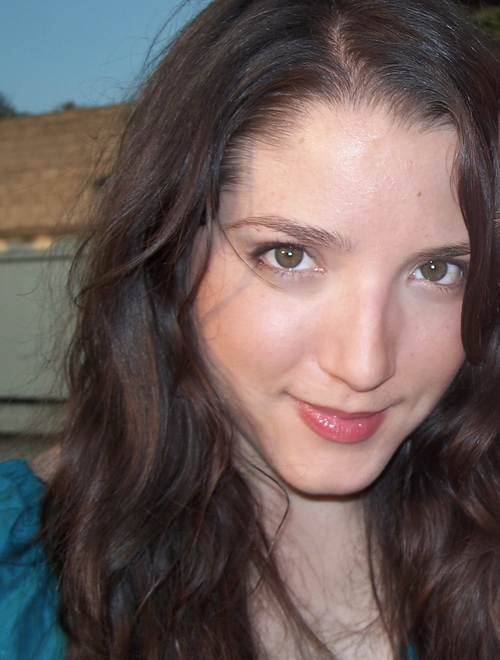
korenI really wanted to challenge the cultural assumption that all mothers are inherently selfless. We’re living in an era of baby-bump obsession, in a don’t-speak-badly-of-your-momma culture. Read an Angelina Jolie profile or watch TLC and you’d think women enter delivery rooms as laboring heffalumps and exit as Battista Salvi’s Madonna and Child. But the word “mother” isn’t synonymous with Mother Theresa, and having a child doesn’t make a woman a mom any more than owning a paintbrush makes her Frida Kahlo.

This idea that all mothers are naturally patient, forgiving and self-sacrificing isn’t just sappy-sweet, it’s callous. It’s dangerous. It discounts experiences by those of us who were raised by women whose genetics and early life traumas permanently altered their brains and made them incapable of empathy.

Here’s the sick truth: Some mothers aren’t naturals. I’d always suspected that as a kid, but I learned it for certain when I moved from Brooklyn to the Catskills. Last lambing season, I was in a New Paltz knitting supply shop, surrounded by beautiful, hand-dyed yarn, when the farmer clomped inside in rubber overalls and announced her sad morning. “The ewes gave birth last night,” she said, darkly. “And two of them just weren’t naturals. They left their newborns to freeze to death on the side of the barn.” Some mothers, no matter how well intentioned, just can’t see their kids as anything other than tools, hindrances or extensions of themselves. Other mothers can’t consider their children at all.

Mother, Mother’s Josephine Hurst isn’t just a critical or controlling mom. She’s a narcissistic mother, and she’s in good company. Loads of women–one out of ten Americans, according to new studies–have Narcissistic Personality Disorder, which many shrinks consider untreatable. Medication rarely helps. Therapy doesn’t do much either.

I hope Josephine will give shivers of recognition to anyone out who grew up with a narcissistic mother. I hope those readers will recognize her neediness, her manipulative nature, her grandiose sense of self-importance, her tendency to play favorites between her children and pit her family against one another, and I hope they seek some small comfort in it. Maybe that sounds crazy, but I really mean it. I hope Josephine puts a name–NPD–to longstanding patterns of maternal chaos. I hope some readers have a light-bulb “this is a syndrome!” moment. (You see: also in the narcissistic mother’s repertoire is “gaslighting.” They’re great at making their victims doubt themselves and question what’s real.)

As for those lucky folks who grew up with the mother of Mother’s Day Cards, I hope Mother, Mother gives them at least a glimmer of the fear that resides in the hearts of kids like Will Hurst. As humans, we are born utterly helpless–dependent on our mothers much longer than any other species on Earth. If mothers are our first teachers, then having a narcissistic mother teaches you that the world is a fucking terrifying place, where the rules change constantly and punishment is the only constant.

You wrote two memoirs before this novel. Was this your first try at fiction?

Yep, this was my first attempt at fiction. Mother, Mother brought me back to Smashed in that way. Smashed was my first prose. Before that, I’d only poetry and interoffice memos.

And how was it different?
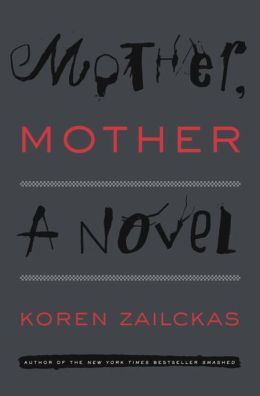
mother motherFiction required a lot more restraint than memoir. By design, memoir is an exercise in over-sharing. You’re giving the reader way too much information to begin with, confiding things you wouldn’t tell to just the casual stranger while you’re waiting side-by-side for a bus: “Warm today, isn’t it?… Let me tell you about that time I staggered, drunk, lost and naked down the halls of a fraternity.” You wouldn’t do that. No emotionally healthy person would do that.

I think I gravitated to memoir because I had my fair share of damage. I grew up in a family a lot like the Hursts, where you weren’t allowed to express emotion, speak openly, talk about why your mom is a radically different person in public, talk about why Dad lives in another state for weeks and months at a time. You bottle all that stuff up over a long period of time and it eventually just explodes all over some poor, unsuspecting victim, no matter who they are, no matter how briefly you’ve happened to know them. I think, to begin with, I wrote Smashed and Fury because I was suffering from what Zbignew Herbert called “suffocation from formlessness.” I was smothering under the weight of all the memories I hadn’t put into words. When I was finally ready to name those experiences (addiction, anger over ongoing family dysfunction) the stories came out, fast, in reams.

In my memoirs, I’ve always tried to best to be as self-aware as I can. To own my shadows. To be ten-times harder on myself than I am on anyone else in the story. But no matter how you slice it, it’s still exhibitionistic. It’s still a bit like being a trench-coat flasher: “Here I am, all at once! Here are my stories! I know they’re flabby in some parts, but I can’t change them–they’re real!”

Maybe the cheap analogy would be: fiction feels like a strip tease. But it’s more than that. Fiction feels like real intimacy. Especially when it comes to psychological thrillers, suspense stuff. You reveal things slowly to the reader, over the course of your time together. Not every character has to be hyper self-aware all the time, owning every character flaw, aware of their deeper motivations. You can gently fold in a hint, here and there. Teaspoon of backstory. Foreshadowing, to taste.

I still find that really difficult from time to time. My husband’s pet name for me is “Spoiler Alert.” He always tells me I say way too much when I’m making movie or book recommendations. My brother-in-law will never forgive me for ruining the grand finale of The Sopranos for him.

I might well have told you how the Hursts end up in Mother, Mother’s first chapter were it not for my long-suffering editor. She probably has carpal tunnel from all the times she went back to the manuscript to slash out obvious clues.

Did you do research into Asperger’s syndrome in order to get it exactly as right as you got it? Did any other aspects of this novel require research?

I did a little bit of research. But mostly, I manifested Will’s Aspergers in a way I could relate to.

Will’s intense focus, his “Aspie interest,” is language. He’s like a collector of rare and precious objects, and in this case, those objects are unusual and arcane words. Autotonsorialist: one who cuts their own hair. Misodoctakleidist: someone who hates practicing piano. Awkwardness ensues whenever Will uses them in spoken conversation, but he just can’t help himself. He’s addicted.

Over the course of Mother, Mother, I think Will’s relationship to language changes. Words stop being a mode of connection. Instead, they become more like trophies, accolades. He trots them out to impress, intimidate or prove his worth. It’s a really narcissistic use of language. It worsens Will’s social functioning, heightens his loneliness and drives him deeper inside himself.

Aspergers? Maybe. The side effect of a dysfunctional family? Possibly. Or maybe, for Will, it really is a burgeoning writer thing. As a writer, you spend so much time alone, trying to think of funny and fresh ways to describe every day things. Then, when it’s time to go out into public, you forget that you don’t have to agonize over word choices. When you’re chatting about weather with your neighbors at the farm stand, you can just say, “It’s pouring.” People look at you funny when you go all Du Maurier and say, “Can you believe this lashing, pitiless rain?”

Two of your main characters share similar experiences but head in very different directions towards the end. Did they always go that way, or did you have to go along for the ride to learn the fates of your characters?

I think I knew from the first word that Violet and Will had very divergent ideas about their family. Any therapist will tell you, siblings can be raised by the exact same people and still have totally different mothers and fathers.

This is especially true in narcissistic families, where the narcissist picks one kid to be the golden child (the person who earns added prestige for the narcissist) and another to be the scapegoat (the person the narcissist projects her own negative self-image onto).

In the Hurst’s case, I think Will is quite genuine in his confusion over his sister. He doesn’t have any clue why Violet’s so angry. Her drug use, her rebelliousness… It seems really irrational to him, especially with his mother right there in his ear, telling him, “Your sister’s crazy.”

And for her part, Violet doesn’t understand why Will is so fearful and reserved. He seems to have his mother’s unconditional approval. Josephine’s love seems to come so naturally to him.

With that dynamic in place, I think I did go along for the ride. When I began, I didn’t quite know what would happen to Will or Violet.

Will, in particular, shocked the hell out of me. It was kind of thrilling to watch him unfold. Especially because he’s at this very pivotal year. He’s twelve when the book begins and really on the brink of adolescence. A transformation happens. One I never saw coming.

Transformations fascinate me, especially where psychology is concerned. That’s what everyone who’s hooked on psychology wants to know: How does change occur? How do good people turn evil? Or, how do kids grow up?

Can you tell me how there came to be humor in such a very dark book? How would you characterize your style of humor?

I suppose I’ve always had a touch of gallows humor. That self-lacerating, inverted kind. Also, a bit of that bone-dry, stuff-your-feelings, British humor too. (Maybe that’s why I married an Englishman.) Also factor in a little bit of defeatist attitude. I’ve always related to that George Bernard Shaw quote: “If you can’t get rid of the family skeleton, you might as well make it dance.”

I’m glad you think this book is funny. I think it’s really important for dark, scary books to be funny. Every few pages, I really wanted there to be at least a restorative chuckle, something to lighten the mood from jet-black to slate.

I think the biggest laughs in life are usually tinged with relief. They’re a kind of collective, hissing sigh: “Wheew, look at us, joking about this really delicate, uncomfortable, offensive topic! We’re really skating on thin ice here, aren’t we? But it’s fun! Hold my hand. Did that sound like a crack?”

Some of the creepiest ladies in the history of literature are also the funniest. Shirley Jackson is fucking hilarious. I wish she were still around today, if not only so her mommy-memoirs could be optioned for a self-starring reality show. Take Life Among the Savages… Beginning each morning with the very real fear that you will slip on a Matchbox car or doll’s broken arm and break your neck on the stairs is morbidly priceless.

In my experience, once you become a mother everything is doubly terrifying and laughable. It only seems natural to mix the two together. (Although, that could just be the sleep deprivation talking.)

The dual first-person perspectives are very unsettling (in a good way). How did you choose that format?

I think sheer panic drove me to tell the story from two perspectives. When I first started thinking about fiction, many years ago, I told Crown’s Molly Stern, “I’m going to write a first-person, one-perspective novel.” Just like that. All fresh-faced bravado. Molly wasn’t discouraging, but she reminded me just how tricky that is. It’s hard to keep the plot constantly pounding when you have just one protagonist.

Initially, with Mother, Mother, I thought (quite cowardly) that I’d hedge my bets between Will and Violet. I thought: double the characters, double the action. Never a dull moment. From there, it became a much more strategic, much more about how “family,” as a concept, is a bit like “car crash.” Everyone experiences it from a different perspective. So why not let the reader get two points of view on the Hursts?

Since you came from writing memoirs, I wonder how present you are in Mother, Mother. Did you have to fight putting yourself in this book, or was it a relief?

I think there are snippets of myself and my childhood all over this book. That said, the Hursts are a prime example of writing what you know, then taking it to a level that is psycho-extreme.

For instance, I always felt like my mom was a little possessive of me when I was a kid, and I tried to go to friend’s houses as opposed to bringing them home to mine, where my mom talked down to them and slated them behind their backs. I was in my thirties when I got a Facebook message from a woman I used to play with when I was seven. “I was sooo afraid of your mom!” She wrote. “She used to call us brats and hooligans. We were only allowed one juice box no matter how thirsty we were!” I think I sort of exorcised some of that in Mother, Mother, and took it to a scarier extreme. I mean, Josephine homeschools Will because she’s so keen to have him to herself.

I’ve been reading Eric Booth’s The Everyday Work of Art, and he has a great line about how the word “art” in its infancy was a word that meant “to put things together.” And the process of writing Mother, Mother really felt like that. Marrying personal experience to the psychological profile of narcissistic mothers. Piecing together recurring nightmares with irrational fears, Frankenstein-ing in ordinary scenes from a modern, American, family life.

You know, it was a relief. I feel like doctors should prescribe thriller-writing to anyone with anxiety or PTSD. You get to be in charge of your fear. And of course, you get to change the outcome. In real-life dysfunctional families, roles shift, but there’s not much change.

What have you read and loved lately?

This is really the golden age of women’s psychological fiction, and for the past few years I’ve been gobbling up everything by Tana French, Gillian Flynn, Laura Lippman, Megan Abbott, Kelly Braffet. It’s just too exciting to look away.

That said, I have three children under four, so I’ve also have Mo Willems on heavy rotation. That’s my life at the moment: Murder and The Pigeon Finds a Hot Dog.


Don’t you just love how very funny she is? Thanks, Koren, for taking the time to share so much with us. I certainly enjoyed it!


This interview originally ran on June 26, 2013 as a Shelf Awareness special issue. To subscribe, click here, and you’ll receive two issues per week of book reviews and other bookish fun!

Maximum Shelf: Mother, Mother by Koren Zailckas

Maximum Shelf is the weekly Shelf Awareness feature focusing on an upcoming title we love and believe will be a great handselling opportunity for booksellers everywhere. The features are written by our editors and reviewers and the publisher has helped support the issue.

This review was published by Shelf Awareness on June 26, 2013.


mother mother
Mother, Mother opens on a quiet Saturday morning in a small town north of New York City. A young boy wakes up with his mother standing over him, waiting to start their day. He is a little odd–we soon learn he’s been recently diagnosed with Asperger’s syndrome and epilepsy–and his mother seems to be wound a little tight, but she’s also concerned and loving. Next, the perspective shifts to that of his older sister, a rebellious teen who has just been placed in a local mental hospital. The father is cheating. The eldest daughter ran away with a boyfriend several years ago.

These are the perceptions presented in the first few pages of Koren Zailckas’s startling debut novel. Do you believe everything you’ve just read?

As the story of the Hurst family unfolds, the reader will learn to question every “fact” exhibited. The youngest child, Will, and the middle daughter, Violet, continue to trade off the first-person relating of their family drama. One is on the autism spectrum and the other is drug-addled; thus the reader has to parse not one unreliable narrator but two. Will both loves his mother and fears her, and is constantly struggling to determine what exactly it is she wants so that he can please her. He is home-schooled, because of the Asperger’s: Is this the cause or the effect of their unusually close relationship? Josephine, the titular mother, starts off coldly Stepford-like and quickly takes a turn toward chilling. Violet, who has been observing Sallekhana (a form of Jainist ritual starvation), recently took psychedelic morning glory seeds and came home to her family out of her mind, hallucinating and violent. Now Josephine is adamantly opposed to Violet coming home from the hospital, ostensibly because of the threat she poses to her little brother. The absent eldest daughter, Rose, remains ghostlike and disembodied for most of the book. Her past is enigmatic and her current location unknown–but unexpectedly, she writes to Violet in the hospital, after years of silence. And while their father, Douglas, is physically present, he has problems of his own that make him self-centered and ineffectual.

Much of Mother, Mother‘s mystery revolves around the night when Violet, in a haze induced by near starvation coupled with the psychedelic seeds, brandished a knife at her family, harming Will. A drunken Douglas drove her to the psych ward. But as it turns out, neither Will nor Violet has a clear memory of what happened on that night. Then Child Protective Services enters the scene, in the form of a case worker surprisingly sympathetic to Violet. This engages Josephine’s protective instincts, and the reader must struggle alongside CPS to discern the truth about where–or from whom–Will suffered his injuries. From the start, the reader is kept off-balance by Will and Violet’s constantly shifting, conflicting, inconsistent narratives. Josephine’s contributions, which come in dialogue form through Will or Violet’s observations, only serve to muddy the waters. From the start, the reader senses that something is amiss, but will have to puzzle for a time over which of these troubled characters to trust.

As the action unfolds, Violet remains institutionalized, but the details of the night in question begin to reveal themselves. Will and Violet both begin to regain their memories, but they continue to interpret those recollections in very different ways. Even as the source of the true evil begins to become clear, the reader is kept guessing as to everyone’s final fates until the closing pages, and the surprises keep coming until the very end.

Koren Zailckas is the bestselling author of two memoirs, Smashed and Fury. Her first attempt at fiction will not disappoint her fans, as she continues to exhibit a nuanced understanding of psychological drama, combined with a wry tone that brings surprising humor to such an unnerving story. Zailckas reveals and conceals fact and rumor in this complex tale with deliciously deceitful cleverness: readers should beware the seemingly straightforward narrative as told by Will and Violet. Take, for example, Will’s placement on the autistic spectrum. In some ways, it is very apt: his obsession with obscure, little-known vocabulary words will of course charm the booklover; but on the other hand, he is awfully good at reading emotions.

Mother, Mother is unsettling, even frightening, and perhaps what makes its atmosphere so successfully compelling is that it is so very domestic and ordinary. The Hursts not only appear outwardly normal, they may be our role models–the perfect family next door. What Zailckas has accomplished is most disturbing because it is so close to home.


Rating: 7 not-so-loving looks.

Come back tomorrow for my interview with Zailckas!

Broken Harbor by Tana French

I consider this to be another great hit from Tana French, author of The Likeness, In the Woods, and Faithful Place. Her mysteries are atmospheric, have a strong sense of place (that place being Dublin and the surrounding suburbs), and look back toward the past. Ireland’s economic depressions and the inheritance of related difficulties with employment and housing also play a role in each book. These four books are a series, loosely, in the sense that certain characters overlap; but each stands alone so well it’s almost a disservice to link them together. By no means would I recommend worrying about reading them all, or reading them in order.

In Broken Harbor, Mike “Scorcher” Kennedy is the reigning bad-ass murder detective on the Dublin squad, but the mistakes of a recent case, never described in detail, have him under a shadow; so he’s relieved and excited to get the latest gruesome, media-intensive case. He’s got a partner, Richie, a brand-new rookie from the wrong side of the tracks, which suits Scorcher because he’d just as soon work alone, and an easily-led rookie is the closest thing to working alone. A family of four named Spain – mom, dad, and two little ones – have been attacked in their home; three are dead, and the mom is in intensive care. Their home is in Brianstown, a fancy new development that got left unfinished in its earliest stages by the failing of of the housing boom; it’s not a pretty place after a few years’ decomposition since construction ceased. And, importantly, Brianstown used to be the seaside village of Broken Harbor, where Scorcher vacationed as a child with his family.

The important elements are several. The mystery of who nearly wiped out the Spain family is, on the face of things, the central plot, and it does keep Scorcher, Richie, and the reader busy for the entire book; the solution isn’t revealed until the final pages. A mystery within the mystery is what’s made all these holes in the walls of their home, and what force was haunting the Spain parents, otherwise poster children for a perfect life, right down to the magazine-worthy interior decor. The economic recession that killed Brianstown before it got out of the gate is an important detail that we attend to throughout, and is part of what makes Dublin & its suburbs the only place this story could be set. And then there are Scorcher’s demons: as we’ve seen in French’s other novels, his childhood connection to Broken Harbor will follow him through this seemingly unrelated case. This is a thriller not just because of the awful fate of the Spains, but also because of Scorcher’s family drama, still playing itself out. His training of the rookie, Richie, is poignant: the detective who never wanted a partner finds himself yearning for the camaraderie he’s observed in other partnerships, wondering if Richie could be “the one.” And finally, Scorcher is forced to do some philosophical questioning. The deal he’s made with the universe, his understanding of the source of the world’s evil, will be challenged.

The tone of this novel is one of my favorite parts. It’s dark, lush, and almost dreamy. Scorcher feels real to me even as he approaches caricature (hey, call me credulous, I’m enjoying this). He’s fatalistic, relying in part upon physical feelings that tell him when he’s getting close; we get hints that he knows what’s coming. His tortured persona, his tendency to distance himself even when he’d like to get close, is a recognizable genre type, but well-done all the same. I always appreciate French’s evocation of Ireland, its culture and the impact its economy continues to have. And the psychological drama of the Kennedy family had me on the edge of my seat. Certain elements are a little formulaic, sure, but beautifully wrought; and the lovely writing puts it in such a package that I don’t mind a bit. This is a great example of why I love Tana French.


Rating: 7 unpleasant memories.

Teaser Tuesdays: Broken Harbor by Tana French

Teaser Tuesdays is a weekly bookish meme, hosted by MizB of Should Be Reading. Anyone can play along! Just open your current read to a random page and share a few sentences. Be careful not to include spoilers!

My excitement about Tana French has only grown as I’ve read her books, culminating with the first she wrote but the last I read, The Likeness. So I was very anxious to get my hands on her new book, Broken Harbor. My review is coming in a day or so, but for now I will tell you that she does not disappoint! Here’s an example of why:

It was October, a thick, cold, gray Tuesday morning, sulky and tantrumy as March.

The plot and the characters are wonderful, too. But I love the evocative tone of that one sentence. Doesn’t it help you picture Dublin (and surrounding areas), and feel the cold? The strong sense of place is one of my favorite elements of French’s mysteries. I’ll go ahead and give her points for “tantrumy,” too, although I’m sure some purists will be offended. 🙂

How’s your Tuesday, and what are you reading?

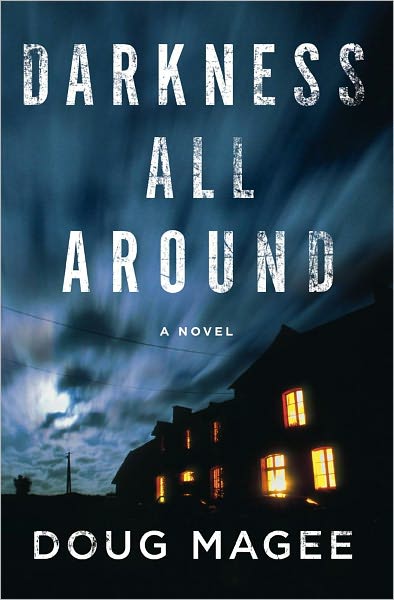
Darkness All Around by Doug Magee

Darkness All Around is a psychological thriller involving a fractured trio of childhood friends from smalltown Braden, Pennsylvania. Risa was always expected to marry Alan but ended up getting pregnant with Sean, the third in their clique, and marrying him instead. Sean, struggling with his father’s suicide, ends up a raging drunk and leaves Risa and their daughter Kevin; Alan the ambitious politician helps her have him declared dead after many years’ absence and marries her himself, and takes over parenting Kevin as well. When the book opens, Kevin is the newly-minted football star of deeply football-obsessed Braden; Alan is on the campaign trail headed to Washington; and Risa is not sure she feels in control of her life. And then Sean shows back up.

Sean suffered a brain injury and very nearly died, to come back freshly sober and trying to remember his life before drink. He’s back in Braden without any intention of bothering Risa and Kevin, feeling good about his old friend Alan’s ability to take care of them. Rather, he’s concerned about the decade-old murder of Risa’s friend Carol: despite a local simpleton having confessed to the crime, new flashbacks convince Sean that he was involved. He contacts a local reporter who covered Carol’s death to try and help him figure out what happened; but of course it’s unavoidable, in a town like Braden, for Risa to avoid learning about his return. And Alan is not the least bit tolerant of this disruption of his campaign.

Sean is sick, but recovering – both in terms of his alcoholism, and his amnesia. His memory returns over the course of the book and he struggles to make sense of it. Risa is still dealing with the trauma of her first marriage, and Alan simply comes across as a self-centered jerk. Teenaged Kevin is understandably insecure about his supposedly dead father reappearing on the scene, especially considering his new football-related issues. The local reporter, Henry, was brand-new to town when Carol was killed but is now fully a part of the action. And as you might have guessed, nothing is as simple as it seems.

The action and the suspense are well-done; I had trouble putting this book down and while it didn’t keep me up at night, it thought about it. Except for Alan, who I wanted to kick, the characters were sympathetic and fairly real; Kevin was nicely done as a sometimes-loving and sometimes-wall-punching teen. I really felt for Sean. Limited character development and occasionally awkward dialog will allow me to move on from this book more quickly than some, but it was thoroughly satisfying and worth my time.

This book was sent to me by the author in exchange for my honest review.


Rating: 4 matches.

Turn of Mind by Alice LaPlante

This was a sad and fascinating book. I read it in a day – not unheard of, but fairly rare considering that it was a regular work day. Started on my lunch break and finished before bedtime. It was absorbing and unique. A murder-mystery, yes, but also sort of a psychological thriller. The unique framing element of the book is this:

Dr. Jennifer White is sixty-four, and has dementia. When the book opens, she’s in the early-to-mid stages of the disease, living at home with a full-time, live-in caretaker. Her best friend of several decades, who is also her three-doors-down neighbor and godmother to her daughter, has been murdered, several fingers cleanly amputated. Dr. White (whose specialty was hand surgery, ahem) is a suspect, and doesn’t know herself whether she did it or not. Her story is told in first-person; we read snippets from the notebook she keeps, hear conversations, and listen to her private thoughts as she struggles with the questions. The questions are only rarely about Amanda’s murder. In reading about this book I thought the murder case was the main focus, but it’s not. Dr. White is only occasionally aware of the question of her friend’s death, because she’s only occasionally aware that her friend is dead. Her disease and its progression, her confusion, the attempts by her adult children to shape her future, and her eventual fate are the book’s main concern – because we see through Dr. White’s eyes.

The mystery of who killed Amanda is different from the usual mystery we encounter, because we don’t see a murderer trying to cover his or her tracks. Dr. White’s children, and the lawyer they hire, work to protect her from an investigation that may damage her fragile mental health. At one point it is decided that she did kill her friend, but the legal system of course won’t take its normal course even in that event. (I’m not giving it away; there are still twists and turns.) And again, the mystery is not the primary focus of the book. As Dr. White’s story unfolds – backwards, in snippets, jumping around chronologically, and never reliably – talk about an unreliable narrator – we learn more about her husband, Amanda, Amanda’s husband, and Dr. White’s two children, as well as the hired caretaker and even the primary police investigator. Of course, no one’s story is simple or unblemished.

A fascinating and engrossing mystery is only part of the attraction of this book. It’s an exploration into the head of an Alzheimer’s sufferer, engaging and overwhelming and sad and riveting. Make no mistake: this is a terribly sad story. Being young myself, and having parents in excellent health and with plenty of youth and life left, I hadn’t thought much about nursing homes, but this book’s portrayal terrified me. If you can steel yourself for the tragedy, though, this is a beautiful story, communicated in a unique format, gripping and sensitive. I recommend it highly.

Never Knowing by Chevy Stevens

An adrenaline-filled rush of a thriller about an adopted woman’s search for her true identity, and the consequences for her own family.

Sara Gallagher has always known she was adopted. It’s not until she has a much-beloved six-year-old daughter, Ally, and is about to get married that she decides to search out her birth mother. But she never dreamed of the repercussions: it’s her birth father’s identity that is the real shock, and the threat he poses to her and her happy family begins to rip their world apart. Sara and her fiance, Evan, struggle to maintain their relationship as the police tap their phone lines and begin to take over their personal lives. The horror only grows–and the pace ratchets up–as she finds herself unable to extricate her birth father, “John,” from her life.

Stevens uses the same unique format that was so successful in her bestselling debut novel, Still Missing: the novel is told in first-person, through Sara’s long one-sided conversation with her psychiatrist, whose voice we never hear. This lets us in to her inner conflict, as she struggles with her love for Evan and Ally (and her sisters and adoptive parents), and her need to protect them from the evil she fears she’s inherited.

Never Knowing addresses issues of adoption, family, and parenthood; it exhibits what a mother’s love can do, and what it means to be a parent. This thriller is relentlessly, heart-thumpingly fast-paced. The suspense will leave you breathless, as you learn to care for the conflicted but likeable characters, whose family ties make it all worthwhile.


I wrote this review for Shelf Awareness for Readers. To subscribe, click here, and you’ll receive two issues per week of book reviews and other bookish fun!

I’d Know You Anywhere by Laura Lippman, and Running the Books by Avi Steinberg

I had some trouble selecting a new book to read over the weekend, and ended up taking home Avi Steinberg’s Running the Books: the adventures of an accidental prison librarian. But before I could get to it, while putting new books up on my new books display, I came across Laura Lippman’s I’d Know You Anywhere, and got involved in it!

I’d Know You Anywhere is about a woman with a pretty good life: husband, two kids, nice house, generally serene, other than her daughter’s beginning to be a teenager. Then she gets a letter from the man, on death row, who abducted, raped, and held her for six weeks when she was 15. Her life is disrupted by corresponding with him, which she feels powerless to avoid. Years of carefully constructed anonymity are threatened.

It was a fun book. I read it almost straight through; it was gripping and interesting; the characters felt like real people. I found a certain theme of family and motherhood, that’s a little new and different to me in the mystery/thriller genre; this was present in Lisa Scottoline’s Look Again as well. I’m not as excited or sentimental about motherhood as some, so this theme could potentially get a bit tiring for me, but in both of these examples the authors have pulled it off. Barely. I’d Know You Anywhere is fast-paced and realistic and raises some interesting questions about victim’s rights and the death penalty, but remains an easy read (it could be a thinker only if you choose it to be). I was glad to spend my time on it.

Then yesterday I got around to Avi Steinberg’s Running the Books. It’s biographical; he’s telling his own story: former Orthodox Jew, then Harvard student, then underachieving freelance obituary writer, finally turned prison librarian. (Whew.) I haven’t gotten very far in, but I’m walking a tightrope: enjoying his clever writing style while worrying that he’s getting a bit pretentious. There’s not much question that there are some interesting stories here, but so far they’re unrelated anecdotes. Let me say this book shows potential to be fascinating and amusing, or tiresome. Jury’s out.

I’m also housing a big, fat Sharon Kay Penman paperback called When Christ and His Saints Slept, and I enjoyed The Reckoning by the same author so much that I’m excited, and hope not to be disappointed since my expectations are so high! So that’s in the queue. Also, I fly to Belgium in just 3 days for a short vacation and will need ratty paperbacks that I can leave behind on the trip. (Not sure Penman’s qualifies for this job.) There’s always more to read…

Enjoy your holidays and please do let me know what you find!