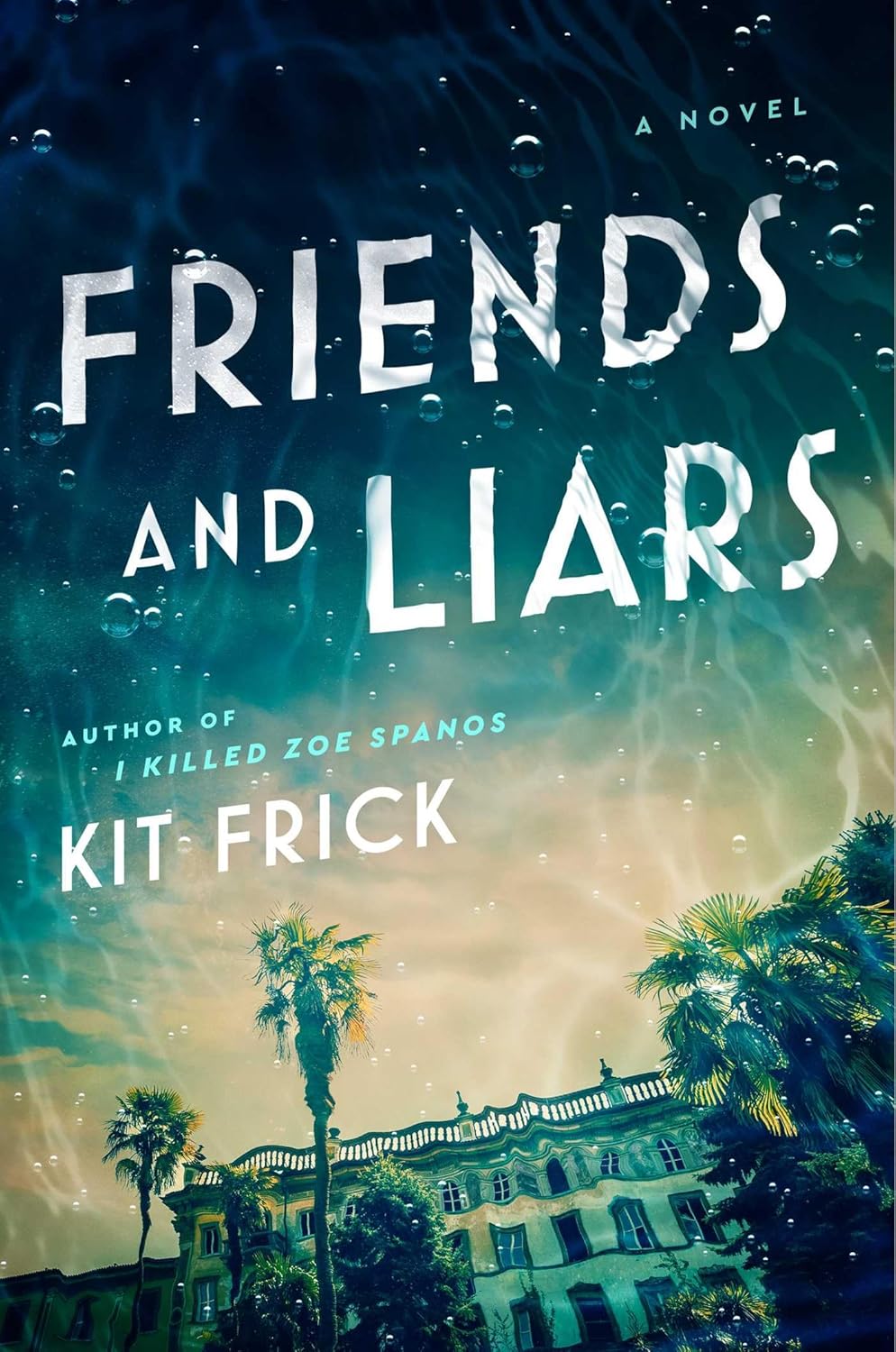
Friends and Liars by Kit Frick

Estranged college friends are drawn back to the palatial Italian estate where old secrets are buried and one of them died in this electric tale of friendship, deceit, and suspense.

Friends and Liars by Kit Frick (I Killed Zoe Spanos) sees a foursome of estranged friends reunite at a luxurious private Italian palazzo for an extravagant weeklong vacation to remember their fifth, heiress Clare Monroe. Clare was 21 when she drowned in Lake Como on New Year’s Eve. Now she would be 27.

Luca, Harper, Sirina, and David gather for an itinerary organized (and paid for) by Clare’s family, the famous and secretive Monroes of Hollywood. Luca is foundering in small-town Florida, recently dropped by his sugar daddy for a younger model. Harper has a nearly five-year-old son with her perfect husband, and she’s the only one of the group to have settled down directly after college. Sirina is hard at work building her acting career. And David–Clare’s boyfriend at the time of her death–is enjoying a successful career in directing, with another girlfriend whose father is well-connected. The friends still care for each other, but have been out of touch since that terrible New Year’s Eve. Clare’s tragic death is all bound up with secrets that each of them would rather not confront again–the lies and betrayals that contributed to her demise.

But, for various personal reasons, none is able to resist the invitation to return to the Palazzo Mella for another series of opulent events orchestrated by Clare’s icy Aunt Catherine. Immediately, their uneasiness is intensified by the appearance of taunting “gifts” and notes left for them in the guest quarters. The message is clear: someone knows what happened on that New Year’s Eve and has come for revenge. The old friends must band together and face their own worst behaviors to solve a compound mystery: Who knows what they’ve each done? Who is preying upon their guilt? What really happened that night, and who will pay for it now?

Friends and Liars achieves a delicious balance of emotional complication, layered deceptions, and consummate psychological drama. Lush with the accoutrements of affluence and charged with the machinations of aspiring creatives, the lavish setting near Bellagio distills to a locked-room mystery. The surviving Monroes, a few family friends, Clare’s four ride-or-die college buddies and their two plus-ones, as well as the household staff, make for colorful suspects in a plot with rising stakes. Heart-racing suspense, compelling characters and relationships, and great danger add up to a highly satisfying puzzle of a novel, which saves surprises for its final pages.


This review originally ran in the October 3, 2025 issue of Shelf Awareness for the Book Trade. To subscribe, click here.


Rating: 7 Paper Planes.

The Favor by Nora Murphy

I really enjoyed this thought-provoking drama. I wondered about that word, ‘enjoy,’ but I did, despite the tough subject matter. The story is well told and it made me think, and talk with a handful of friends about, some very tricky real-life issues we’re all facing in different ways. It had momentum; I was always glad to find time to read more, and sad when it ended. I did find the ending a little bit anticlimactic, for a book with such high tension and high stakes, but I’m still a fan.

The bulk of the book is told from the perspective of two women, Leah and McKenna. They don’t know each other, but they live parallel lives, a short distance apart, in a suburb between Baltimore and DC. One is a lawyer, married to a lawyer, and the other is a doctor, married to a doctor; both have recently become unemployed, following the machinations of their respective husbands. Both are in coercive, abusive relationships. Both were formerly independent, strong, professional women, outwardly successful and attractive in a certain traditional style: fit, blonde, white, put together. Both are now living in an utter nightmare from which they see no escape. That’s when Leah sees McKenna at the liquor store, follows her home, and watches through a kitchen window as a scene unfolds that she recognizes intimately. After a brief spell of observation, Leah sees McKenna’s husband throw her to the floor and begin kicking her in the stomach. Leah shoots him dead.

Mild spoiler there, but these are the events that set off the rest of the novel. McKenna has been suddenly, unexpectedly, and in the most shocking fashion set free of the abuse and control that may well have killed her. She is under police investigation; she is also liberated. Leah is not. The Favor unfolds from there.

There are strong echoes to Strangers on a Train, as well as important differences. We start with an archetypal issue, a sort of classic model of intimate partner violence: male on female, married, with the husband being of sufficient social standing and social skill that if his wife were to make accusations, she is unlikely to be believed. Manipulation, both of the wife and of the surrounding community. And then there are some fascinating moral questions. Self-defense would be one thing (although, I’ve read, such women killing in self-defense are rarely believed in court), but one woman killing in defense of another is still shakier ground… And then there is the inaction of friends and family, when by outward appearance nothing was wrong in a picture-perfect happy marriage, and simultaneously, asked head-on about that marriage, all admit to a sense (at least) of unease. It all gets very sticky very quickly. This work of fiction (authored by a lawyer with significant experience in domestic partner violence) is written in gripping fashion; I felt the pull of the plot, and concern for these characters, to the very end. It was compelling content, well told.

I would just add that this kind of violence and coercive control happens to all kinds of people, in all kinds of relationships – all sorts of combinations of gender roles, across race, ethnicity, education and professional status, social and economic class. Murphy has focused here on one ‘type’ of abusive relationship, but this is only one.

I found this a very engaging book and it’s led to some conversations with friends. Do recommend.


Rating: 7 empty bottles.

We Lie Here by Rachel Howzell Hall

This tense, suspenseful thriller slipped easily along with the momentum of a well-designed plot, for the most part. There were a few hiccups in the late-middle for this reader, but the finish got me, and this author deserves a hat tip for the big reveal which in hindsight feels almost obvious, but I never did see it coming.

We meet Yara Marie Gibson when she’s on her way back to Palmdale from Los Angeles. L.A. holds her moderately successful (it’s still early) career as a writer for television, her awesome boyfriend Shane, and her young-adult life; Palmdale, in the Antelope Valley in northern Los Angeles County, is home, and it’s trying to kill her. The novel’s first line is “The city of Palmdale takes my breath away,” and she means it literally. Yara suffers from severe asthma and allergies, worsened by anxiety, which is in turn worsened by her family in general and her mother in particular, plus the fact that her mother and sister smoke cigarettes every waking moment, and indoors. Yara is highly motivated by the party she’s throwing for her parents’ twentieth wedding anniversary, a very elaborate affair for which she’s footing the bill; nobody even pretends that her younger sister Dominique is not her mother’s favorite, but Yara is driven to give her parents this gift. Her father seems loving, but Barbara Gibson (who goes by a multitude of nicknames in Yara’s first-person narrative) is the sort of figure who sucks all the oxygen out of a room – this works metaphorically as well as in the sense that Yara, again, cannot breathe here…

These 400 pages take place over just a week or so, as Yara prepares for the party while choking to death in her childhood bedroom, and a series of strange events and characters arise: mysterious long-lost family members show up and disappear, threatening messages new and old come to light, bodies are found. There are numerous fights and shouty phone calls, and old secrets from before her parents’ marriage come to light. The Gibsons are a family with some messes and dysfunction–in other words, perfectly normal, if not perfectly healthy. They are also “the only Black family on the block,” and Yara is always aware of the impact of race on her life and safety. There are links to old Black Hollywood royalty, and racism both then and now.

A plot element that threw me for much of the book was Yara’s amateur sleuthing, which is accepted as natural by so many characters, including an old friend of hers who is a sheriff’s deputy. It didn’t quite follow for me that Yara’s job as a writer for a fictional TV crime show, and her blood relationship to a recently deceased woman (potentially a murder in which Yara would be a suspect), would qualify her to get the inside information she receives from such an official source; I expected a little more leave-it-to-the-professionals. This was a minor sticking point, but it lasted long enough for me (a hundred pages or more?) to impact my experience of the book. A lot of Yara’s personality, bless her heart, is her anxiety, forgetfulness, and breathing difficulties. And (highlight white text to reveal spoilers): at the discovery that her father was married before he married her mother, Yara’s reaction is more violent than I found likely. I mean, I guess she might have heard of this before, but the way she flips out felt outsized to me. I did pause and remind myself that we don’t all react to anything in the same way; and it’s clear that Yara’s parents’ marriage carries a lot of weight for her, thus this big party. Ah well. I coached myself through it.

As I said, in the middle portion of the book, there were some draggy bits – especially as I dealt with these small but persistent questions. But it does pick back up again! My experience of the novel’s opening pages was electric: Hall grabbed me with scene, dialog, sensory detail, and a strong sense of place, and anxiety about family is pretty universally relatable; it was a great start. And by the big crescendo and denouement (including a compelling epilogue), we were right back on track and on pace. It was an enjoyable fictional world to sink into, overall: escapism, suspense, momentum. Not perfect, but well worth the price of admission.


Rating: 6-and-a-half puffs on the inhaler.

The Wildelings by Lisa Harding

Lifelong friends splinter and suffer in their first year of college under the spell of a charismatic older student in this atmospheric roller coaster of a novel.

Lisa Harding (Bright Burnings Things; Cloud Girls) will haunt readers with the psychological drama of The Wildelings, a compulsively readable novel in which a woman looks back on her college days and a long-lost friendship.

Jessica is introduced as she begins therapy, newly divorced, in her 40s. The novel’s inciting event, however, is not divorce but a new play by an old acquaintance. Asked by her therapist to write down her memories and “start at the beginning,” Jessica recalls her first year at Dublin’s Wilde College and “The Unholy Quintet: Mark, Linda, Jonathan, Jacques, and me.”

Linda had been Jessica’s best friend since childhood. When the underprivileged, underparented pair achieves surprising slots at the “pretentious arty” college, Jessica is highly ranked for her beauty as well as her acting prowess; Linda, as ever, dwells in the shadows. But just as Jessica enters a charged relationship with the sexy Jacques, Linda finds love with Mark, a magnetic fourth-year playwright and director, after a false start with golden boy Jonathan. The older student’s grasp on the group tightens, especially after Mark casts Jessica in what he claims will be a breakout play. Mark proves treacherously adept at directing the people around him, on and off the stage.

Harding gives Jessica a self-excoriating, incisive, bitter, and evocative first-person voice. The Wildelings‘ inexorable plot is like the proverbial train wreck: shocking, electric, impossible to turn from. Its psychological tumult verges on horror. With this atmospheric roller coaster of a novel, Harding offers pulsing intensity, gut-wrenching emotional upheaval, and high drama in every sense.


This review originally ran in the April 18, 2025 issue of Shelf Awareness for Readers. To subscribe, click here, and you’ll receive two issues per week of book reviews and other bookish news.


Rating: 7 freckles.

Invisible Woman by Katia Lief

A woman troubled by old crimes and loss reaches out to an old friend, with disastrous consequences in this chilling commentary on gender in society.

With Invisible Woman, Katia Lief (Five Days in Summer; The Money Kill) follows a woman navigating professional life, family, friendship, and societal roles, attempting to reconnect with an old friend whose path diverged from hers decades ago. Their stories are individually compelling, as well as offering questions relevant to the #metoo era.

Joni Ackerman had been a pioneering filmmaker in the 1980s and ’90s, and her best friend and former college roommate, Val, was a promising up-and-coming actor. A secret trauma caused the two young women to grow apart; Joni married, had children, and slowly slid beneath the surface of her husband’s sparkling career in television. The novel opens in 2018, when a fresh film-industry scandal emerges that sends Joni looking for her friend. Joni feels that the time has come to speak out about an old crime, but Val wishes to remain in obscurity, and Joni’s husband, Paul, wants to let sleeping dogs lie. Joni wrestles with her long-lost friendship over a significant divide of time and suffering. Her marriage has been strained for years, and a recent cross-country move has left her isolated. She dives into the novels of Patricia Highsmith, in editions long ago given to her by Val, for comfort and escape, but as real life grows darker and weirder, Highsmith’s gritty psychological thrillers start to feel all too close to reality.

The concerns of Invisible Woman are firmly rooted in #metoo, #timesup, and the historical and continuing challenges of women in the entertainment industry. Joni loves her daughters but grapples with what it’s cost her career to become a mother: early in the novel, she’s invited to appear at a film retrospective in a series called “Lost and Forgotten.” She struggles with personal and family difficulties, and with alcohol. Highsmith was a strong influence on Joni’s highly regarded work in film, but also threatens her tenuous grasp on reality. Readers will root for Lief’s carefully crafted protagonist, even as her decisions become increasingly irrational.

Invisible Woman twists and turns, its escalating dangers alternating with fresh reveals, as momentum builds to a breaking point. Joni is compulsive, troubled, but sympathetic; Val is less central but exerts a force of her own. Characters develop quickly from disagreeable but benign to chilling and dangerous; some readers will find this atmospheric novel engaging and disturbing enough to lose sleep. A literary psychological thriller, cultural study, and heartbreaking story of friendship and loss, Joni’s unforgettable story involves layers of lies and the dangers of self-sublimation. Lief chills, entertains, and challenges.


This review originally ran in the October 27, 2023 issue of Shelf Awareness for the Book Trade. To subscribe, click here.


Rating: 7 years.

Here in the Dark by Alexis Soloski

Against the backdrop of New York City’s theater scene, a young woman grapples with the line between life and art in this memorable debut, lush with darkly elegant detail.

Alexis Soloski’s Here in the Dark is a thrillingly dark psychological drama, set in the least visible part of the spectacle of theater. Vivian Parry, 32-year-old theater critic for an important New York City magazine, carefully rations her vodka and sedatives to keep clear of the grasp of the “therapists I’m occasionally required to see.” She holes up in her Manhattan studio apartment, writing and editing in between shows. Readers quickly understand that Vivian is avoiding an unnamed trauma. In the audience–anonymous, with pen and notebook poised–is the only time she is remotely okay: “When I’m in the dark, at that safe remove from daily life, I feel it all–rage, joy, surprise. Until the houselights come on and break it all apart again, I am alive. I know myself again.”

It’s an act: “I am, of necessity, an imitation of myself–a sharp smile, an acid joke, an abyss where a woman should be. For a decade and more I have allowed myself only this lone role, a minor one: Vivian Parry, actor’s scourge and girl-about-town. I don’t play it particularly well.” Seeking a crucial promotion, she reluctantly agrees to an interview with David Adler, an eager graduate student and a man she belatedly suspects may be acting a part, too. “I consider myself a superlative judge of theater and life and the crucial differences between,” she thinks. “But David Adler has shaken that certainty like a cheap souvenir snow globe.” Following their odd and fateful meeting, Vivian finds herself inexorably caught up in intrigues involving a missing person, a dead body discovered in a park, an abandoned fiancé, Russian gangsters, Internet gambling, and more. The line between performance art and “real” life begins to blur still further. Vivian is heavily reliant on drink and pills; it would be easy to mistake her increasing sense of danger for paranoia, but readers can’t deny the threats slipped under her door.

Soloski, in Vivian’s clever, moody, sardonic voice, envelopes readers in details richly laden with subtext. Seasonal decorations include “cardboard Santas leering from store windows, snowflakes hung like suicides from every lamppost.” A large man has “a chest that would intimidate most barrels.” Of Justine, Vivian’s forceful best (and perhaps only) friend: “There are sentimental tragedies shorter than Justine’s texts.” Vivian’s fragile reality fractures in sleek, stylish prose. Here in the Dark is a carefully wrought, slow-burning psychological thriller: as numb as Vivian keeps herself, the terror surges to a crescendo, her wits and understanding of what is real pitched against an unknown foe.

This riveting first novel offers building momentum and looming horror with an entrancing and troubled protagonist and the most sophisticated of settings. Here in the Dark is frightening, delicious, engrossing, and unforgettable.


This review originally ran in the October 16, 2023 issue of Shelf Awareness for the Book Trade. To subscribe, click here.


Rating: 7 thumbnails.

The Diver by Samsun Knight

This novel of existential questions features a grieving, perhaps unhinged widow and the paralegal hired to investigate her, who team up in increasingly bizarre efforts to reconcile their lives.

Samsun Knight’s first novel, The Diver, opens with a brief, dramatic scene: “A scuba diver is on a deepwater dive with her husband, one hundred thirty feet below.” They are exploring a shipwreck from the 1800s when their oxygen tank pressure gauges fail. The diver survives, and her husband does not.

Knight presents this brief section in a third-person perspective that provides details of the dive; the rest of the novel features the first-person voice of a young man named Peter. Peter works as a paralegal at an ethically questionable law firm that specializes in intimidation services on behalf of wealthy clients; the diver’s sister-in-law hires them. In this way Peter comes into contact with Marta, the widowed diver. He wants to help her, and he may love her. He also has his own baggage and history of loss, a “sinkhole of family.” Peter’s plot line is a series of mishaps and grotesque, often darkly comic episodes; readers are privy to his first-person narration and can understand his messy life. Marta’s more enigmatic story is, likewise, filled with grim absurdity. The Diver is further peopled with unfeeling art-school classmates, a mother on the verge of breakdown, a profoundly disturbing fortune-teller, and two goons who share a first name. Knight combines psychological suspense with outrageous catastrophes and a bit of a ghost story.

Knight follows Marta by following Peter; she is the novel’s ostensible protagonist, but it is Peter’s minutiae on display. The two characters are drawn together by their misery and their openness to possibility. They speak in disjointed sentences but, Peter thinks, mostly understand one another: “That sense of broken compartments, of trying and failing to fit Marta’s actions into the boxes I’d established for her, had graduated into a full collapse of anxiety.” The price of their odd alliance, however, may be higher than either one realizes.

The story plays with format and includes interspersed snippets of interview transcripts, tarot cards, diagrams, an art-mag essay about Freud’s concept of unheimlich, and more. The overall result is a little off-kilter and occasionally grisly. (Some readers will struggle with scenes involving animal cruelty.) As an examination of the dark sides of relationships, it is disturbing and always imaginative. Marta, for one, resorts to increasingly weird experiments with the occult in her quest to bring her husband back.

How far would a person go for love, grief, hope, or fear? This disquieting novel pushes these questions beyond expected boundaries in its inquiry into terrible, life-changing wrongs. Dealing in mysticism, love, anguish, and unpardonable crimes, The Diver is not a novel for the faint of heart, but it is rewarding in its surprises.


This review originally ran in the September 28, 2023 issue of Shelf Awareness for the Book Trade. To subscribe, click here.


Rating: 6 bunnies.

Search History by Amy Taylor

This wise debut novel explores modern dating themes and pitfalls in on- and offline realms.

Search History, Amy Taylor’s first novel, focuses on Ana, a woman in her late 20s who is navigating the dating world, both online and in real life, following a significant breakup. Ana’s ups and downs center mainly on the new relationship she begins with Evan, a man with a past. But a variety of experiences in her own and other women characters’ romantic lives are more alarming than encouraging when it comes to the modern dating landscape.

After the end of a four-year relationship, Ana starts over by moving from Perth to Melbourne and beginning a new job. Her friends are astonished when she meets Evan at a bar, rather than online. “Have you found him online yet?” a work friend asks anxiously. When Ana replies that she has, her friend sighs with “genuine relief.” Evan seems perfect–perhaps its own red flag–but Ana has found his ex-girlfriend online, too, and rapidly begins an obsession with that other woman’s online presence, a preoccupation that threatens to overshadow her real-life relationship with Evan. Meanwhile, the men Ana and other women encounter via dating apps or in person showcase a variety of tendencies, ranging from troubling to outright threatening. And Ana struggles as well to connect with each of her parents: her passive-aggressive mother back in Perth, who is giving Ana the silent treatment, and her “belligerently optimistic” father in Bali, where he exclaims a lot (in rare phone calls) over breath work and intimacy coaching.

Search History is concerned with relationships, (mis)communication, and fear. Ana is frightened of the strange man running behind her in the dark, of the man taking the drunk woman home from the party, of sending Evan a text that will scare him away. And in its central theme, the novel questions the usefulness of an online dating persona. Ana notes Evan’s eye color from a picture online: “It was a piece of information I should have learned the first time I saw his eyes catch sunlight, not through a screen.” Is she better off Googling her next potential lover? Is that research necessary for her safety? Or should she allow him “to reveal himself to me piece by piece in real life, unburdened by my preconceived assumptions”? Which version of Evan–and of Ana–is the real one?

With its expert pacing, Search History offers frank handling of sexuality and desire, and unvarnished descriptions of sexual violence and harassment (which may be triggering for some readers). Ana is self-aware and funny, lonely and self-questioning. Her first-person narration is stark, vulnerable, and approachable. Taylor presents a clever and often harrowing examination of 21st-century dating.


This review originally ran in the September 25, 2023 issue of Shelf Awareness for the Book Trade. To subscribe, click here.


Rating: 7 ellipses.

The Last Language by Jennifer duBois

A Harvard-trained linguist enters into an intimate relationship with a nonverbal man in this riveting riddle of a novel.

The Last Language by Jennifer duBois (A Partial History of Lost Causes; Cartwheel; The Spectators) is an utterly compelling puzzle of linguistics, perspective, and some version of love. Angela is 27 years old when her husband dies suddenly; she is four months pregnant (a pregnancy she will lose, “because of the stress, possibly”) and has a four-year-old daughter. Just months later, she is kicked out of her Ph.D. program in linguistics at Harvard, following a nasty exchange with her “intellectual rival and personal archnemesis.” With her daughter, Angela moves in with her mother and takes a low-paying job running an experimental therapy for “facilitated communication” to help nonspeaking patients with motor impairments. This questionable opportunity will have profound consequences. Readers gradually become aware that Angela is writing her first-person narrative while incarcerated. She tells of her love affair with a young man who can communicate only through Angela herself. Or, if readers do not believe her account, she has taken egregious advantage of a seriously disabled man.

Angela’s background in linguistics gives her a complex, many-layered perspective on Sam O’Keefe’s ability to communicate and even to think: “if thinking was language, the linguistic determinist would argue, then there was nothing to discover within people who didn’t have it already.” Despite early reservations, she is quickly taken with Sam’s sardonic humor, the life behind his startling eyes, his wit and intelligence–at least according to her account. Angela is very smart and has a thoroughly expert grasp of languages and linguistic theory; she knows what this looks like, but she knows her love for Sam, and his for her, is real. Readers must decide for themselves. This question is at the deeply intriguing heart of The Last Language. Is Angela a deluded predator or among the most misunderstood lovers of all time? DuBois’s choice to give readers only her perspective on this story is critical to the contortions of this gripping psychological drama.

Angela is ardent. She makes poor decisions, but her love is pure. She sprinkles her narrative with linguistic trivia and philosophic musings: she anticipates the arguments of the prosecution in her case and those of the linguistic scholars who would say “a person cannot conceive of what he cannot name.” She writes to Sam, who will never read her account: “In a very real sense, there was no you.” Together, she and Sam read Nabokov: Pale Fire rather than Lolita, but the parallels present themselves. Backed by Angela’s academic scholarship and the philosophy of what constitutes humanity, The Last Language is a smart intellectual riddle and a mystery with the highest of stakes. Readers will find it unforgettable.


This review originally ran in the August 14, 2023 issue of Shelf Awareness for the Book Trade. To subscribe, click here.


Rating: 8 angles.

Who Is Maud Dixon? by Alexandra Andrews

This delightfully disquieting novel explores identity, deceit and extreme measures through two women’s shape-shifting lives.

Is it really possible to shed one’s history “as easily as a coat slips off the back of a chair” and walk away? And if so–what might one walk into? That’s the puzzle posed by the cunningly plotted Who Is Maud Dixon? by Alexandra Andrews.

Florence Darrow thinks of her past in Florida “as a gangrenous limb that needed to be severed for the greater good.” Now that she’s landed an editorial assistant position in New York City, she can begin remaking herself. However, she can’t quite make out the shape of the new version of herself she’s trying to form. “How did one go about building up someone new? She tried on moods and personalities like outfits.” Then the opportunity of a lifetime comes along: she is hired as personal assistant to Maud Dixon, pseudonym for the electrifying and mysterious author of the biggest bestseller in recent history. Florence becomes one of just two people to know Maud’s true identity. And she finally has a model to guide her own transformation into the bestselling author and confident self-made woman she knows she can be.

Florence sinks with pleasure into her new life: living in the carriage house behind Maud’s lovely old stone house in the country, enjoying Maud’s cooking and fine wines and opera. This, she thinks repeatedly, is where she belongs, this is the life she’d choose for herself. On Maud’s advice, Florence stops returning her mother’s increasingly petulant phone calls.

But who, really, is Maud Dixon? Florence knows her name, and the name of the Mississippi town she comes from. But much of her hero’s persona remains enigmatic: Maud is unpredictable, thorny, wise and (to the Florida ingenue) perfectly captivating. Florence can’t figure out the road map to get from here to there. (Maud says that “here and there are overrated.”) Florence is thrilled to travel with her to Morocco on a research trip for Maud’s long-awaited second novel, but in the new setting, what Florence doesn’t know about her boss quickly turns sinister. Florence may not be the only one with a past she’d like to shed.

Who Is Maud Dixon? is a wickedly fun study in deception, secrets, striving and longing. Andrews’s stylish, intricate debut novel showcases deft prose and expert use of tone and atmosphere: the cooing of pigeons “had the aggressively soothing tones of a nursery rhyme in a horror movie.” What means might one justify to grasp the life she really wants and (she’s tempted to believe) deserves? These memorable pages hold one possible answer.


This review originally ran in the February 26, 2021 issue of Shelf Awareness for the Book Trade. To subscribe, click here.


Rating: 8 clean white towels.