Ishmael by Daniel Quinn

ishmaelIshmael comes recommended by my father, and that’s enough for me.

It’s an environmental novel published in 1992. So, dated? Or prophetic? I’m afraid it stands firm today; we can debate whether it’s overly alarmist (ha) or overly optimistic (sigh), but I didn’t run across anything that dated it especially for me. The premise is: our narrator (who, I’m pretty sure, remains nameless) is a disillusioned 30-something who, as a teen, had looked for someone to guide his idealistic, revolutionary, 1970’s-style environmentalism, and come out disappointed and cynical. Now that it’s “too late”, he’s frustrated to find the following advertisement in the newspaper:

TEACHER seeks pupil. Must have an earnest desire to save the world. Apply in person.

(Is “newspaper” the term that dates this story?) Narrator responds jadedly, assuming this is a charlatan, a scammer; but still he goes to the address listed, because he has to satisfy his curiosity (and presumably because some part of him hopes that someone out there can really teach him how to save the world). In this anonymous retail space, he finds… a gorilla. A big, scary gorilla behind a glass wall; and on Narrator’s side of the wall, a chair. He eventually sits, and our gorilla – Ishmael – “speaks” telepathically to him. Ishmael relates his life story, and they begin discussing What’s Wrong With The World And What We Can Do About It.

Leaving aside the rather strange element of the telepathic and exceptionally well-read gorilla, the structure of this story is much like Sophie’s World, a novel I read pre-blog (thus no review here, sorry) and really, deeply loathed. It is credit to my faith in my father that I picked up Ishmael, knowing it was at all like that other. The structure I’m referring to is part of what I disliked about Sophie, although it works slightly better here: there is no plot, no action in the story, and no character development, because our characters don’t do anything. They form a didactic construction that allows Quinn, in ill-disguised fashion, to voice his own thoughts. If he were doing this in dialogue form, it would make a little more sense; but unfortunately the dialogue mostly consists of many paragraphs by one character, punctuated by the occasional “yes,” “true,” or “I don’t quite understand that part; can you tell me more?” from the other. Now, I liked what Quinn had to say, and I frankly liked the gorilla Ishmael, and so this framing element bothered me far less than it did with Sophie (shudder). But I still felt that it was unnecessary, distracting, and ill-concealed. I’d rather Quinn had just written a manifesto frankly stated as his own.

Quinn’s thesis in a nutshell is that our world is badly f*ed; humans have done it by behaving badly; and we need to change quickly if we hope to salvage the earth itself, its very deserving fellow occupants like butterflies, tigers, flowers and rocks, and any of ourselves. I find this thesis abundantly easy to follow. For decades we’ve known that we were badly screwing up this planet (unless you’re Big Oil and have found a way to put your head under the sand (to look for more oil) in which case you’re probably not reading Ishmael, or this blog). Actually I found the third part of the thesis – that we need to hurry up and change so that we can save the world – hardest to follow, because I think things are worse off than Quinn paints them to be. Of course, I’m writing this more than 20 years later, so I’ll give him a pass there.

That said, the friendly gorilla and the simply stated philosophical approach that he shares with our Narrator make an accessible argument. I could see this being a good entry-level discussion piece – or a jumping-off point for further discussion in a reading group or classroom setting. Ishmael is likeable, and the philosophy is mostly sound (at least until the part about how we can change; I am less hopeful than Ishmael is), and readable.

I am not sorry I read this. But I like Derrick Jensen’s Endgame better, even though it doesn’t have as happy an ending. More on that book to come.


Rating: 5 sessions.

article from Orion magazine: “Dark Ecology” by Paul Kingsnorth

This article came to me from coworker Liz (who always recommends good stuff), and simultaneously from Pops, who also thought it was great. That should be testimony enough; but I am unstoppable and will say just a few words myself, too.

Paul Kingsnorth writes about the future of ecology, conservationism, “green” thinking, or whatever you’d like to call it. This is “dark” ecology because the news is not good. I’ll let him give you the real dish because he does it better – as Pops says, “the good news is that Kingsnorth is a writer first, not a social scientist, so it reads pretty well” – but I really appreciated his willingness to look forward to what’s ahead and what we have to do differently than the old guard of environmentalism, which sadly hasn’t worked. And his ideas about what’s ahead and what we might do in anticipation, however dark, resonated with me. Plus, he writes beautiful thinking lines like these:

Our human relationship to the rest of nature is not akin to the analysis of bacteria in a petri dish; it is more like the complex, love-hate relationship we might have with lovers or parents or siblings. It is who we are, unspoken and felt and frustrating and inspiring and vital and impossible to peer-review. You can reach part of it with the analytical mind, but the rest will remain buried in the ancient woodland floor of human evolution and in the depths of our old ape brains, which see in pictures and think in stories. Civilization has always been a project of control, but you can’t win a war against the wild within yourself.

I give you:

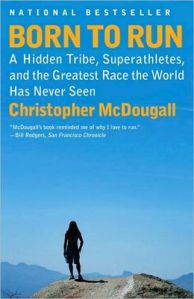
guest review: Born to Run by Christopher McDougall, from Pops

Pops joins us again today to write about a book firmly within his area of expertise: running. We’ve all heard something about Born to Run, I believe. I’ve certainly heard good things; but have never been strongly inclined to pick it up. Pops may change my mind, though.

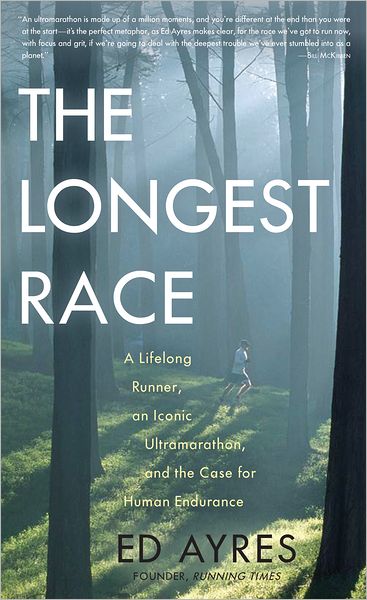
borntorunI am writing to make a public apology to myself for not reading this book three years ago; and to make a few personal comments for what they’re worth. It’s not coincidence that I pulled it from the shelf soon after reading Ayers’ The Longest Race; that book reminded me that McDougall’s work might contain some of the same magic, which I had (indeed!) delayed for too long. That instinct was accurate; there are similarities between the two that I really appreciated: inspiring depictions of running, fascinating science & history and a wonderful (though different) voice.

Much has already been written about this book, mostly positive and in great thoroughness. I won’t add much to that effort. Another place to look for insight would be McDougall’s website where you can peruse selected readers’ comments; this book has literally changed lives and inspired people. There are also some wonderful photos, which illustrate that this really is non-fiction, as absurd as that may seem while reading it.

I have mentioned before that I collect books about running, particularly in an often frustrating search for good fiction. This is one of the best running books I have ever read. In spite of its connection to reality, it reflects some of fiction’s best elements: humbly heroic characters who are larger than life; a compelling story that defies reality; a romantic adventurous heart; a witty rollicking storyteller’s voice; and sexy women running hard & kicking ass.

I knew bits & pieces about many of the characters in this story, about the ultra running culture and community, about the barefoot running revolution it stimulated and about the Tarahumara Indians. None of that prepared me for such a fun, informative, exciting and ultimately poignant journey. It is always risky to compare writers or books, but I must say that McDougall’s work reminded me in some ways of both Tom Wolfe and Hunter S. Thompson. I kept stopping to think “I know this is based on fact, but it’s so wild and so much fun I can’t believe it!”

Arnulfo Quimare, “elite” Tarahumara runner

Arnulfo Quimare, “elite” Tarahumara runner


The poignant part of the story actually arrives outside the book, sharply in the realm of real life but in some ways as hard to believe. This probably qualifies as a spoiler so stop right now if you want to read the book first; but for me it is an important part of the tale. It’s almost like McDougall should write the sequel.

Here is a relevant quote from the book that sets up the surrealistic “real life” conclusion. The main character in the book, Caballo Blanco, is speaking (he worshiped Geronimo as a kid and retained great respect for the Apache warrior.)

“When I get too old to work, I’ll do what Geronimo would’ve if they’d left him alone… I’ll walk off into the deep canyons and find a quiet place to lie down.”

The author then comments: “There was no melodrama or self-pity in the way Caballo said this, just the understanding that someday, the life he’d chosen would require one last disappearance.”

In March of this year (2012) Caballo was visiting southwest New Mexico so he could run the rugged mountain trails in the Gila Wilderness. One day he planned an easy solo run of 12 miles or so – and he never returned. The Forest Service began a search, and many of his friends (including the author and many characters from the book) arrived from around the country to join the hunt by running the trails. On search day 5, it was a group of Caballo’s running friends who found him off an obscure trail near a stream, dead from heart failure apparently unrelated to any disease or abnormality. He was 58 years old.

(This is also a curious “synchronicity” for blog readers who remember our family fixation with Fire Season, which is set only a few miles away from where Caballo met his end.)

You can read more about this sorrowful ending on the author’s web site, various other online sources, or this NY Times story. The author told his own version of this ending in a piece for Outside Magazine.

Caballo Blanco, RIP.

Caballo Blanco, RIP.

Thanks for another solid review, Pops. You make a strong case. Narrative nonfiction (aka “creative nonfiction”) about exciting, culturally diverse, outdoorsy, unbelievable experiences is right up my alley.

guest review: The Longest Race by Ed Ayres, from Pops

As I read The Longest Race, I thought of my father throughout. He is a marathon runner and a trail runner, and has been contemplating issues of climate change, sustainable living, and humans’ place in nature quite a bit recently. I thought this would be a perfect book for him in its combination of themes, which you can read about in my review. Here, he responds. [His page numbers come from my advance review copy.]

Julia has already done her usual commendable job reviewing this book; my personal interest in Ayres’ two main themes – running, and human degradation of our earthly habitat – compel me to comment further (as she knew it would.) At the same time, I want to parse her use of “metaphor” to describe how running and human development are related in Ayres’ story. While he does often employ metaphor, I believe in many cases he is saying that running actually is part of human development and does have an impact on how we relate to the world. Such is the hubris that plays a part in his tale.

For the above reasons, I really enjoyed this read. That doesn’t mean I found it uniformly superb or satisfying, but the book’s strengths were more than enough to keep me going.

Using a 50-mile ultra to structure his narrative worked better than I expected. There were few threads about his race that required following intently, and those were not lost as we periodically reconnect to that story. The more esoteric subjects he contemplates along the way vary greatly – just as would one’s thoughts during the hours of such an endurance event. In fact, that is an example of the athletic authenticity I found throughout. While I was only familiar with Ayres generally as editor of the early magazine “Running Times,” his deep experience as a lifelong runner shows through. His mental meanderings during a 50-miler – and their sometimes-questionable lucidity – are a familiar element of “running long.”

I was not familiar with Ayres’ background in the themes of human impact on the earth; he worked for the Worldwatch Institute and describes how this commitment evolved from a Quaker upbringing and through a lifetime’s experience. Along the run, we gather bits of his own back-story and “meet” such characters as Mohammed Ali, Mikhail Gorbachev and Ted Taylor (nuclear weapon physicist); such moments are fun and interesting – and chilling, as with his quotation from Taylor evoking the cold war’s nuclear terror (p.94). Also chilling is Ayres’ observation that for those who study the science of ecology, the survival of modern human society is “not just an abstract, academic concept;” it is very immediate.

We learn with him on his journey; e.g. Jared Diamond’s observation that agriculture is “in many ways a catastrophe from which we have never recovered” (p.102) – or “anthropomorphism as a major root cause of the ecological crisis” as noted by many literary luminaries over the years (p.106) – or the 1992 consensus-scientists’ dire & explicit climate change declaration so long ago (p.163) – or a reminder that the regressive “progress” of a suburban lifestyle model may prove to be a mere 2-generation phenomenon. We also meet such authorities as Paul Shepard, Rachel Carson and Wendell Berry along the way.

Similarly, Ayres has much to offer about running itself – not just practical stuff, but history and science as well. He met and/or learned from such names as Joan Benoit, Ted Corbitt and George Sheehan. He cites a Joe Henderson article that I know I read at the same time 25 years ago. Ayres is not the namedropper – that’s my doing throughout here – but rather all these names simply arise as part of his story.

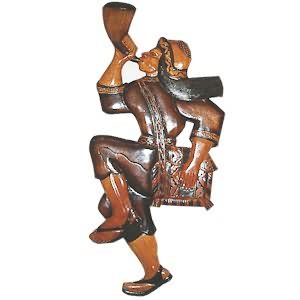
His introduction to the JFK ultra event’s origin unwinds into a period piece on the Kennedy Physical Fitness campaign (which I too experienced), including analysis of JFK’s civic motivation and his 1960 column in Sports Illustrated (who knew?!). I loved learning of David Carrier’s fascinating theory of primitive “persistence hunting,” where humans demonstrated the superior endurance trait that we runners still attempt to conjure (Ch.4). In fact, the role of endurance running throughout early history is compelling – including the Chasquis, the Inca runner-messengers.

Chasqui runner

Chasqui runner


The brief 23 page Appendix, “Notes for an Aspiring Ultrarunner,” is an worthy overview but any really interested reader will do well to research the many other references available.

All together, I enjoyed the blending of themes, emotions and ideas in Ayres’ book. Here is a single passage where Ayres is so nicely able to blend his heritage, running and science:
“The last sounds of the spectators faded, and, after a period of silence that could have been either five minutes or the hundred years it takes for a Quaker kid to sit through Sunday meeting, I found myself glancing left and right, the way I’d been taught as a teenager to drive a car – keep your eyes moving, don’t get fixated on the road ahead. Maybe that was a vestige of the hunter-gatherer’s need to read his surroundings.”

While it is different in some ways, a reader drawn to Ayres book may also appreciate Long Distance, by Bill McKibben. Here you would find a foremost climate change writer who instead writes about his experience pursuing an endurance goal (cross-country skiing) and the lessons he derives for surviving in our every day lives. (Interestingly, the one promotional blurb on the cover of Ayres’ book is a McKibben quote.)

Finally, I must note two of my own favorite observations about running, which he mentions along the way. One is the uncanny and almost inexplicable way that a seasoned trail runner, moving quicker than the eyes seem to process, can cover rough ground dense with rocks & roots – and yet every footstep survives the gauntlet (“almost inexplicable” because there is a scientific story, of course); this phenomenon is well-captured in the exclamation “do my feet have eyes of their own?!” (p.58)

The other fave comes after he has related the many challenges that can test a runner’s resolve and motivation, all the aches & pains & setbacks – which are all so easily overcome by the most sublime moments (or preferably hours!) This he also captures with a mere phrase: “When running is good, there is nothing like it.” (p.98) Alas, as we age, it becomes harder to remember that lesson – but after 35 years it can still be good, and there is still nothing like it.

So glad you liked it, Pops. Thanks for sharing.

guest review: Out Stealing Horses by Per Petterson, trans. by Anne Born – from Pops

Pops joins us again! You can see other contributions from my dad here. He says he wrote this one just to get me interested in reading it myself. 🙂 It’s on the stack, Pops. Thanks for the review!


This is one of the better books I have read in a very long time. I hesitate to use words like “spectacular!” because it’s not that kind of book. Rather, it is quite simply unique, heartwarming, insightful, and a joy to experience. I could also cite this book’s bestselling credentials (from 2005), and its broad acclaim in reviews – but let’s face it, that doesn’t always count for much.

I am also reluctant to describe what the “story” is, because in fact a summary may in itself sound spare and unremarkable – and spoil the real value here. What’s special is the way the story is told and how it is revealed, the author’s voice and the narrative structure he uses. This is a reading experience; I found myself rereading a paragraph to “taste” it anew each time: the content, the style, the implications. I liked the mood his tale creates – relaxed and thoughtful; the endearing characters, and the story’s sense of place.

Trond Sander is 67 years old as the 20th century is coming to a close and he has just moved into a small Norwegian cabin in the woods for his remaining life. In his first person narrative, we gain glimpses of his life from two perspectives: first, as he reflects while establishing a simple routine around the cabin, in the little village, on walks with his dog. His reflection also takes us back to a few formative years of his youth during & just after the German occupation of Norway, and key events that happened then.

His story unfolds in pieces between these times separated by 50 years. The narrative pace varies, sometimes relaxing and melancholy in short and simple sentences, then sometimes without warning winding up into a rush of action, revelation or redirection all in one long continuous sentence that had me holding my breath by the end. I quickly gave up any temptation to decipher “where is this story going?” – quickly I became deeply invested in the journey, it was so delicious; the destination mattered little.

And in fact, there is no conclusion, or closure, or any such catharsis. Against a simple but rich background, we learn a lot about the man, his life, his influences – and are left to contemplate the rest. Similarly, the narrative style leaves ample “work” for the reader to understand, appreciate, interpret. At the risk of confusing my point, in this way I was reminded of John le Carré – which in my sense is high praise; I love such work.

Finally, a word about the translation from Norwegian. I am always intrigued by wondering what a story was like in its original language. It seems the burden of good translation is great, and the results may be anywhere from great to disappointing; the translator essentially becomes a co-author. I don’t know Norwegian; I can only assume that such distinctive narrative style is from the author, and that its wonderful success in English reflects a skilled and faithful translation. Kudos to Anne Born for that. And, just so we get the author’s name right: Per is like “par” and Petter rhymes with “letter.”

Thanks for those final pronunciation tips. We don’t always know when we read, do we.

Well, I’m talked into it. Lovely review, Pops. Thanks for contributing!

guest review: Running the Rift by Naomi Benaron, from Pops

I spotted this title when it was released (in January) and bought it for my Pops – he’ll explain why that was an obvious move, below – and he has graciously written us a review. I’m always glad to have his insightful and well-written book reviews! With no further ado, Pops.

I am a runner; and for more than 3 decades I have been casually collecting fiction having something to do with running. This is a very small niche; so you either can’t be too selective as a literary critic, or you end up with a very small collection. I am such a glutton for the subject that I have read through all levels of writing expertise top to bottom, usually finding “average” entertainment value – and usually centered on running, with a story woven in. All of which makes it pretty special to enjoy the occasional literary gem on this narrow bookshelf.

Even at first mention, the title Running the Rift had my attention. I needed no explanation to surmise the connection between running and the famed Rift valley in Africa. A quick notice of Barbara Kingsolver’s perky book cover endorsement (“culturally rich and completely engrossing”) and the Bellwether Prize for Fiction winner’s medal sharpened my interest. But none of this prepared me for what lies between the covers.

This is not a “book about running”; rather, it is the rare work of fine literature that features a boy who just happens to love running. (For that, I suspect we can thank an author who just happens to be a triathlete.) This is a love story: a love story within family, and about connections to physical and cultural place, more than the trite “love of country.” And it is a coming of age love story between adolescents. But it is so much more, because the story occurs in Rwanda in the 1990’s when that country was the scene of an unspeakable and terrible genocide committed by neighbor upon neighbor.

Rather than explore the colonial, political, economic and social roots of this fratricidal event in history, the story focuses on our main characters and their families, Tutsi and Hutu both, as their lives are torn by forces beyond their grasp. Accounts of the brutal killings are awful to read, as is the gradual approach to the event since we know what’s coming. But it is the richness of the characters, their love of life and family – and, yes, country – that carries us along.

Personally, I was also carried along by an appreciation that the story is based in history – a history we should know better, since these events were truly “unspeakable,” under-reported and poorly understood by much of the world. And of course I was captured by our main character, a boy who truly loves to run and manages to run through one of humankind’s worst moments into manhood and a promising future.

Thank you, Pops, for this lovely review; you’ve certainly convinced me of the value of this book. I’m so glad you liked it, too; I knew very little about it when it caught my eye but it sounds like my instinct was on target. 🙂

Because Pops asked for them, I’ve linked to some other reviews of the book for your reference.

The verdict appears to be a resounding “read this book now.” Thanks for sharing, Pops.

two-wheeled thoughts: Robert Penn

two-wheeled thoughts

You make a covenant with a bike like this – to ride it, and to look after it for as long as it bears you away to a refuge far from the present.

Robert Penn, It’s All About the Bike

Mmm. I’m feeling this one. Last summer I replaced all three of my mountain bikes with 29ers (learn more here), including my Best Bike to Date, a titanium hardtail. And then I hurt my thumb, and then I hurt my knee, and then I had all that time off the bike and then knee surgery, and I am feeling badly about neglecting ALL the bikes. I hope to be back on top of said covenant soon. Thanks again Pops for the inspiring quotations!

two-wheeled thoughts: Antonio Columbo

two-wheeled thoughts

You cannot build good bicycles with unhappy workers.

– Antonio Columbo, scion of the famous Columbus steel tubing dynasty & owner of Cinelli Bicyles.

Thanks (again) to Pops for contributing today’s two-wheeled thoughts. I think there’s more to this one than bicycles. A philosophy for workers’ rights or even LIFE here, no?

two-wheeled thoughts: Robert Penn

two-wheeled thoughts

The bicycle saves my life every day. If you have ever experienced a moment of awe or freedom on a bicycle… We know, it’s all about the bike.

Robert Penn, in the Prologue to It’s All About the Bike

two-wheeled thoughts: Einstein, and my father

two-wheeled thoughts

Life is like riding a bicycle. To keep your balance, you must keep moving.

–Albert Einstein

and the response:

…words for me that quite simply and literally define survival; physical movement = life.

–Pops