Turtle Island by Gary Snyder

turtle island

You all may recall that I am NOT a poetry person. I may be a tad too literal; I loved Shel Silverstein but never graduated from there. Clearly it didn’t help that I attempted Gertrude Stein later in life; her poetry is analogous in my mind to modern abstract art. Either I am a hopeless moronic philistine, or these people are making fun of us to our faces with some of this stuff.

So how did I end up here? I didn’t do my homework. I had heard enough good about Gary Snyder from people I respect for long enough that I finally jumped on a title somebody referenced: Turtle Island. I requested it from my local library. (I LOVE this service.) I went to pick it up when they told me to; and sure enough, on the cover, “Pulitzer Prize for Poetry 1975.” Well, heck, I’ll give it a whirl. (Pops and I are planning a readalong of a Snyder essay collection, Practice of the Wild, coming up, so I’ll get the prose, too.)

Snyder’s poems are short – rarely over one page (in a small format book), and often shorter. They tend towards the natural world and our relationship with it, and these of course were the subjects I was looking for. He’s really pretty accessible – for a poet. I don’t follow the stream-of-consciousness sort of thing very well, but I tried to just let his words float over me when I lost the thread. To mix a metaphor.

I liked several quite well. “Control Burn” (not “controlled”) has a clear message, and one I can get behind; and it read fairly straightforwardly. [Actually, as I look again, it would make for a very coherent sentence if you just took out all the line breaks and added a little punctuation. Look at that. I like poetry when it most resembles prose. sigh] I liked “The Call of the Wild” for its message as well; I appreciated a list of “Facts” (including “General Motors is bigger than Holland.”) but again that’s cheating: it is not a poem. Is it? Hm. If a list of facts can be a poem, maybe I’m a little better off than I thought. “The Wild Mushroom” is a more traditional poem with a recognizable meter, and it rhymes! (I am a philistymes.) It could also serve you as an abridged guide to which wild mushrooms are edible, which poisonous and which might “bring you close to God”; utility in poetry is always welcome, yes please.

“Mother Earth: Her Whales” is a lovely ode to all the earth’s inhabitants and indictment of what we’re doing here. And I love the tale of an ancient turquoise ring from Jemez discovered under the ruins of an apartment complex in Kyoto: “The Jemez Pueblo Ring.” I also like when he writes about his family, mostly his young sons; his tenderness shows clearly through.

But naturally, for me, things really get good when he switches to “Plain Talk” (the final one of the book’s four main sections), which is also known as “prose.” Here Snyder identifies problems with our world – we’re talking about the big problems, like population, pollution, and consumption – and recommends big fixes – with actions organized by social/political, community, and “our own heads.” He is concerned with the relationship of humans to the rest of the world: water, earth, dirt, plants, animals, mountains, air. His prose arguments are beautiful, well thought out, well informed (although brief), and resonate with me perfectly. I suspect that they assume certain things (bison on the plains are a good thing. our kids should play in the dirt) that not everyone agrees with; but I’m on his frequency. The people who think the big car, the big house in the big city, kids who wear designer sneakers, and the fancy career are important goals may not follow along here.

Snyder’s philosophies strike me as abundantly obviously correct, but also (sadly) far too simple and hopeful to work in our complex and stubbornly wrong world. He has all the problems described correctly, except that everything is far worse now than it was when this book was published in 1974. In that respect, it’s not good news, but Snyder shows great foresight in predicting the ways in which we’re doing even more poorly now; and further, I think it’s remarkable how relevant and right he still is in 2014. If you read this book today with no knowledge of its publication date, I think you’d find it intelligent, only understated or optimistic.

This prose conclusion to Turtle Island is absolutely the perfect conclusion to the poetry that precedes it. I confess that if I had to rate the poetry sections, I would probably end up giving this book a bemused 5 feathers or some such, with the qualification that I’m pretty sure there’s more here that I missed. But with this conclusion in “plain talk” to tie it all up for me, Turtle Island becomes a philosophical achievement along the lines of Thoreau, Abbey, Jensen, Dillard, and the like. In fact, I was often reminded of Abbey (as when Snyder refers to growth as a cancer); Jensen (as when he refers to a need for total change and starting over), some thoughts I’ve come up with (“on my own,” in theory, but clearly informed by my reading & discussions), and also with Ken Kesey’s band of Merry Pranksters.

This conclusion to the book bodes extraordinarily well for my shared reading with Pops of Snyder’s essay collection. Stay tuned.


Rating: 9 Ponderosa pines.

poems & booze

Randomly – or less randomly, following the subject of yesterday’s review – I have something to share with you on this Tuesday morning. At my very favorite bar, there is a poem scrawled in chalk on the wall behind the taps & bottles. This is a fairly literary bar – they have open mic poetry nights and, I believe, book talks as well. One of my favorite things about this bar is how easy it is to show up after work and sit at the bar alone with a very fine beer and a book, and not be bothered – as a woman, not a ubiquitous experience. The bartenders are friendly – or to be clearer, I consider them friends – and other than their occasional company I’m left alone. So today I’ll pass on to you the poem featured at Mongoose vs. Cobra: At The Quinte Hotel by Al Purdy. (I accessed it here, and would note that there are a few slightly different versions floating around out there.)

I am drinking
I am drinking beer with yellow flowers
in underground sunlight
and you can see that I am a sensitive man
and I notice that the bartender is a sensitive man
so I tell him about his beer
I tell him the beer he draws
is half fart and half horse piss
and all wonderful yellow flowers
But the bartender is not quite
so sensitive as I supposed he was
the way he looks at me now
and does not appreciate my exquisite analogy
Over in one corner two guys
are quietly making love
in the brief prelude to infinity
Opposite them a peculiar fight
enables the drinkers to lay aside
their comic books and watch with interest
as I watch with interest
a wiry little man slugs another guy
then tracks him bleeding into the toilet
and slugs him to the floor again
with ugly red flowers on the tile
three minutes later he roosters over
to the table where his drunk friend sits
with another friend and slugs both
of em ass-over-electric-kettle
so I have to walk around
on my way for a piss
Now I am a sensitive man
so I say to him mildly as hell
“You shouldn’ta knocked over that good beer
with them beautiful flowers in it”
So he says “Come on”
So I Come On
like a rabbit with weak kidneys I guess
like a yellow streak charging
on flower power I suppose
& knock the shit outa him & sit on him
(he is just a little guy)
and say reprovingly
“Violence will get you nowhere this time chum
Now you take me
I am a sensitive man
and would you believe I write poems?”
But I could see the doubt in his upside down face
in fact in all the faces
“What kind of poems?”
“Flower poems”
“So tell us a poem”
I got off the little guy reluctantly
for he was comfortable
and told them this poem
They crowded around me with tears
in their eyes and wrung my hands feelingly
for my pockets for
it was a heart-warming moment for Literature
and moved by the demonstrable effect
of great Art and the brotherhood of people I remarked
“-the poem oughta be worth some beer”
It was a mistake of terminology
for silence came
and it was brought home to me in the tavern
that poems will not really buy beer or flowers
or a goddam thing
and I was sad
for I am a sensitive man.

From his book “Poems For All The Annettes.”

The Raven by Edgard Allen Poe

(No, not the movie.)
Continuing on a theme (see yesterday’s teaser), I looked up Poe’s famous poem, The Raven. Boy, oh boy. It’s just a short thing, but sooo wonderful – go look it up immediately! I found it online here.

This is the tale of the raven who quoth ‘Nevermore.’ It’s Poe, so you know it’s creepy. It is a short, effective story in its creepiness; but perhaps the most remarkable quality of this poem is linguistic. The rhyme, the rhythm, the cadence, the alliteration makes it positively musical – and to this end there is never a sacrifice in word choice. I can only imagine the time its composer must have spent laboring to create such a piece of poetry that is also such an efficient evocation of mood, and that communicates such a brief but successful story. It pulses (not unlike a tell-tale heart, ha. sorry, couldn’t resist). I recommend it.


Rating: 7 rhyming schemes.

“Grandpa’s Lesson”

Ray March, author of River in Ruin (which will be published April 1, and which I read and enjoyed; my review will be published in Shelf Awareness) has graciously given his permission for me to share this poem with you here, from his blog. Thanks, Ray.

Grandpa’s Lesson

By Ray A. March

My grandfather on my mother’s side was a quiet man.
That’s what I say from what I can remember.
He was a house painter, but mostly he was a fisherman.
My uncle said grandpa was a mediocre talker.
He was and he wasn’t. It all depended on who he
was around. Maybe that went with being a fisherman.
Not talking too much. And my uncle took from an old
wooden box a paper-thin leather wallet.
“This was your grandpa’s,” he said handing it to me.
Inside the wallet’s cloudy plastic window I could see
my grandpa’s last fishing license. There it was, January 7, 1945,
number 29554. Three dollars.
I don’t know why it took my grandpa so long
to get his fishing license that year because 1945 began on a Monday,
but grandpa waited until the following Sunday to pay his three dollars.
He probably figured there wouldn’t be anybody on the river on a Sunday,
as if that was the only day he had to fish, which it wasn’t.
“My dad,” my uncle would say, “he’d quit in the middle of
the day to go fishing.”
The last time I remember fishing with my grandpa I was eleven
and I couldn’t catch a fish no matter what I did.
So, I watched my grandpa as he played out his fly line.
I knew when he had a bite. I knew when he lost one.
All the while not saying a word.
I could see him silently playing the line out when he had a big one on.
And I would watch the tip of my pole with great concentration,
sometimes imagining it was nodding up and down ever so slightly.
I concentrated so hard, I tried not to think. Of anything.
So, as my grandpa wordlessly reeled in fish after fish
I finally gave up and took off my shoes, rolled up my pants and
prepared to go wading.
“I’m quitting, grandpa, I can’t catch anything.”
He looked over at me and smiled.
“But tell me, grandpa, how do you catch a fish?”
He smiled again and said,
“You got to talk to them.”

“Grandpa’s Lesson” first appeared in Gray’s Sporting Journal, May – June, 2007

I share this for Husband, and all the others who are best able to appreciate literature where it intersects with fishing. (Natalie, I think you have one of them, too?) Although I think the lessons learned here go well beyond fishing. What do you think?

Immigrant Picnic by Gregory Djanikian

The 4th-of-July Story of the Week was not a story but a poem called Immigrant Picnic, by Gregory Djanikian. I enjoyed this Armenian-American poet’s celebration of a 4th-of-July picnic in all its multinational, English-as-a-second-language diversity. Please enjoy, below.

Immigrant Picnic

It’s the Fourth of July, the flags
are painting the town,
the plastic forks and knives
are laid out like a parade.

And I’m grilling, I’ve got my apron,
I’ve got potato salad, macaroni, relish,
I’ve got a hat shaped
like the state of Pennsylvania.

I ask my father what’s his pleasure
and he says, “Hot dog, medium rare,”
and then, “Hamburger, sure,
what’s the big difference,”
as if he’s really asking.

I put on hamburgers and hot dogs,
slice up the sour pickles and Bermudas,
uncap the condiments. The paper napkins
are fluttering away like lost messages.

“You’re running around,” my mother says,
“like a chicken with its head loose.”

“Ma,” I say, “you mean cut off,
loose and cut off being as far apart
as, say, son and daughter.”

She gives me a quizzical look as though
I’ve been caught in some impropriety.
“I love you and your sister just the same,” she says.
“Sure,” my grandmother pipes in,
“you’re both our children, so why worry?”

That’s not the point I begin telling them,
and I’m comparing words to fish now,
like the ones in the sea at Port Said,
or like birds among the date palms by the Nile,
unrepentantly elusive, wild.

“Sonia,” my father says to my mother,
“what the hell is he talking about?”
“He’s on a ball,” my mother says.

“That’s roll!” I say, throwing up my hands,
“as in hot dog, hamburger, dinner roll. . . .”

“And what about roll out the barrels?” my mother asks,
and my father claps his hands, “Why sure,” he says,
“let’s have some fun,” and launches

into a polka, twirling my mother
around and around like the happiest top,

and my uncle is shaking his head, saying
“You could grow nuts listening to us,”

and I’m thinking of pistachios in the Sinai
burgeoning without end,
pecans in the South, the jumbled
flavor of them suddenly in my mouth,
wordless, confusing,
crowding out everything else.

Is lovely, no?

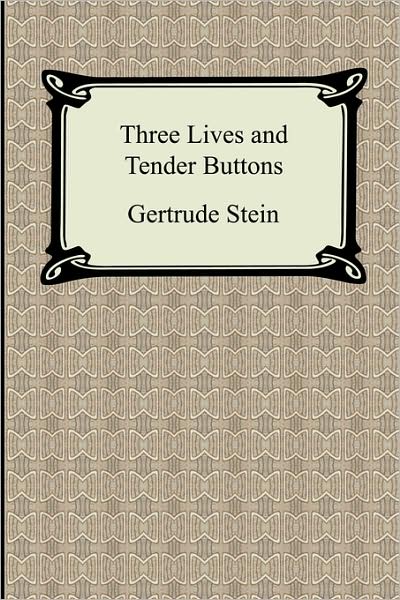
Three Lives and Tender Buttons by Gertrude Stein

I have this Digireads edition, see

I’m cheating a touch, because I read Three Lives some time ago. But it is bound with Tender Buttons in my edition and I’m going to write about them together. It is my hope that my writing about two Stein conundrums will distract you from the fact that I’m confused.

I found some unexpected free time one evening, and knew that I had reading commitments to fulfill, so I didn’t want to start anything of any significant length. I’ll try Tender Buttons, I thought. It’s all of 30 pages, I thought, how hard could it be? HA! Maybe I should have turned back to one of the stories out of The Things They Carried or a chapter of This Book Is Overdue! Either one of those would have been easier options.

So my interest in Gertrude Stein is entirely born of my intense interest in Ernest Hemingway. As we know, Stein was an early friend and mentor, with whom his relationship later soured; he greatly admired, then denigrated, her work, which is famously… er, unique.

When I read Three Lives I was a bit dismayed at my failure to appreciate it. I didn’t find it as difficult as Faulkner, thank goodness, but she certainly doesn’t follow anyone’s model structure for story-telling. Three Lives is made up of three novella-style life stories, of three women in a fictional small town. Their stories don’t go anywhere particular, nor do they join for any greater purpose, although they are evocative and poignant in their moments. I suppose they are vignettes, and well-done at times in their own way; but unorthodox and a little unsettling.

Tender Buttons is a wholly different proposition. It’s a long free-verse poem of sorts, presented sort of as a series of descriptions or discussions of random nouns. For example.

A MOUNTED UMBRELLA.
What was the use of not leaving it there where it would hang what was the use if there was no chance of ever seeing it come there and show that it was handsome and right in the way it showed it. The lesson is to learn that it does show it, that it shows it and that nothing, that there is nothing, that there is no more to do about it and just so much more is there plenty of reason for making an exchange.

or

A NEW CUP AND SAUCER.
Enthusiastically hurting a clouded yellow bud and saucer, enthusiastically so is the bite in the ribbon.

At first this bothered me very much, because I was trying to make sense of it. Her sentences are not sentences; they do not seem to have meaning, or if they do, I am too dense to find it. Unlike the poetry I am familiar with (and I’m no scholar of poetry, but I have read some, and even free-verse generally has some structure – some clues as to how to read it, like line breaks or, hello, punctuation!), there is no guide for where the natural breaks are in language – where a person would draw breath when reading aloud, for instance. (I tried reading this out loud to the Husband while he worked on our deck and he was NOT tolerant.)

But then I decided that Gertrude Stein’s poetry is like Cirque du Soleil or Cats, in that there is no plot or point to speak of, but there is poetry. Read Tender Buttons aloud; it makes music. This is the best way that I can find to appreciate Stein. She is a challenge, make no mistake. And perhaps there is great depth of meaning and I’m missing it because I’m simple. If so, please do comment here, being gentle and kind about it, and explain what I’ve missed. I’m willing to make an effort to appreciate Stein, for Papa’s sake (unlike Faulkner, who I’ve given up on, I think) but she does require an effort. On the other hand, with effort, I find Tender Buttons an intriguing puzzle and it does stimulate and entertain me; just not in the way I usually expect books to do!

I am claiming this one for credit in the Classics Challenge. I think I’ve earned it. Please don’t make me write a book report as I remain a little baffled. But, I’m also excited at the prospect of reading Janet Malcolm’s Two Lives (a biography of Stein and her lifelong partner Alice B. Toklas. notice the play on Stein’s Three Lives), which has patiently resided on my shelf for years now. Look for that one to come. Perhaps Ms. Malcolm will help me understand Ms. Stein!