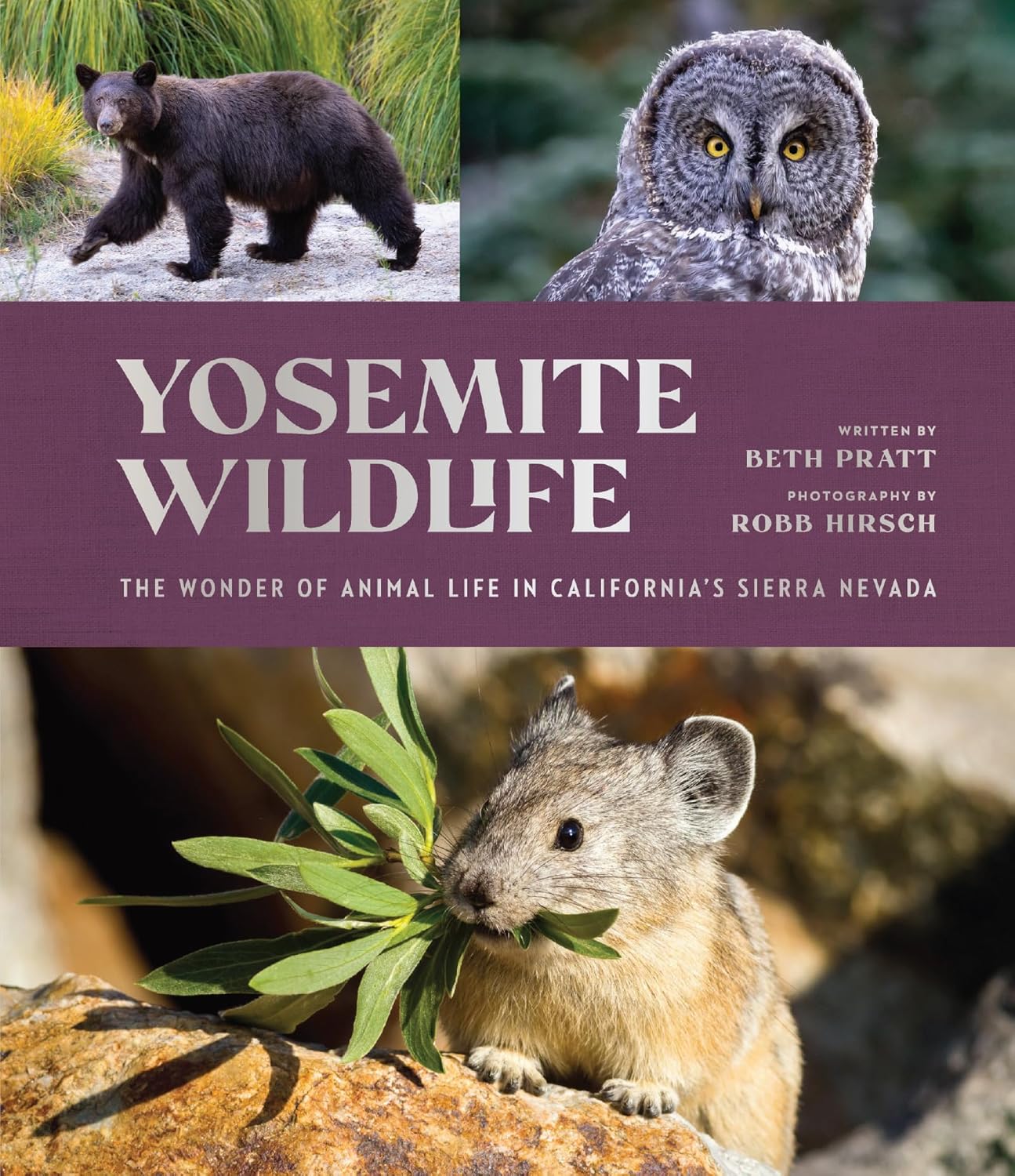
Yosemite Wildlife: The Wonder of Animal Life in California’s Sierra Nevada by Beth Pratt; photographs by Robb Hirsch

Environmental leader and lifelong Yosemite lover Beth Pratt partners with biologist and wildlife photographer Robb Hirsch to offer Yosemite Wildlife: The Wonder of Animal Life in California’s Sierra Nevada, the first book in 100 years to address this national gem’s diverse animal wildlife. With more than 300 images, Yosemite Wildlife is also rich in Pratt’s accessible prose; this thorough survey of observations and storytelling is designed to update a 1924 publication for the historical record. As a beautifully produced, large-format, glossy presentation, it also exhibits Pratt’s and Hirsch’s expertise and passion for a place that is much more than just its famous geology and dramatic scenery. With plentiful archival records, historical images, and personal stories from park staff and naturalists, it’s an informative document as well as a stunning visual feast.

Conservation success stories and profiles of Yosemite’s human defenders over the years accompany Hirsch’s sumptuous images of the iconic black bear and mule deer, the Sierra green sulphur butterfly, the northwestern pond turtle, raptors and songbirds, dragonflies and butterflies, charismatic predators, shy shrews, quirky herptiles, and more. Exquisite.


This review originally ran in the November 4, 2025 gift issue of Shelf Awareness for Readers. To subscribe, click here, and you’ll receive two issues per week of book reviews and other bookish fun.


Rating: 8 push-ups.

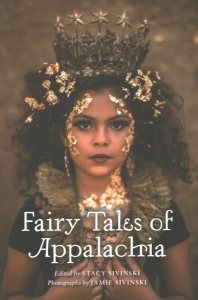
Fairy Tales of Appalachia ed. by Stacy Sivinski, photographs by Jamie Sivinski

I really loved The Crescent Moon Tearoom earlier this year, so imagine my delight to find that its author had also compiled and edited this collection of fairy tales from my adopted home region. The two books are of course very different. But I can hear the echo that the same author/editor was involved with each.

Sivinski opens with twenty-plus pages of introduction in which she details how this book came to be, and this was my favorite part of the book. She begins with her childhood, which was rich with oral storytelling, via her family and community and a unique elementary school that emphasized oral history. An early interest in oral history, and the experience of folktales as living, breathing, changing, current beings, took her through college and graduate school. It was as a graduate student that she found a shortage of “books that portrayed Appalachian folklore as a living genre.” Those she did find felt dated, in their illustrations and in their text, and often felt patronizing or stereotyped, as in their use of ‘eye dialect.’ A new term for me, this is the “transcription process that deliberately misspells words to make them seem more ‘authentic.'” In her graduate research, Sivinski was delighted by the recordings she found of Appalachians telling stories that often featured strong women and girls as central characters, and that played in curious ways on the familiar fairy tales and folktales of Scotch-Irish and German (Grimm) traditions. She quickly began thinking about how to offer those stories in a more modern and ‘living’ book than the ones she found available. And, wouldn’t you know, her sister Jamie Sivinski was already working as a photographer “who specializes in fairy-tale shoots.” So here is this book, a family affair.

There is more to the introduction, about fairy tale traditions, about research and transcription processes and Sivinski’s decision making there, about storytellers and collectors who’ve come before, and about the definitions of fairy tales, folktakes, and wonder tales. I found all of it fascinating, but I liked Sivinski’s personal history and story of this book’s birth the best.

Fairy Tales of Appalachia focuses intentionally (although not exclusively) on stories that center girls and women, with a bit of a corrective aim in response to a story-collecting tradition that has tended to center men. Stories are short – eight or ten pages or just two or three. Each is preceded by Sivinski’s brief notes placing the story in a larger context, for example, of fairy tale traditions: some play on Cinderella or Beauty and the Beast, some combine known elements, and some subvert them. Each contains a reference to the recording (or, in a few cases, transcription) where Sivinski found it. “The Hare Bride” comes from a transcription, with two credited storytellers – Sivinski interprets that one was the teller and the other the transcriber – and one of them hailed from Upshur County, West Virginia, where I live now.

The stories themselves are short, simple, often formulaic, and were not the part of the book that interested me most. (I found the same thing with the Foxfire book, Oral Tradition in Southern Appalachia.) To be fair, Sivinski points out that these stories are best read aloud and shared that way. I did read one aloud and agree that it improves the experience; haven’t tried it with friends yet. I liked the academic work and personal background at least as much as the stories themselves. I’m so grateful they’re collected here.

Jamie Sivinski’s accompanying photographs are certainly beautiful. Some are in black and white and some in color, all matte rather than glossy. I didn’t find that they especially correspond with or illustrate any stories in particular, but rather felt that they just set the tone. While I appreciate the effort, I actually found their inclusion a little distracting, in part because I was looking for connections I didn’t find. I worry that the effort to update the dated illustrations of past collections will only be dated in turn. And… there wasn’t a ton of diversity in the characters / models depicted. I know we think of Appalachia as overwhelmingly white (and my little town here certainly is), but that’s less true throughout than the reputation asserts. The characters in these pictures are almost all girls and women, almost all white, and all stunningly beautiful – rather than looking like ‘real’ people. Maybe that’s the fairy-tale aspect of it. It didn’t work all that well for this reader, although the photos are undeniably lovely in themselves.

I’m glad this scholarship exists and glad the stories are collected in this way, and I’m just trying to figure out which of several friends I’ll pass this one on to.


Rating: 7 apples.

The Women Who Changed Photography: And How To Master Their Techniques by Gemma Padley

Gemma Padley’s The Women Who Changed Photography: And How to Master Their Techniques delivers brief, punchy profiles and incisive assessments of what is revolutionary about these underappreciated photographers. In short chapters, Padley presents 50 women–some well-known, some all but unknown–from all over the world, born from 1799 through 1992. Profiles and portraits are followed by photographs, with Padley’s instruction on how to mimic what is special about the work. This includes technical advice (how to combine and blend portraits; hand-tint a photo; play with angles, color, and flash) and the conceptual (how to use photo stories to raise awareness on an issue). Photographers include Anna Atkins, who “privately published the first book to be illustrated using photography,” and Anne Wardrope, the “first woman in America to photograph her own nude body.” They work in documentary, portraiture, art, photojournalism, and cover war, fashion, conservation, and more. Wide ranging and diverse, with fascinating storytelling, these contents are visually stunning and technically detailed, and will please readers with a variety of interests.


This review originally ran in the November 5, 2024 gift issue of Shelf Awareness for Readers. To subscribe, click here, and you’ll receive two issues per week of book reviews and other bookish fun.


Rating: 7 apertures.

Spirits in the Sky: Northern Lights Photography by Paul Zizka

Nature and adventure photographer Paul Zizka offers stunning images and narrative in Spirits in the Sky: Northern Lights Photography. Photos with brief, descriptive captions take center stage. They are accompanied by a few concise sections of text, which provide an overview of what the northern lights (or aurora borealis) are; some of the myths used to explain them; and the stories behind Zizka’s work in capturing these breathtaking images. Wildlife, human models, outdoor sports and self-portraits appear among the images, but it is the wildly colorful lights themselves–in the striking landscapes of Canada, Greenland, Norway, Iceland and the Faroe Islands–that make these photos unforgettable. Spectacular scenery and an elusive natural phenomenon combine in special ways in this gorgeous collection of art photography.


This review originally ran in the November 4, 2022 gift issue of Shelf Awareness for Readers. To subscribe, click here, and you’ll receive two issues per week of book reviews and other bookish fun.


Rating: 7 moments.

1000 Perfect Weekends by National Geographic

1000 Perfect Weekends is a beautiful, photo-packed offering from National Geographic, sure to expand anyone’s bucket list. Destinations are grouped into 18 chapters, including beaches, mountains, cities, small towns, wildlife and nature themes, family-friendliness and off-grid options. Explore “kayaks like floating La-Z-Boy recliners” on the Delaware River, coffee tours in Panama and a bee farm in the Philippines, alongside references to UNESCO sites, architecture, dining, adventures and a delightful ode to libraries in the chapter on “Historical Explorations.” Entries are short, punchy and accompanied by mouthwatering photographs and frequent, inspiring top-10 lists (sporting events, theme parks, spas). Adrenaline-fueled, enabled and accessible, pet-friendly: there is a perfect weekend for everyone in this tantalizing book, an obvious choice for the frequent flier and the armchair traveler alike.


This review originally ran in the November 2, 2021 gift issue of Shelf Awareness for Readers. To subscribe, click here, and you’ll receive two issues per week of book reviews and other bookish fun.


Rating: 6 Instagram moments.

Barbershops of America: Then and Now by Rob Hammer

Barbershops of America is a photographic tribute to a profession, an aesthetic and a community institution. Photographer Rob Hammer documents both “the old timers… like dinosaurs about to go extinct” and “the next generation,” in two distinct sections covering more than a thousand shops all over the United States. Images are only infrequently interrupted by quotations from barbers and their customers, so readers of this coffee-table book will revel most in the visual: elderly barbers and young, tattooed ones; beat-up barber chairs and decades of detritus; colorful signage, diverse clientele and what Hammer recognizes as the soul of these storied spaces. This collection of glossy documentary art is for lovers of culture, local color and traditions passed down across generations.


This review originally ran in the November 3, 2020 gift issue of Shelf Awareness for Readers. To subscribe, click here, and you’ll receive two issues per week of book reviews and other bookish fun.


Rating: 6 cool vintage chairs.

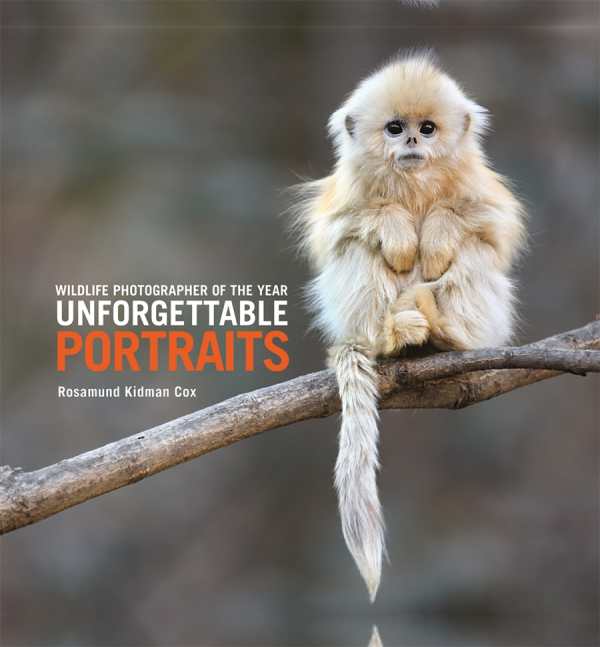
Unforgettable Portraits by Rosamund Kidman Cox

Lions, tigers and bears–and more–light up the incandescent pages of this collection of stunning wildlife photography.

Unforgettable Portraits is a beautiful, large-format collection of images from several decades of the international Wildlife Photographer of the Year competition. Each stunning photo–close-ups and dioramas; elephants, leopards, ants and springtails–gets accompanying text explaining the species, the context, the photographer’s equipment and technique, with an emphasis on endangered species and climate change. Readers meet the Atlantic wolfish, the spotted-tailed quoll and the Namib Desert’s welwitschia, and learn that spirit bears have “a mutation of the same gene that gives rise to red hair in humans” and that the photographer must be part wildlife scientist to get these shots, designing blinds and lying in wait for days, weeks and longer.

These 70 stunning images, by more than 50 photographers from more than 20 countries, would make a wondrous gift for any lover of wildlife, strangeness and beauty.


This review originally ran in the November 5, 2019 gift issue of Shelf Awareness for Readers. To subscribe, click here, and you’ll receive two issues per week of book reviews and other bookish fun.


Rating: 8 whiskers illuminated.