Creative Nonfiction, issue 57: Making a Living (fall 2015)

I had a dream that the next issue came and I had not yet reviewed this one. It was stressful. So, I’d better get to it…

CNF-57-Cover-WebcropThe “Making a Living”-themed issue of Creative Nonfiction is as good as ever. (You can read my review of the previous issue here.) And as ever, I have a few favorites. First of all, Ned Stuckey-French’s opening essay “Required Reading” tells of his reliance on Studs Terkel’s Working to inform his work as a union organizer: a communist college graduate, he’d faked a resume that made him look like an appropriate hire as a hospital janitor, leaving off his studies at Harvard and Brown. Terkel’s interviews with “real” working people helped the young activist place himself somewhat within a world of blue-collar workers, where he didn’t really belong. It’s an essay about disillusionment, the value of reading & writing, and yes, work.

Jennifer Niesslein explores why we write for free (some of us; many of us) in “The Price of Writing.” This is a complicated one, of course, and I think it’s important to note that the ability to write for free is a luxury afforded by some financial security. The writer she quotes as saying “I don’t need the exposure. What I need is to pay my fucking rent” (Nate Thayer, in New York magazine) has a fine point. Niesslein responds that “it can’t be about the money, at least not entirely.” I guess the implication is that if it’s going to be entirely about the money, then you need a day job.

But those are just the introductory pieces, responding to the theme in their own ways. Of the essays about making a living, I think my favorite has to be Kevin Haworth’s “Vivaldi,” which links the musicians who played in the orchestras at Auschwitz to the writer’s son, a passionate budding violinist for whom, happily, music will not be a matter of life and death. It is a powerful piece because of the high stakes of the historical thread, and the emotions in the current one, not to mention the larger issues that will continue to link the two. I also really appreciated Beth Tillman’s “Unleaving,” in which she discusses her career as an estate planning attorney, chosen because of her lifelong anxiety about death. I like the slightly different format she uses, and I empathize with her interest in end-of-life issues, and the day-to-day difficulties she relates.

I also continue to be distracted by both the story and the style of “No Exit,” by Karen Gentry. I will just share what Lee Gutkind wrote in his “What’s the Story?” editor’s column:

…Karen Gentry takes a temp job at a company that helps fired executives find new jobs. Part of her job involves giving Meyers-Briggs tests, and the story tells us a great deal about the corporate world and the way people in it can be reduced to types. But that’s also not at all what the story is about. (To tell you more would be to ruin it.)

I’ll leave it at that, as he did. It is a very fine essay.

Finally, “Tiny Truths” is always a treat: tweets using the tag #cnftweet will be considered for this ongoing contest, which features the best 140-character true stories on a revolving basis. I like that they choose not the flowery, poetic ones – that attempt too much language – but the ones that tell devastating or funny stories very, very simply.

Creative Nonfiction is always filled with greatness. You can read some of the content, or better yet, buy this issue here – or by all means consider a subscription. I don’t do much magazine reading because I’m so busy with BOOKS but this one is always worth my time, a gift in the mailbox.

Creative Nonfiction, issue 56: Waiting (summer 2015)

You can read my review of the previous issue here.

waiting“True stories, well told.” In this issue, they are stories concerned with waiting, whatever that might mean to the writer. (A few craft-related essays are also included.) Unsurprisingly, I am very impressed with the stories CNF chose to publish.

There’s not much not to love here, beginning with Editor Lee Gutkind’s opening piece about all the waiting that goes on in his and my line of work; Dinty W. Moore’s ponderings on the genre name “creative nonfiction” (I am an unrepentant Moore fan); and the essay “Waiting and Wading through Story” by Maggie Messitt, about immersion research and storytelling and the lessons she’s learned from other writers. But I was really blown away by this issue’s winning essay: I agree wholeheartedly with their choice of Joe Fassler’s “Wait Times” as winner of the Best Essay Prize. If you read nothing else in this magazine, please go read this story. It is heartrending and thought-provoking and disturbing, and I’ve thought about it at least daily for more than a week since reading it. It’s about a medical emergency experienced by his wife.

I found Judith Kitchen’s “Any Given Day” harder to love, and I’m sorry to say that, because I’ve heard such wonderful things about her (and have her Half in Shade waiting on my TBR shelf), not least from Gutkind in his opening piece. She died last fall of cancer, and this piece is in part about that ending. But the form of it – loose, amorphous, wandering – didn’t quite work for me. Just a personal reaction; perhaps you’ll find it mindblowing, and I’d love to hear if you do. Certainly she is a fine artist. But this piece didn’t work for me quite so well.

“Lost and Found” by Josephine Fitzpatrick was more a straightforward narrative piece, and call me simple-minded but that struck me more forcefully. Fitzpatrick’s brother went missing in Vietnam when they were both teenagers, and this is the story of waiting for him to come home or for his story to be somehow resolved, for many decades. It is of course touching and thoughtful and, I think, potentially helpful for others suffering from “ambiguous loss” (see also Sonya Lea’s outstanding Wondering Who You Are). Mylène Dressler’s “End Over End”, about coming to surfing as a mature adult and finding the stoke, finds a good balance between cerebral wanderings and narrative.

Following essays and stories about waiting, Sangamithra Iyer’s “The Story Behind the Story,” about searching for her grandfather’s history as civil servant turned activist in Burma, is a touching and instructive piece, not least in its realization that “not getting the story was part of my story, too… the loss of memories, the erasure of our histories, is part of the narrative of many of us children of the diaspora.” I love this concept.

Rachel Beanland’s “Required Reading” was another revelation, about handling the loss of her father by reading numerous memoirs of others’ losses. This strategy was deemed strange or not shared by others but made sense to her, helped her, and this makes sense to me, too. Look, I just said something similar, above, about “Lost and Found” and Wondering Who You Are. This is a short but powerful essay and it contains lots of titles and snippet-quotations that I’m marking for later.

I always look forward with intrigued anticipation to “Pushing the Boundaries,” the section of each issue that includes an “experiment in nonfiction.” This time it is Nathan Elliot’s “An Honest Application,” a response to the part of an immigration application that asks him to justify and place a value on the marriage that hopes to qualify him for permanent Canadian residence. His actual written response is short and simple, but it is accompanied by lengthy footnotes that include all the emotion and indignation he couldn’t put in his application. It is genius – I loved it – and I love as well the story of love that he has to tell.

There were others, but these are my favorites. You can view these pieces and more, or buy the whole issue (do that!) here.

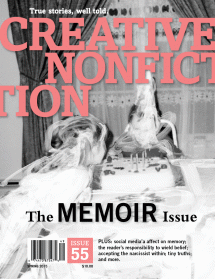
Creative Nonfiction, issue 55: The Memoir Issue (spring 2015)

Full disclosure: I am a fan of the folks over at Creative Nonfiction. I’ve taken one of their classes (and think I’ll do another this winter), and I attended their conference in Pittsburgh last month (also excellent!). This post is about the magazine, which comes out quarterly. Summer 2015 is “The Memoir Issue,” fatter than usual at just over 100 pages, and filled with memoir stories and essays about the genre. I read it from cover to cover, but wanted to share a few of my favorite pieces.

cnf memoirLee Gutkind’s “From the Editor” column asks, “What’s the (Personal) Story?” It’s brief, but a fine backdrop to creative nonfiction and the rise of the memoir. If you ever get a chance to hear Lee speak, expect to be entertained; I enjoyed his energy at the conference, where he helped us all wake up first thing in the morning with his extraordinary energy and enthusiasm. Next, Robert Atwan contributes an essay called “Of Memory and Memoir,” in which he argues that we’d benefit from a better understanding of how memory works (and doesn’t work), in a world where the memoir is so popular and ubiquitous. I think this is an interesting challenge; memoir is often, and appropriately I think, concerned with the line between truth and perspective, and the failure to remember perfectly. I don’t know if we can expect to solve the mystery of our imperfect memories, but Atwan does well to consider the problem.

And then there are the memoir essays themselves, of which I had a few favorites. “Do No Harm” by Kelly Fig Smith won the magazine’s prize, and naturally makes my list. She tells the story of a terrible tragedy that hits her family, and the hospital experience that came with it; it’s about perspective and compassion, I think. “Steps” by Scott Loring Sanders recounts the hike shared by a newly sober father, a young son, and their two dogs; it’s about mistakes and rehabilitation. Gina Warren’s “Girl on Fire” observes the difficulties of caregiving. The final essay, “The Grief Scale,” is by Suzanne Roberts, who wrote Almost Somewhere, a book I rated 6 small but important steps. This essay is better, I think. I like how she circles back at the end to reference the story she thought she was writing, was trying to write; but what we are treated to is instead the story that flows out of her, about being griped at on an airplane, and losing or fearing to lose our loved ones. I found it very effective.

Finally, “The Perils of Perfect Memory” by Daphne Strassmann questions our new reliance on social media and its effects on memory and memoir. Were we better off keeping our memories to ourselves, letting them brew and cure inside us before releasing them on the world? And in “Pushing the Boundaries,” Rolf Potts offers a different format, of found texts assembled in a piece he calls “Age, Formative,” which is powerfully disturbing.

These are just a few of the pieces I found most intriguing; the whole issue is definitely worth taking in. You can view parts of it or buy it here.