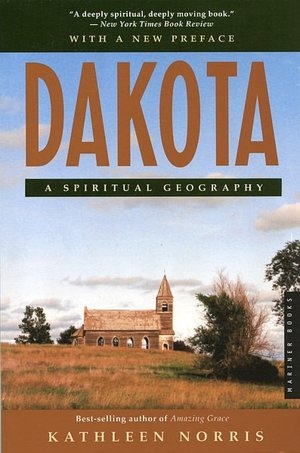
Dakota: A Spiritual Geography by Kathleen Norris

dakotaContinuing in my series of not-new-but-still-important creative nonfiction readings (see The Kiss and The Liars’ Club)… Kathleen Norris’s essay collection, Dakota, is brilliant. I see somewhat where it is dated, discussing for example economic depression and agricultural crisis – because, if anything, things are worse now. But her astute ideas and conclusions are brilliant and in many ways timeless.

You saw my teaser earlier this week, so you know I am impressed. Norris, a poet, of course writes beautifully; it’s worth reading her words for their language alone. But I was really drawn in by the ideas behind them. As her subtitle notes, she is concerned with spirituality and geography. As you might have noted by now about me, I am not attracted to spiritual musings, but I was won over by the geography (in so many senses) and the sense of place which is at the heart of this collection. And I found myself on board for a certain amount of spirituality as well.

My favorite parts of the book were those that characterize place: the physical, biological, climactic characteristics that make “Dakota,” the unique region of both western North and South Dakota that Norris calls home, as well as the cultural and human characteristics of this scarcely populated area. I love thinking about and learning what is definitive about place, in both those senses: the natural, physical, extra-human as well as the human, and the idea of their interconnectedness. (Dakota would doubtless look a little different without people – Las Vegas certainly would – but there is no possibility, I think, of people without place.)

“The Holy Use of Gossip” taught me how gossip can be a good thing, or rather, taught me to recognize as “gossip” (originating, according to the Oxford English Dictionary, from God + sibling) the talking about each other we do in my close group of friends: when we share with each other that one of us is having a bad day, has suffered a loss, needs our help. This is well-intentioned and positive sharing that I’m glad we do. “Gatsby on the Plains” explores how community can lift its members up, or cut itself off from help: Norris writes that

…disconnecting from change does not recapture the past. It loses the future.

Intermittent “Weather Reports” read like short, poetic journal entries of real, specific days, in between more formal essays. They are often not strictly reports on the weather, unless we expand our definitions of weather, which we may well be intended to do.

She writes a good bit about community, how it is formed and how it can be both good and bad for itself. Norris came (back) to Dakota as an adult: her grandparents were of that place, and when she inherited their home there, she and her husband moved in. She is both from there (because the communities knew her grandparents) and not (because she grew up elsewhere, and came in as a traveled, educated, artistic outsider), which made for some interesting challenges for her and her new neighbors. Her 2001 introduction to this edition of the 1993 book discusses her adopted community’s reaction to her work, her publicization of Dakota: in a word, there was both pride and anxiety, but the fact that she stuck around eventually earned her a more thorough local membership.

On the subject of community, I am intrigued by her repeated conflation of the desert, the plains, and even the ocean that once covered this region, with the monastery. She spends quite a few pages throughout comparing the sense of quiet, of great distances increasing mutual support, and contrasting some of the ways in which these communities work. For example, I appreciated the idea (in “Where I Am” – naturally one of my favorite essays) that the monastery is different from small plains towns in that the former has a formal text or rulebook that they agree to live by: in the case of Norris’s central example, Saint Benedict’s Rule, which guides Benedictine monasteries. The small towns often find conflict because they are not all working from one central, agreed upon set of rules or values or ethics.

As an artist, Norris finds that she benefits immensely from the immensity of space in the plains. And she’s got some great stories to tell about sharing art and poetry with her new communities.

I find that prairie people are receptive to a broad range of contemporary poetry, although they’d be unlikely to cross town to attend a poetry reading at a college, were there a college in the vicinity. Their appreciation of the poems I’ve read aloud – from a broad spectrum of contemporary American poets – has given me a new understanding of the communal role of poets, a role poets have mostly abandoned by closeting themselves in academia. Surprises await poets who venture out into the larger community.

I love this idea, that poets (and by extension, many formally educated or academic folks) have quarantined themselves with those like them, and are both failing to share what they have and – more so – failing to learn from others, by locking the doors to the ivory tower.

In a strange counterpoint to this sentiment, though, I found Norris occasionally off-puttingly snobbish about the reading of books: that more prairie people should do it, that they shouldn’t consider themselves well-educated or wise without doing it. Now, don’t get me wrong: clearly I love reading books and find a great deal of value in doing so, and I think books have a lot to offer everyone and everyone should read more. But I also think that people can be very intelligent, wise, and valuable without formal reading; I think that the same prescriptions don’t work for all of us, and I think it’s a shame if she’s found (for example) a great oral storytelling tradition and then laments the lack of book reading. It makes her sound snotty in a way that the rest of the book does not. I like her better than this.

I think it’s just a moment of weakness or misstep, though, because in fact she returns to this subject with more sensitivity in “Status: Or, Should Farmers Read Plato?”

I know as well as anyone that a lot of book learning doesn’t make a person wise (sometimes it simply legitimizes stupidity), but I can’t help but connect the fact that so many Dakotans have been denied access to their culture with the fact that they don’t trust that their own stories are worth much.

The fact of their inhibited access to their own culture and stories is perhaps the best argument for lack of book-reading as a major problem. And she goes on to contemplate what difference it makes to a pig farmer to miss out on Plato, and what Tolstoy and the Brontes can bring to a small-town waitress. I like the nuanced discussion there.

Dakota gets more and more spiritual in its subject matter as it progresses, so that I struggled more toward the end. Discussion of monastic retreats, and Norris’s relationship with the religious communities of Dakota, were often interesting to me; they are in some ways further discussion of community ideals, and I am more or less on board with the spirituality of nature, of relating to wind and sky and plant life. But occasionally there was too much God for my personal tastes. When I encounter the idea of monasteries, and other writers’ productive experiences there, I have found myself tempted sometimes to consider the same; but then I realize what I really need is to just go camping alone.

I found a lot to love and a lot to continue to consider here: about place, about inheritance, about storytelling and relating to one another, about community and about definitions of spirituality. I love Norris’s writing. Although I struggled here and there, or perhaps because I did, this beautiful and thought-provoking book will stay with me and, I think, continue to guide me.


Rating: 8 readings.

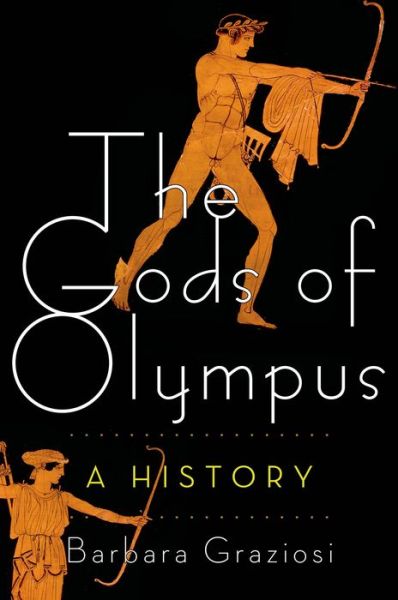
The Gods of Olympus by Barbara Graziosi

For novices and enthusiasts alike, a comprehensive and absorbing study of the gods of Olympus and how their cultural roles have changed over the centuries.

gods of olympus

From Homer and Hesiod, we know that Zeus has a large sexual appetite, that Athena is noble and warlike, that Aphrodite is the goddess of love and sexuality, that Hermes is a messenger with a sense of humor. But how did these myths and the personalities they depict survive to the present? Barbara Graziosi is a professor who’s written several academic works on the classics. In The Gods of Olympus, she directs her expertise to a more general audience for the first time, following the 12 gods and goddesses of the classical Greek pantheon from their first appearances in antiquity through our continuing modern awareness of them. Readers benefit immensely from her proficiency, which comes with a sense of humor: Graziosi occasionally appears in her own narrative, with an endearingly wry, self-deprecating tone.

The history of the immortal Olympians begins in Greece, where Graziosi explores their role in myth, ritual and cultural events. The Athens of Socrates, Plato and Aristotle reconsidered the value of the gods, in literature and in life, and when Alexander the Great expanded his empire toward the ends of the earth, he advertised his ability to travel even further than Dionysus. By gauging his own accomplishments against those of the gods, he sought to make himself like a god even as he reconfirmed the supreme importance of the deities.

Under Alexander’s rule, much of the “known world” was Hellenized, taking on Greek–and therefore Olympian–customs and culture. During the Roman Empire, the gods’ strong personalities were merged with the traditional Roman gods’ rule over matters of state, surviving in slightly different forms that best served those in power. As Graziosi demonstrates, this is the model through which they have come to us over millennia: the rise of Islam and Christianity likewise preserved the Olympians, though it transformed the gods into demons, allegories and cautionary figures. Their original worshippers are long gone, but the Olympic gods survive, flexible and changeable but continuing to inspire art and literature.

Graziosi’s knowledge is obvious, and easy to trust, accompanied by thorough notes and a helpful appendix to the original 12 gods and their corresponding Roman identities. Her writing is accessible and entertaining, her passion for her subject obvious; The Gods of Olympus will equally thrill longtime lovers of the classics, and appeal to readers seeking a friendly, engaging introduction.


This review originally ran in the March 10, 2014 issue of Shelf Awareness for the Book Trade. To subscribe, click here.


Rating: 8 centuries (just for starters).

Joe Hill

Following my experience with Joe Hill’s outstanding NOS4A2, I have been considering the relationship of Hill’s writing to his father’s.

Joe Hill

Joe Hill

A little background: as we all know by now, Joe Hillstrom King is the oldest son of Stephen King. Those being prodigiously large shoes to fill, he began his career as a novelist using Joe Hill as his pen name, not wanting to be associated with Dad – one can imagine the admiration or scrutiny that might have brought. More to the point, I imagine he would have been unable to fully appreciate any success gained as Stephen King’s son, unsure if he could take full credit for it. However, a few books in, it appears he’s now confident in his own career and independence; he “came out” as King’s son in 2007, partly because his public was getting suspicious. (He does awfully resemble his father.) I sympathize with Hill’s need to separate himself early in his career.

Stephen King

Stephen King


[As an aside, I sympathize still more with novelist Kelly Braffet, a lifelong King fan who has ended up his daughter-in-law. As I learned in that article that I recently shared with you, she began her relationship with King’s second son Owen terrified of speaking to her hero. This would indeed be terrifying – I can only imagine! I mean, if I were to date the son of a still-living Hemingway, at least I could rely on the fact that Hem is a bully and a blusterer, which I know how to handle; but King is apparently just a terrifically nice guy. And that’s so much scarier! Speaking of which, I loved the world’s strongest librarian‘s recent blog post about meeting Stephen King.]

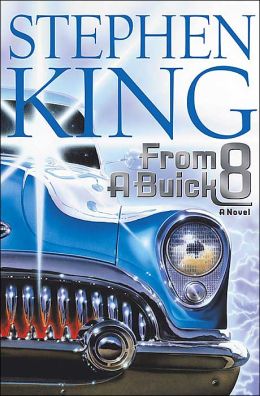
I respect Hill’s decision to hide his family background early on, and I respect his decision to stop hiding it. But I wonder what effect my knowledge has had on my reading of his work, because here’s the thing: NOS4A2 has a hell of a lot of Stephen King in it. I mean this in the best possible way – I love King, and I love NOS4A2. buick8

For one thing, there are plot points: a car with a will of its own is straight out of the very first Stephen King novel I ever read, From a Buick 8. A bicycle that takes its rider otherworldly places played a central role in Stationary Bike. I don’t mean to call Hill statbikederivative – he’s not – but it’s interesting to see these parallels, and it makes me wonder: if your father was Stephen King, would you consciously pull from his novels? Unconsciously? That would seem to be unavoidable.

Stylistically, too, I recognized a King-like realism and heightened awareness of pop culture and strongly recognizable settings; mixed with expert worldbuilding, the result felt inextricably related (no pun intended) to King’s strongest work. But that suggests a question, too. Would I have made these comparisons and found these similarities if I hadn’t known about the familial connection between the two authors? And that question is really the point of this blog post. I feel confident that I would have seen these connections, because they appear so striking. But we’ll never know, because I didn’t get to go into this reading blind. For that matter, I picked this book up because of the Hill’s relationship to King. And the point of that statement is that Joe Hill was so very right to begin his career under cloak of pseudonym. Now, though, it needn’t matter, because he’s a kick-ass author in his own right. Bring on Heart-Shaped Box.

At the end of the audio version of NOS4A2 that I listened to, there was included an author interview with Joe Hill. (That is, there are no questions, just Hill speaking, but it reads like an interview; I imagine the questions were asked off-stage.) This was an enjoyable way to hear him in his own voice, and I loved some of what he had to say about audiobooks in particular. He cites Harold Bloom, eminent literary critic, saying that audio is simply not the same – is not “literature” – and that listening is not reading (well, duh). Hill refutes this idea, pointing out that listening to literature is yes, different, but is its own important thing. He uses as an example a certain blind author of noted “literature”; I would also point out Homer, who was both blind and pre-written-history, who lived back when the oral tradition was the only way to share stories. At any rate, Hill’s celebration of audiobooks was nice to hear. (And unsurprising, considering his upbringing.)

Finally, in the same interview/monologue, Hill says that “imagination is as powerful as physical law.” I want to leave you with that: a very apt point from Hill, as an author and as a product of the King household.

The Song of Achilles by Madeline Miller

I read this book in a day, rapt and tearful and awed. Madeline Miller, I love you. Write more, please.

I expect that most people are at least vaguely familiar with the story of the Trojan War, even if you never read the Iliad, yes? The Greeks sail to Troy in pursuit of Helen, “the face that launched a thousand ships” (that’s these ships!), the most beautiful woman in the world, stolen from her king-husband Menelaus by the Trojan prince Paris. They fight at the gates of Troy for ten years before Odysseus’s characteristically clever notion of the big wooden horse (the Trojan horse of idiom) wins the war for the Greeks. Achilles is a hero of the war, on the Greeks’ side. He had been sitting the war out in protest against an offense to his pride when his close friend (and, most scholars agree, lover) Patroclus goes into battle and is killed. In the opening scene of the Iliad, Achilles is mad with grief and rage, about to rush into battle, kill Hector, and be killed by Paris.

That’s the background. Miller, a scholar of ancient languages (including Greek) and theatre has written a novel from Patroclus’s point of view. This gave her quite a bit of leeway, since Patroclus is not given much coverage in Homer or in ancient myth generally; she got to do what she wanted with him. Here, we see him grow up from a boy: he was a disappointment to his father, then was exiled in dishonor and sent away to be fostered in another kingdom, where Achilles is the prince and heir. The two boys form a decidedly unlikely friendship, with Patroclus the dishonored and weak following in the footsteps of Achilles, whose future is prophesied to be something enormous: he will be Aristos Achaion, the greatest of the Greeks.

Patroclus joins Achilles in his studies and their bond grows closer until they become lovers. They are not eager to join the Greeks and sail to Troy to fight for another king’s wife, but circumstances (and Odysseus, the crafty one) conspire to see them off. From there, you can revisit my synopsis of the Iliad, above – except that we keep Patroclus’s perspective, which actually made the Trojan War that I thought I knew so well spring fresh from the page.

And that is one of the several strengths of this book: that an ancient myth that is familiar to many readers, like me, becomes so real, new, crisp & juicy in Miller’s hands. It definitely made me want to go back and reread the Iliad, as well as other cited works. (Check out the Character Glossary, whether you think you need it or not, for background as well as mentions of other books you’ll want to go find.) The myth of the Trojan War comes alive with Patroclus as it hasn’t before.

Another great strength is the emotional impact Miller achieves. This book is moving, sweet, heartfelt, powerful, in its tragedies as in its loving moments – and the tragedies are plentiful. There is visceral wrath in Achilles’s mother Thetis and her hatred of all mortals and Patroclus in particular; that emotion comes through just as strongly as the love that makes Patroclus put aside jealousy and envy, makes him put Achilles’s needs before his own. I noticed that the first-person voice of Patroclus rarely uses the name Achilles, but just refers to his lover as “he” – thus emphasizing the extent to which Achilles is the center of his world.

As I said at the start of this review, I want more of this! It’s so well done. If you’re taking requests, Ms. Miller, I would like to read a book about what happened to the happy family of Odysseus, Penelope and Telemachus following the conclusion of the Odyssey: how does Odysseus manage to gracefully step down from power and transfer to Telemachus without sacrificing any of his machismo? Reading The Song of Achilles raised this question for me – how a king could step down and preserve his dignity and quality of life. I wonder, too, whether Penelope ever gets grumpy about all the philandering Odysseus did along his homeward journey, while she was standing strong against the suitors.

In a nutshell, this retelling of the Trojan War and the relationship between Achilles and Patroclus is lovely, loving, sweet and deeply emotional; it preserves the grand, sweeping scale and feeling of humanity and drama in the original, but brings it freshly alive in an appealingly different format. The Song of Achilles made me sigh and think and cry, and I wanted more when it was all gone. This may very well be the best book I’ve read in 2012.


Rating: a rare 10 loving caresses.