Maximum Shelf: Dead Wake: The Last Crossing of the Lusitania by Erik Larson

Maximum Shelf is the weekly Shelf Awareness feature focusing on an upcoming title we love and believe will be a great handselling opportunity for booksellers everywhere. The features are written by our editors and reviewers and the publisher has helped support the issue.

This review was published by Shelf Awareness on February 9, 2015.


dead wakeIn May of 1915, a torpedo fired from a German submarine struck the RMS Lusitania, a British passenger ship with nearly 200 Americans aboard. She sunk off the coast of Ireland in less than 20 minutes (due to a sequence of events unforeseen even by its attacker), killing 1,200 passengers and crew, fully half of whose remains were never recovered. Common knowledge has it that this event drove the United States to enter a European war that would become World War I, but, in fact, while the Lusitania‘s fate played some role in that decision, it took two full years and the secret German Zimmerman telegram for the U.S. to enter the war in 1917.

Erik Larson examines this extended U.S. isolationism, the final days aboard the Lusitania, and related events and characters in Dead Wake: The Last Crossing of the Lusitania. As in his earlier books (Isaac’s Storm; In the Garden of Beasts), Larson presents exhaustive research with precision and accuracy, in extraordinarily compelling prose. Dead Wake is a masterpiece of gripping narrative nonfiction, arguably the most riveting of Larson’s works.

Nearly 2,000 people boarded the Lusitania in New York City, bound for Liverpool, including 1,300 passengers, of whom 189 were Americans. An unusually large proportion were children and babies. The Lusitania was the biggest and fastest civilian ship on the seas in that 10th month of European war. These superlatives–plus the reassurances of the captain, William Thomas Turner, and the Liverpool-based Cunard Line–allowed the ship to confidently set sail despite a German warning published in all the New York papers on the morning of the Lusitania‘s departure, that “vessels flying the flag of Great Britain, or of any of her allies, are liable to destruction.” Larson provides detail and humanity by profiling several passengers and crew members, including a Vanderbilt heir; a psychic; and a Boston bookseller who boarded with a small but invaluable collection of William Makepeace Thackeray’s original illustrations and Charles Dickens’s own copy of A Christmas Carol, complete with the author’s marginalia.

Just weeks earlier, another vessel had departed from the other side of the Atlantic Ocean. German Unterseeboot-20 was captained by Walther Schwieger, a well-regarded young Kapitänleutnant known for his aggressive and innovative tactics. Because submarines lost radio contact with their bases almost immediately upon departure and remained out of contact for much of their cruise, Schwieger was in full charge of his boat, empowered to cruise, dive and attack on his own, with the full support of his government. In following Schwieger’s submarine in the weeks leading up to the climax, Larson gives the story dimension; far from presenting the German captain as a monster, he is humanized, for example, by the devotion of the men who worked under him, and the presence on board of a litter of puppies rescued, interestingly, from another ship sunk by torpedo.

As he builds toward the inevitable intersection of U-20 with the Lusitania, Larson introduces more characters. Captain Turner of the Cunard Line had decades of experience at sea, and had just testified in a civil case against the owners of the Titanic on behalf of the families of deceased passengers. He was known to his men as a brave and capable but old-fashioned captain, with “one foot on the deck of a sailing ship.” U.S. President Woodrow Wilson had had a rough year, even without the European conflict: having lost his wife Ellen in late 1914, his mourning left him unmoored and struggling to concentrate, until he met widow Edith Bolling Galt. His love for her would prove overwhelming, and their courtship strained–she rejected his first marriage proposal. This love story is affecting, and if it serves as a distraction from the sinking ship at the center of this book, that is a fine style choice by Larson: it was a distraction for Wilson, too.

Meanwhile, a secret section of the British Admiralty was tasked with intercepting and decoding German wireless messages, a purpose known to only nine senior officials, who were hampered in using any information gained for fear of having its cryptanalysis ability revealed. They would therefore fail to warn Turner of U-20’s preying presence in the waters he sailed. Such parallel plots and individual profiles add color and depth to Larson’s account, as when the chief of British naval intelligence is described as “part Machiavelli, part schoolboy.”

The Lusitania‘s story is in itself moving, and carries great historical significance, but these events positively glitter with life in Larson’s engaging, quick-paced and captivating prose. Though it incorporates well-documented history, Dead Wake still contains elements of suspense for all but the most expert readers; as Larson acknowledges, he had his own misconceptions coming into this project, and learned surprising facts in his research, as readers surely will. The pages fly by as such details are revealed and the action ratchets up toward a climactic event that we all see coming, but that still makes us catch our breath. In spellbinding, immediate language, Larson contrasts the “books, and cigars, and fine foods, afternoon tea, and the easy cadence of shipboard life” on the Lusitania with the “U-boat sweat,” foul odors and close air aboard U-20. His enthralling description of passengers joking about submarines and torpedoes, in the very moments before the torpedo strike, and “making polite apologies” just after, in the scramble for life jackets, keep the reader fully engaged. Appealingly, in his “Note to Readers” and “Sources and Acknowledgments,” Larson writes in a more personal voice about the joy of the research process, and about his frank difficulty in understanding the passengers who boarded the Lusitania in the face of warnings from Germany about travel in a war zone.

Dead Wake is both a thoroughly satisfying read, and an unparalleled adventure into world history. Larson’s fans will rejoice, and grow in number.


Rating: 8 life jackets.

How lucky am I to get to interview Erik Larson?? Come back tomorrow to read the result.

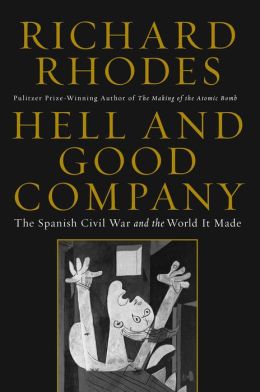
Hell and Good Company: The Spanish Civil War and the World it Made by Richard Rhodes

The Spanish Civil War, and its medical, military and artistic contributions to modernity.

hell

The Spanish Civil War was a precursor to World War II, and served as a practice field where medical and military leaders experimented with new technologies and refined strategies. Creative minds from around the world drew inspiration and horror from the conflict, yielding Picasso’s Guernica, Hemingway’s For Whom the Bell Tolls, Miro’s El Segador and Orwell’s Homage to Catalonia. In Hell and Good Company, Richard Rhodes (The Making of the Atomic Bomb) examines the Spanish Civil War not in exhaustive chronology or complex international intrigue–although both are present–but in its gifts, good and bad, to the world that followed.

As Germany and Italy begrudgingly contributed to the Spanish nationalist (fascist) side, and the Soviet Union just as reluctantly supplied the republicans, new military technologies met old. Advances in aircraft were matched by new strategies, including “carpet bombing,” a term used for the carnage at Guernica. In response, doctors and nurses from Spain and abroad innovated as well: while reliable blood typing and preservation for blood banking had been under development since World War I, safe transfusions in the field were born in the Spanish Civil War, as was the autochir (a mobile, sterile surgical unit).

Rhodes follows various individuals, famous (Hemingway, Picasso) and less so (volunteer doctors, nurses and soldiers from around the world), providing a vivid, wrenching view of war, art and love. While it scrutinizes world-changing new technologies and ways of life, Hell and Good Company is also a fine, accessible introductory history of the Spanish Civil War, and an evocative human story.


This review originally ran in the February 6, 2015 issue of Shelf Awareness for Readers. To subscribe, click here, and you’ll receive two issues per week of book reviews and other bookish fun!


Rating: 7 bombs.

Teaser Tuesdays: Hammer Head: The Making of a Carpenter by Nina MacLaughlin

Teaser Tuesdays is a weekly bookish meme, hosted by MizB of Should Be Reading.

hammer head

When I saw this book, it reminded me immediately of Dirt Work, which I loved. Similar concept: young woman is educated to be an academic, a writer, a journalist with a background in the classics in this case; fed up with that world, but having few or no skills in the other, she nevertheless gets out there and takes on something new. Nina MacLaughlin answers an ad for a carpenter’s apprentice, and learns a physical trade.

But clearly, also, she couldn’t leave the writing behind. Check out this sentence.

I was usually alone when I walked the bridge, occasionally drunk, a few times crying, one time kissed by someone I didn’t like too much.

It is constructions like that that make me want to be a writer, too.

This quotation comes from an uncorrected advance proof and is subject to change.

book beginnings on Friday: Untangling the Knot, edited by Carter Sickels

Thanks to Rose City Reader for hosting this meme. To participate, share the first line or two of the book you are currently reading and, if you feel so moved, let us know what your first impressions were based on that first line.

untangling

This is an essay collection, Queer Voices on Marriage, Relationships and Gender. I found it quite eye-opening and recommend it highly. From the introduction by editor Carter Sickels, a beginning for you:

I’m writing this the day after Oregon has legalized gay marriage, and I can’t stop looking at the pictures of people lined up at the courthouse or listening to the interviews of couples who’ve been waiting for this moment for ten, twenty, thirty years. Today, Portland is a city of celebration.

There is a ‘but’ coming, though. Stick around: it is interesting and enlightening.

This quotation comes from an uncorrected advance proof and is subject to change.

Whipping Boy: The Forty-Year Search for My Twelve-Year-Old Bully by Allen Kurzweil

The lengthy and bizarre search for a childhood bully, with humor, pathos and redemption.

whipping boy

During his single year at a boarding school in Switzerland, sixth-grader Allen Kurzweil roomed with a boy improbably named Cesar Augustus, who bullied him physically and emotionally. Then Allen moved on, lived all over the world, found a successful career in journalism and writing, married a French anthropologist and had a son. But throughout those intervening years, Allen was bothered by the memory of Cesar.

In researching Cesar’s likely whereabouts, Allen dismisses false leads and relives old trauma. Eventually, he finds his childhood tormentor in a nearly unbelievable narrative: Cesar was sentenced to three years in prison for his role in a criminal scam so outlandish that it reads like a novel. Allen Kurzweil’s Whipping Boy is a work of nonfiction, with no names changed; just when it starts feeling like a thriller, it gets stranger than fiction.

Kurzweil is obsessed with Cesar, his “menace and muse.” He wants to right wrongs, to avenge himself and to solve a mystery. He also wants to stick up for his son, also bullied at a young age. Along the way, he is distracted–as is the reader–by the monstrosity and incredibility of con men who claim to be royalty, with costumes and jewelry to match, who manage to defraud eminent savvy businesspeople; and he is forced to consider questions about the nature of memory. But in the end, courage and closure are the rewards for a heartfelt, very funny, poignant and extremely weird story to which Kurzweil’s self-deprecatory voice is perfectly suited.


This review originally ran in the January 27, 2015 issue of Shelf Awareness for Readers. To subscribe, click here, and you’ll receive two issues per week of book reviews and other bookish fun!


Rating: 7 foosballs.

The Conversation: A Revolutionary Plan for End-of-Life Care by Angelo E. Volandes, M.D.

A physician’s fervent quest for better information about medical options for patients nearing their end, and the steps necessary to make those choices clear.

conversation
In The Conversation: A Revolutionary Plan for End-of-Life Care, Angelo Volandes, a medical doctor for decades, focuses on the extensive, intensive, intrusive medical interventions that patients routinely receive at the end of life, many of which extend life by a matter of hours or days or not at all, while decreasing its quality substantially. He earnestly argues that every patient should be offered the option to choose among three broad categories of care: life-prolonging, limited medical and comfort care–in other words, the choice between quantity and quality of life. The Conversation advocates for all patients and families to receive information about what end of life care looks like within these three categories, and firmly states the importance of patients, families and medical professionals having what he calls the Conversation about end-of-life wishes openly and often.

To make these points, Volandes describes his upbringing as the child of Greek immigrants and the impact it has had on his life: from his start as a student of Socrates and a Greek diner cook, his stint as a philosophy major and then his work as a medical practitioner, he has been interested in what good life (and good death) are. Appropriately, Volandes neither attempts nor claims to be impersonal or unemotional about this charged topic; rather, he brings his personal and professional experiences as well as research to his impassioned argument.

The majority of the book is devoted to stories of patients, families and circumstances–and Volandes’s own attempts, good and bad, at approaching the Conversation. With names changed, these are real-life anecdotes of choices made with more or less preparation and knowledge of what a decision will entail, or what an incapacitated patient would have wanted. The last quarter of the book is composed of several appendices and a lengthy, narrative notes section, all of which provides substantive hands-on advice aimed variously at the patient, or the patient’s spouse or children. The Conversation is a how-to manual, enlivened by engaging–if occasionally painful–true stories. Volandes makes his points succinctly and convincingly and offers readers the tools to make change within their own lives.


This review originally ran in the January 6, 2015 issue of Shelf Awareness for the Book Trade. To subscribe, click here, and you’ll receive two issues per week of book reviews and other bookish fun!


Rating: 7 people.

Publishing by Gail Godwin

In a winning voice, novelist Gail Godwin shares her experiences in publishing, which are alternately humorous and moving.

publishing

Gail Godwin is the author of 14 novels, as well as story collections, nonfiction and memoir, now including Publishing: A Writer’s Memoir, which she calls a “meditation on publishing.” In vaguely chronological fashion, she recounts her experiences with the industry; toward the end, she reflects upon earlier times.

Godwin begins with her years as an aspiring writer. Knowing well her mother’s progress from collegiate playwright to journalist to author of magazine romance stories, she is plagued by a hunger for publication and success (which presumably come together). She writes about failed marriages, fiction workshops and teachers who were encouraging and helpful (as well as those who weren’t), rejection and, finally, the book that sold: The Perfectionists, published in 1970. Several poignant chapters cover the “dance” between an author and an editor, with vignettes of each of Godwin’s dance partners over the years, several of whom she lost to unexpected deaths.

At points, her tone becomes elegiac, but Publishing is often funny and joyful as well. In a series of anecdotes, Godwin muses on book tours (the question of funding, author escorts, how long a reading modern audiences will tolerate, the new practice of hiring facilitators to help authors along in public appearances) and the value of bad book reviews. She profiles wonderful, helpful, joy-bringing people, and though she humorously describes the less-pleasant people she has encountered, she graciously avoids naming names. These entertaining, elegant, knowing recollections are accompanied by beautifully simple and appropriate black-and-white line drawings by Godwin’s friend Frances Halsband, which subtly add to the reader’s experience.

While her accounts of writing and publishing are fascinating and amusing, Godwin’s central strength is in her utterly charming personality: wise, occasionally self-deprecating and quietly playful. As promised, Publishing is not a history of the industry nor an instructive manual for the next generation of aspiring writers. It’s simply one woman’s well-told memories, peopled by appealing characters, sketched with wit. Stories about family, travel, love and life make this a book not only for fans of memoir, or dedicated readers, writers, editors and publishers, but for anyone who has pursued a dream or appreciates those who do.


This review originally ran in the January 8, 2015 issue of Shelf Awareness for the Book Trade. To subscribe, click here, and you’ll receive two issues per week of book reviews and other bookish fun!


Rating: 7 funerals.

Teaser Tuesdays: Dead Wake by Erik Larson

Teaser Tuesdays is a weekly bookish meme, hosted by MizB of Should Be Reading.

dead wake

Unsurprisingly, Erik Larson’s newest release is outstanding, a masterpiece of gripping narrative writing with its own momentum. No one would ever think to compare this to a standard, old-fashioned book of history.

One of the things I think he does well is juxtaposition. For example, read these few lines, and imagine them side-by-side with a description of life aboard a German military submarine.

Aboard the Lusitania, there was quiet. There were books, and cigars, and fine foods, afternoon tea, and the easy cadence of shipboard life: strolling the deck, chatting at the rails, doing crochet, and just sitting still in a deck chair in the sea breeze. Now and then a ship appeared in the distance; closer at hand, whales.

It’s the whales that do it for me.

This quotation comes from an uncorrected advance proof and is subject to change.

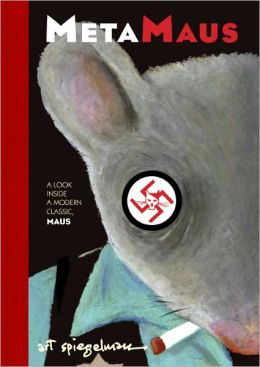
MetaMaus: A Look Inside a Modern Classic, Maus by Art Spiegelman

Begin with Maus I and Maus II. And then move on to MetaMaus, filled with images from the book and discussions with Art, and his wife and two children, about what it all means, his process, his motivations, and the impact these powerful little books have had on all of them.
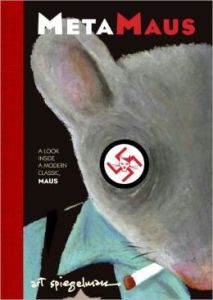
metamaus
At the outset, let me say, holy magnificent book. MetaMaus asks the questions (according to its back cover), why the Holocaust? why mice? why comics? And of course, the Holocaust is the easiest to answer, to me: the Holocaust because it was what he knew (“write what you know”), except that he didn’t know the Holocaust. He emphasizes that. (And I confess it surprised me, that a survivors’ son could have grown up with such a limited knowledge of what happened so recently, and so centrally to his own personal and family history. I had a fairly decent, basic grasp of the Holocaust in grade school. But then, I grew up a full generation after the author did. Clearly a lot had changed.) Still, it was what arced over him, what oppressed him or at least leaned against him; what else was there? In fact, my surprise was that it wasn’t that obvious – that he wasn’t driven to write (draw) about the Holocaust, at least not that he knew: “What consciously motivated me was the impulse of wanting to do a long comic that needed a bookmark.” He needed to make a full-length comic, as it turned out. Who knew. I am baffled by the visual arts, at least as much as I am stimulated and inspired by the written/verbal ones; most of the visual artistry of Maus escaped me before reading this book, which is part of why I found it so wonderful. Unlike many monographs meant to elucidate the visual arts for us plebeians, this really brought it home to me, exposed so much more, increased my understanding & appreciation.

But the real question I was here for: why mice? Honestly, this was my chief concern (followed by: why cats, why pigs, why dogs…) and all those questions are answered, happily. And of course there are only more questions behind them, much discussion of the imagery and symbolism that belongs to animals in different cultures, for example, and some of that taking-back of the derogatory where Jews were called rats by the Nazis, for example. MetaMaus follows these paths, and lets us get to know the author. I found it very satisfying, after getting to know a version of him and feel him so strongly. We should always be so lucky.

And then the CD! This book is accompanied by a CD with complete images of both of the books; over 7,000 early sketches & studies & the like; video and audio files including recordings of interviews with Vladek; and some of the pamphlets off his mother’s bookshelf that Art used in his research. I think there were about 4 hours of Vladek interviews – the man’s actual voice! – and an hour-long home movie made by Art and Francoise on a visit to Auschwitz. Holy smokes, the CD is chock-full of goodies. I did not exhaustively study it, I confess. There was just so much; and I felt so well-served by the reading of the book itself. I did enjoy listening to Vladek’s voice, though: it brought everything to life, and was an interesting counterpoint to the relative unreality of comics.

Of course another theme of the book is the power and faultiness of memory. I love memoir, and I love that memoir almost inevitably has to confront this obstacle: the ‘mem’ in memoir is unavoidably problematic, at least enough to raise questions. In Maus‘s case, the clearest example comes when Vladek describes leaving Auschwitz and denies that there was an orchestra playing at the gates. As Art has documented, there is substantial support for the existence of this orchestra: there are photographs, and there are eyewitnesses among the Nazis, the Jews, and the musicians. But Vladek is sure there was no orchestra. What to do? I love Art’s discussion of the problem: how he could have represented Vladek’s version, or the official one, or left the whole question out of his story; but he instead elected to show the actual question. There is a panel in which there is an orchestra – followed by Vladek’s denial of the orchestra – followed by a panel in which the orchestra is no longer present, except that if you look closely, you can see the tips and shadows of their presence behind the marching prisoners. This is really something. Of course, when I read the comic, I didn’t catch that visual shadow, just the discussion of the question.

I learned a lot of intriguing details. Who knew the size of these (quite small) comics was so important to Spiegelman? Or more surprising, that he drew the originals in that same small size? And the details about the different reactions to the books in different countries (it’s been translated into some thirty languages) were fascinating to me. I had innumerable little details of the comics pointed out to me and elucidated – things I would never, in 100 readings, have figured out for myself, but value greatly once they were explained to me. But I most enjoyed the feeling of greater intimacy with a very talented, and unique artist. And I remain boggled by the dual artistry of the composition of this book as narrative, next to the visual artistry of the comic aspect. Art Spiegelman is a special man. The two Maus books were special, and should be required reading (for, I don’t know, everyone). And then if you like those – do yourself a favor and immerse yourself in this behind-the-scenes look. If you appreciate art (in any format) and are interested in process, also check this one out. And for those of you who prefer other formats than plain old reading, the CD has a great deal to offer in formats all over the map. Major win!

Additionally, I had to mark many passages for further consideration, so many philosophies I found valuable…

On communication vs. High Arts:

I do like to communicate clearly. It’s a pleasure. And as soon as one is involved with communication, one’s already suspect in the High Arts. A lot of what happens in the more rarefied precincts of art is that the word “communication” gets replaced by “communion,” and one is involved in a kind of religious experience with the artist as shaman. And that’s really different than, “Hey, I’ll tell you a yarn.” Or even “I’ll tell you a parable,” if you want to be didactic. And it’s always been either a skill or a deficiency that I try to make contact with with people.

I appreciate this, because I think High Arts (his phrase, but I like it) can sometimes let us down a great deal when it gets religious, or mysterious, or snooty. I’m not saying everything has to be forever perfectly literal and transparent, and I do enjoy moments of inexplicable beauty. But I think it’s exclusive and elitist to shun honest communication.

On the authenticity of his way of story-telling:

Everything drawn in the so-called past in the story that Vladek is telling is very clearly an attempt by the son to show what the father is telling. And that offered a margin within which to operate authentically. The fact that you’re told that I’m trying to show you what I understand of what Vladek is telling me is built into the fabric of the narrative itself, and allows that narrative to get told.

This reminds me of one of my favorite movies, 2 Seconds. There is an extended sequence where Lorenzo is telling Laurie the story of his professional bike racing career and how it ended. He speaks, and we see the action he is describing – but we see it as imagined by Laurie as she listens – but apparently Lorenzo can see it too, because he corrects it here and there. For example, he’s describing walking down a country road, and we see a young man doing just that, and kind of waddling on his clipless cycling shoes, with the cleats on them. And then we skip back to Lorenzo and Laurie sitting and talking, and he corrects her: “no no, we didn’t waddle, our shoes were soft leather” (I paraphrase). Skip back to the young man walking down the country road, smoothly on his smooth soles. I love love love this effect. In the same way, for example, in the question of the orchestra at Auschwitz, Spiegelman makes it clear that his father is correctly his visualization as they go. And this makes it honest and clear that he is only telling a story as told to him and as he understands it, which I appreciate deeply for its honesty.

On nihilism and ethics:

One night, we’re going down to feed the cats after one of our snooze-and-probe sessions, and he’s carrying those scraps downstairs and he says, apropos of I don’t remember what, that basically he’s a nihilist. And I ask him how this involves getting up in the middle of the night to talk to dying AIDS patients, and being so available to patients way past the point of it being good for his health, and he says something that one might take as just an off-the-cuff remark, but I found profound: “Well, I decided that behaving ethically was the most nihilistic thing I could do.” It delighted me as an idea, as a way of living one’s life.

This quotation launched a lengthy discussion for my father and I of the different meanings of ‘values,’ ‘morals’ and ‘ethics.’

On stories:

[The word ‘story’] comes from medieval Latin historia. It refers to those very early comic strips made before the invention of newsprint: the stained-glass windows that told a superhero story about that guy who could walk on water and turn it into wine. This is how in English, the word ‘story’ has come to mean both story as in stories of a building and story as a narrative. And at that point one is steered toward an architectural model for what a comic is, something very basic about comics narrative. Comics pages are structures made up of panels, sort of the way the windows in a church articulate a story. Thinking of these pages as units that have to be joined together, as if each page was some kind of building with windows init, was something that often happens overtly in Maus, and sometimes is just implicit in the DNA of the medium.

Story as architecture was a little mind-blowing to me, too. Allow these few examples to show how deeply thought-provoking I found this book. It’s a really dense, exciting experience.

So, to sum up: I found each Maus book thrilling and touching it itself. MetaMaus was equally thrilling and touching, increased the experience of both Mauses, and additionally set loose all kind of thought threads for me, that I have listed here as briefly as I could stand so as to not ramble on all day. Clearly I’m a fan. Pick up this book, and keep your notebook handy as you go.


Rating: what the hell, 10 sketches.

book beginnings on Friday: Whipping Boy by Allen Kurzweil

Thanks to Rose City Reader for hosting this meme. To participate, share the first line or two of the book you are currently reading and, if you feel so moved, let us know what your first impressions were based on that first line.

whipping boy

On the opening page, we get these lines.

Confession

You’ve been a menace and a muse. A beacon and a roadblock. My jailer and my travel agent.

Kurzweil writes to his childhood bully here, who the whole book is about. And this gets to the heart of his need to research and write it – that first line, in fact, does it alone: “you’ve been a menace and a muse.” A fine beginning, I think, because it says so much so briefly. It is still worth reading the whole story, though, I assure you.

This quotation comes from an uncorrected advance proof and is subject to change.