Among the Bros: A Fraternity Crime Story by Max Marshall

This investigative narrative of fraternity members turned drug dealers–and worse–exposes unsavory aspects of college life.

Among the Bros: A Fraternity Crime Story is Max Marshall’s investigation into the series of arrests and criminal charges related to fraternities at the College of Charleston in South Carolina and the individuals involved. A press conference during the College of Charleston’s 2016 summer break caught the attention of Marshall, a journalist, recent college graduate, and fraternity member himself. Mug shot photos showed five fraternity members and three friends. “They looked like guys who put in time at the gym, and maybe at the beach, and definitely at the putting green,” Marshall writes. These eight young men were accused of selling a variety of controlled substances, including Xanax, which, as police chief Greg Mullen put it, seemed to be “a drug of choice right now.” According to authorities, this case was also related to the recent murder of another fraternity member. Intrigued, Marshall follows the story of those eight arrests and the changing cultural identity of Greek organizations in the United States.

Among the Bros focuses on Mikey Schmidt, a Kappa Alpha, to whom Marshall spoke via a series of contraband cell phones as Mikey served 10 years without parole. Age 21 at the time of his arrest, Mikey is one of the flashiest characters in the story Marshall unearths, and he receives the most serious sentence of the group. He and his best friend, Rob Liljeberg III (also a Kappa Alpha), form the backbone of Marshall’s reporting. They put human faces on an investigation into the intersection of Greek life, drug dealing, and criminal activity by a particularly privileged and overwhelmingly white male demographic.

Over the course of four years, Marshall consulted police files, court transcripts, and other documents, and conducted more than 180 interviews with 124 sources. The narrative he presents is sad, deeply disquieting, and often sordid. The fraternity members he interviews all deny using date-rape drugs but allow that others around them do. He meets with one fraternity alumnus who describes mixing gin, Mountain Dew, Xanax, and cocaine–and then tries to sell Marshall his financial planning service. “When I asked an SAE [Sigma Alpha Epsilon] what his friends did the weekend after the Mother Emmanuel killings, he said, ‘Things just aren’t going to stop…. As insensitive as it sounds, it’s still Friday.'” The portrait these anecdotes paint is not flattering, but Marshall remains compassionate, sympathizing with the pull of belonging, and the promise of like-minded friends.

Among the Bros finishes without moral lessons or final conclusions, instead aiming to clearly report events that will disturb most readers. Combining excellent journalism and deftly paced storytelling, this chilling tale lifts a veil on a decadent and troubling lifestyle.


This review originally ran in the September 8, 2023 issue of Shelf Awareness for the Book Trade. To subscribe, click here.


Rating: 7 brand names I had to look up.

Soil: The Story of a Black Mother’s Garden by Camille T. Dungy

Whether a plot in a yard or pots in a window, every politically engaged person should have a garden. By politically engaged, I mean everyone with a vested interest in the direction the people on this planet take in relationship to others.

This is the best book I’ve read this year.

Soil has an appropriate subtitle, succinctly naming some of the most important elements of what it offers. Camille Dungy is Black, a woman, a mother, and she is determined to grow a garden in the backyard of the home she moves to with husband Ray and daughter Callie in 2013. Their new home is in Fort Collins, Colorado, an overwhelming white city in an overwhelmingly white state*, which is also Dungy’s home state. “Black people are, and always have been, planted everywhere in this country.” They come from California, where Callie was born; Ray is from New York.

Dungy, a respected poet and academic, comes to Fort Collins to teach at Colorado State University. She has always appreciated gardens, gardening, flowers; she comes from gardeners. As a Black person, and as a woman, she has no choice but to track the unjust and frightening trends in the world around her. As a mother, she must balance her work life – her entire life – against the needs of a child. These intersections of identity define the experience she describes in this book, which is a memoir of gardening, as a Black mother, in Fort Collins, in the United States, in a time that includes the 2016 election, the COVID pandemic, numerous murders of Black Americans by police and vigilantes, climate change and environmental degradation, and increasing wildfires in the American West. These are a few of her concerns. In the same sense that every space is political and every person with an interest in humanity’s direction is politically engaged… of course gardening is about race. Everything is about race. “One thing always leads into another here,” she writes, but that’s everywhere, too.

I see this book as a braided essay, in chapters. Dungy chronicles her life, and snippets of Ray’s and of Callie’s, mostly in terms of her garden; but gardening is inextricable from the history of Fort Collins, of Colorado, of the country, of Black Americans. She interrogates history and also literature, particularly nature writing, whose tradition is overwhelmingly white, nearly as overwhelmingly male, and largely free of domestic details, as in, do any of these people ever do laundry? Did you know John Muir had a wife and kids? “What folly to separate the urgent life will of the hollyhock outside my door from the other lives, the family, I hold dear. My life demands a radically domestic ecological thought.” Annie Dillard receives special attention, as does poet Anne Spencer. Dungy writes about the fear her family feels on the night of the 2016 election, and the fear they feel–achingly, that her young child feels–when they hear yet another story like that of Elijah McClain, a 23-year-old Black man who was killed by police in Aurora, Colorado in 2019. It’s all interconnected.

The craft of Dungy’s braid is exquisite, and her points are razor-sharp, wise, true. Because she’s a poet, her writing is obviously strong, too, lyric and imagistic and color-saturated and lovely. She wields metaphor to great effect. “Some large part of gardening, like some large part of living, is figuring out what to cut and when.” It’s just an all-around beautiful book. It made me cry, and it made me pause; it wasn’t always joyful, because nothing true is. Whew.

“I am no angel,” writes Dungy, about her own failure to live flawlessly with regards to “build[ing] a more equitable and sustainable world.” Nobody’s getting it exactly right, but we should still try. Similarly, she wrestles with being a gardener and nature lover when there’s so much she doesn’t know–but she’s learning. “When I told Ray I didn’t know the proper name for the broken digging tool, he didn’t laugh at me. He accepted the fact that I am still and always learning.” (This is one of the attributes I love most in a human: to be still and always learning. Also, there are some sweet notes about a good marriage in this book, too.)

On the simplest literal level, I loved Dungy’s writing about her garden. She works to reclaim the yard of the house they purchase from sedately manicured garden plots, lots of lawn, and river rocks over plasticized landscaping fabric. The aim is to restore more native plants and those that will be drought-resistant, pollinator-friendly, and friendlier to more wildlife in general. These are goals I share in principle, at my own little house, but in practice I’m pretty daunted by the work involved. I do not love the work of gardening nearly as much as Dungy does, and she is honest about how much work it is. I wish I were more like her, in this respect and others. It’s inspirational.

Thank you, Liz, for the recommendation. Like its lovely dust cover and endpapers (I had to go back and tell Liz, who listened to the audiobook, to get a print copy!), this is just a gorgeous book.


Rating: 10 blooms.

*84.5% and 86% “white alone,” respectively, according to the 2022 US Census Bureau QuickFacts sheets for city and state.

The Giant Golden Book of Biology: An Introduction to the Science of Life by Gerald Ames and Rose Wyler, illus. by Charles Harper

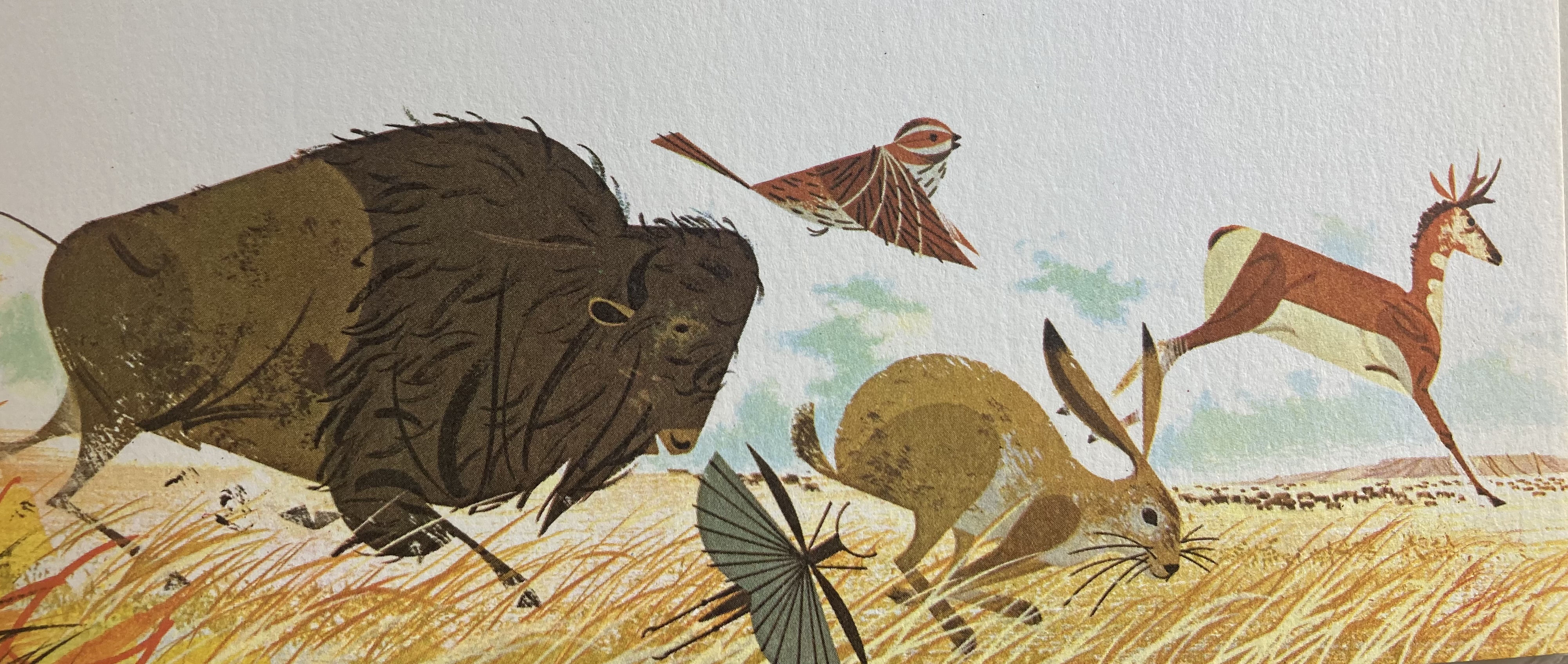
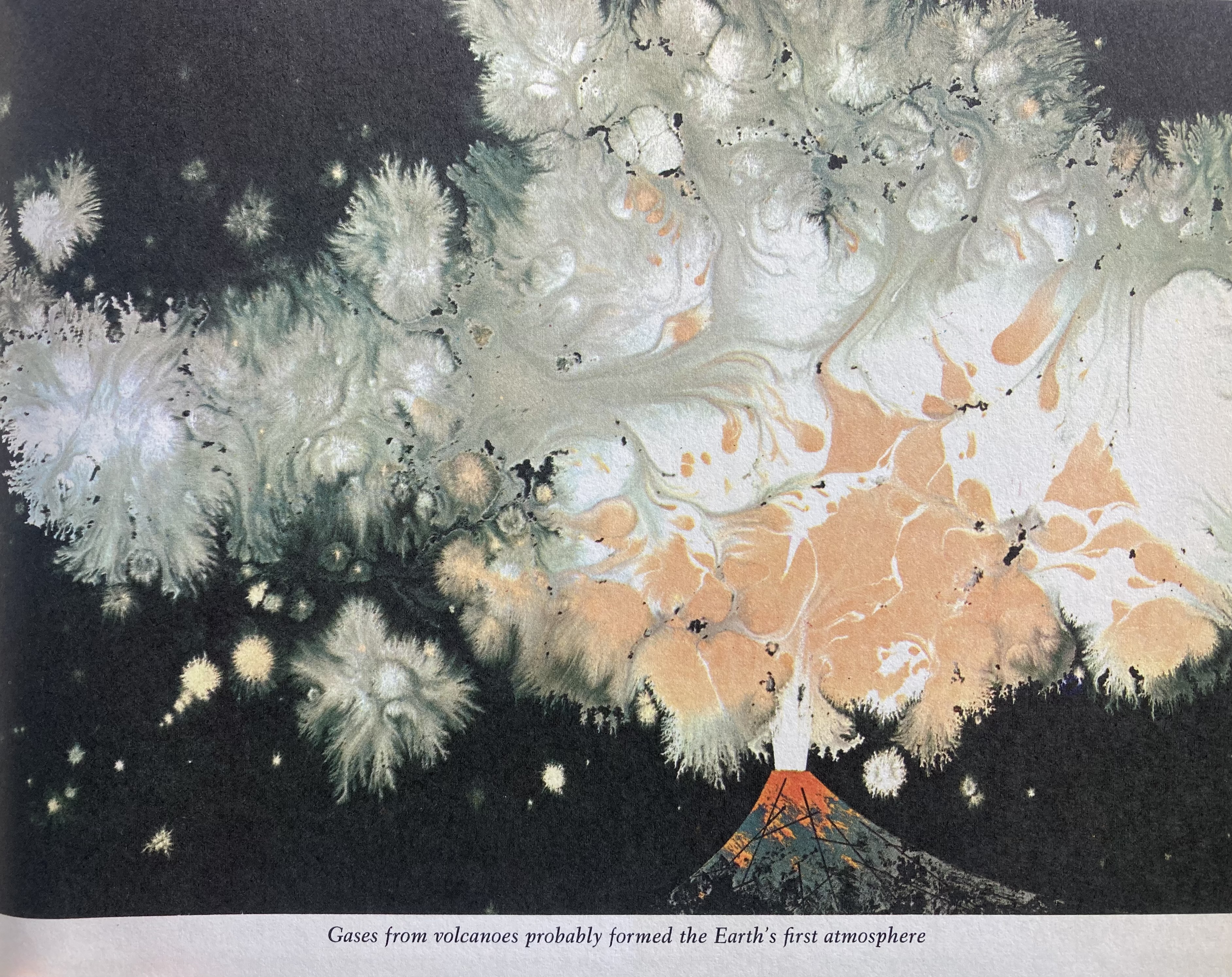
My mother got me this lovely book for the illustrations of Charley Harper, who it turns out was a native of the place I now call home, Upshur County, West Virginia. She tells me he was also a chief illustrator for Ranger Rick magazine. I remember the magazine well, but I’m not sure Harper’s illustrations ring a bell there. They are certainly lovely.

This is an entry-level science book for kids. The foreword, by Harvard biology professor George Wald, claims it isn’t ‘just’ a child’s book, which is true in that I also enjoyed it; but the text has a clear audience in mind. Concepts are plainly presented, although the authors (a married couple) don’t shy away from rather complex ones, such as the work of various scientists to classify living things or run experiments to figure out the principles of dominant versus recessive genes. Content ranges throughout the science of life: small and large living things; microscopes; air, food, fluids, building blocks of cells and protoplasm; growth, sex, and mating; genes; the theory of evolution, the origins of life and development from sea to land and from single-celled to more complex beings; the possibility of life on other planets. It takes us all the way to “the problem of how the earth began”!

I was supposed to be here for the illustrations! but found the text distracting because it was interesting and (I think) surprisingly well-written. Also, despite publication in the 1960s, it didn’t feel terribly dated to me. It does persist in referring to ‘man’ or ‘mankind’ and the ‘he’ pronoun; that’s an out-of-date set of usages. It also leaves us with this very hopeful idea… “Before explorers set off for other worlds, biologists must solve these problems of life in space. And they will be solved, thanks to growing knowledge about life on one remarkable planet, the earth.” Strikes me as awfully optimistic.

I noticed a few spellings that are out of favor now, or Britishisms: ameba for amoeba and oesophagus for esophagus. Also, admittedly, I am not at the cutting edge of science and may have missed something, but I have the general (layperson’s) perspective that not much has changed in our understanding of science at this elementary level. I’m impressed on the whole.

But what we’re really here for: those pictures. I really did appreciate Charley Harper’s illustrations, and from this relaxed-pace read* and the other Harper work I’ve looked at with Mom recently, I’ve definitely come to recognize his distinctive, often geometric style. I’ve pulled out a few of my favorite images here for your enjoyment. (Click to enlarge.)

I am amused at this creeper version of Darwin

*I took my time with this one, not least because it is an older book, rather precious, I think expensive? and visually lovely. I didn’t take it with me on any of my recent travels and was careful around food. Especially since I’ve been traveling a fair amount lately, it took me a long while to get through this book, but that felt good.

Final verdict? Definitely recommend for the visual art; still passable for the science. Thanks, Mom.


Rating: 8 cowbird eggs.

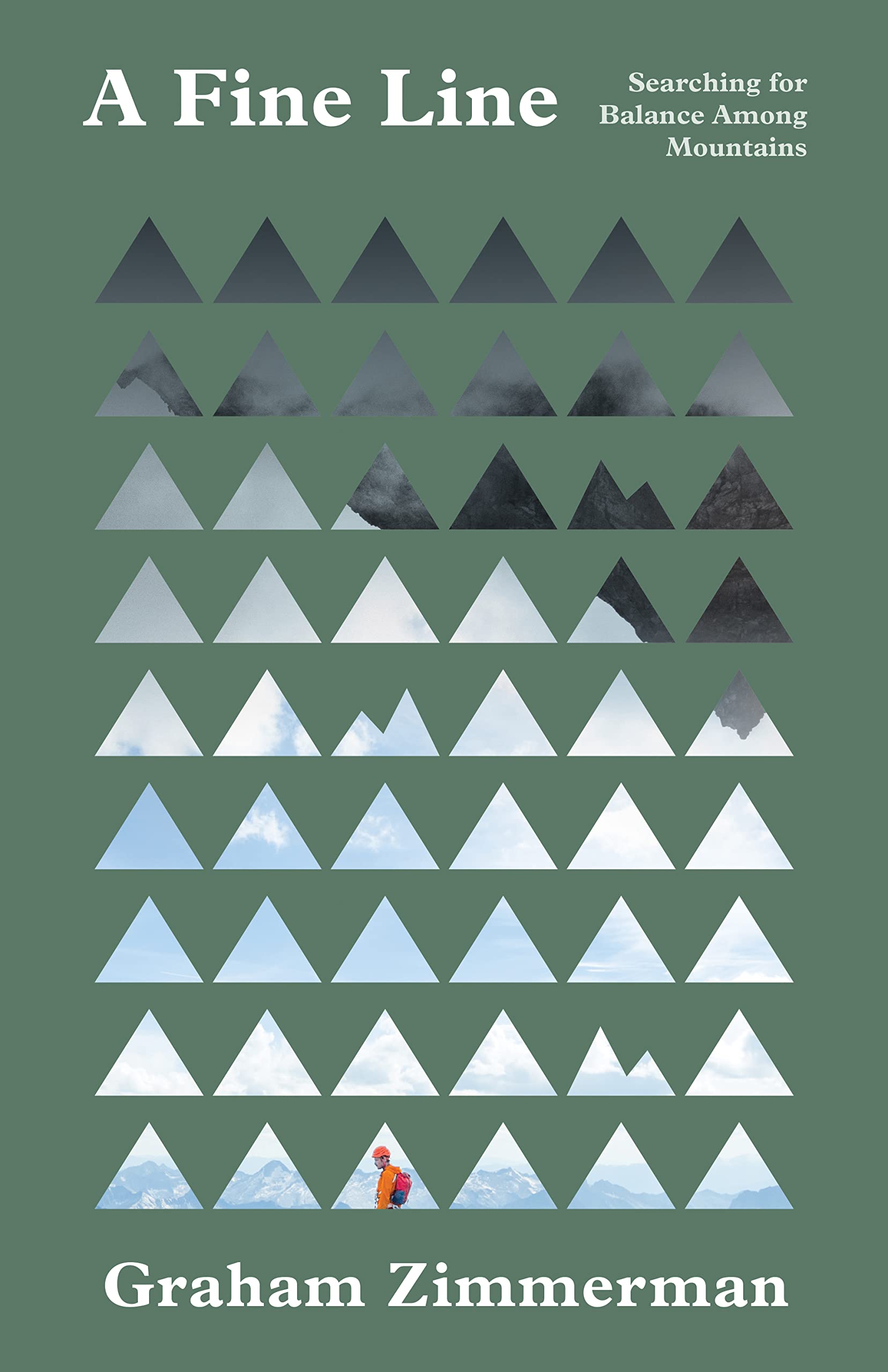
A Fine Line: Searching for Balance Among Mountains by Graham Zimmerman

Alpine climber Graham Zimmerman’s memoir, dense with lessons learned and offered, recounts how he sought balance between his sport and the other elements of life.

Graham Zimmerman felt strongly about climbing from his earliest experiences growing up in the Pacific Northwest, and by age 25 was an avid and accomplished international alpinist with his dreams focused on nothing else. But injury, loss, climate change, and a yearning for connection have forced him to consider how to combine his love for alpine ascents with social and environmental pursuits. A Fine Line: Searching for Balance Among Mountains is his thoughtful story of climbing communities in broader context, and his philosophies for a life well lived.

Not yet 40 at its writing, Zimmerman acknowledges “this is not a complete work,” calling his book “a signpost along the way.” It is still dense with lessons learned and offered, however. At just over 200 pages, A Fine Line reads quickly, many of its action sequences adrenaline-filled as Zimmerman recounts climbs with varying levels of success. It is also a neatly organized memoir, with the tensions between climbing and everything else appearing early. Following a major award, he experiences a significant fall, injury, and lengthy recovery, emphasizing the dangerous nature of his passion and his financial insecurity. The women he attempts to date react poorly to months-long absences on risky expeditions. Frequently climbing at high altitudes amid shrinking glaciers also alerts Zimmerman (trained in geology and glaciology) to the impacts of human-caused climate change. And the young alpinist wrestles with loss, as numerous fellow climbers–his friends–die in the mountains. A mentor cites what he calls the “100-year plan”: to make decisions that will set one up to live to be 100. “I was 26 and only occasionally thought about turning 30, let alone ticking over into triple digits,” Zimmerman reflects. “Do I have a death wish…? No, just a case of severe myopia.” This plan, and meeting the fellow athlete whom he would marry, reset the narrator’s views on risk. Over time he comes to focus on being not just a better climber, but a smarter, safer one: “It hadn’t been more time in the mountains that had set me up for success; rather, it was a stable relationship and being surrounded by positive influences.”

As its subtitle forecasts, A Fine Line is about finding balance between an extreme sport in remote natural settings and “actual life in the lower regions.” As a crafted work of memoir, the book mirrors that achievement with its own balance between gorgeously written adrenaline rushes and philosophic reflections about intentional living, healthy relationships, athletic ambition, and service to human communities and the natural world. Obviously for fans of extreme outdoor sports, Zimmerman’s debut is also recommended for readers seeking wisdom and balance in any pursuit.


This review originally ran in the August 4, 2023 issue of Shelf Awareness for the Book Trade. To subscribe, click here.


Rating: 7 pitches.

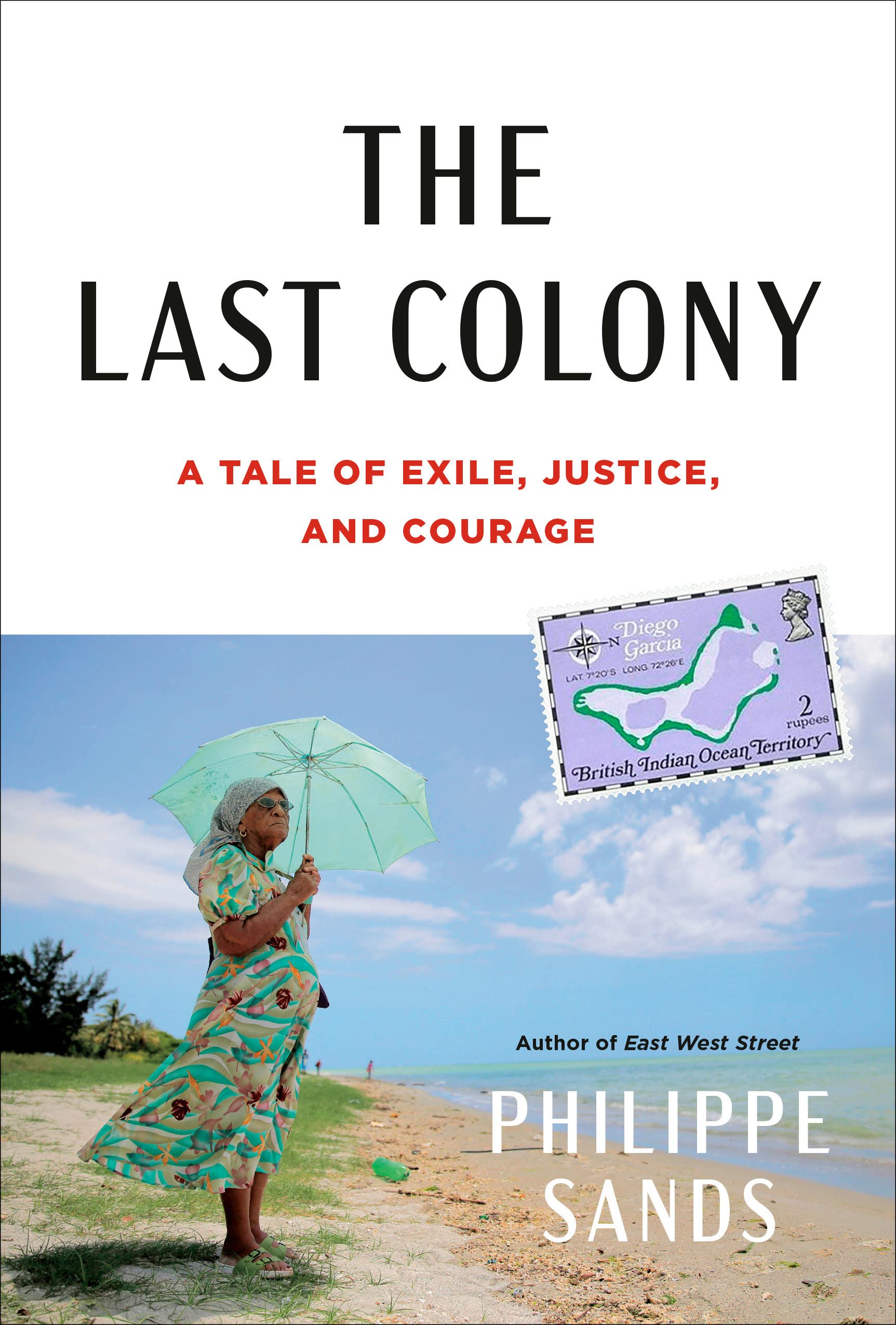
The Last Colony: A Tale of Exile, Justice, and Courage by Philippe Sands

The 2018 freeing of an Indian Ocean archipelago from British colonial rule is both a complex case of international law and a stirring tale of injustice and homecoming.

In The Last Colony: A Tale of Exile, Justice, and Courage, Philippe Sands combines a moving story of human tragedy and injustice with the complexities of international law to great effect.

The Chagos Archipelago is a little-known collection of islands in the Indian Ocean near Mauritius, colonized over centuries by the Portuguese, Dutch, and French before becoming a British colony as part of Mauritius. In 1973, the British forcibly removed its longtime residents, ostensibly to make way for a United States military base on a single island. Residents for generations, in many cases descended from enslaved coconut oil workers, were deported en masse with no notice, forced to leave behind their homes, memories, pets, and any possessions that didn’t fit in a single small trunk. Among them was Liseby Elysé, recently married, 20 years old, and four months pregnant. Decades later, in 2018, Madame Elysé would be present for the decision of the International Court of Justice in The Hague that would allow her to return to her home island, for which she’d yearned all those years. Her testimony would be an important part of that case.

Sands (East West Street; The Ratline) was part of the legal team representing Mauritius in its bid to free the Chagos from British control. With decades of international law experience and an intimate knowledge of many of the judges and lawyers involved, Sands brings authoritative expertise to this subject matter; as an actor in the case at hand, he acknowledges his personal perspective, including an admiration of Madame Elysé and other Chagossian activists. Madame Elysé cannot read or write, but in Sands’s recounting she is a natural storyteller, has an excellent memory, and speaks eloquently and unwaveringly of her strong feelings for her home. This sense of place and feeling of loss for her homeland, even nearly 50 years after leaving, strikes a common chord of human connection to the place from whence one came.

With a lawyer’s careful research and methodical laying out of the facts, Sands rewinds to 1945 and Ralph Bunche’s work on decolonization at the founding of the United Nations; briefly reviews Chagossian history over centuries; and then zooms into the finer points of international law on separation of colonies after World War II. The Last Colony is both a neat work of detailed legal points and history, and a deeply felt narrative about the injustice of deportation and the dwindling number of Chagossians with strong ties to their homeland. Madame Elysé is an impressive, courageous figure and emblem, putting a human face on colonialism’s continuing wrongs, both for the International Court and this book. There is much to appreciate about this little-known story in Sands’s sensitive telling.


This review originally ran in the August 1, 2023 issue of Shelf Awareness for the Book Trade. To subscribe, click here.


Rating: 7 dogs.

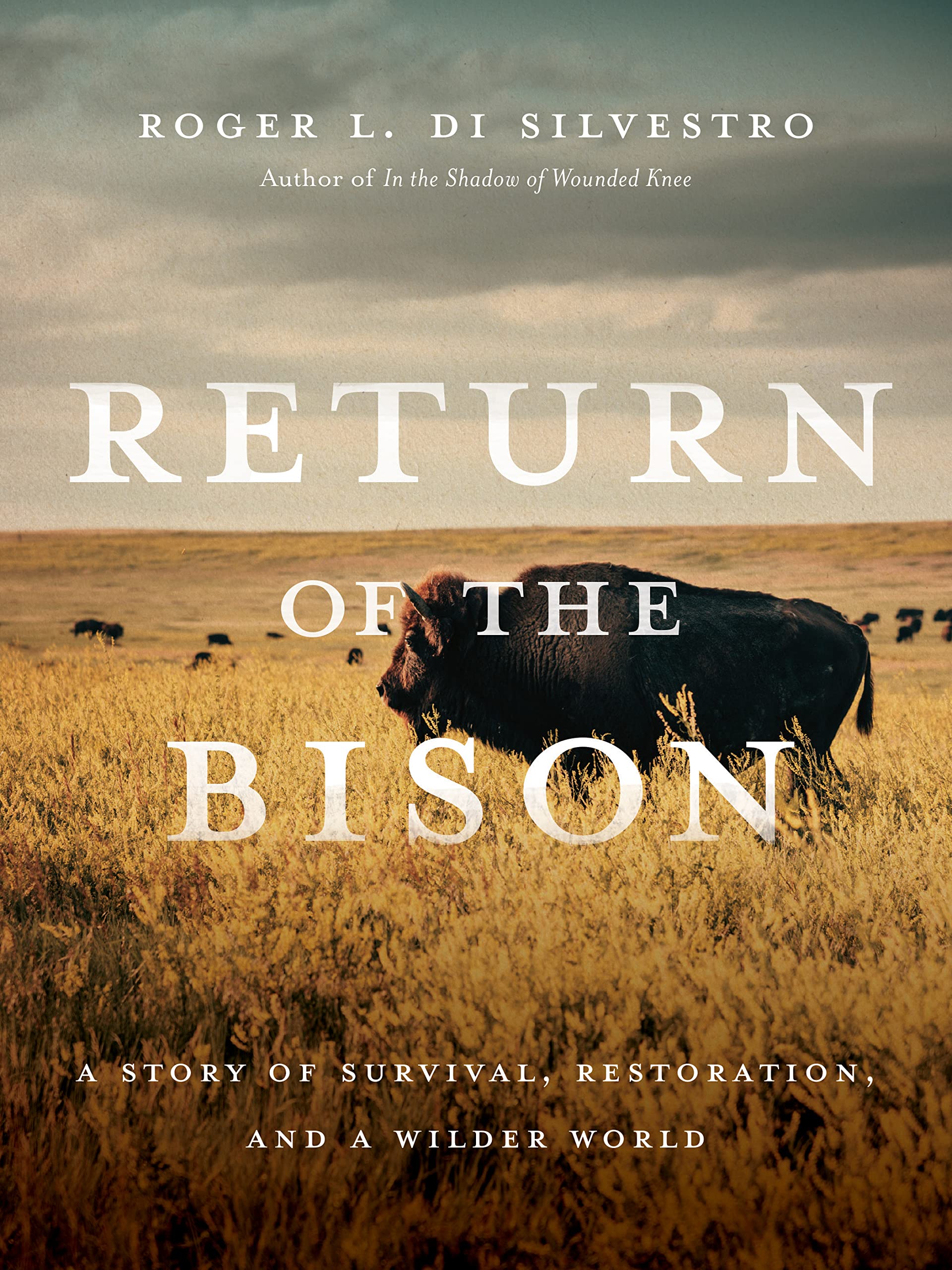
Return of the Bison: A Story of Survival, Restoration, and a Wilder World by Roger Di Silvestro

With fervor and meticulous research–and with implications for the future of megafauna around the world–Roger L. Di Silvestro recounts the complex and difficult ongoing struggle for bison recovery.

With Return of the Bison: A Story of Survival, Restoration, and a Wilder World, naturalist Roger L. Di Silvestro (Theodore Roosevelt in the Badlands) chronicles the history of an iconic species. This exhaustively researched text briefly describes the bison’s early massive proliferation across the North American continent, humans’ heavy pursuit of them, and their near extinction as a result. But it begins in earnest with the earliest conservation efforts, in the 1880s, through the present. Di Silvestro outlines the stories of the American wood bison (western Canada and Alaska) and the European bison, or wisent, but his focus rests chiefly on the American plains bison, which until the late 1800s covered much of North America in the kinds of extraordinary numbers also associated with the now-extinct passenger pigeon. While the bison population has recovered from just a few hundred into the low hundreds of thousands (most of those in commercial herds), its fate is far from secure; in fact, according to some biologists, the bison is already ecologically extinct (“its numbers are so low, so scattered, that it no longer fulfills any ecological role”). The lessons of this story apply to the conservation of other megafauna worldwide, including giraffes, elephants, rhinos, and wildebeest.

Di Silvestro writes with passion about the loss to biodiversity and ecosystems represented by the near-death of a keystone species, as well as the damage to Native American cultures, which have historically been closely tied to the bison’s massive herds. He also considers wild human characters, including Theodore Roosevelt, John Lacey, George Bird Grinnell, William T. Hornaday, and Charles Goodnight. The bison’s tale is poignant, infuriating, inspiring, and hopeful–and perhaps, above all, complicated, involving intricacies of both human and natural histories. At just over 200 pages, Return of the Bison feels longer, dense as it is with detail, such as the bison’s fluctuating population numbers on various tracts of land, the perils of genetic diversity in small herds, human intolerance, cultural clashes, and evolving concepts of and trends in wildlife conservation. This is not only a narrative of the bison; Di Silvestro is concerned with the story of “the first large mammal subjected to recovery efforts” and what lessons this unprecedented battle has for other similar attempts.

Return of the Bison is a thorough, impassioned, expert account of a specific conservation effort over the past 150 years and the questions that will continue to face those who care about wildlife and human impact on the natural world. “The saga of the bison is still an unfurling epic”–and one to watch.


This review originally ran in the June 30, 2023 issue of Shelf Awareness for the Book Trade. To subscribe, click here.


Rating: 6 humps.

Burnt: A Memoir of Fighting Fire by Clare Frank

This exceptional memoir shows wide emotional range in spanning the complexities of firefighting and fire prevention in California and the American West, gender issues, family, work, love, and loss.

Clare Frank’s Burnt: A Memoir of Fighting Fire is a heart-racing, heartfelt story that will make readers laugh, cry, and consider what matters most in life. The author is an indomitable character, from self-supporting teen through a decades-long career in California firefighting (beginning in 1982, when women were few and generally viewed askance), with impressive achievements in her career and personal life. Frank’s memoir is packed not only with adrenaline but with sensitivity, thoughtfulness, and creativity. Beware the impulse to race through these 300-plus pages in a single sitting.

After talking her unorthodox parents into emancipating her at 16, Frank becomes a firefighter at 17 (faced with an age requirement of 18, she simply leaves her birthdate blank on the employment form). Despite being “the youngest, shortest, and lightest person in an academy for the brawniest of professions,” she is indefatigable: stubborn, hardworking, short-fused, and tenacious, earning nicknames like Flipper, Tiger, and Poindexter–as well as degrees in fire administration, law, and creative writing–along the way. Frank rises through the firefighting ranks in her 33-year career (with a five-year doctor-mandated medical break), finishing with the lofty position of State Chief of Fire Protection, six ranks above captain, the highest she once thought she would be willing to attain. She works on structure fires and wildfires, in small firehouses and large ones, in the field and in positions of leadership, on labor and legal issues, prevention, forestry, and more, across the behemoth California Department of Forestry and Fire Protection, aka Cal Fire (the largest fire department in the state).

While she does meditate on firefighting’s gender issues, her response to the question for much of her career is encapsulated in an anecdote: “While I pulled hose through tangled manzanita, the reporter jammed a microphone in my face and yelled, ‘What’s it feel like to be a female on the line?’ I yelled back, ‘The same as it feels for the guys, except I have chee-chees.’ ” She hoped that if she ignored what made her different, everyone else would as well–a strategy that worked frequently but not always.

Frank is a renegade overachiever in all areas: athletic, career, and (after a late return to the classroom) academic. Her writing is not merely serviceable, but thoughtfully constructed; her memoir’s sections are labeled for stages of fire development: ignition, sustained heat, free burn, growth, full development, and decay. Fire is present in every aspect of Frank’s life and work, including writing, but this always feels natural rather than effortful. By the end of this memorable book, readers will reconsider fire policy as well as family, risk, and hard work. With thrilling momentum and a heat of its own, Burnt is a sensation and an inspiration.


This review originally ran in the April 27, 2023 issue of Shelf Awareness for the Book Trade. To subscribe, click here.


Rating: 9 bird’s nests.

Hughes: The Private Diaries, Memos and Letters by Richard Hack

This was a most weird experience. I brought this book home when it was weeded from a library where I used to work, in probably 2010 or 2011. It has therefore made several cross-country moves with me. Why was I so invested in a banged-up copy of a Howard Hughes biography? I guess I was just that interested in learning more about this mysterious figure; but it does feel like an odd choice. Its publication date is now more than 20 years past, and it reads like it could be older still. Hughes is a fairly off-putting guy, to put it very mildly, and our biographer doesn’t benefit from soft-pedaling his criticisms. It frankly gave me the creeps throughout. But Hughes is such a profoundly bizarre man, and this is such a shocking story, that I couldn’t put it down, nor really stop talking or thinking about it. So what does that mean for my review? As a book, it’s got some problems. But I couldn’t walk away. It might earn back some points for that.

Richard Hack is noted in his bio to be an investigative writer largely covering Hollywood and the media. I found his telling to be salacious, sensational, decidedly creepy in its interest in Hughes’s relationships with women and (in particular) teenaged girls. The subject of this biography had deeply problematic relationships with women. That doesn’t mean the author had to join him there. Hack consistently characterizes young women as bimbos or manipulators, uses their first names (in contrast to the last names of their male counterparts), and notes that when Hughes was looking for a wife, one of his interests was “still a minor so of no use now.” That’s not Hughes’s voice, but our author’s. Another teenager is characterized as “the untouched plain; the virgin forest; the next unscaled mountain to conquer for the explorer Hughes.” Again, Hack’s own assessment. I apologize that you just read that and assume you feel as sick as I did. (Also, an aside: Hack insists more than once that Hughes was not impotent. It feels like the lady doth protest too much [and might possibly be projecting].)

A friend of mine encountered a podcast, just when I was reading this biography, which credited Hughes as being an ‘engineering genius.’ I can’t confirm or deny that impression, because this biography was far more interested in madness, sex, and bad behavior than it was in engineering. The book ends with a Hughes quotation: “I’m not nearly as interested in people as I should be, I guess. What I am tremendously interested in… is science.” This line, particularly as final mic-drop moment, did not fit at all with the story I’d been absorbed in for nearly 400 pages. Hack hadn’t much set up our subject as being a man of science. (I am exercising all my restraint to not make a “hack” joke here.)

Each chapter is opened by a Hughes quotation, a number of which are demeaning of women or blatantly and horrifically racist. None of these are handled within the text of the chapter – it’s just a hate bomb, followed by the continued story of Hughes’s life. It feels irresponsible, if not ugly, to drop these nuggets and then walk away without comment.

In short, the writing of this biography had me alternately creeped out and angry. Yes, the book’s 2001 copyright date was a long time ago by some measures. But I knew a lot of people even in 2001 who knew better than some of Hack’s gaffes.

I have some appreciation for the vivid telling of Hughes’s story in this work of creative nonfiction: Hack frequently gives us the play-by-play, including dialog and interior thoughts, in scene. This is fun to read, novelistic, but it raises some questions. The book ends with massively copious source notes, and it’s possible that Hack’s claims about dialogs, thoughts, and small-scale actions are well supported by evidence; but the absence of footnotes or endnotes leaves me wondering where speculation meets documented conclusion. I regret this.

I struggled very much with the telling of this story. But the story itself? Whew. Howard Hughes was many things, as claimed here and elsewhere. He was one of the richest men in the world, arguably the first American billionaire, and in a combination of personal contributions and those of his companies, massively changed aviation and motion-picture-making. He remains an important figure in the history and economy of my hometown of Houston (I have ridden my bike past his gravesite, and fun fact, my former father-in-law worked for Hughes Tool for over 50 years); I didn’t realize til this reading how many pies he had a hand in. He was not self-made (though he did massively increase his personal wealth) but born wealthy, spoiled, and privileged, and was raised in eccentric fashion, probably contributing to his later eccentricity and (I’m going to say it) insanity. It is not for me to diagnose him, but the behaviors described in this biography read as completely unhinged. He was reclusive, paranoid, a strange combination of germaphobe and filthy, a drug abuser and decidedly an abuser of people. I knew he was more or less nuts in popular opinion, but what shocked me most in these pages was not how nutty he was – I have personally known some cases – but how much he got away with. His wealth and fame surrounded him with people who did what he asked even when those asks were unreasonable, abusive, and counter to his own basic physical needs. I was surprised at how far down the rabbit hole he was allowed to travel. According to this telling, there was just one moment when Hughes’s handlers considered having him committed. The ability to keep earning money off his follies seems to have quickly defeated the thought.

I had an obviously conflicted time reading this book, but I couldn’t have put it down, either. For this I’m giving it a very conflicted rating. I’m a little tempted to go find another, better biography of Hughes for comparison and contrast, but I think I’ve spent enough time in the company of a pretty toxic character.

Strange times.


Rating: 6-and-a-half Hershey bars with almonds.

The Wanderer: An Alaska Wolf’s Final Journey by Tom Walker

This unforgettable portrait and travelogue of an individual Alaska gray wolf gorgeously and thoughtfully illuminates issues for the species and for all Arctic wildlife.

Tom Walker (Wild Shots; Alaska Wildlife; The Seventymile Kid), an accomplished photographer, author and longtime Alaskan, turns his naturalist expertise to a single individual animal emblematic of a larger story in The Wanderer: An Alaska Wolf’s Final Journey.

“On the northern frontier of Canada and Alaska sprawls a wilderness largely devoid of human imprint.” Walker outlines his subjects broadly: the land, its natural and human histories, flora and fauna and variations in land use over centuries. He transports his readers to early November of 2010, to the slopes above Copper Creek, where two gray wolves roam: an older female, already collared as Wolf 227, and her younger male companion. Biologists spot them from a helicopter and descend to tag him as Wolf 258, although Walker will call him the Wanderer (with some protest from scientists, who prefer the impersonal numbering system over names, even the archetypal). Over the following 11 months, GPS tracking shows the Wanderer traveling nearly 3,000 miles, earning his nickname in a lengthy quest for prey, territory, and a mate.

Walker narrates this journey in detail, with lyricism and a clear love for the land and life forms he describes, using his informed imagination to provide specifics where the GPS collar cannot. “The Coleen tumbles through treeless highlands that in summer are resplendent with wildflowers. Between storms, the crystalline waters rush lyrically over the cobblestones…. In summer, lupine and fireweed bloom in willow thickets alive with breeding songbirds and ptarmigan.” In Walker’s telling, with the benefit of expert biologists’ opinions, the Wanderer makes repeated inexplicable decisions: to turn away from abundant prey and to move into areas of greater risk from humans or other wolves–although he will generally be lucky in avoiding threats. Through his choices and movements, readers consider broader questions about habitat, climate change, predator/prey relationships, and the rights of human vs. animal hunters. (Walker relates the history of predator control policies in Alaska and throughout the U.S.)

Stunning photographs and essential maps help readers follow the Wanderer’s ramblings. Intermingled with his meticulous account of the wolf’s wanderings, Walker handles related subjects: geology and natural history; Alaska politics; remarkable stories of animal and human life in the Arctic; pack dynamics; and the changing habits and habitats of species the wolf interacts with, including caribou, grizzly bears, Dall sheep, Arctic ground squirrels, moose, and muskox. The Wanderer is a deeply enjoyable example of creative nonfiction and nature writing: literary, lovely, meditative in its pacing, informative and clear.


This review originally ran in the April 6, 2023 issue of Shelf Awareness for the Book Trade. To subscribe, click here.


Rating: 7 artic ground squirrels.

The Same River Twice by Chris Offutt

First book I’ve read in the new year and it is a big winner. I read Offutt’s No Heroes some years ago, and I have a few clear memories of it – and I gave it an 8 – but I have to say it’s faded some since then. This one, I think, will be different. From the first pages he had me nodding along in recognition and agreement, when I wasn’t laughing til my sides split. This is a remarkable book in several ways.

For one thing, as an example of craft and structure in memoir, I appreciated the format: alternate chapters switch between two timelines, one (the narrator’s present) in which his wife is pregnant (with the courtship & marriage compressed at the start), and an earlier one in which the younger man leaves his home in the eastern Kentucky hills and travels for more than a decade around the country as an itinerant, not to say bum, short-term laborer and modestly aspiring artist. In the end, this is a memoir of becoming a father. The younger Offutt’s travels, bumbles, attempts at self-destruction eventually make him the man (for better or worse) who meets Rita, marries, and enters on purpose but somewhat reluctantly into the pregnancy that defines the narrative present. When the two timelines meet at the book’s end there is, again, heavy compression, rushing us through Rita-to-pregnancy; I can sense some readers protesting at that rush, but I think it suits the scope of this book. True memoirists have at least several memoirs in them; there’s a piece of Bernard Cooper wisdom on this topic. The Same River Twice is about Offutt becoming a father within himself. It’s not so much about Rita, who in these pages is a lovely and likeable person but mostly remains off-page.

In his roamings of the country, Offutt recalls Blue Highways (maybe even On the Road) but with perhaps more angst – or at least angst that felt more familiar to my own – and definitely more laughs. I could hardly breathe at Offutt’s first couple of sexual encounters, and his adventures in the Florida swamp had me pretty riveted. This is some of the best humor writing I’ve seen in some time.

And on the other hand, in the later timeline, a more mature and serious-voiced narrator (who nonetheless self-deprecates) walks alone in the floodplain woods near his and Rita’s rental home on a dirt road on the Iowa River. This man is contemplative and highly observant of the natural world. He’s struggling with pending fatherhood; he always wanted children but felt less ready than Rita. She worried about her age, while he worried that he still lacked stable employment (he’s trying to sell his writing) and general responsible adulthood. When Rita becomes pregnant, he feels pride, relief, and happiness that she is happy; he feels terrified of the responsibility, and selfishly (he’d say) sorry to lose his freedom. He’s afraid he’ll damage his child; his father has always said he comes from a long line of bad fathers. Fear, in fact, is paramount. “I fear the loss of independence although I didn’t do so well alone.” He’s on a journey to learn about pregnancy and babies, partly through library books and an ill-fated hospital-based Lamaze class, but also via walks in the woods, where he watches the natural world cycle through life and death. Seamlessly integrated facts about biology and natural and human history add to his musings. If the earlier hapless-bum episodes are woeful and hilarious, the older man is quietly thoughtful and wise (even if he denies it). I thought there were some fascinating observations about what it means to be a parent. (I am not a parent. I did call up a few friends to discuss their experiences.)

Let me also note, I found Offutt because of my connection to writing in Appalachia. Relatively little of this book is set there: we see young Offutt leave as a teen, with two brief returns (one for recuperation from injury, one under great duress for his brother’s wedding); otherwise he is all over the country or settling in Iowa. But eastern Kentucky looms throughout; it’s what he’s escaping and it continues to define him, most obviously in the accent that other people feel marks him as a type.

Where I’m from, the foothills of southern Appalachia are humped like a kicked rug, full of steep furrows. Families live scattered among the ridges and hollows in tiny communities containing no formal elements save a post office… Our hills are the most isolated area of America, the subject of countless doctoral theses. It’s an odd sensation to read about yourself as counterpart to the aborigine or Eskimo*. If VISTA wasn’t bothering us, some clown was running around the hills with a tape recorder. Strangers told us we spoke Elizabethan English, that we were contemporary ancestors to everyone else. They told us the correct way to pronounce “Appalachia,” as if we didn’t know where we’d been living for the past three hundred years.

This is a narrator who then travels to, of all places, Manhattan, where he has to relearn how to walk to accommodate the traffic of other people doing the same thing near him. After some hours on a bench watching New Yorkers walk near each other, he concludes his stride is too long and regular for the environment; the locals use quick, short steps, like dancing. “As long as I concentrated, everything was jake, but the minute my attention wavered, my gait lengthened and someone’s legs entangled with mine.”

Offutt makes repeated references to Kentucky’s Daniel Boone and explorer-to-America Christopher Columbus, as he styles himself also an explorer and a frontiersman, but without the aggrandizement that implies. “Two hundred years back, someone asked Boone if he had ever been lost. He answered no, but that he’d once been bewildered for three days. I knew exactly how he felt.” On returning home for the brother’s wedding: “After Columbus’s third trip across the sea, he was brought home in manacles and chains. I knew how he felt.” The aspiring-writer Offutt is a funny thread: he journals compulsively, copiously, but despite defining himself as a poet for a long stretch, writes no poetry. (He also decides to be a painter and a screenwriter at different points without actually producing any art.) I loved this bit:

My adherence to the jounal slid into a strange realm where I viewed my immediate interactions as a form of living diary. If riding a bicycle through a snowstorm sounded like good material for the journal, I borrowed a bike in a blizzard. The actual ride didn’t matter. What I did was try to observe myself as carefully as possible, while simultaneously imagining myself writing everything down later.

If that doesn’t sound like a social media obsession before its time, I don’t know what does.

Offutt is a gorgeous writer of prose. The subject matter – family dynamics and stress, the natural world, travel and restlessness, the meaning of life, place and particularly Appalachia, the angst of trying to be a writer – certainly speaks to me. An entire chapter is devoted to the importance of names (a special interest of mine). But the writing is notable for its own sake. Check out this metaphor-to-simile turn: “The sky was a gray flannel blanket like a watercolor background with too much paint.” And metaphor plus anthimeria: “The riverbank is a crouching porcupine, bare tree limbs quilling the sky.” This is probably my favorite travels-in-America chronicle yet, and I’ve read a few. I’ll be thinking about this one.


Rating: 9 tracks.

*this book was published in 1993.