The Cowshed: Memories of the Chinese Cultural Revolution by Ji Xianlin, trans. by Chenxing Jiang

This memoir by a survivor of the Chinese Cultural Revolution poignantly sheds light on an under-examined period in history.

cowshed

Ji Xianlin was one of many Chinese intellectuals held in makeshift prisons, called cowsheds, on university campuses during China’s Cultural Revolution, which began in 1966 and lasted for 10 years. He was mocked, humiliated, beaten and starved. He wrote about these experiences only reluctantly, observing late in life that none of his fellows had done so and that younger Chinese need to know their history in order to learn from it. In 1998, he released his memoir, now translated into English for the first time as The Cowshed: Memories of the Chinese Cultural Revolution.

Ji narrates his years of torment compellingly, in remarkably fair-minded fashion. He claims that his work is not literary, but it is adorned with lovely metaphors: he compares his torture to Indian and Chinese concepts of hell, “a veritable pagoda of horrors,” and makes reference to the steep path to Mount Tai, one of five Taoist sacred mountains.

Ji’s story is painfully moving and beautifully related, elevated by his preface and journalist Zha Jianying’s introduction, and his appendix, an abbreviated memoir of Ji’s whole life that puts the bulk of The Cowshed into perspective. He ponders the question of human nature as basically good or bad, and illuminates Chinese culture with sensitivity and humor; for example, “We Chinese intellectuals are descended from a tradition of scholars who would rather be killed than humiliated.” Until his death in Beijing in 2009, the wise older man who wrote this book remained a patriot who wanted the best for China and who appreciated that he saw the Cultural Revolution so intimately, if only so that he could bear witness.


This review originally ran in the February 5, 2016 issue of Shelf Awareness for Readers. To subscribe, click here, and you’ll receive two issues per week of book reviews and other bookish news.


Rating: 7 cornmeal cakes.

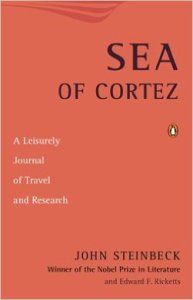
book beginnings on Friday: Sea of Cortez: A Leisurely Journal of Travel and Research by John Steinbeck and Edward F. Ricketts

Thanks to Rose City Reader for hosting this meme. To participate, share the first line or two of the book you are currently reading and, if you feel so moved, let us know what your first impressions were based on that first line.

sea of cortez

I am feeling good to have finally found time to open a big fat Steinbeck book I have had on my shelves for years (and yes, moved across the country with me). Coauthor Ed Ricketts was, among other things, the model for the character Doc in Steinbeck’s Cannery Row. That was my first Steinbeck, and I loved it, and thus that was my introduction to Ricketts. I have heard about their shared work of nonfiction for years, and spent some time myself on the Sea of Cortez, kayaking by day and sleeping on the beaches of Baja by night. So, much to look forward to here.

The very first lines paid off.

The design of a book is the pattern of a reality controlled and shaped by the mind of the writer. This is completely understood about poetry or fiction, but it is too seldom realized about books of fact. And yet the impulse which drives a man to poetry will send another man into the tide pools and force him to try to report what he finds there.

I have been studying creative nonfiction writing for a while now (aside from reading and appreciating it), so this concept really struck me. I knew I could count on Steinbeck. Now when will I find the time for East of Eden?

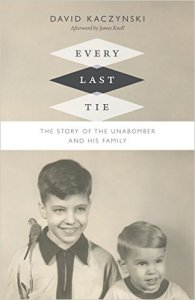
Every Last Tie: The Story of the Unabomber and His Family by David Kaczynski

David Kaczynski’s contemplation of his brother’s life and crimes is sensitive and skillfully composed, with broad appeal.

every last tie

David Kaczynski is a poet, a former English teacher, an impassioned opponent of the death penalty and the younger brother of Ted Kaczynski, better known to the world as the Unabomber. In Every Last Tie, he contemplates “loving memories and painful outcomes,” hoping to illuminate his brother’s and his own experiences.

Some of David’s message involves correcting misconceptions. For example, he says it was not his heroism but his wife Linda’s compassionate and principled actions that identified the Unabomber. He relates the process of recognizing Ted’s voice in the Unabomber’s manifesto: Linda’s concern, David’s denial, the careful considerations they conducted together and the final decision–betrayal of his brother or betrayal of yet more innocent lives. David often contemplates such difficult questions as how to explain Ted Kaczynski’s illness and actions, coming from a family that David portrays as caring, close and committed to education and integrity. He characterizes Ted as a loving older brother increasingly withdrawn from society, a tortured genius and, finally, a mentally ill man David no longer understands. The decision to identify his brother still prickles. “Ted’s cruelty stigmatizes my good name; but my reputation for goodness comes at his expense. Like all contrived opposites, we reinforce one another.”

Every Last Tie is beautifully written, searingly honest, in no way the sensational tell-all it might have been, but a careful exercise–sometimes emotional, sometimes intellectual–in self-examination. David clearly wants to pile praise on his beloved parents, but chooses to consider their complexities, seeking truth over comfort. The result contains a certain amount of psychological analysis (especially in a thorough afterword by James L. Knoll IV, a forensic psychiatrist who has both studied Ted Kaczynski’s case and come to know David well), but the book is also a meditation on notions of family, “the premise that a brother shows you who you are–and who you are not.” David struggles to reconcile the brother he loved and the serial killer he turned in, but does not belabor the point, choosing instead to remember and share what he knows, and acknowledge the mystery. Knoll’s afterword makes a more pointed criticism of the United States’ “nonsystem” of mental health care.

This slim, intriguing book is the story of a family whose two sons lead different lives. David Kaczynski’s voice is quietly thoughtful, and his writing is lovely; he ranges from family anecdote to psychological puzzle to philosophical musing while retaining an even tone. Every Last Tie is both a straightforward story and a complex consideration of an extremely difficult one.


This review originally ran in the January 26, 2016 issue of Shelf Awareness for the Book Trade. To subscribe, click here.


Rating: 8 letters.

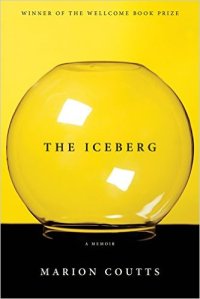
The Iceberg by Marion Coutts

An artist reflects in a variety of ways on the end of her writer husband’s life.

iceberg

Tom Lubbock was an art critic for the Independent and the father of an 18-month-old boy, when he was diagnosed with brain cancer in 2008. In The Iceberg, his wife, Marion Coutts, a versatile and prolific artist and writer, recalls his final years. The resulting memoir is musing, lyrical, ambling and sometimes digressive. The range of emotions she expresses is startling and real.

Coutts begins with “a diagnosis that has the status of an event” as she introduces her husband and their son, Ev. Tom works with words and concepts, meticulously and thoughtfully constructing the writings that are his livelihood and passion. When he has a seizure, a tumor is discovered in the speech and language part of his brain: Tom and Marion must reinvent communication. They practice and make lists: of names of friends, of ideas for outings, of opposing word pairs (big/small, light/heavy). They play a game of yes/no questions when Tom has something to discuss: Is it about your work? Is it about us? Is it food or clothing? These coping mechanisms are an interesting intellectual exercise, but are also central to this family’s experiences. Coutts writes: “I have lost the second consciousness that powers mine. Lost my sounding board, my echo, my check, my stop and finisher. I am down to one.”

The Iceberg neatly captures the events of diagnosis and death, with a stark attention to what comes in between, and little reference to the rest of life. Tom’s medical conditions are described with varying levels of detail, as Coutts often has only a vague understanding of them. Her encounters with the British National Health Service are frequently frustrating. These physical realities are less than central, however. The Iceberg is a forthright emotional account, often celebratory, even exultant: Tom especially often finds joy late in his life. Of course, Coutts is also destitute, bereft, undone. Such feelings alternate with a cerebral, even detached perspective. These jarring intersections are at the center of her story. She writes unflinchingly of her short temper with Ev, and occasionally with Tom; she relates both anguish and resolve, resignation and anger, often with a striking sense of remove. “There is going to be destruction: the obliteration of a person, his intellect, his experience and his agency. I am to watch it. This is my part.” Or of sitting at his deathbed: “I love being in position here. It is perfectly correct.”

Coutts’s prose is layered, textured, dense with meaning and interjected with brief e-mails to loved ones about Tom’s status along the way. As a consideration of art, life, death and love, the full impact of The Iceberg is deeply moving and intelligent, a worthy elegy.


This review originally ran in the January 22, 2016 issue of Shelf Awareness for the Book Trade. To subscribe, click here.


Rating: 7 words.

The Family Tree: A Lynching in Georgia, a Legacy of Secrets, and My Search for the Truth by Karen Branan

A journalist’s research uncovers her own family history and connections to a horrifying hate crime.

family tree

In researching her family history in the little town of Hamilton, Ga., investigative journalist Karen Branan was surprised to find connections to a 1912 lynching. A nephew of her great-grandfather, the sheriff, was murdered. Days later, a local mob killed three black men and a black woman. Branan digs deeper, expecting to find her forebears innocent of violence. The evidence is far more complex in The Family Tree: A Lynching in Georgia, a Legacy of Secrets, and My Search for the Truth.

In a town where nearly everyone has been related by blood or marriage for generations, Branan’s family variously turned a blind eye to the murders, or directly participated. She finds herself related not only to the white mob, but to at least one of the black victims as well. Every new piece of information complicates the story and startles her further, until she has to address her most basic understanding of the world. “I began this journey believing myself to be an unflinching investigative reporter and a nonracist,” Branan writes, but must confront a bias in favor of her own family. Admirably, she examines herself and the preconceptions she brings, even to the pursuit of racial justice.

The Family Tree offers an in-depth study of the history of Southern race relations, particularly in Georgia. The narrative of the lynching is told thrillingly, the background more dryly, but it is Branan’s personal perspective and soul-searching that makes this history insightful, relevant and memorable.


This review originally ran in the January 19, 2016 issue of Shelf Awareness for Readers. To subscribe, click here, and you’ll receive two issues per week of book reviews and other bookish news.


Rating: 6 liaisons.

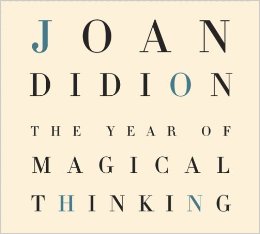
The Year of Magical Thinking by Joan Didion (audio)

I said I was laying off the audiobooks, because my present life & schedule don’t allow for enough listening time. But then I picked up another, and another. Among other things, I’ve hurt my knee again and am back in the gym. But you’re not here to hear about my knee.

year of magical thinkingI’m so glad I tuned into The Year of Magical Thinking. It’s not a feel-good story: it tracks the year in Joan Didion’s life following her husband’s death, and maps her experience with grief. It’s almost New Year’s, and Joan and husband John have been visiting their daughter in the hospital, where she is unconscious with a life-threatening case of pneumonia and septic shock. On December 30, 2003, he collapses at the dinner table, is rushed to the hospital and pronounced dead that night. John is John Gregory Dunne, also an accomplished writer, and their lifestyle has always kept them very close: working from home, together, consulting on every aspect of their lives, from work, food, family and world events to the most insignificant details. Didion is of course, obviously, shocked and unmoored. During the year that follows she experiences different types of grief, shock and bafflement. This book is a little like a diary of that time, which it charts chronologically, ending one year and one day after John’s death.

Along the way, she nimbly weaves in the research she performs on related subjects within psychology, medicine and anthropology: research on grief, on cultural relationships with death and dying, and on medical issues, as she tries to understand when, how and why John died. This last is a surprisingly opaque question, covering the time between his collapse and the doctor’s pronouncement about an hour and a half later. What had been done in the interim? What could have been done? She examines the reports of the ambulance team, the nurses and the ER doctor.

And to compound the complicated and tragic story, daughter Quintana spends most of this year in and out of hospitals, near death on multiple occasions. What we know, although Didion at the time of writing does not, is that Quintana died within the year after the book’s timeline closes. Her later memoir, Blue Nights, covers that personal loss. I haven’t read that one – yet.

The difficulty of this book, then, is obvious: it is filled with sad stuff. Didion is a deft and clever writer, though. We see more than a little joy, although much of it is remembered. We see a strong family, and we see good times. The entwining of personal experience (past and present) and research is beautifully done. Didion uses repeated phrases to draw her reader along the book’s line, to tie everything together. It’s a lovely piece of work, although I did have to turn away when I had a particularly bad day. The subject matter is what it is.

My one criticism is that Didion fails to recognize and acknowledge a certain privilege: that her life is set against the Ritz, the Royal Hawaiian Hotel in Honolulu, the fancy home in Malibu, Chanel, Brooks Brothers, an endless parade of the food, clothing, and scenery of her choice and at her command. This privilege, compounded by her failure to acknowledge it (is it possible she is unaware?), distanced me from her. She is both a fine writer and a complex and sympathetic person; it is my instinct to identify with her, and that is where this memoir shines; but that effect is lessened by her experience of the world to which she is apparently blind. Near the end, she describes a difficulty early in her marriage, when she and John had made a $50,000 down payment on a house in an L.A. suburb but hadn’t yet sold their home in Malibu: where would the money come from? They go to a luxury resort in Hawaii to think it out, then find that the Malibu home has an acceptable offer. She does speak briefly to the irony of the Hawaiian brainstorming session. We could call this a partial exception to my complaint. The episode still comes off a little tone-deaf, though.

This is a fairly small criticism. Because of this privileged position, Didion lost a few degrees of identification with her reader. On the whole, though, she is a sympathetic and fully realized character. Her story is shocking but true; it is beautifully structured and well written, and I will definitely read more Didion.

Barbara Caruso’s narration felt spot-on to me.


Rating: 7 leis.

Lizards on the Mantel, Burros at the Door: A Big Bend Memoir by Etta Koch with June Cooper Price

lizards burrosThanks to Fil for another hit. (Still don’t give me any more books, though, I tell you I’m swamped.) Reading this memoir about a place I love was engaging, amusing and comforting.

Etta Lindeman was born in Ohio in 1904. She was an active youngster but sickly in her young adulthood, when she married Peter Koch. One recommendation to help her breathing troubles was to move to a warm, dry climate. This, combined with Peter’s professional ambitions, took them on a trip cross-country that was to wind up in Arizona, where they would settle and continue to raise their three daughters. Peter was a newspaper photographer who wanted to make nature films and travel the country giving accompanying lectures; the National Parks Service helped by engaging him to promote several parks, including the Great Smoky Mountains National Park and eventually… Big Bend. The Kochs drove their 23-foot trailer (“Porky the Road Hog”) from Ohio to the Smokies, through Louisiana, where Peter filmed the wetlands’ water birds, and into Big Bend through Marathon, Texas. As Etta relates in this journal-like memoir, her family’s adjustment to the West Texas desert near the Mexican border was not without challenges. She was initially leery: “Texas had always been for me a movie set… A place of flimsy barrooms people by six-footers with six-shooters.” But eventually it wins their hearts and they settle permanently. The three Koch daughters have remained in Texas. The eldest, June, is co-author here, having done her own research, pulled together her mother’s papers and a first draft and seen them through to publication.

Etta’s voice is charming. She is not a professional writer, and her prose is perhaps not artful; I think of the term “outsider art” – but surprisingly lovely in moments, too. I liked her evocative descriptions, and these lines:

Nearby is a weeping juniper that is so strange. At first I thought the tree was wilting and perhaps ready to die but was told it is a dejected tree by nature.

Her style is mostly reportorial, but with a brisk, conversational tone. The chapters generally cover episodes or events: the surprise birthday party Pete throws her; a trip to Hot Springs; Pete’s trip down the Santa Elena canyon in a homemade boat. She has a sense of humor, too, a sense of fun (despite describing herself as the scaredy-cat of this active family). My favorite part must have been the final chapter, “Kaufman’s Draw,” which describes an adventure driving across the desert: it reminded me of Abbey’s “Disorder and Early Sorrow,” that story in The Journey Home that I loved so much.

I found the Big Bend I know and love in this book, although earlier, cleaner. When Etta writes,

I didn’t know the sky was so big… so blue… but as we traveled west I discovered that although the earth grew whiter and vegetation sparser, the sky grew more intense, more brilliantly blue.

I recognize this precisely. I have yet to find the scientific explanation for it, but the light out there is different: sharper, brighter.

Lizards on the Mantel, Burros at the Door is also a fine primary source on the work of community building, which is part of what it means to pioneer or homestead: as the Park Service’s settlement (in the Basin of the Chisos Mountains) grows in population, Etta – who had home-schooled her children since arriving in Big Bend – teamed up with other wives and mothers to provide schooling and cultural activities. The community puts on dances, has potluck dinners and cooperates in living and raising kids in such a remote spot.

Simply told but with unmistakable personality, this first-person account of roughing it in far West Texas won my heart. It will get extra points with readers who love the place, like I do, but there is certainly something here for everyone who likes history, memoir, and the romance of simple living.


Rating: 7 murals.

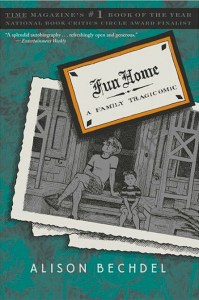
Fun Home: A Family Tragicomic by Alison Bechdel

fun homeFun Home won awards and got more attention than Bechdel’s later Are You My Mother?, which I loved, so this was an obvious choice and yes, I will add my praise to the chorus.

This is a memoir centering around Bechdel’s father Bruce, her own discovery that she is a lesbian and her coming out to her parents, which is immediately followed by the discovery that her father is gay, too, shortly before he kills himself just weeks later. (The evidence is inconclusive, but she makes a good argument for her conviction, that it was suicide.) The title is a reference to the family business, which is a small-town funeral home that they call ‘Fun Home.’ That’s a lot, right? It is also a memoir in graphic form, and I am crazy about Bechdel’s technique, which combines dialog (speech boxes for the characters in her panels) with a voiceover-style narrative in different boxes that sort of caption those same panels. It’s astonishing how much can be communicated in pictorial form.

Despite the often heavy subject matter, Bechdel is often laugh-out-loud funny, while also taking her material seriously. She beautifully evokes the absurdity of many different elements of her story. Bruce is a passionate restorer of historic homes, down to all the details, the bizarrely frothy, lacy, heavy decor. This is both hilarious and pathological. He “treated his furniture like children, and his children like furniture.” Bechdel and her father are most intimate when they share books and reading (note that this is an intimacy with decided remove). Bruce works as an English teacher as well as a funeral director; and two thematic elements of the book are death and books. Bechdel is best able to understand and characterize her parents when viewing them through the lens of literature: her father as Icarus, then Daedalus, then a character from Fitzgerald; her mother one from Henry James. “I employ these allusions to James and Fitzgerald not only as descriptive devices, but because my parents are most real to me in fictional terms.” On the other end of the cultural spectrum, as a child Bechdel confused her family with the Addams family.

The reader has a different experience of the story than she does, because we find out earlier than she does the big reveal – that her father has had relationships with men and boys. But she still has us share in mixed feelings of relief, shock, perplexity.

The story is weird, fascinating, and moving; Bechdel has a gimlet eye for the psychological struggle in each chapter of it; the structure of this book – the disordered chronology and release of facts – is a smart puzzle. But the art is what completes the perfection: I’m still reeling from, and trying to comprehend, how precisely she uses visual images (with those careful text additions) to communicate. I can’t adequately articulate it, but this is a special, a uniquely wonderful way to tell a uniquely interesting story. One to study.


Rating: 9 books, of course.

short pieces: Walker, Tolkein, Stegner and more

Ah, the irony: I said just the other day that I was done with Faulkner, and yet here we are. In a continuation of going through those pages that have been piling up, I’ve read a few essays and short stories – including one by Faulkner.

A Rose for Emily” by William Faulkner: This may be the format for him & me, because I found him perfectly comprehensible and amusing in this short form. It seamlessly evokes a small Southern town with its prejudices and whisperings and feelings of rectitude; it has atmosphere. It also has an engrossing, entertaining, and fully-formed story in it. And I think this is a mark of the master of the short story: that it can feel complete. Those less adept at it leave us feeling like we missed out on something. Not so here. I won’t say any more about the story itself, except that yes, Faulkner can be enjoyable; and if you’ve balked before, as I have firmly balked, you might consider giving this one a try. If you hate it, it’s only six pages long.

An interview with Terry Tempest Williams from YES! magazine: “Survival Becomes a Spiritual Practice.” I still love Terry Tempest Williams. She is wise, even when she can be kind of gauzy and dreamy, as here. I like that this interview addresses two “places” that “we” are in just now: a state of the world, as well as her own geographical placement, moving back and forth between Vermont (where she teaches part of the year at Dartmouth) and her home in the Utah desert.

The Sense of Place” by Wallace Stegner: If I ever get my hands on an audio-cassette player, I have a whole collection of “sense of place” essays by Stegner, read aloud by the man himself, and I cannot wait to hear them. Send me a tape player, somebody.

This essay rounds out that inaccessible collection, as I understand it. Stegner describes us as being defined by place as well as defining place. He presents a possibly controversial idea, that

at least to human perception, a pace is not a place until people have been born in it, have grown up in it, lived in it, known it, died in it – have both experienced and shaped it, as individuals, families, neighborhoods, and communities, over more than one generation.

A few lines earlier:

The deep ecologists warn us not to be anthropocentric, but I know no way to look at the world, settled or wild, except through my own human eyes.

I like this honesty, because I acknowledge and respect the caution not to be anthropocentric; but Stegner makes a true point that we can only know the one perspective, really. (I guess I would counter that being less anthropocentric should simply involve acknowledging that there are other perspectives. I think Stegner gets that, though.) He gives equal airtime to those who have, perhaps, grown up nowhere, too.

If the rest of this essay collection continues on this path – of exploring what we mean to our places and vice versa, how we define one another – I need to hurry up and find that tape recorder.

Leaf by Niggle” by John Ronald Reuel Tolkien (because that is how his name is spelled out at this link. Funny, I never knew what J.R.R. stood for, I don’t guess). What an enchanting story! Niggle is a “little man… who had a long journey to make.” He doesn’t want to take his trip, but he knows he has to. He’d rather finishing this painting first: a painting of trees and countryside. He wants it to be perfect. But there are other pulls on his time, and he ends up being forced to go on his journey without perfecting his work. In fact, he’s so rushed he does not even pack a bag. I won’t tell you the rest…

I wondered throughout if this was a big beautiful allegory for art, for the making of art – Tolkien’s own writing, or any of ours. There are some lovely images and moments:

He had a number of pictures on hand; most of them were too large and ambitious for his skill. He was the sort of painter who can paint leaves better than trees.

And,

There was one picture in particular which bothered him. It had begun with a leaf caught in the wind, and it became a tree; and the tree grew, sending out innumerable branches, and thrusting out the most fantastic roots. Strange birds came and settled on the twigs and had to be attended to. Then all round the Tree, and behind it, through the gaps in the leaves and boughs, a country began to open out; and there were glimpses of a forest marching over the land, and of mountains tipped with snow. Niggle lost interest in his other pictures; or else he took them and tacked them on to the edges of his great picture. Soon the canvas became so large that he had to get a ladder…

Can’t you just see Middle Earth developing, demanding that Tolkien attend to it, in the same way?

“My picture!” exclaimed Niggle.

“I dare say it is,” said the Inspector. “But houses come first. That is the law.”

Ah, and there’s the rub.

This story can be said to comment on religion, the value of art, the question of what we owe our neighbors; it indicates some of Orwell’s 1984; there is a great deal in this short story (nine pages). Strange and fanciful and lovely, like all of Tolkien’s work.

My Father’s Country is the Poor” by Alice Walker, 1977, The New York Times. In a short two and a half pages, Alice Walker paints beautiful, heartbreaking pictures: of her father and her own life, of a visit to Cuba, of the difficulties of race, culture, class, and their inextricability. She tells us “what poverty engenders… what injustice means.” Only Alice Walker, and even in 1977, so much that we should attend to. I don’t want to comment too much on this; better that you go read her words, which are few and flawless.

book beginnings on Friday: Fun Home by Alison Bechdel

fun home

Thanks to Rose City Reader for hosting this meme. To participate, share the first line or two of the book you are currently reading and, if you feel so moved, let us know what your first impressions were based on that first line.

I loved Are You My Mother?, and don’t know why it took me so long to pick up Fun Home, her earlier work and sort of a partner to Mother. She is still hilarious, insightful, and smart.

Because this is a graphic memoir, I’ll have to do this beginning a little differently. Here is an image of the whole first page.

fun home start

That reference to Icarus was when I knew (not that I doubted) that we were going in a good direction. I can’t wait to spend some more time with Bechdel and her wacky family and amazing mind.