guest review: Between the World and Me by Ta-Nehisi Coates, from Pops

between the worldPops sent me this guest review on March 4, 2016.

Ta-Nehisi Coates’ second book, Between the World & Me, forcefully rises to the high standard suggested by Toni Morrison’s full-throated endorsement on the cover. As she says, he fills

the intellectual void that plagued me after James Baldwin died… The language… like Coates’ journey, is visceral, eloquent and beautifully redemptive.

And all this in a mere 152 pages.

Published by chance in the heat of a rising Black Lives Matter! movement, he writes of his own 15-year journey, as the painfully concerned father of a son, himself a fully engaged son of 60’s Black Panther activists, the thankful student of a grandmother with instincts of a genius, and as a “damaged” black man and budding intellectual, forced to survive the trials of Baltimore’s mean streets. By writing so artfully and from the heart, as he relentlessly probes his world, Coates provides an indispensably human extension to essential history & analysis begun by Isabel Wilkerson (The Warmth of Other Suns) and Michelle Alexander (The New Jim Crow.)

Written as a letter to his 15yr old son, his tone is direct but his narrative voice is not simple or simplistic, as he avoids established and inflammatory rhetoric. Instead, he employs the unusual device of creating metaphorical coding for concepts he develops with challenging and sometimes changing meanings. These multiple and interlocking codes begin with the title itself, taken from Richard Wright’s poem of the same name. The World is Coates’ evolving perception of a life entirely outside his own, defined by a concept of Race that is itself parsed and examined in some detail. Coates’ book describes his life’s quest to understand all the implications of that vast space between the World and his own experience.

Wright’s work is quoted at the book’s start with only the first stanza, but a full reading of the poem reveals the raw visceral meaning: for Wright, that space perniciously encompasses the breadth of Jim Crow experience, evoked in verse as a quiet forest, the scene of a most hideous lynching, which rises to threaten the observer’s own Body (which is yet another code Coates uses.) Both title and poetic source are well chosen for Coates’ book.

The World apart from Coates’ own experience is constructed by Dreamers, who are “White – or believe themselves to be white,” as America’s vaunted, inclusive melting pot is exposed to be a muddy “anything but Black” with no cultural identity of its own that is not associated with power.

Race is a convenient contrivance enabled by this insidious fallacy about whiteness, in one of the most demographically and culturally diverse nations in the world. It is a frame that is based in the power relationship of oppression. The Dream is the ideology of that World apart, evoking prosperity, security, possibility – promoted by images that are everywhere around him: TV programming, advertising, schools, churches; the Dream does not appear on the Streets in his Baltimore neighborhood. This entire construct serves to threaten his Body in every moment, as it has for centuries, as the Streets’ death rate rises, infecting his mind and very existence.

The Mecca is the promise he does find – in knowledge, in books, in a vibrant and diverse Black culture, in his father’s radical heritage, in Malcolm X – fully bursting to fruition with Howard University in D.C. (a many-branched family tradition.) His exploration is unbridled, the evolution of his thought continuous and insightful, always delving deeper. A studied understanding of the 1960s overlays his parents’ own experience, becoming almost contemporary for him. (Here, the recent Black Panther documentary is also relevant.) He examines the history of slavery and its neverending web of consequences.

Coates’ concept of community expands steadily as he observes Howard’s international palette of “black.” In one extreme, he is dismayed to find gay & lesbian culture is an accepted part of this Mecca, so far from his Streets. His young family moves to New York City and he is staggered by the spectrum of cultures, from opulent Dreamer Broadway to Harlem, yet some black faces pretend to jump the gap. He takes his son on visits to Civil War battlefields as he seeks to understand. He spins out of his urban northeast orbit with a visit to Paris, and his mental landscape shudders again; yet still there is that space “between the world and me.”

The book begins and ends with the Black Body metaphor, which includes a complex relationship with his father and reoccurs throughout as his existential fear jumps between himself, his son, his friends and his people. When an affluent Howard acquaintance is later murdered by a black cop, the fear is crystallized and colors his perception.

Some years later, his visit with the friend’s mother is compelling and unwinds into a staggering 3-page finish for the book. Above all, with the death of her son in spite of her life’s efforts and “success” at providing him every opportunity, she wishes only that the entire Dream that produced his death fail in some “national doom.” Coates reflects on his culture’s age-old hope that the Dreamer plague would somehow be punished, an idea encouraged from Marcus Garvey to Malcolm X. But his outlook has become too expansive; “I left the Mecca knowing that this is all too pat, knowing that should the Dreamers reap what they had sown, we would reap it right with them.”

His maturing eye spans a wide view of Dreamer destruction, now-unbridled:

[progress] freed the Dreamers to plunder not just the bodies of humans but the body of the Earth itself. The Earth is not our creation. It has no respect for us. It has no use for us. And its vengeance is not the fire in the cities but the fire in the sky. Something more fierce than Marcus Garvey is riding the whirlwind. Something more awful than all our African ancestors rising with the seas.

So what of the future? For a capsulized message to his son, one may well look earlier in Coates’ story, to this statement of purpose directed to his son:

The [Dreamers] who must believe they are white can never be your measuring stick. I would not have you descend into your own dream. I would have you be a conscious citizen of this terrible and wonderful world.

Between the World and Me – and Coates’ singular literary voice – are indispensible for those interested in the ever-unfolding lineage of African-American commentary and literature. He does not provide answers; he challenges us with new ways of seeing our heritage with eyes wide open, even as his own exploration continues. He is only now 40 years old and there is no sign his seeking is complete, so we may expect more from him.


Pops’s rating: 9 revelations.

I don’t know about you, but I want to read it now.

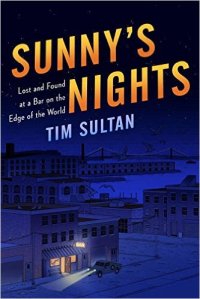
Sunny’s Nights: Lost and Found at a Bar on the Edge of the World by Tim Sultan

A vividly portrayed Brooklyn bar serves as vehicle in a young man’s ode to his friend.

sunnys nights

Tim Sultan wandered by accident through the door beneath the sign that read simply “Bar,” in the derelict neighborhood of mid-1990s Red Hook in Brooklyn, N.Y. Charmed by the proprietor, Antonio Raffaele “Sunny” Balzano, Sultan become a bar regular, then a bartender, and eventually left his Manhattan high-rise job to devote himself to the bar–or, more accurately, to Sunny himself. Sunny’s Nights: Lost and Found at a Bar on the Edge of the World is an appreciation of that man.

Sunny’s bar is “on the edge of the world” because Red Hook is both a point on what Sunny calls the Mississippi-Hudson River (because of the Hudson’s role in his youth, which he recalls in parallel to the adventures of Tom Sawyer and Huck Finn), and an outlier in the consciousness of greater Brooklyn. Sultan explores the history of the neighborhood as well as of Sunny and his bar, a family affair for generations. The result is both memoir and biography, alternating between the protagonists’ years of friendship and their separate pasts: Sultan grew up in West Africa and Germany while Sunny’s childhood was confined to Red Hook. Also an artist in diverse media, Sunny is wildly charismatic, with endless stories that unfailingly hold his audience spellbound; this is the real story of the bar. As Sunny and Sultan share histories, escapades (including a near-drowning in the Mississippi-Hudson) and hospital visits, old Red Hook wise guys (some still bending an elbow at Sunny’s), poets, lovers, musicians and artists make for a colorful, eclectic and winning tale–like Sunny himself.


This review originally ran in the March 1, 2016 issue of Shelf Awareness for Readers. To subscribe, click here, and you’ll receive two issues per week of book reviews and other bookish news.


Rating: 7 Bathtubs.

The Rarest Bird in the World: The Search for the Nechisar Nightjar by Vernon R. L. Head

A master birdwatcher lyrically describes his quest for the first scientific sighting of a little-known species.

rarest bird

“Searching enquiringly, steeped in a willingness to learn, we felt a connection with biodiversity and an appreciation of species.” This recurring concept of inquiry, combined with a sense of wonder, dominates Vernon R.L. Head’s poetic musings in The Rarest Bird in the World: The Search for the Nechisar Nightjar. A conservationist and lifelong birdwatcher, Head was entranced by the findings of a 1990 scientific expedition to the Nechisar plains in Africa’s Great Rift Valley: among many specimens, the team collected a single wing of a bird that turned out to be unknown to science. After some discussion within the ornithological community–can a species be defined by a single body part?–it was named the Nechisar Nightjar, Caprimulgus solala (“solala” meaning “only wing”). “The new species was announced, and birdwatchers like me began to dream.”

Decades later, Head and three elite birdwatching buddies trek to the Plains of Nechisar in Ethiopia to search for this elusive, prized, nearly mythical creature. In an awestruck tone, he describes their journey, interweaving the story of the 1990 discovery, reflections on humanity’s place in the natural world, memories of other birds, and thoughts on taxonomy and naming. Head is appreciative of metaphor and playful with words: he coins the collective “an incantation of ibises,” calls Addis Ababa “a eucalyptopolis,” sees a cliff of striated rock as a “shelf of books to the past.” This fanciful mood defines much of the book, although Head does turn somber in contemplating the future of many rare birds. After slower paced sections, as in recalling the birdwatchers he travels with, the adrenaline increases as they draw closer to meeting the Nechisar Nightjar.

Head’s story of birdwatching and its relationship to conservation is also a meditation on extinction and an ode to the natural world. He is unafraid of wandering within these subjects, and his passion for this work is clear: “Each name [on a birdwatcher’s list] is a story of an interaction, a time of connection with the pristine, a collection of memories, an understanding of our place in the system of natural things, and a hope for the future of that place.” The skills involved in spotting rare species approaches magic, even as it references science. This combination of reverence and scientific history is attractive as both a work of literature and an illumination. The Rarest Bird in the World is an alluring view into birdwatching and multiple rarities.


This review originally ran in the February 22, 2016 issue of Shelf Awareness for the Book Trade. To subscribe, click here.


Rating: 7 eyeshines.

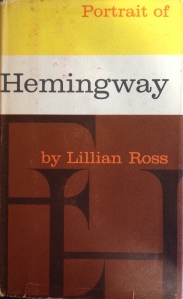
Portrait of Hemingway by Lillian Ross

Portrait of HemingwayLillian Ross originally wrote her ‘Profile’ of Ernest Hemingway for The New Yorker, where it was published on May 13, 1950. In book form, it becomes a ‘Portrait,’ and other than the addition of a delightful preface, I’m not sure what the difference is; the opening pages of my first edition note that Portrait originated as Profile, but there is no indication that the text of both is not the same.

The dust cover offers context.

When Miss Ross wrote this Profile, she made several literary innovations, one of which was to compose a portrait entirely in terms of action… She attempted to put down only what she had seen and heard, and not to comment on the facts or express any opinions or pass any judgments… In her writing for The New Yorker she has raised this severely objective method to an art.

We’ll examine that premise shortly.

The Portrait runs 42 pages: long for a magazine article, but perfectly lovely as a brief glimpse in this format. Let me start where the book does, though. I date the preface to 1961: that is the publication date of this first edition printing; the preface does refer to the reception to her Profile in the magazine, and it refers to Hemingway’s death of July 2 of that year. In it, Ross explains how she got to know Ernest Hemingway and his fourth and final wife, Mary, how they corresponded with each other as friends, and how the profile came about: on a brief stay in New York City on his way to Italy, Hemingway invited Ross to come and hang around with him on various errands, over the course of three days. She wrote up those experiences, and gave Mr. and Mrs. H. the chance to mark up her manuscript before she submitted it. She then describes the responses to her profile. Most readers loved it, she said, but some “reacted violently, and in a very complicated fashion.” Some of these disliked Hemingway’s personality (not an uncommon reaction to the man) and thought the piece backed up their views. Others didn’t like the man as represented in the piece (also understandable), and thought “either Hemingway had not been portrayed as he was or, if he was that way, [Ross] shouldn’t have written about him at all.” She assumes that Hemingway’s death has corrected some of these disapproving interpretations, which I found a little odd, but no matter. Finally, she continues the work of profiling Hem by describing the kind of letter-writer and friend he was. The preface introduces the profile nicely because it gives context to the relationship between writer and character.

And the profile (portrait) itself is indeed wonderful, and as promised, follows Hemingway closely: from arriving at the airport, to the airport bar, to the hotel, where the Hemingways order up caviar, champagne and Marlene Dietrich, who visits with photos and stories of her grandbaby. Then it is late in the next morning, and Ross is awakened by an antsy Hemingway who demands she come over and listen to him talk; more champagne, and she accompanies him on his errands while Mary goes on hers. They buy Papa a coat and other small items at Abercrombie & Fitch. The next morning again, Patrick (the middle Hemingway son) has joined the party, which goes to the Met to “look at pictures” for a few hours, followed by lunch back at the hotel with Charles Scribner (Hemingway’s longtime editor). The story ends mid-lunch.

Ross relates this series of anecdotes as scenes, blow by blow, in real time. It is true, as promised, that this is a portrait “in terms of action,” but I wouldn’t call it “severely objective.” For starters, there is the question of what you put in and what you leave out – because obviously Ross didn’t report every cough and sigh and rustle of a pant leg that took place in three days. She writes, “Patrick told me that he’d just as soon spend the whole day looking at pictures.” And a couple of pages later, Hem gets tired and asks Patrick, “don’t you think two hours is a long time looking at pictures?” and “everybody agreed” and the party moved on. Choosing to put in these contradicting statements says a lot about both Hem and Patrick, and I don’t believe for a moment that that was a mistake.

Too, word choice is always telling, I think. In the nature of this excellent piece my mother sent me the other day, consider the sentence: “He moved in and took the room.” Who can objectively say that Hemingway took the room? No, Lillian Ross is communicating something outside of objectively observable events here. I’m not saying I don’t like it: I do, in fact, very much. But I don’t think it’s entirely accurate to claim that the author is not present in her work – here, or ever.

That’s just a quibble with the dust jacket, though. This vignette is packed with great representative moments. I’ve already shared a few (here, here). Or how about this for a Hemingway speech:

…I was ashamed because I had not written any novels. So I wrote ‘The Sun’ when I was twenty-seven, and I wrote it in six weeks, starting on my birthday, July 21st, in Valencia, and finishing it September 6th, in Paris. But it was really lousy and the rewriting took nearly five months. Maybe that will encourage young writers so they won’t have to go get advice from their psycholoanalysts. Analyst once wrote me, What did I learn from psychoanalysts? I answered, Very little but hope they had learned as much as they were able to understand from my published works. You never saw a counter-puncher who was punchy. Never lead against a hitter unless you can outhit him. Crowd a boxer, and take everything he has, to get inside. Duck a swing. Block a hook. And counter a jab with everything you own. Papa’s delivery of hard-learned facts of life.

Seriously, he’s sort of simultaneously a genius and a walking cariacature. I understand perfectly why those readers thought Ross was making fun of Hemingway; this kind of speech reads that way. I also believe he spoke it. And I like him even while recognizing that he was a blowhard, could be a jerk, and struggled to contain his overcompensating machismo. But I get why others don’t. This is sort of in line with that post I wrote.

I had a wonderfully fun time reading the essence of Hemingway in this perfectly pitched profile. Very enjoyable, and a quirky piece of journalism. Do look it up.


Rating: 8 glasses of champagne.

Teaser Tuesdays: Portrait of Hemingway by Lillian Ross

Teaser Tuesdays is a weekly bookish meme, hosted by MizB of Should Be Reading.

I have read some good books lately – wait til you hear about Lily and the Octopus, oh man – but I’m not sure there’s anything as pleasing and comfortable for me as coming back to Hemingway.

Portrait of Hemingway
This profile was originally published in The New Yorker in 1950, and follows the man closely for two days. That’s it: an anecdote in the life. There is also a most interesting preface, but I will leave that for my review. These are the lines I wanted to share with you today.

He always woke at daybreak, he explained, because his eyelids were especially thin and his eyes especially sensitive to light. “I have seen all the sunrises there have been in my life, and that’s half a hundred years,” he said. He had done considerable revision that morning on the manuscript [of Across the River and Into the Trees]. “I wake up in the morning and my mind starts making sentences, and I have to get rid of them fast – talk them or write them down,” he said.

I feel like that sometimes, too. His sentences are better, though.

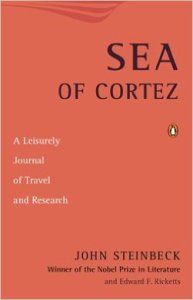
Sea of Cortez: A Leisurely Journal of Travel and Research by John Steinbeck and Edward F. Ricketts

It is advisable to look from the tide pool to the stars and then back to the tide pool again.

sea of cortezIn a word, Steinbeck is as wonderful as ever. (I don’t have an idea of how strong a role Ricketts played in the writing of their shared story.) This unique work, a blend of travelogue, science writing, humor and wide-ranging philosophy, has all the Steinbeck voice and attitude that we love.

Steinbeck, as we know, was a prolific novelist, attached to the central California coast. Ed Ricketts was a marine biologist, and the model for the character Doc in Steinbeck’s Cannery Row. They were good friends. In 1940, they chartered a fishing boat called The Western Flyer to take them from Monterey, California, down around the tip of Baja California, and up and down the Sea of Cortez (also known as the Gulf of California), on a scientific collecting trip. With a small crew and a large (but not large enough) supply of collecting equipment, they toured the coast, visiting small settlements and making notes on local culture, fishing for their meals, drinking more than a little beer, and collecting. The littoral zone they examined yielded enormous numbers of creatures: crabs and fishes, anemones and sea cucumbers and sea hares and shellfish and snails and starfish, on and on.

This is a fat book. My copy of Sea of Cortez: A Leisurely Journal of Travel and Research runs 598 pages. But the narrative or journal part forms only half that (and, as it turns out, is contained in The Log From the Sea of Cortez at 320 pages). The second half of the book is composed of “A Note on Preparing Specimens”; photographs, drawings and charts, of select collected species; and an “Annotated Phyletic Catalogue” (plus references, abbreviations, glossary, index). I confess I read only the narrative, and the introduction to the “Annotated Phyletic Catalogue”; browsing the catalogue itself told me that it was hundreds of pages of descriptions of littoral sea creatures, a significant contribution to science but not something I needed to spend my time on.

This is in part why, as the back-of-book blurb puts it, “Sea of Cortez is one of those rare books that are all things to all readers… science to the scientist, philosophy to the philosopher, and to the average man” (ahem, woman) “an adventure in living and thinking.” There is plenty of good science in this book, including much in the narrative itself, which the authors make accessible and interesting; I didn’t need the list version. I purposefully bought the long, full copy of this book, when it turns out I could have gone with just The Log.

The philosophy referred to in that blurb is no small thing. My only struggle was a chapter of about 20 pages arguing the merits of teleological versus non-teleological thinking, which I found fairly mind-numbing in its abstraction, and about 17 pages too long. Other philosophical musings are more enjoyable, as in discussing the habit of both people and other animals of getting “soft” when the going is too easy, or our yearning for the magic and mystery of the unknown: “Men really need sea-monsters in their personal oceans.” There is a common question, in our world, of whether people still living more “primitive” lives – in this case, Mexican Indians whose chief concerns are food and shelter – are happier than more “civilized” people who worry over

tremendous projects, great drives, the fantastic production of goods that can’t be sold, the clutter of possessions which enslave whole populations with debt, the worry and neuroses that go into the rearing and educating of neurotic children who find no place for themselves in this complicated world…,

etc. This question is as well stated here as anywhere, and sensitively approached, I think, which is to say not entirely answered. After much musing on political concepts and the meaning of life, Steinbeck-Ricketts returns to the immediate question at hand: “our own interest lay in relationships of animal to animal.”

It almost goes without saying that descriptions are lovely and filled with sensory detail that make one want to see this land this sea, or return there.

The sweet smell of the land blew out to us on a warm wind, a smell of sand verbena and grass and mangrove. It is so quickly forgotten, this land smell. We know it so well on shore that the nose forgets it, but after a few days at sea the odor memory pattern is lost so that the first land smell strikes a powerful emotional nostalgia, very sharp and strangely dear.

On a personal note, I was delighted to find reference to places I have been: Loreto, Mulege (where they did not stop, because of the infamous malaria), Coronado Island.

I suspect, as I have before, that Steinbeck is at his best when describing parties. No one has ever written so convincingly, lovingly, entertainingly about people drinking together. And he does it with a sort of formal tone, so that we see his eyes twinkling at us over his real meaning, as when he’s told of an earlier collector who left “large families” of his offspring behind in local communities – “a whole tribe of them” – and the voice of Steinbeck-and-Ricketts notes, “We honor this man for all his activities. He at least was one who literally did proliferate in all directions.” A delightful passage beginning “There is nothing more doleful than a little cantina…” is a perfect capsule tale, that I will reread with pleasure, and if he lets me, read out loud to Husband. See also the party when The Western Flyer leaves the dock in Monterey.

Steinbeck-Ricketts’s discussion of the nature of diplomacy, as their little party prepared to sail into Mexico in a time of international tensions, employs this same tone of formal language poorly disguising sparkling satire. I never loved Steinbeck so much. In this spirit, in praise of clarity, comes a discussion in chapter 10 (March 18’s entry) of the common dullness of scientific writings. “We have not known a single great scientist who could not discourse freely and interestingly with a child.” And so here is Sea of Cortez, a perfect example of a non-dull piece of science writing. Who says creative nonfiction is a new invention?

I have trouble attributing the loveable qualities of this book to one man, or two. It seems obvious on cursory glance that one man is the writer and the other the scientist, but what do I really know of their shared writing process? Ricketts had to have been a fun and full personality, in part because Steinbeck would have required it, I think, and in part because Doc was. There are several anecdotes told in which “one of us” does something or the other, and we are left to wonder.

Perhaps the authors’ best quality is the overall tone of wonder and playful humor in observing the everyday. I especially enjoyed the ongoing joke of the Sea Cow, a motor attached to a little skiff used to leave the boat and go collecting. The Sea Cow is personified as a being with a malevolent will of its own, determined to thwart: it works on beautiful, sunny days for short distances (“in a word, on days when it would have been a pleasure to row”) but never in bad weather, over long distances, or after dark. The Sea Cow figures as a large personality throughout the book.

Their scientific knowledge is not boundless, and they are honest about this fact. Their purpose in this collecting expedition is to collect, that scientists may then study. When encountering a strange islet: “It is nearly all questions, but perhaps someone reading this may know the answers and tell us.” Acknowledgment of what is not known or understood is so rare, and refreshing.

As the back-of-book blurb (quoted above) indicates, this book is many wonderful things in one package, and that package of Steinbeck design: what more could we ask? A delightful true story of travel, of Mexico, of the wonder of really looking around at one’s world, of camaraderie, of joie de vivre. Recommended, of course.


Rating: 8 Sally Lightfoots.

shorter prose: essays, etc.

I took myself away recently for a solo writer’s retreat to a cabin in the woods, on a lake, in the mountains. No phone or internet. Husband dropped me off with the two little dogs and the gear I’d need for two nights. Forty-five minutes after he left the cabin lost power, which put a damper on my reading & writing abilities; but it came back on at 1:37am. I know, because I had left all the lights switched on.

I took lots of work with me. One book completed that needed a review; the second, completed in those first minutes without power, needed a review. The next one, of which I read the half by candlelight that first night, which needed a review and prep for an author interview; four more books in reserve. Seventeen essays, 5 book excerpts, 2 lectures, 2 short stories, 1 piece of longform journalism, and 7 poems. Twenty classmates’ responses to an essay I’d submitted for workshop, representing a range of ideas for expansion and revision. One class assignment, and a broad and vast mandate to create more new work. My only other goals were to feed myself and the dogs, and take us all to go to the bathroom as necessary. I would not get through it all, of course. I had brought so much so that I could pick and choose, and not get bored. On day two, I resisted the urge to go back to the candlelit book of that first night, in favor of all those essays and other writings.

And so here we are. I will not subject you to my reviews of 17 essays, 5 book excerpts, 2 lectures, 2 short stories, 1 piece of longform journalism, and 7 poems; frankly (for this purpose, happily) they were not all worth it. There were some special ones, though. Rebecca Lee’s “The Banks of the Vistula” was shocking, invigorating, and persistent: after several days, I can’t stop thinking about it. Simultaneously, it was beautiful, and it bothers me.

The excerpt from Virginia Holman’s Rescuing Patty Hearst was likewise tantalizing, especially since my copy, for whatever reason, ends mid-sentence: that will bear further review.

Jonathan Swift’s “A Modest Proposal,” which I remember reading – can it have been in middle school? – but don’t much remember, was as wonderful as I suspected, filled to brimming, every line, with humor and of course stinging satire. Montaigne was too densely written; I’m not up for this. Robert Louis Stevenson, rendered here as Robert Lewis Stevenson (and what’s up with that?) is reliable: “An Apology for Idlers” was good and “On the Enjoyment of Unpleasant Places” was outstanding. RLS has this to offer my retreat weekend: “There is no country without some amenity–let [her] only look for it in the right spirit, and [she] will surely find.”

Flannery O’Connor’s “A Good Man Is Hard to Find” was… what? disturbing? I will need some help with this one. Brenda Miller’s “36 Holes” is beautiful, a very different sort of form and one that appeals to me: meditative, wandering, but cohesive; I will reread this. As a fan of the semicolon and general geek, I very much appreciated learning more from Paul Collins in “Has Modern Life Killed the Semicolon?“, which yields such quotations as this one from the Times of London:

The semicolon is the enemy of action; it is the agent of reflection and meditation.

(That must be why I like it so much.) And,

The semicolon allows woozy clauses to lean on each other like drunks for support.

which is less an argument for support, but a great sentence.

One of the best things* I read over the weekend was “Some Holy Ghost,” by David K. Wheeler. Full disclosure: I work with Dave; he’s my editor at Shelf Awareness. But the essay was objectively wonderful, I insist. I love everything about this piece: the structure, wherein he walks around the Art Institute of Chicago meditating on large questions while looking at paintings with specific bearing on those questions; the perfection of his phrases (Dave is also, perhaps foremost, a poet); and the themes and the job he does with them. This is an essay about religion, a subject that usually makes me twitchy, but his thoughts are accessible and revelatory.

The longform journalism is The Bones of Marianna, by David Kushner. It tells the story of a reform school in Florida, the mysteries and pain surrounding its history, and the efforts of citizens and forensic archaeologists to uncover the past. This is a riveting story, and it’s beautifully presented at the link above. Kushner’s telling is more straightforwardly journalistic than creative; I miss the voice I came to know in Alligator Candy (review to come), but this is a good read – just different.

I did not get around to the poems, so those will wait for another day.


*It will be the subject of another post on another day, but I’ll just say here that I can’t stop raving about Lily and the Octopus, a debut novel by Steven Rowley which blew me away. (This is the one begun by candlelit, and finished the second night.) It’s a startling, original piece of work and I highly recommend it.

Hannah Mary Tabbs and the Disembodied Torso: A Tale of Race, Sex, and Violence in America by Kali Nicole Gross

In this shrewd historical study, a salacious murder trial in 1887 Philadelphia offers insights on criminal justice, violence, race and gender.

hannah mary tabbs

When Kali Nicole Gross (Colored Amazons) came across the case of an unusual 1887 Philadelphia murder, she found a story with many layers. In Hannah Mary Tabbs and the Disembodied Torso: A Tale of Race, Sex, and Violence in America, she explores the intricacies of that case and its implications on criminal justice, a culture of violence and conceptions of race and gender.

Hannah Mary Tabbs was an unusual post-Reconstruction black woman–she unabashedly pursued sex outside of marriage and used violence and physical threats to make a reputation for herself in her black community in Philadelphia’s Seventh Ward. In the white community, meanwhile, she upheld the idea of womanly virtue and subservience to her white employers. Gross argues that this manipulative, variable representation of herself allowed Tabbs to almost get away with a serious crime. Tabbs had a lover whose headless, limbless torso turned up on the edge of a pond outside of town. The man convicted for that murder was, Gross contends, a patsy. The skin tones of the various players in this love triangle appear to have played as large a role as their guilt or innocence.

In prose that demonstrates careful research and offers a realistic reconstruction of the crime, Gross comments on social standards for morality and relationships between races and genders. The case of the disembodied torso is not only a sensational piece of true crime, but an opportunity to reflect on these continuing complexities.


This review originally ran in the February 9, 2016 issue of Shelf Awareness for Readers. To subscribe, click here, and you’ll receive two issues per week of book reviews and other bookish news.


Rating: 6 assumptions.

Ostend: Stefan Zweig, Joseph Roth, and the Summer Before the Dark by Volker Weidermann, trans. by Carol Brown Janeway

This poetic contemplation in translation illuminates an uneasy creative community of artists and writers gathered one summer as fascism and Nazism are growing in Europe.

ostend

Volker Weidermann’s Ostend: Stefan Zweig, Joseph Roth, and the Summer Before the Dark is a glimmering work of language and an insightful tribute to literary friendship in a singular historical moment.

Stefan Zweig was a successful and popular Austrian writer; Joseph Roth was less successful but also gifted, a tortured, heavy-drinking writer whom Zweig called his “literary conscience.” When war loomed in the summer of 1936, Zweig returned to the Belgian seaside town of Ostend, where he had spent the summer of 1914. His work no longer welcome in Germany, his home in Salzburg defiled by police and his marriage collapsed, he nonetheless joyfully embarked on new work and new love with his secretary, Lotte Altmann. And he brought along Roth, supporting him financially and in his work (support that would strain their complex, fraternal relationship throughout). The troubled Roth, too, found new and rejuvenating love with a German writer, Irmgard Keun, one of the few non-Jews in their small émigré community.

Aside from brief background and epilogue, Weidermann stays within the boundaries of the summer of 1936–the summer before the dark, in which Zweig, Roth and an assortment of “detractors… fighters… cynics… drinkers… blowhards… silent onlookers” manage for a single season to love, laugh and exercise creative genius in a world rapidly falling into war and fascism. Translated from the German into lyrical, meditative prose by Carol Brown Janeway, Ostend is a brief but scintillating portrayal of this season, its spirit and a set of remarkable characters.


This review originally ran in the February 5, 2016 issue of Shelf Awareness for Readers. To subscribe, click here, and you’ll receive two issues per week of book reviews and other bookish news.


Rating: 8 little schnapps glasses.

Teaser Tuesdays: Sea of Cortez: A Leisurely Journal of Travel and Research by John Steinbeck and Edward F. Ricketts

Teaser Tuesdays is a weekly bookish meme, hosted by MizB of Should Be Reading.

I love Steinbeck. I know we just saw this one in a book beginning, but there is more to love. Check out this paragraph.

sea of cortez

The safety-valve of all speculation is: It might be so. And as long as that might remains, a variable deeply understood, then speculation does not easily become dogma, but remains the fluid creative thing it might be. Thus, a valid painter, letting color and line, observed, sift into this eyes, up the nerve trunks, and mix well with his experience before it flows down his hand to the canvas, has made his painting say, “It might be so.” Perhaps his critic, being not so honest and not so wise, will say, “It is not so. The picture is damned.” If this critic could say, “It is not so with me, but that might be because my mind and experience are not identical with those of the painter,” that critic would be the better critic for it, just as that painter is a better painter for knowing he himself is in the pigment.

I think this is a lovely echo (better than the original) of a post I wrote just the other day. And I appreciate the insertion of this idea about critics, since I consider myself one: that we need to recall our place, acknowledge that my impression is only my own. I hope I remember to do that.