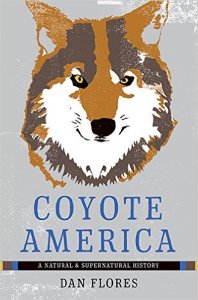
Teaser Tuesdays: Coyote America: A Natural & Supernatural History by Dan Flores

Teaser Tuesdays is a weekly bookish meme, hosted by MizB of Books and a Beat.

Teaser

Coyotes seem to make consistently interesting reading – for me at least – whether Native American mythology or the natural history that is handled here.

coyote america

I thought I’d share one of the fascinating tidbits I learned. Coyotes interbreed quite avidly with red wolves in the southern U.S.; not so the gray wolves of the West.

Mech also points out that killing coyotes, not mating with them, is intrinsic to gray wolf behavior. Julie Young of the Predator Research Facility even told me that in experiments there, coyotes inseminated with gray wolf sperm actually killed the puppies they bore.

They are quite clear on their preferences, it seems. That makes sense to me, considering the Trickster Coyote I knew as a child from books like Coyote &. Stay tuned…

This quotation comes from an uncorrected advance proof and is subject to change.

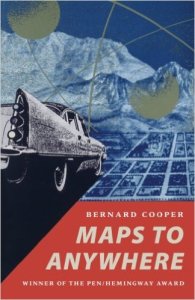
Maps to Anywhere by Bernard Cooper

maps to anywhereMaps to Anywhere is a surprising, complex, lovely collection of essays. I read it for class (one of the creative nonfiction writing classes I’m taking at Western Washington University), and I wonder how I would have approached it otherwise: would I still have been quite so focused on reading like a writer, on dissecting and searching for Cooper’s process and strategies? I hope so, but I can’t say.

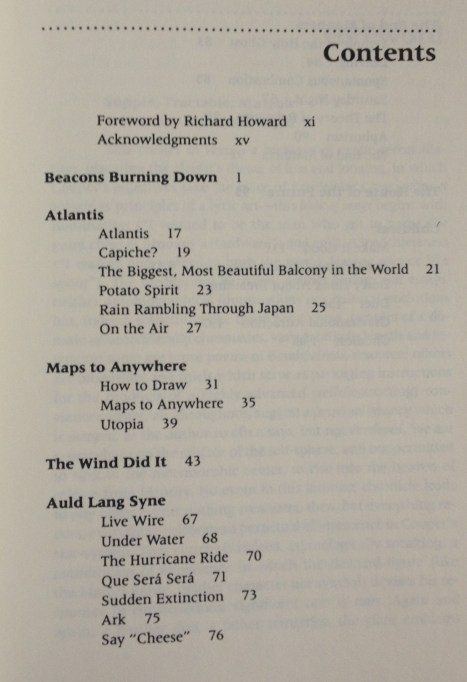
It is an impressive collection of work, and I mean ‘collection’ precisely. The essays themselves are impressive, and varied: some lyrical, including some I unequivocally call prose poems; some more narrative; some conceptual and wandering, some rooted firmly in fact, and some clearly rooted in imagination. But the method of collecting the individual essays is one of the central points of genius that caught my mind. How selected, and how arranged?

Some longer essays are their own entire section. Some sections are made up of shorter essays, and take the name of one of them.

first page of table of contents

first page of table of contents

I marveled over Cooper’s titles, and also his final lines, the way they wrap things up and the way they leave an image or a sound (or both) in the reader’s mind. He is a very aural writer: much of his work demands to be read out loud, or simply makes itself heard. I found assonance I loved, as in the line, “Can mother muster enough thrust to leave the earth in a sudden leap?” (How is this not poetry?) There were amazing concepts, intriguing stories, and a perfect evocation of an era: the U.S.’s forward-looking, plastic-happy 1950’s. In other words, so many skills: I can see why a writing class teaches this book! But again, it was the organization of the moving parts that most confounded and fascinated me. I think I understand that Cooper builds an overall movement (and a sense of movement is central to his work throughout) from a childhood self to a mature and outward-looking one. But the content of the pieces in between jump around in time; it’s far from chronological. Oh, a puzzle: I can’t entirely explain this collection to you. You should go explore it for yourself.


Rating: 9 names.

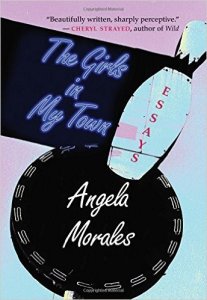
The Girls in My Town by Angela Morales

This collection of essays about a Los Angeles childhood is strongly rooted in place and universal in its themes.

girls in my town

Angela Morales’s The Girls in My Town is a collection of striking, lovely essays about her upbringing in Los Angeles. Vignettes paint a number of vivid scenes: her parents’ appliance store, and the bowling alley where she went to escape it; an elementary school where the girls demanded to be allowed to wash dishes like the boys; a room where a grandmother lay dying, as generations of children ran laps in the yard outside; the community college where Morales teaches remedial English to an ex-con with a pitiable past. These portraits, and the characterization of a larger Los Angeles, form a sense of place that enlivens and colors the collection.

Themes include family, and the changes seen over generations, as in Morales’s journey from daughter to mother, and in telling her grandparents’ stories. Recurring patterns of teen pregnancy, violence against women and girls and the fear it inspires add a tone of somber musing. A series of animal characters–the pet dogs of the author’s childhood, her own children’s pet rats, a mountain lion in the hills–bring layers to a setting both urban and wild, becoming dreamlike on her pre-dawn bike rides. Morales has a strong, lyrical voice, and her essays and anecdotes can be humorous and loving and darkly meditative as they address family, beauty and violence, loss and love. In short, this collection is as varied, charming, stark and inspiring as life itself, in Los Angeles or anywhere.


This review originally ran in the April 8, 2016 issue of Shelf Awareness for Readers. To subscribe, click here, and you’ll receive two issues per week of book reviews and other bookish news.


Rating: 8 bike rides.

The Fire Line: The Story of the Granite Mountain Hotshots and One of the Deadliest Days in American Firefighting by Fernanda Santos

A journalist’s in-depth accounting of the tragic loss of 19 firefighters in an Arizona fire in 2013 gives equal due to detail and emotion.

fire line

On June 30, 2013, 19 firefighters died while fighting an Arizona blaze named the Yarnell Hill Fire. Fernanda Santos, Phoenix bureau chief for the New York Times, explores those 19 lives and the period surrounding their deaths in The Fire Line: The Story of the Granite Mountain Hotshots and One of the Deadliest Days in American Firefighting. She relates this affecting story with respect, momentum and surprising suspense, considering the outcome is known from the beginning.

Santos’s style is traditionally reportorial and, after a brief prologue, chronological. Unlike the expansive, philosophical approach Norman Maclean takes in his acclaimed Young Men and Fire, about a 1949 firefighting disaster in Montana, The Fire Line is straightforwardly written. Despite her apparent closeness to the surviving families and her immersion in her research–among other exercises, she undergoes some wilderness firefighter training–Santos sticks to a journalistic narrative and does not place herself in the story. She describes the Granite Mountain Hotshots and their work: physically hard, underpaid, dirty, but also hard-won, honorable, exciting and close to nature. She introduces the young men succinctly but with touching fine points: one grew up learning about firefighting at his grandfather’s knee, one got teased for his “big calculator wristwatch,” another carried a copy of Goodnight Moon to read to his daughters over the phone when he was away fighting fires. Seven of the Hotshots were new hires, and three of them had babies on the way. Among the team of 20 Granite Mountain Hotshots, they were raising 13 children. Intimate identification with these men is central to the emotional impact of the book, and Santos builds that closeness naturally as she characterizes them.

As the Hotshots’ 2013 fire season unfolds, Santos continues to acquaint her reader with these men, communities and fires. Along the way, she neatly braids in various areas of research: the science of weather and forecasting, fire management history, the techniques of wilderness firefighting, the precise work of incident meteorologists, who assess local weather conditions. According to her author’s note, Santos adheres strictly to fact: feelings, thoughts and memories attributed to her characters come directly from her prodigious research. The Yarnell Hill Fire itself was underestimated in its strength and complexity; The Fire Line takes its time charting movements and decisions, not overtly concerned with assigning blame, but raising certain questions.

Santos brings immediacy and familiarity to a larger-than-life disaster with quiet admiration and loyalty to truth. By the time the Granite Mountain Hotshots, men now familiar to the reader, go missing, the tragedy of these losses is deeply felt.


This review originally ran in the April 8, 2016 issue of Shelf Awareness for the Book Trade. To subscribe, click here.


Rating: 7 texts.

A Distant Heartbeat: A War, a Disappearance, and a Family’s Secrets by Eunice Lipton

An inquisitive memoir investigates the author’s uncle, who was killed in the Abraham Lincoln Brigade in the Spanish Civil War.

distant heartbeat

Eunice Lipton grew up with an awareness of her uncle Dave that was specific and conflicted in emotional tone, and vague in points of fact. She knew he’d been in the Abraham Lincoln Brigade in the Spanish Civil War, and killed in action when he was 22. His brother Phil says, “Dave died for something. He was somebody.” His brother Louis, the author’s father, says he died for nothing. The author’s mother says he was the nicest man she ever knew. A Distant Heartbeat asks: Who was Dave Lipton? Why did this respectful son lie, tell his parents he would be working at a hotel in the Catskills, and then go to Spain? What does his story have to offer history?

Dave Lipton (formerly Lifshitz) was a Latvian Jewish immigrant, immersed in leftist youth politics in 1930s New York City. Surrounded by peers whose convictions mirrored his, Dave was one of very few to join that foreign war. His niece, born after his death, grew up with only scraps of his life and death: the repeated refrains of family members–died for nothing, died for something–and a few photos discovered in her childhood. She speaks to surviving veterans and friends of Dave, travels to an International Brigades reunion in Spain, studies letters and archival photographs. She finds more questions: What is the nature and cause of familial betrayal? Who was Dave’s mystery companion? In the end, Lipton’s research and musings offer only fleeting conclusions about family and principles, in a precise, elegiac journey through history, family tensions and human drama.


This review originally ran in the April 8, 2016 issue of Shelf Awareness for Readers. To subscribe, click here, and you’ll receive two issues per week of book reviews and other bookish news.


Rating: 7 photographs.

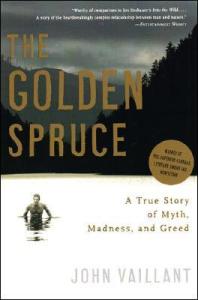
guest review: The Golden Spruce: A True Story of Myth, Madness, and Greed by John Vaillant, from Pops

Some of you will recall that I enjoyed John Vaillant’s The Jaguar’s Children. So I am of course interested in his creative nonfiction, as well. Here’s Pops to fill us in.

golden spruce

On its face, this is the true tale of a man who in 1997 secretly felled the genetically & culturally distinct Golden Spruce at the north end of Haida Gwaii – Queen Charlotte islands of British Columbia. But to disclose this shorthand version is not to spoil the narrative, for it only raises questions: Why was this such a compelling and violent act? Why did he do it? Can it be justified? Can we find wider meaning in the tragedy? And there are more.

Vaillant only gradually provides the tale’s factual skeleton, which reveals no satisfying answers in itself. More significantly, he offers us the chance to learn: about the Pacific northwest temperate rainforest that is so special on this earth; about the people who have inhabited the region for untold millennia, with an oral history linked to special places – and trees; about the waves of outsider “discoverers” that washed on meager shores to harvest the land’s natural riches; and about the logging sub-culture that, while professing its love of trees, is dependent on a timber economy that to this day acts to diminish the forest ecosystem while serving an insatiable global market.

It is only after five chapters of grounding that we first meet the disturbing – and disturbed – character, Grant Hadwin. Yet Vaillant continues to serve up nuance and insight as the narrative unfolds in bits and we wrestle with those questions. His tone suggests a colloquial & confident familiarity with facts – a reflection, no doubt, of both keen research and personal observation by this BC-based author. A fine storyteller, his voice is largely dispassionate and unsentimental, floating above temptations to judge or conclude. As literature is a human realm, one naturally expects telltales of an author’s values; here they are mere wisps – candid, balanced, welcome.

Where some details of Hadwin’s mystery are not known, Vaillant does not embellish or needlessly speculate. There are end notes, but few and spare. It is revealing that the story brings the author to mention Ted Kaczynski – but then also Joan of Arc, Billy the Kid, Scarlet Pimpernel and others. While citing some authority on obvious questions of Hadwin’s mental state, these are not hyper-analyzed. This is refreshing candor consistent with Vaillant’s approach to our limits of understanding.

Indeed, uncertainty of both man & nature is part of our landscape in this saga, as is myth. We are drawn in and encouraged to embrace it. Both natural & human elements of the story’s terrain are informed by the depths of Haida thought and oral history. Vaillant deftly wrestles with the challenges involved, e.g. western “rational” thought ill-equipped for such murkiness; and the tenuous continuity of oral history in a culture nearly extinguished by disease and genocide. He notes: “Time and events are clearly elastic in this version of the story… It is exactly this willingness to host the implausible that makes the islands and their surroundings so extraordinary.”

Logging is treated to a similar reflective treatment, involving our conflicted history of rich benefits, wanton destruction and tragic social dependence. For not the first time, we must glance in a mirror: “in this world, a certain tolerance for moral and cognitive dissonance is necessary.” This account reminds us that, like other chronicles of exhausted natural resources, logging created a culture that also produces human victims, “expendable canaries in the coal mine of resource extraction,” with collective social consequences.

Vaillant’s generous background-telling is no mere regional history or delivery of anecdotes; it can be a gift for those willing to receive – an unusual opportunity to crawl inside forest richness, stretch for cultural understanding, examine our own heritage in new ways and view events from the eyes of others. And the accumulating awareness is not always comfortable, in the way that keen perception often is not: sometimes painfully intimate, sometimes achingly universal, often irresolute and incomplete.

Each chapter opens with a quotation. One is from William Blake: “A fool sees not the same tree as a wise man sees.”

In the end we must recognize this tale is about a tree, not a man. Our young civilization still has much to learn, in the limited time remaining to act; and it is often original cultures and nature’s wonder doing the teaching. In the context of deep time and an infinitely special place, this man’s story is brief and largely complete: he lived, he acted, and he is gone. But as both Haida cultural lore and our lauded science both suggest, the tree’s story reaches far back in time, is inescapably interwoven with the place, and stretches well into the future beyond our knowing.

Teaser Tuesdays: Joe Gould’s Teeth by Jill Lepore

Teaser Tuesdays is a weekly bookish meme, hosted by MizB of Books and a Beat.

Teaser

This is one of the best books I’ve read this year. Please pardon the double-teaser. I couldn’t choose.

First and more complicatedly, Lepore quotes her subject, Joe Gould, in a letter to Ezra Pound in 1930. Gould is known (among other things) for being supposedly at work on a massive “Oral History of Our Time.” The parenthetical is hers.

joe gould's teeth

“Of course, I am a book-reviewer not a critic. That, I fear, is a distinction. It seems marvelous how many critics there are. And the blathering pother they make… Here is something cheerful to think about. To some extent the radio will supersede printing. That is good. There will be fewer books.” (The Oral History, he once explained, would include a discussion of this transformation: “I intend to write a series of chapters on the various means of communication, from oxcarts to airplanes.”)

I really wanted to share the oxcarts-to-airplanes concept because I thought it was delightful. But of course I couldn’t help going up a bit to see the book-reviewer-vs.-critic question, too! And as a bonus: people have been predicting the death of the printed book since way before e-readers. (Spoiler: Joe Gould died in an insane asylum.)

I was also struck by Lepore’s observation, below.

It has taken me a very long time, my whole life, to learn that the asymmetry of the historical record isn’t always a consequence of people being silenced against their will. Some people don’t want to be remembered, or heard, or saved. They want to be left alone.

Compared to the tone of the first teaser I chose, this second is more sober, and sobering. It’s an interesting concept for a historian to keep in mind – for the purposes of research strategies, but possibly ethics as well.

Check out Joe Gould’s Teeth. It’s outstanding.

This quotation comes from an uncorrected advance proof and is subject to change.

Growing Up Twice: Shaping a Future by Reliving My Past by Aaron Kirk Douglas

A raw, honest, and inspirational memoir about a young man growing into his own while mentoring another.

growing up twice

Growing Up Twice is Aaron Kirk Douglas’s memoir about acting as a Big Brother to an at-risk teen named Rico and how their interactions moved him to rethink his own upbringing. The sometimes unpolished language does not detract from a story that is powerful and heartfelt, and certain to appeal to a wide variety of audiences.

…Click here to read the full review.


This review was published on March 23, 2016 by ForeWord Reviews.

clarion 3 star


My rating: 6 Frisbees.

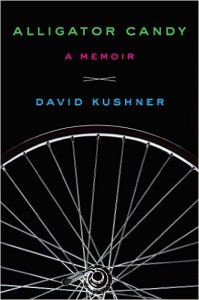
Alligator Candy by David Kushner

This tender, intimate memoir probes the childhood murder of the author’s older brother.

alligator candy

On a Sunday afternoon in 1973, 11-year-old Jon Kushner rode his bike through the woods to the 7-Eleven. His four-year-old brother, David, had asked for one kind of candy in particular. Jon’s family never saw him alive again. Journalist David Kushner still struggles to fathom his brother’s murder and his family’s experience; Alligator Candy is his memoir of investigation and connection.

Kushner lovingly portrays his hippie parents, eldest brother and Jon, who struggled with an auditory deficit disorder and was known for his compassion. Their community in Tampa, Fla., included activists and academics, and emphasized freedom and the outdoors. It was perfectly natural for a boy to ride alone through the woods. Jon’s murder presaged an end to the “ability of kids to simply get on their bikes and go,” as one family friend put it.

Alligator Candy explores how a family and community survive loss. The twin terrors of not knowing fully what happened versus knowing the horrific details of exactly what was done to Jon comprise only two reasons that this is a painful story. However, Kushner can also be funny, and he skillfully captures a child’s innocent curiosity, even in loss. He writes so simply, but this is deceptive. Alligator Candy is sensitive, insightful and understated.

Forty years later, Kushner (Bones of Marianna; Masters of Doom) still struggles with grief, isolation and guilt. In writing Alligator Candy, however, he discovers certain details of his brother’s case for the first time, begins to comprehend his family’s coping methods and, finally, achieves a long-sought connection with Jon.


This review originally ran in the March 25, 2016 issue of Shelf Awareness for Readers. To subscribe, click here, and you’ll receive two issues per week of book reviews and other bookish news.


Rating: 7 pieces of gum.

Teaser Tuesdays: The Hour of Land by Terry Tempest Williams

Teaser Tuesdays is a weekly bookish meme, hosted by MizB of Should Be Reading.

Terry Tempest Williams is as wonderful as ever. As I explore her work, I keep returning to her lesser-known Pieces of White Shell as my personal preference, but The Hour of Land is a new favorite.
hour of land
In these essays, she applies her wise, poetic eye to place, history, ecology, the future, and how we relate to one another, resulting of course in phenomenal writing. Naturally I turn to her chapter on Big Bend for today’s teaser, a single line I loved.

Ocotillo is a green withheld in winter.

Keep your eyes open for this treasure to come in June.


This quotation comes from an uncorrected advance proof and is subject to change.