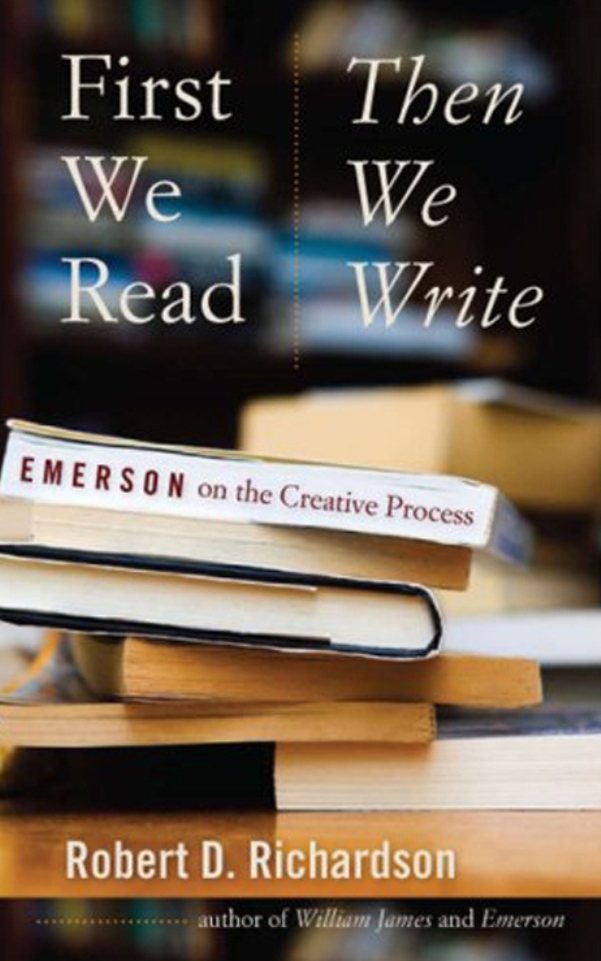
First We Read, Then We Write: Emerson on the Creative Process by Robert D. Richardson

My advisor Kim recommended this book to me as a craft book, although it is not quite a how-to, but rather a contemplation on the reading/writing life.

This short study of Emerson on the subject of writing (by an Emerson expert) is a brief, accessible view on the man. Quotable, but more than a collection of quotations. Richardson portrays a complete man, not simply a set of accomplishments. This Emerson is fascinated with writing as process and lifestyle, philosophic, and committed to exposing his own shortcomings.

I found it worthwhile, and an easy way into Emerson, who I haven’t found terribly approachable before now. I noted several quotations. The part especially intrigued me, in the final pages, where Emerson and Goethe are in some conversation about how intimidating it can be to observe the greats who have come before us… I often feel, when I discover a wonderful, new-to-me writer, both inspired by their achievement and discouraged by how high the bar has been set. And then of course the closing idea that to be a writer is to “abdicate a manifold and duplex life”! Whew.

An easy read, by turns encouraging, thought-provoking, and challenging.


Trivia of which I was unaware: Richardson is married to Annie Dillard. When I read this at the close of his ‘Acknowledgements’ (at the end of the book), I thought, ah! there’s the wisdom. (Some of you may recall that I have a complicated relationship with Annie Dillard–not all love–but enormous respect.)


Rating: 7 white whales.

Consider the Oyster by M.F.K. Fisher

I regret it took me so long to read this slim, delightful collection. M.F.K. Fisher is a very fine essayist, known for her food writing but a clever, funny, thoughtful voice in general. Warning: these delicious little pieces will make you hungry (if you have any taste at all for my favorite bivalve).

Obviously I read this book for my own essay about pearls and oysters which I’ve been working on for years… but it was an absolutely pleasure all around. Consider the Oyster has an original copyright date of 1941, and you can hear its era here and there; but overall, I think it ages really well.

Under 100 pages, and all about oysters. Short essays cover oyster sex; the seasonal nature (or not!) of edible oysters; a great many recipes from throughout history and around the world, with Fisher’s commentary; pearls; the oyster as aphrodisiac; regionalism; and more. Fisher is mostly but not entirely concerned with oysters as eaten by humans. Her writing is pithy, charming, humorous and very smart. She is a real personality, and I am a real fan.

Really, folks. What a short, accessible, but so clever little book this is. You should really pick it up, unless oysters totally disgust you, in which case you still should, because it will educate and probably humor you just the same.


Synchronicity: one of the back-cover blurbs here is credited to Clifton Fadiman, who is himself the subject of one of the next books on my list (for the Shelf), The Wine Lover’s Daughter by Anne Fadiman (author of The Spirit Catches You and You Fall Down, which was one of the first books I personally recognized as “creative nonfiction” as I was beginning to conceive of the genre). Everything is circular. Like a pearl.


Rating: 8 pearls, naturally.

Key Grip by Dustin Beall Smith

Dustin Beall Smith came recommended for his contribution to You. That essay, called “being [t]here,” didn’t particularly grab me (put it up next to Kitchen for being amorphous or abstract, at least too much so for my perhaps overly literal mind). But this book did.

Key Grip is a memoir in essays, in reverse chronological order. The first essay makes up fully a third of the book, followed by eleven shorter ones. The narrator is a risk-taker, a thrill-seeker, with self-destructive behaviors. The book is about those behaviors, about mourning the death of his father, and about art: the lifelong struggle to become a writer, and the decades along the way spent in service to another art form, as a key grip in the movie business. Smith is expert at engaging storytelling, such that the craft appears effortless or invisible. As a classmate once said, the apparently effortless writing is the hardest to achieve. But for me, the most interesting element in this collection was its reverse-chronological organization. That’s what I annotated, for school.

The extra-long opening essay, “Starting at the Bottom Again,” is a hilarious account of a mature Smith (age 57) traveling cross-country with a near stranger, to go on a Lakota vision quest. It is not only hilarious, but also gripping and pathos-ridden, gloriously told. If I have a complaint, it is that we left this absorbing world and did not return to it. I expected to continue chronologically from this point, and perhaps to get sequel vision quests, as Smith’s Lakota spiritual guide suggests to him.

Instead, we go backwards in time, seeing Smith suffer the loss of his father, work as a key grip, get dissipated and wild with drugs etc., become a skydiving instructor, return to childhood. Many of these essays are excellent in their own right. But I remained a little baffled by the departure from that first essay, “Starting.” I think we all generally expect chronological order when we read. We know how to deal with disjointed jumpings around in time; but to start at the end, so to speak, can be a little disorienting.

Nevertheless, once I paid attention to what this backwards-order was doing, I decided I like the way meaning, and characterization of the protagonist, build. For one thing, this is very like how we get to know people in real life: we meet today, in the present, and then (if we get that far) we fill in backstory. We can never know a new acquaintance’s past if we weren’t there for it, but we can listen to the stories.

Smith is a very fine storyteller, and these are amusing, sensational stories he has to tell, always with a note of sadness if not regret. I do recommend his memoir.


Rating: 7 jumps.

Distance and Direction by Judith Kitchen

I remain perplexed by Judith Kitchen. Actually, as I reread my review of Half in Shade, I am tempted to say: this, again, but with different subjects.

Kitchen’s meditations on distance and direction vary from very short lyric pieces to longer essays, and range geographically from Ireland to Brazil, across the United States, and more. They are about connections to place and people; and while she covers many topics, she is perhaps primarily concerned with mourning and remembering her father. Interesting for many craft elements: pronoun-switching, the use of objects, and wide-ranging subjects cohering. She is such a poet, with her words that don’t make literal sense next to one another. But the lines are lovely, and what meaning she does make speaks to me.

This collection as a whole leaves me unsure of what to say. I can best make sense of this art on a sentence level, or at best an essay level. Luckily, that is what I have to annotate (for school): a single element in a single essay, mostly. (There is always the option to annotate a book-level element, such as organization, which is what I did with Dustin Beall Smith’s Key Grip. Review to come.) For Kitchen, I annotated her pronoun-switching in the title essay “Distance and Direction.” While most of the book is written in first person, this essay is told in third person until the final paragraph, when a first-person I comes in to comment on what the she (earlier version of the self) does. This is an unusual use of POVs, and I found it interesting and very effective, although I think it takes a Kitchen-level expert to pull off such a trick.

Despite my attempt to articulate this craft element, I am left with the persistent feeling that Kitchen is not for me; she is too much a poet–too abstract–or perhaps simply too smart for me.


Rating: 7 skulls of horses.

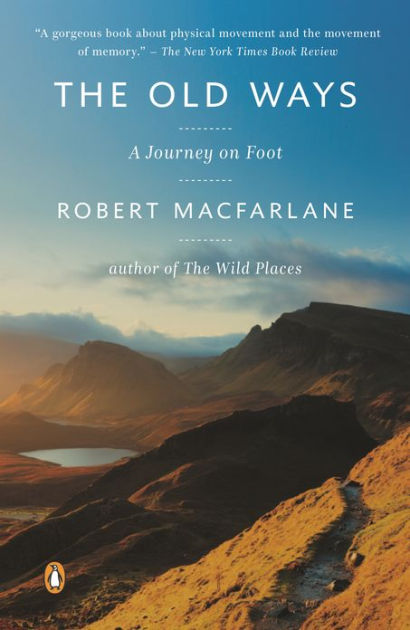
guest review: The Old Ways by Robert Macfarlane, from Pops

More from Pops:

In The Old Ways, Robert Macfarlane speaks to us as he walks countryside in a dozen British and international locales. That is simply said, but the depth and richness of this literary journey easily fills 360 pages. This is not a guidebook, although we get a close look at a variety of places. In parts, it is an adventure in words, history, literature, nature, personal inquiry, human behavior, and sense of place. Macfarlane describes his thoughts and observations as he walks, and that is a treasure. Also in parts: this is a collection of chapters, which could also each stand alone as an essay; even so, chapters proceed in a rough chronology over an indeterminate time period; more broadly, he shares segments of his life’s journey of the mind, enriching literary impressions as he wanders.

Macfarlane’s book shares its title with a Gary Snyder essay collection of the 1970s published by Ferlinghetti’s historic bookstore, City Lights; but the title senses are different, while still related. Snyder’s book could as easily been titled Staying Put (more recently adopted by Scott Russell Sanders) as his “Old Ways” took the typical American word-sense and put deeper meaning to it, as in: “the good old days”; a way of life, which encompasses cultural thoughts & values closely embedded in a place, spiritually and organically vital to the people living there.

Macfarlane’s sense of “Old Ways” considers the old and often veiled path-ways of England & Scotland, which in meaning embraces much: the physical path, historic connection, the chosen route and the legal rights thereof. Way is the root of so many common words (e.g. freeway, doorway, causeway, wayward, wayfinding, right of way) that Americans have lost track of that root in usage. Not so Macfarlane, who explores the etymology at length, both in literal & figurative senses. This includes Snyder’s “way of life”, as Macfarlane describes the essence of walking, for himself, his culture and people in general: in losing the stimulating practice of walking the old ways, we have lost important connections to places along that way. In his pedestrian passion Macfarlane welcomes numerous author allies, including Thoreau in his familiar “Walking.”

Above all else, the magic in these pages is Macfarlane’s way with words; I can hardly explain the eloquence. Description flows beautifully and wraps the reader in feeling, in myriad ways, a place described. His British English – and a commitment to precision, lost words, etymology and meaning – can mystify and charm. At one point he explores the word saunter in four languages, arriving at its best precise use. He refrains from analysis or proclaiming held-values or tragic history; his words translate observations so subtly and powerfully, we feel the implications ourselves.

Humility permeates his writing voice, and the characters he admires. He rarely includes himself in observation; as he is often walking and sleeping in harsh conditions, we do not learn how he does it, how he is equipped or how he feels about it. Rather he is ever looking outward to the pathway’s course, or to inward thoughts; his own circumstances are mere distraction.

Characters in his way-stories are sometimes friends walking alongside; sometimes other walkers, watchers or wanderers; but often they are writers, embodied in their words. He is absorbed by the words of others, and quotes freely from sources obscure to American or casual readers, yet revealing of his own thoughts. In one of many examples, by reference to several other authors, he is also describing what readers may perceive to be our humble narrator’s own path:

All of these people had been animated at first by the delusion of a comprehensive totality, the belief that they might come to know their chosen place utterly because of its boundedness. And all had, after long acquaintance, at last understood that familiarity with a place will lead not to absolute knowledge but only ever to further enquiry.

One of his favorite writers is Edward Thomas; though he died in 1917, Thomas’ physical & life’s journey is Macfarlane’s personal obsession, and a common thread throughout the book. Yet there are many others, and Macfarlane is widely read while not effete; variously, he also invokes Hansel & Gretel, Tolkien, Hiawatha and the Iliad. For this reader, for all that Macfarlane appreciates others, his own prose is unsurpassed and suffers companions only for amusement.

Macfarlane’s observations do not comprise a purist homage to nature or wilderness; these are walks through long-inhabited places, featured with relics and scars left by ancient ancestors of those who still walk today. Quoting the walking Thomas, while again seeming to reflect on himself: “He liked the evidence of human mark-making and tampering over the millennia… testifying to a landscape that was commemorative, tending to the consecrated.” Macfarlane places importance on staying connected to that past, with clear observation, nuance and consideration.

One is drawn to the impression, lulled by our guide’s example, that seeking too much grand meaning can obscure rather than reveal what these already faint tracks offer inquiring minds. Nonetheless, we may seek: for example, how different would perception of our past ways be, if the ancient marks and messages on American landscapes belonged to our own ancestors, rather than to native voices prematurely silenced?

Nearing the end of his walking tales, considering all he had seen, the literary characters he encountered and his obsession with one, Macfarlane reflects:

This, I thought, had been the real discovery: not a ghostly retrieval of Thomas, but an understanding of how for him, as for so many other people, the mind was a landscape of a kind and walking a means of crossing it.

I hope I get to read this someday…

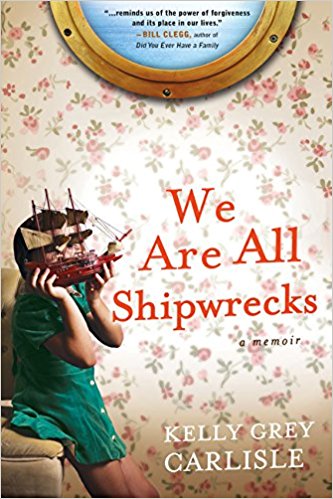
We Are All Shipwrecks by Kelly Grey Carlisle

An unstable childhood on the harbor in Los Angeles yields a wise, contemplative, forgiving memoir by a likable narrator.

A young mother tucked her three-week-old daughter into a drawer in a Hollywood motel room before leaving for the night. A police detective would lift the baby out again, after the mother was murdered. In the opening scene of Kelly Grey Carlisle’s memoir, We Are All Shipwrecks, an eight-year-old Kelly meets that detective for the first time, having just learned how her mother died. It sounds like a sensational beginning, but Carlisle’s measured, wondering tone allows the reader, like the author’s child self, to meet each disorienting new situation with curiosity rather than a sense of spectacle.

Kelly was raised by her maternal grandfather and his much-younger wife, whom she calls Daddy and Mommy. He likes to be called Sir Richard and boasts of a wild and heroic–increasingly incredible–past; her name is Marilyn, and she carries wounds that Kelly will gradually understand. They own a pornography shop near the Los Angeles airport, and for many of Kelly’s formative years, they live on a boat in a marina. Their neighbors are unglamorous down-and-outs, and Kelly is wracked by how normal her childhood isn’t. But in her reflections on the page, she realizes that the adults who surrounded her in her youth played various parts in her unconventional upbringing; many of them were loving, positive figures. We Are All Shipwrecks is a memoir about being adrift and lost on a boat, but also about discovering that we’re all more or less adrift, that yearning is a universal condition.

As she matures and learns more about her grandfather and Marilyn–the nearest to parents that she’ll ever know–Kelly persists in wondering about the mother she lost. Naturally, then, the book follows her progress: from tracking a bewildering childhood to seeking answers about where she’s come from. By the time Kelly becomes a mother, and for some time thereafter, her understanding of her roots continues to evolve. She explores the roles of trauma, love, resilience and forgiveness in shaping a life. “By now, I’ve realized that my grandfather was wrong when he told me, ‘Where you come from is important; it’s who you are,’ because it was only partly true. ‘Who you are’ also happens after you leave home. You are turning into ‘who you are’ your whole life.”

We Are All Shipwrecks is a personal history, a commentary on the experiences of childhood (uncertainty, pain, possible acceptance) and an investigation into what creates us. Readers who appreciate thoughtful memoirs will be charmed by Carlisle’s generosity and easy, open reflections.


This review originally ran in the August 7, 2017 issue of Shelf Awareness for the Book Trade. To subscribe, click here.


Rating: 8 cats on a boat.

The Triggering Town: Lectures and Essays on Poetry and Writing by Richard Hugo

A delightful, short, rich book about writing, deserving of (literal) pocketing alongside Strunk & White’s The Elements of Style.

This book is subtitled “lectures and essays on poetry and writing,” but I found it as intriguing as a creative work in itself as it is a wise craft book. On the surface, it appears aimed at poets, but I think all writers can benefit. Hugo has a refreshingly irreverent attitude and I wish I could have known him–he died the year I was born.

His self-effacing, humorous, but somehow also very serious approach to writing makes perfect sense to me, and his ideas about practice and luck mirror things I’ve been thinking for some time: that all the “bad” work we put in makes room for the good, and that practice allows for luck. (See the title essay, “The Triggering Town.”) There are some lovely essays in this book, as pieces of craft in themselves. How do we count a craft book? I considered annotating either of the last two, “Ci Vediamo” and “How Poets Make a Living” (that is, writing a craft essay for school about one of these essays). The line between craft books and creative works can be broad and fuzzy, can’t it. Recall again Strunk & White, which is such lovely, humorous, personality-rich writing. I’ll be returning to this one for encouragement and warm feelings. And maybe I’ll get around to annotating some, even.


Rating: 9 cartons of cigarettes from Spinazzola.

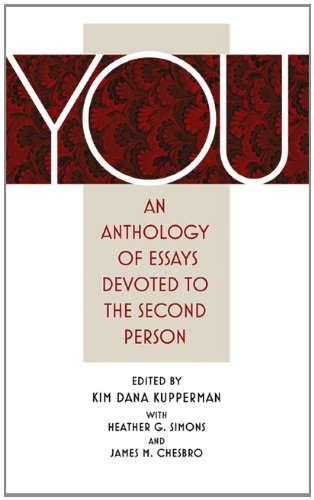
You: An Anthology of Essays Devoted to the Second Person edited by Kim Dana Kupperman

Disclosure: lead editor on this book, and founder of the publisher Welcome Table Press, is my faculty advisor for this semester of graduate study.


What a lovely collection.

These essays are collected for their second-person point of view, and include many I have already known and loved as well as some new to me. Put together like this, and with Kim Kupperman’s brief but artful introduction, they highlight the versatility of the second person, which can address the narrator herself (or an earlier version of the self); a specific individual; or a generalized “you.” It’s a diverse collection; but if there is a common thread, it is the intimacy of this POV, bringing the reader close to the narrator.

I have already admired and (in some cases) written about: Rebecca McClanahan’s “Interstellar,” Kupperman’s “Full Green Jacket,” Amy Leach’s “You Be the Moon,” and Sonja Livingston‘s “The Ghetto Girls’ Guide to Dating and Romance.” There were other authors I was familiar with too: Brenda Miller, Paul Lisicky, Molly Prentiss. I guess it’s comforting, and exciting, to begin to feel like I “know” these names. But the learning never ceases, and thank goodness.

I guess it should go without saying that not every essay in this collection appealed to me. But most did; and I appreciated the diversity of approaches to the second person, and results from it, in terms of my emotional response and what I felt was communicated, and the tone. Intimacy may be a constant, but intimacy can feel like a few different things for the reader: she can be upset, touched, amused, thoughtful or entertained, in various combinations. I was especially excited about a few of them: Kim Adrian’s “Questionnaire for My Grandfather”; Amy Leach’s “You Be the Moon”; Sonja Livingston’s “The Ghetto Girls’ Guide to Dating and Romance”; Rebecca McClanahan’s “Interstellar”; and Becca Lee Jensen Ogden’s “Nothing Good Happens after Forty-One Weeks.”

It’s remarkable that there’s a collection like this in the world. Or is it remarkable that this (published in 2013) is the first of its kind? What a wild and wonderful world of essays, literature, art in all its forms. I feel so lucky to be a student–of this, of life.


Rating: 8 disgusting essays about love.

guest musings: Pops on Brooke Williams at Village Books

Pops again, on Brooke Williams’ recent visit to Village Books. Background: I think Pops and I both know Brooke exclusively from The Story of My Heart.

Brooke Williams is the kind of old guy you would enjoy having visit at your house: wryly humorous, self-deprecating, a creative thinker; an academic to a fault, but in an earnest, generous, unassertive way.

He is touring now in support of his new book, Open Midnight: Where Wilderness & Ancestors Meet. He & Terry Tempest Williams are recently back from touring China, a trip he describes as changing his perspective significantly by resetting his sense of time: their millennial scale of the past contrasts so much with an American sense of history, problems, solutions. Yet, he also describes meeting a group of Chinese nature activists who freely quoted from Abbey, Snyder, Thoreau, TTW & more – drawing lessons from these “recent” thinkers and finding analogues in their own centuries-old philosophers.

Yes, climate change & Trump were an explicit context for many of his comments. He described wondering “how do we find new answers, new ways to be in the world?”

In discussing his book he talked mostly about the writing process, how thoughts & information came to him, how the book came together, with only brief illustrative readings. It was a casual, entertaining, cogent & developed presentation, without being “canned” in any sense. His book includes imaginings – “things I made up” – so he expressed relief that the editor accepted his insistence it be listed as non-fiction. This was an impressive element of his talk, returned to often. I admit some initial skepticism with the idea of made-up non-fiction; but with his book-story, I am more than persuaded. More likely, this is a fine example of creative non-fiction at its most creative. He had wonderful examples of finding facts in his research, which aligned so closely in a pattern that filling in the gaps with reasoned imagining made perfect sense.

By making his book a journey of discovery, the process is part of his story; so the imaginings become part of the “true” narrative, even when that includes feeling the hand of an ancestor on his shoulder. Another way: it is an organic part of the reading process that we embellish or interpret with our own experience & knowledge. Williams is simply – and transparently – offering his own view as a first-cut in this effort. What memoir does not include some of the subject’s imaginings?! That said, there are certainly spiritual & meditative elements to his story; i.e. he explores the literal possibility of “genetic connection to a place.” A full reading of the book would no doubt hold further challenges.

Before ending, he crossed over a line for me, where the arts purport to offer solutions to real-world problems based on such imaginings & speculation. For Williams, and many others, this means changing consciousness of how we view the world, in order to change the course of history. There is plenty of skilled non-fiction available describing the breadth of human knowledge on such questions, without having to resort to extremes of imagination; Harari’s Sapiens is a foremost recent example, albeit imperfect. I am thankful the arts provide comforting form to our feelings & fears, especially in hard times. I cannot go further than that; for more, I take heart in the sciences.

The role of the arts is also posed by comparative essays I found recently from Scott Russell Sanders & Bob Pyle, writing separately about the very same forest in Oregon. Sanders described an obligation for the arts, based on unique human intellect, to contemplate & interpret the natural world; in contrast, Pyle’s chipper humility on the very subject, and deference to his counterparts in the sciences, is refreshing. As usual, Pyle’s eye on our world is such good tonic for over-seriousness by & about our species.

I think you’re continuing to make progress, Pops, toward understanding what this “creative nonfiction” nonsense is that your daughter is studying. (Note: I use ‘nonfiction,’ but I don’t know that your ‘non-fiction’ is wrong.) I came into this field with a fairly righteous feeling for what should be called true, or nonfiction. But it has become more clear to me that what the author imagines is part of her truth. Her memories, even if others deny them, are truly her memories–although I think she owes it to her reader to acknowledge others’ denials. Full disclosure, I say, for what is remembered and what is known and what is imagined; but all of that can be CNF. As for the roll of art in solving real-world problems, I think there’s room for any number of strategies and solutions, but none is for everyone. And I’d certainly hope/expect that Brooke would agree with you on the value of science. I guess without reading his book neither of us can know how far that concept goes or how offended we’d be, and I didn’t hear the talk. I do think that art can not only offer comfort, but real changes of heart, in how we relate to the world and each other. A Google search will give you various articles, for example, on the value of fiction in teaching empathy and improving real relationships–in other words, how taking in art makes people better at living as people. So I think there’s more there than simple comfort (or symptom relief). But art does not replace science.

Thanks for another thoughtful discussion.

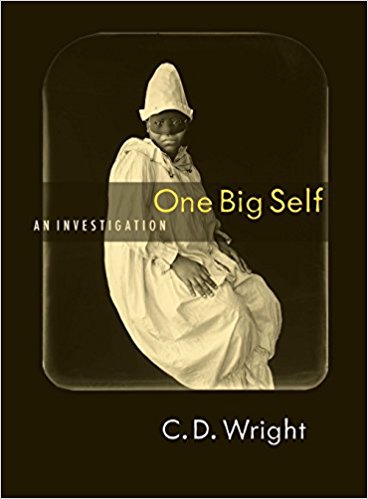
One Big Self by C.D. Wright

One Big Self is a poetry collection inspired by, and meant to record, visits to three Louisiana prisons. C.D. Wright accompanied photographer Deborah Luster on a few of the latter’s trips, and the poems in this collection borrow heavily from the speech of inmates–their vernacular, their direct quotations and their concerns–as well as from signage and other found text. Some of the words on the page are Wright’s, but some are collected. Themes include family ties; the trauma and damage caused by incarceration; and the boom of the for-profit prison industry. Of course much of the subject matter refers to violence, crime, faith, and local culture.

Especially because these are offered to me as persona poems, I am very curious to know how much is transcribed directly as found speech and how much it has been manipulated. Unlike the other persona poems I’ve just read (Patricia Smith’s “Skinhead,” Shara McCallum’s “Calypso,” Ted Hughes’ “Hawk Roosting”), these do not read to me as being about one persona per poem, but rather the collective–the persona of the incarcerated mother, say–by a series of individual contributions. This concept is in the book’s title, One Big Self.

It’s hard for me to see from here who said what. Sometimes individual lines are attributed, but often I’m left wondering. Which lines are quotations, which paraphrases? Why skip the quotation marks, which would have made clear where the speaker stops and the poet begins? And what does each choice contribute–the inmate’s words, against those of other inmates, or against Wright’s?

Sometimes the references or language hint towards Wright. This is my bias at work: when I have to look up a word or a name, I suspect that it’s a decorated poet and not a prison inmate speaking. I looked up terms like cicatrix; the Heisenberg principle; Gramsci; Fila Brasileiro; metonymy; Cioran. Cultural references like these, that go outside of Angola, Louisiana, feel external to the personas in focus here. On the other hand, certain repeated phrases fit our expectations of the setting and scenario: “She was a slab of a woman.” “That’s the tattoo that says Real Men Eat Pussy.” Mostly, I’m guessing whose speech is whose. And perhaps this guessing game, this blurring of the lines between poet/recorder and inmate, is what’s really being got at by Wright’s project, and by her title, “one big self.”

I can only close by repeating my usual lines about poetry. This was pleasant and thought-provoking to read. I like it. I don’t understand it.


Rating: 7 plastic soapdishes.