Galley Love of the Week: The Way Home: Tales From a Life Without Technology by Mark Boyle

First Mark Boyle was The Moneyless Man in his memoir about a year living without money. That impulse has expanded–Boyle now lives on a smallholding in County Galway, Ireland, forgoing electricity, running water, phones and the Internet, and other myriad conveniences the modern world relies upon. Editor Alex Christofi writes, “I think [this lifestyle] takes great courage–he is lighting the way for the rest of us by showing that life begins when you put down your smartphone.” The Way Home is an introspective, heartfelt, practical and often funny chronicle of Boyle’s inaugural year in this new, yet old, lifestyle. Organized as a diary of four seasons, this book will excite the like-minded and jumpstart the unconverted. It is a singular, invigorating read.

Galley Love of the Week or GLOW is a new feature from Shelf Awareness. This edition ran here.

Leaping Poetry by Robert Bly

Note: I’m out of pocket during my final residency period at school. I love your comments! But it may take me several days or a week or more to respond.


I read this little collection of poems and essays for Diane Gilliam’s seminar, “As If the Top of My Head Were Taken Off: Getting More Energy Into Our Poems.” Robert Bly offers his own essays on what he believes poetry should be: that poems should leap, not plod, that they should make wild associations, that they should answer to our animal instincts. He argues that in the Christian world and particularly in “America” (by which I surmise he really means the United States), we have gotten too safe, gotten away from the leap. Alongside his own essays, Bly collects poems he admires (including one of his own), to illustrate his points.

I enjoyed many of the poems, and I found Bly’s commentary interesting, but often problematic. (Here’s where I acknowledge that this book was originally published in 1972, so we can choose to make certain allowances, if we’re so inclined.) For one thing, his assessment of contemporary poetry (more than a generation ago now) is very much defined by national borders. French poets are good; Spanish poets are “much greater”; American poets have “faltered” (in the 1940s and 50s), and are now turning to the South Americans (parse that). I can allow that there is such a thing as a national “school” of poetry or of thought, although I suspect that’s less and less true in the age of swift international communication – which is quite a bit different from 1972, of course, and is still limited by language – one of Bly’s great concerns is that not enough fine Spanish-language poetry has been translated into English (when he says “Spanish,” does he mean coming from Spain? or merely Spanish-language? how concerning). But I think to say that Spanish poets are better than French poets are better than American poets is disturbingly close to racism, or nationalism. It caused me to stumble several times. Was this okay in 1972?

Also, I find myself exasperated that Bly has collected 32 poems (and 2 epigraphs) here, and 31 of those poems (and both epigraphs) were written by men. (Thank you, Marguerite Young, for representing half the world.) I assume that I’m to conclude from this that women just about cannot write good poetry at all… I know, 1970s, but still I’m disgruntled.

As a much smaller point, I wondered at the assertion that “the desert contains almost no mammal images.” This is in the course of a very interesting essay about the “three brains” (reptile, mammal, and ‘new’), and meditation, and accessing different parts of ourselves. This essay was the part of the whole book that I most engaged with. He sets up a desired move from reptile brain to new brain, through the mammal brain, necessitating a journey to “the forest” (he uses quotation marks) and finally to the desert, where an absence of “mammal images” lets us then move to the new brain. Well, I’m intrigued, if not sold. With those quotation marks, “the forest” becomes more archetypal than literal, perhaps, and I can permit that a similarly archetypal desert has fewer mammals than an archetypal forest. But as a lover of a very real desert in particular (that has mammals in it), I stumbled, again.

Leaping Poetry is, at least, an interesting book to engage (and possibly argue) with. I haven’t even touched on his theories of poetry, since I always feel underqualified. As I say every semester about the challenging readings I’m assigned for seminars, I’m looking forward to what Diane Gilliam does with this in her class. I’m sure it will be wonderful.


Rating: 5 stains on a handkerchief.

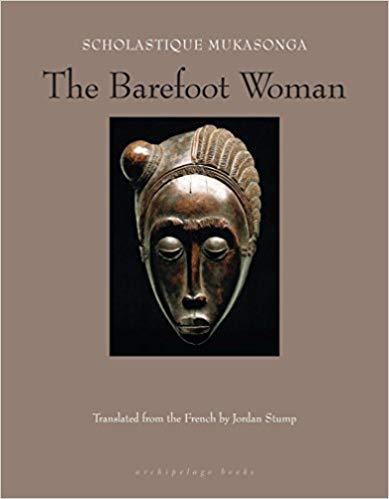
The Barefoot Woman by Scholastique Mukasonga, trans. by Jordan Stump

A shadow of tragedy hangs over this lovely, lyric memoir of Tutsi childhood in Rwanda, but the author’s love for her strong mother remains central.

The Barefoot Woman by Scholastique Mukasonga (Our Lady of the Nile; Cockroaches) is a loving tribute to a strong mother and a striking work of memoir.

Mukasonga and her family lived as exiles in Rwanda in the years leading up to the genocide of the Tutsi. This time in her life, when they were all together and alive, was short, but Mukasonga has vivid memories, especially of her mother, Stefania, a leader in the makeshift village where they were regularly terrorized by Hutu soldiers. In an earlier memoir, Cockroaches, Mukasonga depicted the horrific end of her family. Here, she focuses on her mother: Stefania is a hard worker, always with her hoe in hand; a healer with a medicinal garden of grasses, tubers, roots and tree leaves; a “highly respected matchmaker”; and a dedicated, ever-vigilant protector of her children. Saving them was her “one single project day in and day out, one sole reason to go on surviving.” She is not a hero with a single dimension, though. In Mukasonga’s warm telling, Stefania has personality, a sense of humor and a deep love for her family.

The book opens and closes with dreamlike sequences. At the beginning, in the narrator’s memory, Stefania reminds her children of their duty to their mother upon her death. At the end, Mukasonga describes a dream about her mother’s uncared-for dead body and those of so many Tutsi. This sets the tone for the rest of the memoir, which often feels dreamy as it turns to childhood memories. Extraordinarily, this story is at times horrifying in its content and at other times playful; lyric in its style and tender in its handling of the central character. While the reader’s knowledge of the genocide to come hangs over the narrative, the everyday events often retain a quotidian feeling; Stefania and her neighbors worry over their children but also laugh and celebrate and arrange marriages. As a literary work, this establishes a rare balance. Jordan Stump’s translation from the French beautifully conveys this sense of both tragedy and day-to-day joy.

The Barefoot Woman is also an essential record of traditions and a way of life that are in danger of disappearing. It describes the inzu Stefania builds, with great effort, in exile: a traditional straw-dome house “that was as vital to her as water to a fish.” The importance of keeping a fire going, and why a mother would borrow fire from a neighbor rather than use a match. The significance of sorghum, “a true Rwandan” crop, and why Stefania insisted on a cow, the traditional gift for her son’s marriage pact, even in the inhospitable new place where cows were no longer a part of their everyday lives.

This is an adoring, gorgeously rendered memorial to a mother and testimony to a people.


This review originally ran in the November 19, 2018 issue of Shelf Awareness for the Book Trade. To subscribe, click here.


Rating: 8 little loaves of bread.

Truth Serum by Bernard Cooper

Among the central concerns of Truth Serum lie questions of truth and memory. This is a memoir-in-essays of Cooper’s coming-of-age in Hollywood from the 1950s onward, including his identity as a gay man in the early days of the AIDS virus. I found several elements I appreciated from Maps to Anywhere: lyric language and a profound attention paid to the world. I was reminded of Mark Doty in the moments that Cooper leans in, seeming to slow down time, to examine what’s around him, that the rest of us might have called the everyday. Maps to Anywhere, as I remember it*, had some longer essays but more short ones, several of which qualified as prose poems; by comparison, the essays in this collection are on balance longer, and while the language is undeniably lovely, few of these shapeshift toward poetic form. These essays more frequently offer clear narrative structure.

One shorter one I’d seen before was “The Fine Art of Sighing,” about the sighs of three family members. I’m pretty sure* this one reappears in Short Takes (ed. Judith Kitchen), and/or I’ve read it for class. I also really appreciated the opening piece, “Where to Begin,” which is very much about that problem of creating art: that the biggest question is not what to put in, but what to leave out. Else we’ll end up trying to paint, or write, the whole world, and be defeated before we begin. I loved “Burl’s” for its epiphany of gender fluidity. “Against Gravity,” about weightlifters and men and mortality, was a lovely longer meditation… I really enjoyed how it ranged and returned. “If and When” is a beautiful, tearing-open essay about discovering the narrator’s HIV status, and his partner’s. (I am reminded of an essay Cooper contributed to… some essay collection, about handling the public’s response to his revealing private information, this information in particular.) It’s a simply gorgeous and wrenching portrayal, and I think it’s a generosity. “Tone Poem” answers my statement above, about there being less poetry in this collection than in Maps. It’s not so much a poem itself, though, I argue, as it is about poetry, about finding something beautiful in the mundane. “Train of Thought” was the essay I thought might be a poem: it explores the etymology of that phrase, ‘train of thought,’ and the music and language of trains.

In one seminal dream from my childhood I was on a train with a woman who was dressed in an enormous satin skirt. I was sitting on her lap and we ladled cupfuls of cool water into each other’s mouths. Her petticoats crackled whenever I lifted the cup to her lips. “Where are we going?” I asked her. “To the city,” she said, “where the rustling of a woman’s skirt sounds the same as the rain.”

Which I misread, initially, as ‘the same as a train.’ This attention to language and sound, and a final memory about a boy who memorizes numbers, made me feel a little floated above the world. Lovely.

Finally, I was reminded of Ryan Van Meter’s If You Knew Then What I Know Now. Most obviously, both essay collections handle the narrators’ coming-of-age and coming to terms with being gay men. But that’s not all, and I hope I’m not guilty of that kind of simplification. I’m thinking more about the ordering of essays in both collections, where they proceed more or less chronologically, and with an overarching opening up from the immediately personal (and confusion about the subject at hand) to the outward-facing, the public issues involved with being a gay man (for example) in the 1980s as an unknown virus blooms.

Another lovely one from Cooper, although I missed the poetry in Maps and hope to get back into that book one day, too.


Rating: 8 plums.

*I owe y’all an update on this at some future date, but I’m about to be undertaking some travel and have been packing all my books to go into storage… so the other books I’ve mentioned here are not at hand as they’d usually be. I already miss my library!

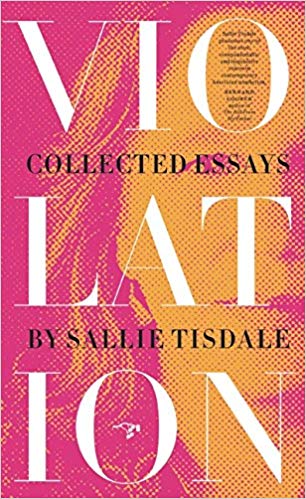
Violation: Collected Essays by Sallie Tisdale

This was a real treat, and an interesting balance between the experience of Many Circles – mind-bending, challenging, slow work – and If You Knew Then What I Know Now, which I read with pleasure in one big gulp. Violation was different from each of those, but fell just between them in its pacing. I was engaged and felt a sense of momentum throughout, but also had to stop and sit with what I was learning, or to react.

These essays span thirty years of Sallie Tisdale’s writing career, and are presented in the order in which they were published, with the final essay previously unpublished. Some of them were in progress for years before publication, but still a chronological order of a sort. While subject matters range quite a bit – elephants, flies, abortion clinics and cancer hospitals, sports, childhood and motherhood – they clearly track the evolution of one mind. Tisdale is a Buddhist, although that doesn’t come up as an explicit fact til late in the collection. She is an artist, passionate, but practically minded. She is concerned with the body, and with feminism, in different ways. I enjoyed very much getting to know her in these essays; but I also have an impression of her as a very private person, and in some ways don’t think I really got to know her very well at all.

The introduction gave me my first moment of aha! simpatico joy: “Long before I knew how to describe it, I liked ambivalence. Certainty has always seemed a bit dishonest to me.” This is so much what I feel, and it’s perhaps something I’m still working on describing, myself. It was my first, early signal that I would get along with this writer.

I really enjoy her style. She is the essayist’s essayist, or these are examples of the classical essay-as-assay: the mind wanders on the page. She is curious. She brings in a huge amount of outside research, sometimes, as when she writes about elephants and moray eels. She reminds me of Annie Dillard in the combination of immediate personal experience with science, but without the raving exuberance that Dillard often brings. Instead, Tisdale remains calm. On the other hand, the title essay is about the memoirist’s famous problem: family responses to one’s work. The nature of memory, and the question of what is ours to write about. More purely personal essays like this one require little or no research.

These essays are concerned with art and creativity, yearning, body image, and what boys and girls were allowed to do (and still are and are not allowed to do)… so many things, but not all at once. They take on really different things. And while most are alike in basic structure – discrete essays, with narrative journeys and mountains to climb and points unto themselves – one of the ones that most struck me was the segmented essay “Scars,” published in 2003, about raising a son. I loved the wordplay (of each segment’s title) and the enormous scope in a small package (just over 7 pages total). It spans a lot of time: sections are labeled with years from 1982 to 1997, and a brief note at the end says that the first section, in its original draft, was one of the first essays Tisdale wrote. I really appreciated seeing the bones of this one a little bit. And then, immediately following, comes “On Being Text,” about what it’s felt like as a writer to be included in anthologies that teach literature or writing: to read what’s said about her and about her methods and intentions. (It’s not all good.) This juxtaposition helped me again to appreciate the range in this collection.

But definitely some of my favorite essays were the two about elephants, “The Only Harmless Great Thing” and “The Birth.” The first, early in the collection (1989), is over 40 pages long, and brings in an enormous amount of scientific and historical information about elephants and zoos, and calls as well on literature and myth. It’s also personal: the narrator feels lucky to have gained back-room access to the elephants at Portland’s Washington Park Zoo. The elephants are magic, and she writes about them beautifully. This was an essay I snuggled into, fascinated and comforted by these strange creatures so loved and respected.

And then “The Birth” (2003), under ten pages, and tender and very much in-the-moment; it handles the same setting and the same (elephant and human) characters, but easily stands alone from the earlier essay too. “Elephants are so outside the size of things.” They “held up the world.” As she later does with the moray eel, Tisdale insists upon a distance from these animals: she acknowledges the temptation to feel close, to anthropomorphize, but holds herself to appreciating their otherness too. These essays are dreamy.

Tisdale is curious, thoughtful, considerate, and honest. I’m so glad that she allows this curiosity and careful consideration to range over the wide, wide world. (I didn’t even get into the lengthy treatise, “The Sutra of Maggots and Blowflies,” about much-maligned insects and Buddhism.) This was a treat, and I highly recommend it for curious readers of all kinds.


Rating: 8 sheep bot flies.

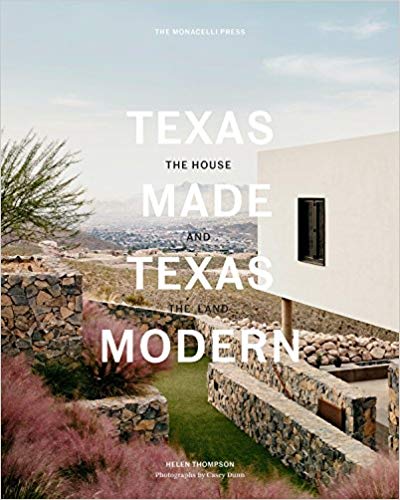
Texas Made/Texas Modern: The House and the Land by Helen Thompson and Casey Dunn

A gorgeous display of modernist architecture and interior design that’s particularly Texan.

Author Helen Thompson and photographer Casey Dunn, the team that created Marfa Modern, offer another stunning display of Texas architecture and design with Texas Made/Texas Modern: The House and the Land. Multipage spreads of beautiful photographs depict 19 houses, inside and out, along with Thompson’s discussion of their individual histories. A foreword by architect Lawrence W. Speck and Thompson’s introduction put this project in perspective. Older and newer structures alike fit into a tradition that is particularly Texan, where modernism–as defined by glass, steel, load-bearing columns and open floor plans–intersects with what is special about the Lone Star State. Texas’s climate, topography, local materials and culture all play a role in the design of these homes, which are as attuned to their natural settings as anything by Frank Lloyd Wright. A house in Wimberley highlights sliding doors at both ends which, opened, transform the house into “a big, happy breezeway.” Another in Mill Spring showcases glass walls that open to the air, allowing residents to rely solely on natural ventilation “except in extreme conditions.”

Sites range geographically across the state (with a focus on Austin, Dallas and the scenic hill country of central Texas), and there is a definite emphasis on interior design alongside architecture: at least half the photographs display indoor spaces, and captions are devoted to the designers of rugs, furniture and knick-knacks. Fans of architecture, design and Texas will appreciate this beautifully presented art book, and its insight into a singular modernist tradition.


This review originally ran in the October 26, 2018 issue of Shelf Awareness for Readers. To subscribe, click here, and you’ll receive two issues per week of book reviews and other bookish news.


Rating: 6 loggias.

my favorite craft books

As we approach the time of year when I usually do lists, I was inspired to add this one, when a dear friend from my MFA program asked me for craft book recommendations in particular. (Abby is usually a fiction writer but is entering her cross-genre semester in nonfiction, so a special emphasis there.) Another dear friend from my MFA program, Okey, used to enjoy this blog and said he especially looked here for craft recommendations. (We lost Okey after this past summer’s residency, unexpectedly, and we are all still reeling. If you haven’t already, please consider this scholarship in his name. It’s a great cause in the name of diversity and inclusivity.)

So. Here’s a list in two tiers, followed by a link to all the craft books I’ve read. Keep in mind that these are the books that have worked best for me, and your mileage may vary. I put a * next to the ones for nonfiction in particular, for Abby and for anyone else who may be interested.

Very favorites, in no particular order:

Well loved, in no particular order:

And, click here to see all books with this tag, which will include titles not listed here.

Thanks for stopping by, as always. Was this list helpful for you? Is there another list you’d like to see me work on? (In the past I’ve done movies, children’s books, audio favorites, science books, LGBTQ…) Let me know, and maybe I’ll put one together!

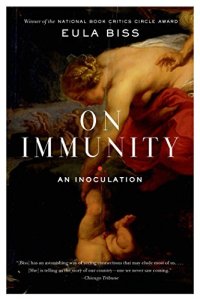
On Immunity: An Inoculation by Eula Biss

Eula Biss, who I adore for Notes From No Man’s Land, with her second nonfiction work: On Immunity.

The precipitating event here is Biss’s becoming a mother. She has a new baby to worry about, decisions to make about vaccinations, and the H1N1 flu strain is spreading frighteningly. She’s surrounded by other mothers who have a wide range of feelings about vaccines and immunizations. In danger after giving birth, Biss is given a transfusion of blood from a public blood bank. These events and opinions swirl in her head, and because she’s Eula Biss, she does research. She reads widely, from antiquity through present-day research articles and conspiracy theories; she interviews doctors, including her father, an oncologist. In fact this is a family affair, calling not only on the father (a sympathetic, sweetly caring, somewhat fatalistic man) but Biss’s mother, a poet, and sister, a Kant scholar and professor of ethics. Biss’s son turns out to battle significant allergies; she and her husband have to decide whether to have him undergo surgery, as well as simple vaccines.

Obviously, the timely subject is the “anti-vaxxers” movement (a term Biss never uses), with their claims that vaccines can cause autism, among other things (the autism claim in particular unsupported by any scientific evidence, although as she points out, a theory once voiced can never be retracted). Vaccination and variolation go back a ways, though, and part of what Biss undertakes here is a social history from the beginnings of germ theory and the Jenner vaccine through the present. Because she is a literary mind, she is also concerned with myth, literary history, and linguistics: in the first few pages, she searches for synonyms for protect and comes to shield, shelter, secure, and then inoculate. The very first page deals with “the first story I ever heard about immunity”: that of Achilles. She ranges across Voltaire’s Candide, Rachel Carson’s Silent Spring, and Bram Stoker’s Dracula, the latter carrying a lot of weight especially late in the book. In other words, it’s the kind of essaying I love: multidisciplinary examination of an important topic of our time and of all times.

There is a central ethical question here, as Biss interrogates the idea of ‘herd immunity’ (unfortunately, as she points out, sounds awfully close to ‘herd mentality’ with its negative association). If only most of us get immunized, a few of us can get away with skipping it; but the threshold for safety within that model is detectable only when we’ve passed it. And the few who skip vaccines, and get away with it, thereby relying on the many who did their civic duty: well, there’s something a little selfish about that, right? Biss has said in an interview (crediting her sister with the idea) that this is much like traffic laws. One or two people can blow through stop signs and get away with it if most of us are obeying the law. But if enough of us disregard that stop sign, soon there will be carnage, and some innocent rule followers will be hurt as well. I’m also thinking about mountain bike trails, because it just won’t stop raining here where I live. Sure, the trails will recover if a few people ride them wet. But only because most of us don’t. Which actually makes the few who ride ruts into the mud really selfish, in my opinion. Out there having their fun while I stay home and wait less and less patiently for the right conditions.

This is also about the extent to which each of us is an individual, and in turn part of something larger, like it or not. The immune system was not introduced as a concept until fairly recently, in the 1970s. Biss muses on the blur between the natural body and the body politic, the ways in which we are undeniably individual (I can clearly see where my body ends) and undeniably united (as in shared risk).

This book is full of metaphor: the original use of ‘inoculation’ as a metaphor for grafting, “as apples are cultivated by grafting a stem from one tree onto the roots of another,” because the initial inoculation was variolation, the skin slit and infectious material placed inside. “It was a metaphor for grafting a disease, which would bear its own fruit, to the rootstock of the body.” Later, “Vaccinating in advance of the flu, critics suggest, was a foolish preemptive strike. But preemption in war has different effects than preemption in health care–rather than generating ongoing conflict, like our preemptive strike against Iraq, preventive health care can make further health care unnecessary.”

These are some of the many beauties of On Immunity. I learned a lot. And I appreciate the ways in which it is like Notes From No Man’s Land. Both deal with what it means to be a citizen, and what damage fear can do. (Also, it will perhaps not surprise you to learn that racism has played a role in the history of immunization.) But, I don’t know, this one did not blow me to pieces like the earlier book did. For one thing, the organization of this book is very different from that last one. On Immunity reads like a single, long narrative. Page breaks are merely breaks; the thread (or various braided threads) connects each smoothly. This is not an essay collection but a long essay in (untitled) chapters. Notes is properly a collection, with an organizing scheme, meaningfully titled chapters, and an order to them.

It has been a good two and a half years since I read that one (and went back and reread a short section a little more recently), but what I recall is incandescent line-by-line writing, fascinatingly complex structure, and great subtlety. This one, On Immunity, is a good book in many ways. But none of these three elements struck me. The writing is always graceful and clear and communicative and often clever, but it did not ring for me like poetry. The structure – well, there is still a structure, a braid, and a range. There are recurring characters (the family members). But I missed a table of contents that could almost be read itself like a song. And the subject matter is faced much more head-on. Not a criticism; but a very different kind of book.

Here is a subtlety I did appreciate, though. For Biss’s subtitle, An Inoculation, I will let her tell it. (From the same Barnes and Noble interview, linked above.)

The subtitle actually started out as a little joke to myself. I didn’t intend for it to remain as the subtitle. But once that subtitle stuck I did start to think of certain aspects of the book that I was uncomfortable with as working like an inoculation works. One of the things I was reluctant to do in this book was repeat fears of vaccination and risk spreading them further, because many of the fears of vaccination that I write about in this book were fears that I didn’t know about and didn’t have until other mothers shared them with me. I felt a little bit infected by fears I hadn’t had before, and I didn’t want to participate in doing that more.

So when I started thinking about the book as an inoculation, I saw the possibility that it could work the way a vaccine works. A vaccine introduces a small amount or a tempered version of the virus into the body — just enough to that the body is able to recognize it and deal with it when it encounters it again in the future. So I was thinking that maybe the book would work like this. If I introduced these fears to readers who may not have encountered them yet, perhaps I could introduce them in a way that would better equip those readers to deal with those fears the next time they ran into them.

I’ll end there: with a lovely metaphor for the fine work of this fine book.


Rating: 8 risks.

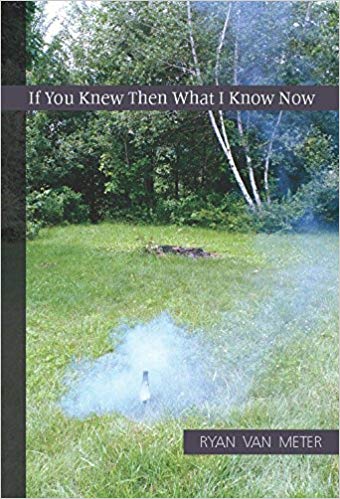
If You Knew Then What I Know Now by Ryan Van Meter

Another beautiful recommendation by Jeremy Jones. Thank you, Jeremy. And thank you Jessie for cuing me to watch this one for its organization. Jessie has not read the book, but she knew that organization of an essay collection is what I need right now and she somehow knew this was the right fit. (Trust in Jeremy, perhaps? What a fascinating, beautiful world.)

This is an essay collection about the narrator’s finding out that he is gay and eventually living as a gay man. These linked essays appear in almost perfectly chronological order, and the bulk of them take place in childhood or young adulthood (while he’s still living at home). The discovery and coming-out processes took time for this individual, and those twenty-three years (I think) therefore take up most of the book. A few essays cover his adult life after coming out; one essay (although a long one) covers an eight-year relationship, which is his first, and this is one of my favorite essays.

These pieces are nicely linked and ordered, with sensible transitions and little repeated information. Each essay within itself tends to feature repeated images or symbolism that work well to make a point, to come to a conclusion–if anything, perhaps a hair more neatly than I’d prefer, but these points are always clear, and maybe that’s the side to err on. As a collection, it’s a beautiful profile of the narrator and a life, tender and thoughtful, and admirably fair to the flawed but loved parents.

I had a few favorites, of course. The opening piece, “First,” is lovely, and I remember it – I assume Jeremy sent it to me during our semester of working together, because I don’t know where else it would have come from. It’s a quick scene, riding in the car as a small boy, and an early (anti-gay) lesson given by his mother. This is a perfect capsule: scene, scrap of dialog, reflection, and back out again. The final line of the essay reads, “We all just sit and wait and watch our own views of the road–the parents see what is ahead of us while the only thing I can look at is what we have just left behind.” Van Meter is really good at final lines. This is one that I’d say approaches the too-neat conclusion, but doesn’t quite go there. Instead, it’s a perfect summing up and cue to the reader of the meaning of this painful scene we’ve just witnessed. It inspires a sigh, a murmur of recognition.

While most essays feature narrative storytelling, with their points subtly made in the narrator’s reflection, one essay was different. “To Bear, To Carry: Notes on ‘Faggot'” is much more an assaying essay, with the narrator musing on a particular nasty word, its etymology and uses and effects in history and in his own life. There are anecdotes, but the essay concentrates on a concept and not a story. While I loved the storytelling style throughout, I thought this essay was both well-written and well-executed, and well placed in the collection. It is the one, I think, that comes out of chronological order–but that’s appropriate because it’s not nearly so rooted in the chronology of the writer’s life. It showcases a different kind of writing skill, and zooms out to give the reader a different perspective on his life. It cues us to a more zoomed-out view of that life, too: from here on the essays will cover much more time compressed in each one. Childhood has ended and adulthood has fully begun. From here, the narrator is no longer struggling to know that he is gay and come out, and begin his life; now he is living.

I think my clear-favorite essay is the one that follows. “The Goldfish History” is one of the longest in the collection, and it’s the one that compresses that eight-year relationship, using as vehicle a pet goldfish. We learn about the narrator’s best friend and that relationship, which has its troubles over the years in question. We meet the first real boyfriend and follow their romance and break-up. Through it all it is the goldfish that holds the threads together and in some very real ways, the people as well. While every essay in this collection has something to teach and much to admire, this is the one I most climbed inside of and loved.

Very readable (in one sitting, in fact, and what a relief following Goldbarth) and highly recommended, for its individual essays and for its organization overall. A tender, heartfelt, generous, brave portrayal of finding one’s way. As sometimes happens when we read personal essays, I feel like I want to be friends with the man who wrote these words.


Rating: 7 stilt-walkers.

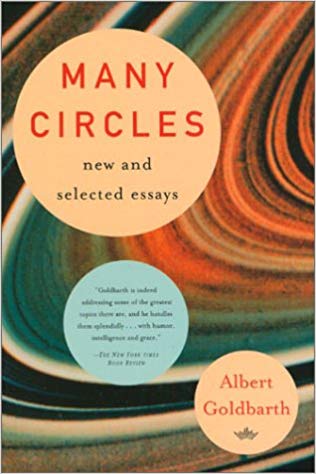
Many Circles: New and Selected Essays by Albert Goldbarth

My word. This is a complicated one.

I admire Albert Goldbarth very much. I’ve read his essay “Fuller” several times now, but I think that’s the only work of his that I’d read before this book. As an overall impression, I am deeply impressed, and challenged. These essays are beautiful and complicated. They are braids of many strands, often organized around an abstract concept, and Goldbarth makes it his job to help us see the connections, which can as well be pretty abstract. In other words, classic essayistic thinking-on-the-page. I’m thinking of the masterful braiding in Jo Ann Beard’s “The Fourth State of Matter,” which I so love, but even more complexly. And long: these essays are 20, 30, 40 and 50 pages long, which can make their braiding quite an organizational feat, and a feat for the reader as well.

They tend to focus on dualities or multiplicities, and profiles of people in history as well as in the present. The amount of information presented in each–scientific, historical–is boggling, and yet each essay makes sense in the end almost despite itself. I want to call the subject matter often obscure, but that’s an issue for each reader to decide, isn’t it; I am not the most well-read person I know, but I am not the least, either, and I certainly found some of the historical figures new to me. (I was fine with Yeats, and Einstein, and the Greek myths, of course; but the archaeologists John Lloyd Stephens* and Augustus Le Plongeon? Millionaire astronomer Pecival Lowell?) Goldbarth himself: extremely well-read and wide-ranging. Reading him is an education.** And I really, really enjoyed reading these essays and learning so much; but they must be taken slowly, to follow and parse all those threads.

Goldbarth is a poet to boot, and adds lyricism and whimsy in where we least expect it, expanding the ways in which he makes connections–imagistic and figurative ones, and wordplay–which make his work so much more beautiful but also that much more complex to follow in his meanings. His images and sentences as well as his essays are surprising, gorgeous, complicated, and rich.

I find his clearest obsession to be the concept of a “sympathy of souls” (the title of an earlier essay collection, many of whose essays reappear here), the interlinking of concepts and images, yes, but also of people. My two favorite examples of this type of essay are “Fuller,” which I’ve read repeatedly and finally begin to grasp, and “After Yitzl.”

The first links Marie Curie with the dancer Loie Fuller. They were contemporaries, and the historical record shows that they met; but much of their touching, close relationship as Goldbarth writes it here is born in his imagination. It’s a stunning piece, first in its portrayal of Marie and Pierre Curie’s passion for their research (and the starry brightness it yielded), and then in its, yes, sympathy between the two women. The narrator’s present life and relationship with his wife sneak in, too. I admired in many essays that the narrator was present as a writer and researcher: this line of poetry he was struggling with and its relationship to the apparently unconnected essay draft, etc.

“After Yitzl” is also a sort of dream sequence, which opens this collection and the earlier Sympathy of Souls. It is about the narrator’s ancestor, his ancestral connections to Jewish immigrants to the United States. It’s brief, and lovely, and as much imagination as anything else, but also research-heavy…

And then there are the longer essays: “Many Circles,” “Worlds,” and “Ellen’s,” which I could read a dozen times and still not grasp all of. It’s about the narrator’s friend Ellen, who is both a genius and mentally ill, and her deep relationship with James Joyce; it’s about Leonardo da Vinci, Dorothy in Oz, and spirals in architecture and nature and imagination. Whew.

Do I recommend this collection? Wholeheartedly, I do; but be ready for a challenge and some slow page-turning, and take notes. I’ll be studying this one for a long time.


Rating: 9 thimbling netsukes, if you’re up for the challenge.

*But then it turned out I did know the archaeologist John Lloyd Stephens: when Goldbarth got to the part about his two-volume work Incidents of Travel in the Yucatán, I looked up and yes, spotted those two volumes on my to-be-read shelf. (Thank you Fil for that perfectly appropriate gift.)


**Stay tuned for a vocabulary lessons post to come on Friday.